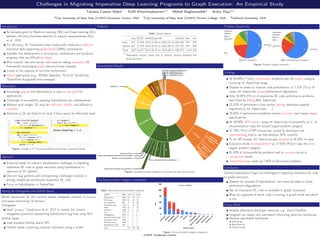
Challenges in Migrating Imperative Deep Learning Programs to Graph Execution: An Empirical Study
Tatiana Castro Vélez1
Raffi Khatchadourian1,2
Mehdi Bagherzadeh3
Anita Raja1,2
1City University of New York (CUNY) Graduate Center, USA 2City University of New York (CUNY) Hunter College, USA 3Oakland University, USA
Introduction
As datasets grow for Machine Learning (ML) and Deep Learning (DL)
systems, efficiency becomes essential to support responsiveness Zhou
et al., 2020.
For efficiency, DL frameworks have traditionally embraces a deferred
execution-style supporting graph-based (DNN) computation.
Scalable, but development is error-prone, cumbersome and produces
programs that are difficult to debug.
More natural, less error-prone, and easier-to-debug imperative DL
frameworks encouraging eager execution have emerged.
Comes at the expense of run-time performance
Hybrid approaches (e.g., MXNet Hybridize, PyTorch TorchScript,
TensorFlow Autograph) have emerged.
Motivation
Knowledge gap in how hybridization is used in real-world DL
applications.
Challenges in successfully applying hybridization are underexplored.
Without such insight, DL may be inefficient, fallible, and difficult to
maintain.
Advances in DL are likely to be futile if they cannot be effectively used.
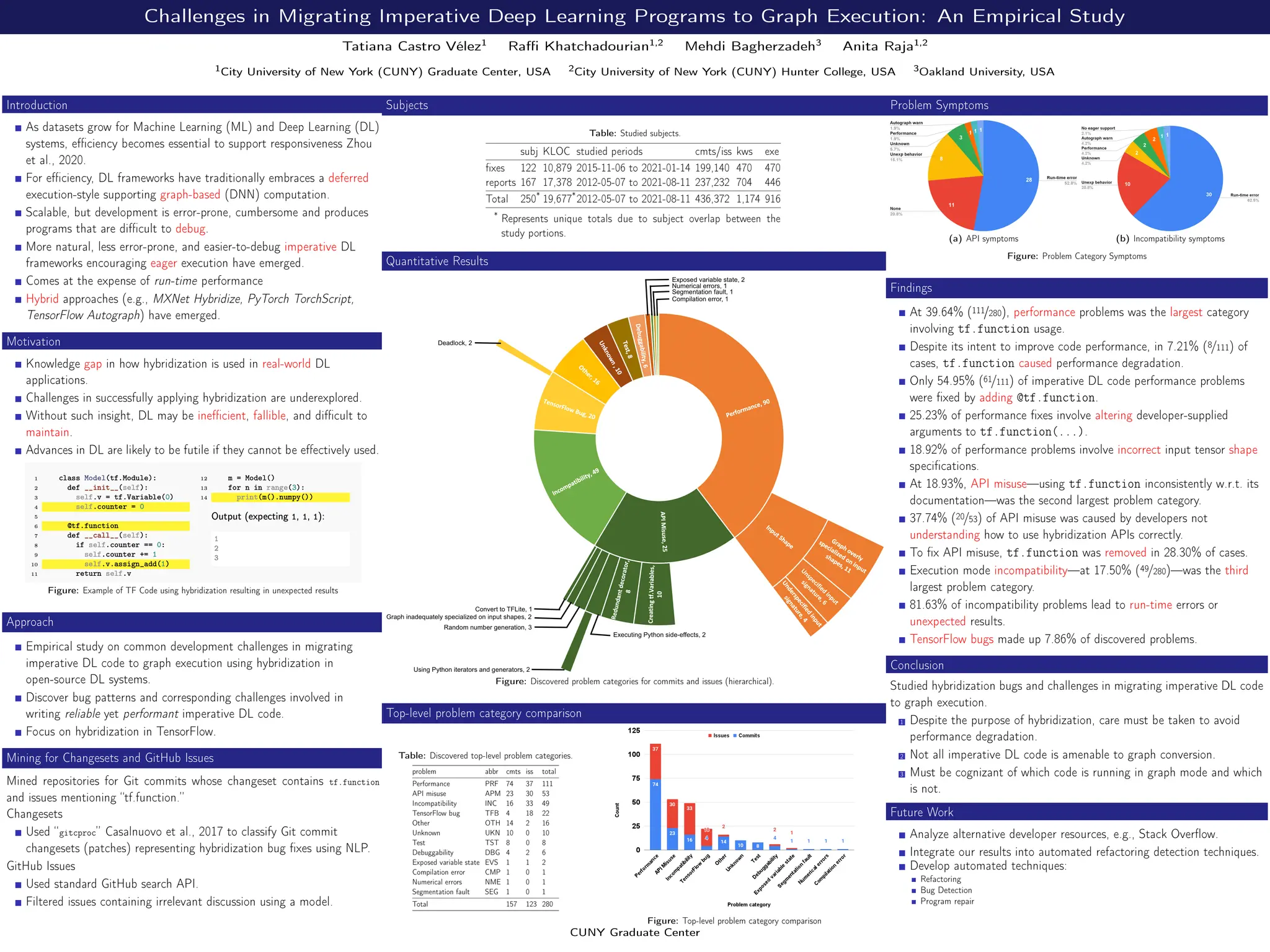
Figure: Example of TF Code using hybridization resulting in unexpected results
Approach
Empirical study on common development challenges in migrating
imperative DL code to graph execution using hybridization in
open-source DL systems.
Discover bug patterns and corresponding challenges involved in
writing reliable yet performant imperative DL code.
Focus on hybridization in TensorFlow.
Mining for Changesets and GitHub Issues
Mined repositories for Git commits whose changeset contains tf.function
and issues mentioning “tf.function.”
Changesets
Used “gitcproc” Casalnuovo et al., 2017 to classify Git commit
changesets (patches) representing hybridization bug fixes using NLP.
GitHub Issues
Used standard GitHub search API.
Filtered issues containing irrelevant discussion using a model.
Subjects
Table: Studied subjects.
subj KLOC studied periods cmts/iss kws exe
fixes 122 10,879 2015-11-06 to 2021-01-14 199,140 470 470
reports 167 17,378 2012-05-07 to 2021-08-11 237,232 704 446
Total 250*
19,677*
2012-05-07 to 2021-08-11 436,372 1,174 916
*
Represents unique totals due to subject overlap between the
study portions.
Quantitative Results
Figure: Discovered problem categories for commits and issues (hierarchical).
Top-level problem category comparison
Table: Discovered top-level problem categories.
problem abbr cmts iss total
Performance PRF 74 37 111
API misuse APM 23 30 53
Incompatibility INC 16 33 49
TensorFlow bug TFB 4 18 22
Other OTH 14 2 16
Unknown UKN 10 0 10
Test TST 8 0 8
Debuggability DBG 4 2 6
Exposed variable state EVS 1 1 2
Compilation error CMP 1 0 1
Numerical errors NME 1 0 1
Segmentation fault SEG 1 0 1
Total 157 123 280
Figure: Top-level problem category comparison
Problem Symptoms
(a) API symptoms (b) Incompatibility symptoms
Figure: Problem Category Symptoms
Findings
At 39.64% (111/280), performance problems was the largest category
involving tf.function usage.
Despite its intent to improve code performance, in 7.21% (8/111) of
cases, tf.function caused performance degradation.
Only 54.95% (61/111) of imperative DL code performance problems
were fixed by adding @tf.function.
25.23% of performance fixes involve altering developer-supplied
arguments to tf.function(...).
18.92% of performance problems involve incorrect input tensor shape
specifications.
At 18.93%, API misuse—using tf.function inconsistently w.r.t. its
documentation—was the second largest problem category.
37.74% (20/53) of API misuse was caused by developers not
understanding how to use hybridization APIs correctly.
To fix API misuse, tf.function was removed in 28.30% of cases.
Execution mode incompatibility—at 17.50% (49/280)—was the third
largest problem category.
81.63% of incompatibility problems lead to run-time errors or
unexpected results.
TensorFlow bugs made up 7.86% of discovered problems.
Conclusion
Studied hybridization bugs and challenges in migrating imperative DL code
to graph execution.
1 Despite the purpose of hybridization, care must be taken to avoid
performance degradation.
2 Not all imperative DL code is amenable to graph conversion.
3 Must be cognizant of which code is running in graph mode and which
is not.
Future Work
Analyze alternative developer resources, e.g., Stack Overflow.
Integrate our results into automated refactoring detection techniques.
Develop automated techniques:
Refactoring
Bug Detection
Program repair
CUNY Graduate Center

Challenges in Migrating Imperative Deep Learning Programs to Graph Execution: An Empirical Study

  • 1.
    Challenges in MigratingImperative Deep Learning Programs to Graph Execution: An Empirical Study Tatiana Castro Vélez1 Raffi Khatchadourian1,2 Mehdi Bagherzadeh3 Anita Raja1,2 1City University of New York (CUNY) Graduate Center, USA 2City University of New York (CUNY) Hunter College, USA 3Oakland University, USA Introduction As datasets grow for Machine Learning (ML) and Deep Learning (DL) systems, efficiency becomes essential to support responsiveness Zhou et al., 2020. For efficiency, DL frameworks have traditionally embraces a deferred execution-style supporting graph-based (DNN) computation. Scalable, but development is error-prone, cumbersome and produces programs that are difficult to debug. More natural, less error-prone, and easier-to-debug imperative DL frameworks encouraging eager execution have emerged. Comes at the expense of run-time performance Hybrid approaches (e.g., MXNet Hybridize, PyTorch TorchScript, TensorFlow Autograph) have emerged. Motivation Knowledge gap in how hybridization is used in real-world DL applications. Challenges in successfully applying hybridization are underexplored. Without such insight, DL may be inefficient, fallible, and difficult to maintain. Advances in DL are likely to be futile if they cannot be effectively used. Figure: Example of TF Code using hybridization resulting in unexpected results Approach Empirical study on common development challenges in migrating imperative DL code to graph execution using hybridization in open-source DL systems. Discover bug patterns and corresponding challenges involved in writing reliable yet performant imperative DL code. Focus on hybridization in TensorFlow. Mining for Changesets and GitHub Issues Mined repositories for Git commits whose changeset contains tf.function and issues mentioning “tf.function.” Changesets Used “gitcproc” Casalnuovo et al., 2017 to classify Git commit changesets (patches) representing hybridization bug fixes using NLP. GitHub Issues Used standard GitHub search API. Filtered issues containing irrelevant discussion using a model. Subjects Table: Studied subjects. subj KLOC studied periods cmts/iss kws exe fixes 122 10,879 2015-11-06 to 2021-01-14 199,140 470 470 reports 167 17,378 2012-05-07 to 2021-08-11 237,232 704 446 Total 250* 19,677* 2012-05-07 to 2021-08-11 436,372 1,174 916 * Represents unique totals due to subject overlap between the study portions. Quantitative Results Figure: Discovered problem categories for commits and issues (hierarchical). Top-level problem category comparison Table: Discovered top-level problem categories. problem abbr cmts iss total Performance PRF 74 37 111 API misuse APM 23 30 53 Incompatibility INC 16 33 49 TensorFlow bug TFB 4 18 22 Other OTH 14 2 16 Unknown UKN 10 0 10 Test TST 8 0 8 Debuggability DBG 4 2 6 Exposed variable state EVS 1 1 2 Compilation error CMP 1 0 1 Numerical errors NME 1 0 1 Segmentation fault SEG 1 0 1 Total 157 123 280 Figure: Top-level problem category comparison Problem Symptoms (a) API symptoms (b) Incompatibility symptoms Figure: Problem Category Symptoms Findings At 39.64% (111/280), performance problems was the largest category involving tf.function usage. Despite its intent to improve code performance, in 7.21% (8/111) of cases, tf.function caused performance degradation. Only 54.95% (61/111) of imperative DL code performance problems were fixed by adding @tf.function. 25.23% of performance fixes involve altering developer-supplied arguments to tf.function(...). 18.92% of performance problems involve incorrect input tensor shape specifications. At 18.93%, API misuse—using tf.function inconsistently w.r.t. its documentation—was the second largest problem category. 37.74% (20/53) of API misuse was caused by developers not understanding how to use hybridization APIs correctly. To fix API misuse, tf.function was removed in 28.30% of cases. Execution mode incompatibility—at 17.50% (49/280)—was the third largest problem category. 81.63% of incompatibility problems lead to run-time errors or unexpected results. TensorFlow bugs made up 7.86% of discovered problems. Conclusion Studied hybridization bugs and challenges in migrating imperative DL code to graph execution. 1 Despite the purpose of hybridization, care must be taken to avoid performance degradation. 2 Not all imperative DL code is amenable to graph conversion. 3 Must be cognizant of which code is running in graph mode and which is not. Future Work Analyze alternative developer resources, e.g., Stack Overflow. Integrate our results into automated refactoring detection techniques. Develop automated techniques: Refactoring Bug Detection Program repair CUNY Graduate Center