The Challenges of B2B User Experience Design
What makes it different to B2C, and why?

13th March 2012


Robert Gillham – Principal Consultant
Part One: What Defines Good?


                    http://commons.wikimedia.org/wiki/File:Essaouira_arganier_fruit_%282%29_1270.JPG
Part One: What Defines Good?


 “We have now
 harvested most of the
 low-hanging fruit from
 the truly horrible
 websites that
 dominated the lost
 decade of Web
 usability”

 Jakob Nielsen
 January 2008


                          http://commons.wikimedia.org/wiki/File:Essaouira_arganier_fruit_%282%29_1270.JPG
What Defines Good? Ecosystems

B2C context


              Pension
              Scheme        Pension plan
              Member         online tool
What Defines Good? Ecosystems

                                                        Institutional
          Consultant
                                                          Investor


B2B
context

                                 Pensions
                                 Manager

               Client                                Pension plan
                                                      online tool
               Company                      Member


                       Trustee
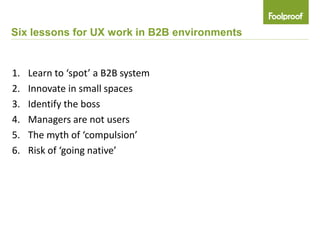
Six lessons for UX work in B2B environments


1.   Learn to ‘spot’ a B2B system
2.   Innovate in small spaces
3.   Identify the boss
4.   Managers are not users
5.   The myth of ‘compulsion’
6.   Risk of ‘going native’
Learn to spot a B2B system


1.   There are multiple users in the system, with
     complementary roles
2.   The main user of the system is probably not the
     named main account holder
3.   The use of the system ties in with other processes to
     meet organisational goals and are domain-specific
4.   The user does not pay for a purchase with their own
     money, but maybe from a budget.
Learn to innovate in small spaces

• Big companies aren’t all Apple or Amazon!
• They tend to be conservative users of IT
• Computer and systems are replaced at a
  slower rate than consumers replace their own
  technology
• Smart phones, tablets etc might be unused, or
  even forbidden in the workplace
• Your usual array of solutions and suggestions
  might not work in this context


  Sometimes you will have to be content with
  the smallest amount you can do that will have
  the greatest impact!                               http://en.wikipedia.org/wiki/
                                                  File:Earls_Court_Police_Box.jpg
Identify the boss

• Sometimes the marketing department may have
  hired you

• But you are working on the IT manager’s
  budget!

• Understand IT teams are subject to all the
  constraints and pressures we just spoke about

• This means you will find yourself under:
   • Pressure to compromise
   • Pressure to deliver early
   • Pressure to say the UX solution is what IT
       were going to do anyway!
Managers are not users

• All managers fondly imagine that they
  can describe user behaviour
  accurately

• They can’t!

• Even if they used to do this job
  themselves

• Senior people who say they are still
  users usually aren’t

• Look for proxies
The Myth of Compulsion

• IT and business
  stakeholders often
  labour under the
  impression that they
  can enforce process
  compliance through
  interface design

• It is your job to
  disabuse them

• People tend to do the
  things they want to do
  – even at work
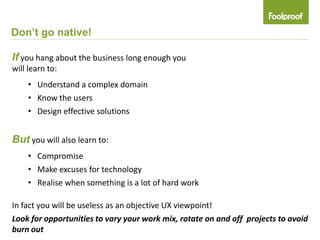
Don’t go native!

If you hang about the business long enough you
will learn to:
    • Understand a complex domain
    • Know the users
    • Design effective solutions


But you will also learn to:
    • Compromise
    • Make excuses for technology
    • Realise when something is a lot of hard work

In fact you will be useless as an objective UX viewpoint!
Look for opportunities to vary your work mix, rotate on and off projects to avoid
burn out
Contact

Robert Gillham
rob.gillham@foolproof.co.uk


                              Foolproof
                              Harella House
                              90-98 Goswell Road
                              London
                              EC1V 7DF
                              +44 (0)20 733 6700

                              www.foolproof.co.uk

Challenges of B2B User Experience Design

  • 1.
    The Challenges ofB2B User Experience Design What makes it different to B2C, and why? 13th March 2012 Robert Gillham – Principal Consultant
  • 2.
    Part One: WhatDefines Good? http://commons.wikimedia.org/wiki/File:Essaouira_arganier_fruit_%282%29_1270.JPG
  • 3.
    Part One: WhatDefines Good? “We have now harvested most of the low-hanging fruit from the truly horrible websites that dominated the lost decade of Web usability” Jakob Nielsen January 2008 http://commons.wikimedia.org/wiki/File:Essaouira_arganier_fruit_%282%29_1270.JPG
  • 4.
    What Defines Good?Ecosystems B2C context Pension Scheme Pension plan Member online tool
  • 5.
    What Defines Good?Ecosystems Institutional Consultant Investor B2B context Pensions Manager Client Pension plan online tool Company Member Trustee
  • 6.
    Six lessons forUX work in B2B environments 1. Learn to ‘spot’ a B2B system 2. Innovate in small spaces 3. Identify the boss 4. Managers are not users 5. The myth of ‘compulsion’ 6. Risk of ‘going native’
  • 7.
    Learn to spota B2B system 1. There are multiple users in the system, with complementary roles 2. The main user of the system is probably not the named main account holder 3. The use of the system ties in with other processes to meet organisational goals and are domain-specific 4. The user does not pay for a purchase with their own money, but maybe from a budget.
  • 8.
    Learn to innovatein small spaces • Big companies aren’t all Apple or Amazon! • They tend to be conservative users of IT • Computer and systems are replaced at a slower rate than consumers replace their own technology • Smart phones, tablets etc might be unused, or even forbidden in the workplace • Your usual array of solutions and suggestions might not work in this context Sometimes you will have to be content with the smallest amount you can do that will have the greatest impact! http://en.wikipedia.org/wiki/ File:Earls_Court_Police_Box.jpg
  • 9.
    Identify the boss •Sometimes the marketing department may have hired you • But you are working on the IT manager’s budget! • Understand IT teams are subject to all the constraints and pressures we just spoke about • This means you will find yourself under: • Pressure to compromise • Pressure to deliver early • Pressure to say the UX solution is what IT were going to do anyway!
  • 10.
    Managers are notusers • All managers fondly imagine that they can describe user behaviour accurately • They can’t! • Even if they used to do this job themselves • Senior people who say they are still users usually aren’t • Look for proxies
  • 11.
    The Myth ofCompulsion • IT and business stakeholders often labour under the impression that they can enforce process compliance through interface design • It is your job to disabuse them • People tend to do the things they want to do – even at work
  • 12.
    Don’t go native! Ifyou hang about the business long enough you will learn to: • Understand a complex domain • Know the users • Design effective solutions But you will also learn to: • Compromise • Make excuses for technology • Realise when something is a lot of hard work In fact you will be useless as an objective UX viewpoint! Look for opportunities to vary your work mix, rotate on and off projects to avoid burn out
  • 13.
    Contact Robert Gillham rob.gillham@foolproof.co.uk Foolproof Harella House 90-98 Goswell Road London EC1V 7DF +44 (0)20 733 6700 www.foolproof.co.uk