Challenges Facing Kansas High Schoolskrhaskin@gmail.comKirk HaskinsThursday, January 14, 2010
AgendaBackground of speakerChallenges Facing Kansas High SchoolsIdentifying three obstaclesAddressing the role of an Education Program ConsultantConclusion1/13/20102Challenges Facing Kansas High Schools
Kirk HaskinsBackground
Kirk HaskinsEducation:Univ. of Kansas  EdD: HE Admin.(Expected 2012)Wichita State Univ. MBA Dec. 1998Washburn Univ.BA: Comm.May 1993Topeka, KS native18 years managing both private and public businesses15 years working in education10 years teaching business and entrepreneurship – high school and collegeSpecialties:Relationship marketingEntrepreneurshipOrganization managementPublic speakingCommunication campaigns – all media formatsInteresting side-bar:Ran a marathon – finished on the same day of its startWon a car at senior high school promExpert on prime time television between 1980-851/13/20104Challenges Facing Kansas High Schoolshttp://www.linkedin.com/in/kirkhaskins
Role of Education Program Consultant - BusinessChallenges Facing KS High Schools
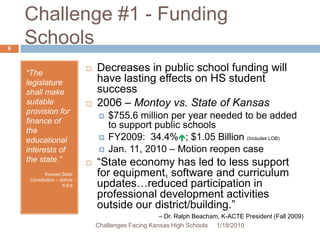
Challenge #1 - Funding Schools“The legislature shall make suitable provision for finance of the educational interests of the state.”Kansas State Constitution – Article 6:6:bDecreases in public school funding will have lasting effects on HS student success2006 – Montoy vs. State of Kansas$755.6 million per year needed to be added to support public schoolsFY2009:  34.4%; $1.05 Billion (Includes LOB)Jan. 11, 2010 – Motion reopen case“State economy has led to less support for equipment, software and curriculum updates…reduced participation in professional development activities outside our district/building.” – Dr. Ralph Beacham, K-ACTE President (Fall 2009)1/13/20106Challenges Facing Kansas High Schools
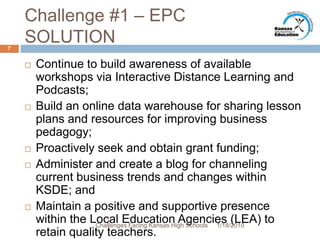
Challenge #1 – EPC SOLUTIONContinue to build awareness of available workshops via Interactive Distance Learning and Podcasts;Build an online data warehouse for sharing lesson plans and resources for improving business pedagogy;Proactively seek and obtain grant funding;Administer and create a blog for channeling current business trends and changes within KSDE; andMaintain a positive and supportive presence within the Local Education Agencies (LEA) to retain quality teachers.1/13/20107Challenges Facing Kansas High Schools
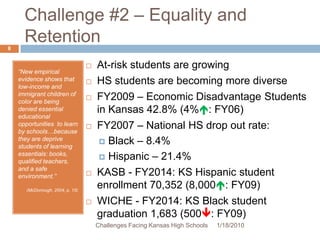
Challenge #2 – Equality and RetentionAt-risk students are growingHS students are becoming more diverseFY2009 – Economic Disadvantage Students in Kansas 42.8% (4%: FY06)FY2007 – National HS drop out rate:Black – 8.4%Hispanic – 21.4%KASB - FY2014: KS Hispanic student enrollment 70,352 (8,000: FY09)WICHE - FY2014: KS Black student graduation 1,683 (500: FY09)“New empirical evidence shows that low-income and immigrant children of color are being denied essential educational opportunities  to learn by schools…because they are deprive students of learning essentials: books, qualified teachers, and a safe environment.”(McDonough, 2004, p. 15)1/13/20108Challenges Facing Kansas High Schools
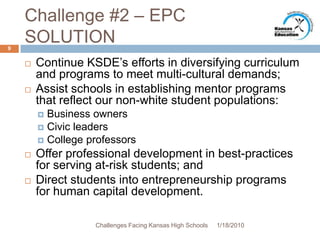
Challenge #2 – EPC SOLUTIONContinue KSDE’s efforts in diversifying curriculum and programs to meet multi-cultural demands;Assist schools in establishing mentor programs that reflect our non-white student populations:Business ownersCivic leadersCollege professorsOffer professional development in best-practices for serving at-risk students; andDirect students into entrepreneurship programs for human capital development.1/13/20109Challenges Facing Kansas High Schools
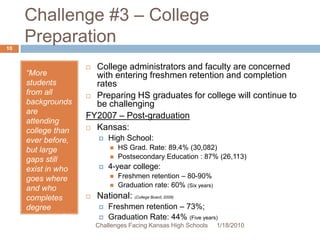
Challenge #3 – College Preparation“More students from all backgrounds are attending college than ever before, but large gaps still exist in who goes where and who completes degree programs.”(Swail, 2002, p. 15)College administrators and faculty are concerned with entering freshmen retention and completion ratesPreparing HS graduates for college will continue to be challengingFY2007 – Post-graduation Kansas:High School:HS Grad. Rate: 89.4% (30,082)	Postsecondary Education : 87% (26,113)4-year college:Freshmen retention – 80-90%Graduation rate: 60% (Six years)National: (College Board, 2009)Freshmen retention – 73%; Graduation Rate: 44% (Five years)1/13/201010Challenges Facing Kansas High Schools
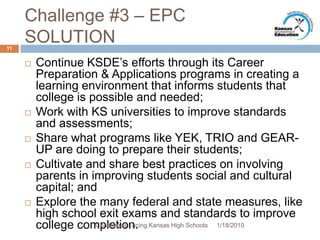
Challenge #3 – EPC SOLUTIONContinue KSDE’s efforts through its Career Preparation & Applications programs in creating a learning environment that informs students that college is possible and needed;Work with KS universities to improve standards and assessments;Share what programs like YEK, TRIO and GEAR-UP are doing to prepare their students;Cultivate and share best practices on involving parents in improving students social and cultural capital; andExplore the many federal and state measures, like high school exit exams and standards to improve college completion.1/13/201011Challenges Facing Kansas High Schools
SummaryConclusion
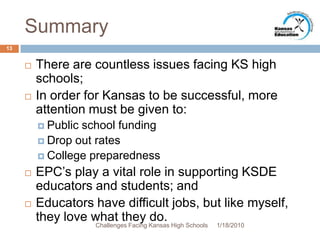
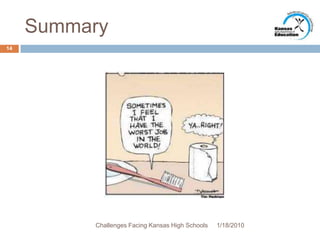
SummaryThere are countless issues facing KS high schools;In order for Kansas to be successful, more attention must be given to:Public school fundingDrop out ratesCollege preparednessEPC’s play a vital role in supporting KSDE educators and students; andEducators have difficult jobs, but like myself, they love what they do.1/13/201013Challenges Facing Kansas High Schools
Summary1/13/201014Challenges Facing Kansas High Schools
Questions?Thank you
ReferencesBaker, T. & Velez, W. (1996). Access to and opportunity in postsecondary education in the United States: A review. Sociology of Education, 69, 82-101College Board, The (2007, 2008, 2009). Trends in Student Aid, Author, Washington, DCKansas Department of Education (2009), Assessment Reports¸ Author, Topeka, KS McDonough, P. M. (2004). The school to college transition: Challenges and prospects. Washington, DC: American Council on Education.National Center for Education Statistics (2007, 2008), Digest of education statistics: 2006-2008 Author, Washington, DCPrescott, B. (2008). Knocking at the college door: Projections of high school graduates by state, income and race/ethnicity, 1992 to 2022. Western Interstate Commission for Higher Education publisherSwail, W. S. (2002). Higher education and the new demographics: Questions for policy. Change, 4, 15-23.US Census Report. (2009). Authors, Washington, DC 1/13/201016Challenges Facing Kansas High Schools

Challenges Facing Kansas High Schools Kh

  • 1.
    Challenges Facing KansasHigh Schoolskrhaskin@gmail.comKirk HaskinsThursday, January 14, 2010
  • 2.
    AgendaBackground of speakerChallengesFacing Kansas High SchoolsIdentifying three obstaclesAddressing the role of an Education Program ConsultantConclusion1/13/20102Challenges Facing Kansas High Schools
  • 3.
  • 4.
    Kirk HaskinsEducation:Univ. ofKansas EdD: HE Admin.(Expected 2012)Wichita State Univ. MBA Dec. 1998Washburn Univ.BA: Comm.May 1993Topeka, KS native18 years managing both private and public businesses15 years working in education10 years teaching business and entrepreneurship – high school and collegeSpecialties:Relationship marketingEntrepreneurshipOrganization managementPublic speakingCommunication campaigns – all media formatsInteresting side-bar:Ran a marathon – finished on the same day of its startWon a car at senior high school promExpert on prime time television between 1980-851/13/20104Challenges Facing Kansas High Schoolshttp://www.linkedin.com/in/kirkhaskins
  • 5.
    Role of EducationProgram Consultant - BusinessChallenges Facing KS High Schools
  • 6.
    Challenge #1 -Funding Schools“The legislature shall make suitable provision for finance of the educational interests of the state.”Kansas State Constitution – Article 6:6:bDecreases in public school funding will have lasting effects on HS student success2006 – Montoy vs. State of Kansas$755.6 million per year needed to be added to support public schoolsFY2009: 34.4%; $1.05 Billion (Includes LOB)Jan. 11, 2010 – Motion reopen case“State economy has led to less support for equipment, software and curriculum updates…reduced participation in professional development activities outside our district/building.” – Dr. Ralph Beacham, K-ACTE President (Fall 2009)1/13/20106Challenges Facing Kansas High Schools
  • 7.
    Challenge #1 –EPC SOLUTIONContinue to build awareness of available workshops via Interactive Distance Learning and Podcasts;Build an online data warehouse for sharing lesson plans and resources for improving business pedagogy;Proactively seek and obtain grant funding;Administer and create a blog for channeling current business trends and changes within KSDE; andMaintain a positive and supportive presence within the Local Education Agencies (LEA) to retain quality teachers.1/13/20107Challenges Facing Kansas High Schools
  • 8.
    Challenge #2 –Equality and RetentionAt-risk students are growingHS students are becoming more diverseFY2009 – Economic Disadvantage Students in Kansas 42.8% (4%: FY06)FY2007 – National HS drop out rate:Black – 8.4%Hispanic – 21.4%KASB - FY2014: KS Hispanic student enrollment 70,352 (8,000: FY09)WICHE - FY2014: KS Black student graduation 1,683 (500: FY09)“New empirical evidence shows that low-income and immigrant children of color are being denied essential educational opportunities to learn by schools…because they are deprive students of learning essentials: books, qualified teachers, and a safe environment.”(McDonough, 2004, p. 15)1/13/20108Challenges Facing Kansas High Schools
  • 9.
    Challenge #2 –EPC SOLUTIONContinue KSDE’s efforts in diversifying curriculum and programs to meet multi-cultural demands;Assist schools in establishing mentor programs that reflect our non-white student populations:Business ownersCivic leadersCollege professorsOffer professional development in best-practices for serving at-risk students; andDirect students into entrepreneurship programs for human capital development.1/13/20109Challenges Facing Kansas High Schools
  • 10.
    Challenge #3 –College Preparation“More students from all backgrounds are attending college than ever before, but large gaps still exist in who goes where and who completes degree programs.”(Swail, 2002, p. 15)College administrators and faculty are concerned with entering freshmen retention and completion ratesPreparing HS graduates for college will continue to be challengingFY2007 – Post-graduation Kansas:High School:HS Grad. Rate: 89.4% (30,082) Postsecondary Education : 87% (26,113)4-year college:Freshmen retention – 80-90%Graduation rate: 60% (Six years)National: (College Board, 2009)Freshmen retention – 73%; Graduation Rate: 44% (Five years)1/13/201010Challenges Facing Kansas High Schools
  • 11.
    Challenge #3 –EPC SOLUTIONContinue KSDE’s efforts through its Career Preparation & Applications programs in creating a learning environment that informs students that college is possible and needed;Work with KS universities to improve standards and assessments;Share what programs like YEK, TRIO and GEAR-UP are doing to prepare their students;Cultivate and share best practices on involving parents in improving students social and cultural capital; andExplore the many federal and state measures, like high school exit exams and standards to improve college completion.1/13/201011Challenges Facing Kansas High Schools
  • 12.
  • 13.
    SummaryThere are countlessissues facing KS high schools;In order for Kansas to be successful, more attention must be given to:Public school fundingDrop out ratesCollege preparednessEPC’s play a vital role in supporting KSDE educators and students; andEducators have difficult jobs, but like myself, they love what they do.1/13/201013Challenges Facing Kansas High Schools
  • 14.
  • 15.
  • 16.
    ReferencesBaker, T. &Velez, W. (1996). Access to and opportunity in postsecondary education in the United States: A review. Sociology of Education, 69, 82-101College Board, The (2007, 2008, 2009). Trends in Student Aid, Author, Washington, DCKansas Department of Education (2009), Assessment Reports¸ Author, Topeka, KS McDonough, P. M. (2004). The school to college transition: Challenges and prospects. Washington, DC: American Council on Education.National Center for Education Statistics (2007, 2008), Digest of education statistics: 2006-2008 Author, Washington, DCPrescott, B. (2008). Knocking at the college door: Projections of high school graduates by state, income and race/ethnicity, 1992 to 2022. Western Interstate Commission for Higher Education publisherSwail, W. S. (2002). Higher education and the new demographics: Questions for policy. Change, 4, 15-23.US Census Report. (2009). Authors, Washington, DC 1/13/201016Challenges Facing Kansas High Schools