Download to read offline

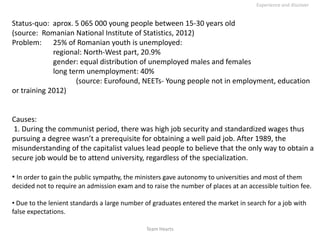
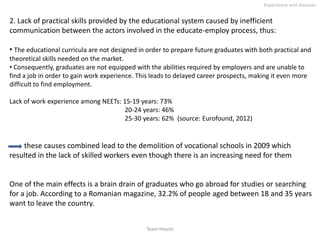
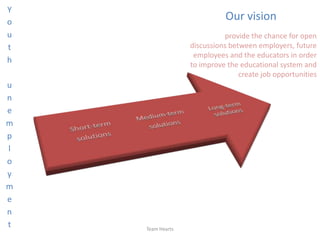
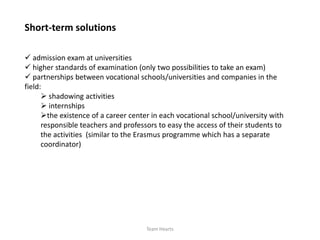

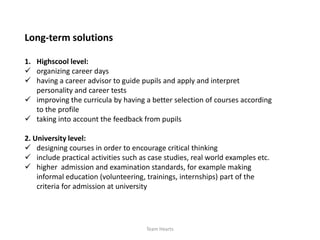
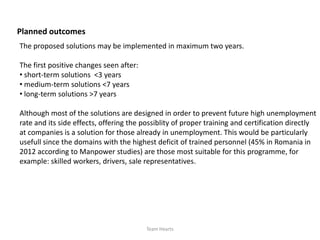

The document analyzes youth unemployment in Romania. It finds that about 25% of Romanian youth ages 15-30 are unemployed. This is caused by a mismatch between the skills graduates obtain in school and the skills employers need. Universities do not require admission exams and have low standards, resulting in graduates without practical skills. The document proposes short, medium, and long-term solutions like strengthening vocational schools, partnerships between employers and educators, and improving career guidance and curriculum standards. The goal is to improve the education system and create jobs to reduce unemployment and brain drain.


![Maximising PG Potential From China [October 2010]](https://cdn.slidesharecdn.com/ss_thumbnails/maximisingpgpotentialfromchinaoctober2010-101015042020-phpapp02-thumbnail.jpg?width=640&height=640&fit=bounds)


![[Challenge:Future] Terminators in reality](https://cdn.slidesharecdn.com/ss_thumbnails/challengefuture-terminators-in-reality3979-111106012046-phpapp02-thumbnail.jpg?width=640&height=640&fit=bounds)
![[Challenge:Future] AralSeadisaster](https://cdn.slidesharecdn.com/ss_thumbnails/challengefuture-aralseadisaster2775-111129161410-phpapp01-thumbnail.jpg?width=640&height=640&fit=bounds)
![[Challenge:Future] Feel nature in Maribor](https://cdn.slidesharecdn.com/ss_thumbnails/challengefuture-feel-nature-in-maribor1174-111211070128-phpapp01-thumbnail.jpg?width=640&height=640&fit=bounds)
![[Challenge:Future] Surround Sofa System](https://cdn.slidesharecdn.com/ss_thumbnails/challengefuture-surround-sofa-system2098-thumbnail.jpg?width=640&height=640&fit=bounds)
![[Challenge:Future] designspace: Fun + Meaning2 = 2030 finals](https://cdn.slidesharecdn.com/ss_thumbnails/challengefuture-designspace-fun-meaning2-2030-finals1099-111115112413-phpapp01-thumbnail.jpg?width=640&height=640&fit=bounds)
![[Challenge:Future] 1 weekend trip to Solcava : Rediscovering rural tourism](https://cdn.slidesharecdn.com/ss_thumbnails/challengefuture-1-weekend-trip-to-solcava-rediscovering-rural-tourism1123-111130154644-phpapp02-thumbnail.jpg?width=640&height=640&fit=bounds)
![[Challenge:Future] Social Security Disaster](https://cdn.slidesharecdn.com/ss_thumbnails/challengefuture-social-security-disaster673-111102112004-phpapp01-thumbnail.jpg?width=640&height=640&fit=bounds)

![[Challenge:Future] Semi finals - lucky strike: Make.it.WORK](https://cdn.slidesharecdn.com/ss_thumbnails/challengefuture-semi-finals-lucky-strike-makeitwork2152-130424065809-phpapp02-thumbnail.jpg?width=640&height=640&fit=bounds)
![[Challenge:Future] CPS - Path to an abundant future](https://cdn.slidesharecdn.com/ss_thumbnails/challengefuture-cps-path-to-an-abundant-future2386-130424065404-phpapp02-thumbnail.jpg?width=640&height=640&fit=bounds)
![[Challenge:Future] Semi finals - Youth acts](https://cdn.slidesharecdn.com/ss_thumbnails/challengefuture-semi-finals-youth-acts2427-130424070007-phpapp02-thumbnail.jpg?width=640&height=640&fit=bounds)
![[Challenge:Future] "The 2 Es that can save EE" by: DiA Desire Innovate Achieve](https://cdn.slidesharecdn.com/ss_thumbnails/challengefuture-the-2-es-that-can-save-ee-by-dia-desire-innovate-achieve4074-130424003607-phpapp02-thumbnail.jpg?width=640&height=640&fit=bounds)
![[Challenge:Future] world in one](https://cdn.slidesharecdn.com/ss_thumbnails/challengefuture-world-in-one2016-111114133432-phpapp02-thumbnail.jpg?width=640&height=640&fit=bounds)
![[Challenge:Future] PEST MANAGEMENT](https://cdn.slidesharecdn.com/ss_thumbnails/challengefuture-pest-management2106-111128105551-phpapp02-thumbnail.jpg?width=640&height=640&fit=bounds)
![[Challenge:Future] Sprouter: The Job of the Future & My Dream Job](https://cdn.slidesharecdn.com/ss_thumbnails/challengefuture-sprouter-the-job-of-the-future-my-dream-job3629-130228030557-phpapp01-thumbnail.jpg?width=640&height=640&fit=bounds)

![[Challenge:Future] IQ: Anti-Trend](https://cdn.slidesharecdn.com/ss_thumbnails/challengefuture-iq-antitrend4077-130228030554-phpapp01-thumbnail.jpg?width=640&height=640&fit=bounds)

![[Challenge:Future] Stillness: My Dream Job](https://cdn.slidesharecdn.com/ss_thumbnails/challengefuture-stillness-my-dream-job2275-130228030546-phpapp01-thumbnail.jpg?width=640&height=640&fit=bounds)
![[Challenge:Future] Aim More Realistically ( AMR): Make.it.WORK](https://cdn.slidesharecdn.com/ss_thumbnails/challengefuture-aim-more-realistically-amr-makeitwork4218-130228014207-phpapp01-thumbnail.jpg?width=640&height=640&fit=bounds)
![[Challenge:Future] Semi finals - Connecting for the future](https://cdn.slidesharecdn.com/ss_thumbnails/challengefuture-semi-finals-connecting-for-the-future1592-130424065803-phpapp01-thumbnail.jpg?width=640&height=640&fit=bounds)
![[Challenge:Future] Make students actors of their future](https://cdn.slidesharecdn.com/ss_thumbnails/challengefuture-make-students-actors-of-their-future993-130228022609-phpapp02-thumbnail.jpg?width=640&height=640&fit=bounds)
![[Challenge:Future] Connecting for the future](https://cdn.slidesharecdn.com/ss_thumbnails/challengefuture-connecting-for-the-future4757-130228014131-phpapp01-thumbnail.jpg?width=640&height=640&fit=bounds)
![[Challenge:Future] The Traineeland - an online platform for internships](https://cdn.slidesharecdn.com/ss_thumbnails/challengefuture-the-traineeland-an-online-platform-for-internships3787-130227071720-phpapp01-thumbnail.jpg?width=640&height=640&fit=bounds)
![[Challenge:Future] Fight youth unemployment from the inside](https://cdn.slidesharecdn.com/ss_thumbnails/challengefuture-fight-youth-unemployment-from-the-inside2398-130228065809-phpapp02-thumbnail.jpg?width=640&height=640&fit=bounds)
![[Challenge:Future] Learn more than just theory, learn skills!](https://cdn.slidesharecdn.com/ss_thumbnails/challengefuture-learn-more-than-just-theory-learn-skills818-130228022604-phpapp02-thumbnail.jpg?width=640&height=640&fit=bounds)
![[Challenge:Future] Change French cursus to have systematically experience](https://cdn.slidesharecdn.com/ss_thumbnails/challengefuture-change-french-cursus-to-have-systematically-experience941-130228021211-phpapp01-thumbnail.jpg?width=640&height=640&fit=bounds)
![[Challenge:Future] Fighting Youth Unemployment Through Empowerment](https://cdn.slidesharecdn.com/ss_thumbnails/challengefuture-fighting-youth-unemployment-through-empowerment4102-130301051604-phpapp02-thumbnail.jpg?width=640&height=640&fit=bounds)
![[Challenge:Future] Fighting Youth Unemployment Through Empowerment](https://cdn.slidesharecdn.com/ss_thumbnails/challengefuture-fighting-youth-unemployment-through-empowerment3633-130227112107-phpapp01-thumbnail.jpg?width=640&height=640&fit=bounds)
![[Challenge:Future] Fighting Youth Unemployment Through Empowerment](https://cdn.slidesharecdn.com/ss_thumbnails/challengefuture-fighting-youth-unemployment-through-empowerment2541-130228034004-phpapp01-thumbnail.jpg?width=640&height=640&fit=bounds)
![[Challenge:Future] Empowered youth now!](https://cdn.slidesharecdn.com/ss_thumbnails/challengefuture-empowered-youth-now2621-130228013748-phpapp02-thumbnail.jpg?width=640&height=640&fit=bounds)
![[Challenge:Future] Global Unemployment: A case study in Vietnam](https://cdn.slidesharecdn.com/ss_thumbnails/challengefuture-global-unemployment-a-case-study-in-vietnam3347-130307063207-phpapp02-thumbnail.jpg?width=640&height=640&fit=bounds)


![[Challenge:Future] GoFurther: Make.it.WORK](https://cdn.slidesharecdn.com/ss_thumbnails/challengefuture-gofurther-makeitwork4903-130226150505-phpapp02-thumbnail.jpg?width=640&height=640&fit=bounds)


![[Challenge:Future] WEmoveYOUth: Make.it.WORK](https://cdn.slidesharecdn.com/ss_thumbnails/challengefuture-wemoveyouth-makeitwork2209-130301031206-phpapp01-thumbnail.jpg?width=640&height=640&fit=bounds)
![[Challenge:Future] Think twice before quitting](https://cdn.slidesharecdn.com/ss_thumbnails/challengefuture-think-twice-before-quitting951-150214074403-conversion-gate01-thumbnail.jpg?width=640&height=640&fit=bounds)
![[Challenge:Future] Raft Guide Job](https://cdn.slidesharecdn.com/ss_thumbnails/challengefuture-raft-guide-job815-150205081913-conversion-gate01-thumbnail.jpg?width=640&height=640&fit=bounds)
![[Challenge:Future] " The Secret of Happiness."](https://cdn.slidesharecdn.com/ss_thumbnails/challengefuture-the-secret-of-happiness3329-150202124318-conversion-gate01-thumbnail.jpg?width=640&height=640&fit=bounds)
![[Challenge:Future] What is life?](https://cdn.slidesharecdn.com/ss_thumbnails/challengefuture-what-is-life1507-150131153303-conversion-gate02-thumbnail.jpg?width=640&height=640&fit=bounds)
![[Challenge:Future] The Power of Happiness](https://cdn.slidesharecdn.com/ss_thumbnails/challengefuture-the-power-of-happiness4947-150131104822-conversion-gate01-thumbnail.jpg?width=640&height=640&fit=bounds)
![[Challenge:Future] Do not delay it!](https://cdn.slidesharecdn.com/ss_thumbnails/challengefuture-do-not-delay-it2242-150129172304-conversion-gate01-thumbnail.jpg?width=640&height=640&fit=bounds)
![[Challenge:Future] Always rely only on yourself](https://cdn.slidesharecdn.com/ss_thumbnails/challengefuture-always-rely-only-on-yourself4726-150129133806-conversion-gate02-thumbnail.jpg?width=640&height=640&fit=bounds)
![[Challenge:Future] Hard work, Dedication & Patience!](https://cdn.slidesharecdn.com/ss_thumbnails/challengefuture-hard-work-dedication-patience94-150128133507-conversion-gate02-thumbnail.jpg?width=640&height=640&fit=bounds)
![[Challenge:Future] I give you this medal as a sign](https://cdn.slidesharecdn.com/ss_thumbnails/challengefuture-i-give-you-this-medal-as-a-sign4652-150120121011-conversion-gate02-thumbnail.jpg?width=640&height=640&fit=bounds)
![[Challenge:Future] Guard Your Soul](https://cdn.slidesharecdn.com/ss_thumbnails/challengefuture-guard-your-soul3130-150120050804-conversion-gate01-thumbnail.jpg?width=640&height=640&fit=bounds)
![[Challenge:Future] My Career Tip for 2015](https://cdn.slidesharecdn.com/ss_thumbnails/challengefuture-my-career-tip-for-20153724-150119150629-conversion-gate01-thumbnail.jpg?width=640&height=640&fit=bounds)
![[Challenge:Future] box of choices](https://cdn.slidesharecdn.com/ss_thumbnails/challengefuture-box-of-choices459-150118141228-conversion-gate02-thumbnail.jpg?width=640&height=640&fit=bounds)
![[Challenge:Future] The magic world of Homo Ludens](https://cdn.slidesharecdn.com/ss_thumbnails/challengefuture-the-magic-world-of-homo-ludens3765-150113074618-conversion-gate01-thumbnail.jpg?width=640&height=640&fit=bounds)
![[Challenge:Future] Break the Borders](https://cdn.slidesharecdn.com/ss_thumbnails/challengefuture-break-the-borders2417-150112055706-conversion-gate02-thumbnail.jpg?width=640&height=640&fit=bounds)
![[Challenge:Future] Passion](https://cdn.slidesharecdn.com/ss_thumbnails/challengefuture-passion3521-150109034003-conversion-gate02-thumbnail.jpg?width=640&height=640&fit=bounds)
![[Challenge:Future] BE YOURSELF](https://cdn.slidesharecdn.com/ss_thumbnails/challengefuture-be-yourself2860-150107152106-conversion-gate01-thumbnail.jpg?width=640&height=640&fit=bounds)
![[Challenge:Future] Lifelong Learning](https://cdn.slidesharecdn.com/ss_thumbnails/challengefuture-lifelong-learning3412-150105134404-conversion-gate02-thumbnail.jpg?width=640&height=640&fit=bounds)
![[Challenge:Future] Smile And Accept the Challange](https://cdn.slidesharecdn.com/ss_thumbnails/challengefuture-smile-and-accept-the-challange4466-150104005903-conversion-gate01-thumbnail.jpg?width=640&height=640&fit=bounds)
![[Challenge:Future] HELP YOURSELF AND LIVE](https://cdn.slidesharecdn.com/ss_thumbnails/challengefuture-help-yourself-and-live870-141223142803-conversion-gate02-thumbnail.jpg?width=640&height=640&fit=bounds)
![[Challenge:Future] Faith in humanity](https://cdn.slidesharecdn.com/ss_thumbnails/challengefuture-faith-in-humanity2748-141218140104-conversion-gate01-thumbnail.jpg?width=640&height=640&fit=bounds)