sustainability
Article
Challenge Based Learning: Innovative Pedagogy for
Sustainability through e-Learning in Higher Education
May Portuguez Castro and Marcela Georgina Gómez Zermeño *
School of Humanities and Education, Tecnologico de Monterrey, Monterrey 64849, Nuevo León, Mexico;
mayportuguezc@gmail.com
* Correspondence: marcela.gomez@tec.mx
Received: 3 April 2020; Accepted: 12 May 2020; Published: 15 May 2020
Abstract: Challenge-Based Learning (CBL) is an innovative teaching methodology that engages
students to resolve real-world challenges while applying the knowledge they acquired during their
professional training. This article describes the results of the implementation of an online course
on entrepreneurship that utilized CBL with a group of 20 undergraduate students from various
disciplines in a university in Mexico. During the course, challenges related to the Sustainable
Development Goals of the United Nations were presented to the participants, making it possible
to observe the students’ interest in resolving these problems. This research uses a case study
methodology and seeks to determine the CBL elements in the e-learning modality. The results showed
that the participants generated sustainable business ideas aimed to resolve local, national, and global
problems. The recommendations are to continue the formation of the businesses proposed in the
project. These ideas can become real ventures that connect various actors in the entrepreneurial
ecosystem and will continue to strengthen transversal skills such as teamwork and communication.
Keywords: challenge-based learning; education in sustainability; e-learning; educational innovation;
higher education; sustainable development goals
1. Introduction
There is no doubt that the development of Information and Communication Technologies (ICT)
has generated transformations of all fields of society, including education [1]. The internet and the use
of network-connected devices [2,3] have penetrated traditional teaching and learning methods. As a
result, different educational modalities have arisen, reflecting these changes and raising new scenarios
that shape training processes [4].
Among the new modalities of online education is e-learning, which uses ICT to provide educational
content and facilitate learning to multiple segments of the population [5]. The advantages of this
modality include its flexibility and the possibility that it can be utilized remotely and at different times,
thanks to synchronous and asynchronous processes [6]. Also, its potential for communication and the
possibilities for ubiquitous learning (anytime, anywhere) promote lifelong learning and interactions
among participants [7,8]. The disadvantages are that if there are no such interactions in a course,
a student’s motivation decreases. Furthermore, evaluations are difficult to do online in disciplines that
require applied practices [9].
Through education, people can improve their quality of life. Using technological tools, they can
develop innovative solutions to the most significant problems of society [10]. So, ICT-based modalities
such as e-learning are considered mechanisms that can improve access to education. They have great
potential to accomplish the objectives set for sustainable development. For this to happen, there must
be an appropriate pedagogical model that incorporates self-regulated learning and a multidisciplinary
approach [11–13].
Sustainability 2020, 12, 4063; doi:10.3390/su12104063 www.mdpi.com/journal/sustainability
Sustainability 2020, 12, 4063 2 of 15
According to UNESCO [14], education for sustainable development aims to give people the skills
and knowledge to find solutions to economic, social, and environmental problems. It encourages
students to reflect on excess consumption, poverty, the stimulation of solidarity and cooperation, and to
recognize that current economic development trends are not sustainable; therefore, programs that
promote these are required [15].
In 2015, the international community proposed the Sustainable Development Goals (SDGs),
including 17 objectives and 169 challenges that proposed to eradicate poverty by the year 2030 [16].
To achieve the goals of the 2030 agenda, citizens must have a world economy that is environmentally
sustainable and inclusive. Therefore, lifelong learning and education should prepare citizens to develop
the skills that make production and consumption sustainable [13,17]. A better-educated workforce
will nurture inclusive economic growth and a focus on human well-being [18].
According to Alcalá and Gutiérrez [19], interest in sustainable education focuses on students and
the innovative pedagogies that bring them closer to social reality and its main conflicts. The goal is for
the students to better understand the environments of their intended professions. A university must
be a driving force that trains students to remain aware of sustainability and the changes it implies.
Therefore, it is a priority in education to work on values that lead to reflection and critical thinking,
and to integrate the themes of sustainability into the contents of subject materials [19].
Takala and Korhonen-Yrjonheikki [20] defined the main competencies for sustainable development
to be holistic understanding, communication, collaborative skills, critical thinking, reflection, creativity,
innovation, and entrepreneurship. To achieve these competencies, one must keep sustainability in
mind as an ongoing process. Teachers should encourage their students to understand their roles in
sustainable development and collaborate in multi-disciplinary ways to share knowledge. Curricular
content must be integrated, teacher training promoted, and there must be public funds for research.
Environmental, social, and economic changes make the issue of sustainable development more
pressing than ever. However, training in universities remains technocratic and does not promote
reflection on these problems [21]. Also, education for sustainable development is still not integrated
into the programs, so most courses do not raise concerns about this issue [20]. The development of
active pedagogical activities that help strengthen the vision of education in this society thus become a
challenge [22–25].
In this context, educational innovation contributes to the design and presentation of programs
that address these challenges [26,27]. However, for there to be educational innovation, we must
introduce new technological tools that are used correctly and appropriated to the various actors that
need them [2]. Additionally, digital learning environments must be created where a student can
contribute directly to improvements, experiments, and shared experiences. All these actions occur
through new forms of teaching [28].
Along these lines, Challenge-Based Learning (CBL) is an innovative pedagogy that actively
engages students in relevant real-world problems that exist in their environments and that require
a solution [29,30]. This pedagogy has its roots in experiential learning. It incorporates the use of
technology, teamwork, self-directed learning, and solutions to real problems that extend from the
classroom to the community [31].
This pedagogical approach leverages students’ interests to give practical meaning to education.
It develops competencies such as multidisciplinary teamwork, decision-making, leadership, and
communication [32,33]. The challenge consists of an activity or situation that involves sincere effort
from the student and triggers him/her to obtain new knowledge through the proposal of a concrete
solution [34]. Content is presented that builds on students’ previous knowledge, and is structured
so that feedback can occur between students and instructors [30]. Therefore, the involvement of
students in the creation of knowledge, both individually and cooperatively, is considered an essential
characteristic of active methodologies [35].
According to Edutrends [30], CBL consists of the following elements:
• The general idea: There is a topic presented to students with importance to society.
Sustainability 2020, 12, 4063 3 of 15
• The essential question: The general idea starts with a problem that reflects the interest of the
students and the needs of the community.
• The challenge: Students must create a solution to the problem posed in the essential question.
• Questions, activities, and guide resources: Students identify elements that are convenient for
developing innovative solutions to problems.
• The solution: Each challenge permits a variety of solutions. These must be concrete and feasible
to implement in the community.
• Implementation: Students test the solution in a real environment.
• The evaluation or assessment is carried out through the challenge process, which confirms the
learning results and supports the decisions made during the implementation.
• Documentation and publication: Students find ways to publish their ideas, blogs, videos, and
other tools.
• Reflection and dialogue that consider the content and the students’ learning and experiences.
Previous studies on CBL like the one by Rådberg et al. [32] have indicated that this multidisciplinary
approach encourages students to work actively with their peers and teachers to identify complex
challenges, ask relevant questions, and take action favoring sustainable development. The three-year
case study involving 38 students was conducted in the Chalmers University Challenge Laboratory.
The results showed that the students developed skills in the formulation of problems and sustainable
development. Although few projects reached their implementation, they had the potential for social
impact. Hence, the authors suggested complementing other projects within the career with this type
of program.
Another study by Malmqvist et al. [33] compared four experiences of CBL in universities in
Australia, the United States, Denmark, and Sweden. The similarity among them was that this
methodology was presented throughout the courses with topics related to social and environmental
sustainability. In one of the universities, the course was positioned in the first year, setting the stage to
continue with subsequent courses and projects based on that initial course, which made planning go
further. The authors concluded that multidisciplinary courses placed new demands on teachers who
may not know about the topics, causing students to feel a lack of support; this implies a need to have
teachers from different disciplines. Students need to develop transversal skills such as communication,
decision-making, leadership, and teamwork, in addition to those in a socio-technical domain. Soft skills
remain outside the regular curricula, but they must become part of them.
In an experience carried out by Azeteiro et al. at a Portuguese university [12], the authors found
that education in sustainability through e-learning can be highly relevant for sustainable development.
However, the authors concluded that students had problems developing some competencies, and that
more studies would be necessary to evaluate the appropriate pedagogical model. In the case of the
e-learning modality, Racovita-Szilagyi et al. [6] conducted research in Spain and the United States
with 400 university teachers in the social work field. The authors inquired about their perceptions on
the opportunities that the e-learning modality creates for their teaching. The participating professors
believed that, through this modality, students in rural areas could have greater accessibility, and that
the students could learn at their own pace and have a mentor. Finally, the authors mentioned that
for future studies, more research should focus on the integration of technology and its impact on
training processes.
According to the literature consulted, these new strategies are necessary to develop more active
learning oriented toward problem-solving [32,36]. However, the programs of higher education are
still more theoretical than practical. There is a gap between what students learn and what they can
apply in their lives [32–37]; therefore, methodologies that promote active learning and learning by
doing [33,38] must be incorporated.
Also, as online education continuously evolves, research should focus on the good practices that
favor its implementation so that the learning mediated by technologies continues [39]. However,
Sustainability 2020, 12, 4063 4 of 15
although CBL has been shown to be positive for students interested in sustainable development
facilitated by the active methodologies used in the courses, some courses are not yet part of the
curricula. Therefore, there is not continuity of the projects. More research is required to learn how to
continue developing sustainable development skills in students [6,12].
The research of this project was carried out in a university in northern Mexico. This institution is
currently implementing an educational model based on active methodologies, so this study sought to
generate knowledge about the results of its implementation related to sustainable education. The study
was carried out in an extracurricular course taught to students from different careers. The courses ere
optional and taken by students interested in this topic of study; they sought to develop transversal
competencies in students, including personal and professional skills for achieving life and career goals
and comprehensive health.
Therefore, this study aimed to implement CBL as an innovative pedagogy through online
education in this particular study group. It had the objectives to determine its results and opportunities
for improvement and to guide students toward solutions for sustainable-development problems.
The study sought to answer the following research questions:
• Q1. How to implement CBL to strengthen education for sustainable development in an e-learning
course in the study context?
• Q2. What was the perception of the enrolled students in the e-learning course about the contribution
they can make to resolving local, national, or global problems?
• Q3. What elements of CBL contribute to providing solutions to local problems through an
e-learning course?
2. Method
To answer these research questions, we used a case study methodology. The approach was
qualitative. In such research, the investigators explore a case or several real-life cases, collecting
data from multiple sources of information such as observations, interviews, audiovisual materials,
documents, and reports [40]. This research developed an e-learning course with training activities and
challenges in which the students solved sustainability problems through entrepreneurial proposals.
The research analyzed a unique case of a class that was participating in an online course.
The evidence obtained describes the intervention and the context in which it occurred [41].
By analyzing the educational experiences that promote active learning, such as CBL, one can discover
how to use active teaching methodologies to generate solutions to local, national, and global problems.
Research such as this can lead to the construction of education for sustainable development.
2.1. Participants
The sample consisted of 20 undergraduate students from a university in northern Mexico.
The participants were selected by convenience, and they agreed to be included in the study [42].
The study aimed to have students from different careers (curricula) in the sample. The most frequent
careers studied by the participants were strategy and business administration, marketing, psychology,
civil engineering, chemical engineering in sustainable processes, mechatronics, and biotechnology.
Table 1 shows the number of students and their gender, career, and average age percentages.
Sustainability 2020, 12, 4063 5 of 15
Table 1. Distribution of the sample.
Total Students Men Women Average Age Career
20 8 12 23 years old
12
6
1
1
40%
5
2
1
0
60%
7
4
0
1
Engineering
Business administration
Industrial design
Clinical psychology
During the first week, 20 students participated. In the second week, six groups were formed
according to the interests of the students; each group was made up of three to four students. Twelve
students completed all the activities. Students who did not finish indicated that they did not have time
to carry out the activities due to other academic obligations and withdrew from the course. Of the
eight students who withdrew, five withdrew before working on the proposals, while the other three
started with their proposals but did not present them.
2.2. Procedure
This study consisted of the implementation of an e-learning course that followed the CBL
methodology. The course was held as an extracurricular activity in a workshop to develop skills for
life and work; it was directed to students of different careers (multidisciplinary). It was optional and
intended for those interested in the topic of entrepreneurship and social innovation.
The main objective of the course was for the students to seek solutions to social problems by
proposing products or services that could become entrepreneurial businesses. The specific objectives
were for the students to (1) describe concepts related to entrepreneurship and innovation for use in
solving problems in their environments; (2) analyze problematic situations in their environments that
can be resolved through innovative and entrepreneurial proposals; (3) propose innovative solutions to
problems collaboratively, and (4) prepare pitches to publicize their proposed solutions.
The course duration was five weeks with synchronous and asynchronous activities and content
related to CBL and entrepreneurship, hosted on a Moodle platform. Synchronous activities were those
related to meetings or chats to organize the group work, and asynchronous activities were forums and
blog interventions. Also, during the last week, some groups presented their pitches face-to-face at
the university. The teacher evaluated using a checklist and rubrics of assessment. Table 2 shows the
contents and activities of the e-learning course.
In the course, the students had a series of challenges related to community problems that had to
be solved collaboratively with peers and teachers. The challenge was to choose one state problem out
of the 10 defined as priorities by the Strategic Plan for the State of Nuevo León 2015-2030 [43], and that
was aligned with the SDGs, as shown in Table 3.
This research also applied a protocol that considered the ethics of educational research to maintain
the privacy, confidentiality, and integrity of the data, as well as the privacy and consent of the
participants. To accomplish this, the considerations were:
1. To clearly explain the objectives of the study, telling the participants that the course was a
research project.
2. To allow researchers to personally visit the class and explain the work to be done, answer any
questions, and explain the time involved and procedures to be followed during the research.
3. To emphasize that participation was voluntary, and that all data would remain confidential.
4. To explain to the participants that they could decide not to participate in the research at any time.
An online form was sent to them with the terms requesting their acceptance in the study.
Sustainability 2020, 12, 4063 6 of 15
Table 2. Contents and activities of the e-learning course.
Learning Objectives Week Activities Assessment
To describe concepts
related to
entrepreneurship and
innovation for use in
solving problems in
their environment.
1. Introduction to the
course
Forum: What do you think is
the importance of
entrepreneurship and
innovation in our country?
Participate in the forum
and comment on at least
two interactions by
partners. Checklist.
To analyze problematic
situations in the local
environment that can be
resolved through
innovative and
entrepreneurial
proposals.
2.Presentation of the
challenge
Presentation of the challenge:
individually, students
reviewed the challenge, and
one of the priority areas to
be solved was chosen.
Participate in the team
forum by choosing a
topic and proposing a
possible solution to the
problem. Checklist.
To propose innovative
solutions to problems
collaboratively and with
the help of a mentor.
3. Preparation of
solution proposals
Brainstorming forum to
coordinate the group work
and define a solution
proposal collaboratively.
Meet with partners to solve
the challenge (through
videoconference/chat/forum).
Participate in the group
forum to coordinate the
activity and propose the
solution. Checklist.
To prepare a pitch to
publicize the
proposed solution
4. Final pitch
Present the final pitch
following the instructions of
the evaluation rubric.
Present a pitch that
includes the problem to
be solved, the proposed
solution, and a
conclusion. Rubric.
5. Final evaluation
Final Reflection: Write a
personal story by answering
questions about the
experience.
Publish your
entrepreneurship story
on your blog. Checklist.
Table 3. Priority areas proposed to be resolved by the students.
Priority Areas Relationship to SDG
Eradicating extreme poverty with particular
emphasis on nutrition
Objectives 1 and 2: End of poverty and zero hunger
Ensuring coverage and effective access of the
population to healthcare for priority health conditions
Objective 3: Health and well-being
Ensuring the employability of young people in the
productive sector
Objective 8: Decent work and economic growth
Generate training programs in reading, written
culture, and development of artistic skills
Objective 4: Quality education
Encouraging physical activity and sports Objective 3: Health and well-being
Improving air quality Objective 11: Sustainable cities and communities
Facilitating the opening and operation of businesses Objective 8: Decent work and economic growth
Identifying and eliminating causes, conditions, and
factors of corruption
Objective 16: Peace, justice, and strong institutions.
Promoting energy security and a transition to
lower-impact fuels
Objective 7: Affordable, non-polluting energy
Strengthening and promoting community and
neighborhood cultures to generate social cohesion
and citizen coexistence
Objective 16: Peace, justice, and strong institutions
Sustainability 2020, 12, 4063 7 of 15
2.3. Instruments
The information was collected through the discussion forums, questionnaires, observation guides,
the evaluation rubrics for the challenge activities, and the solutions proposed by the students.
The discussion-forum-content analysis was used to understand the initial perceptions of the
students regarding the contributions they could make through entrepreneurship to resolve local,
national, or global problems. The students answered the questions from their perspectives and
commented on the responses of at least two classmates.
Observation guides were used during the course to describe how the participants resolved the
challenges. The students answered a few questions about their experiences in the course, namely:
“What did you learn during the course?” “How did you handle the problems or complicated situations
presented to you?” and “How will these lessons that you learned help you in the future?” The responses
were posted on a blog that the students used during the course.
To evaluate the final projects, we developed an evaluation rubric that included the elements listed
in Table 4. The students presented a final pitch that highlighted the essential points of the proposal to
be shown to potential users or clients of the venture.
Table 4. Evaluation rubric of the final projects.
Name of the Product or Service Score (1–5)
Teamwork
Included research on the subject
Included statistics on the problem
Defined the number of users
Validated the idea with potential users
Elaborated a final pitch
Presented interesting data or information
Presented the benefits of the product or service
Presentation of the pitch
Points earned
2.4. Data Analysis
To perform the data analysis, we followed the process suggested by Creswell and Poth [40],
providing the description, analysis, and interpretation of the information generated. In the first phase,
a content analysis of the participants’ discussion forums was conducted to identify categories arising
from the perceptions of the students of the contributions of entrepreneurship and the innovations
to resolving national problems. To carry out the analysis, we identified passages within the data.
We categorized them to determine the intentions of the participants within the context of the study [44].
To determine the categories for analysis, we sought relationships in the participants’ responses in
the discussion forums. Once the categories were defined, we used inductive analysis to segment the
text and gather the evidence for each category. We then reviewed this to identify quotes that were
relevant to the research questions. The data from the participants’ answers were compared to the codes
we had established as links to the answers to the research problems. The course was conducted in
Spanish, so the researchers translated the texts into English to present the results.
Subsequently, proposals made by students were analyzed to determine how the participants
resolved the challenges. The final presentations were reviewed with an evaluation rubric, presenting
tables and graphs to display comparisons of the results [40]. For the answers to the questions about
their experiences, we analyzed each question individually, separated the texts by topic, and determined
the most frequently mentioned responses.
Sustainability 2020, 12, 4063 8 of 15
3. Results
In this section, we first present a content analysis of the initial forum. Then, we continue with a
description of the steps followed to resolve the challenge; next, we discuss the results of the solution
proposals, and, finally, the responses to the questionnaires.
3.1. Forum Content Analysis
According to the responses obtained in the forum, the participants were very concerned about
social and environmental problems. Most of them expressed interest in seeking solutions by developing
ventures related to their careers. However, they stated that they did not know if they had the skills to
develop the ventures or generate solution proposals. They hoped to learn these things in the course.
The most frequently mentioned answers were divided into the following categories:
1. Opinion on entrepreneurship: Students related entrepreneurship to economic growth and job
creation, as well as to the achievement of skills and capacities and personal development. Student
comments from the forum included, “for me, entrepreneurship is focusing on a problem that you
consider important to solve”, “to improve people’s opportunities and quality of life”, and “improvement of
culture and way of thinking of society”.
2. Difficulties: Studnets expressed their concerns about how they could contribute to solving
social problems, improve peoples’ qualities of life, and how, through their careers, they could
generate ideas and propose businesses that could solve these problems. They indicated that
they did not know how to undertake these things or if they had the skills. Also, they responded
that entrepreneurship was not highlighted in their fields of study, that socially responsible
production is a “pending” task in companies, and that they were not clear which businesses to
start. They identified a delay in the country in developing ventures. Their comments included,
“I am not clear which business to start; I must know its advantages and disadvantages. I feel that I have not
developed the abilities needed for entrepreneurship”, “I think it is necessary to know more about the subject
in-depth and how to develop these skills in us better”, and “socially responsible production is a pending
task in companies”.
3. Interests: The students expressed great interest in undertaking social projects and interest in
solving social problems. They mentioned issues such as pollution, the use of polluting materials
in industrial applications, the insertion of older people into the workforce, the development
of the best sustainable practices, and avoiding food waste and water and air pollution, among
other issues. Their comments included, “I want to undertake a social project whose objective is the
reintegration of seniors into the work environment; I encourage that companies obtain a special badge that
qualifies them as socially responsible companies”, “I want to create an environmental consultancy and an
environmental remediation company in contaminated places”, and “I am interested in this course because,
in the future, I want to launch a startup”.
In summary, in this initial participation of the students, we observed that they had great concern
about social and environmental problems. For the most part, they expressed interest in finding
solutions through developing career-related ventures. However, they stated that they did not know if
they had the skills to develop them or know how to generate the proposed solutions, so they hoped to
learn these things in the course.
3.2. Participation in the Challenge
The first step for the students was to choose a challenge from possible alternatives according to
their interests. Of the 10 topics presented, students chose the five that were the most acceptable to
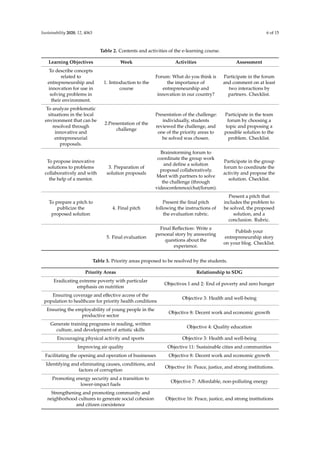
them (see Figure 1). The topic “improving the quality of the air” was selected by two groups. In the
initial selection, the students made individual proposals for possible solutions. The solution proposal
had to be a product or service that would solve the problem under study, define the potential users,
and indicate how their proposal would address the problem.
Sustainability 2020, 12, 4063 9 of 15
The first step for the students was to choose a challenge from possible alternatives according to
their interests. Of the 10 topics presented, students chose the five that were the most acceptable to
them (see Figure 1). The topic “improving the quality of the air” was selected by two groups. In the
initial selection, the students made individual proposals for possible solutions. The solution proposal
had to be a product or service that would solve the problem under study, define the potential users,
and indicate how their proposal would address the problem.
Figure 1. Challenges selected by the online course participants.
The initial proposals of the students included:
• A social enterprise that honors companies that adopt senior mentoring programs, that trains
young people, and in which lack of experience is not an impediment for new employees.
• A platform to support the commercialization of products through employing young people
remotely, and the digitalization of government information for greater transparency.
• A proposal to eradicate the extreme poverty of food in the state of Nuevo León and facilitate
access to health services.
• A proposal to decrease carbon dioxide in the companies that emit it.
• A proposal for an environmental consulting agency that gives incentives to companies that
reduce their emissions.
• A proposal to use plants to reduce air pollution.
As they worked on resolving the challenges, the students brainstormed and researched the data
that would help them solve the problems. To work asynchronously, the students used discussion
forums and Google Docs to upload their findings. They also had some meetings via video
conferencing and chats to agree on what they were going to present.
In the data analysis, we found the following elements in the strategies of the work teams:
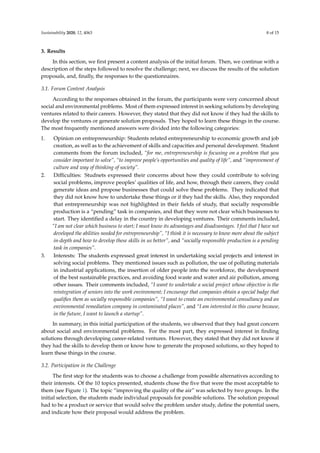
1. Projects resolving problems related to the students’ careers, theoretical research, and statistics
they collected to establish the magnitudes of the problems, as well as analyses of the impacts of
the solutions.
2. Research on the problems using interviews and the applications of the business model canvas to
determine the people affected.
3. Consultations with people affected by the problems and feasibility analysis of each solution’s
implementation.
4. Presentation of a proposal defining a product or service, the benefits of the solution proposed for
the priority area, data related to the impact of the solution, and a value proposition.
The process followed by the participants to resolve the challenge is shown in Figure 2.
Promoting energy security and a transition
to lower impact fuels.
Facilitating the
opening and
formation of
business.
Identifying and
eliminating the
causes and
conditions of
corruption.
Eradicating extreme
poverty and/or
ensure priority
health coverage.
Improving the
quality of the air.
Figure 1. Challenges selected by the online course participants.
The initial proposals of the students included:
• A social enterprise that honors companies that adopt senior mentoring programs, that trains
young people, and in which lack of experience is not an impediment for new employees.
• A platform to support the commercialization of products through employing young people
remotely, and the digitalization of government information for greater transparency.
• A proposal to eradicate the extreme poverty of food in the state of Nuevo León and facilitate
access to health services.
• A proposal to decrease carbon dioxide in the companies that emit it.
• A proposal for an environmental consulting agency that gives incentives to companies that reduce
their emissions.
• A proposal to use plants to reduce air pollution.
As they worked on resolving the challenges, the students brainstormed and researched the data
that would help them solve the problems. To work asynchronously, the students used discussion
forums and Google Docs to upload their findings. They also had some meetings via video conferencing
and chats to agree on what they were going to present.
In the data analysis, we found the following elements in the strategies of the work teams:
1. Projects resolving problems related to the students’ careers, theoretical research, and statistics
they collected to establish the magnitudes of the problems, as well as analyses of the impacts of
the solutions.
2. Research on the problems using interviews and the applications of the business model canvas to
determine the people affected.
3. Consultations with people affected by the problems and feasibility analysis of each
solution’s implementation.
4. Presentation of a proposal defining a product or service, the benefits of the solution proposed for
the priority area, data related to the impact of the solution, and a value proposition.
The process followed by the participants to resolve the challenge is shown in Figure 2.
Sustainability 2020, 12, 4063 10 of 15Sustainability 2020, 12, x FOR PEER REVIEW 10 of 15
Figure 2. The process followed by the participants to resolve the challenge.
3.3. Solution Proposals
The proposals for solutions to the different problems encountered by the students are shown in
Table 5. Five teams presented solutions to the problems. One of the six groups did not present the
final work, which consisted of three students who indicated that they did not have time to complete
the activities and withdrew from the course. The proposed solutions included a biogas producer to
produce clean-energy fuels, an educational program to promote healthy eating, a rewards program
for companies that used a mentoring program, a design of vertical gardens, and an algae-based filter
to reduce pollution.
Table 5. Solution projects proposed by the students.
Problem The solution that addresses the problem
Promoting energy security and a transition to
low-impact fuels
Biodigestor to produce biogas
Eradicating extreme poverty and ensuring
priority health coverage
An educational program focused on healthy
alimentation
Facilitating the opening and formation of
businesses
Various mentors
Improving the quality of the air. Vertical gardens
Identifying and eliminating the causes and
conditions of corruption
The final proposal not presented.
Improving the quality of the air
The capture of contaminants in chimneys by a
microalgae biofilter
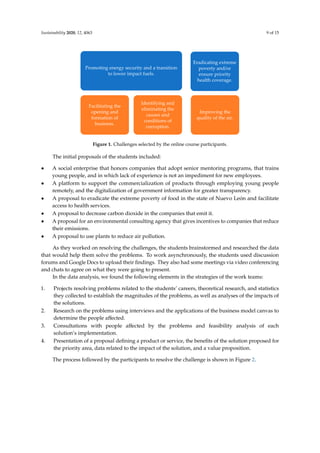
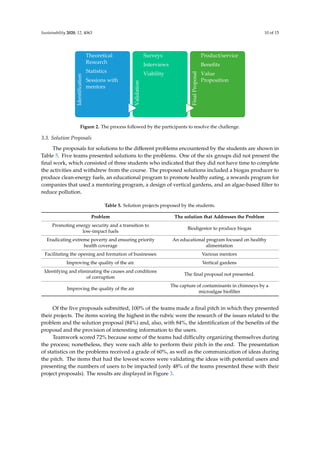
Of the five proposals submitted, 100% of the teams made a final pitch in which they presented
their projects. The items scoring the highest in the rubric were the research of the issues related to the
problem and the solution proposal (84%) and, also, with 84%, the identification of the benefits of the
proposal and the provision of interesting information to the users.
Teamwork scored 72% because some of the teams had difficulty organizing themselves during
the process; nonetheless, they were each able to perform their pitch in the end. The presentation of
statistics on the problems received a grade of 60%, as well as the communication of ideas during the
pitch. The items that had the lowest scores were validating the ideas with potential users and
presenting the numbers of users to be impacted (only 48% of the teams presented these with their
project proposals). The results are displayed in Figure 3.
Identification
Theoretical
Research
Statistics
Sessions with
mentors
Validation
Surveys
Interviews
Viability
FinalProposal
Product/service
Benefits
Value
Proposition
Figure 2. The process followed by the participants to resolve the challenge.
3.3. Solution Proposals
The proposals for solutions to the different problems encountered by the students are shown in
Table 5. Five teams presented solutions to the problems. One of the six groups did not present the
final work, which consisted of three students who indicated that they did not have time to complete
the activities and withdrew from the course. The proposed solutions included a biogas producer to
produce clean-energy fuels, an educational program to promote healthy eating, a rewards program for
companies that used a mentoring program, a design of vertical gardens, and an algae-based filter to
reduce pollution.
Table 5. Solution projects proposed by the students.
Problem The solution that Addresses the Problem
Promoting energy security and a transition to
low-impact fuels
Biodigestor to produce biogas
Eradicating extreme poverty and ensuring priority
health coverage
An educational program focused on healthy
alimentation
Facilitating the opening and formation of businesses Various mentors
Improving the quality of the air. Vertical gardens
Identifying and eliminating the causes and conditions
of corruption
The final proposal not presented.
Improving the quality of the air
The capture of contaminants in chimneys by a
microalgae biofilter
Of the five proposals submitted, 100% of the teams made a final pitch in which they presented
their projects. The items scoring the highest in the rubric were the research of the issues related to the
problem and the solution proposal (84%) and, also, with 84%, the identification of the benefits of the
proposal and the provision of interesting information to the users.
Teamwork scored 72% because some of the teams had difficulty organizing themselves during
the process; nonetheless, they were each able to perform their pitch in the end. The presentation
of statistics on the problems received a grade of 60%, as well as the communication of ideas during
the pitch. The items that had the lowest scores were validating the ideas with potential users and
presenting the numbers of users to be impacted (only 48% of the teams presented these with their
project proposals). The results are displayed in Figure 3.
Sustainability 2020, 12, 4063 11 of 15Sustainability 2020, 12, x FOR PEER REVIEW 11 of 15
Figure 3. Results of the evaluation rubric.
3.4. Responses to the Questionnaires
In the end, the question “what did you learn during the course” was asked of students. The
students answered that their best lessons learned from the course were how to make a profit for
society through entrepreneurship and what knowledge could help them create new companies in the
future. For the question, “how will these lessons that you learned help you in the future”, students
mentioned that this knowledge would be not only useful to building a company, but also for other
uses in life. They mentioned transversal skills such as knowing how to work on projects, teamwork,
and designing and shaping an idea, among others. Regarding the question “how did you handle the
problems or complicated situations presented to you”, the most frequent inconveniences of the
course expressed by the students were a lack of time due to academic workload and an insufficiency
of time to do the activities.
4. Discussion
This study sought to determine how CBL can be implemented in an e-learning course to
strengthen education oriented toward sustainable development. CBL confronts students with real-
life situations, and this project proposed activities that were designed to help them to connect the
knowledge they had acquired to the kind of situations that they will find in their professional
working lives [29]. This ability is the basis for developing problem-solving proposals that promote
sustainable development.
This research aligns with the work reported by Parra [15], where innovative, educational
training methods that promote sustainable development include the study of problem causes, the
formation of possible hypotheses that come from different points of view, and the understanding that
global problems are inter-connected. When students can experience these elements, they can reflect
on the practices that lead to greater sustainability [32].
Our implementation of CBL corresponds with other studies where the application of active
learning methodologies contributes to the acquisition of values that guide college students towards
professional behaviors that promote sustainable development [19]. Also, the training to develop these
competencies is integrated into the curricula and combined with technical skills taught in various
disciplinary careers [20]. We observed that the participants of this study had a great interest in the
social initiatives that help improve the realities of their communities. Therefore, it is appropriate to
present transversal content in the courses offered in their disciplines. This way, the students can
contribute their technical knowledge to problem-solving and, through a rich reflection, offer
insightful solutions that are sustainable and long-lasting [19,20].
Figure 3. Results of the evaluation rubric.
3.4. Responses to the Questionnaires
In the end, the question “what did you learn during the course” was asked of students. The students
answered that their best lessons learned from the course were how to make a profit for society
through entrepreneurship and what knowledge could help them create new companies in the future.
For the question, “how will these lessons that you learned help you in the future”, students mentioned
that this knowledge would be not only useful to building a company, but also for other uses in life.
They mentioned transversal skills such as knowing how to work on projects, teamwork, and designing
and shaping an idea, among others. Regarding the question “how did you handle the problems or
complicated situations presented to you”, the most frequent inconveniences of the course expressed
by the students were a lack of time due to academic workload and an insufficiency of time to do
the activities.
4. Discussion
This study sought to determine how CBL can be implemented in an e-learning course to strengthen
education oriented toward sustainable development. CBL confronts students with real-life situations,
and this project proposed activities that were designed to help them to connect the knowledge they had
acquired to the kind of situations that they will find in their professional working lives [29]. This ability
is the basis for developing problem-solving proposals that promote sustainable development.
This research aligns with the work reported by Parra [15], where innovative, educational training
methods that promote sustainable development include the study of problem causes, the formation
of possible hypotheses that come from different points of view, and the understanding that global
problems are inter-connected. When students can experience these elements, they can reflect on the
practices that lead to greater sustainability [32].
Our implementation of CBL corresponds with other studies where the application of active
learning methodologies contributes to the acquisition of values that guide college students towards
professional behaviors that promote sustainable development [19]. Also, the training to develop these
competencies is integrated into the curricula and combined with technical skills taught in various
disciplinary careers [20]. We observed that the participants of this study had a great interest in the
social initiatives that help improve the realities of their communities. Therefore, it is appropriate
to present transversal content in the courses offered in their disciplines. This way, the students can
contribute their technical knowledge to problem-solving and, through a rich reflection, offer insightful
solutions that are sustainable and long-lasting [19,20].
Sustainability 2020, 12, 4063 12 of 15
In this research, CBL allowed students to take advantage of their desires to find meaning in
education [32,33]. The process followed by the participants to resolve the challenges allowed them to
define solutions in their fields of study, which benefited the research because the students delved into
topics that impacted the community. The students were able to learn more about developing solution
proposals in collaborative and multi-disciplinary ways. This finding is consistent with the results
of Rådberg et al. [32], where the implementation of CBL with university students favored solving
complex, multi-disciplinary problems, and provoked their interest in sustainable development.
In analyzing the elements of CBL that can contribute to solving local problems through an
e-learning course, we found that, in this project, the students started from an essential question.
The participants of the study considered the importance of the role that entrepreneurship has on
economic and social development and employment. In the responses in the discussion forums, the
students were very interested in the topic of sustainable development and how to develop initiatives
that favor it. However, in some cases, they did not know how to generate proposals to develop
initiatives that would address barriers to sustainable development. They also did they know what
their skills were and how to leverage them to create new businesses.
The next step was the presentation of a challenge for students to analyze to create solutions to
the problems. They each chose the challenge they wanted to confront collaboratively with classmates
from various disciplines. This element of collaborative work has previously been studied by Fidalgo
Blanco et al. [35], where CBL encouraged collaboration and communication among team members to
generate a common strategy. In addition, the features of online platforms and communication tools
allow ubiquitous learning that promotes interactions, flexibility, and the achievement of educational
objectives [7,12].
The activities and resources proposed in the course allowed students to reflect on their ideas
through brainstorming and researching data for problem-solving to develop a proposal. They followed
another step of CBL, where each challenge can have a variety of solutions. Also, the students used
previously acquired knowledge that they had developed throughout their curricula. This finding is
consistent with other studies indicating that CBL calls on students to put their prior technical skills
and knowledge into practice [45].
Finally, the students presented their final products in pitches about their solution projects.
They documented their ideas in forums, online documents, and blogs in the course. The teacher of
the course evaluated the documentation with an assessment rubric. The analysis determined that
the most popular elements of the course were conducting the research on the subject and presenting
the expected benefits of the proposed solutions. The items having the lower scores were teamwork,
communication, and validation of the solution proposal with potential users. The implementation in a
real environment was not possible because it was not in the objective of the course.
The contribution of this study to education for sustainable development is to present CBL as
a proposal that provides students the opportunity to reflect on local, national, or global problems.
Reflection was possible via the activity of having students discuss their experiences in the course.
Most of the students expressed that their experiences in the course allowed them to recognize
how to make a profit for society. Such reflections allowed them to delve into their knowledge to
generate innovative solutions to these problems. Also, the ubiquitous ability to leverage e-learning
for interactions and communication among multidisciplinary groups facilitates the development of
transversal competencies in students in university curricula.
5. Conclusions
CBL, as innovative pedagogy, presents university students in multi-disciplinary fields of study
with specific, real-world challenges that can be addressed collaboratively in their college courses.
Presenting real local, national, or global problems can strengthen their motivations to conduct research
and find solutions that address the realities of their environments.
Sustainability 2020, 12, 4063 13 of 15
The application of CBL takes advantage of the e-learning mode and communication tools that
facilitate collaborative work and interactions among the participants at different times and places.
It offers the opportunity to integrate various flexible and inexpensive technological tools into students’
studies, and provides the resources and the content that guide students to resolving the challenges
they have selected [46].
For future applications, we see a need to plan the activity time better and extend the time to be
able to validate the solution proposals with possible users. The students indicated that they do not
know how to generate proposals to develop initiatives that would address challenges to sustainable
development. They also stated that they do not know what their skills are and how to leverage them to
create new businesses. Therefore, it is necessary to provide students with training within their careers
so that they can access this knowledge while taking courses.
We propose that other courses be designed so that students can continue developing their
solution projects with prototypes that they can validate with potential users. They can establish
synergies with other institutions or companies that help them to achieve their goals. Within an
entrepreneurship ecosystem, educators can guide students and support the incubation or acceleration
of their entrepreneurial businesses. Although a single course can help develop specific competencies,
a broader program is more conducive for the integral development of sustainability [47]. Also, we
recommend further research be conducted using larger sample sizes in order to gather and analyze
data quantitatively.
Limitations of the research included that the results obtained were limited to a small study group
that did not represent the general population. However, elements of CBL studied herein could be
replicated in e-learning courses as an active methodology that promotes the solutions to local, national,
and global problems, as well as in other contexts.
Author Contributions: Conceptualization, M.P.C. and M.G.G.Z.; methodology, M.P.C. and M.G.G.Z.; software,
M.P.C.; validation, M.P.C. and M.G.G.Z.; writing—original draft preparation, M.P.C.; writing—review and editing,
M.P.C. and M.G.G.Z.; supervision, M.G.G.Z. All authors have read and agreed to the published version of
the manuscript.
Funding: The authors would like to acknowledge the support of the Novus grant, TecLabs, Tecnologico de
Monterrey, Mexico, in the production of this work.
Acknowledgments: The authors would like to acknowledge the financial and technical support of Writing Lab,
TecLabs, Tecnologico de Monterrey, Mexico, in the production of this work.
Conflicts of Interest: The authors declare no conflict of interest.
References
1. Khaddage, F.; Christensen, R.; Lai, W.; Knezek, G.; Norris, C.; Soloway, E. A model-driven framework to
address challenges in a mobile learning environment. Educ. Inf. Technol. 2015, 20, 625–640. [CrossRef]
2. Vázquez-Cano, E.; López Meneses, E.; Jaén Martínez, A. The group e-portfolio to improve the
teaching-learning process at university. J. e-Learn. Knowl. Soc. 2017, 13, 65–76. [CrossRef]
3. Ozuorcun, N.C.; Tabak, F. Is M-learning versus E-learning, or are they supporting each other? Proc. Soc.
Behav. Sci. 2012, 46, 299–305. [CrossRef]
4. Barrero Fernández, B. Estudios sobre propuestas y experiencias de innovación educativa. Revista de
Currículum y Formación del Profesorado 2018, 22, 1–10. [CrossRef]
5. Huss, J.A.; Sela, O.; Eastep, S. A case study of online instructors and their quest for greater interactivity in
their courses: Overcoming the distance in distance education. Aust. J. Teach. Educ. 2015, 40, 72–86. [CrossRef]
6. Racovita-Szilagyi, L.; Carbonero Muñoz, D.; Diaconu, M. Challenges and opportunities to eLearning in
social work education: Perspectives from Spain and the United States. Eur. J. Soc. Work 2018, 21, 836–849.
[CrossRef]
7. Alemán de la Garza, L.; Gómez Zermeño, M.; Mochizuki, Y.; Bruillard, E.; Anichini, A.; Antal, P.; Beaune, A.;
Bruillard, E.; Burke, D.; Henrique Cacique Braga, P.; et al. Rethinking Pedagogy. Exploring the Potential of
Digital Technology in Achieving Quality Education; UNESCO MGIEP: New Delhi, India, 2019.
Sustainability 2020, 12, 4063 14 of 15
8. Robinson, S.; Neergaard, H.; Tanggaard, L.; Krueger, N. New horizons in entrepreneurship education: From
teacher-led to student-centered learning. Educ. Train. 2016, 58, 661–683. [CrossRef]
9. Rivera Vargas, P.; Alonso Cano, C.; Sancho Gil, J. Desde la educación a distancia al e-learning: Emergencia,
evolución y consolidación. Revista Educ. y Tec. 2017, 10, 1–13.
10. UNESCO. Available online: https://www.un.org/sustainabledevelopment/es/education/ (accessed on 1
April 2020).
11. Lozano, R.; Lukman, R.; Lozano, F.; Huisingh, D.; Lambrechts, W. Declarations for sustainability in higher
education: Becoming better leaders, through addressing the university system. J. Clean. Prod. 2013, 48, 10–19.
[CrossRef]
12. Azeiteiro, U.; Bacelar Nicolau, P.; Caetano, F.; Caeiro, S. Education for sustainable development through
e-learning in higher education: Experiences from Portugal. J. Clean. Prod. 2015, 106, 308–319. [CrossRef]
13. UNESCO. Available online: https://gem-report-2016.unesco.org/es/chapter/la-prosperidad-economias-
sostenibles-e-inclusivas/ (accessed on 1 April 2020).
14. UNESCO. Available online: https://unesdoc.unesco.org/ark:/48223/pf0000252423/PDF/252423spa.pdf.multi
(accessed on 1 April 2020).
15. Parra, S. Exploring the incorporation of values for sustainable entrepreneurship teaching/learning. J. Technol.
Manag. Innov. 2013, 8, 11–20. [CrossRef]
16. Hák, T.; Janoušková, S.; Moldan, B. Sustainable Development Goals: A need for relevant indicators. Ecol. Indic.
2016, 60, 565–573. [CrossRef]
17. Gordon, J.; Halsz, G.; Krawczyk, M.; Leney, T.; Micehl, A.; Pepper, D.; Putkiewicz, E.; Wisniewski, W. Key
Competences in Europe: Opening Doors for Lifelong Learners across the School Curriculum and Teacher’s Education;
Centre for Social and Economic Research on behalf of CASE Network: Warsaw, Poland, 2009.
18. Camacho Yáñez, I.; Gómez Zermeño, M.; Pintor Chávez, M. Competencias digitales en el estudiante adulto
trabajador. Revista Interamericana de Educación de Adultos 2015, 37, 10–24.
19. Alcalá del Olmo, M.; Gutiérrez Sánchez, J. El desarrollo sostenible como reto pedagógico de la universidad
del siglo XXI. Anduli 2019, 19, 59–80. [CrossRef]
20. Takala, A.; Korhonen-Yrjänheikki, K. A decade of Finnish engineering education for sustainable development.
Int. J. Sustain. High. Educ. 2019, 20, 170–186. [CrossRef]
21. El-Zein, A.H.; Hedemann, C. Beyond problem solving: Engineering and the public good in the 21st century.
J. Clean. Prod. 2016, 137, 692–700. [CrossRef]
22. Antonaci, A.; Dagnino, F.; Ott, M.; Bellotti, F.; Berta, R.; De Gloria, A.; Lavagnino, E.; Romero, M.; Usart, M.;
Mayer, M. Gamified collaborative course in entrepreneurship: Focus on objectives and tools. Comput. Hum.
Behav. 2016, 51, 1276–1283. [CrossRef]
23. Zuzeviciute, V.; Praneviciene, B.; Simanaviciene, Z.; Vasiliauskiene, V. Competence for sustainability:
Prevention of dis-balance in higher education: The case of cooperation while educating future law enforcement
officers. Montenegrin J. Econ. 2017, 13, 121–130. [CrossRef]
24. Frey, C.; Osborne, M. The future of employment: How susceptible are jobs to computerization? Technol. Forecast.
Soc. Chang. 2017, 114, 254–280. [CrossRef]
25. Wright, N.; Wrigley, C. Broadening design-led education horizons: Conceptual insights and future research
directions. Int. J. Technol. Des. Ed. 2019, 29, 1–23. [CrossRef]
26. Hasan, M.; Khan, E.; Nabi, M. Entrepreneurial education at the university level and entrepreneurship
development. Educ. Train. 2018, 59, 888–906. [CrossRef]
27. Roffeei, S.; Yusop, F.; Kamarulzaman, Y. Determinants of innovation culture amongst higher education
students. Turkish Online J. Educ. Technol. 2018, 17, 37–50. [CrossRef]
28. Lee, C.; de Vries, W.T. Sustaining a culture of excellence: Massive Open Online Course (MOOC) on land
management. Sustainability 2019, 11, 3280. [CrossRef]
29. Lozano, A.; García, F.; Zubieta Ramírez, C.; López Cruz, C. Competencies associated with Semestre i and its
relationship to academic performance. High. Educ. Skills Work-Based Learn 2019, 10, 387–399. [CrossRef]
30. Edutrends. Aprendizaje Basado en Retos; Observatorio de Innovación Educativa del Tecnológico de Monterrey:
Monterrey, Mexico, 2018.
31. Yang, Z.; Zhoua, Y.; Chung, J.; Tang, Q.; Jiang, L.; Wong, K. Challenge Based Learning nurtures creative
thinking: An evaluative study. Nurse Educ. Today 2018, 71, 40–47. [CrossRef]
Sustainability 2020, 12, 4063 15 of 15
32. Rådberg, K.; Lundqvist, U.; Malmqvist, J.; Svensson, O. From CDIO to challenge-based learning experiences
–expanding student learning as well as societal impact? Eur. J. Eng. Educ. 2020, 45, 22–37. [CrossRef]
33. Malmqvist, J.; Rådberg, K.; Lundqvist, U. Comparative analysis of challenge-based learning experiences.
In Proceedings of the 11th International CDIO Conference, Chengdu, Sichuan, China, 8–11 June 2015.
34. Rowe, C.; Klein-Gardner, S. A study of challenge-based learning techniques in an introduction to engineering
course. In Proceedings of the 2007 Annual Conference & Exposition, Honolulu, Hawaii, 24 June 2007.
35. Fidalgo Blanco, A.; Sein-Echaluce, M.; García Peñalvo, F. Aprendizaje Basado en Retos en una asignatura
académica universitaria. Revista Iberoamericana de Informática Educativa 2017, 25, 1–8. [CrossRef]
36. Buil, M.; Aznar, J.; Galiana, J.; Rocafort-Marco, A. An explanatory study of MBA students with regards to
sustainability and ethics commitment. Sustainability 2016, 8, 280. [CrossRef]
37. Penttilä, T. Desarrollo de organizaciones educativas con pedagogía de innovación. J. Adv. Educ. 2016,
2, 259–267.
38. Portuguez Castro, M.; Ross Scheede, C.; Gómez Zermeño, M. The impact of higher education in
entrepreneurship and the innovation ecosystem: A case study in Mexico. Sustainability 2019, 20, 5597.
[CrossRef]
39. García-Peñalvo, F.; Seoane Pardo, A. Una revisión actualizada del concepto de eLearning. Décimo Aniversario.
Educ. Knowl. Soc. 2015, 16, 119–144. [CrossRef]
40. Creswell, J.W.; Poth, C.N. Qualitative Inquiry and Research Design. Choosing Among Five Approaches; Sage
Publications: Thousand Oaks, CA, USA, 2018.
41. Yin, R. Case Study Research; Sage: Thousand Oaks, CA, USA, 2009.
42. Otzen, T.; Manterola, C. Técnicas de Muestreo sobre una Población a Estudio. Intern. J. Morphol. 2017,
35, 227–232. [CrossRef]
43. Consejo Nuevo León para la Planeación Estratégica. Plan Estratégico para el Estado de Nuevo León 2015–2030;
Consejo de Nuevo León: Monterrey, Mexico, 2016.
44. International Institute for Qualitative Methodology. Available online: https://sites.ualberta.ca/~{}iiqm/pdfs/
introduccion.pdf (accessed on 1 April 2020).
45. Hernández-de-Menéndez, M.; Vallejo Guevara, A.; Tudón Martínez, J.C. Active learning in engineering
education. A review of fundamentals, best practices, and experiences. Int. J. Interact. Des. Manuf. 2019,
13, 909–922. [CrossRef]
46. Rajabion, L.; Wakil, K.; Badfar, A.; Nazif, M.; Ehsani, A. A new model for evaluating the effect of cloud
computing on the e-learning development. J. Workplace Learn. 2019, 31, 324–344. [CrossRef]
47. Mindt, L.; Rieckmann, M. Developing competencies for sustainability-driven entrepreneurship in higher
education: A literature review of teaching and learning methods. Teoría de la Educación 2017, 29, 129–159.
© 2020 by the authors. Licensee MDPI, Basel, Switzerland. This article is an open access
article distributed under the terms and conditions of the Creative Commons Attribution
(CC BY) license (http://creativecommons.org/licenses/by/4.0/).

Challenge Based Learning: Innovative Pedagogy for Sustainability through e-Learning in Higher Education.

  • 1.
    sustainability Article Challenge Based Learning:Innovative Pedagogy for Sustainability through e-Learning in Higher Education May Portuguez Castro and Marcela Georgina Gómez Zermeño * School of Humanities and Education, Tecnologico de Monterrey, Monterrey 64849, Nuevo León, Mexico; mayportuguezc@gmail.com * Correspondence: marcela.gomez@tec.mx Received: 3 April 2020; Accepted: 12 May 2020; Published: 15 May 2020 Abstract: Challenge-Based Learning (CBL) is an innovative teaching methodology that engages students to resolve real-world challenges while applying the knowledge they acquired during their professional training. This article describes the results of the implementation of an online course on entrepreneurship that utilized CBL with a group of 20 undergraduate students from various disciplines in a university in Mexico. During the course, challenges related to the Sustainable Development Goals of the United Nations were presented to the participants, making it possible to observe the students’ interest in resolving these problems. This research uses a case study methodology and seeks to determine the CBL elements in the e-learning modality. The results showed that the participants generated sustainable business ideas aimed to resolve local, national, and global problems. The recommendations are to continue the formation of the businesses proposed in the project. These ideas can become real ventures that connect various actors in the entrepreneurial ecosystem and will continue to strengthen transversal skills such as teamwork and communication. Keywords: challenge-based learning; education in sustainability; e-learning; educational innovation; higher education; sustainable development goals 1. Introduction There is no doubt that the development of Information and Communication Technologies (ICT) has generated transformations of all fields of society, including education [1]. The internet and the use of network-connected devices [2,3] have penetrated traditional teaching and learning methods. As a result, different educational modalities have arisen, reflecting these changes and raising new scenarios that shape training processes [4]. Among the new modalities of online education is e-learning, which uses ICT to provide educational content and facilitate learning to multiple segments of the population [5]. The advantages of this modality include its flexibility and the possibility that it can be utilized remotely and at different times, thanks to synchronous and asynchronous processes [6]. Also, its potential for communication and the possibilities for ubiquitous learning (anytime, anywhere) promote lifelong learning and interactions among participants [7,8]. The disadvantages are that if there are no such interactions in a course, a student’s motivation decreases. Furthermore, evaluations are difficult to do online in disciplines that require applied practices [9]. Through education, people can improve their quality of life. Using technological tools, they can develop innovative solutions to the most significant problems of society [10]. So, ICT-based modalities such as e-learning are considered mechanisms that can improve access to education. They have great potential to accomplish the objectives set for sustainable development. For this to happen, there must be an appropriate pedagogical model that incorporates self-regulated learning and a multidisciplinary approach [11–13]. Sustainability 2020, 12, 4063; doi:10.3390/su12104063 www.mdpi.com/journal/sustainability
  • 2.
    Sustainability 2020, 12,4063 2 of 15 According to UNESCO [14], education for sustainable development aims to give people the skills and knowledge to find solutions to economic, social, and environmental problems. It encourages students to reflect on excess consumption, poverty, the stimulation of solidarity and cooperation, and to recognize that current economic development trends are not sustainable; therefore, programs that promote these are required [15]. In 2015, the international community proposed the Sustainable Development Goals (SDGs), including 17 objectives and 169 challenges that proposed to eradicate poverty by the year 2030 [16]. To achieve the goals of the 2030 agenda, citizens must have a world economy that is environmentally sustainable and inclusive. Therefore, lifelong learning and education should prepare citizens to develop the skills that make production and consumption sustainable [13,17]. A better-educated workforce will nurture inclusive economic growth and a focus on human well-being [18]. According to Alcalá and Gutiérrez [19], interest in sustainable education focuses on students and the innovative pedagogies that bring them closer to social reality and its main conflicts. The goal is for the students to better understand the environments of their intended professions. A university must be a driving force that trains students to remain aware of sustainability and the changes it implies. Therefore, it is a priority in education to work on values that lead to reflection and critical thinking, and to integrate the themes of sustainability into the contents of subject materials [19]. Takala and Korhonen-Yrjonheikki [20] defined the main competencies for sustainable development to be holistic understanding, communication, collaborative skills, critical thinking, reflection, creativity, innovation, and entrepreneurship. To achieve these competencies, one must keep sustainability in mind as an ongoing process. Teachers should encourage their students to understand their roles in sustainable development and collaborate in multi-disciplinary ways to share knowledge. Curricular content must be integrated, teacher training promoted, and there must be public funds for research. Environmental, social, and economic changes make the issue of sustainable development more pressing than ever. However, training in universities remains technocratic and does not promote reflection on these problems [21]. Also, education for sustainable development is still not integrated into the programs, so most courses do not raise concerns about this issue [20]. The development of active pedagogical activities that help strengthen the vision of education in this society thus become a challenge [22–25]. In this context, educational innovation contributes to the design and presentation of programs that address these challenges [26,27]. However, for there to be educational innovation, we must introduce new technological tools that are used correctly and appropriated to the various actors that need them [2]. Additionally, digital learning environments must be created where a student can contribute directly to improvements, experiments, and shared experiences. All these actions occur through new forms of teaching [28]. Along these lines, Challenge-Based Learning (CBL) is an innovative pedagogy that actively engages students in relevant real-world problems that exist in their environments and that require a solution [29,30]. This pedagogy has its roots in experiential learning. It incorporates the use of technology, teamwork, self-directed learning, and solutions to real problems that extend from the classroom to the community [31]. This pedagogical approach leverages students’ interests to give practical meaning to education. It develops competencies such as multidisciplinary teamwork, decision-making, leadership, and communication [32,33]. The challenge consists of an activity or situation that involves sincere effort from the student and triggers him/her to obtain new knowledge through the proposal of a concrete solution [34]. Content is presented that builds on students’ previous knowledge, and is structured so that feedback can occur between students and instructors [30]. Therefore, the involvement of students in the creation of knowledge, both individually and cooperatively, is considered an essential characteristic of active methodologies [35]. According to Edutrends [30], CBL consists of the following elements: • The general idea: There is a topic presented to students with importance to society.
  • 3.
    Sustainability 2020, 12,4063 3 of 15 • The essential question: The general idea starts with a problem that reflects the interest of the students and the needs of the community. • The challenge: Students must create a solution to the problem posed in the essential question. • Questions, activities, and guide resources: Students identify elements that are convenient for developing innovative solutions to problems. • The solution: Each challenge permits a variety of solutions. These must be concrete and feasible to implement in the community. • Implementation: Students test the solution in a real environment. • The evaluation or assessment is carried out through the challenge process, which confirms the learning results and supports the decisions made during the implementation. • Documentation and publication: Students find ways to publish their ideas, blogs, videos, and other tools. • Reflection and dialogue that consider the content and the students’ learning and experiences. Previous studies on CBL like the one by Rådberg et al. [32] have indicated that this multidisciplinary approach encourages students to work actively with their peers and teachers to identify complex challenges, ask relevant questions, and take action favoring sustainable development. The three-year case study involving 38 students was conducted in the Chalmers University Challenge Laboratory. The results showed that the students developed skills in the formulation of problems and sustainable development. Although few projects reached their implementation, they had the potential for social impact. Hence, the authors suggested complementing other projects within the career with this type of program. Another study by Malmqvist et al. [33] compared four experiences of CBL in universities in Australia, the United States, Denmark, and Sweden. The similarity among them was that this methodology was presented throughout the courses with topics related to social and environmental sustainability. In one of the universities, the course was positioned in the first year, setting the stage to continue with subsequent courses and projects based on that initial course, which made planning go further. The authors concluded that multidisciplinary courses placed new demands on teachers who may not know about the topics, causing students to feel a lack of support; this implies a need to have teachers from different disciplines. Students need to develop transversal skills such as communication, decision-making, leadership, and teamwork, in addition to those in a socio-technical domain. Soft skills remain outside the regular curricula, but they must become part of them. In an experience carried out by Azeteiro et al. at a Portuguese university [12], the authors found that education in sustainability through e-learning can be highly relevant for sustainable development. However, the authors concluded that students had problems developing some competencies, and that more studies would be necessary to evaluate the appropriate pedagogical model. In the case of the e-learning modality, Racovita-Szilagyi et al. [6] conducted research in Spain and the United States with 400 university teachers in the social work field. The authors inquired about their perceptions on the opportunities that the e-learning modality creates for their teaching. The participating professors believed that, through this modality, students in rural areas could have greater accessibility, and that the students could learn at their own pace and have a mentor. Finally, the authors mentioned that for future studies, more research should focus on the integration of technology and its impact on training processes. According to the literature consulted, these new strategies are necessary to develop more active learning oriented toward problem-solving [32,36]. However, the programs of higher education are still more theoretical than practical. There is a gap between what students learn and what they can apply in their lives [32–37]; therefore, methodologies that promote active learning and learning by doing [33,38] must be incorporated. Also, as online education continuously evolves, research should focus on the good practices that favor its implementation so that the learning mediated by technologies continues [39]. However,
  • 4.
    Sustainability 2020, 12,4063 4 of 15 although CBL has been shown to be positive for students interested in sustainable development facilitated by the active methodologies used in the courses, some courses are not yet part of the curricula. Therefore, there is not continuity of the projects. More research is required to learn how to continue developing sustainable development skills in students [6,12]. The research of this project was carried out in a university in northern Mexico. This institution is currently implementing an educational model based on active methodologies, so this study sought to generate knowledge about the results of its implementation related to sustainable education. The study was carried out in an extracurricular course taught to students from different careers. The courses ere optional and taken by students interested in this topic of study; they sought to develop transversal competencies in students, including personal and professional skills for achieving life and career goals and comprehensive health. Therefore, this study aimed to implement CBL as an innovative pedagogy through online education in this particular study group. It had the objectives to determine its results and opportunities for improvement and to guide students toward solutions for sustainable-development problems. The study sought to answer the following research questions: • Q1. How to implement CBL to strengthen education for sustainable development in an e-learning course in the study context? • Q2. What was the perception of the enrolled students in the e-learning course about the contribution they can make to resolving local, national, or global problems? • Q3. What elements of CBL contribute to providing solutions to local problems through an e-learning course? 2. Method To answer these research questions, we used a case study methodology. The approach was qualitative. In such research, the investigators explore a case or several real-life cases, collecting data from multiple sources of information such as observations, interviews, audiovisual materials, documents, and reports [40]. This research developed an e-learning course with training activities and challenges in which the students solved sustainability problems through entrepreneurial proposals. The research analyzed a unique case of a class that was participating in an online course. The evidence obtained describes the intervention and the context in which it occurred [41]. By analyzing the educational experiences that promote active learning, such as CBL, one can discover how to use active teaching methodologies to generate solutions to local, national, and global problems. Research such as this can lead to the construction of education for sustainable development. 2.1. Participants The sample consisted of 20 undergraduate students from a university in northern Mexico. The participants were selected by convenience, and they agreed to be included in the study [42]. The study aimed to have students from different careers (curricula) in the sample. The most frequent careers studied by the participants were strategy and business administration, marketing, psychology, civil engineering, chemical engineering in sustainable processes, mechatronics, and biotechnology. Table 1 shows the number of students and their gender, career, and average age percentages.
  • 5.
    Sustainability 2020, 12,4063 5 of 15 Table 1. Distribution of the sample. Total Students Men Women Average Age Career 20 8 12 23 years old 12 6 1 1 40% 5 2 1 0 60% 7 4 0 1 Engineering Business administration Industrial design Clinical psychology During the first week, 20 students participated. In the second week, six groups were formed according to the interests of the students; each group was made up of three to four students. Twelve students completed all the activities. Students who did not finish indicated that they did not have time to carry out the activities due to other academic obligations and withdrew from the course. Of the eight students who withdrew, five withdrew before working on the proposals, while the other three started with their proposals but did not present them. 2.2. Procedure This study consisted of the implementation of an e-learning course that followed the CBL methodology. The course was held as an extracurricular activity in a workshop to develop skills for life and work; it was directed to students of different careers (multidisciplinary). It was optional and intended for those interested in the topic of entrepreneurship and social innovation. The main objective of the course was for the students to seek solutions to social problems by proposing products or services that could become entrepreneurial businesses. The specific objectives were for the students to (1) describe concepts related to entrepreneurship and innovation for use in solving problems in their environments; (2) analyze problematic situations in their environments that can be resolved through innovative and entrepreneurial proposals; (3) propose innovative solutions to problems collaboratively, and (4) prepare pitches to publicize their proposed solutions. The course duration was five weeks with synchronous and asynchronous activities and content related to CBL and entrepreneurship, hosted on a Moodle platform. Synchronous activities were those related to meetings or chats to organize the group work, and asynchronous activities were forums and blog interventions. Also, during the last week, some groups presented their pitches face-to-face at the university. The teacher evaluated using a checklist and rubrics of assessment. Table 2 shows the contents and activities of the e-learning course. In the course, the students had a series of challenges related to community problems that had to be solved collaboratively with peers and teachers. The challenge was to choose one state problem out of the 10 defined as priorities by the Strategic Plan for the State of Nuevo León 2015-2030 [43], and that was aligned with the SDGs, as shown in Table 3. This research also applied a protocol that considered the ethics of educational research to maintain the privacy, confidentiality, and integrity of the data, as well as the privacy and consent of the participants. To accomplish this, the considerations were: 1. To clearly explain the objectives of the study, telling the participants that the course was a research project. 2. To allow researchers to personally visit the class and explain the work to be done, answer any questions, and explain the time involved and procedures to be followed during the research. 3. To emphasize that participation was voluntary, and that all data would remain confidential. 4. To explain to the participants that they could decide not to participate in the research at any time. An online form was sent to them with the terms requesting their acceptance in the study.
  • 6.
    Sustainability 2020, 12,4063 6 of 15 Table 2. Contents and activities of the e-learning course. Learning Objectives Week Activities Assessment To describe concepts related to entrepreneurship and innovation for use in solving problems in their environment. 1. Introduction to the course Forum: What do you think is the importance of entrepreneurship and innovation in our country? Participate in the forum and comment on at least two interactions by partners. Checklist. To analyze problematic situations in the local environment that can be resolved through innovative and entrepreneurial proposals. 2.Presentation of the challenge Presentation of the challenge: individually, students reviewed the challenge, and one of the priority areas to be solved was chosen. Participate in the team forum by choosing a topic and proposing a possible solution to the problem. Checklist. To propose innovative solutions to problems collaboratively and with the help of a mentor. 3. Preparation of solution proposals Brainstorming forum to coordinate the group work and define a solution proposal collaboratively. Meet with partners to solve the challenge (through videoconference/chat/forum). Participate in the group forum to coordinate the activity and propose the solution. Checklist. To prepare a pitch to publicize the proposed solution 4. Final pitch Present the final pitch following the instructions of the evaluation rubric. Present a pitch that includes the problem to be solved, the proposed solution, and a conclusion. Rubric. 5. Final evaluation Final Reflection: Write a personal story by answering questions about the experience. Publish your entrepreneurship story on your blog. Checklist. Table 3. Priority areas proposed to be resolved by the students. Priority Areas Relationship to SDG Eradicating extreme poverty with particular emphasis on nutrition Objectives 1 and 2: End of poverty and zero hunger Ensuring coverage and effective access of the population to healthcare for priority health conditions Objective 3: Health and well-being Ensuring the employability of young people in the productive sector Objective 8: Decent work and economic growth Generate training programs in reading, written culture, and development of artistic skills Objective 4: Quality education Encouraging physical activity and sports Objective 3: Health and well-being Improving air quality Objective 11: Sustainable cities and communities Facilitating the opening and operation of businesses Objective 8: Decent work and economic growth Identifying and eliminating causes, conditions, and factors of corruption Objective 16: Peace, justice, and strong institutions. Promoting energy security and a transition to lower-impact fuels Objective 7: Affordable, non-polluting energy Strengthening and promoting community and neighborhood cultures to generate social cohesion and citizen coexistence Objective 16: Peace, justice, and strong institutions
  • 7.
    Sustainability 2020, 12,4063 7 of 15 2.3. Instruments The information was collected through the discussion forums, questionnaires, observation guides, the evaluation rubrics for the challenge activities, and the solutions proposed by the students. The discussion-forum-content analysis was used to understand the initial perceptions of the students regarding the contributions they could make through entrepreneurship to resolve local, national, or global problems. The students answered the questions from their perspectives and commented on the responses of at least two classmates. Observation guides were used during the course to describe how the participants resolved the challenges. The students answered a few questions about their experiences in the course, namely: “What did you learn during the course?” “How did you handle the problems or complicated situations presented to you?” and “How will these lessons that you learned help you in the future?” The responses were posted on a blog that the students used during the course. To evaluate the final projects, we developed an evaluation rubric that included the elements listed in Table 4. The students presented a final pitch that highlighted the essential points of the proposal to be shown to potential users or clients of the venture. Table 4. Evaluation rubric of the final projects. Name of the Product or Service Score (1–5) Teamwork Included research on the subject Included statistics on the problem Defined the number of users Validated the idea with potential users Elaborated a final pitch Presented interesting data or information Presented the benefits of the product or service Presentation of the pitch Points earned 2.4. Data Analysis To perform the data analysis, we followed the process suggested by Creswell and Poth [40], providing the description, analysis, and interpretation of the information generated. In the first phase, a content analysis of the participants’ discussion forums was conducted to identify categories arising from the perceptions of the students of the contributions of entrepreneurship and the innovations to resolving national problems. To carry out the analysis, we identified passages within the data. We categorized them to determine the intentions of the participants within the context of the study [44]. To determine the categories for analysis, we sought relationships in the participants’ responses in the discussion forums. Once the categories were defined, we used inductive analysis to segment the text and gather the evidence for each category. We then reviewed this to identify quotes that were relevant to the research questions. The data from the participants’ answers were compared to the codes we had established as links to the answers to the research problems. The course was conducted in Spanish, so the researchers translated the texts into English to present the results. Subsequently, proposals made by students were analyzed to determine how the participants resolved the challenges. The final presentations were reviewed with an evaluation rubric, presenting tables and graphs to display comparisons of the results [40]. For the answers to the questions about their experiences, we analyzed each question individually, separated the texts by topic, and determined the most frequently mentioned responses.
  • 8.
    Sustainability 2020, 12,4063 8 of 15 3. Results In this section, we first present a content analysis of the initial forum. Then, we continue with a description of the steps followed to resolve the challenge; next, we discuss the results of the solution proposals, and, finally, the responses to the questionnaires. 3.1. Forum Content Analysis According to the responses obtained in the forum, the participants were very concerned about social and environmental problems. Most of them expressed interest in seeking solutions by developing ventures related to their careers. However, they stated that they did not know if they had the skills to develop the ventures or generate solution proposals. They hoped to learn these things in the course. The most frequently mentioned answers were divided into the following categories: 1. Opinion on entrepreneurship: Students related entrepreneurship to economic growth and job creation, as well as to the achievement of skills and capacities and personal development. Student comments from the forum included, “for me, entrepreneurship is focusing on a problem that you consider important to solve”, “to improve people’s opportunities and quality of life”, and “improvement of culture and way of thinking of society”. 2. Difficulties: Studnets expressed their concerns about how they could contribute to solving social problems, improve peoples’ qualities of life, and how, through their careers, they could generate ideas and propose businesses that could solve these problems. They indicated that they did not know how to undertake these things or if they had the skills. Also, they responded that entrepreneurship was not highlighted in their fields of study, that socially responsible production is a “pending” task in companies, and that they were not clear which businesses to start. They identified a delay in the country in developing ventures. Their comments included, “I am not clear which business to start; I must know its advantages and disadvantages. I feel that I have not developed the abilities needed for entrepreneurship”, “I think it is necessary to know more about the subject in-depth and how to develop these skills in us better”, and “socially responsible production is a pending task in companies”. 3. Interests: The students expressed great interest in undertaking social projects and interest in solving social problems. They mentioned issues such as pollution, the use of polluting materials in industrial applications, the insertion of older people into the workforce, the development of the best sustainable practices, and avoiding food waste and water and air pollution, among other issues. Their comments included, “I want to undertake a social project whose objective is the reintegration of seniors into the work environment; I encourage that companies obtain a special badge that qualifies them as socially responsible companies”, “I want to create an environmental consultancy and an environmental remediation company in contaminated places”, and “I am interested in this course because, in the future, I want to launch a startup”. In summary, in this initial participation of the students, we observed that they had great concern about social and environmental problems. For the most part, they expressed interest in finding solutions through developing career-related ventures. However, they stated that they did not know if they had the skills to develop them or know how to generate the proposed solutions, so they hoped to learn these things in the course. 3.2. Participation in the Challenge The first step for the students was to choose a challenge from possible alternatives according to their interests. Of the 10 topics presented, students chose the five that were the most acceptable to them (see Figure 1). The topic “improving the quality of the air” was selected by two groups. In the initial selection, the students made individual proposals for possible solutions. The solution proposal had to be a product or service that would solve the problem under study, define the potential users, and indicate how their proposal would address the problem.
  • 9.
    Sustainability 2020, 12,4063 9 of 15 The first step for the students was to choose a challenge from possible alternatives according to their interests. Of the 10 topics presented, students chose the five that were the most acceptable to them (see Figure 1). The topic “improving the quality of the air” was selected by two groups. In the initial selection, the students made individual proposals for possible solutions. The solution proposal had to be a product or service that would solve the problem under study, define the potential users, and indicate how their proposal would address the problem. Figure 1. Challenges selected by the online course participants. The initial proposals of the students included: • A social enterprise that honors companies that adopt senior mentoring programs, that trains young people, and in which lack of experience is not an impediment for new employees. • A platform to support the commercialization of products through employing young people remotely, and the digitalization of government information for greater transparency. • A proposal to eradicate the extreme poverty of food in the state of Nuevo León and facilitate access to health services. • A proposal to decrease carbon dioxide in the companies that emit it. • A proposal for an environmental consulting agency that gives incentives to companies that reduce their emissions. • A proposal to use plants to reduce air pollution. As they worked on resolving the challenges, the students brainstormed and researched the data that would help them solve the problems. To work asynchronously, the students used discussion forums and Google Docs to upload their findings. They also had some meetings via video conferencing and chats to agree on what they were going to present. In the data analysis, we found the following elements in the strategies of the work teams: 1. Projects resolving problems related to the students’ careers, theoretical research, and statistics they collected to establish the magnitudes of the problems, as well as analyses of the impacts of the solutions. 2. Research on the problems using interviews and the applications of the business model canvas to determine the people affected. 3. Consultations with people affected by the problems and feasibility analysis of each solution’s implementation. 4. Presentation of a proposal defining a product or service, the benefits of the solution proposed for the priority area, data related to the impact of the solution, and a value proposition. The process followed by the participants to resolve the challenge is shown in Figure 2. Promoting energy security and a transition to lower impact fuels. Facilitating the opening and formation of business. Identifying and eliminating the causes and conditions of corruption. Eradicating extreme poverty and/or ensure priority health coverage. Improving the quality of the air. Figure 1. Challenges selected by the online course participants. The initial proposals of the students included: • A social enterprise that honors companies that adopt senior mentoring programs, that trains young people, and in which lack of experience is not an impediment for new employees. • A platform to support the commercialization of products through employing young people remotely, and the digitalization of government information for greater transparency. • A proposal to eradicate the extreme poverty of food in the state of Nuevo León and facilitate access to health services. • A proposal to decrease carbon dioxide in the companies that emit it. • A proposal for an environmental consulting agency that gives incentives to companies that reduce their emissions. • A proposal to use plants to reduce air pollution. As they worked on resolving the challenges, the students brainstormed and researched the data that would help them solve the problems. To work asynchronously, the students used discussion forums and Google Docs to upload their findings. They also had some meetings via video conferencing and chats to agree on what they were going to present. In the data analysis, we found the following elements in the strategies of the work teams: 1. Projects resolving problems related to the students’ careers, theoretical research, and statistics they collected to establish the magnitudes of the problems, as well as analyses of the impacts of the solutions. 2. Research on the problems using interviews and the applications of the business model canvas to determine the people affected. 3. Consultations with people affected by the problems and feasibility analysis of each solution’s implementation. 4. Presentation of a proposal defining a product or service, the benefits of the solution proposed for the priority area, data related to the impact of the solution, and a value proposition. The process followed by the participants to resolve the challenge is shown in Figure 2.
  • 10.
    Sustainability 2020, 12,4063 10 of 15Sustainability 2020, 12, x FOR PEER REVIEW 10 of 15 Figure 2. The process followed by the participants to resolve the challenge. 3.3. Solution Proposals The proposals for solutions to the different problems encountered by the students are shown in Table 5. Five teams presented solutions to the problems. One of the six groups did not present the final work, which consisted of three students who indicated that they did not have time to complete the activities and withdrew from the course. The proposed solutions included a biogas producer to produce clean-energy fuels, an educational program to promote healthy eating, a rewards program for companies that used a mentoring program, a design of vertical gardens, and an algae-based filter to reduce pollution. Table 5. Solution projects proposed by the students. Problem The solution that addresses the problem Promoting energy security and a transition to low-impact fuels Biodigestor to produce biogas Eradicating extreme poverty and ensuring priority health coverage An educational program focused on healthy alimentation Facilitating the opening and formation of businesses Various mentors Improving the quality of the air. Vertical gardens Identifying and eliminating the causes and conditions of corruption The final proposal not presented. Improving the quality of the air The capture of contaminants in chimneys by a microalgae biofilter Of the five proposals submitted, 100% of the teams made a final pitch in which they presented their projects. The items scoring the highest in the rubric were the research of the issues related to the problem and the solution proposal (84%) and, also, with 84%, the identification of the benefits of the proposal and the provision of interesting information to the users. Teamwork scored 72% because some of the teams had difficulty organizing themselves during the process; nonetheless, they were each able to perform their pitch in the end. The presentation of statistics on the problems received a grade of 60%, as well as the communication of ideas during the pitch. The items that had the lowest scores were validating the ideas with potential users and presenting the numbers of users to be impacted (only 48% of the teams presented these with their project proposals). The results are displayed in Figure 3. Identification Theoretical Research Statistics Sessions with mentors Validation Surveys Interviews Viability FinalProposal Product/service Benefits Value Proposition Figure 2. The process followed by the participants to resolve the challenge. 3.3. Solution Proposals The proposals for solutions to the different problems encountered by the students are shown in Table 5. Five teams presented solutions to the problems. One of the six groups did not present the final work, which consisted of three students who indicated that they did not have time to complete the activities and withdrew from the course. The proposed solutions included a biogas producer to produce clean-energy fuels, an educational program to promote healthy eating, a rewards program for companies that used a mentoring program, a design of vertical gardens, and an algae-based filter to reduce pollution. Table 5. Solution projects proposed by the students. Problem The solution that Addresses the Problem Promoting energy security and a transition to low-impact fuels Biodigestor to produce biogas Eradicating extreme poverty and ensuring priority health coverage An educational program focused on healthy alimentation Facilitating the opening and formation of businesses Various mentors Improving the quality of the air. Vertical gardens Identifying and eliminating the causes and conditions of corruption The final proposal not presented. Improving the quality of the air The capture of contaminants in chimneys by a microalgae biofilter Of the five proposals submitted, 100% of the teams made a final pitch in which they presented their projects. The items scoring the highest in the rubric were the research of the issues related to the problem and the solution proposal (84%) and, also, with 84%, the identification of the benefits of the proposal and the provision of interesting information to the users. Teamwork scored 72% because some of the teams had difficulty organizing themselves during the process; nonetheless, they were each able to perform their pitch in the end. The presentation of statistics on the problems received a grade of 60%, as well as the communication of ideas during the pitch. The items that had the lowest scores were validating the ideas with potential users and presenting the numbers of users to be impacted (only 48% of the teams presented these with their project proposals). The results are displayed in Figure 3.
  • 11.
    Sustainability 2020, 12,4063 11 of 15Sustainability 2020, 12, x FOR PEER REVIEW 11 of 15 Figure 3. Results of the evaluation rubric. 3.4. Responses to the Questionnaires In the end, the question “what did you learn during the course” was asked of students. The students answered that their best lessons learned from the course were how to make a profit for society through entrepreneurship and what knowledge could help them create new companies in the future. For the question, “how will these lessons that you learned help you in the future”, students mentioned that this knowledge would be not only useful to building a company, but also for other uses in life. They mentioned transversal skills such as knowing how to work on projects, teamwork, and designing and shaping an idea, among others. Regarding the question “how did you handle the problems or complicated situations presented to you”, the most frequent inconveniences of the course expressed by the students were a lack of time due to academic workload and an insufficiency of time to do the activities. 4. Discussion This study sought to determine how CBL can be implemented in an e-learning course to strengthen education oriented toward sustainable development. CBL confronts students with real- life situations, and this project proposed activities that were designed to help them to connect the knowledge they had acquired to the kind of situations that they will find in their professional working lives [29]. This ability is the basis for developing problem-solving proposals that promote sustainable development. This research aligns with the work reported by Parra [15], where innovative, educational training methods that promote sustainable development include the study of problem causes, the formation of possible hypotheses that come from different points of view, and the understanding that global problems are inter-connected. When students can experience these elements, they can reflect on the practices that lead to greater sustainability [32]. Our implementation of CBL corresponds with other studies where the application of active learning methodologies contributes to the acquisition of values that guide college students towards professional behaviors that promote sustainable development [19]. Also, the training to develop these competencies is integrated into the curricula and combined with technical skills taught in various disciplinary careers [20]. We observed that the participants of this study had a great interest in the social initiatives that help improve the realities of their communities. Therefore, it is appropriate to present transversal content in the courses offered in their disciplines. This way, the students can contribute their technical knowledge to problem-solving and, through a rich reflection, offer insightful solutions that are sustainable and long-lasting [19,20]. Figure 3. Results of the evaluation rubric. 3.4. Responses to the Questionnaires In the end, the question “what did you learn during the course” was asked of students. The students answered that their best lessons learned from the course were how to make a profit for society through entrepreneurship and what knowledge could help them create new companies in the future. For the question, “how will these lessons that you learned help you in the future”, students mentioned that this knowledge would be not only useful to building a company, but also for other uses in life. They mentioned transversal skills such as knowing how to work on projects, teamwork, and designing and shaping an idea, among others. Regarding the question “how did you handle the problems or complicated situations presented to you”, the most frequent inconveniences of the course expressed by the students were a lack of time due to academic workload and an insufficiency of time to do the activities. 4. Discussion This study sought to determine how CBL can be implemented in an e-learning course to strengthen education oriented toward sustainable development. CBL confronts students with real-life situations, and this project proposed activities that were designed to help them to connect the knowledge they had acquired to the kind of situations that they will find in their professional working lives [29]. This ability is the basis for developing problem-solving proposals that promote sustainable development. This research aligns with the work reported by Parra [15], where innovative, educational training methods that promote sustainable development include the study of problem causes, the formation of possible hypotheses that come from different points of view, and the understanding that global problems are inter-connected. When students can experience these elements, they can reflect on the practices that lead to greater sustainability [32]. Our implementation of CBL corresponds with other studies where the application of active learning methodologies contributes to the acquisition of values that guide college students towards professional behaviors that promote sustainable development [19]. Also, the training to develop these competencies is integrated into the curricula and combined with technical skills taught in various disciplinary careers [20]. We observed that the participants of this study had a great interest in the social initiatives that help improve the realities of their communities. Therefore, it is appropriate to present transversal content in the courses offered in their disciplines. This way, the students can contribute their technical knowledge to problem-solving and, through a rich reflection, offer insightful solutions that are sustainable and long-lasting [19,20].
  • 12.
    Sustainability 2020, 12,4063 12 of 15 In this research, CBL allowed students to take advantage of their desires to find meaning in education [32,33]. The process followed by the participants to resolve the challenges allowed them to define solutions in their fields of study, which benefited the research because the students delved into topics that impacted the community. The students were able to learn more about developing solution proposals in collaborative and multi-disciplinary ways. This finding is consistent with the results of Rådberg et al. [32], where the implementation of CBL with university students favored solving complex, multi-disciplinary problems, and provoked their interest in sustainable development. In analyzing the elements of CBL that can contribute to solving local problems through an e-learning course, we found that, in this project, the students started from an essential question. The participants of the study considered the importance of the role that entrepreneurship has on economic and social development and employment. In the responses in the discussion forums, the students were very interested in the topic of sustainable development and how to develop initiatives that favor it. However, in some cases, they did not know how to generate proposals to develop initiatives that would address barriers to sustainable development. They also did they know what their skills were and how to leverage them to create new businesses. The next step was the presentation of a challenge for students to analyze to create solutions to the problems. They each chose the challenge they wanted to confront collaboratively with classmates from various disciplines. This element of collaborative work has previously been studied by Fidalgo Blanco et al. [35], where CBL encouraged collaboration and communication among team members to generate a common strategy. In addition, the features of online platforms and communication tools allow ubiquitous learning that promotes interactions, flexibility, and the achievement of educational objectives [7,12]. The activities and resources proposed in the course allowed students to reflect on their ideas through brainstorming and researching data for problem-solving to develop a proposal. They followed another step of CBL, where each challenge can have a variety of solutions. Also, the students used previously acquired knowledge that they had developed throughout their curricula. This finding is consistent with other studies indicating that CBL calls on students to put their prior technical skills and knowledge into practice [45]. Finally, the students presented their final products in pitches about their solution projects. They documented their ideas in forums, online documents, and blogs in the course. The teacher of the course evaluated the documentation with an assessment rubric. The analysis determined that the most popular elements of the course were conducting the research on the subject and presenting the expected benefits of the proposed solutions. The items having the lower scores were teamwork, communication, and validation of the solution proposal with potential users. The implementation in a real environment was not possible because it was not in the objective of the course. The contribution of this study to education for sustainable development is to present CBL as a proposal that provides students the opportunity to reflect on local, national, or global problems. Reflection was possible via the activity of having students discuss their experiences in the course. Most of the students expressed that their experiences in the course allowed them to recognize how to make a profit for society. Such reflections allowed them to delve into their knowledge to generate innovative solutions to these problems. Also, the ubiquitous ability to leverage e-learning for interactions and communication among multidisciplinary groups facilitates the development of transversal competencies in students in university curricula. 5. Conclusions CBL, as innovative pedagogy, presents university students in multi-disciplinary fields of study with specific, real-world challenges that can be addressed collaboratively in their college courses. Presenting real local, national, or global problems can strengthen their motivations to conduct research and find solutions that address the realities of their environments.
  • 13.
    Sustainability 2020, 12,4063 13 of 15 The application of CBL takes advantage of the e-learning mode and communication tools that facilitate collaborative work and interactions among the participants at different times and places. It offers the opportunity to integrate various flexible and inexpensive technological tools into students’ studies, and provides the resources and the content that guide students to resolving the challenges they have selected [46]. For future applications, we see a need to plan the activity time better and extend the time to be able to validate the solution proposals with possible users. The students indicated that they do not know how to generate proposals to develop initiatives that would address challenges to sustainable development. They also stated that they do not know what their skills are and how to leverage them to create new businesses. Therefore, it is necessary to provide students with training within their careers so that they can access this knowledge while taking courses. We propose that other courses be designed so that students can continue developing their solution projects with prototypes that they can validate with potential users. They can establish synergies with other institutions or companies that help them to achieve their goals. Within an entrepreneurship ecosystem, educators can guide students and support the incubation or acceleration of their entrepreneurial businesses. Although a single course can help develop specific competencies, a broader program is more conducive for the integral development of sustainability [47]. Also, we recommend further research be conducted using larger sample sizes in order to gather and analyze data quantitatively. Limitations of the research included that the results obtained were limited to a small study group that did not represent the general population. However, elements of CBL studied herein could be replicated in e-learning courses as an active methodology that promotes the solutions to local, national, and global problems, as well as in other contexts. Author Contributions: Conceptualization, M.P.C. and M.G.G.Z.; methodology, M.P.C. and M.G.G.Z.; software, M.P.C.; validation, M.P.C. and M.G.G.Z.; writing—original draft preparation, M.P.C.; writing—review and editing, M.P.C. and M.G.G.Z.; supervision, M.G.G.Z. All authors have read and agreed to the published version of the manuscript. Funding: The authors would like to acknowledge the support of the Novus grant, TecLabs, Tecnologico de Monterrey, Mexico, in the production of this work. Acknowledgments: The authors would like to acknowledge the financial and technical support of Writing Lab, TecLabs, Tecnologico de Monterrey, Mexico, in the production of this work. Conflicts of Interest: The authors declare no conflict of interest. References 1. Khaddage, F.; Christensen, R.; Lai, W.; Knezek, G.; Norris, C.; Soloway, E. A model-driven framework to address challenges in a mobile learning environment. Educ. Inf. Technol. 2015, 20, 625–640. [CrossRef] 2. Vázquez-Cano, E.; López Meneses, E.; Jaén Martínez, A. The group e-portfolio to improve the teaching-learning process at university. J. e-Learn. Knowl. Soc. 2017, 13, 65–76. [CrossRef] 3. Ozuorcun, N.C.; Tabak, F. Is M-learning versus E-learning, or are they supporting each other? Proc. Soc. Behav. Sci. 2012, 46, 299–305. [CrossRef] 4. Barrero Fernández, B. Estudios sobre propuestas y experiencias de innovación educativa. Revista de Currículum y Formación del Profesorado 2018, 22, 1–10. [CrossRef] 5. Huss, J.A.; Sela, O.; Eastep, S. A case study of online instructors and their quest for greater interactivity in their courses: Overcoming the distance in distance education. Aust. J. Teach. Educ. 2015, 40, 72–86. [CrossRef] 6. Racovita-Szilagyi, L.; Carbonero Muñoz, D.; Diaconu, M. Challenges and opportunities to eLearning in social work education: Perspectives from Spain and the United States. Eur. J. Soc. Work 2018, 21, 836–849. [CrossRef] 7. Alemán de la Garza, L.; Gómez Zermeño, M.; Mochizuki, Y.; Bruillard, E.; Anichini, A.; Antal, P.; Beaune, A.; Bruillard, E.; Burke, D.; Henrique Cacique Braga, P.; et al. Rethinking Pedagogy. Exploring the Potential of Digital Technology in Achieving Quality Education; UNESCO MGIEP: New Delhi, India, 2019.
  • 14.
    Sustainability 2020, 12,4063 14 of 15 8. Robinson, S.; Neergaard, H.; Tanggaard, L.; Krueger, N. New horizons in entrepreneurship education: From teacher-led to student-centered learning. Educ. Train. 2016, 58, 661–683. [CrossRef] 9. Rivera Vargas, P.; Alonso Cano, C.; Sancho Gil, J. Desde la educación a distancia al e-learning: Emergencia, evolución y consolidación. Revista Educ. y Tec. 2017, 10, 1–13. 10. UNESCO. Available online: https://www.un.org/sustainabledevelopment/es/education/ (accessed on 1 April 2020). 11. Lozano, R.; Lukman, R.; Lozano, F.; Huisingh, D.; Lambrechts, W. Declarations for sustainability in higher education: Becoming better leaders, through addressing the university system. J. Clean. Prod. 2013, 48, 10–19. [CrossRef] 12. Azeiteiro, U.; Bacelar Nicolau, P.; Caetano, F.; Caeiro, S. Education for sustainable development through e-learning in higher education: Experiences from Portugal. J. Clean. Prod. 2015, 106, 308–319. [CrossRef] 13. UNESCO. Available online: https://gem-report-2016.unesco.org/es/chapter/la-prosperidad-economias- sostenibles-e-inclusivas/ (accessed on 1 April 2020). 14. UNESCO. Available online: https://unesdoc.unesco.org/ark:/48223/pf0000252423/PDF/252423spa.pdf.multi (accessed on 1 April 2020). 15. Parra, S. Exploring the incorporation of values for sustainable entrepreneurship teaching/learning. J. Technol. Manag. Innov. 2013, 8, 11–20. [CrossRef] 16. Hák, T.; Janoušková, S.; Moldan, B. Sustainable Development Goals: A need for relevant indicators. Ecol. Indic. 2016, 60, 565–573. [CrossRef] 17. Gordon, J.; Halsz, G.; Krawczyk, M.; Leney, T.; Micehl, A.; Pepper, D.; Putkiewicz, E.; Wisniewski, W. Key Competences in Europe: Opening Doors for Lifelong Learners across the School Curriculum and Teacher’s Education; Centre for Social and Economic Research on behalf of CASE Network: Warsaw, Poland, 2009. 18. Camacho Yáñez, I.; Gómez Zermeño, M.; Pintor Chávez, M. Competencias digitales en el estudiante adulto trabajador. Revista Interamericana de Educación de Adultos 2015, 37, 10–24. 19. Alcalá del Olmo, M.; Gutiérrez Sánchez, J. El desarrollo sostenible como reto pedagógico de la universidad del siglo XXI. Anduli 2019, 19, 59–80. [CrossRef] 20. Takala, A.; Korhonen-Yrjänheikki, K. A decade of Finnish engineering education for sustainable development. Int. J. Sustain. High. Educ. 2019, 20, 170–186. [CrossRef] 21. El-Zein, A.H.; Hedemann, C. Beyond problem solving: Engineering and the public good in the 21st century. J. Clean. Prod. 2016, 137, 692–700. [CrossRef] 22. Antonaci, A.; Dagnino, F.; Ott, M.; Bellotti, F.; Berta, R.; De Gloria, A.; Lavagnino, E.; Romero, M.; Usart, M.; Mayer, M. Gamified collaborative course in entrepreneurship: Focus on objectives and tools. Comput. Hum. Behav. 2016, 51, 1276–1283. [CrossRef] 23. Zuzeviciute, V.; Praneviciene, B.; Simanaviciene, Z.; Vasiliauskiene, V. Competence for sustainability: Prevention of dis-balance in higher education: The case of cooperation while educating future law enforcement officers. Montenegrin J. Econ. 2017, 13, 121–130. [CrossRef] 24. Frey, C.; Osborne, M. The future of employment: How susceptible are jobs to computerization? Technol. Forecast. Soc. Chang. 2017, 114, 254–280. [CrossRef] 25. Wright, N.; Wrigley, C. Broadening design-led education horizons: Conceptual insights and future research directions. Int. J. Technol. Des. Ed. 2019, 29, 1–23. [CrossRef] 26. Hasan, M.; Khan, E.; Nabi, M. Entrepreneurial education at the university level and entrepreneurship development. Educ. Train. 2018, 59, 888–906. [CrossRef] 27. Roffeei, S.; Yusop, F.; Kamarulzaman, Y. Determinants of innovation culture amongst higher education students. Turkish Online J. Educ. Technol. 2018, 17, 37–50. [CrossRef] 28. Lee, C.; de Vries, W.T. Sustaining a culture of excellence: Massive Open Online Course (MOOC) on land management. Sustainability 2019, 11, 3280. [CrossRef] 29. Lozano, A.; García, F.; Zubieta Ramírez, C.; López Cruz, C. Competencies associated with Semestre i and its relationship to academic performance. High. Educ. Skills Work-Based Learn 2019, 10, 387–399. [CrossRef] 30. Edutrends. Aprendizaje Basado en Retos; Observatorio de Innovación Educativa del Tecnológico de Monterrey: Monterrey, Mexico, 2018. 31. Yang, Z.; Zhoua, Y.; Chung, J.; Tang, Q.; Jiang, L.; Wong, K. Challenge Based Learning nurtures creative thinking: An evaluative study. Nurse Educ. Today 2018, 71, 40–47. [CrossRef]
  • 15.
    Sustainability 2020, 12,4063 15 of 15 32. Rådberg, K.; Lundqvist, U.; Malmqvist, J.; Svensson, O. From CDIO to challenge-based learning experiences –expanding student learning as well as societal impact? Eur. J. Eng. Educ. 2020, 45, 22–37. [CrossRef] 33. Malmqvist, J.; Rådberg, K.; Lundqvist, U. Comparative analysis of challenge-based learning experiences. In Proceedings of the 11th International CDIO Conference, Chengdu, Sichuan, China, 8–11 June 2015. 34. Rowe, C.; Klein-Gardner, S. A study of challenge-based learning techniques in an introduction to engineering course. In Proceedings of the 2007 Annual Conference & Exposition, Honolulu, Hawaii, 24 June 2007. 35. Fidalgo Blanco, A.; Sein-Echaluce, M.; García Peñalvo, F. Aprendizaje Basado en Retos en una asignatura académica universitaria. Revista Iberoamericana de Informática Educativa 2017, 25, 1–8. [CrossRef] 36. Buil, M.; Aznar, J.; Galiana, J.; Rocafort-Marco, A. An explanatory study of MBA students with regards to sustainability and ethics commitment. Sustainability 2016, 8, 280. [CrossRef] 37. Penttilä, T. Desarrollo de organizaciones educativas con pedagogía de innovación. J. Adv. Educ. 2016, 2, 259–267. 38. Portuguez Castro, M.; Ross Scheede, C.; Gómez Zermeño, M. The impact of higher education in entrepreneurship and the innovation ecosystem: A case study in Mexico. Sustainability 2019, 20, 5597. [CrossRef] 39. García-Peñalvo, F.; Seoane Pardo, A. Una revisión actualizada del concepto de eLearning. Décimo Aniversario. Educ. Knowl. Soc. 2015, 16, 119–144. [CrossRef] 40. Creswell, J.W.; Poth, C.N. Qualitative Inquiry and Research Design. Choosing Among Five Approaches; Sage Publications: Thousand Oaks, CA, USA, 2018. 41. Yin, R. Case Study Research; Sage: Thousand Oaks, CA, USA, 2009. 42. Otzen, T.; Manterola, C. Técnicas de Muestreo sobre una Población a Estudio. Intern. J. Morphol. 2017, 35, 227–232. [CrossRef] 43. Consejo Nuevo León para la Planeación Estratégica. Plan Estratégico para el Estado de Nuevo León 2015–2030; Consejo de Nuevo León: Monterrey, Mexico, 2016. 44. International Institute for Qualitative Methodology. Available online: https://sites.ualberta.ca/~{}iiqm/pdfs/ introduccion.pdf (accessed on 1 April 2020). 45. Hernández-de-Menéndez, M.; Vallejo Guevara, A.; Tudón Martínez, J.C. Active learning in engineering education. A review of fundamentals, best practices, and experiences. Int. J. Interact. Des. Manuf. 2019, 13, 909–922. [CrossRef] 46. Rajabion, L.; Wakil, K.; Badfar, A.; Nazif, M.; Ehsani, A. A new model for evaluating the effect of cloud computing on the e-learning development. J. Workplace Learn. 2019, 31, 324–344. [CrossRef] 47. Mindt, L.; Rieckmann, M. Developing competencies for sustainability-driven entrepreneurship in higher education: A literature review of teaching and learning methods. Teoría de la Educación 2017, 29, 129–159. © 2020 by the authors. Licensee MDPI, Basel, Switzerland. This article is an open access article distributed under the terms and conditions of the Creative Commons Attribution (CC BY) license (http://creativecommons.org/licenses/by/4.0/).