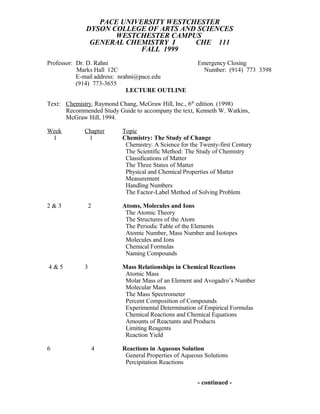
PACE UNIVERSITY WESTCHESTER
DYSON COLLEGE OF ARTS AND SCIENCES
WESTCHESTER CAMPUS
GENERAL CHEMISTRY I CHE 111
FALL 1999
Professor: Dr. D. Rahni Emergency Closing
Marks Hall 12C Number: (914) 773 3398
E-mail address: nrahni@pace.edu
(914) 773-3655
LECTURE OUTLINE
Text: Chemistry, Raymond Chang, McGraw Hill, Inc., 6th
edition. (1998)
Recommended Study Guide to accompany the text, Kenneth W. Watkins,
McGraw Hill, 1994.
Week Chapter Topic
1 1 Chemistry: The Study of Change
Chemistry: A Science for the Twenty-first Century
The Scientific Method: The Study of Chemistry
Classifications of Matter
The Three States of Matter
Physical and Chemical Properties of Matter
Measurement
Handling Numbers
The Factor-Label Method of Solving Problem
2 & 3 2 Atoms, Molecules and Ions
The Atomic Theory
The Structures of the Atom
The Periodic Table of the Elements
Atomic Number, Mass Number and Isotopes
Molecules and Ions
Chemical Formulas
Naming Compounds
4 & 5 3 Mass Relationships in Chemical Reactions
Atomic Mass
Molar Mass of an Element and Avogadro’s Number
Molecular Mass
The Mass Spectrometer
Percent Composition of Compounds
Experimental Determination of Empirical Formulas
Chemical Reactions and Chemical Equations
Amounts of Reactants and Products
Limiting Reagents
Reaction Yield
6 4 Reactions in Aqueous Solution
General Properties of Aqueous Solutions
Percipitation Reactions
- continued -
Chemistry 111
Lecture Outline page 2
Week Chapter Topic
6 4 continued
Acid - Base Reactions
Oxidation - Reduction Reactions
Concentration of Solutions
Gravimetric Analysis
Acid - Base Titrations
Redox Titrations
7 E X A M I ~ Chapters 1-4
7 5 The Gaseous State
Substances that Exist as Gases
Pressure of a Gas
The Gas Laws
The Ideal Gas Equation
Gas Stoichiometry
Dalton’s Law of Partial Pressures
The Kinetic Molecular Theory of Gases
Deviation from Ideal Behavior
8 & 9 6 Thermochemistry
The Nature of Energy and Types of Energy
Energy Changes in Chemical Reactions
Enthalpy
Calorimetry
Standard Enthalpy of Formation and Reaction
Heat of Solution and Dilution
Introduction to Thermodynamics
10 & 11 7 Quantum Theory and the Electronic Structure of Atoms
From Classical Physics to Quantum Theory
The Photoelectric Effect
Bohr’s Theory of the Hydrogen Atom
The Dual Nature of the Electron
Quantum Mechanics and Quantum Numbers
Atomic Orbitals
Electron Configuration
The Building-Up Principal
11 E X A M II ~ Chapters 5 -7
12 8 Periodic Relationships Among the Elements
Development of the Periodic Table
Periodic Classification of the Elements
Periodic Variation in Physical Properties
Ionization Energy
Electron Affinity
Variation in Chemical Properties of the
Representative Elements
- continued -
Chemistry 111
Lecture Outline page 3
Week Chapter Topic
13 9 Chemical Bonding I: Basic Concepts
Lewis Dot Symbols
The Ionic Bond
Lattice Energy of Ionic Compounds
The Covalent Bond
Electronegativity
Writing Lewis Structures
Formal Charge and Lewis Structure
The Concept of Resonance
Exceptions to the Octet Rule
Bond Dissociation Energy
F I N A L E X A M
(CUMULATIVE)
COURSE GRADE:
Exam I } 15%
Exam II } 20%
Final Exam (Cumulative) 30%
Laboratory 25%
Homework Assignment * 10%
Recitation, and class participation
While there is no provision for make-up exams, such decision is only at the discretion of
the professor and based upon a well-documented reason as verified by the appropriate
University office, and only for the most compelling reason.
All students must pass the laboratory component in order to pass this course.
* Homework assignment: At the completion of a chapter, you select and solve no less
than 12 number crunching questions from the end of the chapter. Whereas your degree of
selecting and tackling more challenging questions will each be included in the outcome,
such a batch is due within a week from the completion of a chapter. You will then have
access to solutions in Dyson 213 by presenting a picture I.D.
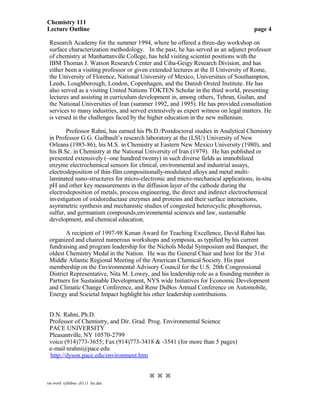
David N. Rahni is Professor of Analytical Chemistry and, the founder and former
Director of Graduate Program in Environmental Science at Pace University, Pleasantville,
New York. In addition, he serves as an adjunct professor in both the LL.M.
Environmental Law Program at the Pace University School of Law, and the Department
of Dermatology at the New York Medical College. He is the 1999 Chair-Elect, and 2000
Chair of the American Chemical Society’s New York Section. He was selected the 1996
Distinguished Scientist by the American Chemical Society’s Westchester Section. During
1993-94, he was J. William Fulbright Senior Research Scholar at the Technical
University of Denmark (DTU) and visiting professor at the University of Oxford, UK.
He was also awarded a visiting professorship to DTU, Denmark by the Royal Danish
continued
Chemistry 111
Lecture Outline page 4
Research Academy for the summer 1994, where he offered a three-day workshop on
surface characterization methodology. In the past, he has served as an adjunct professor
of chemistry at Manhattanville College, has held visiting scientist positions with the
IBM Thomas J. Watson Research Center and Ciba-Geigy Research Division, and has
either been a visiting professor or given extended lectures at the II University of Rome,
the University of Florence, National University of Mexico, Universities of Southampton,
Leeds, Loughborough, London, Copenhagen, and the Danish Orsted Institute. He has
also served as a visiting United Nations TOKTEN Scholar in the third world, presenting
lectures and assisting in curriculum development in, among others, Tehran, Guilan, and
the National Universities of Iran (summer 1992, and 1995). He has provided consultation
services to many industries, and served extensively as expert witness on legal matters. He
is versed in the challenges faced by the higher education in the new millenium.
Professor Rahni, has earned his Ph.D./Postdoctoral studies in Analytical Chemistry
in Professor G.G. Guilbault’s research laboratory at the (LSU) University of New
Orleans (1985-86), his M.S. in Chemistry at Eastern New Mexico University (1980), and
his B.Sc. in Chemistry at the National University of Iran (1979). He has published or
presented extensively (~one hundred twenty) in such diverse fields as immobilized
enzyme electrochemical sensors for clinical, environmental and industrial assays,
electrodeposition of thin-film compositionally-modulated alloys and metal multi-
laminated nano-structures for micro-electronic and micro-mechanical applications, in-situ
pH and other key measurements in the diffusion layer of the cathode during the
electrodeposition of metals, process engineering, the direct and indirect electrochemical
investigation of oxidoreductase enzymes and proteins and their surface interactions,
asymmetric synthesis and mechanistic studies of congested heterocyclic phosphorous,
sulfur, and germanium compounds,environmental sciences and law, sustainable
development, and chemical education.
A recipient of 1997-98 Kenan Award for Teaching Excellence, David Rahni has
organized and chaired numerous workshops and symposia, as typified by his current
fundraising and program leadership for the Nichols Medal Symposium and Banquet, the
oldest Chemistry Medal in the Nation. He was the General Chair and host for the 31st
Middle Atlantic Regional Meeting of the American Chemical Society. His past
membership on the Environmental Advisory Council for the U.S. 20th Congressional
District Representative, Nita M. Lowey, and his leadership role as a founding member in
Partners for Sustainable Development, NYS wide Initiatives for Economic Development
and Climatic Change Conference, and Rene DuBos Annual Conference on Automobile,
Energy and Societal Impact highlight his other leadership contributions.
D.N. Rahni, Ph.D.
Professor of Chemistry, and Dir. Grad. Prog. Environmental Science
PACE UNIVERSITY
Pleasantville, NY 10570-2799
voice (914)773-3655; Fax (914)773-3418 & -3541 (for more than 5 pages)
e-mail nrahni@pace.edu
http://dyson.pace.edu/environment.htm
   
ms word syllabus ch111 lec.doc

Ch111lec

  • 1.
    PACE UNIVERSITY WESTCHESTER DYSONCOLLEGE OF ARTS AND SCIENCES WESTCHESTER CAMPUS GENERAL CHEMISTRY I CHE 111 FALL 1999 Professor: Dr. D. Rahni Emergency Closing Marks Hall 12C Number: (914) 773 3398 E-mail address: nrahni@pace.edu (914) 773-3655 LECTURE OUTLINE Text: Chemistry, Raymond Chang, McGraw Hill, Inc., 6th edition. (1998) Recommended Study Guide to accompany the text, Kenneth W. Watkins, McGraw Hill, 1994. Week Chapter Topic 1 1 Chemistry: The Study of Change Chemistry: A Science for the Twenty-first Century The Scientific Method: The Study of Chemistry Classifications of Matter The Three States of Matter Physical and Chemical Properties of Matter Measurement Handling Numbers The Factor-Label Method of Solving Problem 2 & 3 2 Atoms, Molecules and Ions The Atomic Theory The Structures of the Atom The Periodic Table of the Elements Atomic Number, Mass Number and Isotopes Molecules and Ions Chemical Formulas Naming Compounds 4 & 5 3 Mass Relationships in Chemical Reactions Atomic Mass Molar Mass of an Element and Avogadro’s Number Molecular Mass The Mass Spectrometer Percent Composition of Compounds Experimental Determination of Empirical Formulas Chemical Reactions and Chemical Equations Amounts of Reactants and Products Limiting Reagents Reaction Yield 6 4 Reactions in Aqueous Solution General Properties of Aqueous Solutions Percipitation Reactions - continued -
  • 2.
    Chemistry 111 Lecture Outlinepage 2 Week Chapter Topic 6 4 continued Acid - Base Reactions Oxidation - Reduction Reactions Concentration of Solutions Gravimetric Analysis Acid - Base Titrations Redox Titrations 7 E X A M I ~ Chapters 1-4 7 5 The Gaseous State Substances that Exist as Gases Pressure of a Gas The Gas Laws The Ideal Gas Equation Gas Stoichiometry Dalton’s Law of Partial Pressures The Kinetic Molecular Theory of Gases Deviation from Ideal Behavior 8 & 9 6 Thermochemistry The Nature of Energy and Types of Energy Energy Changes in Chemical Reactions Enthalpy Calorimetry Standard Enthalpy of Formation and Reaction Heat of Solution and Dilution Introduction to Thermodynamics 10 & 11 7 Quantum Theory and the Electronic Structure of Atoms From Classical Physics to Quantum Theory The Photoelectric Effect Bohr’s Theory of the Hydrogen Atom The Dual Nature of the Electron Quantum Mechanics and Quantum Numbers Atomic Orbitals Electron Configuration The Building-Up Principal 11 E X A M II ~ Chapters 5 -7 12 8 Periodic Relationships Among the Elements Development of the Periodic Table Periodic Classification of the Elements Periodic Variation in Physical Properties Ionization Energy Electron Affinity Variation in Chemical Properties of the Representative Elements - continued -
  • 3.
    Chemistry 111 Lecture Outlinepage 3 Week Chapter Topic 13 9 Chemical Bonding I: Basic Concepts Lewis Dot Symbols The Ionic Bond Lattice Energy of Ionic Compounds The Covalent Bond Electronegativity Writing Lewis Structures Formal Charge and Lewis Structure The Concept of Resonance Exceptions to the Octet Rule Bond Dissociation Energy F I N A L E X A M (CUMULATIVE) COURSE GRADE: Exam I } 15% Exam II } 20% Final Exam (Cumulative) 30% Laboratory 25% Homework Assignment * 10% Recitation, and class participation While there is no provision for make-up exams, such decision is only at the discretion of the professor and based upon a well-documented reason as verified by the appropriate University office, and only for the most compelling reason. All students must pass the laboratory component in order to pass this course. * Homework assignment: At the completion of a chapter, you select and solve no less than 12 number crunching questions from the end of the chapter. Whereas your degree of selecting and tackling more challenging questions will each be included in the outcome, such a batch is due within a week from the completion of a chapter. You will then have access to solutions in Dyson 213 by presenting a picture I.D. David N. Rahni is Professor of Analytical Chemistry and, the founder and former Director of Graduate Program in Environmental Science at Pace University, Pleasantville, New York. In addition, he serves as an adjunct professor in both the LL.M. Environmental Law Program at the Pace University School of Law, and the Department of Dermatology at the New York Medical College. He is the 1999 Chair-Elect, and 2000 Chair of the American Chemical Society’s New York Section. He was selected the 1996 Distinguished Scientist by the American Chemical Society’s Westchester Section. During 1993-94, he was J. William Fulbright Senior Research Scholar at the Technical University of Denmark (DTU) and visiting professor at the University of Oxford, UK. He was also awarded a visiting professorship to DTU, Denmark by the Royal Danish continued
  • 4.
    Chemistry 111 Lecture Outlinepage 4 Research Academy for the summer 1994, where he offered a three-day workshop on surface characterization methodology. In the past, he has served as an adjunct professor of chemistry at Manhattanville College, has held visiting scientist positions with the IBM Thomas J. Watson Research Center and Ciba-Geigy Research Division, and has either been a visiting professor or given extended lectures at the II University of Rome, the University of Florence, National University of Mexico, Universities of Southampton, Leeds, Loughborough, London, Copenhagen, and the Danish Orsted Institute. He has also served as a visiting United Nations TOKTEN Scholar in the third world, presenting lectures and assisting in curriculum development in, among others, Tehran, Guilan, and the National Universities of Iran (summer 1992, and 1995). He has provided consultation services to many industries, and served extensively as expert witness on legal matters. He is versed in the challenges faced by the higher education in the new millenium. Professor Rahni, has earned his Ph.D./Postdoctoral studies in Analytical Chemistry in Professor G.G. Guilbault’s research laboratory at the (LSU) University of New Orleans (1985-86), his M.S. in Chemistry at Eastern New Mexico University (1980), and his B.Sc. in Chemistry at the National University of Iran (1979). He has published or presented extensively (~one hundred twenty) in such diverse fields as immobilized enzyme electrochemical sensors for clinical, environmental and industrial assays, electrodeposition of thin-film compositionally-modulated alloys and metal multi- laminated nano-structures for micro-electronic and micro-mechanical applications, in-situ pH and other key measurements in the diffusion layer of the cathode during the electrodeposition of metals, process engineering, the direct and indirect electrochemical investigation of oxidoreductase enzymes and proteins and their surface interactions, asymmetric synthesis and mechanistic studies of congested heterocyclic phosphorous, sulfur, and germanium compounds,environmental sciences and law, sustainable development, and chemical education. A recipient of 1997-98 Kenan Award for Teaching Excellence, David Rahni has organized and chaired numerous workshops and symposia, as typified by his current fundraising and program leadership for the Nichols Medal Symposium and Banquet, the oldest Chemistry Medal in the Nation. He was the General Chair and host for the 31st Middle Atlantic Regional Meeting of the American Chemical Society. His past membership on the Environmental Advisory Council for the U.S. 20th Congressional District Representative, Nita M. Lowey, and his leadership role as a founding member in Partners for Sustainable Development, NYS wide Initiatives for Economic Development and Climatic Change Conference, and Rene DuBos Annual Conference on Automobile, Energy and Societal Impact highlight his other leadership contributions. D.N. Rahni, Ph.D. Professor of Chemistry, and Dir. Grad. Prog. Environmental Science PACE UNIVERSITY Pleasantville, NY 10570-2799 voice (914)773-3655; Fax (914)773-3418 & -3541 (for more than 5 pages) e-mail nrahni@pace.edu http://dyson.pace.edu/environment.htm     ms word syllabus ch111 lec.doc