CRYPTOGRAPHY AND NETWORK SECURITY
IS62214IC
Department of Information Science & Engineering
By
Prof. Prajna U R
Assistant Professor
Department of Information Science & Engineering
Sahyadri College of Engineering and Management, Adyar Mangaluru
Email:prajnau.is@sahyadri.edu.in
Mob:8495971075
COURSE OUTCOMES (COs)
CO1
Understand the fundamentals of networks security,
security architecture, threats and vulnerabilities
1 CL2
CO2
Apply the different cryptographic operations of symmetric
cryptographic algorithms.
2 CL3
CO3
Apply the different cryptographic operations of public key
cryptography
3 CL3
CO4
Apply the various Authentication schemes to simulate
different applications.
4 CL3
CO5
Understand various Security practices and System security
standards.
5 CL 4
Text Book List
TB1.
AtulKahate, Cryptography and Network Security, 4th Edition,2019
TB2.
William Stallings, Cryptography and Network Security: Principles and Practices,
7th
Edition,2019.
TB3. Nina Godbole and SunitBelapure, Cyber Security, 1st Edition, 2019.
MODULE-1
Introduction to Network Security
What is Computer network?
A computer network is a group of computers that use a
set of common communication protocols over digital
interconnections for the purpose of sharing recourses
located on or provided by the network nodes.
What is Network Security?
Is described as the implementation of technologies,
processes and protocols designed to safeguard an
individual or organizations communications and
information
ComputeComputer Security cur
The protection afforded to an automated information system in order to
attain the applicable objectives of preserving the integrity, availability,
and confidentiality of information system resources (includes hardware,
software, firmware, information/data, and telecommunications).
Security Approaches
•Prevention- Prevent the treat by identifying
underlying causes before they occur.
•Protection- Treats are ready to occur and eliminating
the threat
•Resilience-Treat is already occurred- Need to adopt
some mechanism through which we have to solve the
threat
Modern nature of attack
• Automating attacks-Mirai Botnet, SolarWinds Supply Chain Attack
• Privacy concerns - Aadhaar Data Breach
• Distance does not matter-DDoS Attack on GitHub
Security approaches
1) Trusted system
A Trusted system is a computer system that can be trusted to a specified extent to
enforce a specified security policy.
• Mandatory Access Control (MAC)
• Role-Based Access Control (RBAC)
• Trusted Computing (TC) & Hardware Security-TPM Chips in Laptops – Used in
Windows BitLocker to encrypt data.
• Zero Trust Security Model
• Blockchain for Trusted Transactions
• Multi-Factor Authentication (MFA) & Biometric Security
• End-to-End Encryption (E2EE) for Secure Communication
• A trusted system integrates multiple security layers to protect data and prevent
cyber threats. Organizations use trusted computing, access control models,
encryption
2) Security Models
• No security
• Security through obscurity
• Host security
• Network security
3) Security management practices
• Security policy
Key aspects
• Affordability(Cost-Effectiveness)
• Functionality(Effectiveness)
• Cultural Issues
• Legality(Compliance with Laws)
• A good security policy balances cost, effectiveness, cultural
differences, and legal requirements to ensure strong protection
without causing unnecessary difficulties.
Key Security Concepts
PPrinciples of Security
CIA triad
• Confidentiality
• Integrity
• Authentication
• Non repudiation
• Access control
• Availability
Confidentiality
• Type of attack- Interception
• Interception Causes loss of message confidentiality
• Confidentiality: (Account Information)
o Data confidentiality: Assures confidential information is not made
available or disclosed to unauthorized individuals.
o Privacy: Assures that individuals control or influence what
information related to them may be collected and stored and by whom
and to whom that information may be disclosed.
Integrity
• Type of attack- Modification
• Modification Causes loss of message Integrity.
• Integrity: (Patient information)
o Data integrity: Assures that information and programs are changed
only in a specified and authorized manner.
o System integrity: Assures that a system performs its intended function
in an unimpaired manner, free from deliberate or inadvertent
unauthorized manipulation of the system.
• Any modification in message should be identified by the security system
Authentication
• Type of attack- Fabrication
• Fabrication is possible in the absence of proper authentication mechanisms.
Availability
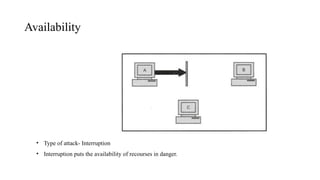
• Type of attack- Interruption
• Interruption puts the availability of recourses in danger.
• Availability: Google vs Banking sites
o Assures that systems work promptly and service is not denied to
authorized users.
• Authenticity:
o The property of being genuine and being able to be verified and
trusted; confidence in the validity of a transmission, a message, or
message originator.
• Accountability:
o truly secure systems are not yet an achievable goal, must be able to
trace a security breach to a responsible party
Non Repudiation
Non repudiation does not allow the sender of a message to refute the claim
of not sending that message.
Access control
• The principle of Access control determines who should be able to
access what.
• Access control broadly related to two areas.
• Role management-user side
• Rule management-resources side
Access control specifies and controls who can access what.
OSI SECURITY ARCHITECTURE
Threat v/s Attack
Threat
A potential for violation of security, which exists when there is a
circumstance, capability, action, or event that could breach security and
cause harm. That is, a threat is a possible danger that might exploit a
vulnerability.
Attack
An assault on system security that derives from an intelligent threat; that
is, an intelligent act that is a deliberate attempt (especially in the sense of
a method or technique) to evade security services and violate the security
policy of a system.
Types of attack
• General View
Criminal attacks
Publicity Attack
Legal Attacks
• Technical View
Theoretical concepts
Practical approaches
Criminal attacks- Financial Gain
Theorical concepts
• Interception
• Fabrication
• Modification
• Interruption
• Passive attack and Active attack
Practical side of attacks
• Application level attacks
Attacks happen at Application level –attempts to access
modify or prevent access to information
• Network level attacks-Aim to reducing the capabilities of a network-
slow down,bring to halt, on CN.
Attacks on wireless Networks
• Passive attacks
• Active attacks
• Person in the middle attacks
• Jamming attacks
Programs that attack computer system
• 1. Virus
Virus
Four phases of Virus
• Dormant
• Propagation
• Triggering
• Execution
Classification of viruses
• Parasitic
• Memory Resident
• Boot sector
• Stealth
• Polymorphic
• Metamorphic
• Macro
2. Worm
3. Trojan Horse
Dealing with viruses
Virus elimination steps
Generations of anti-virus software
Specific attacks
1. Sniffing and Spoofing
Two forms
1. packet Sniffing(IP sniffing)
2. Packet Spoofing (IP Spoofing)
2.Phishing
3.Pharming(DNS Spoofing)
Phishing
• Phishing is a form of online fraud in which hackers attempt
to get your private information such as passwords, credit
cards, or bank account data. This is usually done by sending
false emails or messages that appear to be from trusted
sources like banks or well-known websites.
Pharming (DNS Spoofing)
DNS spoofing or DNS cache poisoning is an attack in
which altered DNS records are used to redirect users or
data to a fraudulent website or link
Secure DNS-Protocol

Cryptography and network Security--MOD-1.pptx

  • 1.
    CRYPTOGRAPHY AND NETWORKSECURITY IS62214IC Department of Information Science & Engineering By Prof. Prajna U R Assistant Professor Department of Information Science & Engineering Sahyadri College of Engineering and Management, Adyar Mangaluru Email:prajnau.is@sahyadri.edu.in Mob:8495971075
  • 2.
    COURSE OUTCOMES (COs) CO1 Understandthe fundamentals of networks security, security architecture, threats and vulnerabilities 1 CL2 CO2 Apply the different cryptographic operations of symmetric cryptographic algorithms. 2 CL3 CO3 Apply the different cryptographic operations of public key cryptography 3 CL3 CO4 Apply the various Authentication schemes to simulate different applications. 4 CL3 CO5 Understand various Security practices and System security standards. 5 CL 4
  • 3.
    Text Book List TB1. AtulKahate,Cryptography and Network Security, 4th Edition,2019 TB2. William Stallings, Cryptography and Network Security: Principles and Practices, 7th Edition,2019. TB3. Nina Godbole and SunitBelapure, Cyber Security, 1st Edition, 2019.
  • 4.
  • 6.
    What is Computernetwork? A computer network is a group of computers that use a set of common communication protocols over digital interconnections for the purpose of sharing recourses located on or provided by the network nodes. What is Network Security? Is described as the implementation of technologies, processes and protocols designed to safeguard an individual or organizations communications and information
  • 9.
    ComputeComputer Security cur Theprotection afforded to an automated information system in order to attain the applicable objectives of preserving the integrity, availability, and confidentiality of information system resources (includes hardware, software, firmware, information/data, and telecommunications).
  • 10.
    Security Approaches •Prevention- Preventthe treat by identifying underlying causes before they occur. •Protection- Treats are ready to occur and eliminating the threat •Resilience-Treat is already occurred- Need to adopt some mechanism through which we have to solve the threat
  • 11.
    Modern nature ofattack • Automating attacks-Mirai Botnet, SolarWinds Supply Chain Attack • Privacy concerns - Aadhaar Data Breach • Distance does not matter-DDoS Attack on GitHub
  • 13.
    Security approaches 1) Trustedsystem A Trusted system is a computer system that can be trusted to a specified extent to enforce a specified security policy. • Mandatory Access Control (MAC) • Role-Based Access Control (RBAC) • Trusted Computing (TC) & Hardware Security-TPM Chips in Laptops – Used in Windows BitLocker to encrypt data. • Zero Trust Security Model • Blockchain for Trusted Transactions • Multi-Factor Authentication (MFA) & Biometric Security • End-to-End Encryption (E2EE) for Secure Communication • A trusted system integrates multiple security layers to protect data and prevent cyber threats. Organizations use trusted computing, access control models, encryption
  • 14.
    2) Security Models •No security • Security through obscurity • Host security • Network security
  • 15.
    3) Security managementpractices • Security policy Key aspects • Affordability(Cost-Effectiveness) • Functionality(Effectiveness) • Cultural Issues • Legality(Compliance with Laws) • A good security policy balances cost, effectiveness, cultural differences, and legal requirements to ensure strong protection without causing unnecessary difficulties.
  • 16.
    Key Security Concepts PPrinciplesof Security CIA triad • Confidentiality • Integrity • Authentication • Non repudiation • Access control • Availability
  • 17.
    Confidentiality • Type ofattack- Interception • Interception Causes loss of message confidentiality
  • 18.
    • Confidentiality: (AccountInformation) o Data confidentiality: Assures confidential information is not made available or disclosed to unauthorized individuals. o Privacy: Assures that individuals control or influence what information related to them may be collected and stored and by whom and to whom that information may be disclosed.
  • 19.
    Integrity • Type ofattack- Modification • Modification Causes loss of message Integrity.
  • 20.
    • Integrity: (Patientinformation) o Data integrity: Assures that information and programs are changed only in a specified and authorized manner. o System integrity: Assures that a system performs its intended function in an unimpaired manner, free from deliberate or inadvertent unauthorized manipulation of the system. • Any modification in message should be identified by the security system
  • 21.
    Authentication • Type ofattack- Fabrication • Fabrication is possible in the absence of proper authentication mechanisms.
  • 22.
    Availability • Type ofattack- Interruption • Interruption puts the availability of recourses in danger.
  • 23.
    • Availability: Googlevs Banking sites o Assures that systems work promptly and service is not denied to authorized users. • Authenticity: o The property of being genuine and being able to be verified and trusted; confidence in the validity of a transmission, a message, or message originator. • Accountability: o truly secure systems are not yet an achievable goal, must be able to trace a security breach to a responsible party
  • 24.
    Non Repudiation Non repudiationdoes not allow the sender of a message to refute the claim of not sending that message.
  • 25.
    Access control • Theprinciple of Access control determines who should be able to access what. • Access control broadly related to two areas. • Role management-user side • Rule management-resources side Access control specifies and controls who can access what.
  • 26.
  • 27.
  • 28.
  • 29.
    Threat A potential forviolation of security, which exists when there is a circumstance, capability, action, or event that could breach security and cause harm. That is, a threat is a possible danger that might exploit a vulnerability. Attack An assault on system security that derives from an intelligent threat; that is, an intelligent act that is a deliberate attempt (especially in the sense of a method or technique) to evade security services and violate the security policy of a system.
  • 33.
    Types of attack •General View Criminal attacks Publicity Attack Legal Attacks • Technical View Theoretical concepts Practical approaches
  • 34.
  • 35.
    Theorical concepts • Interception •Fabrication • Modification • Interruption • Passive attack and Active attack
  • 43.
    Practical side ofattacks • Application level attacks Attacks happen at Application level –attempts to access modify or prevent access to information • Network level attacks-Aim to reducing the capabilities of a network- slow down,bring to halt, on CN.
  • 44.
    Attacks on wirelessNetworks • Passive attacks • Active attacks • Person in the middle attacks • Jamming attacks
  • 45.
    Programs that attackcomputer system • 1. Virus
  • 46.
    Virus Four phases ofVirus • Dormant • Propagation • Triggering • Execution Classification of viruses • Parasitic • Memory Resident • Boot sector • Stealth • Polymorphic • Metamorphic • Macro
  • 47.
  • 48.
  • 49.
    Dealing with viruses Viruselimination steps
  • 50.
  • 51.
    Specific attacks 1. Sniffingand Spoofing Two forms 1. packet Sniffing(IP sniffing) 2. Packet Spoofing (IP Spoofing) 2.Phishing 3.Pharming(DNS Spoofing)
  • 52.
    Phishing • Phishing isa form of online fraud in which hackers attempt to get your private information such as passwords, credit cards, or bank account data. This is usually done by sending false emails or messages that appear to be from trusted sources like banks or well-known websites.
  • 53.
    Pharming (DNS Spoofing) DNSspoofing or DNS cache poisoning is an attack in which altered DNS records are used to redirect users or data to a fraudulent website or link Secure DNS-Protocol

Editor's Notes

  • #13 A Trusted system is a computer system that can be trusted to a specified extent to enforce a specified security policy