© 2008 Pearson Prentice Hall, Electronic Commerce 2008, Efraim Turban, et al.
Chapter 6
Launching a Successful
Online Business and EC Projects
16-2
Starting a New Online Business
 An E-Start-Up Is a Start-Up
 An e-start-up is basically a start-up and,
as such, must consider all the issues
faced by a physical start up
 Guidelines to avoid dot-com failures:
1. The growth rate of the market you plan to enter
2. The timing of your market entry
3. The revenue flow
4. The cycle that the market is in
16-3
Starting a New Online Business
 Steps in Creating a New Company or
Adding an Online Project
1. Identify a consumer or business need in
the marketplace
2. Investigate the opportunity
3. Determine the business owner’s ability to
meet the need
16-4
Starting a New Online Business
Online Business Planning
business plan
A written document that identifies a
company’s goals and outlines how the
company achieves goals and at what cost
business case
A document that justifies the investment
of internal, organizational resources in a
specific application or project
16-5
Starting a New Online Business
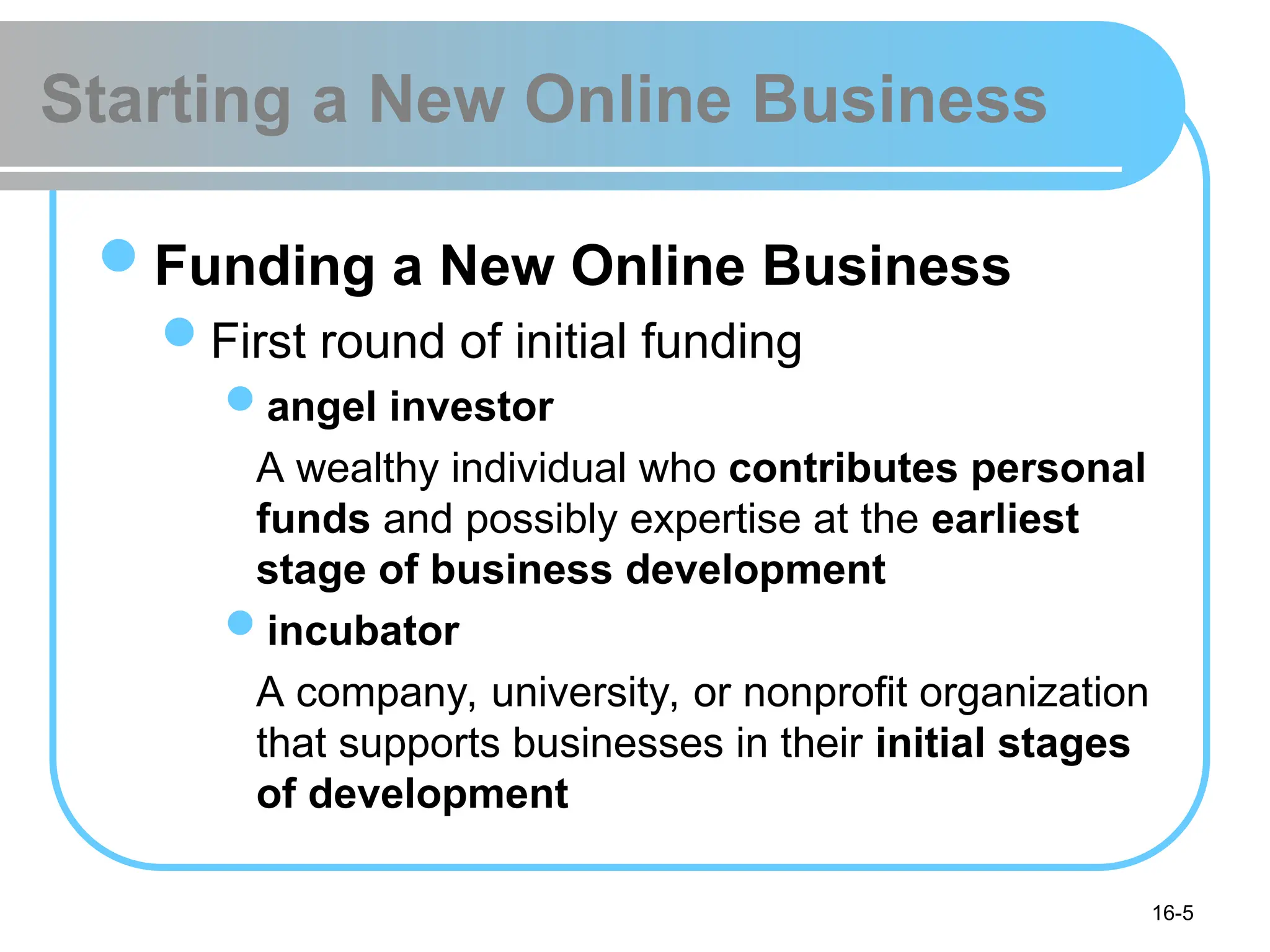
Funding a New Online Business
First round of initial funding
angel investor
A wealthy individual who contributes personal
funds and possibly expertise at the earliest
stage of business development
incubator
A company, university, or nonprofit organization
that supports businesses in their initial stages
of development
16-6
Starting a New Online Business
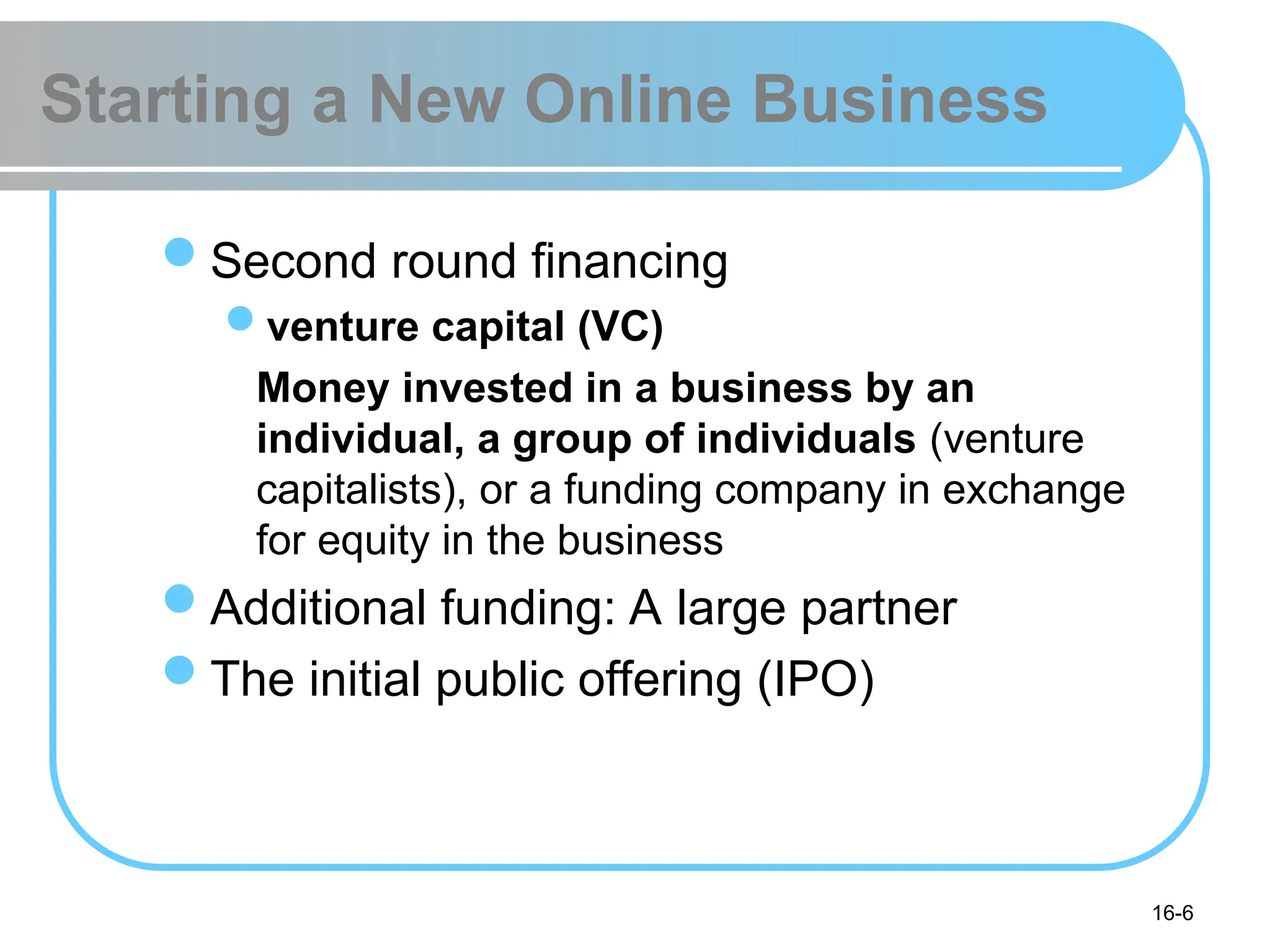
Second round financing
venture capital (VC)
Money invested in a business by an
individual, a group of individuals (venture
capitalists), or a funding company in exchange
for equity in the business
Additional funding: A large partner
The initial public offering (IPO)
16-7
Adding E-Commerce Initiatives or
Transforming to an E-Business
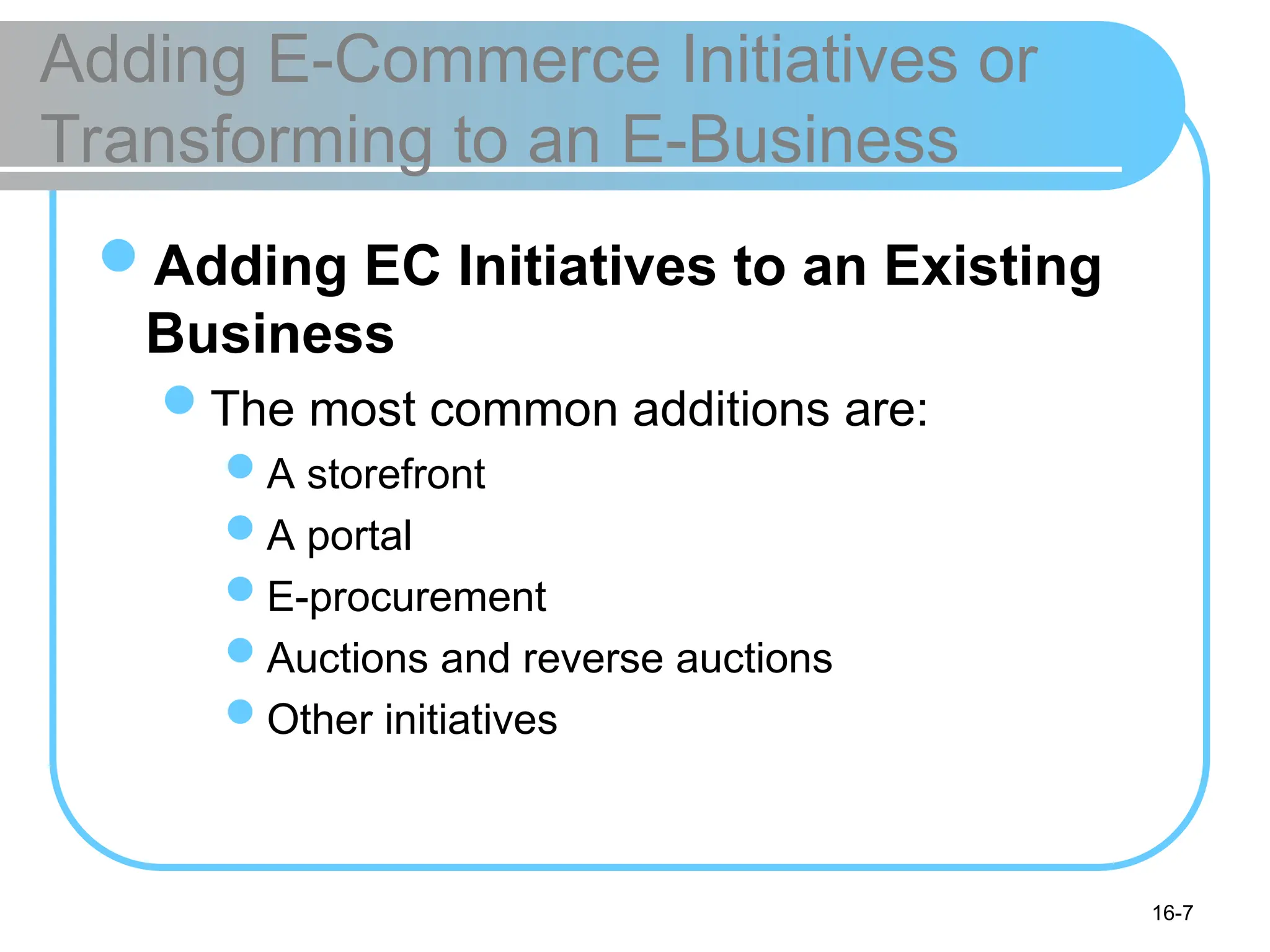
Adding EC Initiatives to an Existing
Business
The most common additions are:
A storefront
A portal
E-procurement
Auctions and reverse auctions
Other initiatives
16-8
Adding E-Commerce Initiatives or
Transforming to an E-Business
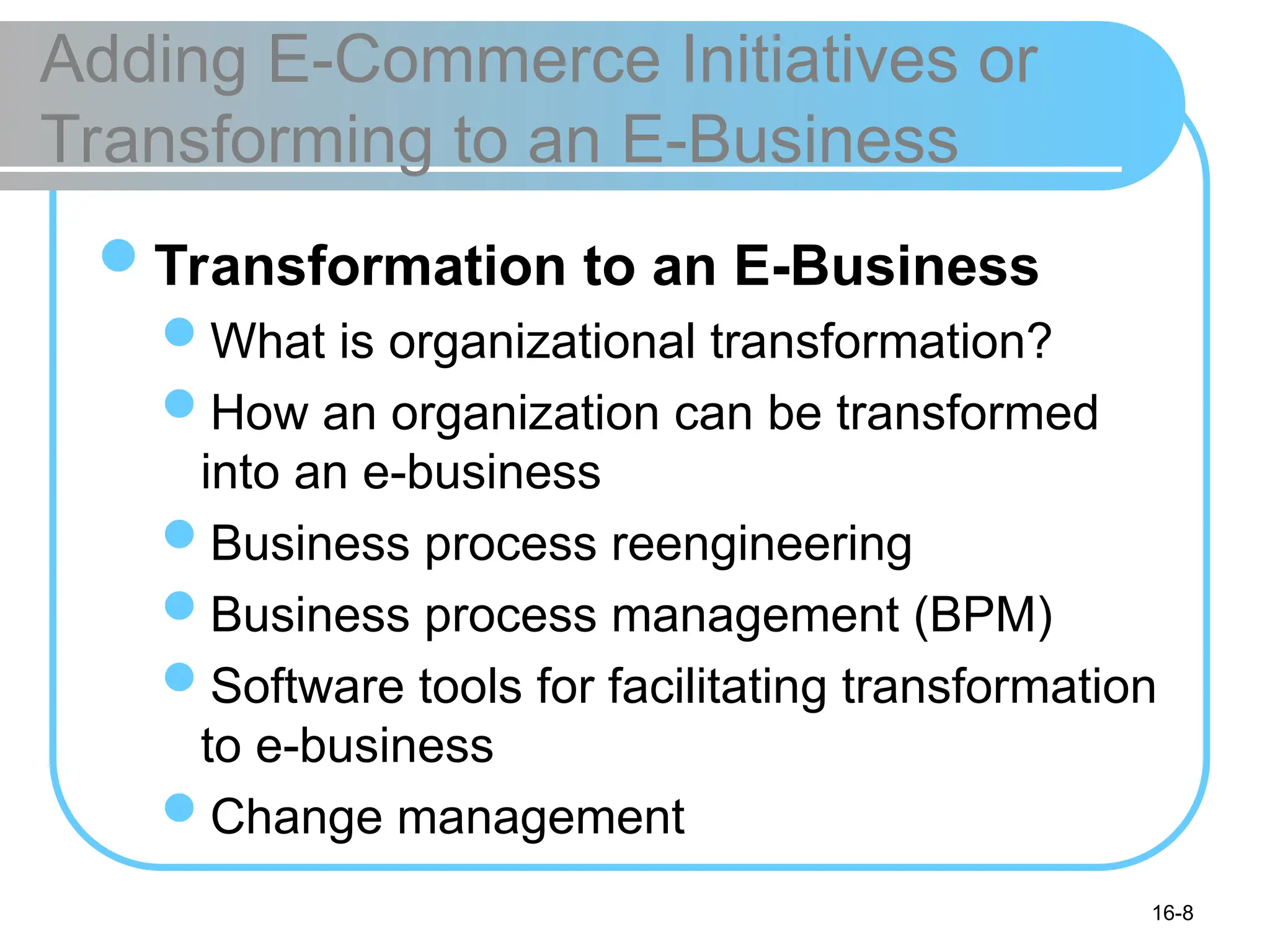
Transformation to an E-Business
What is organizational transformation?
How an organization can be transformed
into an e-business
Business process reengineering
Business process management (BPM)
Software tools for facilitating transformation
to e-business
Change management
16-9
Adding E-Commerce Initiatives or
Transforming to an E-Business
business process management (BPM)
A method for business restructuring that
combines workflow systems and
redesign methods; covers three process
categories—people-to-people, systems-
to-systems, and systems-to-people
interactions
16-10
Building or Acquiring a Web Site
Classification of Web Sites
informational Web site
A Web site that does little more than
provide information about the business
and its products and services
interactive Web site
A Web site that provides opportunities for
the customers and the business to
communicate and share information
16-11
Building or Acquiring a Web Site
attractors
Web site features that attract and interact
with visitors in the target stakeholder group
transactional Web site
A Web site that sells products and services
collaborative Web site
A site that allows business partners to
collaborate
16-12
Building or Acquiring a Web Site
Steps in Building a Web Site
Select a Web host
Register a domain name
Create and manage content
Design the Web site
Construct the Web site and test
Market and promote the Web site
16-13
Web Site Hosting
and Obtaining a Domain Name
Web Hosting Options
Store-builder service
A hosting service that provides disk
space and services to help small and micro-
businesses build a Web site quickly and
cheaply
16-14
Web Site Hosting
and Obtaining a Domain Name
A pure hosting service
Web hosting service
A defining of the Web site hosting company that offers
a wide range of hosting services and functionality to
businesses of all sizes
mirror site
An exact duplicate of an original Web site that is
physically located on a Web server on another
continent or in another country
co-location
A Web server owned and maintained by the business
is given to a Web hosting service that manages the
server’s connection to the Internet
16-15
Web Site Hosting
and Obtaining a Domain Name
ISP hosting service
A hosting service that provides an
independent, stand-alone Web site for
small and medium-sized businesses
self-hosting
When a business acquires the hardware,
software, staff, and dedicated
telecommunications services necessary to
set up and manage its own Web site
16-16
Web Site Hosting
and Obtaining a Domain Name
Registering a Domain Name
domain name
A name-based address that identifies an
Internet-connected server. Usually, it
refers to the portion of the address to the
left of .com and .org, etc.
domain name registrar
A business that assists Web site owners
with finding and registering the domain
name of their choice
16-17
Content Creation,
Delivery, and Management
content
The text, images, sound, and video that
make up a Web page
Categories and Types of Content
dynamic Web content
Content that must be kept up-to-date
commodity content
Information that is widely available and
generally free to access on the Web
16-18
Content Creation,
Delivery, and Management
16-19
Content Creation,
Delivery, and Management
Primary and secondary content
Primary content is information about the
product itself
Secondary content offers marketing
opportunities
16-20
Content Creation,
Delivery, and Management
Secondary content
cross-selling
Offering similar or complementary products and
services to increase sales
up-selling
Offering an upgraded version of the product in
order to boost sales and profit
Promotion
Comment
16-21
Content Creation,
Delivery, and Management
Creation or Acquisition
syndication
The sale of the same good (e.g., digital
content) to many customers, who then
integrate it with other offerings and resell it or
give it away free
Web syndication
A form of syndication in which a section of a
Web site is made available for other sites to
use
16-22
Content Creation,
Delivery, and Management
RSS
An XML format for syndicating and sharing Web
content
podcast
A media file distributed over the Internet using
syndication feeds. A collection of audio files in
MP3 format
16-23
Content Creation,
Delivery, and Management
personalized content
Web content that matches the needs and
expectations of the individual visitor
Delivering content by e-newsletter
e-newsletter
A collection of short, informative articles
sent at regular intervals by e-mail to
individuals who have an interest in the
newsletter’s topic
16-24
Content Creation,
Delivery, and Management
Content Management and
Maintenance
content management
The process of adding, revising, and
removing content from a Web site to keep
content fresh, accurate, compelling, and
credible
16-25
Content Creation,
Delivery, and Management
Main activities of the content management
Content testing and updating
Measuring content quality
Defining barriers of content management
Content removal
Content management software
16-26
Content Creation,
Delivery, and Management
Catalog Content and Its Management
For B2B buyers who aggregate suppliers’ catalogs
on their own Web sites, content management
begins with engaging suppliers and then collecting,
standardizing, classifying, hosting, and continually
updating their catalog data
Content Maximization and Streaming
Services
Many companies provide media-rich content, such
as video clips, music, or Flash media, in an effort to
reach their target audience with an attractive
marketing message
16-27
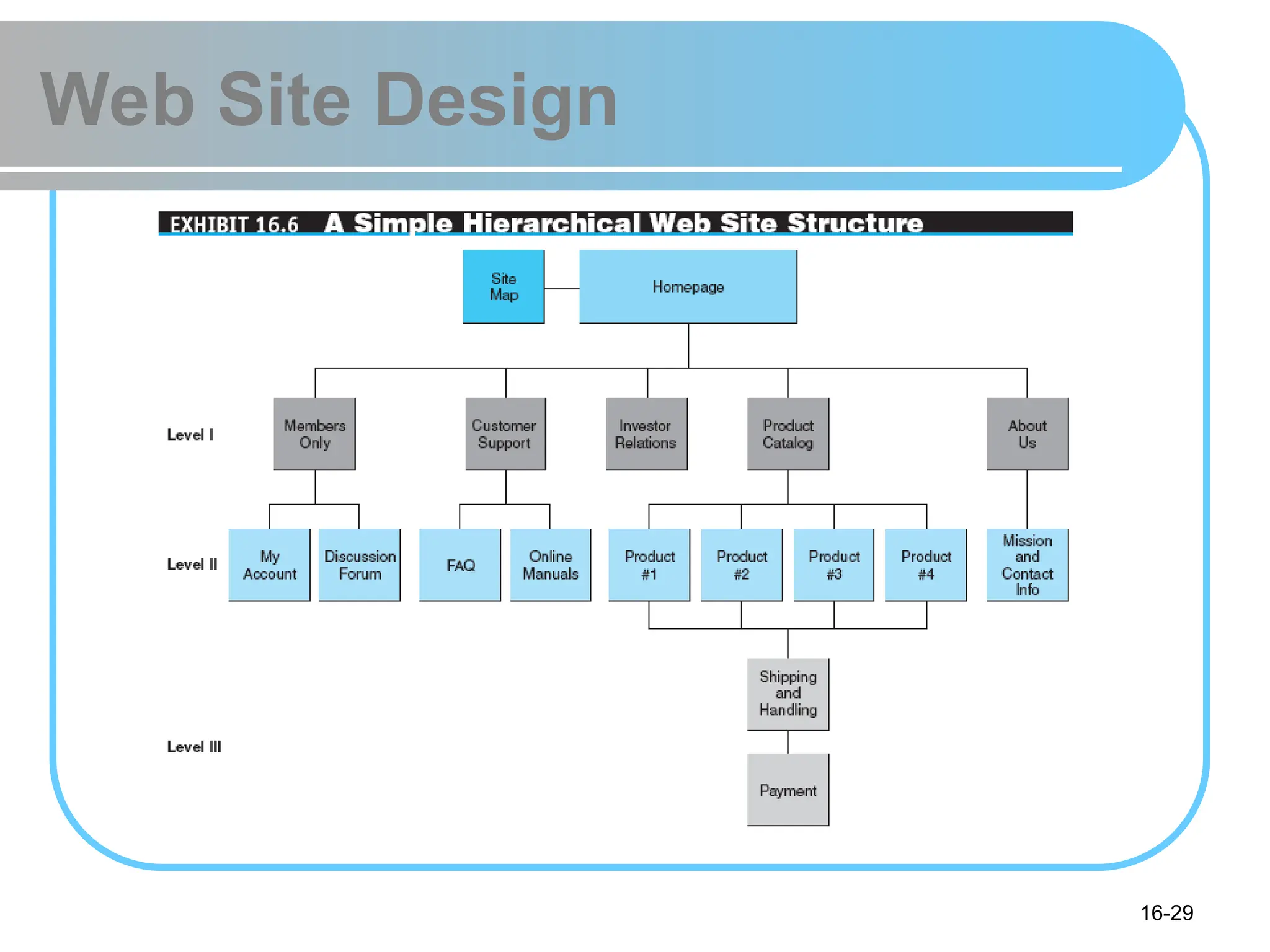
Web Site Design
information architecture
How the site and its Web pages are
organized, labeled, and navigated to
support browsing and searching
throughout the Web site
16-28
Web Site Design
Response time
Appearance
Quality Assurance
Availability
Interactivity
Content
Usability
Security
Web Site Design Criteria Navigation
16-29
Web Site Design
16-30
Web Site Design
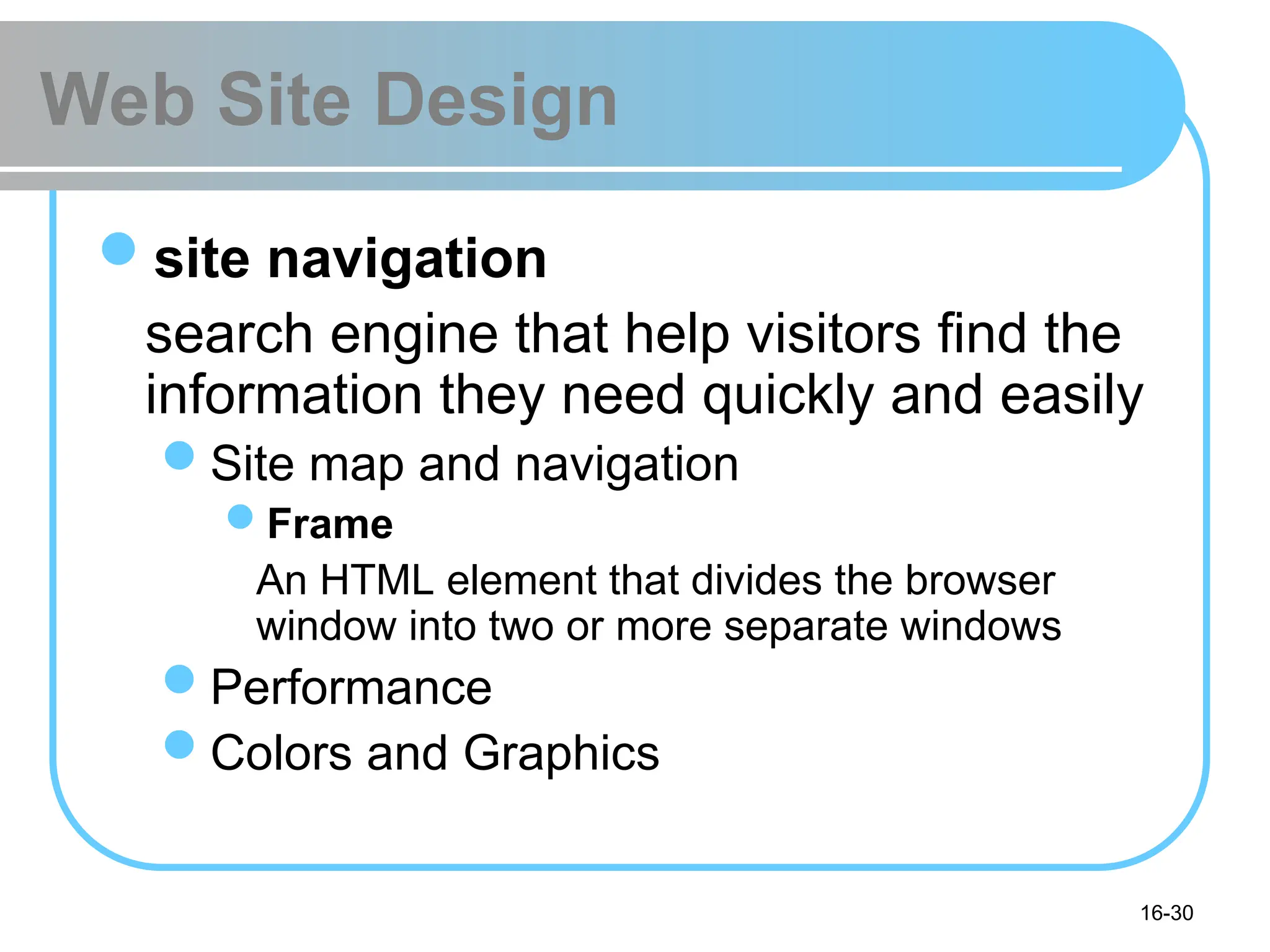
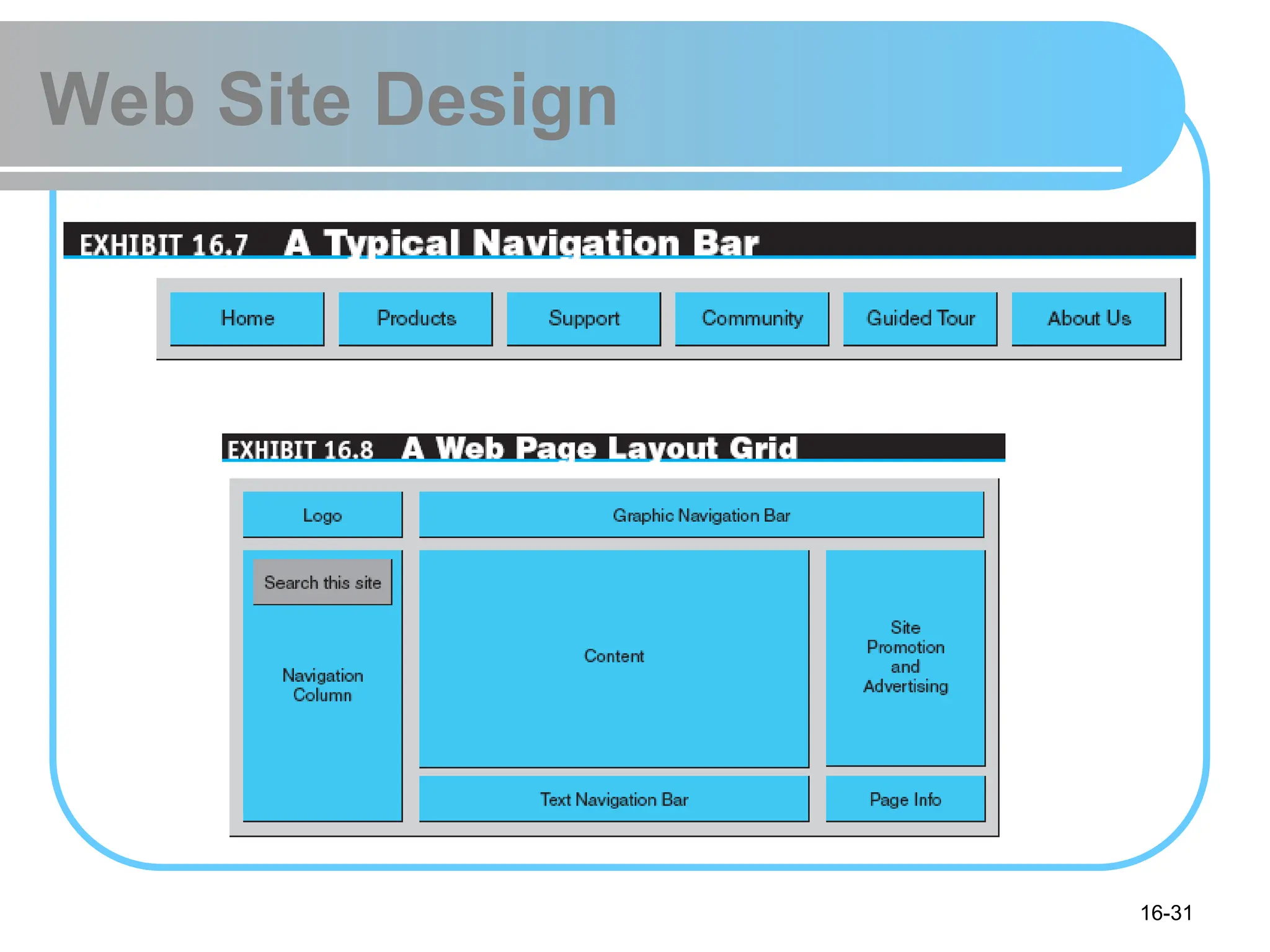
site navigation
search engine that help visitors find the
information they need quickly and easily
Site map and navigation
Frame
An HTML element that divides the browser
window into two or more separate windows
Performance
Colors and Graphics
16-31
Web Site Design
16-32
Web Site Design
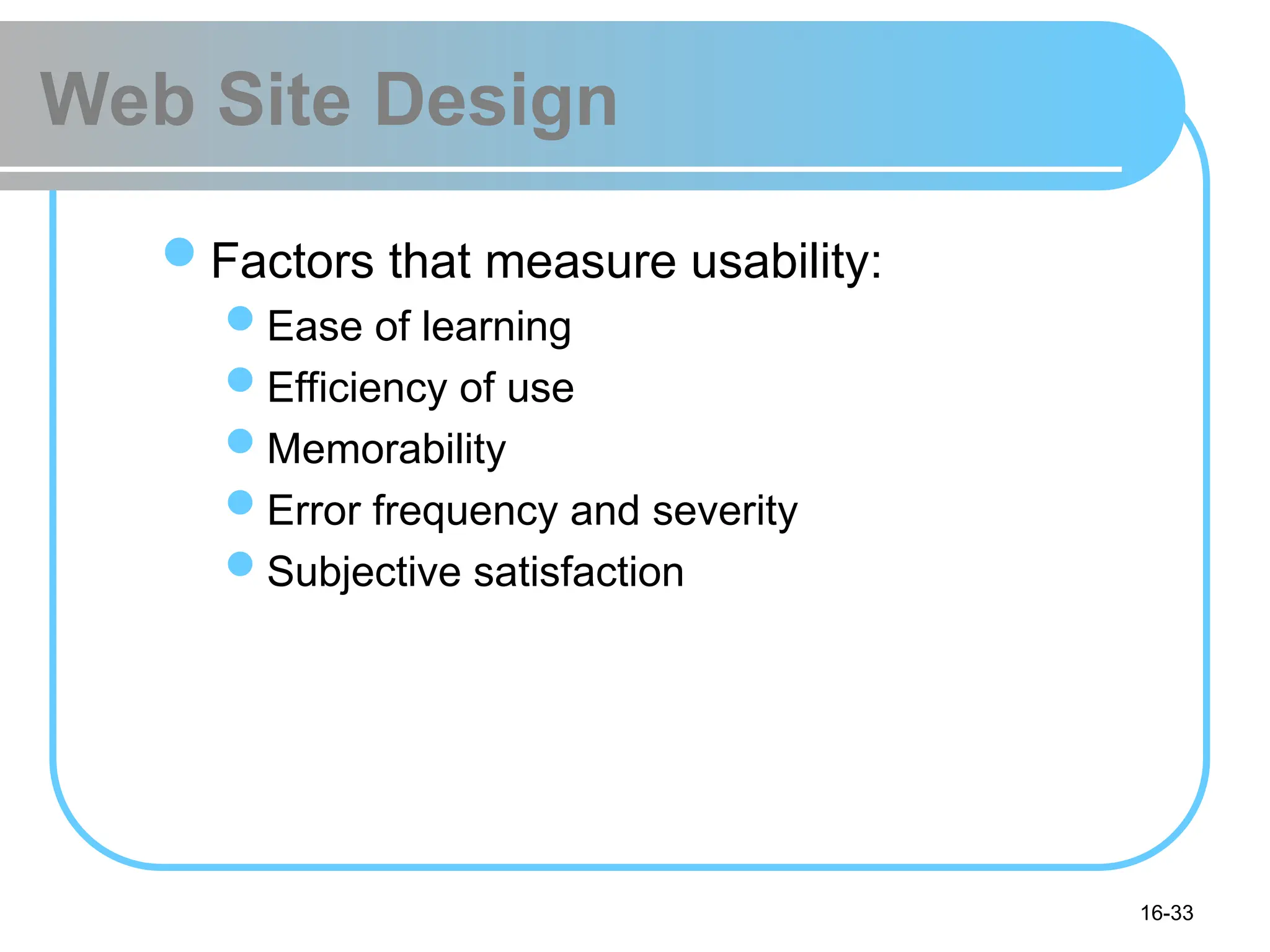
usability (of Web site)
The quality of the user’s experience
when interacting with the Web site
16-33
Web Site Design
Factors that measure usability:
Ease of learning
Efficiency of use
Memorability
Error frequency and severity
Subjective satisfaction
16-34
Providing
E-Commerce Support Services
Payments: Accepting Credit Cards
card-not-present (CNP) transaction
A credit card transaction in which the
merchant does not verify the customer’s
signature
16-35
Providing
E-Commerce Support Services
An online business that wants to accept
credit cards must:
Open a merchant account
Purchase credit card processing software
Integrate the credit card processing software
into the transaction system
16-36
Providing
E-Commerce Support Services
Web Site Promotion
Internal Web site promotion
signature file
A simple text message an e-mail program
automatically adds to outgoing messages
search engine optimization (SEO)
The application of strategies intended to
position a Web site at the top of Web
search engines
16-37
Providing
E-Commerce Support Services
Customer Relationship Management
The first step to building customer relationships is
to give customers good reasons to visit and
return to the Web site
The site should be rich in information and have
more valuable content.
The site should include not just product
information but also value-added content from
which visitors can get valuable information and
services for free
16-38
Opening a Web Storefront
Options for having Storefronts
Build them from scratch
Build them from components
Build with templates (storebuilders)
Use someone else’s storefront
16-39
Opening a Web Storefront
Selecting a Development Option
Considerations when defining
requirements for a development option:
Customers
Sales service
Promotion
Transaction processing
Marketing data and analysis
Branding
CH06Launching a Successful Online Business and EC Projects.ppt

  • 1.
    © 2008 PearsonPrentice Hall, Electronic Commerce 2008, Efraim Turban, et al. Chapter 6 Launching a Successful Online Business and EC Projects
  • 2.
    16-2 Starting a NewOnline Business  An E-Start-Up Is a Start-Up  An e-start-up is basically a start-up and, as such, must consider all the issues faced by a physical start up  Guidelines to avoid dot-com failures: 1. The growth rate of the market you plan to enter 2. The timing of your market entry 3. The revenue flow 4. The cycle that the market is in
  • 3.
    16-3 Starting a NewOnline Business  Steps in Creating a New Company or Adding an Online Project 1. Identify a consumer or business need in the marketplace 2. Investigate the opportunity 3. Determine the business owner’s ability to meet the need
  • 4.
    16-4 Starting a NewOnline Business Online Business Planning business plan A written document that identifies a company’s goals and outlines how the company achieves goals and at what cost business case A document that justifies the investment of internal, organizational resources in a specific application or project
  • 5.
    16-5 Starting a NewOnline Business Funding a New Online Business First round of initial funding angel investor A wealthy individual who contributes personal funds and possibly expertise at the earliest stage of business development incubator A company, university, or nonprofit organization that supports businesses in their initial stages of development
  • 6.
    16-6 Starting a NewOnline Business Second round financing venture capital (VC) Money invested in a business by an individual, a group of individuals (venture capitalists), or a funding company in exchange for equity in the business Additional funding: A large partner The initial public offering (IPO)
  • 7.
    16-7 Adding E-Commerce Initiativesor Transforming to an E-Business Adding EC Initiatives to an Existing Business The most common additions are: A storefront A portal E-procurement Auctions and reverse auctions Other initiatives
  • 8.
    16-8 Adding E-Commerce Initiativesor Transforming to an E-Business Transformation to an E-Business What is organizational transformation? How an organization can be transformed into an e-business Business process reengineering Business process management (BPM) Software tools for facilitating transformation to e-business Change management
  • 9.
    16-9 Adding E-Commerce Initiativesor Transforming to an E-Business business process management (BPM) A method for business restructuring that combines workflow systems and redesign methods; covers three process categories—people-to-people, systems- to-systems, and systems-to-people interactions
  • 10.
    16-10 Building or Acquiringa Web Site Classification of Web Sites informational Web site A Web site that does little more than provide information about the business and its products and services interactive Web site A Web site that provides opportunities for the customers and the business to communicate and share information
  • 11.
    16-11 Building or Acquiringa Web Site attractors Web site features that attract and interact with visitors in the target stakeholder group transactional Web site A Web site that sells products and services collaborative Web site A site that allows business partners to collaborate
  • 12.
    16-12 Building or Acquiringa Web Site Steps in Building a Web Site Select a Web host Register a domain name Create and manage content Design the Web site Construct the Web site and test Market and promote the Web site
  • 13.
    16-13 Web Site Hosting andObtaining a Domain Name Web Hosting Options Store-builder service A hosting service that provides disk space and services to help small and micro- businesses build a Web site quickly and cheaply
  • 14.
    16-14 Web Site Hosting andObtaining a Domain Name A pure hosting service Web hosting service A defining of the Web site hosting company that offers a wide range of hosting services and functionality to businesses of all sizes mirror site An exact duplicate of an original Web site that is physically located on a Web server on another continent or in another country co-location A Web server owned and maintained by the business is given to a Web hosting service that manages the server’s connection to the Internet
  • 15.
    16-15 Web Site Hosting andObtaining a Domain Name ISP hosting service A hosting service that provides an independent, stand-alone Web site for small and medium-sized businesses self-hosting When a business acquires the hardware, software, staff, and dedicated telecommunications services necessary to set up and manage its own Web site
  • 16.
    16-16 Web Site Hosting andObtaining a Domain Name Registering a Domain Name domain name A name-based address that identifies an Internet-connected server. Usually, it refers to the portion of the address to the left of .com and .org, etc. domain name registrar A business that assists Web site owners with finding and registering the domain name of their choice
  • 17.
    16-17 Content Creation, Delivery, andManagement content The text, images, sound, and video that make up a Web page Categories and Types of Content dynamic Web content Content that must be kept up-to-date commodity content Information that is widely available and generally free to access on the Web
  • 18.
  • 19.
    16-19 Content Creation, Delivery, andManagement Primary and secondary content Primary content is information about the product itself Secondary content offers marketing opportunities
  • 20.
    16-20 Content Creation, Delivery, andManagement Secondary content cross-selling Offering similar or complementary products and services to increase sales up-selling Offering an upgraded version of the product in order to boost sales and profit Promotion Comment
  • 21.
    16-21 Content Creation, Delivery, andManagement Creation or Acquisition syndication The sale of the same good (e.g., digital content) to many customers, who then integrate it with other offerings and resell it or give it away free Web syndication A form of syndication in which a section of a Web site is made available for other sites to use
  • 22.
    16-22 Content Creation, Delivery, andManagement RSS An XML format for syndicating and sharing Web content podcast A media file distributed over the Internet using syndication feeds. A collection of audio files in MP3 format
  • 23.
    16-23 Content Creation, Delivery, andManagement personalized content Web content that matches the needs and expectations of the individual visitor Delivering content by e-newsletter e-newsletter A collection of short, informative articles sent at regular intervals by e-mail to individuals who have an interest in the newsletter’s topic
  • 24.
    16-24 Content Creation, Delivery, andManagement Content Management and Maintenance content management The process of adding, revising, and removing content from a Web site to keep content fresh, accurate, compelling, and credible
  • 25.
    16-25 Content Creation, Delivery, andManagement Main activities of the content management Content testing and updating Measuring content quality Defining barriers of content management Content removal Content management software
  • 26.
    16-26 Content Creation, Delivery, andManagement Catalog Content and Its Management For B2B buyers who aggregate suppliers’ catalogs on their own Web sites, content management begins with engaging suppliers and then collecting, standardizing, classifying, hosting, and continually updating their catalog data Content Maximization and Streaming Services Many companies provide media-rich content, such as video clips, music, or Flash media, in an effort to reach their target audience with an attractive marketing message
  • 27.
    16-27 Web Site Design informationarchitecture How the site and its Web pages are organized, labeled, and navigated to support browsing and searching throughout the Web site
  • 28.
    16-28 Web Site Design Responsetime Appearance Quality Assurance Availability Interactivity Content Usability Security Web Site Design Criteria Navigation
  • 29.
  • 30.
    16-30 Web Site Design sitenavigation search engine that help visitors find the information they need quickly and easily Site map and navigation Frame An HTML element that divides the browser window into two or more separate windows Performance Colors and Graphics
  • 31.
  • 32.
    16-32 Web Site Design usability(of Web site) The quality of the user’s experience when interacting with the Web site
  • 33.
    16-33 Web Site Design Factorsthat measure usability: Ease of learning Efficiency of use Memorability Error frequency and severity Subjective satisfaction
  • 34.
    16-34 Providing E-Commerce Support Services Payments:Accepting Credit Cards card-not-present (CNP) transaction A credit card transaction in which the merchant does not verify the customer’s signature
  • 35.
    16-35 Providing E-Commerce Support Services Anonline business that wants to accept credit cards must: Open a merchant account Purchase credit card processing software Integrate the credit card processing software into the transaction system
  • 36.
    16-36 Providing E-Commerce Support Services WebSite Promotion Internal Web site promotion signature file A simple text message an e-mail program automatically adds to outgoing messages search engine optimization (SEO) The application of strategies intended to position a Web site at the top of Web search engines
  • 37.
    16-37 Providing E-Commerce Support Services CustomerRelationship Management The first step to building customer relationships is to give customers good reasons to visit and return to the Web site The site should be rich in information and have more valuable content. The site should include not just product information but also value-added content from which visitors can get valuable information and services for free
  • 38.
    16-38 Opening a WebStorefront Options for having Storefronts Build them from scratch Build them from components Build with templates (storebuilders) Use someone else’s storefront
  • 39.
    16-39 Opening a WebStorefront Selecting a Development Option Considerations when defining requirements for a development option: Customers Sales service Promotion Transaction processing Marketing data and analysis Branding