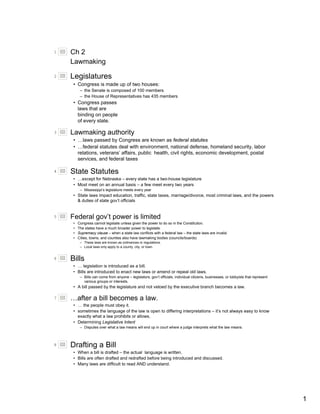
1   Ch 2
    Lawmaking
2   Legislatures
     • Congress is made up of two houses:
          – the Senate is composed of 100 members
          – the House of Representatives has 435 members
     • Congress passes
       laws that are
       binding on people
       of every state.

3   Lawmaking authority
     • …laws passed by Congress are known as federal statutes
     • …federal statutes deal with environment, national defense, homeland security, labor
       relations, veterans’ affairs, public health, civil rights, economic development, postal
       services, and federal taxes

4   State Statutes
     • …except for Nebraska – every state has a two-house legislature
     • Most meet on an annual basis – a few meet every two years
          – Mississippi’s legislature meets every year
     • State laws impact education, traffic, state taxes, marriage/divorce, most criminal laws, and the powers
       & duties of state gov’t officials


5   Federal gov’t power is limited
     •   Congress cannot legislate unless given the power to do so in the Constitution.
     •   The states have a much broader power to legislate.
     •   Supremacy clause – when a state law conflicts with a federal law – the state laws are invalid.
     •   Cities, towns, and counties also have lawmaking bodies (councils/boards)
          – These laws are known as ordinances or regulations.
          – Local laws only apply to a county, city, or town.


6   Bills
     • … legislation is introduced as a bill.
     • Bills are introduced to enact new laws or amend or repeal old laws.
          – Bills can come from anyone – legislators, gov’t officials, individual citizens, businesses, or lobbyists that represent
            various groups or interests.
     • A bill passed by the legislature and not vetoed by the executive branch becomes a law.

7   …after a bill becomes a law.
     • … the people must obey it.
     • sometimes the language of the law is open to differing interpretations – it’s not always easy to know
       exactly what a law prohibits or allows.
     • Determining Legislative Intent
          – Disputes over what a law means will end up in court where a judge interprets what the law means.


8   Drafting a Bill
     • When a bill is drafted – the actual language is written.
     • Bills are often drafted and redrafted before being introduced and discussed.
     • Many laws are difficult to read AND understand.


                                                                                                                                      1
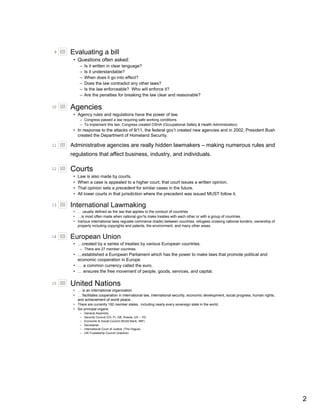
9   Evaluating a bill
      • Questions often asked:
           –   Is it written in clear language?
           –   Is it understandable?
           –   When does it go into effect?
           –   Does the law contradict any other laws?
           –   Is the law enforceable? Who will enforce it?
           –   Are the penalties for breaking the law clear and reasonable?

10   Agencies
      • Agency rules and regulations have the power of law.
           – Congress passed a law requiring safe working conditions.
           – To implement this law, Congress created OSHA (Occupational Safety & Health Administration)
      • In response to the attacks of 9/11, the federal gov’t created new agencies and in 2002, President Bush
        created the Department of Homeland Security.

11   Administrative agencies are really hidden lawmakers – making numerous rules and
     regulations that affect business, industry, and individuals.

12   Courts
      •   Law is also made by courts.
      •   When a case is appealed to a higher court, that court issues a written opinion.
      •   That opinion sets a precedent for similar cases in the future.
      •   All lower courts in that jurisdiction where the precedent was issued MUST follow it.

13   International Lawmaking
      • … usually defined as the law that applies to the conduct of countries.
      • …is most often made when national gov’ts make treaties with each other or with a group of countries.
      • Various international laws regulate commerce (trade) between countries, refugees crossing national borders, ownership of
        property including copyrights and patents, the environment, and many other areas.

14   European Union
      • …created by a series of treaties by various European countries.
           – There are 27 member countries.
      • …established a European Parliament which has the power to make laws that promote political and
        economic cooperation in Europe
      • … a common currency called the euro.
      • … ensures the free movement of people, goods, services, and capital.

15   United Nations
      • … is an international organization
      • … facilitates cooperation in international law, international security, economic development, social progress, human rights,
        and achievement of world peace.
      • There are currently 192 member states, including nearly every sovereign state in the world.
      • Six principal organs:
           –   General Assembly
           –   Security Council (Ch, Fr, GB, Russia, US – 10)
           –   Economic & Social Council (World Bank, IMF)
           –   Secretariat
           –   International Court of Justice (The Hague)
           –   UN Trusteeship Council (inactive)


                                                                                                                                       2

Ch 2 lawmaking outline notes

  • 1.
    1 Ch 2 Lawmaking 2 Legislatures • Congress is made up of two houses: – the Senate is composed of 100 members – the House of Representatives has 435 members • Congress passes laws that are binding on people of every state. 3 Lawmaking authority • …laws passed by Congress are known as federal statutes • …federal statutes deal with environment, national defense, homeland security, labor relations, veterans’ affairs, public health, civil rights, economic development, postal services, and federal taxes 4 State Statutes • …except for Nebraska – every state has a two-house legislature • Most meet on an annual basis – a few meet every two years – Mississippi’s legislature meets every year • State laws impact education, traffic, state taxes, marriage/divorce, most criminal laws, and the powers & duties of state gov’t officials 5 Federal gov’t power is limited • Congress cannot legislate unless given the power to do so in the Constitution. • The states have a much broader power to legislate. • Supremacy clause – when a state law conflicts with a federal law – the state laws are invalid. • Cities, towns, and counties also have lawmaking bodies (councils/boards) – These laws are known as ordinances or regulations. – Local laws only apply to a county, city, or town. 6 Bills • … legislation is introduced as a bill. • Bills are introduced to enact new laws or amend or repeal old laws. – Bills can come from anyone – legislators, gov’t officials, individual citizens, businesses, or lobbyists that represent various groups or interests. • A bill passed by the legislature and not vetoed by the executive branch becomes a law. 7 …after a bill becomes a law. • … the people must obey it. • sometimes the language of the law is open to differing interpretations – it’s not always easy to know exactly what a law prohibits or allows. • Determining Legislative Intent – Disputes over what a law means will end up in court where a judge interprets what the law means. 8 Drafting a Bill • When a bill is drafted – the actual language is written. • Bills are often drafted and redrafted before being introduced and discussed. • Many laws are difficult to read AND understand. 1
  • 2.
    9 Evaluating a bill • Questions often asked: – Is it written in clear language? – Is it understandable? – When does it go into effect? – Does the law contradict any other laws? – Is the law enforceable? Who will enforce it? – Are the penalties for breaking the law clear and reasonable? 10 Agencies • Agency rules and regulations have the power of law. – Congress passed a law requiring safe working conditions. – To implement this law, Congress created OSHA (Occupational Safety & Health Administration) • In response to the attacks of 9/11, the federal gov’t created new agencies and in 2002, President Bush created the Department of Homeland Security. 11 Administrative agencies are really hidden lawmakers – making numerous rules and regulations that affect business, industry, and individuals. 12 Courts • Law is also made by courts. • When a case is appealed to a higher court, that court issues a written opinion. • That opinion sets a precedent for similar cases in the future. • All lower courts in that jurisdiction where the precedent was issued MUST follow it. 13 International Lawmaking • … usually defined as the law that applies to the conduct of countries. • …is most often made when national gov’ts make treaties with each other or with a group of countries. • Various international laws regulate commerce (trade) between countries, refugees crossing national borders, ownership of property including copyrights and patents, the environment, and many other areas. 14 European Union • …created by a series of treaties by various European countries. – There are 27 member countries. • …established a European Parliament which has the power to make laws that promote political and economic cooperation in Europe • … a common currency called the euro. • … ensures the free movement of people, goods, services, and capital. 15 United Nations • … is an international organization • … facilitates cooperation in international law, international security, economic development, social progress, human rights, and achievement of world peace. • There are currently 192 member states, including nearly every sovereign state in the world. • Six principal organs: – General Assembly – Security Council (Ch, Fr, GB, Russia, US – 10) – Economic & Social Council (World Bank, IMF) – Secretariat – International Court of Justice (The Hague) – UN Trusteeship Council (inactive) 2