September 17, 2010
By: Caroline Busnach
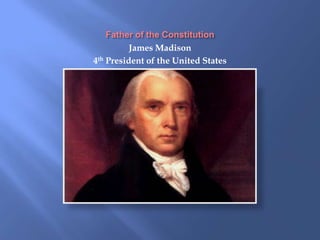
James Madison
4th President of the United States
   What is a
    constitution?
   Why did the United
    States create its
    constitution?
   Who were the
    Founding Fathers?
   What is our national
    government?
•This was the government prior to the
Constitution
•It created a confederate government
    •This type of government made the states
    stronger than the central government
    •States had separate money and it was
    worthless in other states
    •People were going into debt
    •America needed a change
•Also called Congress
•Consists of the House of
Representatives and the Senate
•This branch is able to:
  •Make laws
  •Impeach officials, or remove them
  from power
  •Originate spending bills
  •Approve treaties
  •Declare war
•This branch is headed by the President, but also includes the
Vice President, the Cabinet, and independent agencies
•It employs over 4 million people!

•The cabinet is an advisory body made up of the heads of 15
departments. These heads are appointed, or chosen, by the
president. Some of these are:
    •   Department of Agriculture
    •   Department of Education
    •   Department of Defense
•Some   responsibilities of the President include:
    •   Carrying out federal laws
    •   Recommending new laws
    •   Vetoing, or rejecting laws
    •   Directing national defense and foreign policy. He is the
        commander in chief of all Armed Forces.
    •   Performing ceremonial duties, such as hosting foreign
        dignitaries
•This  branch interprets laws passed by the
legislative branch
•It currently consists of nine federal justices (this
number is left up to the Senate to decide upon)
•They serve until their death or until they retire

•The president appoints a judge to serve on this
branch, but they must be approved by Congress
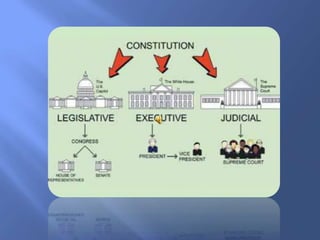
•   Separation of Power
    • Legislative-makes laws
    • Executive-makes sure laws are carried out
    • Judicial-interprets laws
•   Checks and balances
    • No one branch has more power over the
      others
•   Shared Power
    • A Federation-strong central government that
      shares power with the states
      • Only federal government can declare war
        and print money
      • Only states can establish schools and
        regulate local governments
      • Both can impose taxes, regulate banks, and
        have their own courts
•The Preamble
•The Articles
•The Amendments
  • The Bill of Rights
We the people of the United States, in
  order to form a more perfect union,
   establish justice, insure domestic
 tranquility, provide for the common
defense, promote the general welfare,
 and secure the blessings of liberty to
ourselves and our posterity, do ordain
and establish this constitution for the
       United States of America.
There are 7 articles
These state the original
rules of the constitution
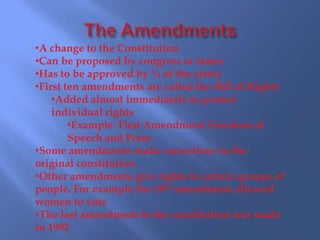
•A change to the Constitution
•Can be proposed by congress or states
•Has to be approved by ¾ of the states
•First ten amendments are called the Bill of Rights
    •Added almost immediately to protect
    individual rights
        •Example: First Amendment: Freedom of
        Speech and Press
•Some amendments make corrections to the
original constitution
•Other amendments give rights to certain groups of
people. For example the 19th amendment allowed
women to vote
•The last amendment to the constitution was made
in 1992
   SchoolTube - School House Rock: The
    Preamble
   http://hmheducation.com/history/resources_
    1.php
   http://hmheducation.com/history/pdfs/Elem
    LessonPlan_DocumentingDemocracy.pdf
   http://hmheducation.com/history/pdfs/Elem
    LessonPlan_DocumentingDemocracy_wTTE.p
    df
   http://www.archives.gov/exhibits/charters/c
    onstitution.html
   http://www.congressforkids.net/Constitution
    _threebranches.htm
   http://www.whitehouse.gov/our-government
Celebrate Constitution Day

Celebrate Constitution Day

  • 1.
    September 17, 2010 By:Caroline Busnach
  • 3.
    James Madison 4th Presidentof the United States
  • 4.
    What is a constitution?  Why did the United States create its constitution?  Who were the Founding Fathers?  What is our national government?
  • 6.
    •This was thegovernment prior to the Constitution •It created a confederate government •This type of government made the states stronger than the central government •States had separate money and it was worthless in other states •People were going into debt •America needed a change
  • 10.
    •Also called Congress •Consistsof the House of Representatives and the Senate •This branch is able to: •Make laws •Impeach officials, or remove them from power •Originate spending bills •Approve treaties •Declare war
  • 11.
    •This branch isheaded by the President, but also includes the Vice President, the Cabinet, and independent agencies •It employs over 4 million people! •The cabinet is an advisory body made up of the heads of 15 departments. These heads are appointed, or chosen, by the president. Some of these are: • Department of Agriculture • Department of Education • Department of Defense •Some responsibilities of the President include: • Carrying out federal laws • Recommending new laws • Vetoing, or rejecting laws • Directing national defense and foreign policy. He is the commander in chief of all Armed Forces. • Performing ceremonial duties, such as hosting foreign dignitaries
  • 12.
    •This branchinterprets laws passed by the legislative branch •It currently consists of nine federal justices (this number is left up to the Senate to decide upon) •They serve until their death or until they retire •The president appoints a judge to serve on this branch, but they must be approved by Congress
  • 13.
    Separation of Power • Legislative-makes laws • Executive-makes sure laws are carried out • Judicial-interprets laws • Checks and balances • No one branch has more power over the others • Shared Power • A Federation-strong central government that shares power with the states • Only federal government can declare war and print money • Only states can establish schools and regulate local governments • Both can impose taxes, regulate banks, and have their own courts
  • 14.
    •The Preamble •The Articles •TheAmendments • The Bill of Rights
  • 15.
    We the peopleof the United States, in order to form a more perfect union, establish justice, insure domestic tranquility, provide for the common defense, promote the general welfare, and secure the blessings of liberty to ourselves and our posterity, do ordain and establish this constitution for the United States of America.
  • 16.
    There are 7articles These state the original rules of the constitution
  • 17.
    •A change tothe Constitution •Can be proposed by congress or states •Has to be approved by ¾ of the states •First ten amendments are called the Bill of Rights •Added almost immediately to protect individual rights •Example: First Amendment: Freedom of Speech and Press •Some amendments make corrections to the original constitution •Other amendments give rights to certain groups of people. For example the 19th amendment allowed women to vote •The last amendment to the constitution was made in 1992
  • 19.
    SchoolTube - School House Rock: The Preamble
  • 21.
    http://hmheducation.com/history/resources_ 1.php  http://hmheducation.com/history/pdfs/Elem LessonPlan_DocumentingDemocracy.pdf  http://hmheducation.com/history/pdfs/Elem LessonPlan_DocumentingDemocracy_wTTE.p df  http://www.archives.gov/exhibits/charters/c onstitution.html  http://www.congressforkids.net/Constitution _threebranches.htm  http://www.whitehouse.gov/our-government