WORKING EFFECTIVELY
WITH VETERANS ON
CAMPUS


              Cerritos College Veteran Affairs
                           Norwalk, California
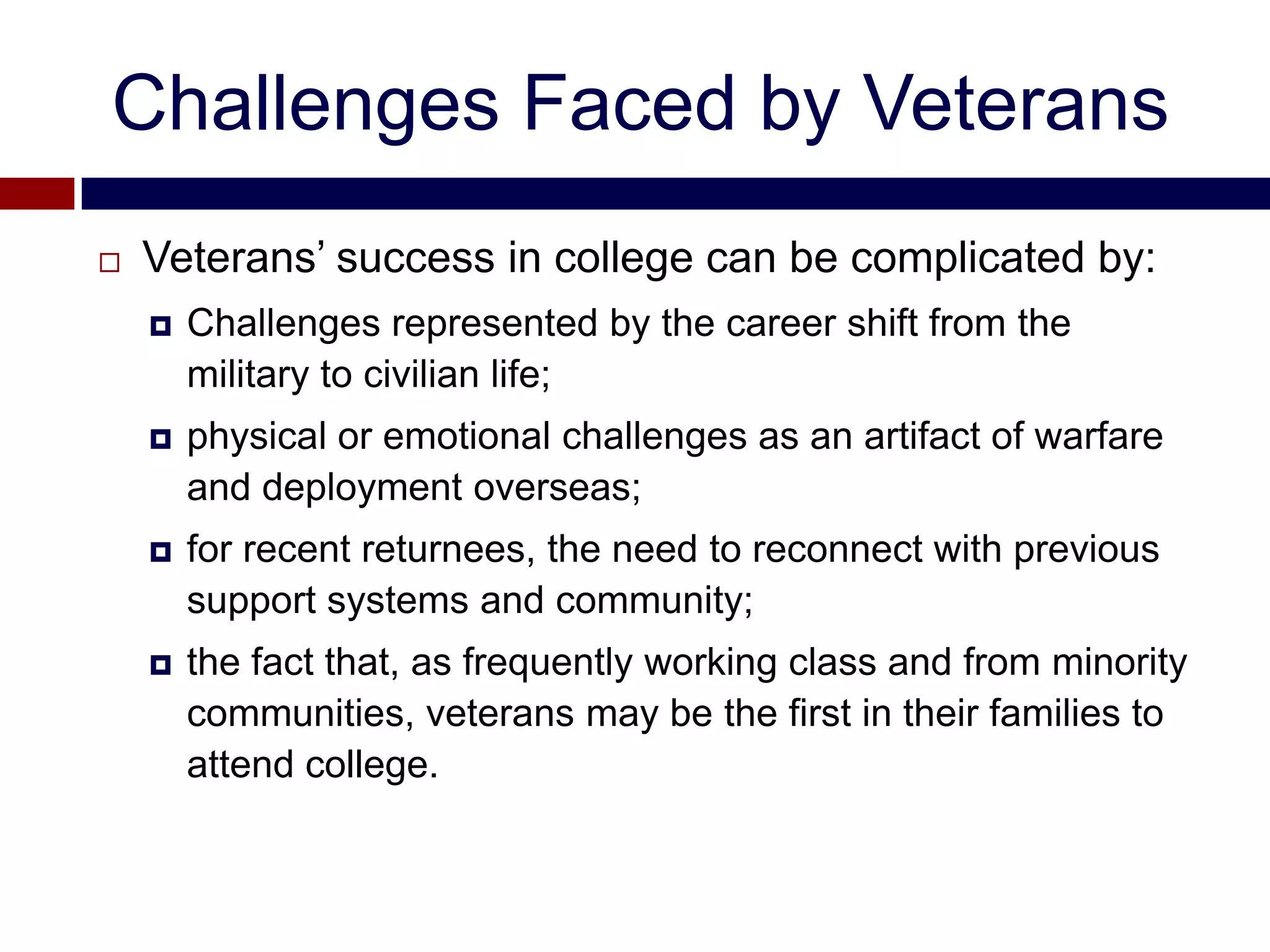
Challenges Faced by Veterans
   Veterans’ success in college can be complicated by:
       Challenges represented by the career shift from the
        military to civilian life;
       physical or emotional challenges as an artifact of warfare
        and deployment overseas;
       for recent returnees, the need to reconnect with previous
        support systems and community;
       the fact that, as frequently working class and from minority
        communities, veterans may be the first in their families to
        attend college.
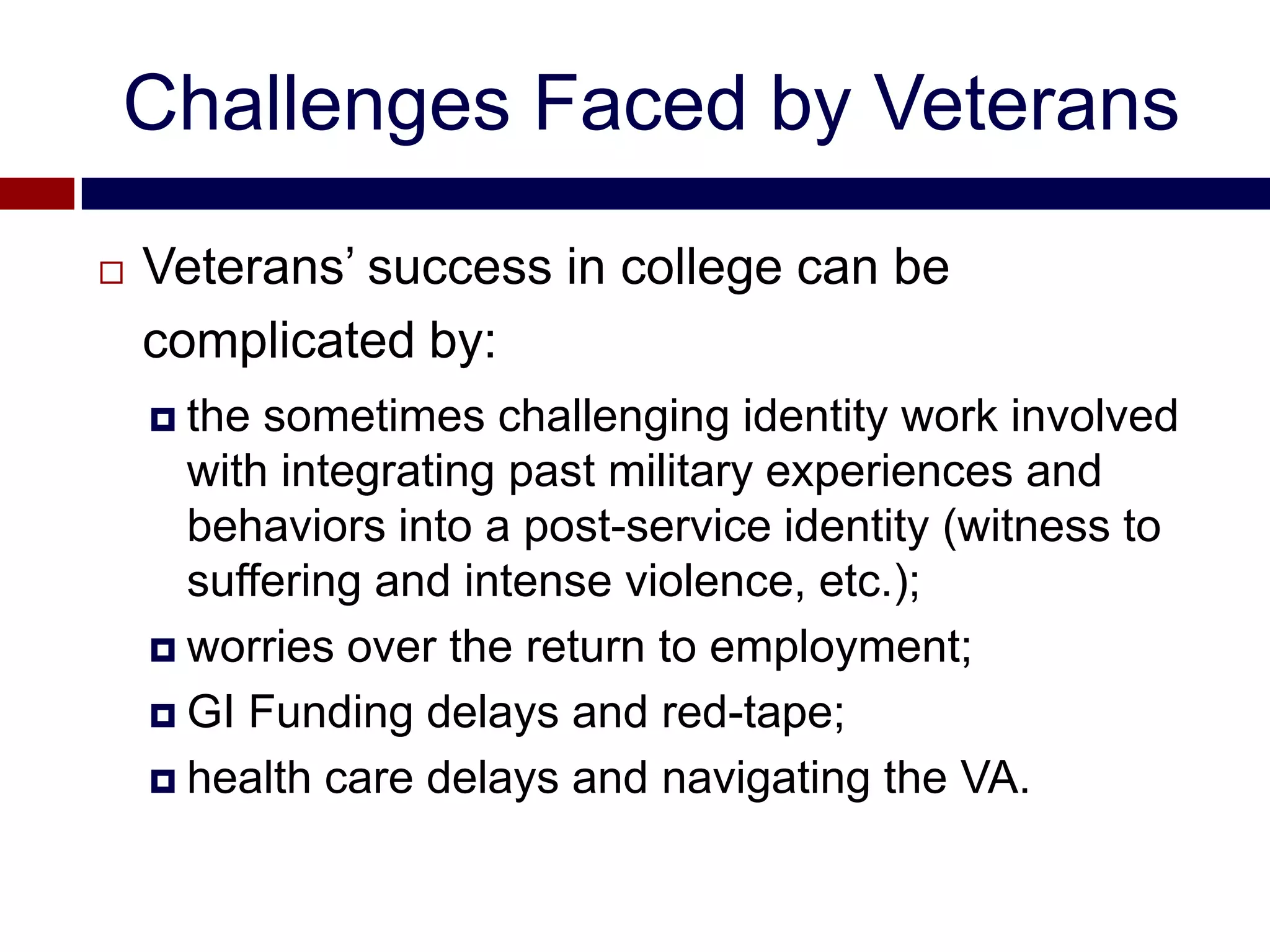
Challenges Faced by Veterans
   Veterans’ success in college can be
    complicated by:
     the sometimes challenging identity work involved
      with integrating past military experiences and
      behaviors into a post-service identity (witness to
      suffering and intense violence, etc.);
     worries over the return to employment;

     GI Funding delays and red-tape;

     health care delays and navigating the VA.
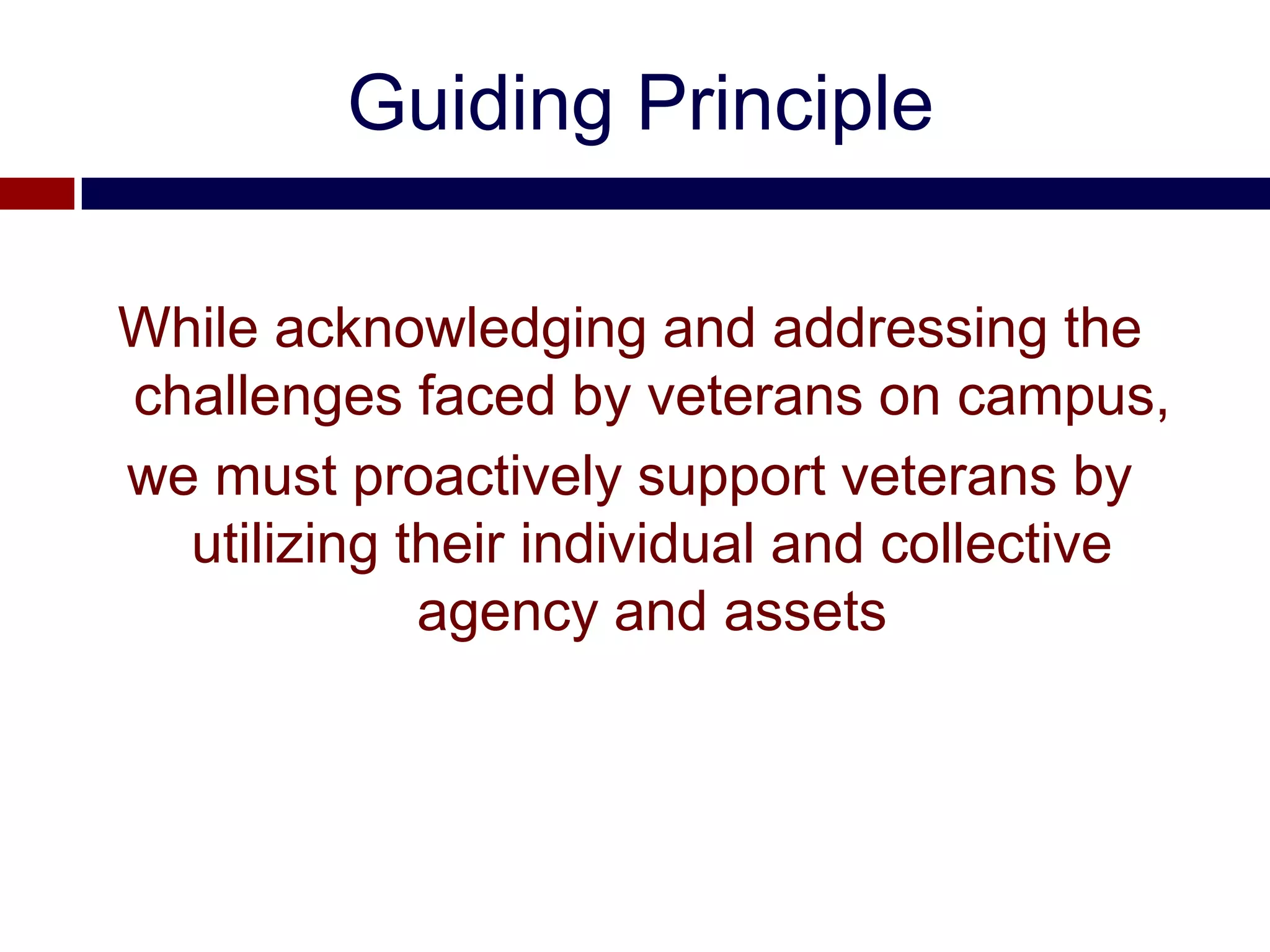
Guiding Principle

While acknowledging and addressing the
challenges faced by veterans on campus,
we must proactively support veterans by
  utilizing their individual and collective
             agency and assets
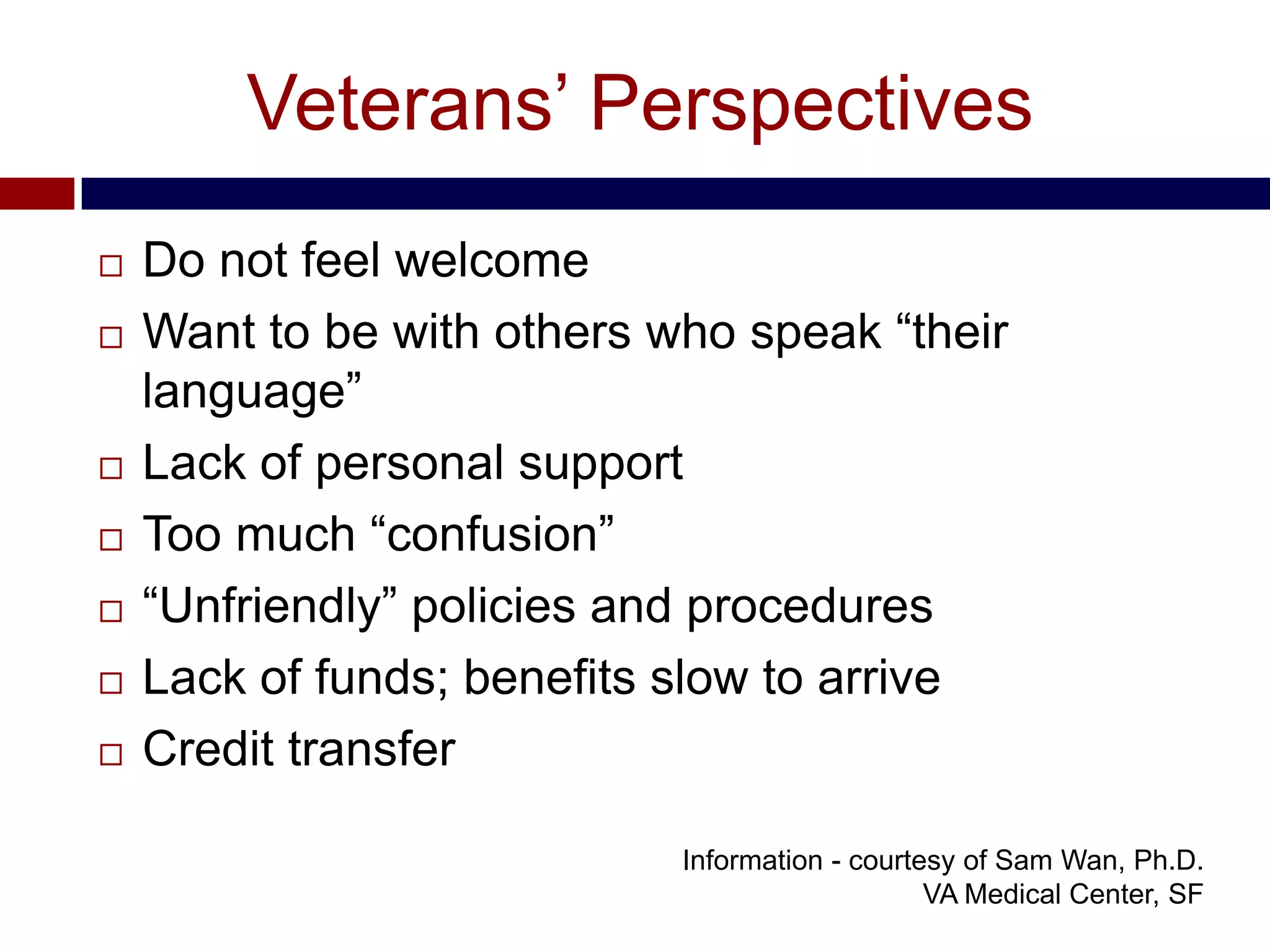
Veterans’ Perspectives
   Do not feel welcome
   Want to be with others who speak “their
    language”
   Lack of personal support
   Too much “confusion”
   “Unfriendly” policies and procedures
   Lack of funds; benefits slow to arrive
   Credit transfer

                            Information - courtesy of Sam Wan, Ph.D.
                                                VA Medical Center, SF
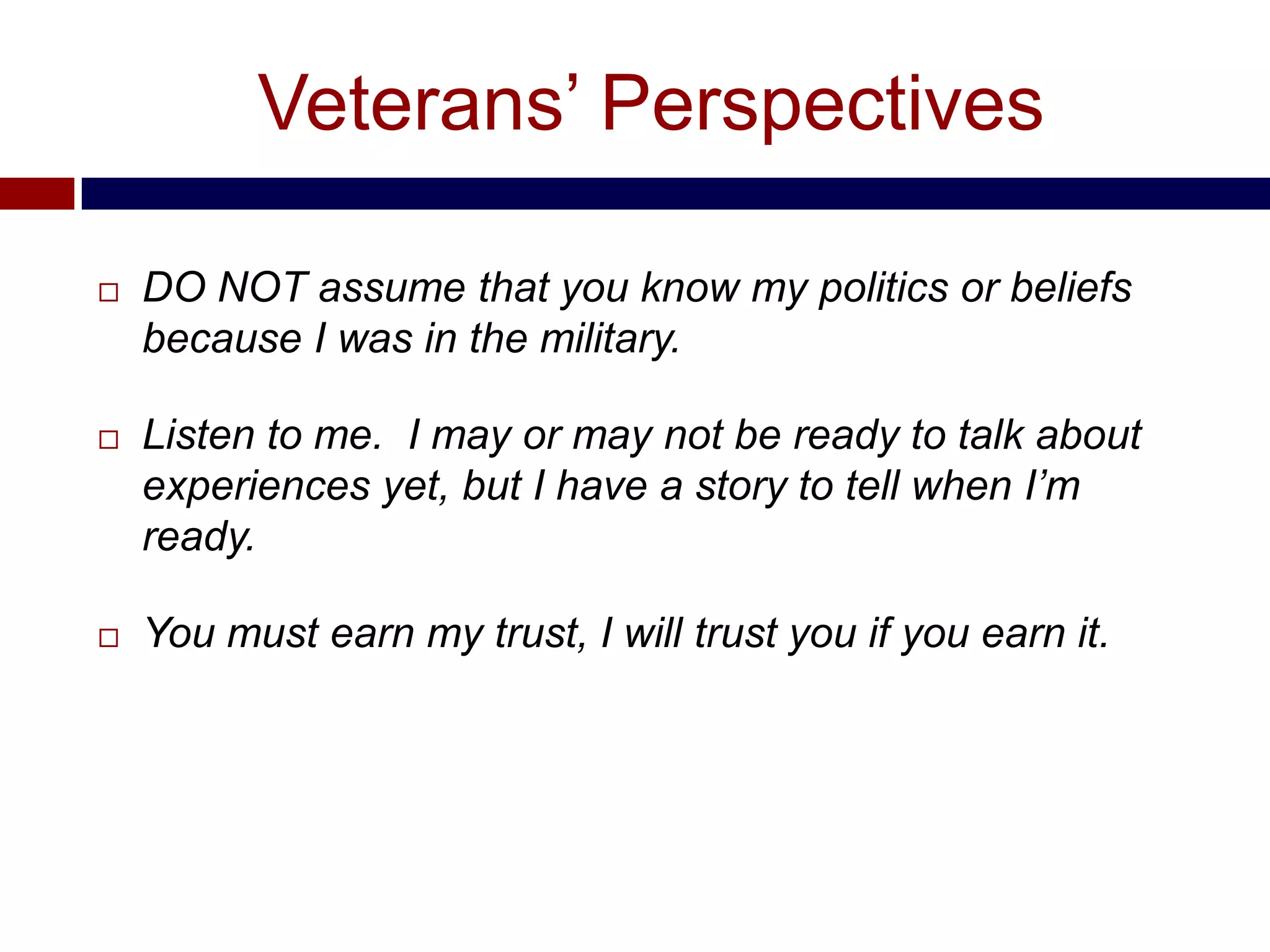
Veterans’ Perspectives

   DO NOT assume that you know my politics or beliefs
    because I was in the military.

   Listen to me. I may or may not be ready to talk about
    experiences yet, but I have a story to tell when I’m
    ready.

   You must earn my trust, I will trust you if you earn it.
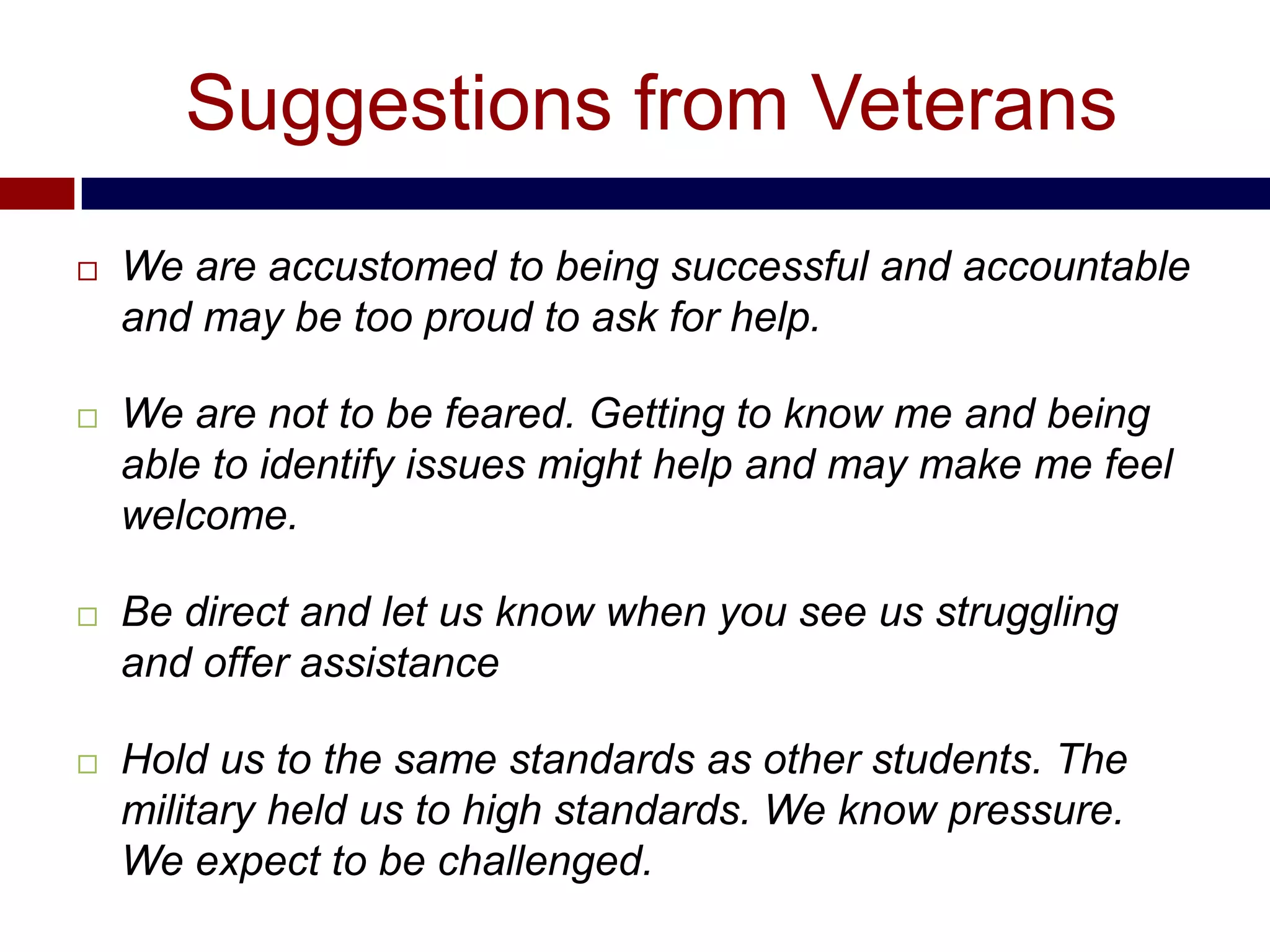
Suggestions from Veterans
   We are accustomed to being successful and accountable
    and may be too proud to ask for help.

   We are not to be feared. Getting to know me and being
    able to identify issues might help and may make me feel
    welcome.

   Be direct and let us know when you see us struggling
    and offer assistance

   Hold us to the same standards as other students. The
    military held us to high standards. We know pressure.
    We expect to be challenged.
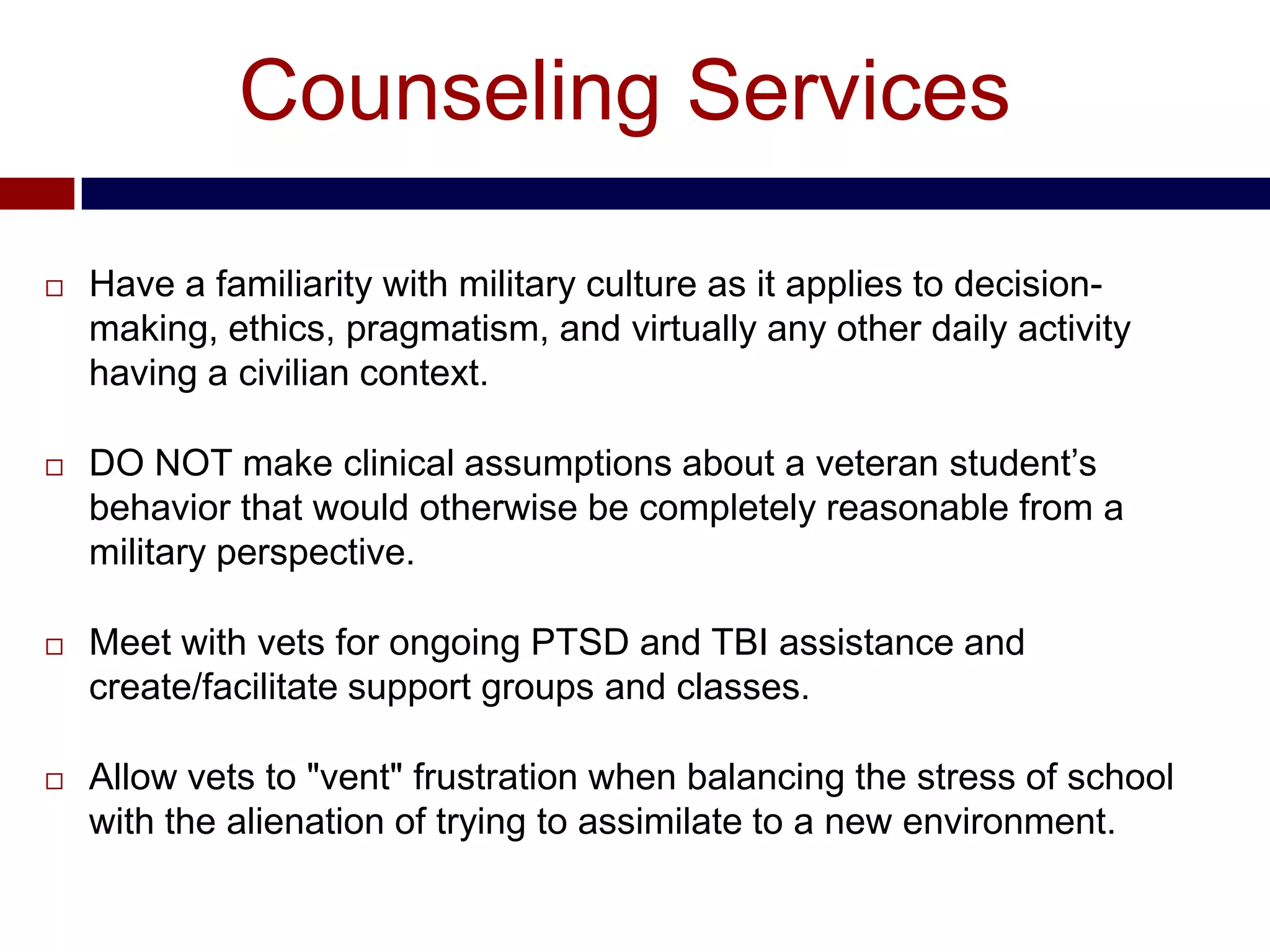
Counseling Services

   Have a familiarity with military culture as it applies to decision-
    making, ethics, pragmatism, and virtually any other daily activity
    having a civilian context.

   DO NOT make clinical assumptions about a veteran student’s
    behavior that would otherwise be completely reasonable from a
    military perspective.

   Meet with vets for ongoing PTSD and TBI assistance and
    create/facilitate support groups and classes.

   Allow vets to "vent" frustration when balancing the stress of school
    with the alienation of trying to assimilate to a new environment.
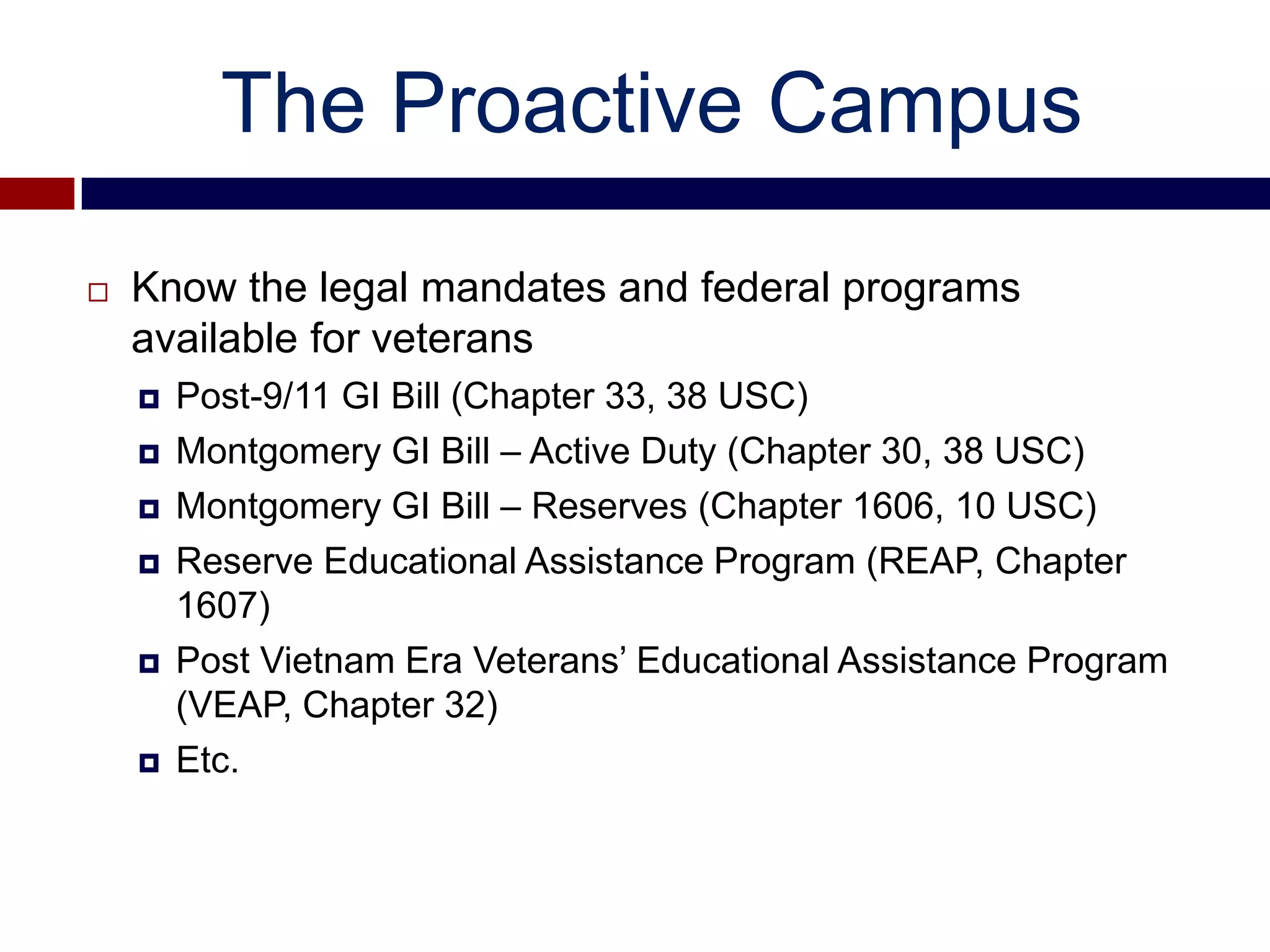
The Proactive Campus

   Know the legal mandates and federal programs
    available for veterans
       Post-9/11 GI Bill (Chapter 33, 38 USC)
       Montgomery GI Bill – Active Duty (Chapter 30, 38 USC)
       Montgomery GI Bill – Reserves (Chapter 1606, 10 USC)
       Reserve Educational Assistance Program (REAP, Chapter
        1607)
       Post Vietnam Era Veterans’ Educational Assistance Program
        (VEAP, Chapter 32)
       Etc.
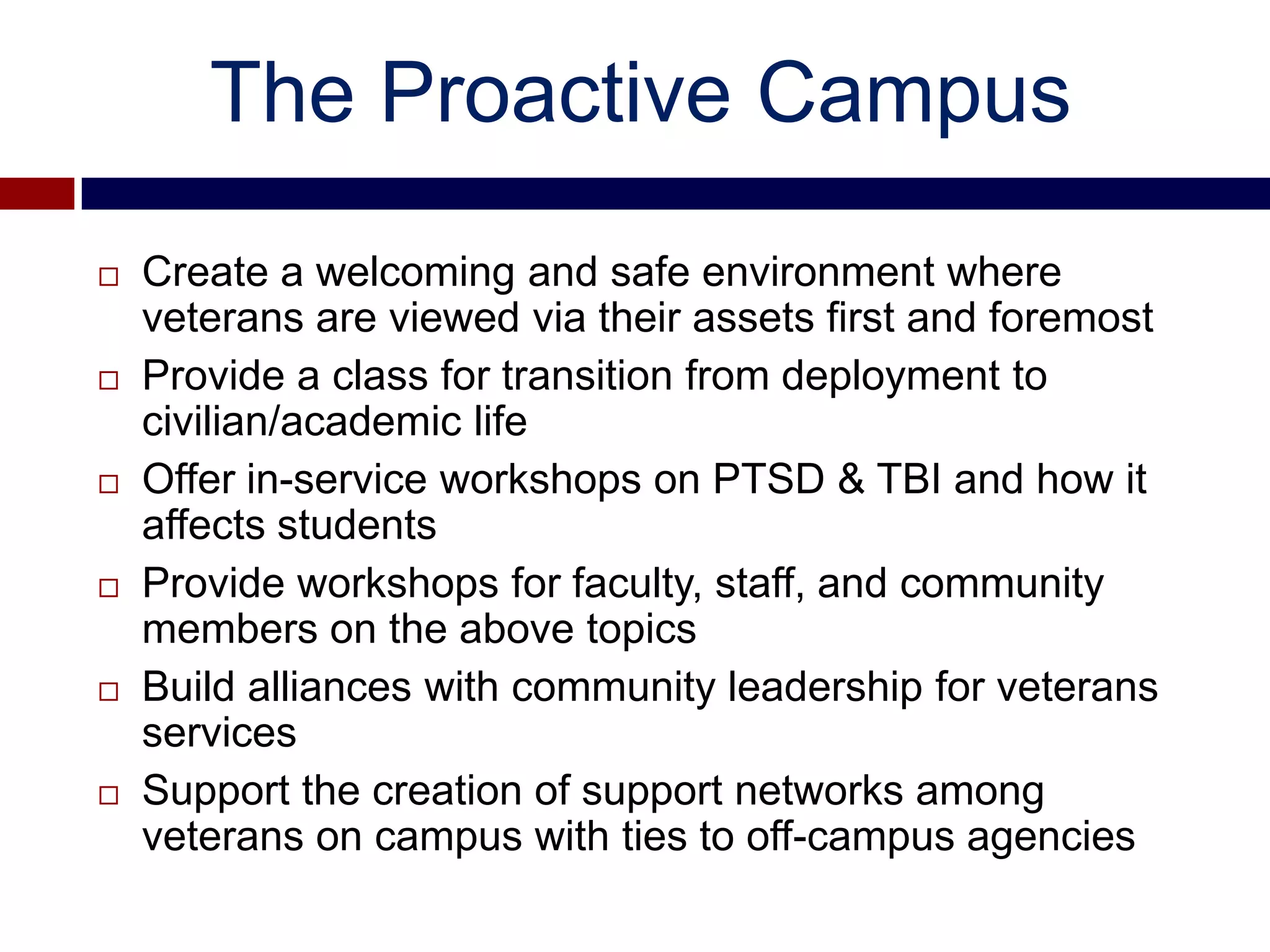
The Proactive Campus
   Create a welcoming and safe environment where
    veterans are viewed via their assets first and foremost
   Provide a class for transition from deployment to
    civilian/academic life
   Offer in-service workshops on PTSD & TBI and how it
    affects students
   Provide workshops for faculty, staff, and community
    members on the above topics
   Build alliances with community leadership for veterans
    services
   Support the creation of support networks among
    veterans on campus with ties to off-campus agencies
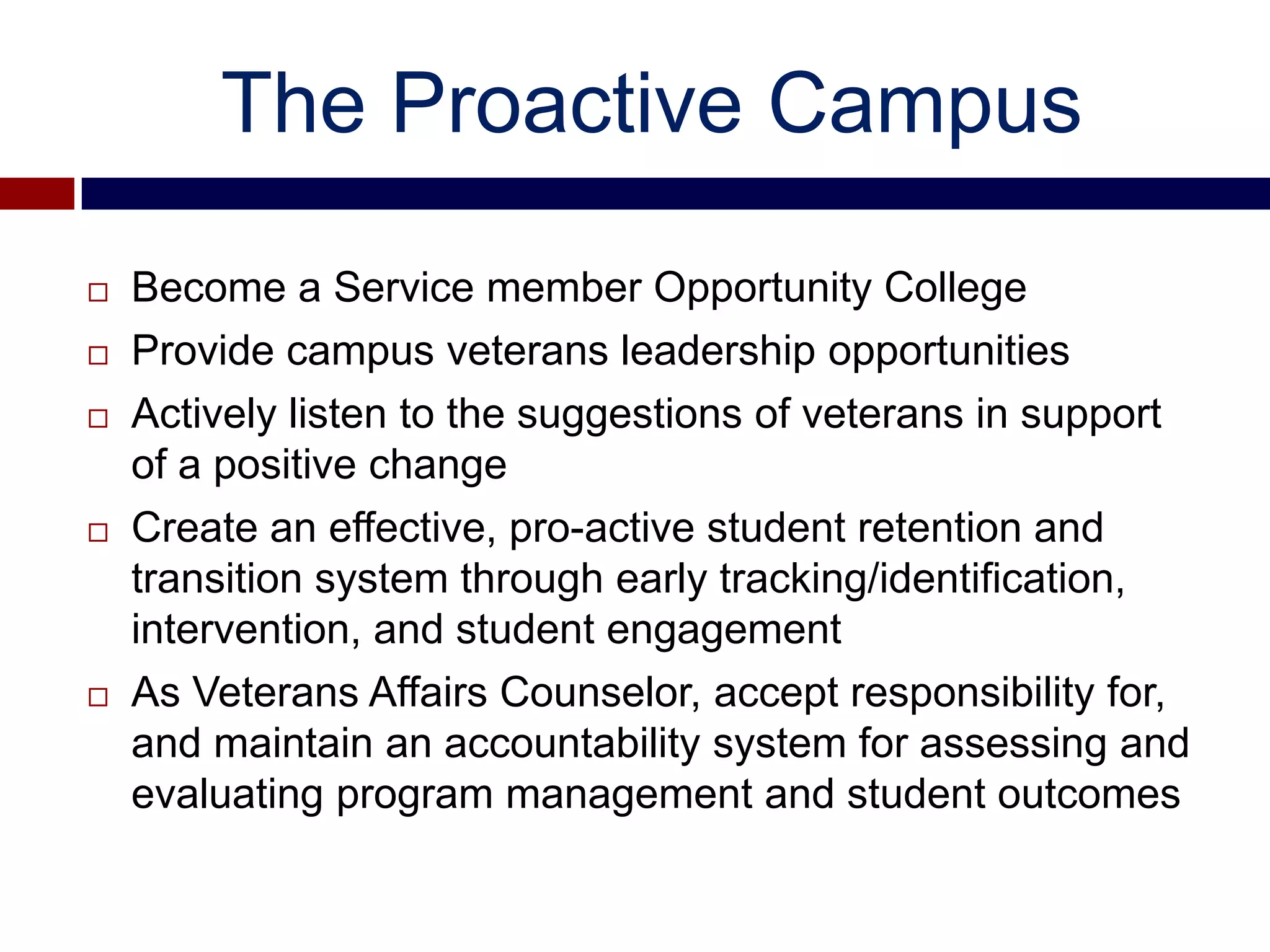
The Proactive Campus

   Become a Service member Opportunity College
   Provide campus veterans leadership opportunities
   Actively listen to the suggestions of veterans in support
    of a positive change
   Create an effective, pro-active student retention and
    transition system through early tracking/identification,
    intervention, and student engagement
   As Veterans Affairs Counselor, accept responsibility for,
    and maintain an accountability system for assessing and
    evaluating program management and student outcomes

Cerritos college veterans_issues_presentation_2011_final__b

  • 1.
    WORKING EFFECTIVELY WITH VETERANSON CAMPUS Cerritos College Veteran Affairs Norwalk, California
  • 2.
    Challenges Faced byVeterans  Veterans’ success in college can be complicated by:  Challenges represented by the career shift from the military to civilian life;  physical or emotional challenges as an artifact of warfare and deployment overseas;  for recent returnees, the need to reconnect with previous support systems and community;  the fact that, as frequently working class and from minority communities, veterans may be the first in their families to attend college.
  • 3.
    Challenges Faced byVeterans  Veterans’ success in college can be complicated by:  the sometimes challenging identity work involved with integrating past military experiences and behaviors into a post-service identity (witness to suffering and intense violence, etc.);  worries over the return to employment;  GI Funding delays and red-tape;  health care delays and navigating the VA.
  • 4.
    Guiding Principle While acknowledgingand addressing the challenges faced by veterans on campus, we must proactively support veterans by utilizing their individual and collective agency and assets
  • 5.
    Veterans’ Perspectives  Do not feel welcome  Want to be with others who speak “their language”  Lack of personal support  Too much “confusion”  “Unfriendly” policies and procedures  Lack of funds; benefits slow to arrive  Credit transfer Information - courtesy of Sam Wan, Ph.D. VA Medical Center, SF
  • 6.
    Veterans’ Perspectives  DO NOT assume that you know my politics or beliefs because I was in the military.  Listen to me. I may or may not be ready to talk about experiences yet, but I have a story to tell when I’m ready.  You must earn my trust, I will trust you if you earn it.
  • 7.
    Suggestions from Veterans  We are accustomed to being successful and accountable and may be too proud to ask for help.  We are not to be feared. Getting to know me and being able to identify issues might help and may make me feel welcome.  Be direct and let us know when you see us struggling and offer assistance  Hold us to the same standards as other students. The military held us to high standards. We know pressure. We expect to be challenged.
  • 8.
    Counseling Services  Have a familiarity with military culture as it applies to decision- making, ethics, pragmatism, and virtually any other daily activity having a civilian context.  DO NOT make clinical assumptions about a veteran student’s behavior that would otherwise be completely reasonable from a military perspective.  Meet with vets for ongoing PTSD and TBI assistance and create/facilitate support groups and classes.  Allow vets to "vent" frustration when balancing the stress of school with the alienation of trying to assimilate to a new environment.
  • 9.
    The Proactive Campus  Know the legal mandates and federal programs available for veterans  Post-9/11 GI Bill (Chapter 33, 38 USC)  Montgomery GI Bill – Active Duty (Chapter 30, 38 USC)  Montgomery GI Bill – Reserves (Chapter 1606, 10 USC)  Reserve Educational Assistance Program (REAP, Chapter 1607)  Post Vietnam Era Veterans’ Educational Assistance Program (VEAP, Chapter 32)  Etc.
  • 10.
    The Proactive Campus  Create a welcoming and safe environment where veterans are viewed via their assets first and foremost  Provide a class for transition from deployment to civilian/academic life  Offer in-service workshops on PTSD & TBI and how it affects students  Provide workshops for faculty, staff, and community members on the above topics  Build alliances with community leadership for veterans services  Support the creation of support networks among veterans on campus with ties to off-campus agencies
  • 11.
    The Proactive Campus  Become a Service member Opportunity College  Provide campus veterans leadership opportunities  Actively listen to the suggestions of veterans in support of a positive change  Create an effective, pro-active student retention and transition system through early tracking/identification, intervention, and student engagement  As Veterans Affairs Counselor, accept responsibility for, and maintain an accountability system for assessing and evaluating program management and student outcomes