We want you:
Marketing highly selective four
     year colleges to veterans


                             Kim Blank
                M.Ed. Higher Education
                        Administration
           College of William and Mary
Presentation Outline
•   Background information
•   Selection & Methodology
•   Survey
•   Selected Results
•   Interpreting Results
•   Practical Application
•   Recommendations
Background
• Servicemen’s Readjustment Act of
  1944 (also called the G.I. Bill)
• Educational benefits
  – College, business
  – Technical or vocational
  – Apprenticeship/job training
  – Flight training
Background
• Veterans’ Adjustment Act of 1952
  – Added Korean War veterans
• Veterans Readjustment Benefits Act of
  1966
  – Added those who served in times of war and peace
• Veterans Education Assistance
  Program (VEAP): in response to the
  transition to an all-volunteer military
• Montgomery G.I. Bill
Background
• VEAP was Chapter 32 (for those who
  entered active duty between 1/1/77-
  6/30/85): contributions matched 2:1
• Post-9/11 G.I. Bill (Chapter 33) initially
  approved in 2008 and updated in 2010 and
  2011
  – Extends eligibility to members of the National
    Guard
  – Adds provision for distance learners
Selection
• Carnegie Classifications of Institutions of
  Higher Education
  – Highly selective
  – Not-for-profit
  – Four-year
• 338 colleges/universities
  – Remove non-English language websites
  – Remove for-profit
  – Collect email addresses for chief enrollment
    officers (VP Enrollment, Director of
    Admissions, etc.)
Methodology
• Qualtrics Survey System
• Emailed survey to chief enrollment
  officers (personal email addresses
  when possible)
• Reminder survey one week from initial
  email
• 43/50 responses within the first week
• 4 respondents requested results
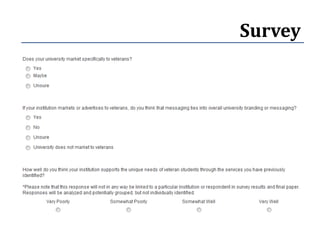
Survey
• Add stuff here

• REMEMBER TO CITE
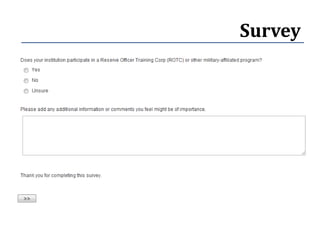
Survey
• Add stuff here

• REMEMBER TO CITE
Survey
• Add stuff here

• REMEMBER TO CITE
Survey
• Add stuff here

• REMEMBER TO CITE
Survey
• Add stuff here

• REMEMBER TO CITE
Survey
• Add stuff here

• REMEMBER TO CITE
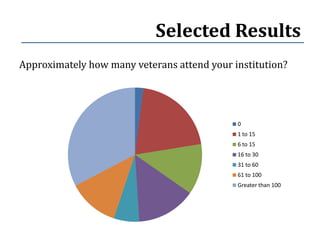
Selected Results
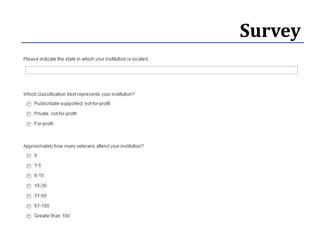
Approximately how many veterans attend your institution?


                                             0
                                             1 to 15
                                             6 to 15
                                             16 to 30
                                             31 to 60
                                             61 to 100
                                             Greater than 100
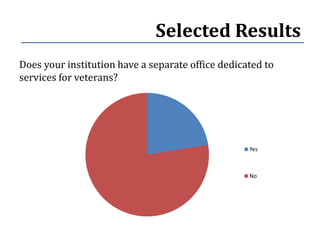
Selected Results
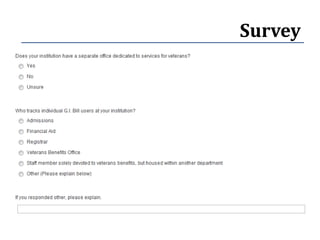
Does your institution have a separate office dedicated to
services for veterans?


                                                   Yes


                                                   No
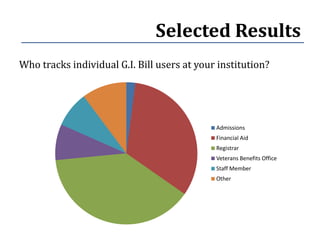
Selected Results
Who tracks individual G.I. Bill users at your institution?


                                             Admissions
                                             Financial Aid
                                             Registrar
                                             Veterans Benefits Office
                                             Staff Member
                                             Other
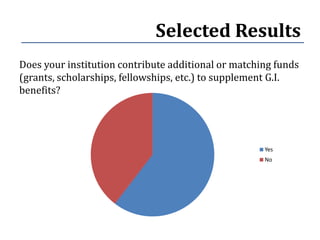
Selected Results
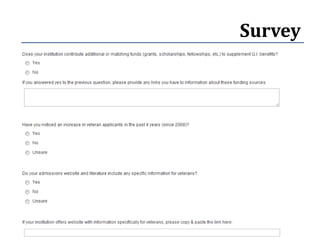
Does your institution contribute additional or matching funds
(grants, scholarships, fellowships, etc.) to supplement G.I.
benefits?


                                                     Yes
                                                     No
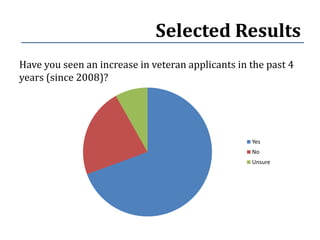
Selected Results
Have you seen an increase in veteran applicants in the past 4
years (since 2008)?


                                                   Yes
                                                   No
                                                   Unsure
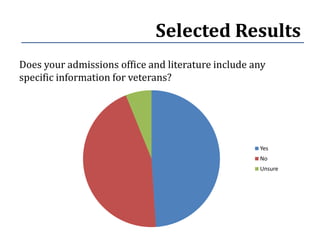
Selected Results
Does your admissions office and literature include any
specific information for veterans?


                                                    Yes
                                                    No
                                                    Unsure
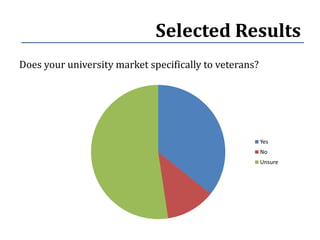
Selected Results
Does your university market specifically to veterans?


                                                        Yes
                                                        No
                                                        Unsure
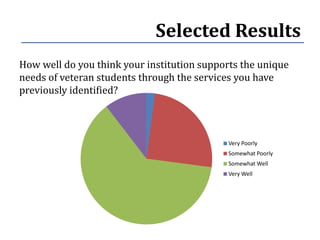
Selected Results
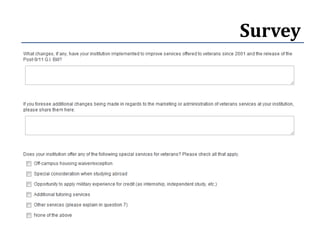
How well do you think your institution supports the unique
needs of veteran students through the services you have
previously identified?


                                             Very Poorly
                                             Somewhat Poorly
                                             Somewhat Well
                                             Very Well
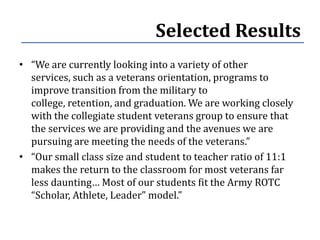
Selected Results
• “We are currently looking into a variety of other
  services, such as a veterans orientation, programs to
  improve transition from the military to
  college, retention, and graduation. We are working closely
  with the collegiate student veterans group to ensure that
  the services we are providing and the avenues we are
  pursuing are meeting the needs of the veterans.”
• “Our small class size and student to teacher ratio of 11:1
  makes the return to the classroom for most veterans far
  less daunting… Most of our students fit the Army ROTC
  “Scholar, Athlete, Leader” model.”
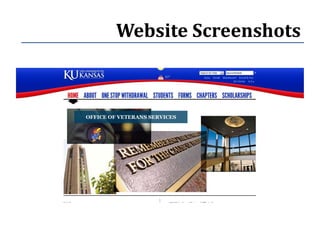
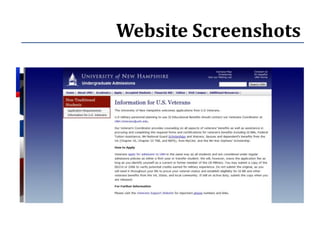
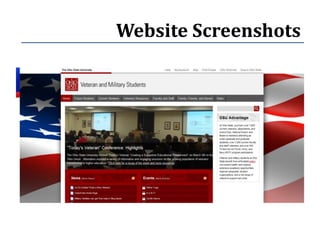
Website Screenshots
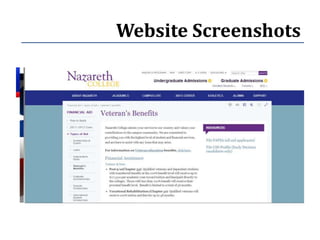
Website Screenshots
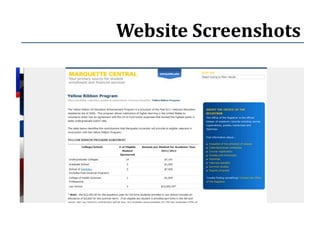
Website Screenshots
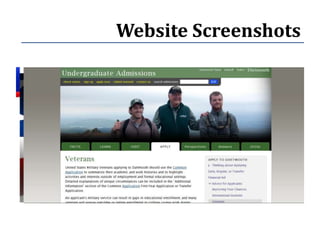
Website Screenshots
Website Screenshots
Website Screenshots
What do they mean?
• Enrollment is on the rise– should
  universities be acting differently?
• Only approximately ½ mention
  veterans in their literature– could they
  add just a line or paragraph?
• Many respondents are unsure of
  marketing strategies (see question 16)
• Few universities require separate
  offices, since the numbers are not large
Practical Application
• A separate office isn’t typically necessary
• Many institutions provided website links;
  could create a linked page at little cost
• Few institutions report specific literature;
  updates could be made to offer inclusion of
  basic info/link
• Few noteworthy differences between
  states
• Few noteworthy differences between
  public/private institutions
Recommendations
• Create prominent link on admissions
  website (many are hidden)
  –Include links to useful websites, like
   Veteran Friendly Toolkit
  –Link to other institutional sites
   (financial aid, residence life, etc.)
  –Include in literature (see next
   recommendation)
Recommendations
• Update literature to include
  information for veterans
  – Create insert if publications are already
    printed
  – At least include a link to the website from
    the previous recommendation
  – Consistency across publications
Recommendations
• Utilize outside sources (Veterans
  Toolkit, other websites)
  –Veteran Friendly Toolkit
  –VA website
  –Yellow Ribbon Program
  –Other military-supporting non-profits
Recommendations
• Better training of admissions staff
  – Consistent information (do we market to
    veterans?)
  – Sharing across departments (residence
    life, academic life, registrar, financial aid)
  – Knowledge of outside resources (VA
    contacts, non-profits)
Additional Resources
• My Wiki Page
   – http://kbmastersproject.wmwikis.net/
• G.I. Bill
   – http://www.gibill.va.gov/
• Yellow Ribbon Program
   – http://www.yellowribbon.mil/
• Toolkit for Veteran Friendly Institutions
   – http://vetfriendlytoolkit.org/
References
• See complete reference list at:
http://kbmastersproject.wmwikis.n
et/References

We want you

  • 1.
    We want you: Marketinghighly selective four year colleges to veterans Kim Blank M.Ed. Higher Education Administration College of William and Mary
  • 2.
    Presentation Outline • Background information • Selection & Methodology • Survey • Selected Results • Interpreting Results • Practical Application • Recommendations
  • 3.
    Background • Servicemen’s ReadjustmentAct of 1944 (also called the G.I. Bill) • Educational benefits – College, business – Technical or vocational – Apprenticeship/job training – Flight training
  • 4.
    Background • Veterans’ AdjustmentAct of 1952 – Added Korean War veterans • Veterans Readjustment Benefits Act of 1966 – Added those who served in times of war and peace • Veterans Education Assistance Program (VEAP): in response to the transition to an all-volunteer military • Montgomery G.I. Bill
  • 5.
    Background • VEAP wasChapter 32 (for those who entered active duty between 1/1/77- 6/30/85): contributions matched 2:1 • Post-9/11 G.I. Bill (Chapter 33) initially approved in 2008 and updated in 2010 and 2011 – Extends eligibility to members of the National Guard – Adds provision for distance learners
  • 6.
    Selection • Carnegie Classificationsof Institutions of Higher Education – Highly selective – Not-for-profit – Four-year • 338 colleges/universities – Remove non-English language websites – Remove for-profit – Collect email addresses for chief enrollment officers (VP Enrollment, Director of Admissions, etc.)
  • 7.
    Methodology • Qualtrics SurveySystem • Emailed survey to chief enrollment officers (personal email addresses when possible) • Reminder survey one week from initial email • 43/50 responses within the first week • 4 respondents requested results
  • 8.
    Survey • Add stuffhere • REMEMBER TO CITE
  • 9.
    Survey • Add stuffhere • REMEMBER TO CITE
  • 10.
    Survey • Add stuffhere • REMEMBER TO CITE
  • 11.
    Survey • Add stuffhere • REMEMBER TO CITE
  • 12.
    Survey • Add stuffhere • REMEMBER TO CITE
  • 13.
    Survey • Add stuffhere • REMEMBER TO CITE
  • 14.
    Selected Results Approximately howmany veterans attend your institution? 0 1 to 15 6 to 15 16 to 30 31 to 60 61 to 100 Greater than 100
  • 15.
    Selected Results Does yourinstitution have a separate office dedicated to services for veterans? Yes No
  • 16.
    Selected Results Who tracksindividual G.I. Bill users at your institution? Admissions Financial Aid Registrar Veterans Benefits Office Staff Member Other
  • 17.
    Selected Results Does yourinstitution contribute additional or matching funds (grants, scholarships, fellowships, etc.) to supplement G.I. benefits? Yes No
  • 18.
    Selected Results Have youseen an increase in veteran applicants in the past 4 years (since 2008)? Yes No Unsure
  • 19.
    Selected Results Does youradmissions office and literature include any specific information for veterans? Yes No Unsure
  • 20.
    Selected Results Does youruniversity market specifically to veterans? Yes No Unsure
  • 21.
    Selected Results How welldo you think your institution supports the unique needs of veteran students through the services you have previously identified? Very Poorly Somewhat Poorly Somewhat Well Very Well
  • 22.
    Selected Results • “Weare currently looking into a variety of other services, such as a veterans orientation, programs to improve transition from the military to college, retention, and graduation. We are working closely with the collegiate student veterans group to ensure that the services we are providing and the avenues we are pursuing are meeting the needs of the veterans.” • “Our small class size and student to teacher ratio of 11:1 makes the return to the classroom for most veterans far less daunting… Most of our students fit the Army ROTC “Scholar, Athlete, Leader” model.”
  • 23.
  • 24.
  • 25.
  • 26.
  • 27.
  • 28.
  • 29.
    What do theymean? • Enrollment is on the rise– should universities be acting differently? • Only approximately ½ mention veterans in their literature– could they add just a line or paragraph? • Many respondents are unsure of marketing strategies (see question 16) • Few universities require separate offices, since the numbers are not large
  • 30.
    Practical Application • Aseparate office isn’t typically necessary • Many institutions provided website links; could create a linked page at little cost • Few institutions report specific literature; updates could be made to offer inclusion of basic info/link • Few noteworthy differences between states • Few noteworthy differences between public/private institutions
  • 31.
    Recommendations • Create prominentlink on admissions website (many are hidden) –Include links to useful websites, like Veteran Friendly Toolkit –Link to other institutional sites (financial aid, residence life, etc.) –Include in literature (see next recommendation)
  • 32.
    Recommendations • Update literatureto include information for veterans – Create insert if publications are already printed – At least include a link to the website from the previous recommendation – Consistency across publications
  • 33.
    Recommendations • Utilize outsidesources (Veterans Toolkit, other websites) –Veteran Friendly Toolkit –VA website –Yellow Ribbon Program –Other military-supporting non-profits
  • 34.
    Recommendations • Better trainingof admissions staff – Consistent information (do we market to veterans?) – Sharing across departments (residence life, academic life, registrar, financial aid) – Knowledge of outside resources (VA contacts, non-profits)
  • 35.
    Additional Resources • MyWiki Page – http://kbmastersproject.wmwikis.net/ • G.I. Bill – http://www.gibill.va.gov/ • Yellow Ribbon Program – http://www.yellowribbon.mil/ • Toolkit for Veteran Friendly Institutions – http://vetfriendlytoolkit.org/
  • 36.
    References • See completereference list at: http://kbmastersproject.wmwikis.n et/References