© 2023, IRJET | Impact Factor value: 8.226 | ISO 9001:2008 Certified Journal | Page 1
Centrifugal Pump Impeller Design by Model to Proto Method and Its
Performance Verification by Simulation and Experimental Method
Suhas Prakash Vibhute, AGM, KBL
---------------------------------------------------------------------***---------------------------------------------------------------------
Abstract -
The use of centrifugal pumps has increased because of their capability of handling a variety of liquid applications. It converts
rotational kinetic energy to the hydrodynamic energy of the fluid flow. The source forthegenerationofrotationalkineticenergy is
the driver (an electric motor). Today, due to the vast change in industrial scenarios, more andmorecomplicatedrequirements are
arriving at pump manufacturers. Drinking water is the basic need to live for every human being on earth. In India, rivers are the
main source of water supply. The subject customer's specified duty parameters requirement calls for a pump that should be
suitable for liquid water application, have inadequate suction/inletconditionsatthesiteduetovariationinsump waterlevels, and
also be installed in the limited space available at the site.
To achieve customer-specified duty parameter requirements at specified speeds, NetPositiveSuctionHeadRequirements(NPSHr)
and to suit available site conditions This paper revolves around the hydraulic design of a centrifugal pump impeller by the model-
to-protocol method. After that, performance verification is done by simulation methods like computational fluid dynamics (CFD)
analysis and also by physical testing of prototypes in the test lab.
Key Words: Centrifugal pumps, CFD analysis, specified speeds, NPSHr
1. INTRODUCTION:
The centrifugal pump is the most widely used type of pump in a varietyofliquidapplications. Inthispaper,thetypeofpumping
liquid considered for experimentation is water. There is a city water supply scheme, and the river is the main source of water
for the city. Two major water treatment plants are there for water treatment. The objective is to maintain a steady supply of
raw water to the water treatment plant and an uninterrupted supply of treated drinking water to the city. The main obstacles
on site are
 There is frequent variation in river water levels.
 Inadequate suction/inlet conditions at the site are due to variations in sump water levels.
 Space limitation
Customer specified duty parameters requirements
 Flow (Q) : 7945 m3/hr (34980.77 USGPM)
 Head (H) : 36.6 mtr (120.08 ft.)
 Speed (N) : 595 rpm.
 Efficiency : 87%
 NPSHr : Less than 6 meter
To achieve customer-specified duty parameters at specified speeds, it is proposed to carry out the design of a new
hydraulic impeller. The subject impeller is to be assembled inHorizontal SplitcaseTypecentrifugal pumpwitha bottom
suction configuration. The main objectives of this research work are
 Impeller hydraulic design based on specific speed and model to proto phenomenon
 Lower Net Positive Suction Head Requirement (NPSHr) of pump to operate satisfactorily atsitefor variedwater
levels in sump
 Verification and validation of the actual design in comparison to analytical and Computational Fluid Dynamics
(CFD) prediction.
International Research Journal of Engineering and Technology (IRJET) e-ISSN: 2395-0056
Volume: 10 Issue: 11 | Nov 2023 www.irjet.net p-ISSN: 2395-0072
International Research Journal of Engineering and Technology (IRJET) e-ISSN: 2395-0056
Volume: 10 Issue: 11 | Nov 2023 www.irjet.net p-ISSN: 2395-0072
© 2023, IRJET | Impact Factor value: 8.226 | ISO 9001:2008 Certified Journal | Page 2
 To compare predicted results with actual results
For the successful performance of the pump, hydrauliccomponentsplayanimportant role.Itgivesthe bestperformance
by ratio of outflow to inflow of any pump. The impeller is the most important rotating part of a pump; it imparts energy
to the fluid. The type of impeller design is based on the specific speed of the pump. Refer to Figure 1.1
Figure 1.1-Specific speed and Shape of impeller.
There are a variety of design procedures and methods of calculation. The methods that we have used for the design of
the proto-pump impeller are.
A] As per the guidelines given in the JIS B 8327-2002 standard: Model to Proto scale ratio
B] As per the guidelines given in the Val S Lobanoff pump book
2 Impeller Design As Per- JIS B 8327-2002 standard guidelines:
This standard specifies the method of predicting the performance of a proto pump based on the performanceofa model pump
having approximately the same specific speed. This method is followed whenproven hydraulicsareavailableina model pump.
We have a standard performance curve for the model pump at the required duty parameters, and basedonthesameandusing
the model to proto performance prediction formulas given in the standard JIS-B-8327-2002, we canpredicttheperformance
of the proto pump.
 Flow/Discharge Of proto pump : Qp=[Dp/Dm]³ x [Np/Nm] x Qm
 Head Of Proto pump : Hp=[Dp/Dm]² x [Np/Nm]² x Hm
 Power Of Proto pump : Pp =Pm x [Np/Nm]³ x [Dp/Dm]5
 NPSHr of Proto pump : NPSHp =[Dp/Dm] ² x [Np/Nm] ² x NPSHm
Where,
H = Total head of pump in meter
Q = Discharge/Flow of pump in m³/s
P = Shaft power of pump in kW
N = Rotational speed in rpm
D = representative dimension of impeller dia. [mm]
m : model pump , p : proto pump
International Research Journal of Engineering and Technology (IRJET) e-ISSN: 2395-0056
Volume: 10 Issue: 11 | Nov 2023 www.irjet.net p-ISSN: 2395-0072
© 2023, IRJET | Impact Factor value: 8.226 | ISO 9001:2008 Certified Journal | Page 3
Table 1.1 - Proto pump and Model pump duty parameters-
Description
Proto Pump Duty
Parameters
Model Pump Duty
Parameters
Flow/Discharge Q,m³/hr 7945 650
Total Head H, meter 36.6 23.3
NPSHr, meter 5.5 3.46
Speed N,rpm 595 1480
Pump efficiency ƞ,% 87% 88%
Liquid specific gravity 1.0 1.0
Power P,kW 910.23 46.67
Specific Speed,Ns (metric) 153.31 153.05
Specific Speed,Ns (US units) 2169.98 2166.27
Table.1.2-Model to Proto scale ratio.
PREDICTION OF PROTO PUMP PERFORMANCE FROM MODEL PUMP PARAMETERS ( JIS-B-8327-
2002)
MODEL
PUMP
Q 325 m³/hr Q 3973 m³/hr
PROTO
PUMP
0.09028 m³/s 1.1035 m³/s
H 23.3 meter H 36.6 meter
N 1480 rpm N 595 rpm
P 47.41 kW P 895.87 kW
ƞ 87 % ƞ 88.34 %
g 1.0 g 1.0
Ns 153.05 metric Ns 153.31 metric
Ns 2166.23 US Units Ns 2169.98 US
Units
NPSHr 3.460 meter NPSHr 5.44 meter
Nss 9055.55 US Units Nss 9063 US
Units
Dp/Dm ratio from discharge 3.121
Dp/Dm ratio from head 3.118
Mean model to proto ratio 3.119
Q = Flow/Discharge in m³/s (For single suction)
H = Total head (per stage) in meter
N = Speed in rpm
Ƞ = Efficiency,%
g=Specific gravity
Ns = Pump Specific speed
Nss= Pump suction specific speed
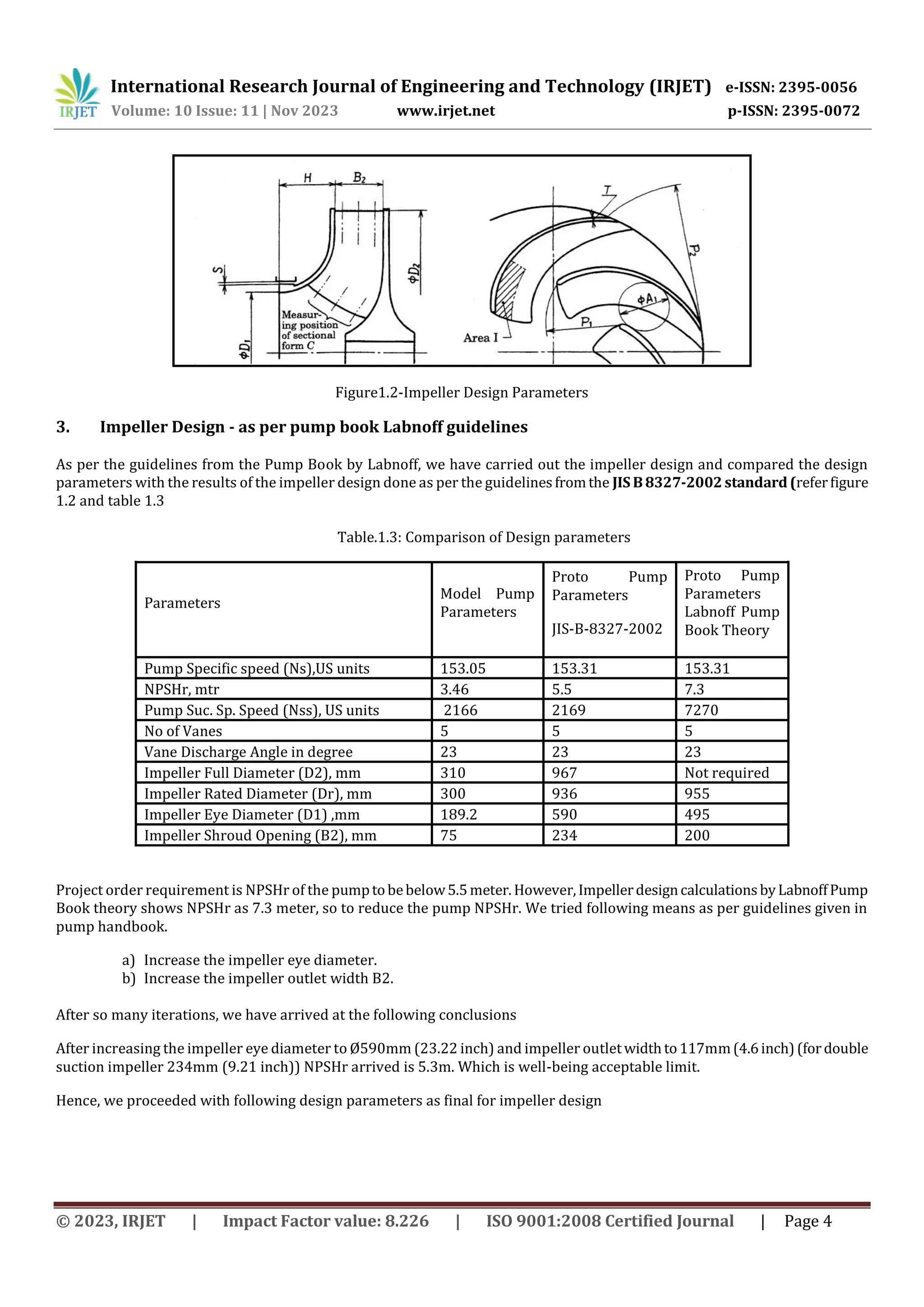
Based on the model-to-proto scale ratio of 3.119, we are now able to predict the tentative dimensions of the proto pump
impeller by multiplying the model pump impeller hydraulic dimensions by arrivedscaleratio.Refertofigures1.2 andtable1.3
International Research Journal of Engineering and Technology (IRJET) e-ISSN: 2395-0056
Volume: 10 Issue: 11 | Nov 2023 www.irjet.net p-ISSN: 2395-0072
© 2023, IRJET | Impact Factor value: 8.226 | ISO 9001:2008 Certified Journal | Page 4
Figure1.2-Impeller Design Parameters
3. Impeller Design - as per pump book Labnoff guidelines
As per the guidelines from the Pump Book by Labnoff, we have carried out the impeller design and compared the design
parameters with the results of the impeller design done as per the guidelinesfromthe JISB8327-2002standard(referfigure
1.2 and table 1.3
Table.1.3: Comparison of Design parameters
Parameters
Model Pump
Parameters
Proto Pump
Parameters
JIS-B-8327-2002
Proto Pump
Parameters
Labnoff Pump
Book Theory
Pump Specific speed (Ns),US units 153.05 153.31 153.31
NPSHr, mtr 3.46 5.5 7.3
Pump Suc. Sp. Speed (Nss), US units 2166 2169 7270
No of Vanes 5 5 5
Vane Discharge Angle in degree 23 23 23
Impeller Full Diameter (D2), mm 310 967 Not required
Impeller Rated Diameter (Dr), mm 300 936 955
Impeller Eye Diameter (D1) ,mm 189.2 590 495
Impeller Shroud Opening (B2), mm 75 234 200
Project order requirement is NPSHr of the pumptobebelow5.5meter.However,ImpellerdesigncalculationsbyLabnoffPump
Book theory shows NPSHr as 7.3 meter, so to reduce the pump NPSHr. We tried following means as per guidelines given in
pump handbook.
a) Increase the impeller eye diameter.
b) Increase the impeller outlet width B2.
After so many iterations, we have arrived at the following conclusions
After increasing the impeller eye diameter to Ø590mm (23.22 inch) and impeller outletwidthto117mm(4.6inch)(fordouble
suction impeller 234mm (9.21 inch)) NPSHr arrived is 5.3m. Which is well-being acceptable limit.
Hence, we proceeded with following design parameters as final for impeller design
International Research Journal of Engineering and Technology (IRJET) e-ISSN: 2395-0056
Volume: 10 Issue: 11 | Nov 2023 www.irjet.net p-ISSN: 2395-0072
© 2023, IRJET | Impact Factor value: 8.226 | ISO 9001:2008 Certified Journal | Page 5
Table.1.4: Proto pump final design parameters
Parameters Values
NPSHr, mtr 5.3
No of Vanes 5
Vane Discharge Angle in degree 23
Impeller Full Diameter (D2), mm 967
Impeller Rated Diameter (Dr), mm 936
Impeller Eye Diameter (De) ,mm 590
Impeller Shroud Opening (b2), mm 234ouble suction)
4. Computational Fluid Dynamics ( CFD) Analysis :
After finalization of impeller design parameters, hydraulic performance verification is determined by computational fluid
dynamics (CFD) analysis before actual manufacturing of the impeller. After manufacturing, experimental performancetesting
of the pump is carried out to validate the physical performance with respect to design parameters. Based on the above-
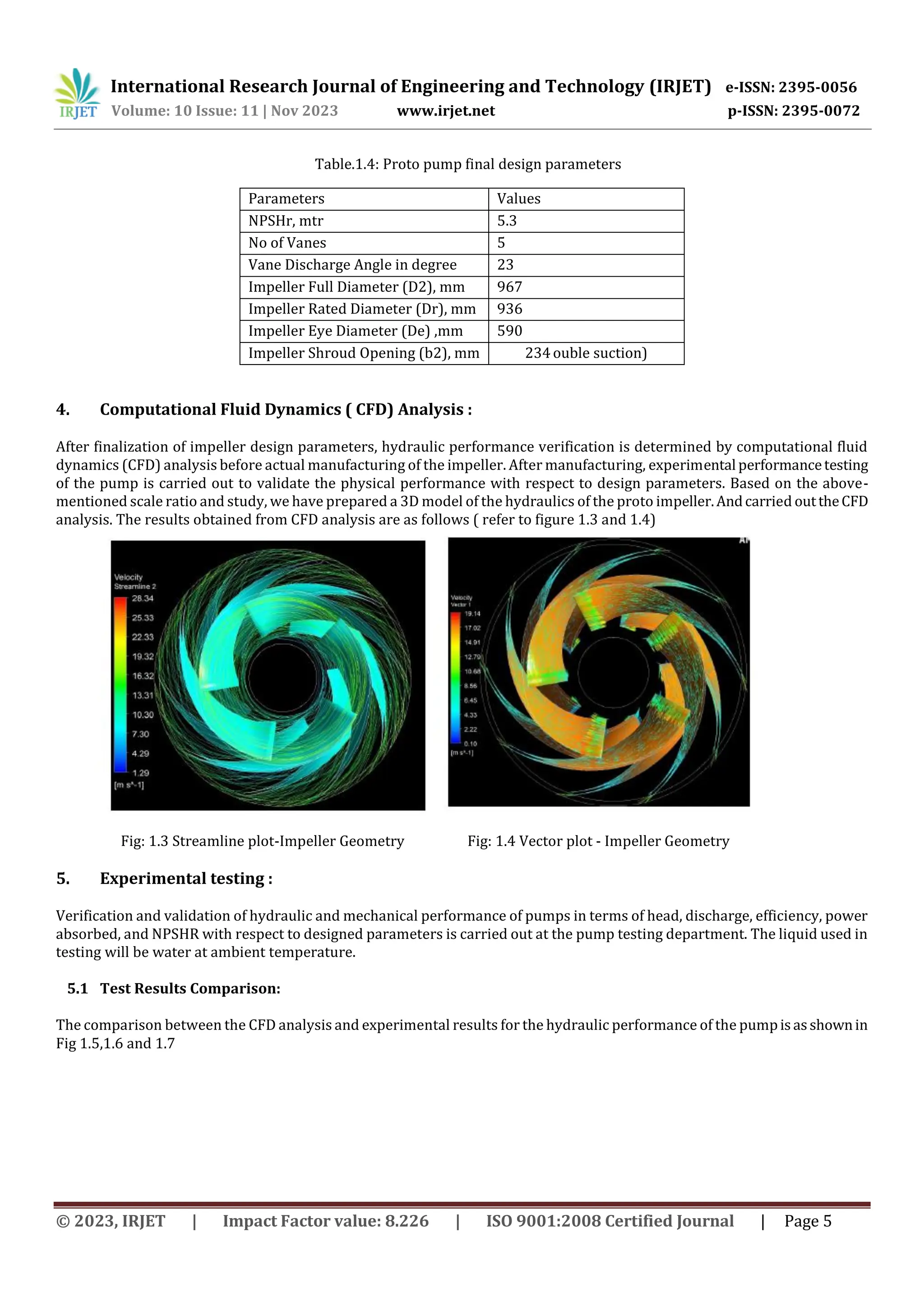
mentioned scale ratio and study, we have prepared a 3D model of the hydraulics of the proto impeller.Andcarried outtheCFD
analysis. The results obtained from CFD analysis are as follows ( refer to figure 1.3 and 1.4)
Fig: 1.3 Streamline plot-Impeller Geometry Fig: 1.4 Vector plot - Impeller Geometry
5. Experimental testing :
Verification and validation of hydraulic and mechanical performance of pumps in terms of head, discharge, efficiency, power
absorbed, and NPSHR with respect to designed parameters is carried out at the pump testing department. The liquid used in
testing will be water at ambient temperature.
5.1 Test Results Comparison:
The comparison between the CFD analysis and experimental results for the hydraulic performance of the pumpisasshownin
Fig 1.5,1.6 and 1.7
International Research Journal of Engineering and Technology (IRJET) e-ISSN: 2395-0056
Volume: 10 Issue: 11 | Nov 2023 www.irjet.net p-ISSN: 2395-0072
© 2023, IRJET | Impact Factor value: 8.226 | ISO 9001:2008 Certified Journal | Page 6
Fig.1.5: Discharge vs. Head Comparison
Fig.1.6: Discharge vs. Input Power Comparison
Fig.1.7: Discharge vs. Efficiency Comparison:
Small variations in the experimental results Head, input power, and efficiency are found to vary because of manufacturing
variation during the casting and machining stages, and factors like surface finish along the hydraulic passage insidethecasing
and impeller vary as compared to the assumed surface finish in CFD analysis.Theheadatthefull dischargesideisof a drooping
nature, and the full open discharge is slightly low because of the NPSH available constraint at the test lab.Overall performance
is satisfactory and well within acceptable limits of the Gr 2B tolerances mentioned in ISO 9906-2012 Rot Dynamic Pumps-
Hydraulic Performance Acceptance Tests International Standard.
International Research Journal of Engineering and Technology (IRJET) e-ISSN: 2395-0056
Volume: 10 Issue: 11 | Nov 2023 www.irjet.net p-ISSN: 2395-0072
© 2023, IRJET | Impact Factor value: 8.226 | ISO 9001:2008 Certified Journal | Page 7
The vibrations are slightly higher because of the temporary foundation and clamping arrangements at the test lab.
Table 1.5 - Comparison for specified and actual test results :
Sr. Parameter Specified Observed Remarks
01 Total Head (m) 36.60 36.96 Satisfactory
02 Flow/Discharge (m³/hr) 7945 7953.5 Satisfactory
03 Pump Efficiency (%) 87% 88.09% Satisfactory
04 Noise 87 dBA 82 dBA Acceptable
05 NPSHr, (m) 5.5 5.3
06 Power,P,kW 910.23 908.78
07 Vibrations at Duty
RMS mm/s
-----------------------------
Direction X /Y/Z
As per
ISO10816 Cat-II
Zone B
6.1
4.7 /2.9 / 7.2 Acceptable
Overall performance is satisfactory and well within acceptable limits of the Gr 2B tolerances mentioned in ISO 9906-2012Rot
Dynamic Pumps-Hydraulic Performance Acceptance Tests International Standard.
6. CONCLUSIONS :
 The method of ‘Model to Proto Ratio’ is accurate and the best-suited method for the design of pump hydraulic
components when proven hydraulic at the same specific speed is available.
 Due to the design of the double suction impeller, the pump requires a low NPSHr as compared to to pump with a
single suction impeller having the same capacity.
 The computational fluid dynamics (CFD) analysis technology used is a very useful tool. not only to know the flow
pattern in hydraulic passages but also to predict the hydraulic performance well before building the actual proto.
 In comparison to CFD results, a small variation is observed in the experimental results. It is because of
manufacturing variations during the casting and machining stages.
 To be cost-competitive, the subject impeller is cast using the sand casting method. Further Improvement in
performance will be achieved if we go for 3D printing casting.
REFERENCES
1] Val S. Lobanoff and Robert R. Ross, “Centrifugal Pumps Design and Application”, Jaico publishing house, (1995), pp
28-44.
2] A.J.Stepanoff, “Centrifugal and Axial Flow Pumps - Theory, Design and Application”, John Wiley and Sons, (1953).pp
90-108.
3] JIS-B-8327-2002: Japanese Industrial Standard for “Testing methods for performance of pump, using model pump”.
4] HI20.3-2010 : Hydraulic Institute standard for “Rotodynamic (Centrifugal and Vertical) pumpEfficiencyPrediction”.
5] BS EN ISO9906: 2012 : Rotodynamic pumps-HydraulicperformanceacceptanceTests-Grade1,1and(ISO9906:2012)

Centrifugal Pump Impeller Design by Model to Proto Method and Its Performance Verification by Simulation and Experimental Method

  • 1.
    © 2023, IRJET| Impact Factor value: 8.226 | ISO 9001:2008 Certified Journal | Page 1 Centrifugal Pump Impeller Design by Model to Proto Method and Its Performance Verification by Simulation and Experimental Method Suhas Prakash Vibhute, AGM, KBL ---------------------------------------------------------------------***--------------------------------------------------------------------- Abstract - The use of centrifugal pumps has increased because of their capability of handling a variety of liquid applications. It converts rotational kinetic energy to the hydrodynamic energy of the fluid flow. The source forthegenerationofrotationalkineticenergy is the driver (an electric motor). Today, due to the vast change in industrial scenarios, more andmorecomplicatedrequirements are arriving at pump manufacturers. Drinking water is the basic need to live for every human being on earth. In India, rivers are the main source of water supply. The subject customer's specified duty parameters requirement calls for a pump that should be suitable for liquid water application, have inadequate suction/inletconditionsatthesiteduetovariationinsump waterlevels, and also be installed in the limited space available at the site. To achieve customer-specified duty parameter requirements at specified speeds, NetPositiveSuctionHeadRequirements(NPSHr) and to suit available site conditions This paper revolves around the hydraulic design of a centrifugal pump impeller by the model- to-protocol method. After that, performance verification is done by simulation methods like computational fluid dynamics (CFD) analysis and also by physical testing of prototypes in the test lab. Key Words: Centrifugal pumps, CFD analysis, specified speeds, NPSHr 1. INTRODUCTION: The centrifugal pump is the most widely used type of pump in a varietyofliquidapplications. Inthispaper,thetypeofpumping liquid considered for experimentation is water. There is a city water supply scheme, and the river is the main source of water for the city. Two major water treatment plants are there for water treatment. The objective is to maintain a steady supply of raw water to the water treatment plant and an uninterrupted supply of treated drinking water to the city. The main obstacles on site are  There is frequent variation in river water levels.  Inadequate suction/inlet conditions at the site are due to variations in sump water levels.  Space limitation Customer specified duty parameters requirements  Flow (Q) : 7945 m3/hr (34980.77 USGPM)  Head (H) : 36.6 mtr (120.08 ft.)  Speed (N) : 595 rpm.  Efficiency : 87%  NPSHr : Less than 6 meter To achieve customer-specified duty parameters at specified speeds, it is proposed to carry out the design of a new hydraulic impeller. The subject impeller is to be assembled inHorizontal SplitcaseTypecentrifugal pumpwitha bottom suction configuration. The main objectives of this research work are  Impeller hydraulic design based on specific speed and model to proto phenomenon  Lower Net Positive Suction Head Requirement (NPSHr) of pump to operate satisfactorily atsitefor variedwater levels in sump  Verification and validation of the actual design in comparison to analytical and Computational Fluid Dynamics (CFD) prediction. International Research Journal of Engineering and Technology (IRJET) e-ISSN: 2395-0056 Volume: 10 Issue: 11 | Nov 2023 www.irjet.net p-ISSN: 2395-0072
  • 2.
    International Research Journalof Engineering and Technology (IRJET) e-ISSN: 2395-0056 Volume: 10 Issue: 11 | Nov 2023 www.irjet.net p-ISSN: 2395-0072 © 2023, IRJET | Impact Factor value: 8.226 | ISO 9001:2008 Certified Journal | Page 2  To compare predicted results with actual results For the successful performance of the pump, hydrauliccomponentsplayanimportant role.Itgivesthe bestperformance by ratio of outflow to inflow of any pump. The impeller is the most important rotating part of a pump; it imparts energy to the fluid. The type of impeller design is based on the specific speed of the pump. Refer to Figure 1.1 Figure 1.1-Specific speed and Shape of impeller. There are a variety of design procedures and methods of calculation. The methods that we have used for the design of the proto-pump impeller are. A] As per the guidelines given in the JIS B 8327-2002 standard: Model to Proto scale ratio B] As per the guidelines given in the Val S Lobanoff pump book 2 Impeller Design As Per- JIS B 8327-2002 standard guidelines: This standard specifies the method of predicting the performance of a proto pump based on the performanceofa model pump having approximately the same specific speed. This method is followed whenproven hydraulicsareavailableina model pump. We have a standard performance curve for the model pump at the required duty parameters, and basedonthesameandusing the model to proto performance prediction formulas given in the standard JIS-B-8327-2002, we canpredicttheperformance of the proto pump.  Flow/Discharge Of proto pump : Qp=[Dp/Dm]³ x [Np/Nm] x Qm  Head Of Proto pump : Hp=[Dp/Dm]² x [Np/Nm]² x Hm  Power Of Proto pump : Pp =Pm x [Np/Nm]³ x [Dp/Dm]5  NPSHr of Proto pump : NPSHp =[Dp/Dm] ² x [Np/Nm] ² x NPSHm Where, H = Total head of pump in meter Q = Discharge/Flow of pump in m³/s P = Shaft power of pump in kW N = Rotational speed in rpm D = representative dimension of impeller dia. [mm] m : model pump , p : proto pump
  • 3.
    International Research Journalof Engineering and Technology (IRJET) e-ISSN: 2395-0056 Volume: 10 Issue: 11 | Nov 2023 www.irjet.net p-ISSN: 2395-0072 © 2023, IRJET | Impact Factor value: 8.226 | ISO 9001:2008 Certified Journal | Page 3 Table 1.1 - Proto pump and Model pump duty parameters- Description Proto Pump Duty Parameters Model Pump Duty Parameters Flow/Discharge Q,m³/hr 7945 650 Total Head H, meter 36.6 23.3 NPSHr, meter 5.5 3.46 Speed N,rpm 595 1480 Pump efficiency ƞ,% 87% 88% Liquid specific gravity 1.0 1.0 Power P,kW 910.23 46.67 Specific Speed,Ns (metric) 153.31 153.05 Specific Speed,Ns (US units) 2169.98 2166.27 Table.1.2-Model to Proto scale ratio. PREDICTION OF PROTO PUMP PERFORMANCE FROM MODEL PUMP PARAMETERS ( JIS-B-8327- 2002) MODEL PUMP Q 325 m³/hr Q 3973 m³/hr PROTO PUMP 0.09028 m³/s 1.1035 m³/s H 23.3 meter H 36.6 meter N 1480 rpm N 595 rpm P 47.41 kW P 895.87 kW ƞ 87 % ƞ 88.34 % g 1.0 g 1.0 Ns 153.05 metric Ns 153.31 metric Ns 2166.23 US Units Ns 2169.98 US Units NPSHr 3.460 meter NPSHr 5.44 meter Nss 9055.55 US Units Nss 9063 US Units Dp/Dm ratio from discharge 3.121 Dp/Dm ratio from head 3.118 Mean model to proto ratio 3.119 Q = Flow/Discharge in m³/s (For single suction) H = Total head (per stage) in meter N = Speed in rpm Ƞ = Efficiency,% g=Specific gravity Ns = Pump Specific speed Nss= Pump suction specific speed Based on the model-to-proto scale ratio of 3.119, we are now able to predict the tentative dimensions of the proto pump impeller by multiplying the model pump impeller hydraulic dimensions by arrivedscaleratio.Refertofigures1.2 andtable1.3
  • 4.
    International Research Journalof Engineering and Technology (IRJET) e-ISSN: 2395-0056 Volume: 10 Issue: 11 | Nov 2023 www.irjet.net p-ISSN: 2395-0072 © 2023, IRJET | Impact Factor value: 8.226 | ISO 9001:2008 Certified Journal | Page 4 Figure1.2-Impeller Design Parameters 3. Impeller Design - as per pump book Labnoff guidelines As per the guidelines from the Pump Book by Labnoff, we have carried out the impeller design and compared the design parameters with the results of the impeller design done as per the guidelinesfromthe JISB8327-2002standard(referfigure 1.2 and table 1.3 Table.1.3: Comparison of Design parameters Parameters Model Pump Parameters Proto Pump Parameters JIS-B-8327-2002 Proto Pump Parameters Labnoff Pump Book Theory Pump Specific speed (Ns),US units 153.05 153.31 153.31 NPSHr, mtr 3.46 5.5 7.3 Pump Suc. Sp. Speed (Nss), US units 2166 2169 7270 No of Vanes 5 5 5 Vane Discharge Angle in degree 23 23 23 Impeller Full Diameter (D2), mm 310 967 Not required Impeller Rated Diameter (Dr), mm 300 936 955 Impeller Eye Diameter (D1) ,mm 189.2 590 495 Impeller Shroud Opening (B2), mm 75 234 200 Project order requirement is NPSHr of the pumptobebelow5.5meter.However,ImpellerdesigncalculationsbyLabnoffPump Book theory shows NPSHr as 7.3 meter, so to reduce the pump NPSHr. We tried following means as per guidelines given in pump handbook. a) Increase the impeller eye diameter. b) Increase the impeller outlet width B2. After so many iterations, we have arrived at the following conclusions After increasing the impeller eye diameter to Ø590mm (23.22 inch) and impeller outletwidthto117mm(4.6inch)(fordouble suction impeller 234mm (9.21 inch)) NPSHr arrived is 5.3m. Which is well-being acceptable limit. Hence, we proceeded with following design parameters as final for impeller design
  • 5.
    International Research Journalof Engineering and Technology (IRJET) e-ISSN: 2395-0056 Volume: 10 Issue: 11 | Nov 2023 www.irjet.net p-ISSN: 2395-0072 © 2023, IRJET | Impact Factor value: 8.226 | ISO 9001:2008 Certified Journal | Page 5 Table.1.4: Proto pump final design parameters Parameters Values NPSHr, mtr 5.3 No of Vanes 5 Vane Discharge Angle in degree 23 Impeller Full Diameter (D2), mm 967 Impeller Rated Diameter (Dr), mm 936 Impeller Eye Diameter (De) ,mm 590 Impeller Shroud Opening (b2), mm 234ouble suction) 4. Computational Fluid Dynamics ( CFD) Analysis : After finalization of impeller design parameters, hydraulic performance verification is determined by computational fluid dynamics (CFD) analysis before actual manufacturing of the impeller. After manufacturing, experimental performancetesting of the pump is carried out to validate the physical performance with respect to design parameters. Based on the above- mentioned scale ratio and study, we have prepared a 3D model of the hydraulics of the proto impeller.Andcarried outtheCFD analysis. The results obtained from CFD analysis are as follows ( refer to figure 1.3 and 1.4) Fig: 1.3 Streamline plot-Impeller Geometry Fig: 1.4 Vector plot - Impeller Geometry 5. Experimental testing : Verification and validation of hydraulic and mechanical performance of pumps in terms of head, discharge, efficiency, power absorbed, and NPSHR with respect to designed parameters is carried out at the pump testing department. The liquid used in testing will be water at ambient temperature. 5.1 Test Results Comparison: The comparison between the CFD analysis and experimental results for the hydraulic performance of the pumpisasshownin Fig 1.5,1.6 and 1.7
  • 6.
    International Research Journalof Engineering and Technology (IRJET) e-ISSN: 2395-0056 Volume: 10 Issue: 11 | Nov 2023 www.irjet.net p-ISSN: 2395-0072 © 2023, IRJET | Impact Factor value: 8.226 | ISO 9001:2008 Certified Journal | Page 6 Fig.1.5: Discharge vs. Head Comparison Fig.1.6: Discharge vs. Input Power Comparison Fig.1.7: Discharge vs. Efficiency Comparison: Small variations in the experimental results Head, input power, and efficiency are found to vary because of manufacturing variation during the casting and machining stages, and factors like surface finish along the hydraulic passage insidethecasing and impeller vary as compared to the assumed surface finish in CFD analysis.Theheadatthefull dischargesideisof a drooping nature, and the full open discharge is slightly low because of the NPSH available constraint at the test lab.Overall performance is satisfactory and well within acceptable limits of the Gr 2B tolerances mentioned in ISO 9906-2012 Rot Dynamic Pumps- Hydraulic Performance Acceptance Tests International Standard.
  • 7.
    International Research Journalof Engineering and Technology (IRJET) e-ISSN: 2395-0056 Volume: 10 Issue: 11 | Nov 2023 www.irjet.net p-ISSN: 2395-0072 © 2023, IRJET | Impact Factor value: 8.226 | ISO 9001:2008 Certified Journal | Page 7 The vibrations are slightly higher because of the temporary foundation and clamping arrangements at the test lab. Table 1.5 - Comparison for specified and actual test results : Sr. Parameter Specified Observed Remarks 01 Total Head (m) 36.60 36.96 Satisfactory 02 Flow/Discharge (m³/hr) 7945 7953.5 Satisfactory 03 Pump Efficiency (%) 87% 88.09% Satisfactory 04 Noise 87 dBA 82 dBA Acceptable 05 NPSHr, (m) 5.5 5.3 06 Power,P,kW 910.23 908.78 07 Vibrations at Duty RMS mm/s ----------------------------- Direction X /Y/Z As per ISO10816 Cat-II Zone B 6.1 4.7 /2.9 / 7.2 Acceptable Overall performance is satisfactory and well within acceptable limits of the Gr 2B tolerances mentioned in ISO 9906-2012Rot Dynamic Pumps-Hydraulic Performance Acceptance Tests International Standard. 6. CONCLUSIONS :  The method of ‘Model to Proto Ratio’ is accurate and the best-suited method for the design of pump hydraulic components when proven hydraulic at the same specific speed is available.  Due to the design of the double suction impeller, the pump requires a low NPSHr as compared to to pump with a single suction impeller having the same capacity.  The computational fluid dynamics (CFD) analysis technology used is a very useful tool. not only to know the flow pattern in hydraulic passages but also to predict the hydraulic performance well before building the actual proto.  In comparison to CFD results, a small variation is observed in the experimental results. It is because of manufacturing variations during the casting and machining stages.  To be cost-competitive, the subject impeller is cast using the sand casting method. Further Improvement in performance will be achieved if we go for 3D printing casting. REFERENCES 1] Val S. Lobanoff and Robert R. Ross, “Centrifugal Pumps Design and Application”, Jaico publishing house, (1995), pp 28-44. 2] A.J.Stepanoff, “Centrifugal and Axial Flow Pumps - Theory, Design and Application”, John Wiley and Sons, (1953).pp 90-108. 3] JIS-B-8327-2002: Japanese Industrial Standard for “Testing methods for performance of pump, using model pump”. 4] HI20.3-2010 : Hydraulic Institute standard for “Rotodynamic (Centrifugal and Vertical) pumpEfficiencyPrediction”. 5] BS EN ISO9906: 2012 : Rotodynamic pumps-HydraulicperformanceacceptanceTests-Grade1,1and(ISO9906:2012)