Presentation by: Andrew Danis
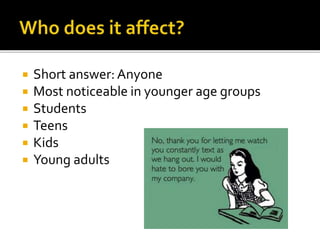
 Short answer: Anyone
 Most noticeable in younger age groups
 Students
 Teens
 Kids
 Young adults
 Stress
 Anxiety
 Sleep disturbance/loss of sleep
 Vision problems
 Symptoms of depression
 Poor performance in school
 Relationship issues with friends, family, and a
significant other
 Users experience anxiety/withdrawal
symptoms if they are without their phones, or
waiting on a text.
 When we are stressed or in uncomfortable
situations we check our phones more
frequently.
 We lose sleep checking sites/watching videos,
or texting others/waiting for a reply.
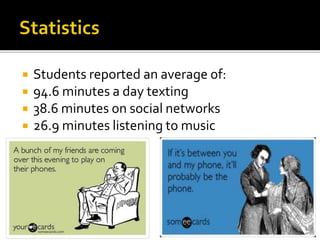
 Students reported an average of:
 94.6 minutes a day texting
 38.6 minutes on social networks
 26.9 minutes listening to music
 Women average 10 hours a day on their
phones
 Men average 8 hours a day on their phones
 College students in general average 9 hours.
 60% of college students admit they may be
addicted to their phones
 Limit yourself!
 Shut your phone off
 Have a friend or family member hold onto it
 Take breaks
 Focus on objects that are further distances
away every 15 minutes to reduce eye strain.
 Media Communications. (2014, August 27). Retrieved March 27, 2015, from
http://www.baylor.edu/mediacommunications/news.php?action=story&story=14
5864
 Obsessed with your cell phone? (2012, May 7). <i>Kashmir Monitor</i>. Retrieved
April 2, 2015, from
https://www.lexisnexis.com/lnacui2api/auth/checkbrowser.do?t=1428026667312
&bhcp=1
 Wood, J. (2014, August 31). College Students In Study Spend 8 to 10 Hours Daily
on Cell Phone. Retrieved March 27, 2015, from
http://psychcentral.com/news/2014/08/31/new-study-finds-cell-phone-addiction-
increasingly-realistic-possibility/74312.html
 Kowalski, K. (2014, September 17). Watch out: Cell phones can be addictive.
Retrieved March 27, 2015, from
https://student.societyforscience.org/article/watch-out-cell-phones-can-be-
addictive

Cell Phone Addiction

  • 1.
  • 2.
     Short answer:Anyone  Most noticeable in younger age groups  Students  Teens  Kids  Young adults
  • 3.
     Stress  Anxiety Sleep disturbance/loss of sleep  Vision problems  Symptoms of depression  Poor performance in school  Relationship issues with friends, family, and a significant other
  • 4.
     Users experienceanxiety/withdrawal symptoms if they are without their phones, or waiting on a text.  When we are stressed or in uncomfortable situations we check our phones more frequently.  We lose sleep checking sites/watching videos, or texting others/waiting for a reply.
  • 5.
     Students reportedan average of:  94.6 minutes a day texting  38.6 minutes on social networks  26.9 minutes listening to music
  • 6.
     Women average10 hours a day on their phones  Men average 8 hours a day on their phones  College students in general average 9 hours.  60% of college students admit they may be addicted to their phones
  • 7.
     Limit yourself! Shut your phone off  Have a friend or family member hold onto it  Take breaks  Focus on objects that are further distances away every 15 minutes to reduce eye strain.
  • 8.
     Media Communications.(2014, August 27). Retrieved March 27, 2015, from http://www.baylor.edu/mediacommunications/news.php?action=story&story=14 5864  Obsessed with your cell phone? (2012, May 7). <i>Kashmir Monitor</i>. Retrieved April 2, 2015, from https://www.lexisnexis.com/lnacui2api/auth/checkbrowser.do?t=1428026667312 &bhcp=1  Wood, J. (2014, August 31). College Students In Study Spend 8 to 10 Hours Daily on Cell Phone. Retrieved March 27, 2015, from http://psychcentral.com/news/2014/08/31/new-study-finds-cell-phone-addiction- increasingly-realistic-possibility/74312.html  Kowalski, K. (2014, September 17). Watch out: Cell phones can be addictive. Retrieved March 27, 2015, from https://student.societyforscience.org/article/watch-out-cell-phones-can-be- addictive