Cell Structure & Function
Cells, the smallest structures capable of maintaining life and reproducing,
compose all living things, from single-celled plants to multibillion-celled animals.
The human body, which is made up of numerous cells, begins as a single, newly
fertilized cell.
Cell Structure
Ideas about cell structure have changed considerably over the years. Early
biologists saw cells as simple membranous sacs containing fluid and a few
floating particles. Today's biologists know that cells are infinitely more complex
than this.
There are many different types, sizes, and shapes of cells in the body. For
descriptive purposes, the concept of a "generalized cell" is introduced. It includes
features from all cell types. A cell consists of three parts: the cell membrane,
the nucleus, and, between the two, the cytoplasm. Within the cytoplasm lie
intricate arrangements of fine fibers and hundreds or even thousands of
miniscule but distinct structures called organelles.
Cell membrane
Every cell in the body is enclosed by a cell (Plasma) membrane. The cell
membrane separates the material outside the cell, extracellular, from the material
inside the cell, intracellular. It maintains the integrity of a cell and controls
passage of materials into and out of the cell. All materials within a cell must have
access to the cell membrane (the cell's boundary) for the needed exchange.
The cell membrane is a double layer of phospholipid molecules. Proteins in the
cell membrane provide structural support, form channels for passage of
materials, act as receptor sites, function as carrier molecules, and provide
identification markers.
Nucleus and Nucleolus
The nucleus, formed by a nuclear membrane around a fluid nucleoplasm, is the
control center of the cell. Threads of chromatin in the nucleus
contain deoxyribonucleic acid (DNA), the genetic material of the cell.
The nucleolus is a dense region of ribonucleic acid (RNA) in the nucleus and is
the site of ribosome formation. The nucleus determines how the cell will
function, as well as the basic structure of that cell.
Cytoplasm
The cytoplasm is the gel-like fluid inside the cell. It is the medium for chemical
reaction. It provides a platform upon which other organelles can operate within
the cell. All of the functions for cell expansion, growth and replication are carried
out in the cytoplasm of a cell. Within the cytoplasm, materials move by diffusion,
a physical process that can work only for short distances.
Cytoplasmic organelles
Cytoplasmic organelles are "little organs" that are suspended in the cytoplasm
of the cell. Each type of organelle has a definite structure and a specific role in
the function of the cell. Examples of cytoplasmic organelles
are mitochondrion, ribosomes, endoplasmic reticulum, golgi apparatus,
and lysosomes.
Cell Function
The structural and functional characteristics of different types of cells are
determined by the nature of the proteins present.
Cells of various types have different functions because cell structure and function
are closely related. It is apparent that a cell that is very thin is not well suited for
a protective function.
Bone cells do not have an appropriate structure for nerve impulse conduction.
Just as there are many cell types, there are varied cell functions. The generalized
cell functions include movement of substances across the cell membrane, cell
division to make new cells, and protein synthesis.
Movement of substances across the cell membrane
The survival of the cell depends on maintaining the difference between
extracellular and intracellular material.
Mechanisms of movement across the cell membrane include
simple diffusion, osmosis, filtration, active transport, endocytosis,
and exocytosis.
Simple diffusion is the movement of particles (solutes) from a region of
higher solute concentration to a region of lower solute concentration. Osmosis
is the diffusion of solvent or water molecules through a
selectively permeable membrane.
Filtration utilizes pressure to push substances through a membrane. Active
transport moves substances against a concentration gradient from a region of
lower concentration to a region of higher concentration. It requires
a carrier molecule and uses energy.
Endocytosis refers to the formation of vesicles to transfer particles and droplets
from outside to inside the cell. Secretory vesicles are moved from the inside to
the outside of the cell by exocytosis.
Cell division
Cell division is the process by which new cells are formed for growth, repair, and
replacement in the body. This process includes division of the nuclear material
and division of the cytoplasm. All cells in the body (somatic cells), except those
that give rise to the eggs and sperm (gametes), reproduce by mitosis. Egg and
sperm cells are produced by a special type of nuclear division called meiosis in
which the number of chromosomes is halved. Division of the cytoplasm is
called cytokinesis.
Somatic cells reproduce by mitosis, which results in two cells identical to the one
parent cell. Interphase is the period between successive cell divisions. It is the
longest part of the cell cycle. The successive stages of mitosis
are prophase, metaphase, anaphase, and telophase. Cytokinesis, division of the
cytoplasm, occurs during telophase.
Meiosis is a special type of cell division that occurs in the production of the
gametes, or eggs and sperm. These cells have only 23 chromosomes, one-half
the number found in somatic cells, so that when fertilization takes place the
resulting cell will again have 46 chromosomes, 23 from the egg and 23 from the
sperm.
DNA replication and protein synthesis
Proteins that are synthesized in the cytoplasm function as structural materials,
enzymes that regulate chemical reactions, hormones, and other vital
substances. DNA in the nucleus directs protein synthesis in the cytoplasm.
A gene is the portion of a DNA molecule that controls the synthesis of one
specific protein molecule. Messenger RNA carries the genetic information from
the DNA in the nucleus to the sites of protein synthesis in the cytoplasm.
What do Prokaryotes and Eukaryotes have in Common
Both prokaryotic and eukaryotic cells are alike in some ways and share some common
features that are given below:
 Plasma Membrane, an outer covering that allows selective entry and exit of substances
in and out of the cell, is found in both cell types. Their fundamental composition in
forming a lipid bilayer with embedded proteins is also the same.
 Both contain cytoplasm, a jelly-like fluid that fills the cell’s entire interior, where all
other cellular components are found.
 DNA is the genetic material in both cell types.
 In both, ribosomes help in protein synthesis.
Examples of prokaryotic cells?
 Escherichia coli.
 Streptococcus.
 Anabaena.
 Cyanobacteria.
Examples of eukaryotic cells:
 Muscle cells.
 Stem cell.
 Bone cells.
 Cancer cells.
 Plant cells.
 Meristematic cells.
 Ova.
 Fungal cells.

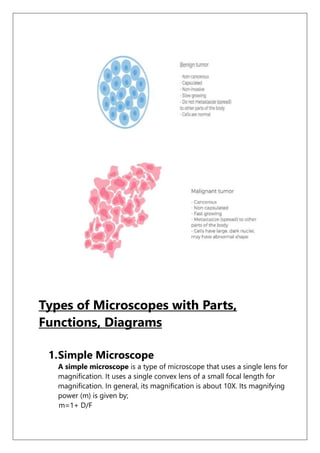
What Is a Tumor?
Atumor (also called neoplasm) is an abnormal mass of cells in the body. It is caused by
cells dividing more than normal or not dying when they should. Tumors can be classified
as benign or malignant.
They grow and behave differently depending on whether they are benign (noncancerous)
or malignant (cancerous).
The main difference between the two is that benign tumors do not spread to other parts of the
body, while malignant tumors can spread and become life-threatening.
Benign Tumors
Benign tumors are non-cancerous growths that do not spread to other parts of the body.
They are usually slow-growing and do not invade nearby tissues or organs.
They are often encapsulated, meaning they are surrounded by a fibrous capsule that separates them
from the surrounding tissues.
They can cause problems if they grow in a confined space, such as the brain, and put pressure on
surrounding tissues. They are generally not life-threatening, but some can become cancerous over
time.
Malignant Tumors
Malignant tumors are cancerous growths that can spread to other parts of the body.
They grow and invade nearby tissues and organs, and can form new tumors in other parts of the body
through a process called metastasis.
They can be life-threatening if they are not detected and treated early. They can cause a range of
symptoms, including pain, fatigue, weight loss, and changes in bowel or bladder habits.
They are often treated with a combination of surgery, radiation therapy, and chemotherapy.
Benign tumors are usually slow-growing and do not invade nearby tissues, while malignant tumors grow
quickly and invade nearby tissues.
Benign tumors are often encapsulated, while malignant tumors are not.
Benign tumors do not spread to other parts of the body, while malignant tumors can metastasize and
form new tumors in other parts of the body.
Benign tumors generally do not cause symptoms, while malignant tumors can cause a range of
symptoms depending on their location and size.
Types of Microscopes with Parts,
Functions, Diagrams
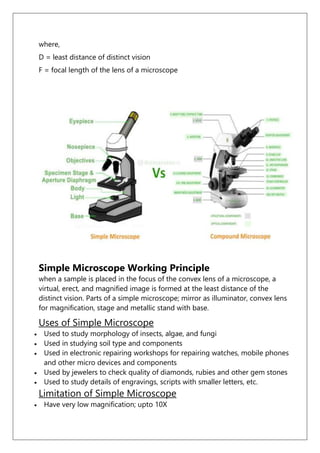
1.Simple Microscope
A simple microscope is a type of microscope that uses a single lens for
magnification. It uses a single convex lens of a small focal length for
magnification. In general, its magnification is about 10X. Its magnifying
power (m) is given by;
m=1+ D/F
where,
D = least distance of distinct vision
F = focal length of the lens of a microscope
Simple Microscope Working Principle
when a sample is placed in the focus of the convex lens of a microscope, a
virtual, erect, and magnified image is formed at the least distance of the
distinct vision. Parts of a simple microscope; mirror as illuminator, convex lens
for magnification, stage and metallic stand with base.
Uses of Simple Microscope
 Used to study morphology of insects, algae, and fungi
 Used in studying soil type and components
 Used in electronic repairing workshops for repairing watches, mobile phones
and other micro devices and components
 Used by jewelers to check quality of diamonds, rubies and other gem stones
 Used to study details of engravings, scripts with smaller letters, etc.
Limitation of Simple Microscope
 Have very low magnification; upto 10X
 Mirror for illumination and lack of mechanical stage
 Require thin stained specimen for clear vision
 Very low resolution and image contrast
2.Compound Microscope
Compound Microscope is a type of microscope that used visible light
for illumination and multiple lenses system for magnification of
specimen. Generally, it consists of two lenses; objective lens and ocular
lens. It can magnify images up to 1000X. Its magnifying power is equal to
the product of magnifying power of the objective lens in use and the
ocular lens. Mathematically it is expressed as;
m= D/f0 x L/fe
where,
m = magnifying power
D = least distance of distinct visio
L = length of the tube
fe = focal length of the ocular lens
f0 = focal length of objective lens
It is the most widely used microscope in biological fields like medicine,
microbiology, life-sciences, pathology, hematology, anatomy, molecular
biology, etc.
Compound Microscope Working Principle
When light is focused through a condenser on a specimen placed on stage, the
light transmitted by the specimen is picked by the objective lens. A magnified
image is formed at the body tube. This is called the primary image. The light
bends in the body tube and passes through the ocular lens. When passing
through the ocular lens, the image is magnified for the second time. This is
called the secondary image. Finally, a highly double magnified image is formed
at a distance of distinct vision.
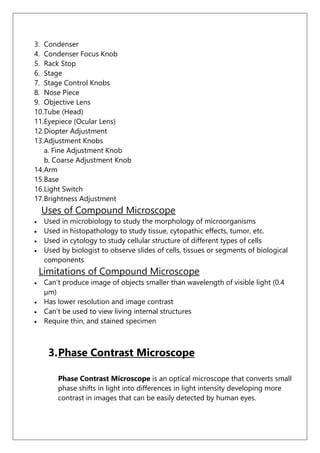
Compound Microscope Parts
1. Illuminator (Light Source)
2. Diaphragm (Iris)
3. Condenser
4. Condenser Focus Knob
5. Rack Stop
6. Stage
7. Stage Control Knobs
8. Nose Piece
9. Objective Lens
10.Tube (Head)
11.Eyepiece (Ocular Lens)
12.Diopter Adjustment
13.Adjustment Knobs
a. Fine Adjustment Knob
b. Coarse Adjustment Knob
14.Arm
15.Base
16.Light Switch
17.Brightness Adjustment
Uses of Compound Microscope
 Used in microbiology to study the morphology of microorganisms
 Used in histopathology to study tissue, cytopathic effects, tumor, etc.
 Used in cytology to study cellular structure of different types of cells
 Used by biologist to observe slides of cells, tissues or segments of biological
components
Limitations of Compound Microscope
 Can’t produce image of objects smaller than wavelength of visible light (0.4
μm)
 Has lower resolution and image contrast
 Can’t be used to view living internal structures
 Require thin, and stained specimen
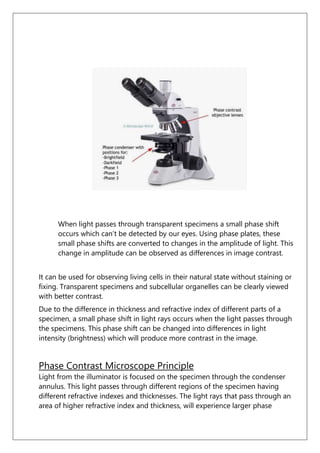
3.Phase Contrast Microscope
Phase Contrast Microscope is an optical microscope that converts small
phase shifts in light into differences in light intensity developing more
contrast in images that can be easily detected by human eyes.
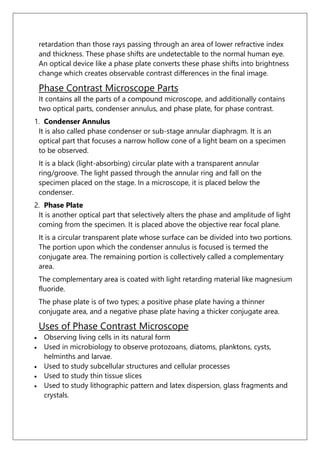
When light passes through transparent specimens a small phase shift
occurs which can’t be detected by our eyes. Using phase plates, these
small phase shifts are converted to changes in the amplitude of light. This
change in amplitude can be observed as differences in image contrast.
It can be used for observing living cells in their natural state without staining or
fixing. Transparent specimens and subcellular organelles can be clearly viewed
with better contrast.
Due to the difference in thickness and refractive index of different parts of a
specimen, a small phase shift in light rays occurs when the light passes through
the specimens. This phase shift can be changed into differences in light
intensity (brightness) which will produce more contrast in the image.
Phase Contrast Microscope Principle
Light from the illuminator is focused on the specimen through the condenser
annulus. This light passes through different regions of the specimen having
different refractive indexes and thicknesses. The light rays that pass through an
area of higher refractive index and thickness, will experience larger phase
retardation than those rays passing through an area of lower refractive index
and thickness. These phase shifts are undetectable to the normal human eye.
An optical device like a phase plate converts these phase shifts into brightness
change which creates observable contrast differences in the final image.
Phase Contrast Microscope Parts
It contains all the parts of a compound microscope, and additionally contains
two optical parts, condenser annulus, and phase plate, for phase contrast.
1. Condenser Annulus
It is also called phase condenser or sub-stage annular diaphragm. It is an
optical part that focuses a narrow hollow cone of a light beam on a specimen
to be observed.
It is a black (light-absorbing) circular plate with a transparent annular
ring/groove. The light passed through the annular ring and fall on the
specimen placed on the stage. In a microscope, it is placed below the
condenser.
2. Phase Plate
It is another optical part that selectively alters the phase and amplitude of light
coming from the specimen. It is placed above the objective rear focal plane.
It is a circular transparent plate whose surface can be divided into two portions.
The portion upon which the condenser annulus is focused is termed the
conjugate area. The remaining portion is collectively called a complementary
area.
The complementary area is coated with light retarding material like magnesium
fluoride.
The phase plate is of two types; a positive phase plate having a thinner
conjugate area, and a negative phase plate having a thicker conjugate area.
Uses of Phase Contrast Microscope
 Observing living cells in its natural form
 Used in microbiology to observe protozoans, diatoms, planktons, cysts,
helminths and larvae.
 Used to study subcellular structures and cellular processes
 Used to study thin tissue slices
 Used to study lithographic pattern and latex dispersion, glass fragments and
crystals.
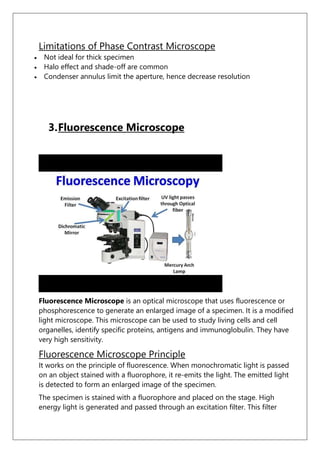
Limitations of Phase Contrast Microscope
 Not ideal for thick specimen
 Halo effect and shade-off are common
 Condenser annulus limit the aperture, hence decrease resolution
3.Fluorescence Microscope
Fluorescence Microscope is an optical microscope that uses fluorescence or
phosphorescence to generate an enlarged image of a specimen. It is a modified
light microscope. This microscope can be used to study living cells and cell
organelles, identify specific proteins, antigens and immunoglobulin. They have
very high sensitivity.
Fluorescence Microscope Principle
It works on the principle of fluorescence. When monochromatic light is passed
on an object stained with a fluorophore, it re-emits the light. The emitted light
is detected to form an enlarged image of the specimen.
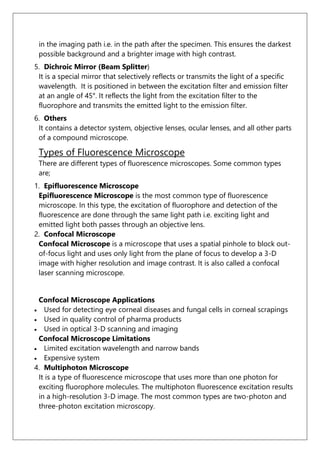
The specimen is stained with a fluorophore and placed on the stage. High
energy light is generated and passed through an excitation filter. This filter
allows only the light of a particular short wavelength (UV region) capable of
exciting the fluorescent molecule to pass through and block all other
wavelength light.
The filtered light is reflected to the sample using a dichroic filter. The
fluorophore absorbs the light rays which cause the electron to excite in a
higher energy state. The excited electrons return to the ground state releasing
the excited energy in form of light rays with a longer wavelength.
The emitted light passes through the dichroic mirror and hits the emission
filter. This filter blocks the short-wavelength light and allows longer wavelength
light to pass through ocular lenses to a detector system.
In the detector, an enlarged image is formed. The background is observed as
dark and the image appears as bright.
Fluorescence Microscope Parts
A typical fluorescence microscope contains the following parts;
1. Fluorophore (Fluorescent Dye)
These are the chemical compounds that possess the property of fluorescence
i.e. re-emit the light upon excitation by light. These are combinations of several
aromatic or planar compounds with several pi (π) bonds. Most of them are
organic compounds. They stain a wide range of biomolecules and cellular
structures. Some common fluorophores used are fluorescein, rhodamine,
cyanine, antraquinone, acridine orange, acridine yellow, auramine, malachite
green, etc.
2. Light Source
Commonly mercury vapor lamp is used for generating UV light. Besides, xenon
arc lamps, high-power LEDs, and lasers are also used. They emit the light of
high energy.
3. Excitation Filter
It is a band-pass filter that allows the light of a short wavelength that can excite
the fluorophore to pass through and block all other exciting and long-
wavelength radiations. They are placed in an illumination path i.e. in the path
before the specimen.
4. Emission Filter
It is another band-pass filter that allows all the fluorophore emitted light to
pass through and block all other light in the excitation range. They are placed
in the imaging path i.e. in the path after the specimen. This ensures the darkest
possible background and a brighter image with high contrast.
5. Dichroic Mirror (Beam Splitter)
It is a special mirror that selectively reflects or transmits the light of a specific
wavelength. It is positioned in between the excitation filter and emission filter
at an angle of 45°. It reflects the light from the excitation filter to the
fluorophore and transmits the emitted light to the emission filter.
6. Others
It contains a detector system, objective lenses, ocular lenses, and all other parts
of a compound microscope.
Types of Fluorescence Microscope
There are different types of fluorescence microscopes. Some common types
are;
1. Epifluorescence Microscope
Epifluorescence Microscope is the most common type of fluorescence
microscope. In this type, the excitation of fluorophore and detection of the
fluorescence are done through the same light path i.e. exciting light and
emitted light both passes through an objective lens.
2. Confocal Microscope
Confocal Microscope is a microscope that uses a spatial pinhole to block out-
of-focus light and uses only light from the plane of focus to develop a 3-D
image with higher resolution and image contrast. It is also called a confocal
laser scanning microscope.
Confocal Microscope Applications
 Used for detecting eye corneal diseases and fungal cells in corneal scrapings
 Used in quality control of pharma products
 Used in optical 3-D scanning and imaging
Confocal Microscope Limitations
 Limited excitation wavelength and narrow bands
 Expensive system
4. Multiphoton Microscope
It is a type of fluorescence microscope that uses more than one photon for
exciting fluorophore molecules. The multiphoton fluorescence excitation results
in a high-resolution 3-D image. The most common types are two-photon and
three-photon excitation microscopy.
5. Total Internal Reflection Fluorescence (TIRF) Microscope
It is a type of fluorescence microscope that is used for selectively imaging
fluorophore molecules in an aqueous environment close to a solid surface with
a high refractive index. High-resolution images with better contrast decreased
background and brighter clearer images are its advantages.
Uses of Fluorescence Microscope
 Study structure of fixed and live cells and cell organelles
 Used to measure physiological state of cells
 Detection of acid fast bacteria, malarial parasites and other microorganisms in
clinical samples
 Used in immunology and biochemistry to study macromolecules and nucleic
acids
 Used in Fluorescent In-situ Hybridization (FISH) technique in study of
microbial ecology
Limitations of Fluorescence Microscope
 Photo-bleaching limits the time interval for observation of specimen
 Phototoxic effects of fluorophore
 Need of specific fluorophore for staining specific structures
5. Electron Microscope
Electron microscopy. The energy source used in the electron microscope is a
beam of electrons. Since the beam has an exceptionally short wavelength, it
strikes most objects in its path and increases the resolution of the microscope
significantly. Viruses and some large molecules can be seen with this
instrument. The electrons travel in a vacuum to avoid contact with deflecting air
molecules, and magnets focus the beam on the object to be viewed. An image
is created on a monitor and viewed by the technologist.
The more traditional form of electron microscope is the transmission electron
microscope (TEM). To use this instrument, one places ultrathin slices of
microorganisms or viruses on a wire grid and then stains them with gold or
palladium before viewing. The densely coated parts of the specimen deflect the
electron beam, and both dark and light areas show up on the image.
The scanning electron microscope (SEM) is the more contemporary form
electron microscope. Although this microscope gives lower magnifications than
the TEM, the SEM permits three‐dimensional views of microorganisms and
other objects. Whole objects are used, and gold or palladium staining is
employed.
Scanning Electron Microscope (SEM) vs Transmission
Electron Microscope (TEM)
Scanning Electron Microscope (SEM) Transmission Electron Microscope (TEM)
Its imaging is based on emitted and scattered electrons. Its imaging is based on transmitted electrons.
It produces a 3-D image. It produces a 2-D image.
It provides information about morphology and topography. It provides information about morphology only.
A thicker sample can be processed. Need a very thin sample.
It can resolve objects as close as 20 nm. It can resolve objects as close as 1nm.
Comparatively lower magnification, up to 50,000X. Higher magnification, upto 2,000,000X.
Uses of Electron Microscope
 Used in microbiology to study structure of viruses, flagella, pili, and bacterial
cells.
 Used in crystallography, and nano-technology
 To study morphology of cellular organelles
 Used in forensics for ballistic study of gunshots
 Used in geology for studying rocks, minerals and gems
 Used in quality control, detection of fracture and cracks, drug development
and analysis of atomic structure.
Limitations of Electron Microscope
 Highly expensive and complex system
 Images are in black and white
 TEM requires very thin specimen
 Need of vacuum system.

CELL MICROBIOLOGY AND MICROSCOPE TYPES

  • 1.
    Cell Structure &Function Cells, the smallest structures capable of maintaining life and reproducing, compose all living things, from single-celled plants to multibillion-celled animals. The human body, which is made up of numerous cells, begins as a single, newly fertilized cell. Cell Structure Ideas about cell structure have changed considerably over the years. Early biologists saw cells as simple membranous sacs containing fluid and a few floating particles. Today's biologists know that cells are infinitely more complex than this. There are many different types, sizes, and shapes of cells in the body. For descriptive purposes, the concept of a "generalized cell" is introduced. It includes features from all cell types. A cell consists of three parts: the cell membrane, the nucleus, and, between the two, the cytoplasm. Within the cytoplasm lie intricate arrangements of fine fibers and hundreds or even thousands of miniscule but distinct structures called organelles. Cell membrane Every cell in the body is enclosed by a cell (Plasma) membrane. The cell membrane separates the material outside the cell, extracellular, from the material
  • 2.
    inside the cell,intracellular. It maintains the integrity of a cell and controls passage of materials into and out of the cell. All materials within a cell must have access to the cell membrane (the cell's boundary) for the needed exchange. The cell membrane is a double layer of phospholipid molecules. Proteins in the cell membrane provide structural support, form channels for passage of materials, act as receptor sites, function as carrier molecules, and provide identification markers. Nucleus and Nucleolus The nucleus, formed by a nuclear membrane around a fluid nucleoplasm, is the control center of the cell. Threads of chromatin in the nucleus contain deoxyribonucleic acid (DNA), the genetic material of the cell. The nucleolus is a dense region of ribonucleic acid (RNA) in the nucleus and is the site of ribosome formation. The nucleus determines how the cell will function, as well as the basic structure of that cell. Cytoplasm The cytoplasm is the gel-like fluid inside the cell. It is the medium for chemical reaction. It provides a platform upon which other organelles can operate within the cell. All of the functions for cell expansion, growth and replication are carried out in the cytoplasm of a cell. Within the cytoplasm, materials move by diffusion, a physical process that can work only for short distances. Cytoplasmic organelles Cytoplasmic organelles are "little organs" that are suspended in the cytoplasm of the cell. Each type of organelle has a definite structure and a specific role in the function of the cell. Examples of cytoplasmic organelles are mitochondrion, ribosomes, endoplasmic reticulum, golgi apparatus, and lysosomes. Cell Function The structural and functional characteristics of different types of cells are determined by the nature of the proteins present.
  • 3.
    Cells of varioustypes have different functions because cell structure and function are closely related. It is apparent that a cell that is very thin is not well suited for a protective function. Bone cells do not have an appropriate structure for nerve impulse conduction. Just as there are many cell types, there are varied cell functions. The generalized cell functions include movement of substances across the cell membrane, cell division to make new cells, and protein synthesis. Movement of substances across the cell membrane The survival of the cell depends on maintaining the difference between extracellular and intracellular material. Mechanisms of movement across the cell membrane include simple diffusion, osmosis, filtration, active transport, endocytosis, and exocytosis. Simple diffusion is the movement of particles (solutes) from a region of higher solute concentration to a region of lower solute concentration. Osmosis is the diffusion of solvent or water molecules through a selectively permeable membrane. Filtration utilizes pressure to push substances through a membrane. Active transport moves substances against a concentration gradient from a region of lower concentration to a region of higher concentration. It requires a carrier molecule and uses energy. Endocytosis refers to the formation of vesicles to transfer particles and droplets from outside to inside the cell. Secretory vesicles are moved from the inside to the outside of the cell by exocytosis.
  • 4.
    Cell division Cell divisionis the process by which new cells are formed for growth, repair, and replacement in the body. This process includes division of the nuclear material and division of the cytoplasm. All cells in the body (somatic cells), except those that give rise to the eggs and sperm (gametes), reproduce by mitosis. Egg and sperm cells are produced by a special type of nuclear division called meiosis in which the number of chromosomes is halved. Division of the cytoplasm is called cytokinesis. Somatic cells reproduce by mitosis, which results in two cells identical to the one parent cell. Interphase is the period between successive cell divisions. It is the longest part of the cell cycle. The successive stages of mitosis are prophase, metaphase, anaphase, and telophase. Cytokinesis, division of the cytoplasm, occurs during telophase. Meiosis is a special type of cell division that occurs in the production of the gametes, or eggs and sperm. These cells have only 23 chromosomes, one-half the number found in somatic cells, so that when fertilization takes place the resulting cell will again have 46 chromosomes, 23 from the egg and 23 from the sperm.
  • 5.
    DNA replication andprotein synthesis Proteins that are synthesized in the cytoplasm function as structural materials, enzymes that regulate chemical reactions, hormones, and other vital substances. DNA in the nucleus directs protein synthesis in the cytoplasm. A gene is the portion of a DNA molecule that controls the synthesis of one specific protein molecule. Messenger RNA carries the genetic information from the DNA in the nucleus to the sites of protein synthesis in the cytoplasm.
  • 6.
    What do Prokaryotesand Eukaryotes have in Common Both prokaryotic and eukaryotic cells are alike in some ways and share some common features that are given below:  Plasma Membrane, an outer covering that allows selective entry and exit of substances in and out of the cell, is found in both cell types. Their fundamental composition in forming a lipid bilayer with embedded proteins is also the same.  Both contain cytoplasm, a jelly-like fluid that fills the cell’s entire interior, where all other cellular components are found.  DNA is the genetic material in both cell types.  In both, ribosomes help in protein synthesis. Examples of prokaryotic cells?  Escherichia coli.  Streptococcus.  Anabaena.  Cyanobacteria. Examples of eukaryotic cells:  Muscle cells.  Stem cell.  Bone cells.  Cancer cells.
  • 7.
     Plant cells. Meristematic cells.  Ova.  Fungal cells.  What Is a Tumor? Atumor (also called neoplasm) is an abnormal mass of cells in the body. It is caused by cells dividing more than normal or not dying when they should. Tumors can be classified as benign or malignant. They grow and behave differently depending on whether they are benign (noncancerous) or malignant (cancerous). The main difference between the two is that benign tumors do not spread to other parts of the body, while malignant tumors can spread and become life-threatening. Benign Tumors Benign tumors are non-cancerous growths that do not spread to other parts of the body. They are usually slow-growing and do not invade nearby tissues or organs. They are often encapsulated, meaning they are surrounded by a fibrous capsule that separates them from the surrounding tissues. They can cause problems if they grow in a confined space, such as the brain, and put pressure on surrounding tissues. They are generally not life-threatening, but some can become cancerous over time. Malignant Tumors Malignant tumors are cancerous growths that can spread to other parts of the body. They grow and invade nearby tissues and organs, and can form new tumors in other parts of the body through a process called metastasis. They can be life-threatening if they are not detected and treated early. They can cause a range of symptoms, including pain, fatigue, weight loss, and changes in bowel or bladder habits. They are often treated with a combination of surgery, radiation therapy, and chemotherapy.
  • 8.
    Benign tumors areusually slow-growing and do not invade nearby tissues, while malignant tumors grow quickly and invade nearby tissues. Benign tumors are often encapsulated, while malignant tumors are not. Benign tumors do not spread to other parts of the body, while malignant tumors can metastasize and form new tumors in other parts of the body. Benign tumors generally do not cause symptoms, while malignant tumors can cause a range of symptoms depending on their location and size.
  • 9.
    Types of Microscopeswith Parts, Functions, Diagrams 1.Simple Microscope A simple microscope is a type of microscope that uses a single lens for magnification. It uses a single convex lens of a small focal length for magnification. In general, its magnification is about 10X. Its magnifying power (m) is given by; m=1+ D/F
  • 10.
    where, D = leastdistance of distinct vision F = focal length of the lens of a microscope Simple Microscope Working Principle when a sample is placed in the focus of the convex lens of a microscope, a virtual, erect, and magnified image is formed at the least distance of the distinct vision. Parts of a simple microscope; mirror as illuminator, convex lens for magnification, stage and metallic stand with base. Uses of Simple Microscope  Used to study morphology of insects, algae, and fungi  Used in studying soil type and components  Used in electronic repairing workshops for repairing watches, mobile phones and other micro devices and components  Used by jewelers to check quality of diamonds, rubies and other gem stones  Used to study details of engravings, scripts with smaller letters, etc. Limitation of Simple Microscope  Have very low magnification; upto 10X
  • 11.
     Mirror forillumination and lack of mechanical stage  Require thin stained specimen for clear vision  Very low resolution and image contrast 2.Compound Microscope Compound Microscope is a type of microscope that used visible light for illumination and multiple lenses system for magnification of specimen. Generally, it consists of two lenses; objective lens and ocular lens. It can magnify images up to 1000X. Its magnifying power is equal to the product of magnifying power of the objective lens in use and the ocular lens. Mathematically it is expressed as; m= D/f0 x L/fe where, m = magnifying power D = least distance of distinct visio L = length of the tube fe = focal length of the ocular lens f0 = focal length of objective lens It is the most widely used microscope in biological fields like medicine, microbiology, life-sciences, pathology, hematology, anatomy, molecular biology, etc. Compound Microscope Working Principle When light is focused through a condenser on a specimen placed on stage, the light transmitted by the specimen is picked by the objective lens. A magnified image is formed at the body tube. This is called the primary image. The light bends in the body tube and passes through the ocular lens. When passing through the ocular lens, the image is magnified for the second time. This is called the secondary image. Finally, a highly double magnified image is formed at a distance of distinct vision. Compound Microscope Parts 1. Illuminator (Light Source) 2. Diaphragm (Iris)
  • 12.
    3. Condenser 4. CondenserFocus Knob 5. Rack Stop 6. Stage 7. Stage Control Knobs 8. Nose Piece 9. Objective Lens 10.Tube (Head) 11.Eyepiece (Ocular Lens) 12.Diopter Adjustment 13.Adjustment Knobs a. Fine Adjustment Knob b. Coarse Adjustment Knob 14.Arm 15.Base 16.Light Switch 17.Brightness Adjustment Uses of Compound Microscope  Used in microbiology to study the morphology of microorganisms  Used in histopathology to study tissue, cytopathic effects, tumor, etc.  Used in cytology to study cellular structure of different types of cells  Used by biologist to observe slides of cells, tissues or segments of biological components Limitations of Compound Microscope  Can’t produce image of objects smaller than wavelength of visible light (0.4 μm)  Has lower resolution and image contrast  Can’t be used to view living internal structures  Require thin, and stained specimen 3.Phase Contrast Microscope Phase Contrast Microscope is an optical microscope that converts small phase shifts in light into differences in light intensity developing more contrast in images that can be easily detected by human eyes.
  • 13.
    When light passesthrough transparent specimens a small phase shift occurs which can’t be detected by our eyes. Using phase plates, these small phase shifts are converted to changes in the amplitude of light. This change in amplitude can be observed as differences in image contrast. It can be used for observing living cells in their natural state without staining or fixing. Transparent specimens and subcellular organelles can be clearly viewed with better contrast. Due to the difference in thickness and refractive index of different parts of a specimen, a small phase shift in light rays occurs when the light passes through the specimens. This phase shift can be changed into differences in light intensity (brightness) which will produce more contrast in the image. Phase Contrast Microscope Principle Light from the illuminator is focused on the specimen through the condenser annulus. This light passes through different regions of the specimen having different refractive indexes and thicknesses. The light rays that pass through an area of higher refractive index and thickness, will experience larger phase
  • 14.
    retardation than thoserays passing through an area of lower refractive index and thickness. These phase shifts are undetectable to the normal human eye. An optical device like a phase plate converts these phase shifts into brightness change which creates observable contrast differences in the final image. Phase Contrast Microscope Parts It contains all the parts of a compound microscope, and additionally contains two optical parts, condenser annulus, and phase plate, for phase contrast. 1. Condenser Annulus It is also called phase condenser or sub-stage annular diaphragm. It is an optical part that focuses a narrow hollow cone of a light beam on a specimen to be observed. It is a black (light-absorbing) circular plate with a transparent annular ring/groove. The light passed through the annular ring and fall on the specimen placed on the stage. In a microscope, it is placed below the condenser. 2. Phase Plate It is another optical part that selectively alters the phase and amplitude of light coming from the specimen. It is placed above the objective rear focal plane. It is a circular transparent plate whose surface can be divided into two portions. The portion upon which the condenser annulus is focused is termed the conjugate area. The remaining portion is collectively called a complementary area. The complementary area is coated with light retarding material like magnesium fluoride. The phase plate is of two types; a positive phase plate having a thinner conjugate area, and a negative phase plate having a thicker conjugate area. Uses of Phase Contrast Microscope  Observing living cells in its natural form  Used in microbiology to observe protozoans, diatoms, planktons, cysts, helminths and larvae.  Used to study subcellular structures and cellular processes  Used to study thin tissue slices  Used to study lithographic pattern and latex dispersion, glass fragments and crystals.
  • 15.
    Limitations of PhaseContrast Microscope  Not ideal for thick specimen  Halo effect and shade-off are common  Condenser annulus limit the aperture, hence decrease resolution 3.Fluorescence Microscope Fluorescence Microscope is an optical microscope that uses fluorescence or phosphorescence to generate an enlarged image of a specimen. It is a modified light microscope. This microscope can be used to study living cells and cell organelles, identify specific proteins, antigens and immunoglobulin. They have very high sensitivity. Fluorescence Microscope Principle It works on the principle of fluorescence. When monochromatic light is passed on an object stained with a fluorophore, it re-emits the light. The emitted light is detected to form an enlarged image of the specimen. The specimen is stained with a fluorophore and placed on the stage. High energy light is generated and passed through an excitation filter. This filter
  • 16.
    allows only thelight of a particular short wavelength (UV region) capable of exciting the fluorescent molecule to pass through and block all other wavelength light. The filtered light is reflected to the sample using a dichroic filter. The fluorophore absorbs the light rays which cause the electron to excite in a higher energy state. The excited electrons return to the ground state releasing the excited energy in form of light rays with a longer wavelength. The emitted light passes through the dichroic mirror and hits the emission filter. This filter blocks the short-wavelength light and allows longer wavelength light to pass through ocular lenses to a detector system. In the detector, an enlarged image is formed. The background is observed as dark and the image appears as bright. Fluorescence Microscope Parts A typical fluorescence microscope contains the following parts; 1. Fluorophore (Fluorescent Dye) These are the chemical compounds that possess the property of fluorescence i.e. re-emit the light upon excitation by light. These are combinations of several aromatic or planar compounds with several pi (π) bonds. Most of them are organic compounds. They stain a wide range of biomolecules and cellular structures. Some common fluorophores used are fluorescein, rhodamine, cyanine, antraquinone, acridine orange, acridine yellow, auramine, malachite green, etc. 2. Light Source Commonly mercury vapor lamp is used for generating UV light. Besides, xenon arc lamps, high-power LEDs, and lasers are also used. They emit the light of high energy. 3. Excitation Filter It is a band-pass filter that allows the light of a short wavelength that can excite the fluorophore to pass through and block all other exciting and long- wavelength radiations. They are placed in an illumination path i.e. in the path before the specimen. 4. Emission Filter It is another band-pass filter that allows all the fluorophore emitted light to pass through and block all other light in the excitation range. They are placed
  • 17.
    in the imagingpath i.e. in the path after the specimen. This ensures the darkest possible background and a brighter image with high contrast. 5. Dichroic Mirror (Beam Splitter) It is a special mirror that selectively reflects or transmits the light of a specific wavelength. It is positioned in between the excitation filter and emission filter at an angle of 45°. It reflects the light from the excitation filter to the fluorophore and transmits the emitted light to the emission filter. 6. Others It contains a detector system, objective lenses, ocular lenses, and all other parts of a compound microscope. Types of Fluorescence Microscope There are different types of fluorescence microscopes. Some common types are; 1. Epifluorescence Microscope Epifluorescence Microscope is the most common type of fluorescence microscope. In this type, the excitation of fluorophore and detection of the fluorescence are done through the same light path i.e. exciting light and emitted light both passes through an objective lens. 2. Confocal Microscope Confocal Microscope is a microscope that uses a spatial pinhole to block out- of-focus light and uses only light from the plane of focus to develop a 3-D image with higher resolution and image contrast. It is also called a confocal laser scanning microscope. Confocal Microscope Applications  Used for detecting eye corneal diseases and fungal cells in corneal scrapings  Used in quality control of pharma products  Used in optical 3-D scanning and imaging Confocal Microscope Limitations  Limited excitation wavelength and narrow bands  Expensive system 4. Multiphoton Microscope It is a type of fluorescence microscope that uses more than one photon for exciting fluorophore molecules. The multiphoton fluorescence excitation results in a high-resolution 3-D image. The most common types are two-photon and three-photon excitation microscopy.
  • 18.
    5. Total InternalReflection Fluorescence (TIRF) Microscope It is a type of fluorescence microscope that is used for selectively imaging fluorophore molecules in an aqueous environment close to a solid surface with a high refractive index. High-resolution images with better contrast decreased background and brighter clearer images are its advantages. Uses of Fluorescence Microscope  Study structure of fixed and live cells and cell organelles  Used to measure physiological state of cells  Detection of acid fast bacteria, malarial parasites and other microorganisms in clinical samples  Used in immunology and biochemistry to study macromolecules and nucleic acids  Used in Fluorescent In-situ Hybridization (FISH) technique in study of microbial ecology Limitations of Fluorescence Microscope  Photo-bleaching limits the time interval for observation of specimen  Phototoxic effects of fluorophore  Need of specific fluorophore for staining specific structures 5. Electron Microscope Electron microscopy. The energy source used in the electron microscope is a beam of electrons. Since the beam has an exceptionally short wavelength, it strikes most objects in its path and increases the resolution of the microscope significantly. Viruses and some large molecules can be seen with this instrument. The electrons travel in a vacuum to avoid contact with deflecting air molecules, and magnets focus the beam on the object to be viewed. An image is created on a monitor and viewed by the technologist. The more traditional form of electron microscope is the transmission electron microscope (TEM). To use this instrument, one places ultrathin slices of microorganisms or viruses on a wire grid and then stains them with gold or palladium before viewing. The densely coated parts of the specimen deflect the electron beam, and both dark and light areas show up on the image. The scanning electron microscope (SEM) is the more contemporary form electron microscope. Although this microscope gives lower magnifications than
  • 19.
    the TEM, theSEM permits three‐dimensional views of microorganisms and other objects. Whole objects are used, and gold or palladium staining is employed. Scanning Electron Microscope (SEM) vs Transmission Electron Microscope (TEM) Scanning Electron Microscope (SEM) Transmission Electron Microscope (TEM) Its imaging is based on emitted and scattered electrons. Its imaging is based on transmitted electrons. It produces a 3-D image. It produces a 2-D image. It provides information about morphology and topography. It provides information about morphology only. A thicker sample can be processed. Need a very thin sample. It can resolve objects as close as 20 nm. It can resolve objects as close as 1nm. Comparatively lower magnification, up to 50,000X. Higher magnification, upto 2,000,000X. Uses of Electron Microscope  Used in microbiology to study structure of viruses, flagella, pili, and bacterial cells.  Used in crystallography, and nano-technology  To study morphology of cellular organelles  Used in forensics for ballistic study of gunshots  Used in geology for studying rocks, minerals and gems  Used in quality control, detection of fracture and cracks, drug development and analysis of atomic structure. Limitations of Electron Microscope  Highly expensive and complex system  Images are in black and white  TEM requires very thin specimen  Need of vacuum system.