By
Dr. Mayada Saad Farrag
Lecturer of Pathlogy
Faculty of Medicine
Welcome
Key Concepts
* Normal cells have a fairly narrow range of
function or steady state: Homeostasis.
• Excess physiologic or pathologic stress may
force the cell to a new steady state:
Adaptation.
* Too much stress exceeds the cell’s adaptive
capacity: Injury.
Adaptation
Reversible Injury
Irreversible injury
Cell Death
Normal cell
Cellular Response to Stress
Adaptations
It is modification of cell morphology and function
to achieve a new steady but altered state,
preserving the viability of cells, which include
1- Hypertrophy
2 –Atrophy
3- Hyperplasia
4- Metaplasia
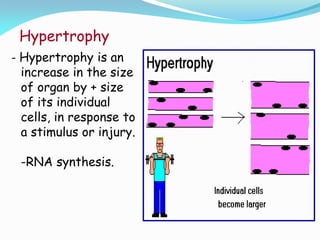
Hypertrophy
- Hypertrophy is an
increase in the size
of organ by + size
of its individual
cells, in response to
a stimulus or injury.
-RNA synthesis.
Types
 Physiological
 Hormonal: pregnancy
 Adaptive: athletes
 Pathological
 Hormonal: Gigantism
 Adaptive: LVH
 Compensatory: paired organs
Hyperplasia
-Is an increase in organ size by increase of
number of its cells, in response to a
stimulus or persistent cell injury.
-DNA synthesis
-Imp:
 C/p: mass - bleeding
 Reversible
 Precancerous
Types
 Physiological
 Hormonal: Lactation (breast)
 Adaptive: puberty (thyroid)
 Pathological
 Hormonal: endometrial
 Irritative: epithelium
 Compensatory: hepatoctes
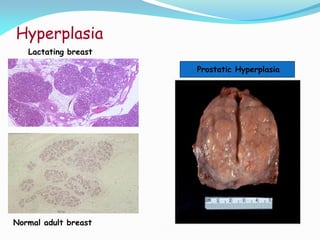
Hyperplasia
Normal adult breast
Lactating breast
Prostatic Hyperplasia
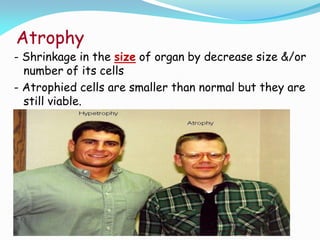
Atrophy
- Shrinkage in the size of organ by decrease size &/or
number of its cells
- Atrophied cells are smaller than normal but they are
still viable.
Atrophy
Physiologic
 General:senility
 Local:Tissues / structures present in embryo or in childhood.
Pathologic
 General: starvatin –toxic-hormonal
 Local
Disuse
Neurogenic
Ischaemic
Hormonal
Thermal
Immune
pressure
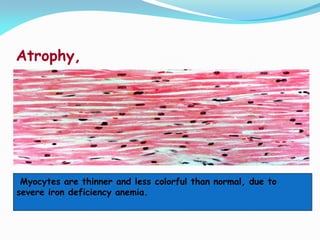
Atrophy,
Myocytes are thinner and less colorful than normal, due to
severe iron deficiency anemia.
Morphology
N/E
 General
Skin: wrinkled
Fat: exhausted
Muscles: wasted
Lung: atrophic emphysema
Bone: osteoporosis
Heart: brown atrophy
 Local: decrease size &
weight.
M/E
 Cytoplasm: reduced
 Nucleus: normal
 Intercellular spaces:
fibrous or fibrofatty
tissue.
Metaplasia
-A reversible change in which one mature/adult cell
type (epithelial or mesenchymal) is replaced by
another mature cell type of the same category.
- A/E: Chronic irritation- avitminosis A- genetic
- Types: Epithelial, C.T, Mesothelial
Epithelial metaplasia
 Causes: It is an adaptive mechanism by which the
cells less sensitive to stress are replaced by
other cell type more capable to withstand the
adverse enviroment.
 Types: - Squamous metaplasia.
- Glandular metaplasia.
- Mesothelial metaplasia.
 It may be precancerous especially epithelial
metaplasia although it is reversible
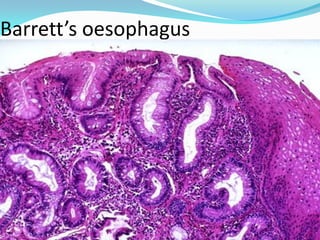
Barrett’s oesophagus
Cell inj 1.pdf

Cell inj 1.pdf

  • 1.
    By Dr. Mayada SaadFarrag Lecturer of Pathlogy Faculty of Medicine
  • 2.
  • 3.
    Key Concepts * Normalcells have a fairly narrow range of function or steady state: Homeostasis. • Excess physiologic or pathologic stress may force the cell to a new steady state: Adaptation. * Too much stress exceeds the cell’s adaptive capacity: Injury.
  • 4.
    Adaptation Reversible Injury Irreversible injury CellDeath Normal cell Cellular Response to Stress
  • 5.
    Adaptations It is modificationof cell morphology and function to achieve a new steady but altered state, preserving the viability of cells, which include 1- Hypertrophy 2 –Atrophy 3- Hyperplasia 4- Metaplasia
  • 6.
    Hypertrophy - Hypertrophy isan increase in the size of organ by + size of its individual cells, in response to a stimulus or injury. -RNA synthesis.
  • 7.
    Types  Physiological  Hormonal:pregnancy  Adaptive: athletes  Pathological  Hormonal: Gigantism  Adaptive: LVH  Compensatory: paired organs
  • 8.
    Hyperplasia -Is an increasein organ size by increase of number of its cells, in response to a stimulus or persistent cell injury. -DNA synthesis -Imp:  C/p: mass - bleeding  Reversible  Precancerous
  • 9.
    Types  Physiological  Hormonal:Lactation (breast)  Adaptive: puberty (thyroid)  Pathological  Hormonal: endometrial  Irritative: epithelium  Compensatory: hepatoctes
  • 10.
    Hyperplasia Normal adult breast Lactatingbreast Prostatic Hyperplasia
  • 11.
    Atrophy - Shrinkage inthe size of organ by decrease size &/or number of its cells - Atrophied cells are smaller than normal but they are still viable.
  • 12.
    Atrophy Physiologic  General:senility  Local:Tissues/ structures present in embryo or in childhood. Pathologic  General: starvatin –toxic-hormonal  Local Disuse Neurogenic Ischaemic Hormonal Thermal Immune pressure
  • 13.
    Atrophy, Myocytes are thinnerand less colorful than normal, due to severe iron deficiency anemia.
  • 14.
    Morphology N/E  General Skin: wrinkled Fat:exhausted Muscles: wasted Lung: atrophic emphysema Bone: osteoporosis Heart: brown atrophy  Local: decrease size & weight. M/E  Cytoplasm: reduced  Nucleus: normal  Intercellular spaces: fibrous or fibrofatty tissue.
  • 15.
    Metaplasia -A reversible changein which one mature/adult cell type (epithelial or mesenchymal) is replaced by another mature cell type of the same category. - A/E: Chronic irritation- avitminosis A- genetic - Types: Epithelial, C.T, Mesothelial
  • 16.
    Epithelial metaplasia  Causes:It is an adaptive mechanism by which the cells less sensitive to stress are replaced by other cell type more capable to withstand the adverse enviroment.  Types: - Squamous metaplasia. - Glandular metaplasia. - Mesothelial metaplasia.  It may be precancerous especially epithelial metaplasia although it is reversible
  • 18.