


Stopping the Sequester
February 19th, 2013


Celinda Lake
Washington, DC | Berkeley, CA | New York, NY
LakeResearch.com
202.776.9066
Strategic Summary: Context
•   We have seen major wins with the public on taxes. Voters still believe the
    wealthiest 2% and big corporations are not paying enough in taxes. We have
    seen losses in the budget debates with increased salience around deficits and
    support for across the board cuts.

•   Voters still believe the budget can be balanced by cutting waste, fraud, and
    abuse.

•   We are paying a price for the lack of a comprehensive progressive economic
    narrative.

•   When we have candidates that do implement progressive economic policies,
    they do not talk about them enough. This vacuum of information is filled by
    Republican talking points on “big government” and “wasteful spending.”

•   In the near future, we can not allow the sequester and other short term budget
    gimmicks from Republicans deal fatal blows to Medicare and Social Security.      2
Strategic Summary: Policies
•   On the idea of reducing the deficit, the public sides with Republicans, but when specific
    proposals are mentioned they are on our side.

•   When the public is faced with actual choices to reduce the budget deficit, the only
    ideas that gain majority approval involve raising taxes on the wealthy, like limiting
    deductions or raising the tax on investment income. We should not just refer to
    revenue. The only budget item that voters support cutting is foreign aid.

•   Reducing Social Security and Medicare benefits for higher income retirees is a much
    more popular proposal than raising the retirement age, but it would set a dangerous
    precedent. Voters do support lifting the cap on income subject to Social Security taxes.

•   Cutting defense spending is also an unpopular option, largely driven by resistance from
    women. Women are very skeptical that the defense budget can be cut without posing a
    threat to national security in general, but more specifically they worry about the impact
    on troops and their families.

•   People like balanced approaches with budget cuts and taxes.
                                                                                                3
Strategic Summary: Strategies
•   In the big picture, it is important to remember that the debate over the
    budget deficit is part of a political strategy by the Republican Party.

•   They made attacking the deficit a political strategy to attack President Obama
    from the beginning of his first term, when only the most cynical observers
    would deny that the deficit was left on Obama’s doorstep following the Great
    Recession and the fiscal irresponsibility of the Bush Administration.

•   They continue to raise it as an issue because it neutralizes the trust the public
    has with Democrats on protecting Social Security and Medicare.

•   It is important to shift away from an austerity debate, not only to protect
    America’s seniors, but also to devote attention and political capital to
    progressive priorities like the environment, immigration reform, and
    strengthening gun laws.

                                                                                        4
Strategic Summary: Message
•   Going forward, there are several key ingredients made up the message
    frames that led Democrats to victory this cycle and should remain as a
    component of the Democratic messaging on the economy:

     – Economic fairness: juxtaposing the windfall profits of a handful of
       millionaires and billionaires with the steady erosion of America’s working
       middle class. The best budget arguments contrast tax breaks with a focus
       on education and protecting Medicare.

     – Job creation: outlining plans to rebuild the middle class through a Made-
       in-America agenda and cracking down on job outsourcing, unfair trade
       deals, and corporate tax loopholes, and making bold investments.

     – GOP’s wrong priorities: drawing a strong contrast with Republican plans
       to gut Medicare and education in order to subsidize tax breaks for
       millionaires.
                                                                                    5
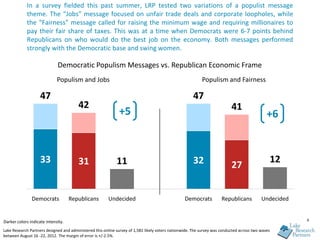
In a survey fielded this past summer, LRP tested two variations of a populist message
            theme. The “Jobs” message focused on unfair trade deals and corporate loopholes, while
            the “Fairness” message called for raising the minimum wage and requiring millionaires to
            pay their fair share of taxes. This was at a time when Democrats were 6-7 points behind
            Republicans on who would do the best job on the economy. Both messages performed
            strongly with the Democratic base and swing women.

                             Democratic Populism Messages vs. Republican Economic Frame
                             Populism and Jobs                                                             Populism and Fairness

                    47                                                                                47
                                        42                                                                                 41
                                                              +5                                                                              +6


                    33                  31                   11                                       32                                       12
                                                                                                                           27


               Democrats            Republicans         Undecided                                 Democrats          Republicans           Undecided


Darker colors indicate intensity.                                                                                                                      6

Lake Research Partners designed and administered this online survey of 1,581 likely voters nationwide. The survey was conducted across two waves
between August 16 -22, 2012. The margin of error is +/-2.5%.
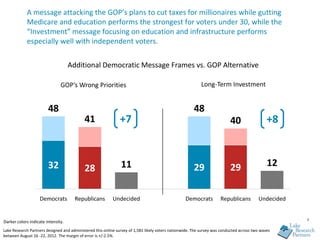
A message attacking the GOP’s plans to cut taxes for millionaires while gutting
            Medicare and education performs the strongest for voters under 30, while the
            “Investment” message focusing on education and infrastructure performs
            especially well with independent voters.

                                    Additional Democratic Message Frames vs. GOP Alternative

                               GOP’s Wrong Priorities                                                     Long-Term Investment


                        48                                                                             48
                                           41                  +7                                                         40                  +8


                        32                                     11                                      29                 29                  12
                                           28

                   Democrats          Republicans          Undecided                              Democrats          Republicans         Undecided


Darker colors indicate intensity.                                                                                                                    7

Lake Research Partners designed and administered this online survey of 1,581 likely voters nationwide. The survey was conducted across two waves
between August 16 -22, 2012. The margin of error is +/-2.5%.
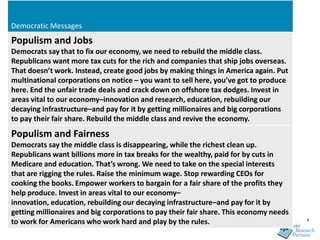
Democratic Messages
Populism and Jobs
Democrats say that to fix our economy, we need to rebuild the middle class.
Republicans want more tax cuts for the rich and companies that ship jobs overseas.
That doesn’t work. Instead, create good jobs by making things in America again. Put
multinational corporations on notice – you want to sell here, you’ve got to produce
here. End the unfair trade deals and crack down on offshore tax dodges. Invest in
areas vital to our economy–innovation and research, education, rebuilding our
decaying infrastructure–and pay for it by getting millionaires and big corporations
to pay their fair share. Rebuild the middle class and revive the economy.
Populism and Fairness
Democrats say the middle class is disappearing, while the richest clean up.
Republicans want billions more in tax breaks for the wealthy, paid for by cuts in
Medicare and education. That’s wrong. We need to take on the special interests
that are rigging the rules. Raise the minimum wage. Stop rewarding CEOs for
cooking the books. Empower workers to bargain for a fair share of the profits they
help produce. Invest in areas vital to our economy–
innovation, education, rebuilding our decaying infrastructure–and pay for it by
getting millionaires and big corporations to pay their fair share. This economy needs
to work for Americans who work hard and play by the rules.                              8
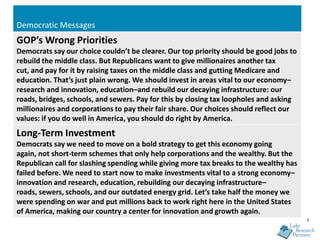
Democratic Messages
GOP’s Wrong Priorities
Democrats say our choice couldn’t be clearer. Our top priority should be good jobs to
rebuild the middle class. But Republicans want to give millionaires another tax
cut, and pay for it by raising taxes on the middle class and gutting Medicare and
education. That’s just plain wrong. We should invest in areas vital to our economy–
research and innovation, education–and rebuild our decaying infrastructure: our
roads, bridges, schools, and sewers. Pay for this by closing tax loopholes and asking
millionaires and corporations to pay their fair share. Our choices should reflect our
values: if you do well in America, you should do right by America.
Long-Term Investment
Democrats say we need to move on a bold strategy to get this economy going
again, not short-term schemes that only help corporations and the wealthy. But the
Republican call for slashing spending while giving more tax breaks to the wealthy has
failed before. We need to start now to make investments vital to a strong economy–
innovation and research, education, rebuilding our decaying infrastructure–
roads, sewers, schools, and our outdated energy grid. Let’s take half the money we
were spending on war and put millions back to work right here in the United States
of America, making our country a center for innovation and growth again.
                                                                                        9
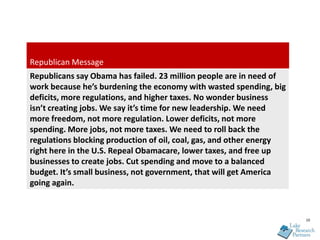
Republican Message
Republicans say Obama has failed. 23 million people are in need of
work because he’s burdening the economy with wasted spending, big
deficits, more regulations, and higher taxes. No wonder business
isn’t creating jobs. We say it’s time for new leadership. We need
more freedom, not more regulation. Lower deficits, not more
spending. More jobs, not more taxes. We need to roll back the
regulations blocking production of oil, coal, gas, and other energy
right here in the U.S. Repeal Obamacare, lower taxes, and free up
businesses to create jobs. Cut spending and move to a balanced
budget. It’s small business, not government, that will get America
going again.


                                                                      10
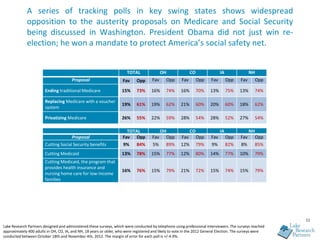
A series of tracking polls in key swing states shows widespread
             opposition to the austerity proposals on Medicare and Social Security
             being discussed in Washington. President Obama did not just win re-
             election; he won a mandate to protect America’s social safety net.


                                                                        TOTAL               OH               CO                IA               NH
                                       Proposal                      Fav     Opp      Fav     Opp      Fav        Opp    Fav        Opp   Fav        Opp

                        Ending traditional Medicare                  15%     73%      16%     74%      16%        70%   13%         75%   13%     74%

                        Replacing Medicare with a voucher
                                                                     19%     61%      19%     62%      21%        60%   20%         60%   18%     62%
                        system

                        Privatizing Medicare                         26%     55%      22%     59%      28%        54%   28%         52%   27%     54%

                                                                       TOTAL                OH               CO                IA               NH
                                       Proposal                      Fav Opp          Fav     Opp      Fav        Opp    Fav        Opp   Fav        Opp
                        Cutting Social Security benefits             9%      84%      5%      89%      12%        79%    9%         82%   8%      85%
                        Cutting Medicaid                             13%     78%      15%     77%      12%        80%   14%         77%   10%     79%
                        Cutting Medicaid, the program that
                        provides health insurance and
                                                                     16%     76%      15%     79%      21%        72%   15%         74%   15%     79%
                        nursing home care for low-income
                        families


                                                                                                                                                           11
Lake Research Partners designed and administered these surveys, which were conducted by telephone using professional interviewers. The surveys reached
approximately 400 adults in OH, CO, IA, and NH, 18 years or older, who were registered and likely to vote in the 2012 General Election. The surveys were
conducted between October 18th and November 4th, 2012. The margin of error for each poll is +/-4.9%.
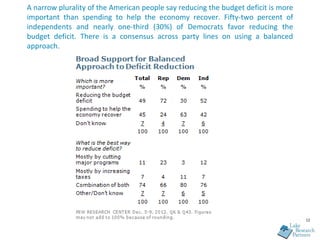
A narrow plurality of the American people say reducing the budget deficit is more
important than spending to help the economy recover. Fifty-two percent of
independents and nearly one-third (30%) of Democrats favor reducing the
budget deficit. There is a consensus across party lines on using a balanced
approach.


                                                                                    12
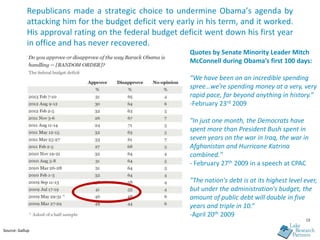
Republicans made a strategic choice to undermine Obama’s agenda by
            attacking him for the budget deficit very early in his term, and it worked.
            His approval rating on the federal budget deficit went down his first year
            in office and has never recovered.
                                                         Quotes by Senate Minority Leader Mitch
                                                         McConnell during Obama’s first 100 days:

                                                         “We have been on an incredible spending
                                                         spree…we’re spending money at a very, very
                                                         rapid pace, far beyond anything in history.”
                                                         -February 23rd 2009

                                                         "In just one month, the Democrats have
                                                         spent more than President Bush spent in
                                                         seven years on the war in Iraq, the war in
                                                         Afghanistan and Hurricane Katrina
                                                         combined."
                                                         - February 27th 2009 in a speech at CPAC

                                                         "The nation's debt is at its highest level ever,
                                                         but under the administration's budget, the
                                                         amount of public debt will double in five
                                                         years and triple in 10.”
                                                         -April 20th 2009
                                                                                                    13

Source: Gallup
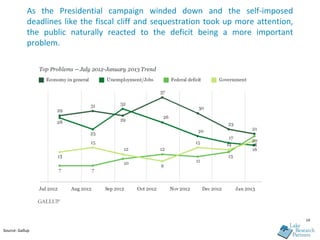
As the Presidential campaign winded down and the self-imposed
            deadlines like the fiscal cliff and sequestration took up more attention,
            the public naturally reacted to the deficit being a more important
            problem.


                                                                                        14

Source: Gallup
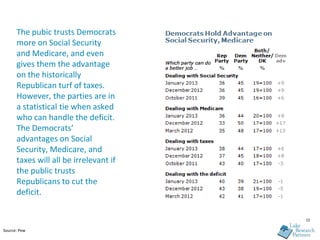
The pubic trusts Democrats
      more on Social Security
      and Medicare, and even
      gives them the advantage
      on the historically
      Republican turf of taxes.
      However, the parties are in
      a statistical tie when asked
      who can handle the deficit.
      The Democrats’
      advantages on Social
      Security, Medicare, and
      taxes will all be irrelevant if
      the public trusts
      Republicans to cut the
      deficit.

                                        15

Source: Pew
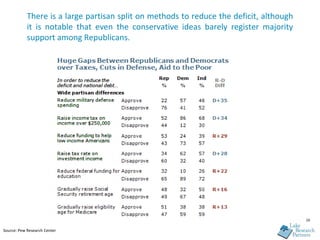
There is a large partisan split on methods to reduce the deficit, although
            it is notable that even the conservative ideas barely register majority
            support among Republicans.


                                                                                         16

Source: Pew Research Center
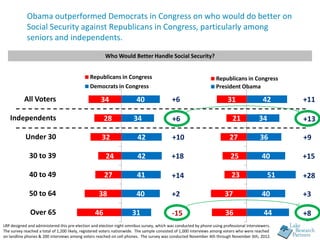
Obama outperformed Democrats in Congress on who would do better on
            Social Security against Republicans in Congress, particularly among
            seniors and independents.
                                                      Who Would Better Handle Social Security?


                                              Republicans in Congress                                             Republicans in Congress
                                              Democrats in Congress                                               President Obama

           All Voters                               34                 40 All Voters
                                                                                 +6                                     31                 42      +11

   Independents                                       28              Indepednents
                                                                      34       +6                                          21            34        +13

            Under 30                                 32                 42 Under +10
                                                                                 30                                      27               36       +9

              30 to 39                                 24               42       30 to+18
                                                                                      39                                  25               40      +15

              40 to 49                                27                41       40 to +14
                                                                                       49                                 23                  51   +28

              50 to 64                             38                  40        50 to +2
                                                                                       64                              37                  40      +3

              Over 65                            46                  31           Over -15
                                                                                        65                             36                   44     +8
                                                                                                                                                   17
LRP designed and administered this pre-election and election night omnibus survey, which was conducted by phone using professional interviewers.
The survey reached a total of 1,200 likely, registered voters nationwide. The sample consisted of 1,000 interviews among voters who were reached
on landline phones & 200 interviews among voters reached on cell phones. The survey was conducted November 4th through November 6th, 2012.
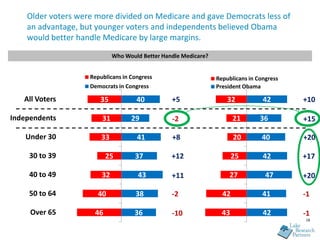
Older voters were more divided on Medicare and gave Democrats less of
    an advantage, but younger voters and independents believed Obama
    would better handle Medicare by large margins.
                             Who Would Better Handle Medicare?


                    Republicans in Congress                      Republicans in Congress
                    Democrats in Congress                        President Obama

   All Voters          35            40 All Voters
                                               +5                    32           42       +10

Independents            31          Indepednents
                                   29        -2                         21       36        +15

    Under 30            33           41 Under +8
                                              30                        20       40        +20

    30 to 39              25        37        30 to+12
                                                   39                   25        42       +17

    40 to 49            32           43       40 to +11
                                                    49                27           47      +20

    50 to 64          40             38       50 to -2
                                                     64            42             41       -1

     Over 65         46             36        Over -10
                                                    65             43             42       -1
                                                                                           18
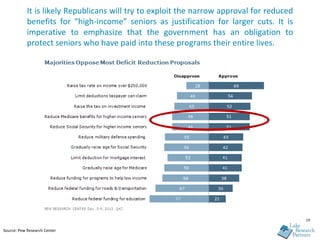
It is likely Republicans will try to exploit the narrow approval for reduced
            benefits for “high-income” seniors as justification for larger cuts. It is
            imperative to emphasize that the government has an obligation to
            protect seniors who have paid into these programs their entire lives.


                                                                                           19

Source: Pew Research Center
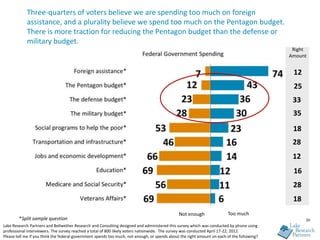
Three-quarters of voters believe we are spending too much on foreign
            assistance, and a plurality believe we spend too much on the Pentagon budget.
            There is more traction for reducing the Pentagon budget than the defense or
            military budget.
                                                                                                                                              Right
                                                                                                                                             Amount


                                                                                                                                              12
                                                                                                                                              25
                                                                                                                                              33
                                                                                                                                              35
                                                                                                                                              18
                                                                                                                                              28
                                                                                                                                              12
                                                                                                                                              16
                                                                                                                                              28
                                                                                                                                              18
                                                                                               Not enough                Too much
        *Split sample question                                                                                                                     20
Lake Research Partners and Bellwether Research and Consulting designed and administered this survey which was conducted by phone using
professional interviewers. The survey reached a total of 800 likely voters nationwide. The survey was conducted April 17-22, 2012.
Please tell me if you think the federal government spends too much, not enough, or spends about the right amount on each of the following?
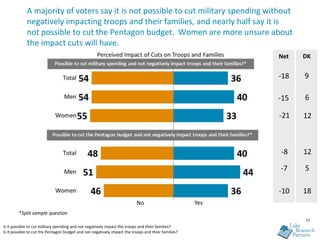
A majority of voters say it is not possible to cut military spending without
             negatively impacting troops and their families, and nearly half say it is
             not possible to cut the Pentagon budget. Women are more unsure about
             the impact cuts will have.
                                                                                                           Net   DK


                                                                                                           -18   9

                                                                                                           -15   6

                                                                                                           -21   12


                                                                                                           -8    12

                                                                                                           -7    5

                                                                                                           -10   18
                                                                          No                         Yes
        *Split sample question
                                                                                                                 21
Is it possible to cut military spending and not negatively impact the troops and their families?
Is it possible to cut the Pentagon budget and not negatively impact the troops and their families?
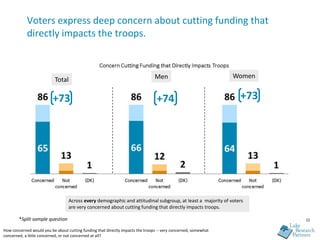
Voters express deep concern about cutting funding that
            directly impacts the troops.


                                                                                Men                             Women
                           Total

                          +73                                                    +74                             +73


                                  Across every demographic and attitudinal subgroup, at least a majority of voters
                                  are very concerned about cutting funding that directly impacts troops.

        *Split sample question                                                                                          22

How concerned would you be about cutting funding that directly impacts the troops -- very concerned, somewhat
concerned, a little concerned, or not concerned at all?
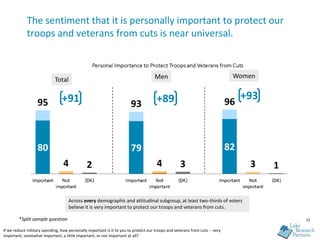
The sentiment that it is personally important to protect our
             troops and veterans from cuts is near universal.


                                                                                     Men                                     Women
                            Total

                                +91                                                   +89                                     +93


                                    Across every demographic and attitudinal subgroup, at least two-thirds of voters
                                    believe it is very important to protect our troops and veterans from cuts.

        *Split sample question                                                                                                       23

If we reduce military spending, how personally important is it to you to protect our troops and veterans from cuts -- very
important, somewhat important, a little important, or not important at all?
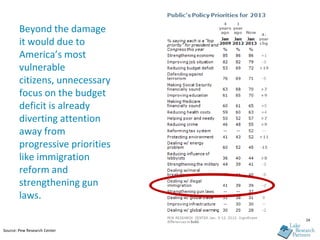
Beyond the damage
        it would due to
        America’s most
        vulnerable
        citizens, unnecessary
        focus on the budget
        deficit is already
        diverting attention
        away from
        progressive priorities
        like immigration
        reform and
        strengthening gun
        laws.

                                 24

Source: Pew Research Center
Washington, DC | Berkeley, CA | New York, NY
LakeResearch.com
202.776.9066

Celinda Lake
clake@lakeresearch.com

Celinda Lake: Effective Messaging On the Sequester

  • 1.
    Stopping the Sequester February19th, 2013 Celinda Lake Washington, DC | Berkeley, CA | New York, NY LakeResearch.com 202.776.9066
  • 2.
    Strategic Summary: Context • We have seen major wins with the public on taxes. Voters still believe the wealthiest 2% and big corporations are not paying enough in taxes. We have seen losses in the budget debates with increased salience around deficits and support for across the board cuts. • Voters still believe the budget can be balanced by cutting waste, fraud, and abuse. • We are paying a price for the lack of a comprehensive progressive economic narrative. • When we have candidates that do implement progressive economic policies, they do not talk about them enough. This vacuum of information is filled by Republican talking points on “big government” and “wasteful spending.” • In the near future, we can not allow the sequester and other short term budget gimmicks from Republicans deal fatal blows to Medicare and Social Security. 2
  • 3.
    Strategic Summary: Policies • On the idea of reducing the deficit, the public sides with Republicans, but when specific proposals are mentioned they are on our side. • When the public is faced with actual choices to reduce the budget deficit, the only ideas that gain majority approval involve raising taxes on the wealthy, like limiting deductions or raising the tax on investment income. We should not just refer to revenue. The only budget item that voters support cutting is foreign aid. • Reducing Social Security and Medicare benefits for higher income retirees is a much more popular proposal than raising the retirement age, but it would set a dangerous precedent. Voters do support lifting the cap on income subject to Social Security taxes. • Cutting defense spending is also an unpopular option, largely driven by resistance from women. Women are very skeptical that the defense budget can be cut without posing a threat to national security in general, but more specifically they worry about the impact on troops and their families. • People like balanced approaches with budget cuts and taxes. 3
  • 4.
    Strategic Summary: Strategies • In the big picture, it is important to remember that the debate over the budget deficit is part of a political strategy by the Republican Party. • They made attacking the deficit a political strategy to attack President Obama from the beginning of his first term, when only the most cynical observers would deny that the deficit was left on Obama’s doorstep following the Great Recession and the fiscal irresponsibility of the Bush Administration. • They continue to raise it as an issue because it neutralizes the trust the public has with Democrats on protecting Social Security and Medicare. • It is important to shift away from an austerity debate, not only to protect America’s seniors, but also to devote attention and political capital to progressive priorities like the environment, immigration reform, and strengthening gun laws. 4
  • 5.
    Strategic Summary: Message • Going forward, there are several key ingredients made up the message frames that led Democrats to victory this cycle and should remain as a component of the Democratic messaging on the economy: – Economic fairness: juxtaposing the windfall profits of a handful of millionaires and billionaires with the steady erosion of America’s working middle class. The best budget arguments contrast tax breaks with a focus on education and protecting Medicare. – Job creation: outlining plans to rebuild the middle class through a Made- in-America agenda and cracking down on job outsourcing, unfair trade deals, and corporate tax loopholes, and making bold investments. – GOP’s wrong priorities: drawing a strong contrast with Republican plans to gut Medicare and education in order to subsidize tax breaks for millionaires. 5
  • 6.
    In a surveyfielded this past summer, LRP tested two variations of a populist message theme. The “Jobs” message focused on unfair trade deals and corporate loopholes, while the “Fairness” message called for raising the minimum wage and requiring millionaires to pay their fair share of taxes. This was at a time when Democrats were 6-7 points behind Republicans on who would do the best job on the economy. Both messages performed strongly with the Democratic base and swing women. Democratic Populism Messages vs. Republican Economic Frame Populism and Jobs Populism and Fairness 47 47 42 41 +5 +6 33 31 11 32 12 27 Democrats Republicans Undecided Democrats Republicans Undecided Darker colors indicate intensity. 6 Lake Research Partners designed and administered this online survey of 1,581 likely voters nationwide. The survey was conducted across two waves between August 16 -22, 2012. The margin of error is +/-2.5%.
  • 7.
    A message attackingthe GOP’s plans to cut taxes for millionaires while gutting Medicare and education performs the strongest for voters under 30, while the “Investment” message focusing on education and infrastructure performs especially well with independent voters. Additional Democratic Message Frames vs. GOP Alternative GOP’s Wrong Priorities Long-Term Investment 48 48 41 +7 40 +8 32 11 29 29 12 28 Democrats Republicans Undecided Democrats Republicans Undecided Darker colors indicate intensity. 7 Lake Research Partners designed and administered this online survey of 1,581 likely voters nationwide. The survey was conducted across two waves between August 16 -22, 2012. The margin of error is +/-2.5%.
  • 8.
    Democratic Messages Populism andJobs Democrats say that to fix our economy, we need to rebuild the middle class. Republicans want more tax cuts for the rich and companies that ship jobs overseas. That doesn’t work. Instead, create good jobs by making things in America again. Put multinational corporations on notice – you want to sell here, you’ve got to produce here. End the unfair trade deals and crack down on offshore tax dodges. Invest in areas vital to our economy–innovation and research, education, rebuilding our decaying infrastructure–and pay for it by getting millionaires and big corporations to pay their fair share. Rebuild the middle class and revive the economy. Populism and Fairness Democrats say the middle class is disappearing, while the richest clean up. Republicans want billions more in tax breaks for the wealthy, paid for by cuts in Medicare and education. That’s wrong. We need to take on the special interests that are rigging the rules. Raise the minimum wage. Stop rewarding CEOs for cooking the books. Empower workers to bargain for a fair share of the profits they help produce. Invest in areas vital to our economy– innovation, education, rebuilding our decaying infrastructure–and pay for it by getting millionaires and big corporations to pay their fair share. This economy needs to work for Americans who work hard and play by the rules. 8
  • 9.
    Democratic Messages GOP’s WrongPriorities Democrats say our choice couldn’t be clearer. Our top priority should be good jobs to rebuild the middle class. But Republicans want to give millionaires another tax cut, and pay for it by raising taxes on the middle class and gutting Medicare and education. That’s just plain wrong. We should invest in areas vital to our economy– research and innovation, education–and rebuild our decaying infrastructure: our roads, bridges, schools, and sewers. Pay for this by closing tax loopholes and asking millionaires and corporations to pay their fair share. Our choices should reflect our values: if you do well in America, you should do right by America. Long-Term Investment Democrats say we need to move on a bold strategy to get this economy going again, not short-term schemes that only help corporations and the wealthy. But the Republican call for slashing spending while giving more tax breaks to the wealthy has failed before. We need to start now to make investments vital to a strong economy– innovation and research, education, rebuilding our decaying infrastructure– roads, sewers, schools, and our outdated energy grid. Let’s take half the money we were spending on war and put millions back to work right here in the United States of America, making our country a center for innovation and growth again. 9
  • 10.
    Republican Message Republicans sayObama has failed. 23 million people are in need of work because he’s burdening the economy with wasted spending, big deficits, more regulations, and higher taxes. No wonder business isn’t creating jobs. We say it’s time for new leadership. We need more freedom, not more regulation. Lower deficits, not more spending. More jobs, not more taxes. We need to roll back the regulations blocking production of oil, coal, gas, and other energy right here in the U.S. Repeal Obamacare, lower taxes, and free up businesses to create jobs. Cut spending and move to a balanced budget. It’s small business, not government, that will get America going again. 10
  • 11.
    A series oftracking polls in key swing states shows widespread opposition to the austerity proposals on Medicare and Social Security being discussed in Washington. President Obama did not just win re- election; he won a mandate to protect America’s social safety net. TOTAL OH CO IA NH Proposal Fav Opp Fav Opp Fav Opp Fav Opp Fav Opp Ending traditional Medicare 15% 73% 16% 74% 16% 70% 13% 75% 13% 74% Replacing Medicare with a voucher 19% 61% 19% 62% 21% 60% 20% 60% 18% 62% system Privatizing Medicare 26% 55% 22% 59% 28% 54% 28% 52% 27% 54% TOTAL OH CO IA NH Proposal Fav Opp Fav Opp Fav Opp Fav Opp Fav Opp Cutting Social Security benefits 9% 84% 5% 89% 12% 79% 9% 82% 8% 85% Cutting Medicaid 13% 78% 15% 77% 12% 80% 14% 77% 10% 79% Cutting Medicaid, the program that provides health insurance and 16% 76% 15% 79% 21% 72% 15% 74% 15% 79% nursing home care for low-income families 11 Lake Research Partners designed and administered these surveys, which were conducted by telephone using professional interviewers. The surveys reached approximately 400 adults in OH, CO, IA, and NH, 18 years or older, who were registered and likely to vote in the 2012 General Election. The surveys were conducted between October 18th and November 4th, 2012. The margin of error for each poll is +/-4.9%.
  • 12.
    A narrow pluralityof the American people say reducing the budget deficit is more important than spending to help the economy recover. Fifty-two percent of independents and nearly one-third (30%) of Democrats favor reducing the budget deficit. There is a consensus across party lines on using a balanced approach. 12
  • 13.
    Republicans made astrategic choice to undermine Obama’s agenda by attacking him for the budget deficit very early in his term, and it worked. His approval rating on the federal budget deficit went down his first year in office and has never recovered. Quotes by Senate Minority Leader Mitch McConnell during Obama’s first 100 days: “We have been on an incredible spending spree…we’re spending money at a very, very rapid pace, far beyond anything in history.” -February 23rd 2009 "In just one month, the Democrats have spent more than President Bush spent in seven years on the war in Iraq, the war in Afghanistan and Hurricane Katrina combined." - February 27th 2009 in a speech at CPAC "The nation's debt is at its highest level ever, but under the administration's budget, the amount of public debt will double in five years and triple in 10.” -April 20th 2009 13 Source: Gallup
  • 14.
    As the Presidentialcampaign winded down and the self-imposed deadlines like the fiscal cliff and sequestration took up more attention, the public naturally reacted to the deficit being a more important problem. 14 Source: Gallup
  • 15.
    The pubic trustsDemocrats more on Social Security and Medicare, and even gives them the advantage on the historically Republican turf of taxes. However, the parties are in a statistical tie when asked who can handle the deficit. The Democrats’ advantages on Social Security, Medicare, and taxes will all be irrelevant if the public trusts Republicans to cut the deficit. 15 Source: Pew
  • 16.
    There is alarge partisan split on methods to reduce the deficit, although it is notable that even the conservative ideas barely register majority support among Republicans. 16 Source: Pew Research Center
  • 17.
    Obama outperformed Democratsin Congress on who would do better on Social Security against Republicans in Congress, particularly among seniors and independents. Who Would Better Handle Social Security? Republicans in Congress Republicans in Congress Democrats in Congress President Obama All Voters 34 40 All Voters +6 31 42 +11 Independents 28 Indepednents 34 +6 21 34 +13 Under 30 32 42 Under +10 30 27 36 +9 30 to 39 24 42 30 to+18 39 25 40 +15 40 to 49 27 41 40 to +14 49 23 51 +28 50 to 64 38 40 50 to +2 64 37 40 +3 Over 65 46 31 Over -15 65 36 44 +8 17 LRP designed and administered this pre-election and election night omnibus survey, which was conducted by phone using professional interviewers. The survey reached a total of 1,200 likely, registered voters nationwide. The sample consisted of 1,000 interviews among voters who were reached on landline phones & 200 interviews among voters reached on cell phones. The survey was conducted November 4th through November 6th, 2012.
  • 18.
    Older voters weremore divided on Medicare and gave Democrats less of an advantage, but younger voters and independents believed Obama would better handle Medicare by large margins. Who Would Better Handle Medicare? Republicans in Congress Republicans in Congress Democrats in Congress President Obama All Voters 35 40 All Voters +5 32 42 +10 Independents 31 Indepednents 29 -2 21 36 +15 Under 30 33 41 Under +8 30 20 40 +20 30 to 39 25 37 30 to+12 39 25 42 +17 40 to 49 32 43 40 to +11 49 27 47 +20 50 to 64 40 38 50 to -2 64 42 41 -1 Over 65 46 36 Over -10 65 43 42 -1 18
  • 19.
    It is likelyRepublicans will try to exploit the narrow approval for reduced benefits for “high-income” seniors as justification for larger cuts. It is imperative to emphasize that the government has an obligation to protect seniors who have paid into these programs their entire lives. 19 Source: Pew Research Center
  • 20.
    Three-quarters of votersbelieve we are spending too much on foreign assistance, and a plurality believe we spend too much on the Pentagon budget. There is more traction for reducing the Pentagon budget than the defense or military budget. Right Amount 12 25 33 35 18 28 12 16 28 18 Not enough Too much *Split sample question 20 Lake Research Partners and Bellwether Research and Consulting designed and administered this survey which was conducted by phone using professional interviewers. The survey reached a total of 800 likely voters nationwide. The survey was conducted April 17-22, 2012. Please tell me if you think the federal government spends too much, not enough, or spends about the right amount on each of the following?
  • 21.
    A majority ofvoters say it is not possible to cut military spending without negatively impacting troops and their families, and nearly half say it is not possible to cut the Pentagon budget. Women are more unsure about the impact cuts will have. Net DK -18 9 -15 6 -21 12 -8 12 -7 5 -10 18 No Yes *Split sample question 21 Is it possible to cut military spending and not negatively impact the troops and their families? Is it possible to cut the Pentagon budget and not negatively impact the troops and their families?
  • 22.
    Voters express deepconcern about cutting funding that directly impacts the troops. Men Women Total +73 +74 +73 Across every demographic and attitudinal subgroup, at least a majority of voters are very concerned about cutting funding that directly impacts troops. *Split sample question 22 How concerned would you be about cutting funding that directly impacts the troops -- very concerned, somewhat concerned, a little concerned, or not concerned at all?
  • 23.
    The sentiment thatit is personally important to protect our troops and veterans from cuts is near universal. Men Women Total +91 +89 +93 Across every demographic and attitudinal subgroup, at least two-thirds of voters believe it is very important to protect our troops and veterans from cuts. *Split sample question 23 If we reduce military spending, how personally important is it to you to protect our troops and veterans from cuts -- very important, somewhat important, a little important, or not important at all?
  • 24.
    Beyond the damage it would due to America’s most vulnerable citizens, unnecessary focus on the budget deficit is already diverting attention away from progressive priorities like immigration reform and strengthening gun laws. 24 Source: Pew Research Center
  • 25.
    Washington, DC |Berkeley, CA | New York, NY LakeResearch.com 202.776.9066 Celinda Lake clake@lakeresearch.com