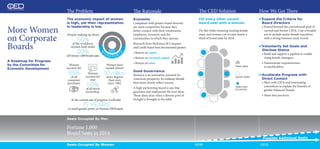
More Women
on Corporate
Boards
A Roadmap for Progress
by the Committee for
Economic Development
The Problem
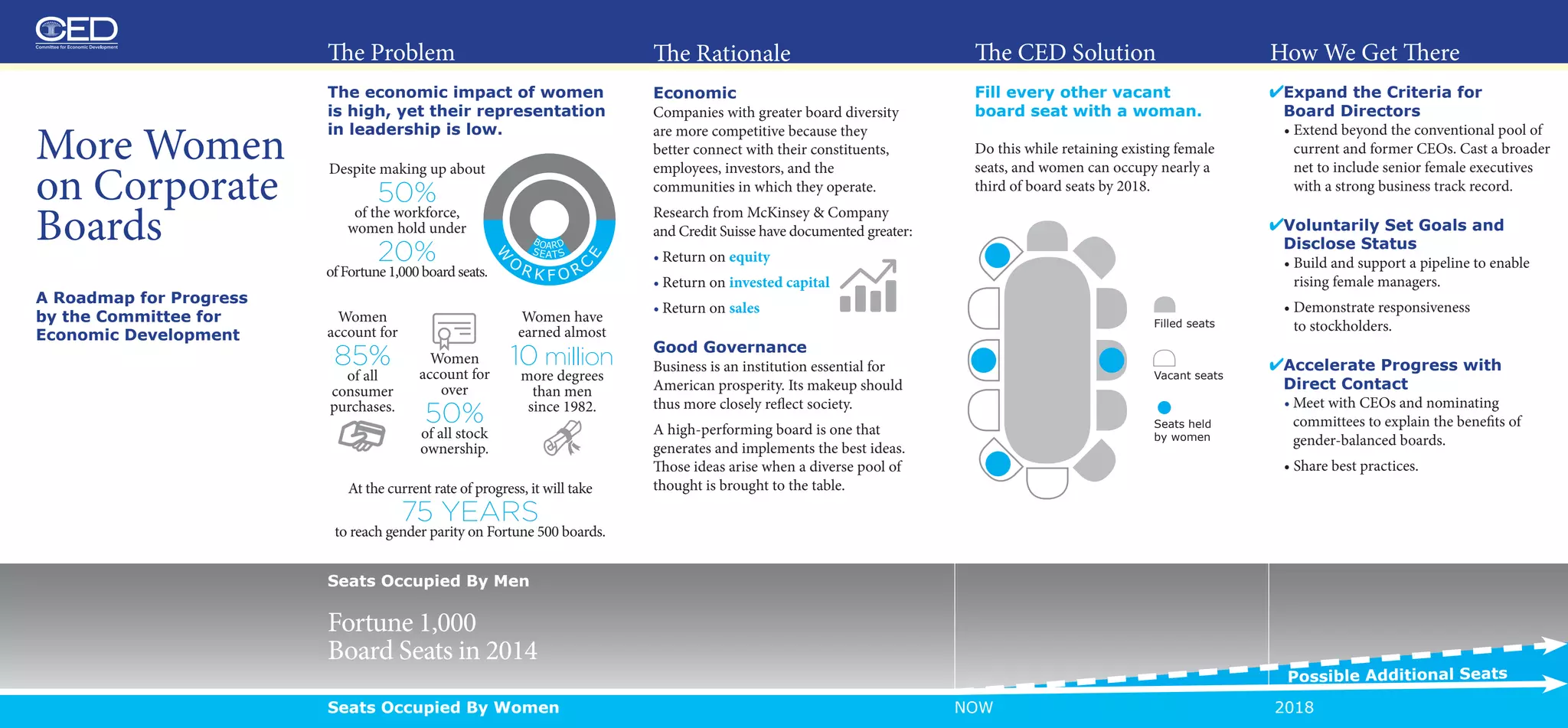
The economic impact of women
is high, yet their representation
in leadership is low.
The Rationale
Economic
Companies with greater board diversity
are more competitive because they
better connect with their constituents,
employees, investors, and the
communities in which they operate.
Research from McKinsey & Company
and Credit Suisse have documented greater:
• Return on equity
• Return on invested capital
• Return on sales
Good Governance
Business is an institution essential for
American prosperity. Its makeup should
thus more closely reflect society.
A high-performing board is one that
generates and implements the best ideas.
Those ideas arise when a diverse pool of
thought is brought to the table.
The CED Solution
Fill every other vacant
board seat with a woman.
Do this while retaining existing female
seats, and women can occupy nearly a
third of board seats by 2018.
How We Get There
Expand the Criteria for
Board Directors
• Extend beyond the conventional pool of
current and former CEOs. Cast a broader
net to include senior female executives
with a strong business track record.
Voluntarily Set Goals and
Disclose Status
• Build and support a pipeline to enable
rising female managers.
• Demonstrate responsiveness
to stockholders.
Accelerate Progress with
Direct Contact
• Meet with CEOs and nominating
committees to explain the benefits of
gender-balanced boards.
• Share best practices.
Seats Occupied By Men
Seats Occupied By Women NOW 2018
Possible Additional Seats
Filled seats
Vacant seats
Seats held
by women
Fortune 1,000
Board Seats in 2014
Despite making up about
50%
of the workforce,
women hold under
20%
ofFortune1,000boardseats.
W
O
R K F O R C
E
BOARD
SEATS
At the current rate of progress, it will take
75 YEARS
to reach gender parity on Fortune 500 boards.
Women
account for
85%
of all
consumer
purchases.
Women
account for
over
50%
of all stock
ownership.
Women have
earned almost
10 million
more degrees
than men
since 1982.
The Committee for Economic
Development of The Conference Board
(CED) is a nonprofit, nonpartisan,
business-led public policy organization
that delivers well-researched analysis and
reasoned solutions to our nation’s most
critical issues.
For more recommendations
and information, see CED’s
“Every Other One”
report:
www.ced.org/everyotherone
Continue the conversation on Twitter:
@CEDUpdate #womenonboards
Committee for Economic Development
1530 Wilson Blvd, Suite 400
Arlington, VA 22209
202.296.5860
www.ced.org
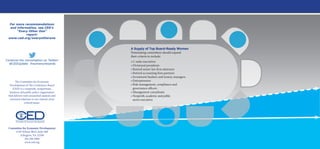
A Supply of Top Board-Ready Women
Nominating committees should expand
their criteria to include:
• C-suite executives
• Divisional presidents
• Retired senior law firm attorneys
• Retired accounting firm partners
• Investment bankers and money managers
• Entrepreneurs
• Risk management, compliance and
governance officers
• Management consultants
• Nonprofit, academic and public
sector executives

CED Roadmap Infographic

  • 1.
    More Women on Corporate Boards ARoadmap for Progress by the Committee for Economic Development The Problem The economic impact of women is high, yet their representation in leadership is low. The Rationale Economic Companies with greater board diversity are more competitive because they better connect with their constituents, employees, investors, and the communities in which they operate. Research from McKinsey & Company and Credit Suisse have documented greater: • Return on equity • Return on invested capital • Return on sales Good Governance Business is an institution essential for American prosperity. Its makeup should thus more closely reflect society. A high-performing board is one that generates and implements the best ideas. Those ideas arise when a diverse pool of thought is brought to the table. The CED Solution Fill every other vacant board seat with a woman. Do this while retaining existing female seats, and women can occupy nearly a third of board seats by 2018. How We Get There Expand the Criteria for Board Directors • Extend beyond the conventional pool of current and former CEOs. Cast a broader net to include senior female executives with a strong business track record. Voluntarily Set Goals and Disclose Status • Build and support a pipeline to enable rising female managers. • Demonstrate responsiveness to stockholders. Accelerate Progress with Direct Contact • Meet with CEOs and nominating committees to explain the benefits of gender-balanced boards. • Share best practices. Seats Occupied By Men Seats Occupied By Women NOW 2018 Possible Additional Seats Filled seats Vacant seats Seats held by women Fortune 1,000 Board Seats in 2014 Despite making up about 50% of the workforce, women hold under 20% ofFortune1,000boardseats. W O R K F O R C E BOARD SEATS At the current rate of progress, it will take 75 YEARS to reach gender parity on Fortune 500 boards. Women account for 85% of all consumer purchases. Women account for over 50% of all stock ownership. Women have earned almost 10 million more degrees than men since 1982.
  • 2.
    The Committee forEconomic Development of The Conference Board (CED) is a nonprofit, nonpartisan, business-led public policy organization that delivers well-researched analysis and reasoned solutions to our nation’s most critical issues. For more recommendations and information, see CED’s “Every Other One” report: www.ced.org/everyotherone Continue the conversation on Twitter: @CEDUpdate #womenonboards Committee for Economic Development 1530 Wilson Blvd, Suite 400 Arlington, VA 22209 202.296.5860 www.ced.org A Supply of Top Board-Ready Women Nominating committees should expand their criteria to include: • C-suite executives • Divisional presidents • Retired senior law firm attorneys • Retired accounting firm partners • Investment bankers and money managers • Entrepreneurs • Risk management, compliance and governance officers • Management consultants • Nonprofit, academic and public sector executives