01
By James Magness,
Head of Investor Research
No room for passengers
February 2015
Are auto manufacturers reducing emissions quickly enough?
02
03
Contents
Linking emissions-related metrics to earnings 	 4
Leaders and laggards 	 5
Linking our findings to investment choices	 7
Methodology	8
For further study	 9
04
Linking emissions-related metrics to earnings
1	Derived from Bloomberg data but adjusted by assigning total sales made by Chinese joint ventures (JVs) to their respective non-Chinese OEM partner (see fleet emissions summary).
2	Averaged over the auto OEMs that responded to the CDP Climate Change Questionnaire
Overview
In this report, we launch our new Super-League Table
(SLT) for the global automobile original equipment
manufacturers (OEMs).
We rank those companies that responded to CDP’s
Climate Change questionnaire, which account for 83%1
of the global auto market by sales volume, based on
a number of different emissions-related metrics. When
taken in aggregate, we believe these metrics could have
a material impact on a company’s earnings in a global
auto market where emissions regulation is tightening and
there are significant penalties for non-compliance.
We highlight those companies that are best positioned
to benefit from this regulatory change and those that will
struggle without adapting their existing business models.
Scope of report: emissions
Our SLT focuses on three key areas:
	 Fleet emissions: these account for 75% of total
emissions for the auto industry2
.
	Advanced Vehicles: Battery Electric Vehicles
(BEVs), Plug-in Hybrid Electric Vehicles (PHEVs)
and Fuel Cell Vehicles (FCVs) which will increasingly
contribute to lowering total emissions.
	Manufacturing emissions: these account for 20%
of total emissions, split roughly as 17% supplier
emissions and 3% auto OEMs own manufacturing
emissions (mostly assembly).
Scope of report: geographies
Our study spans the three largest auto markets globally,
which together account for 75% of global auto demand.
	 The EU (22% share): a leader in emissions
regulations, it has by far the lowest fleet-wide
emissions (on a per unit basis). Vehicle sales in the
EU have been declining over the last decade or so.
	 The US (25% share): by far the highest fleet-wide
emissions (on a per unit basis). US consumers
demand more super-sized powerful cars. Fleet
emissions rules and penalties have been in place
since the 1980s, though there has been a culture of
non-compliance, with penalties seen as an ongoing
business cost that is passed on to consumers. This
is set to change under the new EPA regulations that
kick in from a penalty perspective in 2016.
	 China (28% share): is the largest auto market
globally, having tripled in size from 2008-2013. It
could be an explosive market for Advanced Vehicles
if it becomes more stringent in its megacity Low
Emission Zones (LEZs). The Chinese government
has very aggressive targets for total sales of BEVs
and PHEVs of 5 million units by 2020 – achieving
this would imply sales of approximately 2 million
per annum by 2020, we estimate, which roughly
equates to total annual car sales in the UK (or India).
	We launch our new ‘Super-League Table’ which ranks companies based on a num-
ber of emissions-related metrics which in aggregate could have a material impact
on company performance
	Leaders are: Nissan, Toyota, and Renault
	Laggards are: Tata Motors (owner of Jaguar Land Rover), Hyundai,
and General Motors
05
Leaders and laggards
14 of the top 16 auto OEMs globally (excluding China)
responded to CDP’s 2014 questionnaire, and together
represent 83% of the global auto market and US$844
billion in market cap. The non-responders were Suzuki
(10th, 3.4% share) and Kia (11th, 3.2% share). The
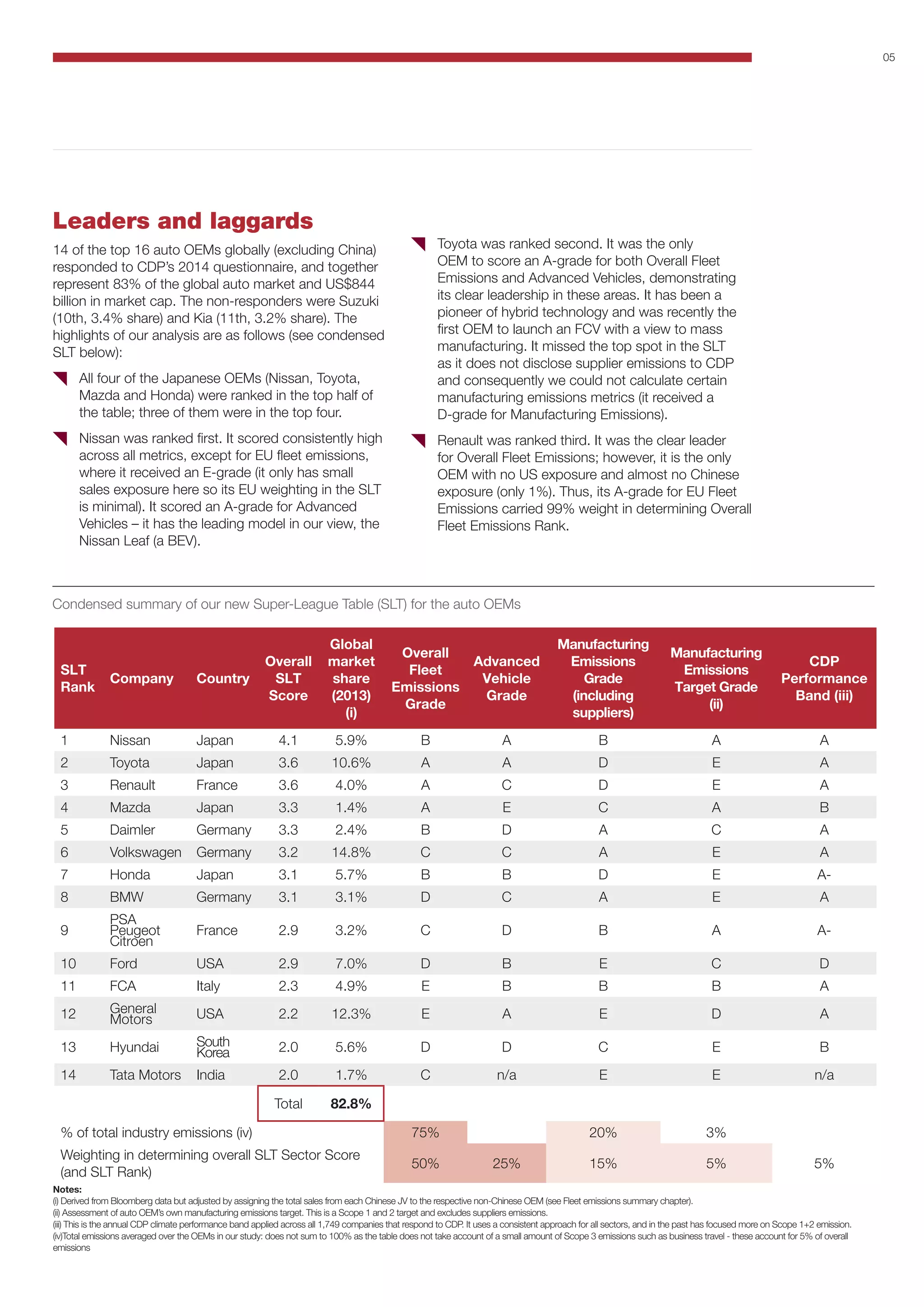
highlights of our analysis are as follows (see condensed
SLT below):
	All four of the Japanese OEMs (Nissan, Toyota,
Mazda and Honda) were ranked in the top half of
the table; three of them were in the top four.
	Nissan was ranked first. It scored consistently high
across all metrics, except for EU fleet emissions,
where it received an E-grade (it only has small
sales exposure here so its EU weighting in the SLT
is minimal). It scored an A-grade for Advanced
Vehicles – it has the leading model in our view, the
Nissan Leaf (a BEV).
	Toyota was ranked second. It was the only
OEM to score an A-grade for both Overall Fleet
Emissions and Advanced Vehicles, demonstrating
its clear leadership in these areas. It has been a
pioneer of hybrid technology and was recently the
first OEM to launch an FCV with a view to mass
manufacturing. It missed the top spot in the SLT
as it does not disclose supplier emissions to CDP
and consequently we could not calculate certain
manufacturing emissions metrics (it received a
D-grade for Manufacturing Emissions).
	Renault was ranked third. It was the clear leader
for Overall Fleet Emissions; however, it is the only
OEM with no US exposure and almost no Chinese
exposure (only 1%). Thus, its A-grade for EU Fleet
Emissions carried 99% weight in determining Overall
Fleet Emissions Rank.
SLT
Rank
Company Country
Overall
SLT
Score
Global
market
share
(2013)
(i)
Overall
Fleet
Emissions
Grade
Advanced
Vehicle
Grade
Manufacturing
Emissions
Grade
(including
suppliers)
Manufacturing
Emissions
Target Grade
(ii)
CDP
Performance
Band (iii)
1 Nissan Japan 4.1 5.9% B A B A A
2 Toyota Japan 3.6 10.6% A A D E A
3 Renault France 3.6 4.0% A C D E A
4 Mazda Japan 3.3 1.4% A E C A B
5 Daimler Germany 3.3 2.4% B D A C A
6 Volkswagen Germany 3.2 14.8% C C A E A
7 Honda Japan 3.1 5.7% B B D E A-
8 BMW Germany 3.1 3.1% D C A E A
9
PSA
Peugeot
Citroen
France 2.9 3.2% C D B A A-
10 Ford USA 2.9 7.0% D B E C D
11 FCA Italy 2.3 4.9% E B B B A
12 General
Motors USA 2.2 12.3% E A E D A
13 Hyundai South
Korea 2.0 5.6% D D C E B
14 Tata Motors India 2.0 1.7% C n/a E E n/a
Total 82.8%
% of total industry emissions (iv) 75% 20% 3%
Weighting in determining overall SLT Sector Score
(and SLT Rank)
50% 25% 15% 5% 5%
Notes:
(i) Derived from Bloomberg data but adjusted by assigning the total sales from each Chinese JV to the respective non-Chinese OEM (see Fleet emissions summary chapter).
(ii) Assessment of auto OEM’s own manufacturing emissions target. This is a Scope 1 and 2 target and excludes suppliers emissions.
(iii) This is the annual CDP climate performance band applied across all 1,749 companies that respond to CDP. It uses a consistent approach for all sectors, and in the past has focused more on Scope 1+2 emission.
(iv)Total emissions averaged over the OEMs in our study: does not sum to 100% as the table does not take account of a small amount of Scope 3 emissions such as business travel - these account for 5% of overall
emissions
Condensed summary of our new Super-League Table (SLT) for the auto OEMs
06
	The German OEMs were all placed in the top-mid
range table. Daimler was fifth, VW, the world’s
largest auto OEM, is ranked sixth and BMW eigth.
	Daimler (owners of Mercedes and Smart cars)
scored a B-grade for Overall Fleet Emissions due
to an impressive track record of fleet emissions
reductions in Europe. We estimate that if this
progress is maintained its fleet will be one of the
most efficient in the EU by 2021. Smart cars will
increasingly contribute.
	We note that the rankings in a large portion of the
table are very tight. There was a narrow range for
the Overall SLT Score between fourth and tenth
places. For instance, if French OEM, PSA Peugeot
Citroen which ranked ninth had received a B-grade
rather than a D-grade for Advanced Vehicles, it
would have been propelled up to fourth place.
This suggests that there is everything to fight for
amongst the OEMs. Technological advancements
could see a dramatic change in the rankings in
future iterations of our SLT.
	The US OEMs were both ranked towards the
bottom of the SLT, which is not surprising given their
market-leading positions in (and sales exposure
to) the US market. US consumers tend to demand
more super-sized cars (which have notably higher
emissions). GM was third from bottom – it was
graded E for Overall Fleet Emissions but was
saved from bottom rank by its A-grade for
Advanced Vehicles. Ford was ranked tenth
(or fifth from bottom).
	Tata Motors is the bottom-ranked OEM. This is
partly due to an incomplete response to CDP’s
questionnaire but also due to its high-emitting
Jaguar Land Rover brands coupled with the fact
that it is the only OEM in our analysis that is yet to
release an Advanced Vehicle.
	FCA was the worst performer from a fleet emissions
perspective, which is perhaps not quite so
surprising given that its US-based Chrysler division
has a high-emitting vehicle range, coupled with
the fact that FCA has consistently made one of the
lowest investments in RD over a number of years.
That said, FCA shows some promise with a B-grade
achieved for Advanced Vehicles.
	Hyundai was the most consistent poor performer,
with D-grades for its fleet emissions in each of
the EU, US and China, and also for its Advanced
Vehicle Grade. It was hardly surprising that Hyundai
ranked second from bottom.
	The Japanese OEMs may have performed even
better had our analysis extended to the Japanese
market (which like the EU is a relatively low-emission
market); a lack of credible data prevented this. That
said, they each have more than 50% sales exposure
(before our normalization) to the geographies
covered in this report.
Penalties
	General Motors and FCA are the only two OEMs
that are at notable risk of a penalty in both the EU
and US; these penalties could potentially equate
to a combined US$1.7 billion (33% of EBIT3
) and
US$574 million (15% of EBIT) respectively.
	In addition, we estimate that Ford is at risk of a
penalty in the US of US$889 million (or 16% of EBIT).
	BMW, Volkswagen, Daimler, Hyundai, and Nissan
are all also at risk of a penalty in either the EU or US.
	The potential penalties facing OEMs at risk of
missing their targets are CDP estimates. They
do not take into account any credits available to
OEMs to assist the transition of their fleets to meet
regulatory targets. The penalties are for illustrative
purposes only.
	We note that CAFE fleet emissions penalties have
been levied in the US since the 1980s and it is not
uncommon to see OEMs pay fines into the tens of
millions of US dollars. We note that recently in 2011,
Daimler paid a fine of US$16 million and Tata Motors
paid a fine of US$14 million. The highest fine paid so
far has been US$90 million by Daimler-Chrysler (as it
was then) in 2006.
See the Fleet emissions summary chapter for more
detail on the potential penalties.
3 EBIT – Earning Before Interest  Tax
07
Linking our findings to
investment choices
We recognize that investment decisions are based on a
multitude of different factors and that some of these
factors can be misaligned with emissions reductions.
Our SLT rankings are not intended as definitive winners
and losers for investment purposes, more as a proxy
for business-readiness in an industry where there is
significant regulatory tightening across all major vehicle
markets.
We would flag that companies towards the bottom of
our SLT are possibly higher risk investments than those
towards the top. However, we appreciate an investment
such as Tata Motors, a leader in the fast growing SUV
segment of the vehicle market, could well be able to
pass penalties on to consumers of its premium vehi-
cles without a major impact on earnings. On this basis,
investors might view Tata Motors as a high(er) risk but
potentially high reward investment.
Area in Super-
League table
Link to company earnings Metrics Weighting
Fleet emissions Significant financial penalties for non-compliance.
(i) EU fleet emissions (gCO2
/km)
(ii) US fleet emissions (mpg)
(iii) China fleet emissions (L/100km)
50%
Advanced Vehicles
Potentially explosive market growth opportunity,
in particular in China. Early movers will benefit.
Laggards may miss out.
(i) Technical grade
(ii) Sales momentum/first mover grade
(iii) other considerations i.e. technology
collaborations, domestic market strength
25%
Manufacturing
emissions
Efficient manufacturing can enhance financial
performance. Manufacturing emissions
(intensity) reduction is a proxy for increased
manufacturing efficiency
(i) Manufacturing emissions intensity
(ii) Reduction in intensity 2011-13
(iii) Supply chain engagement (by % spend)
(iv) Emissions reduction target analysis
20%
CDP climate
performance band
A good annual CDP score is a proxy for a generally
well run company. Well run companies are better
placed to succeed in a changing marketplace.
(i) CDP 2014 climate change
performance band
5%
Source: CDP
A summary of key areas, associated metrics and relative weighting in the Super-League Table
08
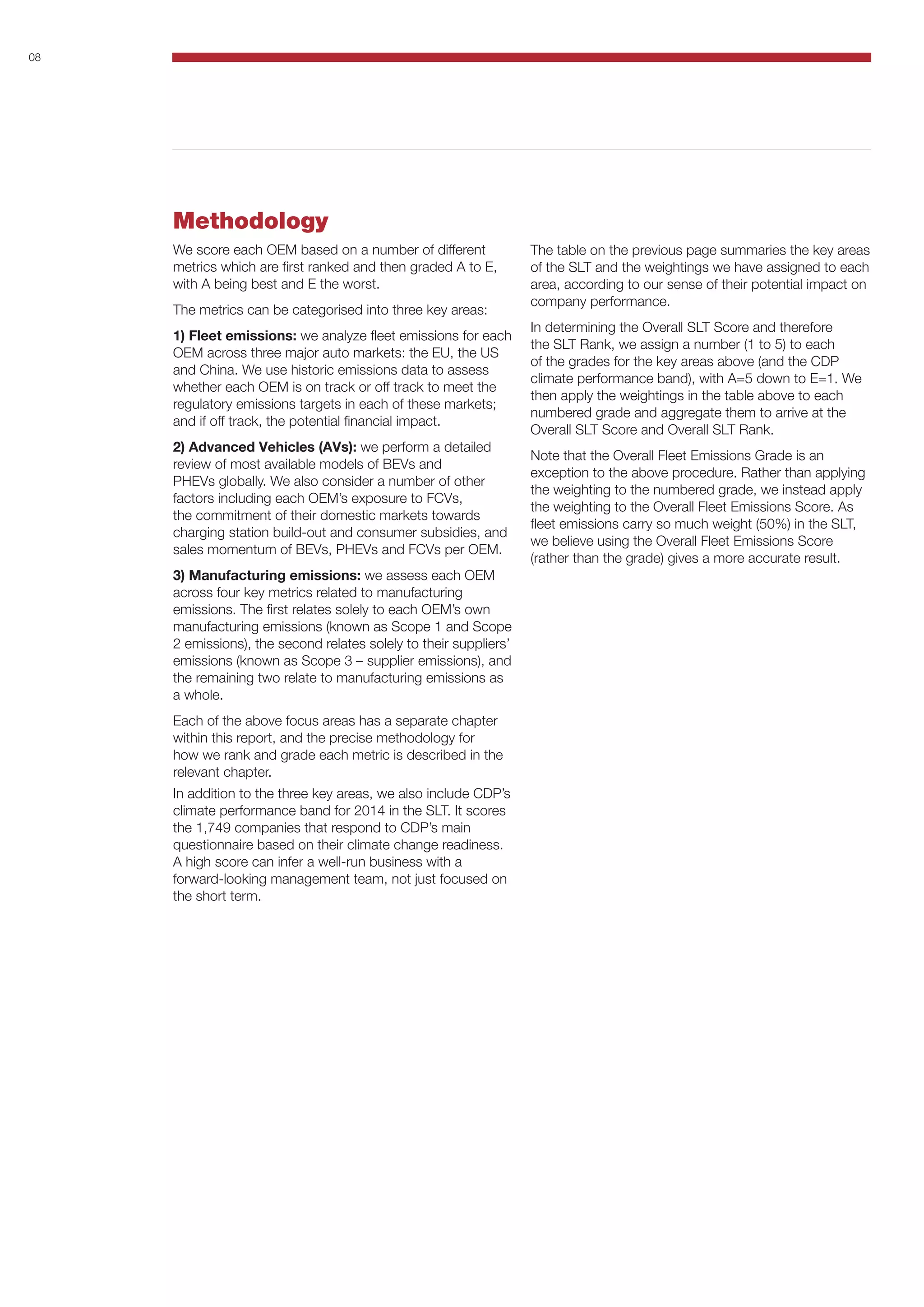
Methodology
We score each OEM based on a number of different
metrics which are first ranked and then graded A to E,
with A being best and E the worst.
The metrics can be categorised into three key areas:
1) Fleet emissions: we analyze fleet emissions for each
OEM across three major auto markets: the EU, the US
and China. We use historic emissions data to assess
whether each OEM is on track or off track to meet the
regulatory emissions targets in each of these markets;
and if off track, the potential financial impact.
2) Advanced Vehicles (AVs): we perform a detailed
review of most available models of BEVs and
PHEVs globally. We also consider a number of other
factors including each OEM’s exposure to FCVs,
the commitment of their domestic markets towards
charging station build-out and consumer subsidies, and
sales momentum of BEVs, PHEVs and FCVs per OEM.
3) Manufacturing emissions: we assess each OEM
across four key metrics related to manufacturing
emissions. The first relates solely to each OEM’s own
manufacturing emissions (known as Scope 1 and Scope
2 emissions), the second relates solely to their suppliers’
emissions (known as Scope 3 – supplier emissions), and
the remaining two relate to manufacturing emissions as
a whole.
Each of the above focus areas has a separate chapter
within this report, and the precise methodology for
how we rank and grade each metric is described in the
relevant chapter.
In addition to the three key areas, we also include CDP’s
climate performance band for 2014 in the SLT. It scores
the 1,749 companies that respond to CDP’s main
questionnaire based on their climate change readiness.
A high score can infer a well-run business with a
forward-looking management team, not just focused on
the short term.
The table on the previous page summaries the key areas
of the SLT and the weightings we have assigned to each
area, according to our sense of their potential impact on
company performance.
In determining the Overall SLT Score and therefore
the SLT Rank, we assign a number (1 to 5) to each
of the grades for the key areas above (and the CDP
climate performance band), with A=5 down to E=1. We
then apply the weightings in the table above to each
numbered grade and aggregate them to arrive at the
Overall SLT Score and Overall SLT Rank.
Note that the Overall Fleet Emissions Grade is an
exception to the above procedure. Rather than applying
the weighting to the numbered grade, we instead apply
the weighting to the Overall Fleet Emissions Score. As
fleet emissions carry so much weight (50%) in the SLT,
we believe using the Overall Fleet Emissions Score
(rather than the grade) gives a more accurate result.
09
For further study
Interesting areas for further investigation include:
Different profiles for forecasting
reductions in fleet emissions
rather than assuming a constant
percentage reduction across the
forecast periods for all OEMs.
Such profiles might include
a period of steady emissions
reductions followed by a period
of faster reductions as new
technologies are implemented.
One could also look to vary the
emissions reduction profile for
each OEM and link it to forecast/
targeted RD spend and the
release of new technologies,
model renewal cycles or changes
to average fleet mass.
An extension of the fleet emissions
study to other regions including
Japan, India, and Latin America,
and the level of potential penalties
for non-compliance, if applicable.
Expand the study to include other
pollutants arising from vehicles,
such as nitrogen oxides, fine
particulate matter, volatile organic
compounds, carbon monoxide,
and sulphur dioxide, amongst
others.
Incorporate a ‘lobbying’ grade
into the SLT to assess which
companies are most involved in
shaping the future.
An extension of our study to
include light commercial vehicles,
as well as trucks (and heavier
vehicles) where relevant.
Further work on the component
suppliers and each OEM’s
exposure to other components
used to optimize existing
combustion engine technology,
for example, super-chargers, fly-
wheels etc.
Adding a consumer review score
for the main BEVs and PHEVs on
the market as another component
in determining the Advanced
Vehicle Grade.
The cost per OEM of complying
with the fleet emissions targets
in each region and whether they
would need to increase their RD
spend to meet these targets.
10
Design and production
www.productionstudios.co.uk
11
CDP contacts
Frances Way
Co-Chief Operating Officer
James Hulse
Head of Investor Initiatives
James Magness
Head of Research,
Investor Initiatives
+44 (0) 20 3818 3935
james.magness@cdp.net
Emanuele Fanelli
Senior Vice President,
Investor Initiatives
+ 44 (0) 203 818 3961
Emanuele.Fanelli@cdp.net
Chris Fowle
Vice President, Investor
Initiatives North America
+1 646 517 1459
Chris.Fowle@cdp.net
Cynthia Simon
Senior Manager, Investor
Initiatives
North America
+1 646 517 1469
cynthia.simon@cdp.net
Henry Repard
Project Officer,
Investor Initiatives
+44 (0) 203 818 3928
henry.repard@cdp.net
CDP Board of Trustees
Chairman: Alan Brown
James Cameron
Climate Change Capital  ODI
Ben Goldsmith
WHEB
Chris Page
Rockefeller Philanthropy
Advisors
Jeremy Smith
Takejiro Sueyoshi
Tessa Tennant
Martin Wise
Relationship Capital Partners
CDP UK
3rd Floor, Quadrant House,
4 Thomas More Square,
Thomas More Street
London, E1W 1YW
United Kingdom
Tel: +44 (0) 203 818 3900
@cdp
www.cdp.net
info@cdp.net
Important Notice:
CDP is not an investment advisor, and makes no representation regarding the advisability of investing in any particular company or investment fund or other vehicle. A decision to invest in any such invest-
ment fund or other entity should not be made in reliance on any of the statements set forth in this publication. While CDP has obtained information believed to be reliable, it makes no representation or
warranty (express or implied) as to the accuracy or completeness of the information and opinions contained in this report, and it shall not be liable for any claims or losses of any nature in connection with
information contained in this document, including but not limited to, lost profits or punitive or consequential damages.
The contents of this report may be used by anyone providing acknowledgement is given to CDP. This does not represent a license to repackage or resell any of the data reported to CDP and presented in
this report. If you intend to repackage or resell any of the contents of this report, you need to obtain express permission from CDP before doing so.

CDP Auto Manufacturers report

  • 1.
    01 By James Magness, Headof Investor Research No room for passengers February 2015 Are auto manufacturers reducing emissions quickly enough?
  • 2.
  • 3.
    03 Contents Linking emissions-related metricsto earnings 4 Leaders and laggards 5 Linking our findings to investment choices 7 Methodology 8 For further study 9
  • 4.
    04 Linking emissions-related metricsto earnings 1 Derived from Bloomberg data but adjusted by assigning total sales made by Chinese joint ventures (JVs) to their respective non-Chinese OEM partner (see fleet emissions summary). 2 Averaged over the auto OEMs that responded to the CDP Climate Change Questionnaire Overview In this report, we launch our new Super-League Table (SLT) for the global automobile original equipment manufacturers (OEMs). We rank those companies that responded to CDP’s Climate Change questionnaire, which account for 83%1 of the global auto market by sales volume, based on a number of different emissions-related metrics. When taken in aggregate, we believe these metrics could have a material impact on a company’s earnings in a global auto market where emissions regulation is tightening and there are significant penalties for non-compliance. We highlight those companies that are best positioned to benefit from this regulatory change and those that will struggle without adapting their existing business models. Scope of report: emissions Our SLT focuses on three key areas: Fleet emissions: these account for 75% of total emissions for the auto industry2 . Advanced Vehicles: Battery Electric Vehicles (BEVs), Plug-in Hybrid Electric Vehicles (PHEVs) and Fuel Cell Vehicles (FCVs) which will increasingly contribute to lowering total emissions. Manufacturing emissions: these account for 20% of total emissions, split roughly as 17% supplier emissions and 3% auto OEMs own manufacturing emissions (mostly assembly). Scope of report: geographies Our study spans the three largest auto markets globally, which together account for 75% of global auto demand. The EU (22% share): a leader in emissions regulations, it has by far the lowest fleet-wide emissions (on a per unit basis). Vehicle sales in the EU have been declining over the last decade or so. The US (25% share): by far the highest fleet-wide emissions (on a per unit basis). US consumers demand more super-sized powerful cars. Fleet emissions rules and penalties have been in place since the 1980s, though there has been a culture of non-compliance, with penalties seen as an ongoing business cost that is passed on to consumers. This is set to change under the new EPA regulations that kick in from a penalty perspective in 2016. China (28% share): is the largest auto market globally, having tripled in size from 2008-2013. It could be an explosive market for Advanced Vehicles if it becomes more stringent in its megacity Low Emission Zones (LEZs). The Chinese government has very aggressive targets for total sales of BEVs and PHEVs of 5 million units by 2020 – achieving this would imply sales of approximately 2 million per annum by 2020, we estimate, which roughly equates to total annual car sales in the UK (or India). We launch our new ‘Super-League Table’ which ranks companies based on a num- ber of emissions-related metrics which in aggregate could have a material impact on company performance Leaders are: Nissan, Toyota, and Renault Laggards are: Tata Motors (owner of Jaguar Land Rover), Hyundai, and General Motors
  • 5.
    05 Leaders and laggards 14of the top 16 auto OEMs globally (excluding China) responded to CDP’s 2014 questionnaire, and together represent 83% of the global auto market and US$844 billion in market cap. The non-responders were Suzuki (10th, 3.4% share) and Kia (11th, 3.2% share). The highlights of our analysis are as follows (see condensed SLT below): All four of the Japanese OEMs (Nissan, Toyota, Mazda and Honda) were ranked in the top half of the table; three of them were in the top four. Nissan was ranked first. It scored consistently high across all metrics, except for EU fleet emissions, where it received an E-grade (it only has small sales exposure here so its EU weighting in the SLT is minimal). It scored an A-grade for Advanced Vehicles – it has the leading model in our view, the Nissan Leaf (a BEV). Toyota was ranked second. It was the only OEM to score an A-grade for both Overall Fleet Emissions and Advanced Vehicles, demonstrating its clear leadership in these areas. It has been a pioneer of hybrid technology and was recently the first OEM to launch an FCV with a view to mass manufacturing. It missed the top spot in the SLT as it does not disclose supplier emissions to CDP and consequently we could not calculate certain manufacturing emissions metrics (it received a D-grade for Manufacturing Emissions). Renault was ranked third. It was the clear leader for Overall Fleet Emissions; however, it is the only OEM with no US exposure and almost no Chinese exposure (only 1%). Thus, its A-grade for EU Fleet Emissions carried 99% weight in determining Overall Fleet Emissions Rank. SLT Rank Company Country Overall SLT Score Global market share (2013) (i) Overall Fleet Emissions Grade Advanced Vehicle Grade Manufacturing Emissions Grade (including suppliers) Manufacturing Emissions Target Grade (ii) CDP Performance Band (iii) 1 Nissan Japan 4.1 5.9% B A B A A 2 Toyota Japan 3.6 10.6% A A D E A 3 Renault France 3.6 4.0% A C D E A 4 Mazda Japan 3.3 1.4% A E C A B 5 Daimler Germany 3.3 2.4% B D A C A 6 Volkswagen Germany 3.2 14.8% C C A E A 7 Honda Japan 3.1 5.7% B B D E A- 8 BMW Germany 3.1 3.1% D C A E A 9 PSA Peugeot Citroen France 2.9 3.2% C D B A A- 10 Ford USA 2.9 7.0% D B E C D 11 FCA Italy 2.3 4.9% E B B B A 12 General Motors USA 2.2 12.3% E A E D A 13 Hyundai South Korea 2.0 5.6% D D C E B 14 Tata Motors India 2.0 1.7% C n/a E E n/a Total 82.8% % of total industry emissions (iv) 75% 20% 3% Weighting in determining overall SLT Sector Score (and SLT Rank) 50% 25% 15% 5% 5% Notes: (i) Derived from Bloomberg data but adjusted by assigning the total sales from each Chinese JV to the respective non-Chinese OEM (see Fleet emissions summary chapter). (ii) Assessment of auto OEM’s own manufacturing emissions target. This is a Scope 1 and 2 target and excludes suppliers emissions. (iii) This is the annual CDP climate performance band applied across all 1,749 companies that respond to CDP. It uses a consistent approach for all sectors, and in the past has focused more on Scope 1+2 emission. (iv)Total emissions averaged over the OEMs in our study: does not sum to 100% as the table does not take account of a small amount of Scope 3 emissions such as business travel - these account for 5% of overall emissions Condensed summary of our new Super-League Table (SLT) for the auto OEMs
  • 6.
    06 The German OEMswere all placed in the top-mid range table. Daimler was fifth, VW, the world’s largest auto OEM, is ranked sixth and BMW eigth. Daimler (owners of Mercedes and Smart cars) scored a B-grade for Overall Fleet Emissions due to an impressive track record of fleet emissions reductions in Europe. We estimate that if this progress is maintained its fleet will be one of the most efficient in the EU by 2021. Smart cars will increasingly contribute. We note that the rankings in a large portion of the table are very tight. There was a narrow range for the Overall SLT Score between fourth and tenth places. For instance, if French OEM, PSA Peugeot Citroen which ranked ninth had received a B-grade rather than a D-grade for Advanced Vehicles, it would have been propelled up to fourth place. This suggests that there is everything to fight for amongst the OEMs. Technological advancements could see a dramatic change in the rankings in future iterations of our SLT. The US OEMs were both ranked towards the bottom of the SLT, which is not surprising given their market-leading positions in (and sales exposure to) the US market. US consumers tend to demand more super-sized cars (which have notably higher emissions). GM was third from bottom – it was graded E for Overall Fleet Emissions but was saved from bottom rank by its A-grade for Advanced Vehicles. Ford was ranked tenth (or fifth from bottom). Tata Motors is the bottom-ranked OEM. This is partly due to an incomplete response to CDP’s questionnaire but also due to its high-emitting Jaguar Land Rover brands coupled with the fact that it is the only OEM in our analysis that is yet to release an Advanced Vehicle. FCA was the worst performer from a fleet emissions perspective, which is perhaps not quite so surprising given that its US-based Chrysler division has a high-emitting vehicle range, coupled with the fact that FCA has consistently made one of the lowest investments in RD over a number of years. That said, FCA shows some promise with a B-grade achieved for Advanced Vehicles. Hyundai was the most consistent poor performer, with D-grades for its fleet emissions in each of the EU, US and China, and also for its Advanced Vehicle Grade. It was hardly surprising that Hyundai ranked second from bottom. The Japanese OEMs may have performed even better had our analysis extended to the Japanese market (which like the EU is a relatively low-emission market); a lack of credible data prevented this. That said, they each have more than 50% sales exposure (before our normalization) to the geographies covered in this report. Penalties General Motors and FCA are the only two OEMs that are at notable risk of a penalty in both the EU and US; these penalties could potentially equate to a combined US$1.7 billion (33% of EBIT3 ) and US$574 million (15% of EBIT) respectively. In addition, we estimate that Ford is at risk of a penalty in the US of US$889 million (or 16% of EBIT). BMW, Volkswagen, Daimler, Hyundai, and Nissan are all also at risk of a penalty in either the EU or US. The potential penalties facing OEMs at risk of missing their targets are CDP estimates. They do not take into account any credits available to OEMs to assist the transition of their fleets to meet regulatory targets. The penalties are for illustrative purposes only. We note that CAFE fleet emissions penalties have been levied in the US since the 1980s and it is not uncommon to see OEMs pay fines into the tens of millions of US dollars. We note that recently in 2011, Daimler paid a fine of US$16 million and Tata Motors paid a fine of US$14 million. The highest fine paid so far has been US$90 million by Daimler-Chrysler (as it was then) in 2006. See the Fleet emissions summary chapter for more detail on the potential penalties. 3 EBIT – Earning Before Interest Tax
  • 7.
    07 Linking our findingsto investment choices We recognize that investment decisions are based on a multitude of different factors and that some of these factors can be misaligned with emissions reductions. Our SLT rankings are not intended as definitive winners and losers for investment purposes, more as a proxy for business-readiness in an industry where there is significant regulatory tightening across all major vehicle markets. We would flag that companies towards the bottom of our SLT are possibly higher risk investments than those towards the top. However, we appreciate an investment such as Tata Motors, a leader in the fast growing SUV segment of the vehicle market, could well be able to pass penalties on to consumers of its premium vehi- cles without a major impact on earnings. On this basis, investors might view Tata Motors as a high(er) risk but potentially high reward investment. Area in Super- League table Link to company earnings Metrics Weighting Fleet emissions Significant financial penalties for non-compliance. (i) EU fleet emissions (gCO2 /km) (ii) US fleet emissions (mpg) (iii) China fleet emissions (L/100km) 50% Advanced Vehicles Potentially explosive market growth opportunity, in particular in China. Early movers will benefit. Laggards may miss out. (i) Technical grade (ii) Sales momentum/first mover grade (iii) other considerations i.e. technology collaborations, domestic market strength 25% Manufacturing emissions Efficient manufacturing can enhance financial performance. Manufacturing emissions (intensity) reduction is a proxy for increased manufacturing efficiency (i) Manufacturing emissions intensity (ii) Reduction in intensity 2011-13 (iii) Supply chain engagement (by % spend) (iv) Emissions reduction target analysis 20% CDP climate performance band A good annual CDP score is a proxy for a generally well run company. Well run companies are better placed to succeed in a changing marketplace. (i) CDP 2014 climate change performance band 5% Source: CDP A summary of key areas, associated metrics and relative weighting in the Super-League Table
  • 8.
    08 Methodology We score eachOEM based on a number of different metrics which are first ranked and then graded A to E, with A being best and E the worst. The metrics can be categorised into three key areas: 1) Fleet emissions: we analyze fleet emissions for each OEM across three major auto markets: the EU, the US and China. We use historic emissions data to assess whether each OEM is on track or off track to meet the regulatory emissions targets in each of these markets; and if off track, the potential financial impact. 2) Advanced Vehicles (AVs): we perform a detailed review of most available models of BEVs and PHEVs globally. We also consider a number of other factors including each OEM’s exposure to FCVs, the commitment of their domestic markets towards charging station build-out and consumer subsidies, and sales momentum of BEVs, PHEVs and FCVs per OEM. 3) Manufacturing emissions: we assess each OEM across four key metrics related to manufacturing emissions. The first relates solely to each OEM’s own manufacturing emissions (known as Scope 1 and Scope 2 emissions), the second relates solely to their suppliers’ emissions (known as Scope 3 – supplier emissions), and the remaining two relate to manufacturing emissions as a whole. Each of the above focus areas has a separate chapter within this report, and the precise methodology for how we rank and grade each metric is described in the relevant chapter. In addition to the three key areas, we also include CDP’s climate performance band for 2014 in the SLT. It scores the 1,749 companies that respond to CDP’s main questionnaire based on their climate change readiness. A high score can infer a well-run business with a forward-looking management team, not just focused on the short term. The table on the previous page summaries the key areas of the SLT and the weightings we have assigned to each area, according to our sense of their potential impact on company performance. In determining the Overall SLT Score and therefore the SLT Rank, we assign a number (1 to 5) to each of the grades for the key areas above (and the CDP climate performance band), with A=5 down to E=1. We then apply the weightings in the table above to each numbered grade and aggregate them to arrive at the Overall SLT Score and Overall SLT Rank. Note that the Overall Fleet Emissions Grade is an exception to the above procedure. Rather than applying the weighting to the numbered grade, we instead apply the weighting to the Overall Fleet Emissions Score. As fleet emissions carry so much weight (50%) in the SLT, we believe using the Overall Fleet Emissions Score (rather than the grade) gives a more accurate result.
  • 9.
    09 For further study Interestingareas for further investigation include: Different profiles for forecasting reductions in fleet emissions rather than assuming a constant percentage reduction across the forecast periods for all OEMs. Such profiles might include a period of steady emissions reductions followed by a period of faster reductions as new technologies are implemented. One could also look to vary the emissions reduction profile for each OEM and link it to forecast/ targeted RD spend and the release of new technologies, model renewal cycles or changes to average fleet mass. An extension of the fleet emissions study to other regions including Japan, India, and Latin America, and the level of potential penalties for non-compliance, if applicable. Expand the study to include other pollutants arising from vehicles, such as nitrogen oxides, fine particulate matter, volatile organic compounds, carbon monoxide, and sulphur dioxide, amongst others. Incorporate a ‘lobbying’ grade into the SLT to assess which companies are most involved in shaping the future. An extension of our study to include light commercial vehicles, as well as trucks (and heavier vehicles) where relevant. Further work on the component suppliers and each OEM’s exposure to other components used to optimize existing combustion engine technology, for example, super-chargers, fly- wheels etc. Adding a consumer review score for the main BEVs and PHEVs on the market as another component in determining the Advanced Vehicle Grade. The cost per OEM of complying with the fleet emissions targets in each region and whether they would need to increase their RD spend to meet these targets.
  • 10.
  • 11.
    11 CDP contacts Frances Way Co-ChiefOperating Officer James Hulse Head of Investor Initiatives James Magness Head of Research, Investor Initiatives +44 (0) 20 3818 3935 james.magness@cdp.net Emanuele Fanelli Senior Vice President, Investor Initiatives + 44 (0) 203 818 3961 Emanuele.Fanelli@cdp.net Chris Fowle Vice President, Investor Initiatives North America +1 646 517 1459 Chris.Fowle@cdp.net Cynthia Simon Senior Manager, Investor Initiatives North America +1 646 517 1469 cynthia.simon@cdp.net Henry Repard Project Officer, Investor Initiatives +44 (0) 203 818 3928 henry.repard@cdp.net CDP Board of Trustees Chairman: Alan Brown James Cameron Climate Change Capital ODI Ben Goldsmith WHEB Chris Page Rockefeller Philanthropy Advisors Jeremy Smith Takejiro Sueyoshi Tessa Tennant Martin Wise Relationship Capital Partners CDP UK 3rd Floor, Quadrant House, 4 Thomas More Square, Thomas More Street London, E1W 1YW United Kingdom Tel: +44 (0) 203 818 3900 @cdp www.cdp.net info@cdp.net Important Notice: CDP is not an investment advisor, and makes no representation regarding the advisability of investing in any particular company or investment fund or other vehicle. A decision to invest in any such invest- ment fund or other entity should not be made in reliance on any of the statements set forth in this publication. While CDP has obtained information believed to be reliable, it makes no representation or warranty (express or implied) as to the accuracy or completeness of the information and opinions contained in this report, and it shall not be liable for any claims or losses of any nature in connection with information contained in this document, including but not limited to, lost profits or punitive or consequential damages. The contents of this report may be used by anyone providing acknowledgement is given to CDP. This does not represent a license to repackage or resell any of the data reported to CDP and presented in this report. If you intend to repackage or resell any of the contents of this report, you need to obtain express permission from CDP before doing so.