EMBEDDING DIGITAL LITERACY
THE COURSE PROPOSAL:
slide 2
A CPD course to assist front line education staff
in the pursuit of attainment of Welsh Government
digital literacy standards in learners.
EMBEDDING DIGITAL LITERACY
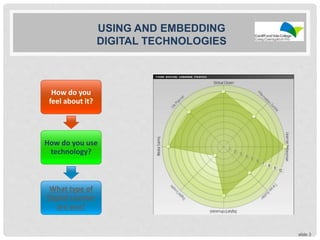
USING AND EMBEDDING
DIGITAL TECHNOLOGIES
slide 3
How do you
feel about it?
How do you use
technology?
What type of
Digital Learner
are you?
… those capabilities which fit an individual
for living, learning and working in a digital
society.
slide 4
WHAT IS DIGITAL LITERACY?
Digital Literacy:
The Third Essential Skill in Wales
Sarah Davies, Jisc Developing digital literacies, 2014
March 2015 - JISC PRIORITY
AREA – TEACHER TRAINING.
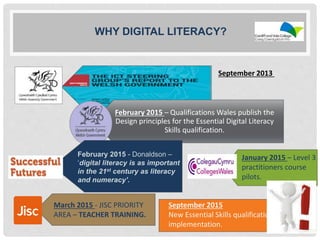
WHY DIGITAL LITERACY?
February 2015 – Qualifications Wales publish the
Design principles for the Essential Digital Literacy
Skills qualification.
September 2013
February 2015 - Donaldson –
‘digital literacy is as important
in the 21st century as literacy
and numeracy’.
September 2015
New Essential Skills qualifications
implementation.
January 2015 – Level 3
practitioners course
pilots.
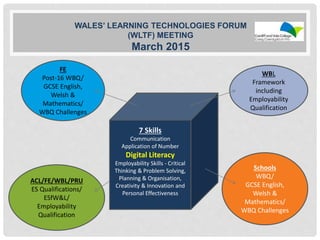
WALES’ LEARNING TECHNOLOGIES FORUM
(WLTF) MEETING
March 2015
7 Skills
Communication
Application of Number
Digital Literacy
Employability Skills - Critical
Thinking & Problem Solving,
Planning & Organisation,
Creativity & Innovation and
Personal Effectiveness
FE
Post-16 WBQ/
GCSE English,
Welsh &
Mathematics/
WBQ Challenges
WBL
Framework
including
Employability
Qualification
ACL/FE/WBL/PRU
ES Qualifications/
ESfW&L/
Employability
Qualification
Schools
WBQ/
GCSE English,
Welsh &
Mathematics/
WBQ Challenges
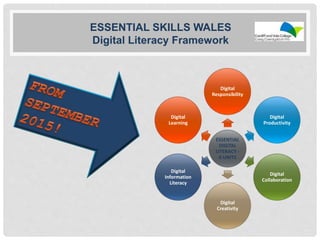
ESSENTIAL
DIGITAL
LITERACY -
6 UNITS
Digital
Responsibility
Digital
Productivity
Digital
Collaboration
Digital
Creativity
Digital
Information
Literacy
Digital
Learning
ESSENTIAL SKILLS WALES
Digital Literacy Framework
slide 8
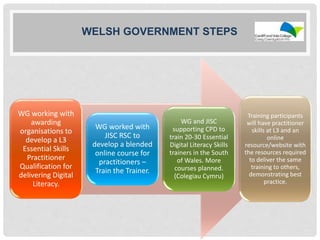
WG working with
awarding
organisations to
develop a L3
Essential Skills
Practitioner
Qualification for
delivering Digital
Literacy.
WG worked with
JISC RSC to
develop a blended
online course for
practitioners –
Train the Trainer.
WG and JISC
supporting CPD to
train 20-30 Essential
Digital Literacy Skills
trainers in the South
of Wales. More
courses planned.
(Colegiau Cymru)
Training participants
will have practitioner
skills at L3 and an
online
resource/website with
the resources required
to deliver the same
training to others,
demonstrating best
practice.
WELSH GOVERNMENT STEPS
10
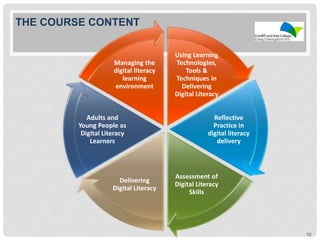
THE COURSE CONTENT
Using Learning
Technologies,
Tools &
Techniques in
Delivering
Digital Literacy
Reflective
Practice in
digital literacy
delivery
Assessment of
Digital Literacy
Skills
Delivering
Digital Literacy
Adults and
Young People as
Digital Literacy
Learners
Managing the
digital literacy
learning
environment
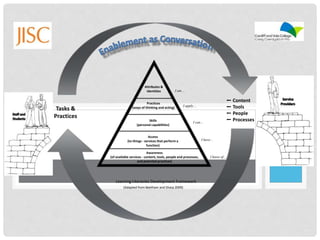
⬅ Content
⬅ Tools
⬅ People
⬅ Processes
Access
(to things - services that perform a
function)
Skills
(personal capabilities)
Practices
(ways of thinking and acting)
Attributes &
Identities
Awareness
(of available services - content, tools, people and processes,
and potential practices)
I know of…
I have…
I can…
I apply…
I am…
Tasks &
Practices
Learning Literacies Development Framework
(Adapted from Beetham and Sharp 2009)
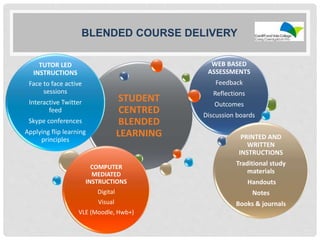
BLENDED COURSE DELIVERY
STUDENT
CENTRED
BLENDED
LEARNING
TUTOR LED
INSTRUCTIONS
Face to face active
sessions
Interactive Twitter
feed
Skype conferences
Applying flip learning
principles
WEB BASED
ASSESSMENTS
Feedback
Reflections
Outcomes
Discussion boards
PRINTED AND
WRITTEN
INSTRUCTIONS
Traditional study
materials
Handouts
Notes
Books & journals
COMPUTER
MEDIATED
INSTRUCTIONS
Digital
Visual
VLE (Moodle, Hwb+)
slide 13
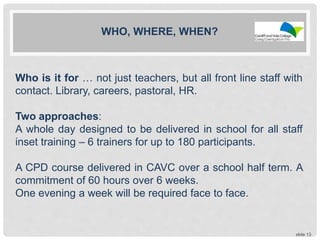
WHO, WHERE, WHEN?
Who is it for … not just teachers, but all front line staff with
contact. Library, careers, pastoral, HR.
Two approaches:
A whole day designed to be delivered in school for all staff
inset training – 6 trainers for up to 180 participants.
A CPD course delivered in CAVC over a school half term. A
commitment of 60 hours over 6 weeks.
One evening a week will be required face to face.
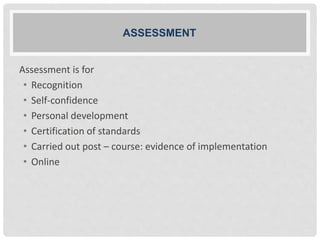
ASSESSMENT
Assessment is for
• Recognition
• Self-confidence
• Personal development
• Certification of standards
• Carried out post – course: evidence of implementation
• Online
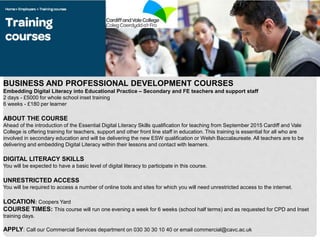
BUSINESS AND PROFESSIONAL DEVELOPMENT COURSES
Embedding Digital Literacy into Educational Practice – Secondary and FE teachers and support staff
2 days - £5000 for whole school inset training
6 weeks - £180 per learner
ABOUT THE COURSE
Ahead of the introduction of the Essential Digital Literacy Skills qualification for teaching from September 2015 Cardiff and Vale
College is offering training for teachers, support and other front line staff in education. This training is essential for all who are
involved in secondary education and will be delivering the new ESW qualification or Welsh Baccalaureate. All teachers are to be
delivering and embedding Digital Literacy within their lessons and contact with learners.
DIGITAL LITERACY SKILLS
You will be expected to have a basic level of digital literacy to participate in this course.
UNRESTRICTED ACCESS
You will be required to access a number of online tools and sites for which you will need unrestricted access to the internet.
LOCATION: Coopers Yard
COURSE TIMES: This course will run one evening a week for 6 weeks (school half terms) and as requested for CPD and Inset
training days.
APPLY: Call our Commercial Services department on 030 30 30 10 40 or email commercial@cavc.ac.uk
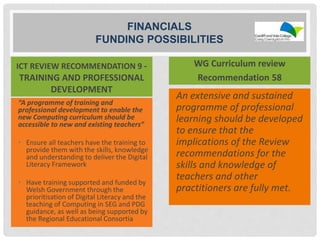
FINANCIALS
FUNDING POSSIBILITIES
ICT REVIEW RECOMMENDATION 9 -
TRAINING AND PROFESSIONAL
DEVELOPMENT
“A programme of training and
professional development to enable the
new Computing curriculum should be
accessible to new and existing teachers”
• Ensure all teachers have the training to
provide them with the skills, knowledge
and understanding to deliver the Digital
Literacy Framework
• Have training supported and funded by
Welsh Government through the
prioritisation of Digital Literacy and the
teaching of Computing in SEG and PDG
guidance, as well as being supported by
the Regional Educational Consortia
WG Curriculum review
Recommendation 58
An extensive and sustained
programme of professional
learning should be developed
to ensure that the
implications of the Review
recommendations for the
skills and knowledge of
teachers and other
practitioners are fully met.
FINANCIALS
Cdil assignment

Cdil assignment

  • 1.
  • 2.
    THE COURSE PROPOSAL: slide2 A CPD course to assist front line education staff in the pursuit of attainment of Welsh Government digital literacy standards in learners. EMBEDDING DIGITAL LITERACY
  • 3.
    USING AND EMBEDDING DIGITALTECHNOLOGIES slide 3 How do you feel about it? How do you use technology? What type of Digital Learner are you?
  • 4.
    … those capabilitieswhich fit an individual for living, learning and working in a digital society. slide 4 WHAT IS DIGITAL LITERACY? Digital Literacy: The Third Essential Skill in Wales Sarah Davies, Jisc Developing digital literacies, 2014
  • 5.
    March 2015 -JISC PRIORITY AREA – TEACHER TRAINING. WHY DIGITAL LITERACY? February 2015 – Qualifications Wales publish the Design principles for the Essential Digital Literacy Skills qualification. September 2013 February 2015 - Donaldson – ‘digital literacy is as important in the 21st century as literacy and numeracy’. September 2015 New Essential Skills qualifications implementation. January 2015 – Level 3 practitioners course pilots.
  • 6.
    WALES’ LEARNING TECHNOLOGIESFORUM (WLTF) MEETING March 2015 7 Skills Communication Application of Number Digital Literacy Employability Skills - Critical Thinking & Problem Solving, Planning & Organisation, Creativity & Innovation and Personal Effectiveness FE Post-16 WBQ/ GCSE English, Welsh & Mathematics/ WBQ Challenges WBL Framework including Employability Qualification ACL/FE/WBL/PRU ES Qualifications/ ESfW&L/ Employability Qualification Schools WBQ/ GCSE English, Welsh & Mathematics/ WBQ Challenges
  • 7.
  • 8.
  • 9.
    WG working with awarding organisationsto develop a L3 Essential Skills Practitioner Qualification for delivering Digital Literacy. WG worked with JISC RSC to develop a blended online course for practitioners – Train the Trainer. WG and JISC supporting CPD to train 20-30 Essential Digital Literacy Skills trainers in the South of Wales. More courses planned. (Colegiau Cymru) Training participants will have practitioner skills at L3 and an online resource/website with the resources required to deliver the same training to others, demonstrating best practice. WELSH GOVERNMENT STEPS
  • 10.
    10 THE COURSE CONTENT UsingLearning Technologies, Tools & Techniques in Delivering Digital Literacy Reflective Practice in digital literacy delivery Assessment of Digital Literacy Skills Delivering Digital Literacy Adults and Young People as Digital Literacy Learners Managing the digital literacy learning environment
  • 11.
    ⬅ Content ⬅ Tools ⬅People ⬅ Processes Access (to things - services that perform a function) Skills (personal capabilities) Practices (ways of thinking and acting) Attributes & Identities Awareness (of available services - content, tools, people and processes, and potential practices) I know of… I have… I can… I apply… I am… Tasks & Practices Learning Literacies Development Framework (Adapted from Beetham and Sharp 2009)
  • 12.
    BLENDED COURSE DELIVERY STUDENT CENTRED BLENDED LEARNING TUTORLED INSTRUCTIONS Face to face active sessions Interactive Twitter feed Skype conferences Applying flip learning principles WEB BASED ASSESSMENTS Feedback Reflections Outcomes Discussion boards PRINTED AND WRITTEN INSTRUCTIONS Traditional study materials Handouts Notes Books & journals COMPUTER MEDIATED INSTRUCTIONS Digital Visual VLE (Moodle, Hwb+)
  • 13.
    slide 13 WHO, WHERE,WHEN? Who is it for … not just teachers, but all front line staff with contact. Library, careers, pastoral, HR. Two approaches: A whole day designed to be delivered in school for all staff inset training – 6 trainers for up to 180 participants. A CPD course delivered in CAVC over a school half term. A commitment of 60 hours over 6 weeks. One evening a week will be required face to face.
  • 14.
    ASSESSMENT Assessment is for •Recognition • Self-confidence • Personal development • Certification of standards • Carried out post – course: evidence of implementation • Online
  • 15.
    BUSINESS AND PROFESSIONALDEVELOPMENT COURSES Embedding Digital Literacy into Educational Practice – Secondary and FE teachers and support staff 2 days - £5000 for whole school inset training 6 weeks - £180 per learner ABOUT THE COURSE Ahead of the introduction of the Essential Digital Literacy Skills qualification for teaching from September 2015 Cardiff and Vale College is offering training for teachers, support and other front line staff in education. This training is essential for all who are involved in secondary education and will be delivering the new ESW qualification or Welsh Baccalaureate. All teachers are to be delivering and embedding Digital Literacy within their lessons and contact with learners. DIGITAL LITERACY SKILLS You will be expected to have a basic level of digital literacy to participate in this course. UNRESTRICTED ACCESS You will be required to access a number of online tools and sites for which you will need unrestricted access to the internet. LOCATION: Coopers Yard COURSE TIMES: This course will run one evening a week for 6 weeks (school half terms) and as requested for CPD and Inset training days. APPLY: Call our Commercial Services department on 030 30 30 10 40 or email commercial@cavc.ac.uk
  • 16.
    FINANCIALS FUNDING POSSIBILITIES ICT REVIEWRECOMMENDATION 9 - TRAINING AND PROFESSIONAL DEVELOPMENT “A programme of training and professional development to enable the new Computing curriculum should be accessible to new and existing teachers” • Ensure all teachers have the training to provide them with the skills, knowledge and understanding to deliver the Digital Literacy Framework • Have training supported and funded by Welsh Government through the prioritisation of Digital Literacy and the teaching of Computing in SEG and PDG guidance, as well as being supported by the Regional Educational Consortia WG Curriculum review Recommendation 58 An extensive and sustained programme of professional learning should be developed to ensure that the implications of the Review recommendations for the skills and knowledge of teachers and other practitioners are fully met.
  • 17.

Editor's Notes

  • #4 Do you know what that term means? 2. Quick hands up – what devices, what have they been used for? 3. My results.
  • #5 Digital literacy video. 4 minutes.
  • #7 JISC RSC Wales and ColegauCymru/CollegesWales have teamed up to bring you the new Wales’ Learning Technologies Forum. This forum brings together a range of other networks all working to similar objectives. Bringing them together, provides a platform through which all sectors can learn from one-another, provides a much more sustainable approach to peer networking, innovation, and sharing of experience. This new forum is open to all providers within the post-16 sector in Wales who have an interest in the use of digital technologies to support and progress organisational practices related to teaching and learning. The main focus for forum activities will revolve around sharing best practice, and providing a cross-sectored environment through which new relationships can form and collaborative activities flourish. It also provides a very cost effective way of channelling relevant information to all sectors at the same time, in the same way, enabling all sectors to benefit equally. JISC are a registered charity and champion the use of digital technologies in UK education and research
  • #8 The new Essential Skills web site: Design Principles for the Essential Dig Lit Skills qualification. http://www.qualificationswales.org/uploads/documents/150205-design-principles-for-the-essential-digital-literacy-skills-qualification-en.pdf So Digital Literacy is replacing ICT as the third Essential Skill in Wales. That transition is now in progress for implementation from this September in all secondary schools and FE colleges, both as stand alone qualifications and as a part of the assessment of Welsh Bac. . A new framework of learner qualifications has been created, with six levels (Entry 1 to Level 3) and six themes. These themes are: Digital Responsibility, Digital Information Literacy, Digital Productivity, Digital Collaboration, Digital Creativity and Digital Learning.
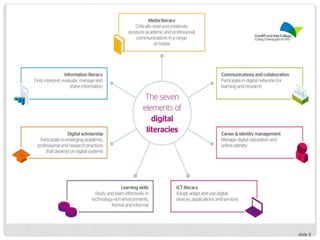
  • #9 BUT these themes are for the learners. Those involved with learners through delivery and support, need to be looking at the wider digital literacy elements, shown here. These elements have informed the development of the requirements for front line staff.
  • #10 https://twitter.com/search?q=%23jiscdiglit&src=typd&lang=en This course is now running – 6 sessions – One North and one south. One person from CAV is completing. . . Next slide.
  • #13 Delivered via a Blended Learning philosophy. A true blended learning classroom should have differentiated instruction, individualized learning, be student centered, and help the educator see who needs help and where.
  • #15 External accreditation as incentive and for recognition