CDC Clear Communication Index Score Sheet
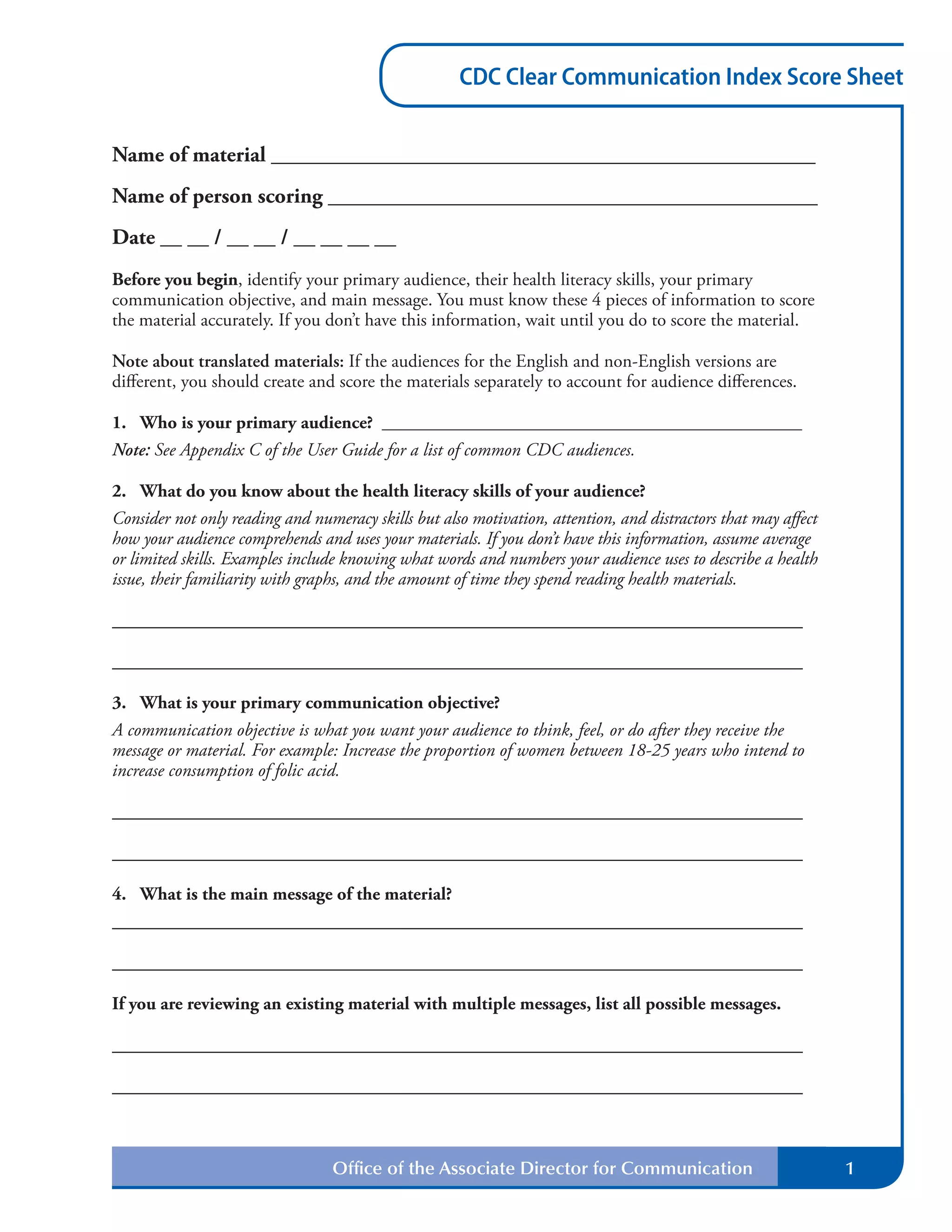
Name of material __________________________________________________
Name of person scoring _____________________________________________
Date __ __ / __ __ / __ __ __ __
Before you begin, identify your primary audience, their health literacy skills, your primary
communication objective, and main message. You must know these 4 pieces of information to score
the material accurately. If you don’t have this information, wait until you do to score the material.
Note about translated materials: If the audiences for the English and non-English versions are
different, you should create and score the materials separately to account for audience differences.
1. Who is your primary audience? ______________________________________________
Note: See Appendix C of the User Guide for a list of common CDC audiences.
2. What do you know about the health literacy skills of your audience?
Consider not only reading and numeracy skills but also motivation, attention, and distractors that may affect
how your audience comprehends and uses your materials. If you don’t have this information, assume average
or limited skills. Examples include knowing what words and numbers your audience uses to describe a health
issue, their familiarity with graphs, and the amount of time they spend reading health materials.  
__________________________________________________________________________
__________________________________________________________________________
3. What is your primary communication objective?
A communication objective is what you want your audience to think, feel, or do after they receive the
or example: Imessage or material. F ncrease the proportion of women between 18-25 years who intend to
increase consumption of folic acid.
__________________________________________________________________________
__________________________________________________________________________
4. What is the main message of the material?
__________________________________________________________________________
__________________________________________________________________________
If you are reviewing an existing material with multiple messages, list all possible messages.
__________________________________________________________________________
__________________________________________________________________________
Office of the Associate Director for Communication 1
Save Form Next Page
Reset Form
Revised May 2013
Print
CDC Clear Communication Index Score Sheet
Using the Score Sheet
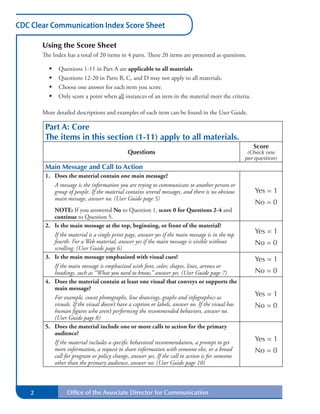
The Index has a total of 20 items in 4 parts. These 20 items are presented as questions.
•	 Questions 1-11 in Part A are applicable to all materials
•	 Questions 12-20 in Parts B, C, and D may not apply to all materials.
•	 Choose one answer for each item you score.
•	 Only score a point when all instances of an item in the material meet the criteria.
More detailed descriptions and examples of each item can be found in the User Guide.
Part A: Core
The items in this section (1-11) apply to all materials.
Score
Questions (Check one
per question)
Main Message and Call to Action
1. Does the material contain one main message?
A message is the information you are trying to communicate to another person or
group of people. If the material contains several messages, and there is no obvious Yes = 1
main message, answer no. (User Guide page 5)
No = 0
NOTE: If you answered No to Question 1, score 0 for Questions 2-4 and
continue to Question 5.
2. Is the main message at the top, beginning, or front of the material?
Yes = 1If the material is a single print page, answer yes if the main message is in the top
fourth. For a Web material, answer yes if the main message is visible without No = 0
scrolling. (User Guide page 6)
3. Is the main message emphasized with visual cues? Yes = 1
If the main message is emphasized with font, color, shapes, lines, arrows or
headings, such as “What you need to know,” answer yes. (User Guide page 7) No = 0
4. Does the material contain at least one visual that conveys or supports the
main message?
Yes = 1For example, count photographs, line drawings, graphs and infographics as
visuals. If the visual doesn’t have a caption or labels, answer no. If the visual has No = 0
human figures who aren’t performing the recommended behaviors, answer no.
(User Guide page 8)
5. Does the material include one or more calls to action for the primary
audience?
Yes = 1If the material includes a specific behavioral recommendation, a prompt to get
more information, a request to share information with someone else, or a broad No = 0
call for program or policy change, answer yes. If the call to action is for someone
other than the primary audience, answer no. (User Guide page 10)
2 Office of the Associate Director for Communication
Save Form Next Page
Previous Page
Revised May 2013
CDC Clear Communication Index Score Sheet
Language
6. Do both the main message and the call to action use the active voice? Yes = 1
If only the main message or only the call to action uses the active voice, answer no.
If you answered no to #1 or #5, answer no. (User Guide page 11) No = 0
7. Does the material always use language the primary audience would use?
See top of Score Sheet for primary audience. Yes = 1
If all specialized or unfamiliar terms are explained or described (not just defined)
the first time they are used, answer yes. Acronyms and abbreviations must be No = 0
spelled out and explained if unfamiliar to the audience. (User Guide page 12)
Information Design
8. Does the material use bulleted or numbered lists?
Yes = 1If the material contains a list with more than 7 items, and the list is not broken
up into sub-lists, answer no. If the list is for additional information or references No = 0
only or at the end of the material, answer no. (User Guide page 14)
9. Is the material organized in chunks with headings?
Yes = 1This item applies to prose text and lists. If the chunks contain more than one idea
each, answer no. If the headings don’t match the information chunks, answer no. No = 0
(User Guide page 15)
10. Is the most important information the primary audience needs
summarized in the first paragraph or section? Yes = 1
The most important information must include the main message. (User Guide No = 0
page 17)
State of the Science
11. Does the material explain what authoritative sources, such as subject
matter experts and agency spokespersons, know and don’t know about Yes = 1
the topic?
If the material addresses both, answer yes. If the material addresses only one (what No = 0
is known or not known), answer no. (User Guide page 18)
Part A score Total _____ / 11
Comments
Office of the Associate Director for Communication 3
0
Save Form Next Page
Previous Page
Revised May 2013
CDC Clear Communication Index Score Sheet
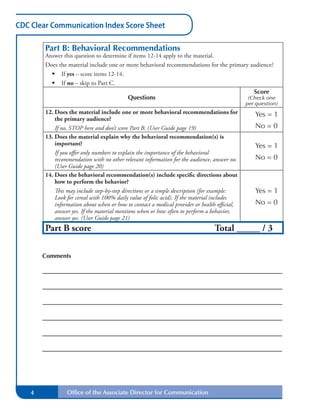
Part B: Behavioral Recommendations
Answer this question to determine if items 12-14 apply to the material.
Does the material include one or more behavioral recommendations for the primary audience?
•	 If yes – score items 12-14.
•	 If no – skip to Part C.
Score
Questions (Check one
per question)
12. Does the material include one or more behavioral recommendations for Yes = 1
the primary audience?
If no, STOP here and don’t score Part B. (User Guide page 19) No = 0
13. Does the material explain why the behavioral recommendation(s) is
important? Yes = 1
If you offer only numbers to explain the importance of the behavioral
recommendation with no other relevant information for the audience, answer no. No = 0
(User Guide page 20)
14. Does the behavioral recommendation(s) include specific directions about
how to perform the behavior?
This may include step-by-step directions or a simple description (for example: Yes = 1
Look for cereal with 100% daily value of folic acid). If the material includes
information about when or how to contact a medical provider or health official, No = 0
answer yes. If the material mentions when or how often to perform a behavior,
answer yes. (User Guide page 21)
Part B score Total _____ / 3
Comments
4 Office of the Associate Director for Communication
0
Save Form Next Page
Previous Page
Go to Part C
Revised May 2013
CDC Clear Communication Index Score Sheet
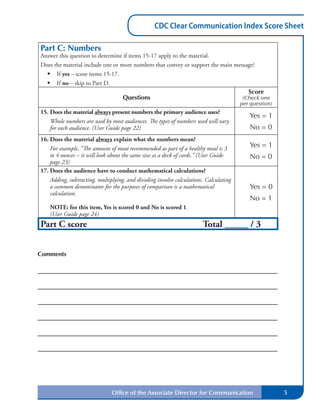
Part C: Numbers
Answer this question to determine if items 15-17 apply to the material.
Does the material include one or more numbers that convey or support the main message?
•	 If yes – score items 15-17.
•	 If no – skip to Part D.
Score
Questions (Check one
per question)
15. Does the material always present numbers the primary audience uses?
Yes = 1
Whole numbers are used by most audiences. The types of numbers used will vary
for each audience. (User Guide page 22) No = 0
16. Does the material always explain what the numbers mean?
Yes = 1For example, “The amount of meat recommended as part of a healthy meal is 3
to 4 ounces – it will look about the same size as a deck of cards.” (User Guide No = 0
page 23)
17. Does the audience have to conduct mathematical calculations?
Adding, subtracting, multiplying, and dividing involve calculations. Calculating
a common denominator for the purposes of comparison is a mathematical Yes = 0
calculation.
No = 1
NOTE: for this item, Yes is scored 0 and No is scored 1.
(User Guide page 24)
Part C score Total _____ / 3
Comments
Office of the Associate Director for Communication 5
0
Save Form Next Page
Previous Page
Go to Part D
Revised May 2013
CDC Clear Communication Index Score Sheet
Part D: Risk
Answer this question to determine if items 18-20 apply to the material.
Does the material present information, including numbers, about risk?
•	 If yes – score items 18-20.
•	 Items 19 and 20 have a “not applicable” (NA) option.
•	 If no – skip to Calculate Your Score.
Score
Questions (Check One
per Question)
18. Does the material explain the nature of the risk?
If the material states the threat or harm and how and why people may be affected,
answer yes. If the material has only the threat or harm but no explanation, Yes = 1
answer no. For example, if the material states there are 1,000 new cases of a
contagious disease in Springfield, does it also state that people in Springfield may No = 0
be more likely to get the disease, why they may be more likely, and how serious the
threat of the disease is? (User Guide page 26)
19. Does the material address both the risks and benefits of the
Yes = 1recommended behaviors?
This includes actual risks and benefits and those perceived by your audience. If No = 0
the material addresses only risks or only benefits, answer no. If no behavioral
NArecommendation is presented, answer not applicable (NA). (User Guide page 27)
20. If the material uses numeric probability to describe risk, is the
probability also explained with words or a visual?
Examples of probability information in a risk message are numbers (such as 1 in Yes = 1
5 or 20%). If the material presents numeric risk and also uses text to explain the No = 0
probability, answer yes. If the material presents numeric risk and also uses a visual
to explain the probability, answer yes. If the material only presents numeric risk, NA
answer no. If the material does not include this type of probability information,
answer not applicable (NA). (User Guide page 28)
Part D score Total _____ / 3
OR _____ / 2
(if you answered NA for only 1 item)
OR _____ / 1
(if you answered NA for 2 items)
Comments
6 Office of the Associate Director for Communication
0 3
Save Form Next Page
Previous Page
Go to Calculate
Revised May 2013
CDC Clear Communication Index Score Sheet
Calculate the Score for the Material
•	 Step 1: The total points that the material earned (this is the numerator).
» A: _____ B: _____ C: _____ D: _____ = _____
•	 Step 2: The total possible points that the material could have earned (this is the denominator).
» A: 11 B: _____ C: _____ D: _____ = _____
•	 Step 3: The numerator divided by the denominator multiplied by 100 to get the total score.
_____ / _____ x 100 = _____
How to Interpret the Score
The purpose of the Index is to improve the clarity of communication products.
If the total score is 90 or above:
Excellent! You have addressed most items that make materials easier to understand and use.
If the total score is 89 or below:
Note which items scored 0 points. Use the descriptions and examples in the User Guide to revise and
improve the material. Then apply the Index again to check your work. You can use the Index as many
times as you need to revise the material to get a score of 90 or above.
Additional Comments
Office of the Associate Director for Communication 7
0 0 0 0 0
0 0 0 11
0 11 0.0
Email Form Print Save Form
Previous Page
Revised May 2013

Cdc comm index score cards

  • 1.
    CDC Clear CommunicationIndex Score Sheet Name of material __________________________________________________ Name of person scoring _____________________________________________ Date __ __ / __ __ / __ __ __ __ Before you begin, identify your primary audience, their health literacy skills, your primary communication objective, and main message. You must know these 4 pieces of information to score the material accurately. If you don’t have this information, wait until you do to score the material. Note about translated materials: If the audiences for the English and non-English versions are different, you should create and score the materials separately to account for audience differences. 1. Who is your primary audience? ______________________________________________ Note: See Appendix C of the User Guide for a list of common CDC audiences. 2. What do you know about the health literacy skills of your audience? Consider not only reading and numeracy skills but also motivation, attention, and distractors that may affect how your audience comprehends and uses your materials. If you don’t have this information, assume average or limited skills. Examples include knowing what words and numbers your audience uses to describe a health issue, their familiarity with graphs, and the amount of time they spend reading health materials.   __________________________________________________________________________ __________________________________________________________________________ 3. What is your primary communication objective? A communication objective is what you want your audience to think, feel, or do after they receive the or example: Imessage or material. F ncrease the proportion of women between 18-25 years who intend to increase consumption of folic acid. __________________________________________________________________________ __________________________________________________________________________ 4. What is the main message of the material? __________________________________________________________________________ __________________________________________________________________________ If you are reviewing an existing material with multiple messages, list all possible messages. __________________________________________________________________________ __________________________________________________________________________ Office of the Associate Director for Communication 1 Save Form Next Page Reset Form Revised May 2013 Print
  • 2.
    CDC Clear CommunicationIndex Score Sheet Using the Score Sheet The Index has a total of 20 items in 4 parts. These 20 items are presented as questions. • Questions 1-11 in Part A are applicable to all materials • Questions 12-20 in Parts B, C, and D may not apply to all materials. • Choose one answer for each item you score. • Only score a point when all instances of an item in the material meet the criteria. More detailed descriptions and examples of each item can be found in the User Guide. Part A: Core The items in this section (1-11) apply to all materials. Score Questions (Check one per question) Main Message and Call to Action 1. Does the material contain one main message? A message is the information you are trying to communicate to another person or group of people. If the material contains several messages, and there is no obvious Yes = 1 main message, answer no. (User Guide page 5) No = 0 NOTE: If you answered No to Question 1, score 0 for Questions 2-4 and continue to Question 5. 2. Is the main message at the top, beginning, or front of the material? Yes = 1If the material is a single print page, answer yes if the main message is in the top fourth. For a Web material, answer yes if the main message is visible without No = 0 scrolling. (User Guide page 6) 3. Is the main message emphasized with visual cues? Yes = 1 If the main message is emphasized with font, color, shapes, lines, arrows or headings, such as “What you need to know,” answer yes. (User Guide page 7) No = 0 4. Does the material contain at least one visual that conveys or supports the main message? Yes = 1For example, count photographs, line drawings, graphs and infographics as visuals. If the visual doesn’t have a caption or labels, answer no. If the visual has No = 0 human figures who aren’t performing the recommended behaviors, answer no. (User Guide page 8) 5. Does the material include one or more calls to action for the primary audience? Yes = 1If the material includes a specific behavioral recommendation, a prompt to get more information, a request to share information with someone else, or a broad No = 0 call for program or policy change, answer yes. If the call to action is for someone other than the primary audience, answer no. (User Guide page 10) 2 Office of the Associate Director for Communication Save Form Next Page Previous Page Revised May 2013
  • 3.
    CDC Clear CommunicationIndex Score Sheet Language 6. Do both the main message and the call to action use the active voice? Yes = 1 If only the main message or only the call to action uses the active voice, answer no. If you answered no to #1 or #5, answer no. (User Guide page 11) No = 0 7. Does the material always use language the primary audience would use? See top of Score Sheet for primary audience. Yes = 1 If all specialized or unfamiliar terms are explained or described (not just defined) the first time they are used, answer yes. Acronyms and abbreviations must be No = 0 spelled out and explained if unfamiliar to the audience. (User Guide page 12) Information Design 8. Does the material use bulleted or numbered lists? Yes = 1If the material contains a list with more than 7 items, and the list is not broken up into sub-lists, answer no. If the list is for additional information or references No = 0 only or at the end of the material, answer no. (User Guide page 14) 9. Is the material organized in chunks with headings? Yes = 1This item applies to prose text and lists. If the chunks contain more than one idea each, answer no. If the headings don’t match the information chunks, answer no. No = 0 (User Guide page 15) 10. Is the most important information the primary audience needs summarized in the first paragraph or section? Yes = 1 The most important information must include the main message. (User Guide No = 0 page 17) State of the Science 11. Does the material explain what authoritative sources, such as subject matter experts and agency spokespersons, know and don’t know about Yes = 1 the topic? If the material addresses both, answer yes. If the material addresses only one (what No = 0 is known or not known), answer no. (User Guide page 18) Part A score Total _____ / 11 Comments Office of the Associate Director for Communication 3 0 Save Form Next Page Previous Page Revised May 2013
  • 4.
    CDC Clear CommunicationIndex Score Sheet Part B: Behavioral Recommendations Answer this question to determine if items 12-14 apply to the material. Does the material include one or more behavioral recommendations for the primary audience? • If yes – score items 12-14. • If no – skip to Part C. Score Questions (Check one per question) 12. Does the material include one or more behavioral recommendations for Yes = 1 the primary audience? If no, STOP here and don’t score Part B. (User Guide page 19) No = 0 13. Does the material explain why the behavioral recommendation(s) is important? Yes = 1 If you offer only numbers to explain the importance of the behavioral recommendation with no other relevant information for the audience, answer no. No = 0 (User Guide page 20) 14. Does the behavioral recommendation(s) include specific directions about how to perform the behavior? This may include step-by-step directions or a simple description (for example: Yes = 1 Look for cereal with 100% daily value of folic acid). If the material includes information about when or how to contact a medical provider or health official, No = 0 answer yes. If the material mentions when or how often to perform a behavior, answer yes. (User Guide page 21) Part B score Total _____ / 3 Comments 4 Office of the Associate Director for Communication 0 Save Form Next Page Previous Page Go to Part C Revised May 2013
  • 5.
    CDC Clear CommunicationIndex Score Sheet Part C: Numbers Answer this question to determine if items 15-17 apply to the material. Does the material include one or more numbers that convey or support the main message? • If yes – score items 15-17. • If no – skip to Part D. Score Questions (Check one per question) 15. Does the material always present numbers the primary audience uses? Yes = 1 Whole numbers are used by most audiences. The types of numbers used will vary for each audience. (User Guide page 22) No = 0 16. Does the material always explain what the numbers mean? Yes = 1For example, “The amount of meat recommended as part of a healthy meal is 3 to 4 ounces – it will look about the same size as a deck of cards.” (User Guide No = 0 page 23) 17. Does the audience have to conduct mathematical calculations? Adding, subtracting, multiplying, and dividing involve calculations. Calculating a common denominator for the purposes of comparison is a mathematical Yes = 0 calculation. No = 1 NOTE: for this item, Yes is scored 0 and No is scored 1. (User Guide page 24) Part C score Total _____ / 3 Comments Office of the Associate Director for Communication 5 0 Save Form Next Page Previous Page Go to Part D Revised May 2013
  • 6.
    CDC Clear CommunicationIndex Score Sheet Part D: Risk Answer this question to determine if items 18-20 apply to the material. Does the material present information, including numbers, about risk? • If yes – score items 18-20. • Items 19 and 20 have a “not applicable” (NA) option. • If no – skip to Calculate Your Score. Score Questions (Check One per Question) 18. Does the material explain the nature of the risk? If the material states the threat or harm and how and why people may be affected, answer yes. If the material has only the threat or harm but no explanation, Yes = 1 answer no. For example, if the material states there are 1,000 new cases of a contagious disease in Springfield, does it also state that people in Springfield may No = 0 be more likely to get the disease, why they may be more likely, and how serious the threat of the disease is? (User Guide page 26) 19. Does the material address both the risks and benefits of the Yes = 1recommended behaviors? This includes actual risks and benefits and those perceived by your audience. If No = 0 the material addresses only risks or only benefits, answer no. If no behavioral NArecommendation is presented, answer not applicable (NA). (User Guide page 27) 20. If the material uses numeric probability to describe risk, is the probability also explained with words or a visual? Examples of probability information in a risk message are numbers (such as 1 in Yes = 1 5 or 20%). If the material presents numeric risk and also uses text to explain the No = 0 probability, answer yes. If the material presents numeric risk and also uses a visual to explain the probability, answer yes. If the material only presents numeric risk, NA answer no. If the material does not include this type of probability information, answer not applicable (NA). (User Guide page 28) Part D score Total _____ / 3 OR _____ / 2 (if you answered NA for only 1 item) OR _____ / 1 (if you answered NA for 2 items) Comments 6 Office of the Associate Director for Communication 0 3 Save Form Next Page Previous Page Go to Calculate Revised May 2013
  • 7.
    CDC Clear CommunicationIndex Score Sheet Calculate the Score for the Material • Step 1: The total points that the material earned (this is the numerator). » A: _____ B: _____ C: _____ D: _____ = _____ • Step 2: The total possible points that the material could have earned (this is the denominator). » A: 11 B: _____ C: _____ D: _____ = _____ • Step 3: The numerator divided by the denominator multiplied by 100 to get the total score. _____ / _____ x 100 = _____ How to Interpret the Score The purpose of the Index is to improve the clarity of communication products. If the total score is 90 or above: Excellent! You have addressed most items that make materials easier to understand and use. If the total score is 89 or below: Note which items scored 0 points. Use the descriptions and examples in the User Guide to revise and improve the material. Then apply the Index again to check your work. You can use the Index as many times as you need to revise the material to get a score of 90 or above. Additional Comments Office of the Associate Director for Communication 7 0 0 0 0 0 0 0 0 11 0 11 0.0 Email Form Print Save Form Previous Page Revised May 2013