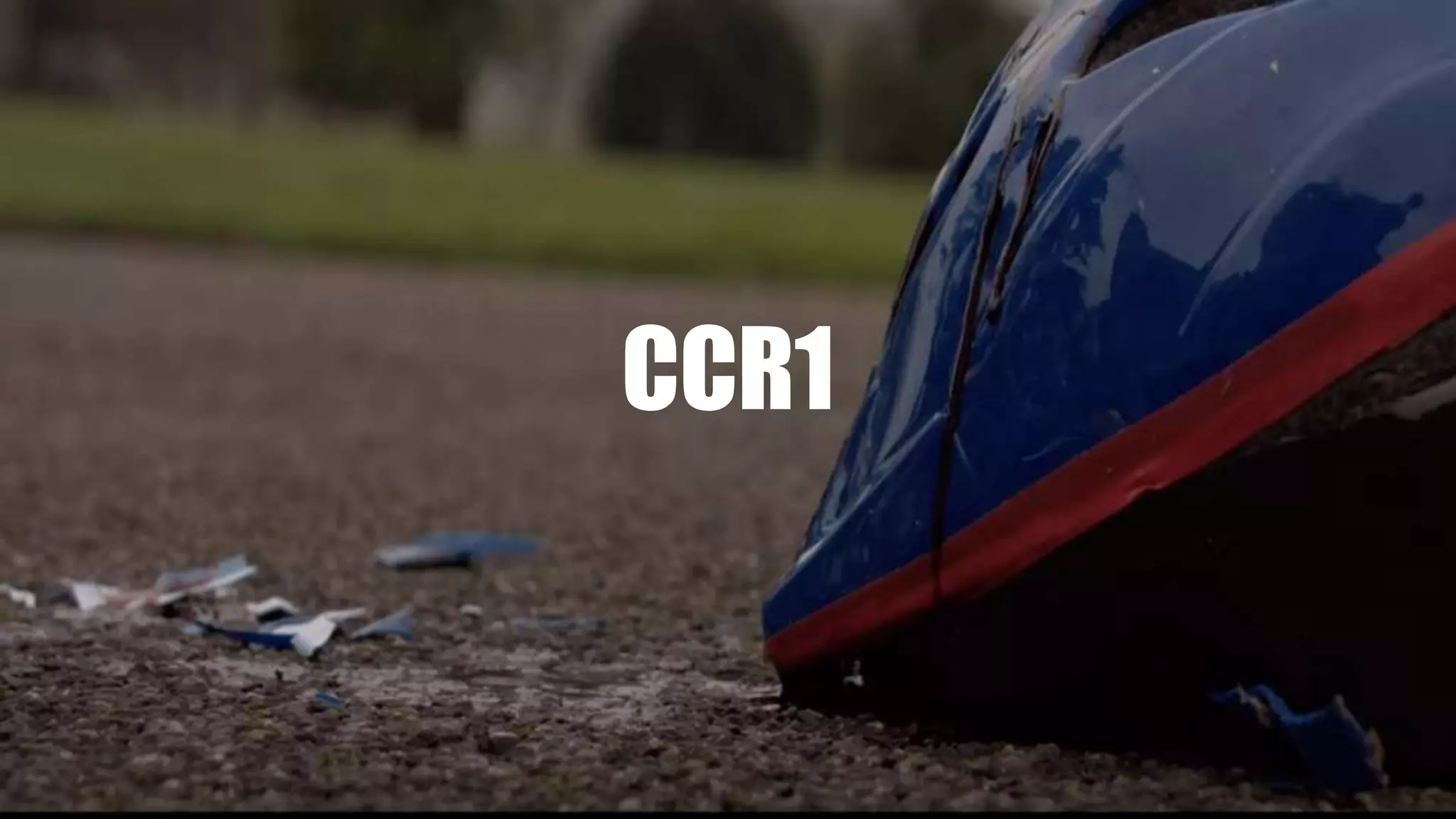
CCR1
What genre have you made and what are genre conventions?
The genre of our opening title sequence is a thriller crime including topics such as death, crime and mystery.
Genre conventions are rules (for the institution) and expectations for the audience. Forms of conventions include
narrative, theme and characters. Specifically technological conventions including sound, editing and camera but
also symbolic conventions which is all of the elements making up mise-en-scene.
Conventions are used to engage and reach the target audience and are specifically used in the opening as it sets
the tone for the whole film but later on can challenge some of these conventions to surprise the audiences
expectations as if there are no conventions used in the first place how can they be challenged.
Similar products
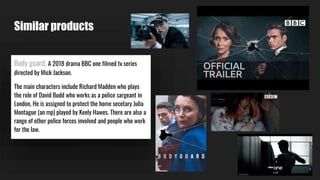
Body guard, A 2018 drama BBC one filmed tv series
directed by Mick Jackson.
The main characters include Richard Madden who plays
the role of David Budd who works as a police sargeant in
London, He is assigned to protect the home secetary Julia
Montague (an mp) played by Keely Hawes. There are also a
range of other police forces involved and people who work
for the law.
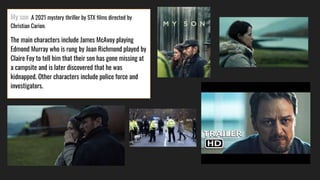
My son ,A 2021 mystery thriller by STX films directed by
Christian Carion.
The main characters include James McAvoy playing
Edmond Murray who is rung by Joan Richmond played by
Claire Foy to tell him that their son has gone missing at
a campsite and is later discovered that he was
kidnapped. Other characters include police force and
investigators.
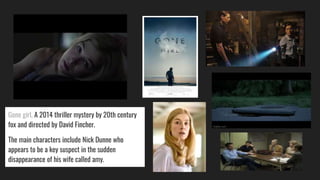
Gone girl, A 2014 thriller mystery by 20th century
fox and directed by David Fincher.
The main characters include Nick Dunne who
appears to be a key suspect in the sudden
disappearance of his wife called amy.
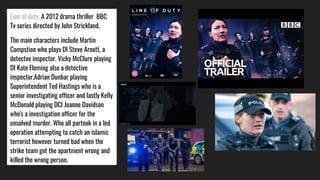
Line of duty, A 2012 drama thriller BBC
Tv series directed by John Strickland.
The main characters include Martin
Compstion who plays DI Steve Arnott, a
detectve inspector. Vicky McClure playing
DI Kate Fleming also a detective
inspector,Adrian Dunbar playing
Superintendent Ted Hastings who is a
senior investigating officer and lastly Kelly
McDonald playing DCI Joanne Davidson
who's a investigation officer for the
unsolved murder. Who all partook in a led
operation attempting to catch an islamic
terrorist however turned bad when the
strike team got the apartment wrong and
killed the wrong person.
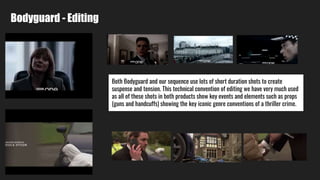
Bodyguard - Editing
Both Bodyguard and our sequence use lots of short duration shots to create
suspense and tension. This technical convention of editing we have very much used
as all of these shots in both products show key events and elements such as props
(guns and handcuffs) showing the key iconic genre conventions of a thriller crime.
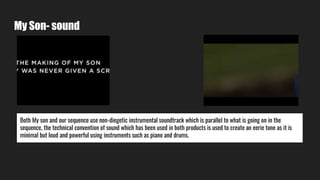
My Son- sound
Both My son and our sequence use non-diegetic instrumental soundtrack which is parallel to what is going on in the
sequence, the technical convention of sound which has been used in both products is used to create an eerie tone as it is
minimal but loud and powerful using instruments such as piano and drums.
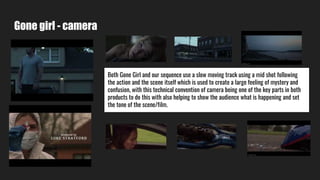
Gone girl - camera
Both Gone Girl and our sequence use a slow moving track using a mid shot following
the action and the scene itself which is used to create a large feeling of mystery and
confusion, with this technical convention of camera being one of the key parts in both
products to do this with also helping to show the audience what is happening and set
the tone of the scene/film.
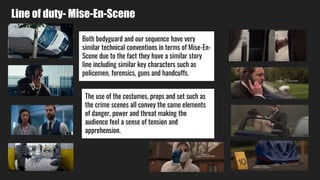
Line of duty- Mise-En-Scene
Both bodyguard and our sequence have very
similar technical conventions in terms of Mise-En-
Scene due to the fact they have a similar story
line including similar key characters such as
policemen, forensics, guns and handcuffs.
The use of the costumes, props and set such as
the crime scenes all convey the same elements
of danger, power and threat making the
audience feel a sense of tension and
apprehension.
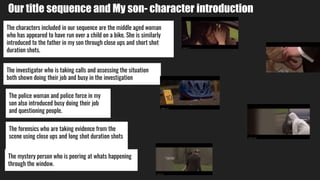
Our title sequence and My son- character introduction
The characters included in our sequence are the middle aged woman
who has appeared to have run over a child on a bike. She is similarly
introduced to the father in my son through close ups and short shot
duration shots.
The forensics who are taking evidence from the
scene using close ups and long shot duration shots
The investigator who is taking calls and assessing the situation
both shown doing their job and busy in the investigation
The police woman and police force in my
son also introduced busy doing their job
and questioning people.
The mystery person who is peering at whats happening
through the window.
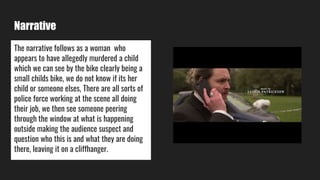
Narrative
The narrative follows as a woman who
appears to have allegedly murdered a child
which we can see by the bike clearly being a
small childs bike, we do not know if its her
child or someone elses, There are all sorts of
police force working at the scene all doing
their job, we then see someone peering
through the window at what is happening
outside making the audience suspect and
question who this is and what they are doing
there, leaving it on a cliffhanger.
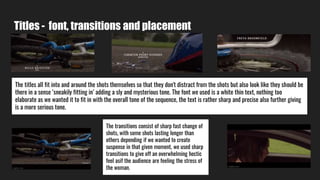
Titles - font, transitions and placement
The titles all fit into and around the shots themselves so that they don't distract from the shots but also look like they should be
there in a sense ‘sneakily fitting in’ adding a sly and mysterious tone. The font we used is a white thin text, nothing too
elaborate as we wanted it to fit in with the overall tone of the sequence, the text is rather sharp and precise also further giving
is a more serious tone.
The transitions consist of sharp fast change of
shots, with some shots lasting longer than
others depending if we wanted to create
suspense in that given moment, we used sharp
transitions to give off an overwhelming hectic
feel asif the audience are feeling the stress of
the woman.
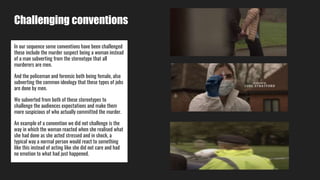
Challenging conventions
In our sequence some conventions have been challenged
these include the murder suspect being a woman instead
of a man subverting from the stereotype that all
murderers are men.
And the policeman and forensic both being female, also
subverting the common ideology that these types of jobs
are done by men.
We subverted from both of these stereotypes to
challenge the audiences expectations and make them
more suspicious of who actually committed the murder.
An example of a convention we did not challenge is the
way in which the woman reacted when she realised what
she had done as she acted stressed and in shock, a
typical way a normal person would react to something
like this instead of acting like she did not care and had
no emotion to what had just happened.
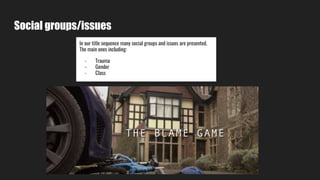
Social groups/issues
In our title sequence many social groups and issues are presented.
The main ones including:
- Trauma
- Gender
- Class
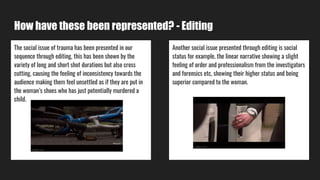
How have these been represented? - Editing
The social issue of trauma has been presented in our
sequence through editing, this has been shown by the
variety of long and short shot durations but also cross
cutting, causing the feeling of inconsistency towards the
audience making them feel unsettled as if they are put in
the woman’s shoes who has just potentially murdered a
child.
Another social issue presented through editing is social
status for example, the linear narrative showing a slight
feeling of order and professionalism from the investigators
and forensics etc, showing their higher status and being
superior compared to the woman.
Camera
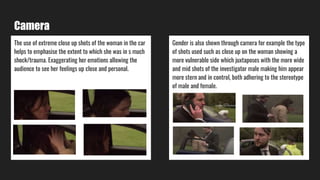
The use of extreme close up shots of the woman in the car
helps to emphasise the extent to which she was in s much
shock/trauma. Exaggerating her emotions allowing the
audience to see her feelings up close and personal.
Gender is also shown through camera for example the type
of shots used such as close up on the woman showing a
more vulnerable side which juxtaposes with the more wide
and mid shots of the investigator male making him appear
more stern and in control, both adhering to the stereotype
of male and female.
Sound
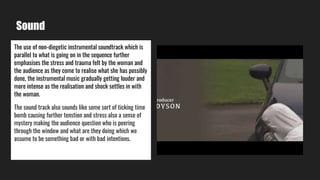
The use of non-diegetic instrumental soundtrack which is
parallel to what is going on in the sequence further
emphasises the stress and trauma felt by the woman and
the audience as they come to realise what she has possibly
done, the instrumental music gradually getting louder and
more intense as the realisation and shock settles in with
the woman.
The sound track also sounds like some sort of ticking time
bomb causing further tenstion and stress also a sense of
mystery making the audience question who is peering
through the window and what are they doing which we
assume to be something bad or with bad intentions.
Mise-en-scene
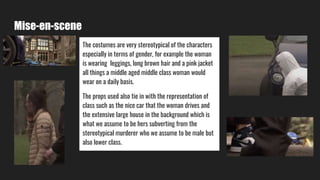
The costumes are very stereotypical of the characters
especially in terms of gender, for example the woman
is wearing leggings, long brown hair and a pink jacket
all things a middle aged middle class woman would
wear on a daily basis.
The props used also tie in with the representation of
class such as the nice car that the woman drives and
the extensive large house in the background which is
what we assume to be hers subverting from the
stereotypical murderer who we assume to be male but
also lower class.

CCR Task 1

  • 1.
  • 2.
    What genre haveyou made and what are genre conventions? The genre of our opening title sequence is a thriller crime including topics such as death, crime and mystery. Genre conventions are rules (for the institution) and expectations for the audience. Forms of conventions include narrative, theme and characters. Specifically technological conventions including sound, editing and camera but also symbolic conventions which is all of the elements making up mise-en-scene. Conventions are used to engage and reach the target audience and are specifically used in the opening as it sets the tone for the whole film but later on can challenge some of these conventions to surprise the audiences expectations as if there are no conventions used in the first place how can they be challenged.
  • 3.
    Similar products Body guard,A 2018 drama BBC one filmed tv series directed by Mick Jackson. The main characters include Richard Madden who plays the role of David Budd who works as a police sargeant in London, He is assigned to protect the home secetary Julia Montague (an mp) played by Keely Hawes. There are also a range of other police forces involved and people who work for the law.
  • 4.
    My son ,A2021 mystery thriller by STX films directed by Christian Carion. The main characters include James McAvoy playing Edmond Murray who is rung by Joan Richmond played by Claire Foy to tell him that their son has gone missing at a campsite and is later discovered that he was kidnapped. Other characters include police force and investigators.
  • 5.
    Gone girl, A2014 thriller mystery by 20th century fox and directed by David Fincher. The main characters include Nick Dunne who appears to be a key suspect in the sudden disappearance of his wife called amy.
  • 6.
    Line of duty,A 2012 drama thriller BBC Tv series directed by John Strickland. The main characters include Martin Compstion who plays DI Steve Arnott, a detectve inspector. Vicky McClure playing DI Kate Fleming also a detective inspector,Adrian Dunbar playing Superintendent Ted Hastings who is a senior investigating officer and lastly Kelly McDonald playing DCI Joanne Davidson who's a investigation officer for the unsolved murder. Who all partook in a led operation attempting to catch an islamic terrorist however turned bad when the strike team got the apartment wrong and killed the wrong person.
  • 7.
    Bodyguard - Editing BothBodyguard and our sequence use lots of short duration shots to create suspense and tension. This technical convention of editing we have very much used as all of these shots in both products show key events and elements such as props (guns and handcuffs) showing the key iconic genre conventions of a thriller crime.
  • 8.
    My Son- sound BothMy son and our sequence use non-diegetic instrumental soundtrack which is parallel to what is going on in the sequence, the technical convention of sound which has been used in both products is used to create an eerie tone as it is minimal but loud and powerful using instruments such as piano and drums.
  • 9.
    Gone girl -camera Both Gone Girl and our sequence use a slow moving track using a mid shot following the action and the scene itself which is used to create a large feeling of mystery and confusion, with this technical convention of camera being one of the key parts in both products to do this with also helping to show the audience what is happening and set the tone of the scene/film.
  • 10.
    Line of duty-Mise-En-Scene Both bodyguard and our sequence have very similar technical conventions in terms of Mise-En- Scene due to the fact they have a similar story line including similar key characters such as policemen, forensics, guns and handcuffs. The use of the costumes, props and set such as the crime scenes all convey the same elements of danger, power and threat making the audience feel a sense of tension and apprehension.
  • 11.
    Our title sequenceand My son- character introduction The characters included in our sequence are the middle aged woman who has appeared to have run over a child on a bike. She is similarly introduced to the father in my son through close ups and short shot duration shots. The forensics who are taking evidence from the scene using close ups and long shot duration shots The investigator who is taking calls and assessing the situation both shown doing their job and busy in the investigation The police woman and police force in my son also introduced busy doing their job and questioning people. The mystery person who is peering at whats happening through the window.
  • 12.
    Narrative The narrative followsas a woman who appears to have allegedly murdered a child which we can see by the bike clearly being a small childs bike, we do not know if its her child or someone elses, There are all sorts of police force working at the scene all doing their job, we then see someone peering through the window at what is happening outside making the audience suspect and question who this is and what they are doing there, leaving it on a cliffhanger.
  • 13.
    Titles - font,transitions and placement The titles all fit into and around the shots themselves so that they don't distract from the shots but also look like they should be there in a sense ‘sneakily fitting in’ adding a sly and mysterious tone. The font we used is a white thin text, nothing too elaborate as we wanted it to fit in with the overall tone of the sequence, the text is rather sharp and precise also further giving is a more serious tone. The transitions consist of sharp fast change of shots, with some shots lasting longer than others depending if we wanted to create suspense in that given moment, we used sharp transitions to give off an overwhelming hectic feel asif the audience are feeling the stress of the woman.
  • 14.
    Challenging conventions In oursequence some conventions have been challenged these include the murder suspect being a woman instead of a man subverting from the stereotype that all murderers are men. And the policeman and forensic both being female, also subverting the common ideology that these types of jobs are done by men. We subverted from both of these stereotypes to challenge the audiences expectations and make them more suspicious of who actually committed the murder. An example of a convention we did not challenge is the way in which the woman reacted when she realised what she had done as she acted stressed and in shock, a typical way a normal person would react to something like this instead of acting like she did not care and had no emotion to what had just happened.
  • 15.
    Social groups/issues In ourtitle sequence many social groups and issues are presented. The main ones including: - Trauma - Gender - Class
  • 16.
    How have thesebeen represented? - Editing The social issue of trauma has been presented in our sequence through editing, this has been shown by the variety of long and short shot durations but also cross cutting, causing the feeling of inconsistency towards the audience making them feel unsettled as if they are put in the woman’s shoes who has just potentially murdered a child. Another social issue presented through editing is social status for example, the linear narrative showing a slight feeling of order and professionalism from the investigators and forensics etc, showing their higher status and being superior compared to the woman.
  • 17.
    Camera The use ofextreme close up shots of the woman in the car helps to emphasise the extent to which she was in s much shock/trauma. Exaggerating her emotions allowing the audience to see her feelings up close and personal. Gender is also shown through camera for example the type of shots used such as close up on the woman showing a more vulnerable side which juxtaposes with the more wide and mid shots of the investigator male making him appear more stern and in control, both adhering to the stereotype of male and female.
  • 18.
    Sound The use ofnon-diegetic instrumental soundtrack which is parallel to what is going on in the sequence further emphasises the stress and trauma felt by the woman and the audience as they come to realise what she has possibly done, the instrumental music gradually getting louder and more intense as the realisation and shock settles in with the woman. The sound track also sounds like some sort of ticking time bomb causing further tenstion and stress also a sense of mystery making the audience question who is peering through the window and what are they doing which we assume to be something bad or with bad intentions.
  • 19.
    Mise-en-scene The costumes arevery stereotypical of the characters especially in terms of gender, for example the woman is wearing leggings, long brown hair and a pink jacket all things a middle aged middle class woman would wear on a daily basis. The props used also tie in with the representation of class such as the nice car that the woman drives and the extensive large house in the background which is what we assume to be hers subverting from the stereotypical murderer who we assume to be male but also lower class.