Object Oriented
Programming in
C++
(Including Lab Programs & Practicals)
(As per New CBCS Syllabus for 2nd
Year, 4th
Semester, B.Com. Computers &
Computer Applications for Various Universities in Telangana State w.e.f.
2016-17)
Sandeep Agarwalla
MCA, M.Tech. (CSE)
Faculty, Department of Computer Science,
Indian Institute of Management &
Commerce (IIMC),
Khairatabad, Hyderabad-500 004.
Priyanka Roy
MCA, M.Tech. (CSE)
Assistant Professor,
Department of Computer Science
Aliens Degree College,
Tarnaka, Hyderabad-500 007.
Tulasi Ram Kandula
M.Sc. (Comp Sc.)
Head, Department of Computer Science,
St. Mary’s Centenary Degree College, &
St. Francis Street, Secunderabad-500 003.
V. Sreeprada
M.Sc. (CS), M.Tech. (CSE)
Faculty, department of Computer Science
St. Mary’s Centenary Degree College, &
St. Francis Street, Secunderabad-500 003.
ISO 9001:2008 CERTIFIED
© Authors
No part of this publication may be reproduced, stored in a retrieval system, or transmitted in any form or by any
means, electronic, mechanical, photocopying, recording and/or otherwise without the prior written permission of the
author and the publishers.
First Edition : 2018
Published by : Mrs. Meena Pandey for Himalaya Publishing House Pvt. Ltd.,
“Ramdoot”, Dr. Bhalerao Marg, Girgaon, Mumbai - 400 004.
Phone: 022-23860170, 23863863; Fax: 022-23877178
E-mail: himpub@vsnl.com; Website: www.himpub.com
Branch Offices :
New Delhi : “Pooja Apartments”, 4-B, Murari Lal Street, Ansari Road, Darya Ganj, New Delhi - 110 002.
Phone: 011-23270392, 23278631; Fax: 011-23256286
Nagpur : Kundanlal Chandak Industrial Estate, Ghat Road, Nagpur - 440 018.
Phone: 0712-2738731, 3296733; Telefax: 0712-2721216
Bengaluru : Plot No. 91-33, 2nd Main Road, Seshadripuram, Behind Nataraja Theatre,
Bengaluru - 560 020. Phone: 080-41138821; Mobile: 09379847017, 09379847005
Hyderabad : No. 3-4-184, Lingampally, Besides Raghavendra Swamy Matham, Kachiguda,
Hyderabad - 500 027. Phone: 040-27560041, 27550139
Chennai : New No. 48/2, Old No. 28/2, Ground Floor, Sarangapani Street, T. Nagar,
Chennai - 600 012. Mobile: 09380460419
Pune : “Laksha” Apartment, First Floor, No. 527, Mehunpura, Shaniwarpeth (Near Prabhat Theatre),
Pune - 411 030. Phone: 020-24496323, 24496333; Mobile: 09370579333
Lucknow : House No. 731, Shekhupura Colony, Near B.D. Convent School, Aliganj,
Lucknow - 226 022. Phone: 0522-4012353; Mobile: 09307501549
Ahmedabad : 114, “SHAIL”, 1st Floor, Opp. Madhu Sudan House, C.G. Road, Navrang Pura,
Ahmedabad - 380 009. Phone: 079-26560126; Mobile: 09377088847
Ernakulam : 39/176 (New No. 60/251), 1st Floor, Karikkamuri Road, Ernakulam, Kochi - 682 011.
Phone: 0484-2378012, 2378016; Mobile: 09387122121
Bhubaneswar : Plot No. 214/1342, Budheswari Colony, Behind Durga Mandap, Bhubaneswar - 751 006.
Phone: 0674-2575129; Mobile: 09338746007
Kolkata : 108/4, Beliaghata Main Road, Near ID Hospital, Opp. SBI Bank, Kolkata - 700 010.
Phone: 033-32449649; Mobile: 07439040301
DTP by : Hansa Bhoir
Printed at : M/s. Aditya Offset Process (I) Pvt. Ltd., Hyderabad. On behalf of HPH.
Preface
CPP is an Object Oriented Language and it an extension of C Language. It is a flexible and
powerful language. This book is for all the programmers who wish to know about the language in
depth.
This book is designed for all degree students under various universities of India. Its main
objective is to create awareness about programming and OOPS concepts to the students. We tried
to discuss about everything that related to Object Oriented Programming.
We also tried to place object oriented capabilities such as data abstraction, inheritance and
polymorphism. Also, we explained all the procedure oriented concepts in the first few chapters.
Concepts are explained through diagrams so that readers can understand in a better way.
However, there are still ways in which the presentation can be improved. Valuable
comments from the students and teachers for further improvement of this book are welcome; we
assure that suggestions will be incorporated in the next edition. We believe that our approach will
bring unique benefits to all groups of readers.
We would like to thank M/s Himalaya Publishing House Pvt Ltd., Shri Niraj Pandey MD,
Shri Vijay Pandey Regional Manager, and Mr. G. Anil Kumar, Assistant Sales Manager,
Hyderabad, and his team who had inspired and motivated for preparing this project, with good
get-up in short span of time that they had provided us.
No project could ever get in progress much less accomplished, without help from a lot of
fantastic people. We are grateful to Almighty God, who has given us strength to take and
complete this project. We would like to express gratitude to our parents and family members who
have encouraged us to complete this project.
We, sincerely and wholeheartedly thank Our Principal, Gurus, Shri. K. Raghuveer, Indian
Institute of Management & Commerce (IIMC), Prestigious Institute in Hyderabad and Rev. Fr.
D. Sunder Reddy, Principal, St. Mary’s Centenary Degree College, Secunderabad for their
continuous support and encouragement while completing this prestigious project.
Though we had taken every care in presenting this book in simple and lucid style, some
errors may crept in. However, there are still ways in which the presentation can be improved by
giving your valuable suggestions and criticisms shall be equally accepted by students and faculty
for improving this book in consequent editions with good input quality.
Hyderabad
January 2018 AUTHORS
Syllabus
Paper: (BC 407): Object Oriented Programming in C++
Paper: BC 407 Maximum Marks: 70T + 30P
PPW: 4 (3T + 2P) Exam Duration: 3 Hours
Credits: 4
Objective: To gain skills of Object Oriented Programming using C++ Language.
Unit I: Introduction
Object Oriented Programming: Concepts – Benefits – Languages – Structured vs. Object
Oriented Programming. C++: Genesis – Structure of a Program – Tokens – Data Types – Operators –
Control Structures – C vs. C++ – Functions.
.
Unit – II: Classes, Objects, Constructors and Destructors
Encapsulation – Hiding – Abstract Data Types – Object and Classes – Attributes – Methods –
C++ Class Declaration – State Identity and Behaviour of an Object. Purpose of Constructors – Default
Constructor – Parameterized Constructors – Copy Constructor – Instantiation of Objects – Default
Parameter Value – Object Types – C++ Garbage Collection – Dynamic Memory Allocation – Meta
Class/Abstract Classes.
Unit III: Overloading, Conversions, Derived Classes and Inheritance
Function and Operator Overloading – Overloading Unary and Binary Operators – Data and Type
Conversions – Derived Classes – Concept of Reusability – Visibility Modes – Types of Inheritance –
Single and Multiple Inheritance – Multilevel Inheritance.
Unit IV: Polymorphism, Virtual Function, Streams and Files
Polymorphism – Virtual – Classes – Pointer to Derived Class – Virtual Functions – Rules for
Virtual Function – Pure Virtual Functions – Stream Classes – Types of I/O – Formatting Outputs –
File Pointers – Buffer – C++ Stream – Unformatted Console I/O Operations – Functions: get() –
put() – Formatted Console I /O Operations – IOS Class Format Functions – Manipulators.
Unit V: Exception Handling and Data Structures in C++
Exceptions in C++ Programs – Try and Catch Expressions – Exceptions with Arguments. Data
Structures: Introduction – Linked List – Stacks – Queues.
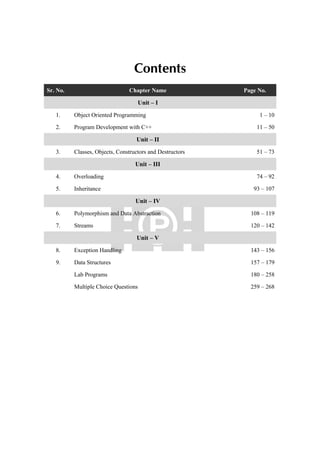
Contents
Sr. No. Chapter Name Page No.
Unit – I
1. Object Oriented Programming 1 – 10
2. Program Development with C++ 11 – 50
Unit – II
3. Classes, Objects, Constructors and Destructors 51 – 73
Unit – III
4. Overloading 74 – 92
5. Inheritance 93 – 107
Unit – IV
6. Polymorphism and Data Abstraction 108 – 119
7. Streams 120 – 142
Unit – V
8. Exception Handling 143 – 156
9. Data Structures 157 – 179
Lab Programs 180 – 258
Multiple Choice Questions 259 – 268
Unit – I
Object Oriented
Programming1
INTRODUCTION
Developments in software technology continue to be dynamic. New tools and techniques are
announced in quick succession. This has forced the software engineers and industry to continuously
look for new approaches to software design and development, and they are becoming more and more
critical in view of the increasing complexity of software systems as well as the highly competitive
nature of the industry. These rapid advances appear to have created a situation of crisis within the
industry. The following issues need to be addressed to face the crisis:
 How to represent real-life entities of problems in system design?
 How to design system with open interfaces?
 How to ensure reusability and extensibility of modules?
 How to develop modules that are tolerant of any changes in future?
 How to improve software productivity and decrease software cost?
 How to improve the quality of software?
 How to manage time schedules?
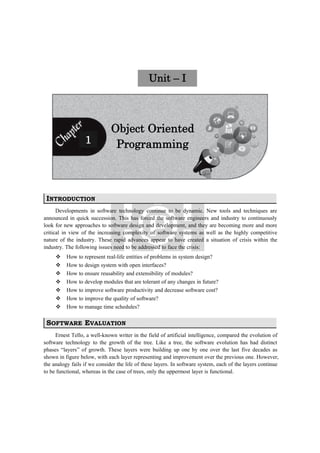
SOFTWARE EVALUATION
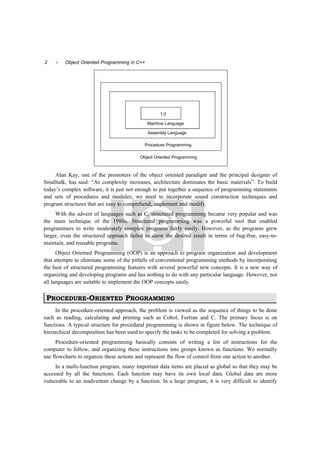
Ernest Tello, a well-known writer in the field of artificial intelligence, compared the evolution of
software technology to the growth of the tree. Like a tree, the software evolution has had distinct
phases “layers” of growth. These layers were building up one by one over the last five decades as
shown in figure below, with each layer representing and improvement over the previous one. However,
the analogy fails if we consider the life of these layers. In software system, each of the layers continue
to be functional, whereas in the case of trees, only the uppermost layer is functional.
2  Object Oriented Programming in C++
Object Oriented Programming
Procedure Programming
Assembly Language
Machine Language
1,0
Alan Kay, one of the promoters of the object oriented paradigm and the principal designer of
Smalltalk, has said: “As complexity increases, architecture dominates the basic materials”. To build
today’s complex software, it is just not enough to put together a sequence of programming statements
and sets of procedures and modules; we need to incorporate sound construction techniques and
program structures that are easy to comprehend, implement and modify.
With the advent of languages such as C, structured programming became very popular and was
the main technique of the 1980s. Structured programming was a powerful tool that enabled
programmers to write moderately complex programs fairly easily. However, as the programs grew
larger, even the structured approach failed to show the desired result in terms of bug-free, easy-to-
maintain, and reusable programs.
Object Oriented Programming (OOP) is an approach to program organization and development
that attempts to eliminate some of the pitfalls of conventional programming methods by incorporating
the best of structured programming features with several powerful new concepts. It is a new way of
organizing and developing programs and has nothing to do with any particular language. However, not
all languages are suitable to implement the OOP concepts easily.
PROCEDURE-ORIENTED PROGRAMMING
In the procedure-oriented approach, the problem is viewed as the sequence of things to be done
such as reading, calculating and printing such as Cobol, Fortran and C. The primary focus is on
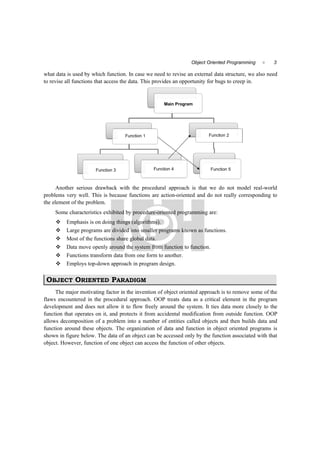
functions. A typical structure for procedural programming is shown in figure below. The technique of
hierarchical decomposition has been used to specify the tasks to be completed for solving a problem.
Procedure-oriented programming basically consists of writing a list of instructions for the
computer to follow, and organizing these instructions into groups known as functions. We normally
use flowcharts to organize these actions and represent the flow of control from one action to another.
In a multi-function program, many important data items are placed as global so that they may be
accessed by all the functions. Each function may have its own local data. Global data are more
vulnerable to an inadvertent change by a function. In a large program, it is very difficult to identify
3Object Oriented Programming 
what data is used by which function. In case we need to revise an external data structure, we also need
to revise all functions that access the data. This provides an opportunity for bugs to creep in.
Main Program
Function 1 Function 2
Function 3 Function 4 Function 5
Another serious drawback with the procedural approach is that we do not model real-world
problems very well. This is because functions are action-oriented and do not really corresponding to
the element of the problem.
Some characteristics exhibited by procedure-oriented programming are:
 Emphasis is on doing things (algorithms).
 Large programs are divided into smaller programs known as functions.
 Most of the functions share global data.
 Data move openly around the system from function to function.
 Functions transform data from one form to another.
 Employs top-down approach in program design.
OBJECT ORIENTED PARADIGM
The major motivating factor in the invention of object oriented approach is to remove some of the
flaws encountered in the procedural approach. OOP treats data as a critical element in the program
development and does not allow it to flow freely around the system. It ties data more closely to the
function that operates on it, and protects it from accidental modification from outside function. OOP
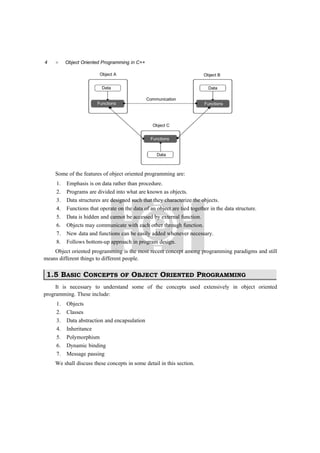
allows decomposition of a problem into a number of entities called objects and then builds data and
function around these objects. The organization of data and function in object oriented programs is
shown in figure below. The data of an object can be accessed only by the function associated with that
object. However, function of one object can access the function of other objects.
4  Object Oriented Programming in C++
Object A Object B
Communication
Object C
Data
DataData
Functions
Functions
Functions
Some of the features of object oriented programming are:
1. Emphasis is on data rather than procedure.
2. Programs are divided into what are known as objects.
3. Data structures are designed such that they characterize the objects.
4. Functions that operate on the data of an object are tied together in the data structure.
5. Data is hidden and cannot be accessed by external function.
6. Objects may communicate with each other through function.
7. New data and functions can be easily added whenever necessary.
8. Follows bottom-up approach in program design.
Object oriented programming is the most recent concept among programming paradigms and still
means different things to different people.
1.5 BASIC CONCEPTS OF OBJECT ORIENTED PROGRAMMING
It is necessary to understand some of the concepts used extensively in object oriented
programming. These include:
1. Objects
2. Classes
3. Data abstraction and encapsulation
4. Inheritance
5. Polymorphism
6. Dynamic binding
7. Message passing
We shall discuss these concepts in some detail in this section.
5Object Oriented Programming 
1. Objects
Objects are the basic run-time entities in an object oriented system. They may represent a person,
a place, a bank account, a table of data or any item that the program has to handle. They may also
represent user-defined data such as vectors, time and lists. Programming problem is analyzed in terms
of objects and the nature of communication between them. Program objects should be chosen such that
they match closely with the real-world objects. Objects take up space in the memory and have an
associated address like a record in Pascal, or a structure in C.
When a program is executed, the objects interact by sending messages to one another. For
example, if “customer” and “account” are to object in a program, then the customer object may send a
message to the count object requesting for the bank balance. Each object contain data, and code to
manipulate data. Objects can interact without having to know details of each other’s data or code. It is
sufficient to know the type of message accepted, and the type of response returned by the objects.
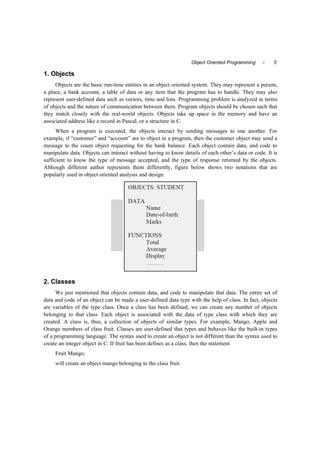
Although different author represents them differently, figure below shows two notations that are
popularly used in object oriented analysis and design.
2. Classes
We just mentioned that objects contain data, and code to manipulate that data. The entire set of
data and code of an object can be made a user-defined data type with the help of class. In fact, objects
are variables of the type class. Once a class has been defined, we can create any number of objects
belonging to that class. Each object is associated with the data of type class with which they are
created. A class is, thus, a collection of objects of similar types. For example, Mango, Apple and
Orange members of class fruit. Classes are user-defined that types and behaves like the built-in types
of a programming language. The syntax used to create an object is not different than the syntax used to
create an integer object in C. If fruit has been defines as a class, then the statement
Fruit Mango;
will create an object mango belonging to the class fruit.
6  Object Oriented Programming in C++
3. Data Abstraction and Encapsulation
The wrapping up of data and function into a single unit (called class) is known as encapsulation.
Data and encapsulation is the most striking feature of a class. The data is not accessible to the outside
world, and only those functions which are wrapped in the class can access it. These functions provide
the interface between the object’s data and the program. This insulation of the data from direct access
by the program is called data hiding or information hiding.
Abstraction refers to the act of representing essential features without including the background
details or explanation. Classes use the concept of abstraction and are defined as a list of abstract
attributes such as size, wait, and cost, and function operate on these attributes. They encapsulate all the
essential properties of the object that are to be created. The attributes are sometimes called data
members because they hold information. The functions that operate on these data are sometimes called
methods or member function.
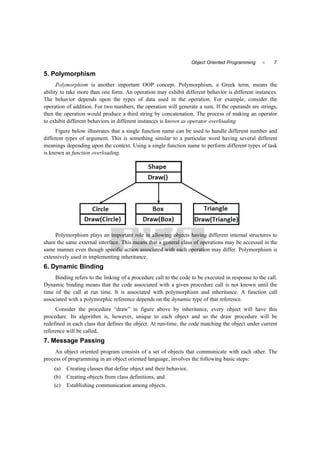
4. Inheritance
Inheritance is the process by which objects of one class acquired the properties of objects of
another classes. It supports the concept of hierarchical classification. For example, the bird ‘robin’ is a
part of class ‘flying bird’ which is again a part of the class ‘bird’. The principal behind this sort of
division is that each derived class shares common characteristics with the class from which it is
derived as illustrated in figure below .
In OOP, the concept of inheritance provides the idea of reusability. This means that we can add
additional features to an existing class without modifying it. This is possible by deriving a new class
from the existing one. The new class will have the combined feature of both the classes. The real
appeal and power of the inheritance mechanism is that it allows the programmer to reuse a class, i.e.,
almost, but not exactly, what he wants, and to tailor the class in such a way that it does not introduce
any undesirable side-effects into the rest of classes.
7Object Oriented Programming 
5. Polymorphism
Polymorphism is another important OOP concept. Polymorphism, a Greek term, means the
ability to take more than one form. An operation may exhibit different behavior is different instances.
The behavior depends upon the types of data used in the operation. For example, consider the
operation of addition. For two numbers, the operation will generate a sum. If the operands are strings,
then the operation would produce a third string by concatenation. The process of making an operator
to exhibit different behaviors in different instances is known as operator overloading.
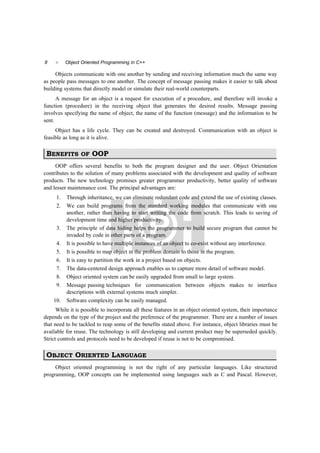
Figure below illustrates that a single function name can be used to handle different number and
different types of argument. This is something similar to a particular word having several different
meanings depending upon the context. Using a single function name to perform different types of task
is known as function overloading.
Polymorphism plays an important role in allowing objects having different internal structures to
share the same external interface. This means that a general class of operations may be accessed in the
same manner even though specific action associated with each operation may differ. Polymorphism is
extensively used in implementing inheritance.
6. Dynamic Binding
Binding refers to the linking of a procedure call to the code to be executed in response to the call.
Dynamic binding means that the code associated with a given procedure call is not known until the
time of the call at run time. It is associated with polymorphism and inheritance. A function call
associated with a polymorphic reference depends on the dynamic type of that reference.
Consider the procedure “draw” in figure above by inheritance, every object will have this
procedure. Its algorithm is, however, unique to each object and so the draw procedure will be
redefined in each class that defines the object. At run-time, the code matching the object under current
reference will be called.
7. Message Passing
An object oriented program consists of a set of objects that communicate with each other. The
process of programming in an object oriented language, involves the following basic steps:
(a) Creating classes that define object and their behavior,
(b) Creating objects from class definitions, and
(c) Establishing communication among objects.
8  Object Oriented Programming in C++
Objects communicate with one another by sending and receiving information much the same way
as people pass messages to one another. The concept of message passing makes it easier to talk about
building systems that directly model or simulate their real-world counterparts.
A message for an object is a request for execution of a procedure, and therefore will invoke a
function (procedure) in the receiving object that generates the desired results. Message passing
involves specifying the name of object, the name of the function (message) and the information to be
sent.
Object has a life cycle. They can be created and destroyed. Communication with an object is
feasible as long as it is alive.
BENEFITS OF OOP
OOP offers several benefits to both the program designer and the user. Object Orientation
contributes to the solution of many problems associated with the development and quality of software
products. The new technology promises greater programmer productivity, better quality of software
and lesser maintenance cost. The principal advantages are:
1. Through inheritance, we can eliminate redundant code and extend the use of existing classes.
2. We can build programs from the standard working modules that communicate with one
another, rather than having to start writing the code from scratch. This leads to saving of
development time and higher productivity.
3. The principle of data hiding helps the programmer to build secure program that cannot be
invaded by code in other parts of a program.
4. It is possible to have multiple instances of an object to co-exist without any interference.
5. It is possible to map object in the problem domain to those in the program.
6. It is easy to partition the work in a project based on objects.
7. The data-centered design approach enables us to capture more detail of software model.
8. Object oriented system can be easily upgraded from small to large system.
9. Message passing techniques for communication between objects makes to interface
descriptions with external systems much simpler.
10. Software complexity can be easily managed.
While it is possible to incorporate all these features in an object oriented system, their importance
depends on the type of the project and the preference of the programmer. There are a number of issues
that need to be tackled to reap some of the benefits stated above. For instance, object libraries must be
available for reuse. The technology is still developing and current product may be superseded quickly.
Strict controls and protocols need to be developed if reuse is not to be compromised.
OBJECT ORIENTED LANGUAGE
Object oriented programming is not the right of any particular languages. Like structured
programming, OOP concepts can be implemented using languages such as C and Pascal. However,
9Object Oriented Programming 
programming becomes clumsy and may generate confusion when the programs grow large. A
language that is specially designed to support the OOP concepts makes it easier to implement them.
The languages should support several of the OOP concepts to claim that they are object oriented.
Depending upon the features they support, they can be classified into the following two categories:
1. Object-based programming languages, and
2. Object oriented programming languages.
1. Object-based programming is the style of programming that primarily supports
encapsulation and object identity. Major features that are required for object based programming are:
 Data encapsulation
 Data hiding and access mechanisms
 Automatic initialization and clear-up of objects
 Operator overloading
Languages that support programming with objects are said to the object-based programming
languages. They do not support inheritance and dynamic binding. Ada is a typical object-based
programming language.
2. Object oriented programming language incorporates all of object-based programming
features along with two additional features, namely, inheritance and dynamic binding. Object oriented
programming can, therefore, be characterized by the following statements:
 Object-based features + Inheritance + Dynamic binding
APPLICATION OF OOP
OOP has become one of the programming buzzwords today. There appears to be a great deal of
excitement and interest among software engineers in using OOP. Applications of OOP are beginning
to gain importance in many areas. The most popular application of object oriented programming, up to
now, has been in the area of user interface design such as Windows. Hundreds of windowing systems
have been developed using the OOP techniques.
Real business system are often much more complex and contain many more objects with
complicated attributes and methods. OOP is useful in these types of application because it can simplify
a complex problem.
The promising areas of applications of OOP include:
 Real-time system
 Simulation and modeling
 Object oriented databases
 Hypertext, Hypermedia, and Expertext
 AI and expert systems
 Neural networks and parallel programming
 Decision support and office automation systems
 CIM/CAM/CAD systems
10  Object Oriented Programming in C++
The object oriented paradigm sprang from the language, has matured into design, and has
recently moved into analysis. It is believed that the richness of OOP environment will enable the
software industry to improve not only the quality of software system but also its productivity. Object
oriented technology is certainly going to change the way the software engineers think, analyze, design
and implement future system.
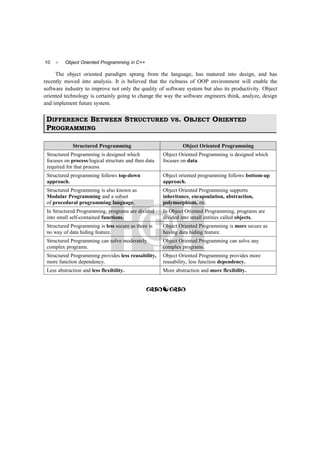
DIFFERENCE BETWEEN STRUCTURED VS. OBJECT ORIENTED
PROGRAMMING
Structured Programming Object Oriented Programming
Structured Programming is designed which
focuses on process/logical structure and then data
required for that process.
Object Oriented Programming is designed which
focuses on data.
Structured programming follows top-down
approach.
Object oriented programming follows bottom-up
approach.
Structured Programming is also known as
Modular Programming and a subset
of procedural programming language.
Object Oriented Programming supports
inheritance, encapsulation, abstraction,
polymorphism, etc.
In Structured Programming, programs are divided
into small self-contained functions.
In Object Oriented Programming, programs are
divided into small entities called objects.
Structured Programming is less secure as there is
no way of data hiding feature.
Object Oriented Programming is more secure as
having data hiding feature.
Structured Programming can solve moderately
complex programs.
Object Oriented Programming can solve any
complex programs.
Structured Programming provides less reusability,
more function dependency.
Object Oriented Programming provides more
reusability, less function dependency.
Less abstraction and less flexibility. More abstraction and more flexibility.


C++chapter2671

  • 2.
    Object Oriented Programming in C++ (IncludingLab Programs & Practicals) (As per New CBCS Syllabus for 2nd Year, 4th Semester, B.Com. Computers & Computer Applications for Various Universities in Telangana State w.e.f. 2016-17) Sandeep Agarwalla MCA, M.Tech. (CSE) Faculty, Department of Computer Science, Indian Institute of Management & Commerce (IIMC), Khairatabad, Hyderabad-500 004. Priyanka Roy MCA, M.Tech. (CSE) Assistant Professor, Department of Computer Science Aliens Degree College, Tarnaka, Hyderabad-500 007. Tulasi Ram Kandula M.Sc. (Comp Sc.) Head, Department of Computer Science, St. Mary’s Centenary Degree College, & St. Francis Street, Secunderabad-500 003. V. Sreeprada M.Sc. (CS), M.Tech. (CSE) Faculty, department of Computer Science St. Mary’s Centenary Degree College, & St. Francis Street, Secunderabad-500 003. ISO 9001:2008 CERTIFIED
  • 3.
    © Authors No partof this publication may be reproduced, stored in a retrieval system, or transmitted in any form or by any means, electronic, mechanical, photocopying, recording and/or otherwise without the prior written permission of the author and the publishers. First Edition : 2018 Published by : Mrs. Meena Pandey for Himalaya Publishing House Pvt. Ltd., “Ramdoot”, Dr. Bhalerao Marg, Girgaon, Mumbai - 400 004. Phone: 022-23860170, 23863863; Fax: 022-23877178 E-mail: himpub@vsnl.com; Website: www.himpub.com Branch Offices : New Delhi : “Pooja Apartments”, 4-B, Murari Lal Street, Ansari Road, Darya Ganj, New Delhi - 110 002. Phone: 011-23270392, 23278631; Fax: 011-23256286 Nagpur : Kundanlal Chandak Industrial Estate, Ghat Road, Nagpur - 440 018. Phone: 0712-2738731, 3296733; Telefax: 0712-2721216 Bengaluru : Plot No. 91-33, 2nd Main Road, Seshadripuram, Behind Nataraja Theatre, Bengaluru - 560 020. Phone: 080-41138821; Mobile: 09379847017, 09379847005 Hyderabad : No. 3-4-184, Lingampally, Besides Raghavendra Swamy Matham, Kachiguda, Hyderabad - 500 027. Phone: 040-27560041, 27550139 Chennai : New No. 48/2, Old No. 28/2, Ground Floor, Sarangapani Street, T. Nagar, Chennai - 600 012. Mobile: 09380460419 Pune : “Laksha” Apartment, First Floor, No. 527, Mehunpura, Shaniwarpeth (Near Prabhat Theatre), Pune - 411 030. Phone: 020-24496323, 24496333; Mobile: 09370579333 Lucknow : House No. 731, Shekhupura Colony, Near B.D. Convent School, Aliganj, Lucknow - 226 022. Phone: 0522-4012353; Mobile: 09307501549 Ahmedabad : 114, “SHAIL”, 1st Floor, Opp. Madhu Sudan House, C.G. Road, Navrang Pura, Ahmedabad - 380 009. Phone: 079-26560126; Mobile: 09377088847 Ernakulam : 39/176 (New No. 60/251), 1st Floor, Karikkamuri Road, Ernakulam, Kochi - 682 011. Phone: 0484-2378012, 2378016; Mobile: 09387122121 Bhubaneswar : Plot No. 214/1342, Budheswari Colony, Behind Durga Mandap, Bhubaneswar - 751 006. Phone: 0674-2575129; Mobile: 09338746007 Kolkata : 108/4, Beliaghata Main Road, Near ID Hospital, Opp. SBI Bank, Kolkata - 700 010. Phone: 033-32449649; Mobile: 07439040301 DTP by : Hansa Bhoir Printed at : M/s. Aditya Offset Process (I) Pvt. Ltd., Hyderabad. On behalf of HPH.
  • 4.
    Preface CPP is anObject Oriented Language and it an extension of C Language. It is a flexible and powerful language. This book is for all the programmers who wish to know about the language in depth. This book is designed for all degree students under various universities of India. Its main objective is to create awareness about programming and OOPS concepts to the students. We tried to discuss about everything that related to Object Oriented Programming. We also tried to place object oriented capabilities such as data abstraction, inheritance and polymorphism. Also, we explained all the procedure oriented concepts in the first few chapters. Concepts are explained through diagrams so that readers can understand in a better way. However, there are still ways in which the presentation can be improved. Valuable comments from the students and teachers for further improvement of this book are welcome; we assure that suggestions will be incorporated in the next edition. We believe that our approach will bring unique benefits to all groups of readers. We would like to thank M/s Himalaya Publishing House Pvt Ltd., Shri Niraj Pandey MD, Shri Vijay Pandey Regional Manager, and Mr. G. Anil Kumar, Assistant Sales Manager, Hyderabad, and his team who had inspired and motivated for preparing this project, with good get-up in short span of time that they had provided us. No project could ever get in progress much less accomplished, without help from a lot of fantastic people. We are grateful to Almighty God, who has given us strength to take and complete this project. We would like to express gratitude to our parents and family members who have encouraged us to complete this project. We, sincerely and wholeheartedly thank Our Principal, Gurus, Shri. K. Raghuveer, Indian Institute of Management & Commerce (IIMC), Prestigious Institute in Hyderabad and Rev. Fr. D. Sunder Reddy, Principal, St. Mary’s Centenary Degree College, Secunderabad for their continuous support and encouragement while completing this prestigious project. Though we had taken every care in presenting this book in simple and lucid style, some errors may crept in. However, there are still ways in which the presentation can be improved by giving your valuable suggestions and criticisms shall be equally accepted by students and faculty for improving this book in consequent editions with good input quality. Hyderabad January 2018 AUTHORS
  • 6.
    Syllabus Paper: (BC 407):Object Oriented Programming in C++ Paper: BC 407 Maximum Marks: 70T + 30P PPW: 4 (3T + 2P) Exam Duration: 3 Hours Credits: 4 Objective: To gain skills of Object Oriented Programming using C++ Language. Unit I: Introduction Object Oriented Programming: Concepts – Benefits – Languages – Structured vs. Object Oriented Programming. C++: Genesis – Structure of a Program – Tokens – Data Types – Operators – Control Structures – C vs. C++ – Functions. . Unit – II: Classes, Objects, Constructors and Destructors Encapsulation – Hiding – Abstract Data Types – Object and Classes – Attributes – Methods – C++ Class Declaration – State Identity and Behaviour of an Object. Purpose of Constructors – Default Constructor – Parameterized Constructors – Copy Constructor – Instantiation of Objects – Default Parameter Value – Object Types – C++ Garbage Collection – Dynamic Memory Allocation – Meta Class/Abstract Classes. Unit III: Overloading, Conversions, Derived Classes and Inheritance Function and Operator Overloading – Overloading Unary and Binary Operators – Data and Type Conversions – Derived Classes – Concept of Reusability – Visibility Modes – Types of Inheritance – Single and Multiple Inheritance – Multilevel Inheritance. Unit IV: Polymorphism, Virtual Function, Streams and Files Polymorphism – Virtual – Classes – Pointer to Derived Class – Virtual Functions – Rules for Virtual Function – Pure Virtual Functions – Stream Classes – Types of I/O – Formatting Outputs – File Pointers – Buffer – C++ Stream – Unformatted Console I/O Operations – Functions: get() – put() – Formatted Console I /O Operations – IOS Class Format Functions – Manipulators. Unit V: Exception Handling and Data Structures in C++ Exceptions in C++ Programs – Try and Catch Expressions – Exceptions with Arguments. Data Structures: Introduction – Linked List – Stacks – Queues.
  • 8.
    Contents Sr. No. ChapterName Page No. Unit – I 1. Object Oriented Programming 1 – 10 2. Program Development with C++ 11 – 50 Unit – II 3. Classes, Objects, Constructors and Destructors 51 – 73 Unit – III 4. Overloading 74 – 92 5. Inheritance 93 – 107 Unit – IV 6. Polymorphism and Data Abstraction 108 – 119 7. Streams 120 – 142 Unit – V 8. Exception Handling 143 – 156 9. Data Structures 157 – 179 Lab Programs 180 – 258 Multiple Choice Questions 259 – 268
  • 10.
    Unit – I ObjectOriented Programming1 INTRODUCTION Developments in software technology continue to be dynamic. New tools and techniques are announced in quick succession. This has forced the software engineers and industry to continuously look for new approaches to software design and development, and they are becoming more and more critical in view of the increasing complexity of software systems as well as the highly competitive nature of the industry. These rapid advances appear to have created a situation of crisis within the industry. The following issues need to be addressed to face the crisis:  How to represent real-life entities of problems in system design?  How to design system with open interfaces?  How to ensure reusability and extensibility of modules?  How to develop modules that are tolerant of any changes in future?  How to improve software productivity and decrease software cost?  How to improve the quality of software?  How to manage time schedules? SOFTWARE EVALUATION Ernest Tello, a well-known writer in the field of artificial intelligence, compared the evolution of software technology to the growth of the tree. Like a tree, the software evolution has had distinct phases “layers” of growth. These layers were building up one by one over the last five decades as shown in figure below, with each layer representing and improvement over the previous one. However, the analogy fails if we consider the life of these layers. In software system, each of the layers continue to be functional, whereas in the case of trees, only the uppermost layer is functional.
  • 11.
    2  ObjectOriented Programming in C++ Object Oriented Programming Procedure Programming Assembly Language Machine Language 1,0 Alan Kay, one of the promoters of the object oriented paradigm and the principal designer of Smalltalk, has said: “As complexity increases, architecture dominates the basic materials”. To build today’s complex software, it is just not enough to put together a sequence of programming statements and sets of procedures and modules; we need to incorporate sound construction techniques and program structures that are easy to comprehend, implement and modify. With the advent of languages such as C, structured programming became very popular and was the main technique of the 1980s. Structured programming was a powerful tool that enabled programmers to write moderately complex programs fairly easily. However, as the programs grew larger, even the structured approach failed to show the desired result in terms of bug-free, easy-to- maintain, and reusable programs. Object Oriented Programming (OOP) is an approach to program organization and development that attempts to eliminate some of the pitfalls of conventional programming methods by incorporating the best of structured programming features with several powerful new concepts. It is a new way of organizing and developing programs and has nothing to do with any particular language. However, not all languages are suitable to implement the OOP concepts easily. PROCEDURE-ORIENTED PROGRAMMING In the procedure-oriented approach, the problem is viewed as the sequence of things to be done such as reading, calculating and printing such as Cobol, Fortran and C. The primary focus is on functions. A typical structure for procedural programming is shown in figure below. The technique of hierarchical decomposition has been used to specify the tasks to be completed for solving a problem. Procedure-oriented programming basically consists of writing a list of instructions for the computer to follow, and organizing these instructions into groups known as functions. We normally use flowcharts to organize these actions and represent the flow of control from one action to another. In a multi-function program, many important data items are placed as global so that they may be accessed by all the functions. Each function may have its own local data. Global data are more vulnerable to an inadvertent change by a function. In a large program, it is very difficult to identify
  • 12.
    3Object Oriented Programming what data is used by which function. In case we need to revise an external data structure, we also need to revise all functions that access the data. This provides an opportunity for bugs to creep in. Main Program Function 1 Function 2 Function 3 Function 4 Function 5 Another serious drawback with the procedural approach is that we do not model real-world problems very well. This is because functions are action-oriented and do not really corresponding to the element of the problem. Some characteristics exhibited by procedure-oriented programming are:  Emphasis is on doing things (algorithms).  Large programs are divided into smaller programs known as functions.  Most of the functions share global data.  Data move openly around the system from function to function.  Functions transform data from one form to another.  Employs top-down approach in program design. OBJECT ORIENTED PARADIGM The major motivating factor in the invention of object oriented approach is to remove some of the flaws encountered in the procedural approach. OOP treats data as a critical element in the program development and does not allow it to flow freely around the system. It ties data more closely to the function that operates on it, and protects it from accidental modification from outside function. OOP allows decomposition of a problem into a number of entities called objects and then builds data and function around these objects. The organization of data and function in object oriented programs is shown in figure below. The data of an object can be accessed only by the function associated with that object. However, function of one object can access the function of other objects.
  • 13.
    4  ObjectOriented Programming in C++ Object A Object B Communication Object C Data DataData Functions Functions Functions Some of the features of object oriented programming are: 1. Emphasis is on data rather than procedure. 2. Programs are divided into what are known as objects. 3. Data structures are designed such that they characterize the objects. 4. Functions that operate on the data of an object are tied together in the data structure. 5. Data is hidden and cannot be accessed by external function. 6. Objects may communicate with each other through function. 7. New data and functions can be easily added whenever necessary. 8. Follows bottom-up approach in program design. Object oriented programming is the most recent concept among programming paradigms and still means different things to different people. 1.5 BASIC CONCEPTS OF OBJECT ORIENTED PROGRAMMING It is necessary to understand some of the concepts used extensively in object oriented programming. These include: 1. Objects 2. Classes 3. Data abstraction and encapsulation 4. Inheritance 5. Polymorphism 6. Dynamic binding 7. Message passing We shall discuss these concepts in some detail in this section.
  • 14.
    5Object Oriented Programming 1. Objects Objects are the basic run-time entities in an object oriented system. They may represent a person, a place, a bank account, a table of data or any item that the program has to handle. They may also represent user-defined data such as vectors, time and lists. Programming problem is analyzed in terms of objects and the nature of communication between them. Program objects should be chosen such that they match closely with the real-world objects. Objects take up space in the memory and have an associated address like a record in Pascal, or a structure in C. When a program is executed, the objects interact by sending messages to one another. For example, if “customer” and “account” are to object in a program, then the customer object may send a message to the count object requesting for the bank balance. Each object contain data, and code to manipulate data. Objects can interact without having to know details of each other’s data or code. It is sufficient to know the type of message accepted, and the type of response returned by the objects. Although different author represents them differently, figure below shows two notations that are popularly used in object oriented analysis and design. 2. Classes We just mentioned that objects contain data, and code to manipulate that data. The entire set of data and code of an object can be made a user-defined data type with the help of class. In fact, objects are variables of the type class. Once a class has been defined, we can create any number of objects belonging to that class. Each object is associated with the data of type class with which they are created. A class is, thus, a collection of objects of similar types. For example, Mango, Apple and Orange members of class fruit. Classes are user-defined that types and behaves like the built-in types of a programming language. The syntax used to create an object is not different than the syntax used to create an integer object in C. If fruit has been defines as a class, then the statement Fruit Mango; will create an object mango belonging to the class fruit.
  • 15.
    6  ObjectOriented Programming in C++ 3. Data Abstraction and Encapsulation The wrapping up of data and function into a single unit (called class) is known as encapsulation. Data and encapsulation is the most striking feature of a class. The data is not accessible to the outside world, and only those functions which are wrapped in the class can access it. These functions provide the interface between the object’s data and the program. This insulation of the data from direct access by the program is called data hiding or information hiding. Abstraction refers to the act of representing essential features without including the background details or explanation. Classes use the concept of abstraction and are defined as a list of abstract attributes such as size, wait, and cost, and function operate on these attributes. They encapsulate all the essential properties of the object that are to be created. The attributes are sometimes called data members because they hold information. The functions that operate on these data are sometimes called methods or member function. 4. Inheritance Inheritance is the process by which objects of one class acquired the properties of objects of another classes. It supports the concept of hierarchical classification. For example, the bird ‘robin’ is a part of class ‘flying bird’ which is again a part of the class ‘bird’. The principal behind this sort of division is that each derived class shares common characteristics with the class from which it is derived as illustrated in figure below . In OOP, the concept of inheritance provides the idea of reusability. This means that we can add additional features to an existing class without modifying it. This is possible by deriving a new class from the existing one. The new class will have the combined feature of both the classes. The real appeal and power of the inheritance mechanism is that it allows the programmer to reuse a class, i.e., almost, but not exactly, what he wants, and to tailor the class in such a way that it does not introduce any undesirable side-effects into the rest of classes.
  • 16.
    7Object Oriented Programming 5. Polymorphism Polymorphism is another important OOP concept. Polymorphism, a Greek term, means the ability to take more than one form. An operation may exhibit different behavior is different instances. The behavior depends upon the types of data used in the operation. For example, consider the operation of addition. For two numbers, the operation will generate a sum. If the operands are strings, then the operation would produce a third string by concatenation. The process of making an operator to exhibit different behaviors in different instances is known as operator overloading. Figure below illustrates that a single function name can be used to handle different number and different types of argument. This is something similar to a particular word having several different meanings depending upon the context. Using a single function name to perform different types of task is known as function overloading. Polymorphism plays an important role in allowing objects having different internal structures to share the same external interface. This means that a general class of operations may be accessed in the same manner even though specific action associated with each operation may differ. Polymorphism is extensively used in implementing inheritance. 6. Dynamic Binding Binding refers to the linking of a procedure call to the code to be executed in response to the call. Dynamic binding means that the code associated with a given procedure call is not known until the time of the call at run time. It is associated with polymorphism and inheritance. A function call associated with a polymorphic reference depends on the dynamic type of that reference. Consider the procedure “draw” in figure above by inheritance, every object will have this procedure. Its algorithm is, however, unique to each object and so the draw procedure will be redefined in each class that defines the object. At run-time, the code matching the object under current reference will be called. 7. Message Passing An object oriented program consists of a set of objects that communicate with each other. The process of programming in an object oriented language, involves the following basic steps: (a) Creating classes that define object and their behavior, (b) Creating objects from class definitions, and (c) Establishing communication among objects.
  • 17.
    8  ObjectOriented Programming in C++ Objects communicate with one another by sending and receiving information much the same way as people pass messages to one another. The concept of message passing makes it easier to talk about building systems that directly model or simulate their real-world counterparts. A message for an object is a request for execution of a procedure, and therefore will invoke a function (procedure) in the receiving object that generates the desired results. Message passing involves specifying the name of object, the name of the function (message) and the information to be sent. Object has a life cycle. They can be created and destroyed. Communication with an object is feasible as long as it is alive. BENEFITS OF OOP OOP offers several benefits to both the program designer and the user. Object Orientation contributes to the solution of many problems associated with the development and quality of software products. The new technology promises greater programmer productivity, better quality of software and lesser maintenance cost. The principal advantages are: 1. Through inheritance, we can eliminate redundant code and extend the use of existing classes. 2. We can build programs from the standard working modules that communicate with one another, rather than having to start writing the code from scratch. This leads to saving of development time and higher productivity. 3. The principle of data hiding helps the programmer to build secure program that cannot be invaded by code in other parts of a program. 4. It is possible to have multiple instances of an object to co-exist without any interference. 5. It is possible to map object in the problem domain to those in the program. 6. It is easy to partition the work in a project based on objects. 7. The data-centered design approach enables us to capture more detail of software model. 8. Object oriented system can be easily upgraded from small to large system. 9. Message passing techniques for communication between objects makes to interface descriptions with external systems much simpler. 10. Software complexity can be easily managed. While it is possible to incorporate all these features in an object oriented system, their importance depends on the type of the project and the preference of the programmer. There are a number of issues that need to be tackled to reap some of the benefits stated above. For instance, object libraries must be available for reuse. The technology is still developing and current product may be superseded quickly. Strict controls and protocols need to be developed if reuse is not to be compromised. OBJECT ORIENTED LANGUAGE Object oriented programming is not the right of any particular languages. Like structured programming, OOP concepts can be implemented using languages such as C and Pascal. However,
  • 18.
    9Object Oriented Programming programming becomes clumsy and may generate confusion when the programs grow large. A language that is specially designed to support the OOP concepts makes it easier to implement them. The languages should support several of the OOP concepts to claim that they are object oriented. Depending upon the features they support, they can be classified into the following two categories: 1. Object-based programming languages, and 2. Object oriented programming languages. 1. Object-based programming is the style of programming that primarily supports encapsulation and object identity. Major features that are required for object based programming are:  Data encapsulation  Data hiding and access mechanisms  Automatic initialization and clear-up of objects  Operator overloading Languages that support programming with objects are said to the object-based programming languages. They do not support inheritance and dynamic binding. Ada is a typical object-based programming language. 2. Object oriented programming language incorporates all of object-based programming features along with two additional features, namely, inheritance and dynamic binding. Object oriented programming can, therefore, be characterized by the following statements:  Object-based features + Inheritance + Dynamic binding APPLICATION OF OOP OOP has become one of the programming buzzwords today. There appears to be a great deal of excitement and interest among software engineers in using OOP. Applications of OOP are beginning to gain importance in many areas. The most popular application of object oriented programming, up to now, has been in the area of user interface design such as Windows. Hundreds of windowing systems have been developed using the OOP techniques. Real business system are often much more complex and contain many more objects with complicated attributes and methods. OOP is useful in these types of application because it can simplify a complex problem. The promising areas of applications of OOP include:  Real-time system  Simulation and modeling  Object oriented databases  Hypertext, Hypermedia, and Expertext  AI and expert systems  Neural networks and parallel programming  Decision support and office automation systems  CIM/CAM/CAD systems
  • 19.
    10  ObjectOriented Programming in C++ The object oriented paradigm sprang from the language, has matured into design, and has recently moved into analysis. It is believed that the richness of OOP environment will enable the software industry to improve not only the quality of software system but also its productivity. Object oriented technology is certainly going to change the way the software engineers think, analyze, design and implement future system. DIFFERENCE BETWEEN STRUCTURED VS. OBJECT ORIENTED PROGRAMMING Structured Programming Object Oriented Programming Structured Programming is designed which focuses on process/logical structure and then data required for that process. Object Oriented Programming is designed which focuses on data. Structured programming follows top-down approach. Object oriented programming follows bottom-up approach. Structured Programming is also known as Modular Programming and a subset of procedural programming language. Object Oriented Programming supports inheritance, encapsulation, abstraction, polymorphism, etc. In Structured Programming, programs are divided into small self-contained functions. In Object Oriented Programming, programs are divided into small entities called objects. Structured Programming is less secure as there is no way of data hiding feature. Object Oriented Programming is more secure as having data hiding feature. Structured Programming can solve moderately complex programs. Object Oriented Programming can solve any complex programs. Structured Programming provides less reusability, more function dependency. Object Oriented Programming provides more reusability, less function dependency. Less abstraction and less flexibility. More abstraction and more flexibility. 