Download the full version of the ebook at
https://ebookgate.com
Programming in C 2nd Edition Safari
https://ebookgate.com/product/programming-
in-c-2nd-edition-safari/
Explore and download more ebook at https://ebookgate.com
Recommended digital products (PDF, EPUB, MOBI) that
you can download immediately if you are interested.
Programming with ANSI C 2nd ed Edition Trivedi
https://ebookgate.com/product/programming-with-ansi-c-2nd-ed-edition-
trivedi/
ebookgate.com
C for business programming 2nd ed Edition Molluzzo
https://ebookgate.com/product/c-for-business-programming-2nd-ed-
edition-molluzzo/
ebookgate.com
Programming Principles and Practices using C 2nd Edition
Bjarne Stroustrup
https://ebookgate.com/product/programming-principles-and-practices-
using-c-2nd-edition-bjarne-stroustrup/
ebookgate.com
Programming in Objective C 4th Edition Stephen Kochan
https://ebookgate.com/product/programming-in-objective-c-4th-edition-
stephen-kochan/
ebookgate.com
Programming in ANSI C 6th Edition E. Balagurusamy
https://ebookgate.com/product/programming-in-ansi-c-6th-edition-e-
balagurusamy/
ebookgate.com
Programming in Scala 2nd 2nd Edition Martin Odersky
https://ebookgate.com/product/programming-in-scala-2nd-2nd-edition-
martin-odersky/
ebookgate.com
Mobile Computing 1st edition Edition Safari
https://ebookgate.com/product/mobile-computing-1st-edition-edition-
safari/
ebookgate.com
Separation Process Engineering Second Edition Safari
https://ebookgate.com/product/separation-process-engineering-second-
edition-safari/
ebookgate.com
Programming in Java 2nd edition Edition Choudhary
https://ebookgate.com/product/programming-in-java-2nd-edition-edition-
choudhary/
ebookgate.com
Programming in C++
Second Edition
Ashok Namdev Kamthane
Associate Professor
Department of Electronics and Telecommunication Engineering
Shri Guru Gobind Singhji
Institute of Engineering and Technology
Nanded, Maharashtra
Copyright © 2013 Dorling Kindersley (India) Pvt. Ltd.
Licensees of Pearson Education in South Asia
No part of this eBook may be used or reproduced in any manner whatsoever without the publisher’s
prior written consent.
This eBook may or may not include all assets that were part of the print version. The publisher
reserves the right to remove any material in this eBook at any time.
ISBN 9788131791448
eISBN 9789332520288
Head Office: A-8(A), Sector 62, Knowledge Boulevard, 7th Floor, NOIDA 201 309, India
Registered Office: 11 Local Shopping Centre, Panchsheel Park, New Delhi 110 017, India
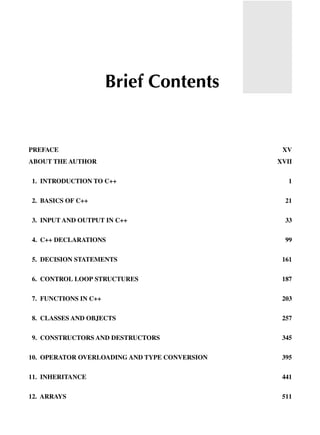
PrEfAcE xv
About thE Author xvii
1. iNtroductioN to c++ 1
2. bASicS of c++ 21
3. iNPut ANd outPut iN c++ 33
4. c++ dEclArAtioNS 99
5. dEciSioN StAtEmENtS 161
6. coNtrol looP StructurES 187
7. fuNctioNS iN c++ 203
8. clASSES ANd objEctS 257
9. coNStructorS ANd dEStructorS 345
10. oPErAtor ovErloAdiNg ANd tyPE coNvErSioN 395
11. iNhEritANcE 441
12. ArrAyS 511
Brief Contents
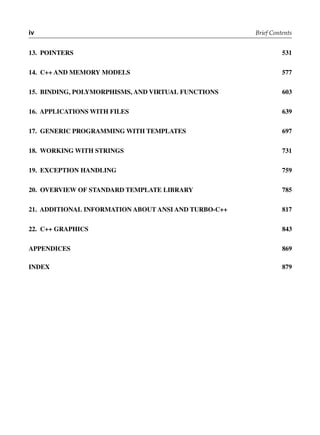
iv Brief Contents
13. PoiNtErS 531
14. c++ ANd mEmory modElS 577
15. biNdiNg, PolymorPhiSmS, ANd virtuAl fuNctioNS 603
16. APPlicAtioNS with filES 639
17. gENEric ProgrAmmiNg with tEmPlAtES 697
18. worKiNg with StriNgS 731
19. ExcEPtioN hANdliNg 759
20. ovErviEw of StANdArd tEmPlAtE librAry 785
21. AdditioNAl iNformAtioN About ANSi ANd turbo-c++ 817
22. c++ grAPhicS 843
APPENdicES 869
iNdEx 879
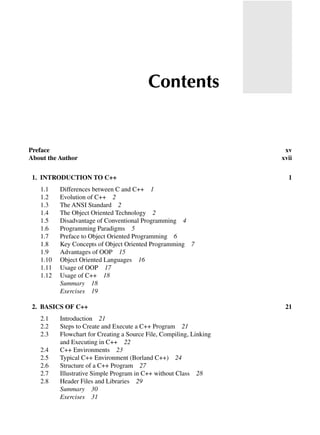
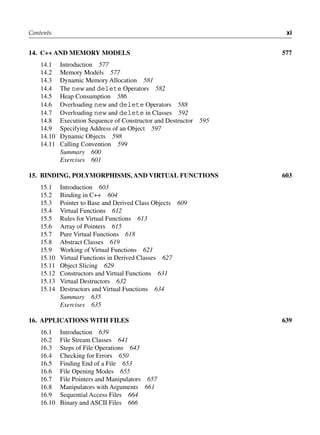
Preface xv
About the Author xvii
1. iNtroductioN to c++ 1
1.1 Differences between C and C++ 1
1.2 Evolution of C++ 2
1.3 The ANSI Standard 2
1.4 The Object Oriented Technology 2
1.5 Disadvantage of Conventional Programming 4
1.6 Programming Paradigms 5
1.7 Preface to Object Oriented Programming 6
1.8 Key Concepts of Object Oriented Programming 7
1.9 Advantages of OOP 15
1.10 Object Oriented Languages 16
1.11 Usage of OOP 17
1.12 Usage of C++ 18
Summary 18
Exercises 19
2. bASicS of c++ 21
2.1 Introduction 21
2.2 Steps to Create and Execute a C++ Program 21
2.3 Flowchart for Creating a Source File, Compiling, Linking
and Executing in C++ 22
2.4 C++ Environments 23
2.5 Typical C++ Environment (Borland C++) 24
2.6 Structure of a C++ Program 27
2.7 Illustrative Simple Program in C++ without Class 28
2.8 Header Files and Libraries 29
Summary 30
Exercises 31
Contents
vi Contents
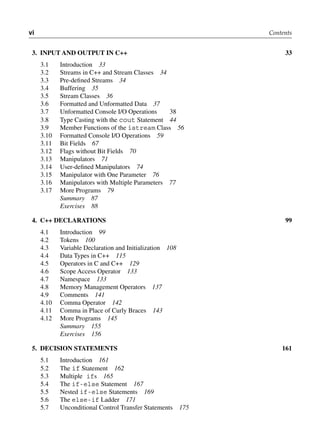
3. iNPut ANd outPut iN c++ 33
3.1 Introduction 33
3.2 Streams in C++ and Stream Classes 34
3.3 Pre-defined Streams 34
3.4 Buffering 35
3.5 Stream Classes 36
3.6 Formatted and Unformatted Data 37
3.7 Unformatted Console I/O Operations 38
3.8 Type Casting with the cout Statement 44
3.9 Member Functions of the istream Class 56
3.10 Formatted Console I/O Operations 59
3.11 Bit Fields 67
3.12 Flags without Bit Fields 70
3.13 Manipulators 71
3.14 User-defined Manipulators 74
3.15 Manipulator with One Parameter 76
3.16 Manipulators with Multiple Parameters 77
3.17 More Programs 79
Summary 87
Exercises 88
4. c++ dEclArAtioNS 99
4.1 Introduction 99
4.2 Tokens 100
4.3 Variable Declaration and Initialization 108
4.4 Data Types in C++ 115
4.5 Operators in C and C++ 129
4.6 Scope Access Operator 133
4.7 Namespace 133
4.8 Memory Management Operators 137
4.9 Comments 141
4.10 Comma Operator 142
4.11 Comma in Place of Curly Braces 143
4.12 More Programs 145
Summary 155
Exercises 156
5. dEciSioN StAtEmENtS 161
5.1 Introduction 161
5.2 The if Statement 162
5.3 Multiple ifs 165
5.4 The if-else Statement 167
5.5 Nested if-else Statements 169
5.6 The else-if Ladder 171
5.7 Unconditional Control Transfer Statements 175
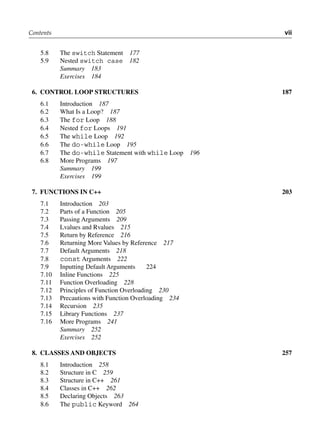
Contents vii
5.8 The switch Statement 177
5.9 Nested switch case 182
Summary 183
Exercises 184
6. coNtrol looP StructurES 187
6.1 Introduction 187
6.2 What Is a Loop? 187
6.3 The for Loop 188
6.4 Nested for Loops 191
6.5 The while Loop 192
6.6 The do-while Loop 195
6.7 The do-while Statement with while Loop 196
6.8 More Programs 197
Summary 199
Exercises 199
7. fuNctioNS iN c++ 203
7.1 Introduction 203
7.2 Parts of a Function 205
7.3 Passing Arguments 209
7.4 Lvalues and Rvalues 215
7.5 Return by Reference 216
7.6 Returning More Values by Reference 217
7.7 Default Arguments 218
7.8 const Arguments 222
7.9 Inputting Default Arguments 224
7.10 Inline Functions 225
7.11 Function Overloading 228
7.12 Principles of Function Overloading 230
7.13 Precautions with Function Overloading 234
7.14 Recursion 235
7.15 Library Functions 237
7.16 More Programs 241
Summary 252
Exercises 252
8. clASSES ANd objEctS 257
8.1 Introduction 258
8.2 Structure in C 259
8.3 Structure in C++ 261
8.4 Classes in C++ 262
8.5 Declaring Objects 263
8.6 The public Keyword 264
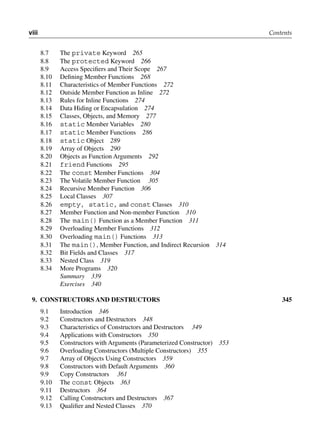
viii Contents
8.7 The private Keyword 265
8.8 The protected Keyword 266
8.9 Access Specifiers and Their Scope 267
8.10 Defining Member Functions 268
8.11 Characteristics of Member Functions 272
8.12 Outside Member Function as Inline 272
8.13 Rules for Inline Functions 274
8.14 Data Hiding or Encapsulation 274
8.15 Classes, Objects, and Memory 277
8.16 static Member Variables 280
8.17 static Member Functions 286
8.18 static Object 289
8.19 Array of Objects 290
8.20 Objects as Function Arguments 292
8.21 friend Functions 295
8.22 The const Member Functions 304
8.23 The Volatile Member Function 305
8.24 Recursive Member Function 306
8.25 Local Classes 307
8.26 empty, static, and const Classes 310
8.27 Member Function and Non-member Function 310
8.28 The main() Function as a Member Function 311
8.29 Overloading Member Functions 312
8.30 Overloading main() Functions 313
8.31 The main(), Member Function, and Indirect Recursion 314
8.32 Bit Fields and Classes 317
8.33 Nested Class 319
8.34 More Programs 320
Summary 339
Exercises 340
9. coNStructorS ANd dEStructorS 345
9.1 Introduction 346
9.2 Constructors and Destructors 348
9.3 Characteristics of Constructors and Destructors 349
9.4 Applications with Constructors 350
9.5 Constructors with Arguments (Parameterized Constructor) 353
9.6 Overloading Constructors (Multiple Constructors) 355
9.7 Array of Objects Using Constructors 359
9.8 Constructors with Default Arguments 360
9.9 Copy Constructors 361
9.10 The const Objects 363
9.11 Destructors 364
9.12 Calling Constructors and Destructors 367
9.13 Qualifier and Nested Classes 370
Contents ix
9.14 Anonymous Objects 372
9.15 Private Constructors and Destructors 374
9.16 Dynamic Initialization Using Constructors 375
9.17 Dynamic Operators and Constructors 377
9.18 main() as a Constructor and Destructor 379
9.19 Recursive Constructors 380
9.20 Program Execution Before main() 381
9.21 Constructor and Destructor with Static Members 383
9.22 Local Versus Global Object 384
9.23 More Programs 385
Summary 392
Exercises 392
10. oPErAtor ovErloAdiNg ANd tyPE coNvErSioN 395
10.1 Introduction 395
10.2 The Keyword Operator 398
10.3 Overloading Unary Operators 400
10.4 Operator Return Type 403
10.5 Constraint on Increment and Decrement Operators 404
10.6 Overloading Binary Operators 405
10.7 Overloading with friend Function 409
10.8 Overloading Assignment Operator (=) 412
10.9 Type Conversion 414
10.10 Rules for Overloading Operators 422
10.11 One-Argument Constructor and Operator Function 424
10.12 Overloading Stream Operators 425
10.13 More Programs 427
Summary 438
Exercises 439
11. iNhEritANcE 441
11.1 Introduction 442
11.2 Reusability 442
11.3 Access Specifiers and Simple Inheritance 442
11.4 Protected Data with Private Inheritance 449
11.5 Types of Inheritance 454
11.6 Single Inheritance 456
11.7 Multilevel Inheritance 457
11.8 Multiple Inheritance 459
11.9 Hierarchical Inheritance 460
11.10 Hybrid Inheritance 462
11.11 Multipath Inheritance 465
11.12 Virtual Base Classes 466
11.13 Constructors, Destructors, and Inheritance 468
11.14 Object as a Class Member 483
11.15 Abstract Classes 489
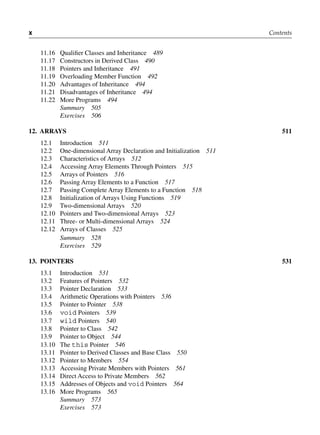
x Contents
11.16 Qualifier Classes and Inheritance 489
11.17 Constructors in Derived Class 490
11.18 Pointers and Inheritance 491
11.19 Overloading Member Function 492
11.20 Advantages of Inheritance 494
11.21 Disadvantages of Inheritance 494
11.22 More Programs 494
Summary 505
Exercises 506
12. ArrAyS 511
12.1 Introduction 511
12.2 One-dimensional Array Declaration and Initialization 511
12.3 Characteristics of Arrays 512
12.4 Accessing Array Elements Through Pointers 515
12.5 Arrays of Pointers 516
12.6 Passing Array Elements to a Function 517
12.7 Passing Complete Array Elements to a Function 518
12.8 Initialization of Arrays Using Functions 519
12.9 Two-dimensional Arrays 520
12.10 Pointers and Two-dimensional Arrays 523
12.11 Three- or Multi-dimensional Arrays 524
12.12 Arrays of Classes 525
Summary 528
Exercises 529
13. PoiNtErS 531
13.1 Introduction 531
13.2 Features of Pointers 532
13.3 Pointer Declaration 533
13.4 Arithmetic Operations with Pointers 536
13.5 Pointer to Pointer 538
13.6 void Pointers 539
13.7 wild Pointers 540
13.8 Pointer to Class 542
13.9 Pointer to Object 544
13.10 The this Pointer 546
13.11 Pointer to Derived Classes and Base Class 550
13.12 Pointer to Members 554
13.13 Accessing Private Members with Pointers 561
13.14 Direct Access to Private Members 562
13.15 Addresses of Objects and void Pointers 564
13.16 More Programs 565
Summary 573
Exercises 573
Contents xi
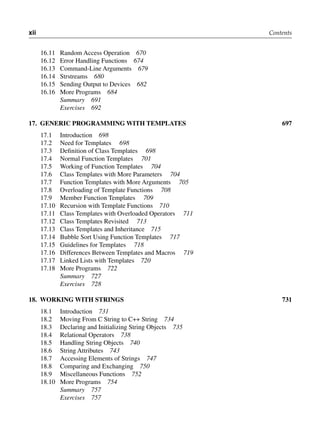
14. c++ ANd mEmory modElS 577
14.1 Introduction 577
14.2 Memory Models 577
14.3 Dynamic Memory Allocation 581
14.4 The new and delete Operators 582
14.5 Heap Consumption 586
14.6 Overloading new and delete Operators 588
14.7 Overloading new and delete in Classes 592
14.8 Execution Sequence of Constructor and Destructor 595
14.9 Specifying Address of an Object 597
14.10 Dynamic Objects 598
14.11 Calling Convention 599
Summary 600
Exercises 601
15. biNdiNg, PolymorPhiSmS, ANd virtuAl fuNctioNS 603
15.1 Introduction 603
15.2 Binding in C++ 604
15.3 Pointer to Base and Derived Class Objects 609
15.4 Virtual Functions 612
15.5 Rules for Virtual Functions 613
15.6 Array of Pointers 615
15.7 Pure Virtual Functions 618
15.8 Abstract Classes 619
15.9 Working of Virtual Functions 621
15.10 Virtual Functions in Derived Classes 627
15.11 Object Slicing 629
15.12 Constructors and Virtual Functions 631
15.13 Virtual Destructors 632
15.14 Destructors and Virtual Functions 634
Summary 635
Exercises 635
16. APPlicAtioNS with filES 639
16.1 Introduction 639
16.2 File Stream Classes 641
16.3 Steps of File Operations 643
16.4 Checking for Errors 650
16.5 Finding End of a File 653
16.6 File Opening Modes 655
16.7 File Pointers and Manipulators 657
16.8 Manipulators with Arguments 661
16.9 Sequential Access Files 664
16.10 Binary and ASCII Files 666
xii Contents
16.11 Random Access Operation 670
16.12 Error Handling Functions 674
16.13 Command-Line Arguments 679
16.14 Strstreams 680
16.15 Sending Output to Devices 682
16.16 More Programs 684
Summary 691
Exercises 692
17. gENEric ProgrAmmiNg with tEmPlAtES 697
17.1 Introduction 698
17.2 Need for Templates 698
17.3 Definition of Class Templates 698
17.4 Normal Function Templates 701
17.5 Working of Function Templates 704
17.6 Class Templates with More Parameters 704
17.7 Function Templates with More Arguments 705
17.8 Overloading of Template Functions 708
17.9 Member Function Templates 709
17.10 Recursion with Template Functions 710
17.11 Class Templates with Overloaded Operators 711
17.12 Class Templates Revisited 713
17.13 Class Templates and Inheritance 715
17.14 Bubble Sort Using Function Templates 717
17.15 Guidelines for Templates 718
17.16 Differences Between Templates and Macros 719
17.17 Linked Lists with Templates 720
17.18 More Programs 722
Summary 727
Exercises 728
18. worKiNg with StriNgS 731
18.1 Introduction 731
18.2 Moving From C String to C++ String 734
18.3 Declaring and Initializing String Objects 735
18.4 Relational Operators 738
18.5 Handling String Objects 740
18.6 String Attributes 743
18.7 Accessing Elements of Strings 747
18.8 Comparing and Exchanging 750
18.9 Miscellaneous Functions 752
18.10 More Programs 754
Summary 757
Exercises 757
Contents xiii
19. ExcEPtioN hANdliNg 759
19.1 Introduction 759
19.2 Principles of Exception Handling 760
19.3 The Keywords try, throw, and catch 760
19.4 Guidelines for Exception Handling 761
19.5 Multiple catch Statements 765
19.6 Catching Multiple Exceptions 767
19.7 Re-throwing Exception 768
19.8 Specifying Exceptions 769
19.9 Exceptions in Constructors and Destructors 771
19.10 Controlling Uncaught Exceptions 773
19.11 Exceptions and Operator Overloading 774
19.12 Exceptions and Inheritance 776
19.13 Class Templates with Exception Handling 777
19.14 Guidelines for Exception Handling 778
19.15 More Programs 779
Summary 781
Exercises 782
20. ovErviEw of StANdArd tEmPlAtE librAry 785
20.1 Introduction to STL 785
20.2 STL Programing Model 786
20.3 Containers 786
20.4 Sequence Containers 787
20.5 Associative Containers 789
20.6 Algorithms 789
20.7 Iterators 794
20.8 Vectors 795
20.9 Lists 801
20.10 Maps 808
20.11 Function Objects 811
Summary 814
Exercises 815
21. AdditioNAl iNformAtioN About ANSi ANd turbo-c++ 817
21.1 Introduction 817
21.2 Innovative Data Types 818
21.3 New Type-casting Operators 821
21.4 The Keyword explicit 826
21.5 The Keyword mutable 827
21.6 Namespace Scope 828
21.7 Nested Namespaces 829
21.8 Anonymous Namespaces 830
21.9 The Keyword using 830
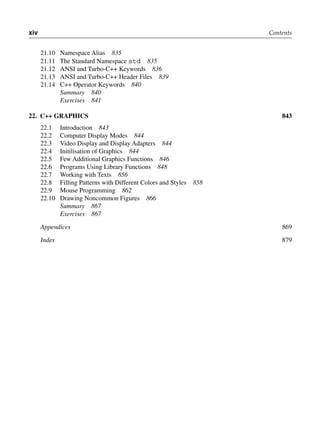
xiv Contents
21.10 Namespace Alias 835
21.11 The Standard Namespace std 835
21.12 ANSI and Turbo-C++ Keywords 836
21.13 ANSI and Turbo-C++ Header Files 839
21.14 C++ Operator Keywords 840
Summary 840
Exercises 841
22. c++ grAPhicS 843
22.1 Introduction 843
22.2 Computer Display Modes 844
22.3 Video Display and Display Adapters 844
22.4 Initilisation of Graphics 844
22.5 Few Additional Graphics Functions 846
22.6 Programs Using Library Functions 848
22.7 Working with Texts 856
22.8 Filling Patterns with Different Colors and Styles 858
22.9 Mouse Programming 862
22.10 Drawing Noncommon Figures 866
Summary 867
Exercises 867
Appendices 869
Index 879
Programming in C++ is meant for students pursuing various disciplines such as engineer-
ing, science, computer application, and diploma courses. Students who are learning object-
oriented programming (OOP) can also refer to this book. It covers the subject of C++ as per
the syllabi prescribed by various branches of Indian universities, state board of technical
educations, and the Department of Electronics and Accreditation of Computer Courses. Hence,
this book can be adopted in engineering, degree as well as other courses that deal with this sub-
ject. Written for beginners and for those who have some knowledge of C, the book will be espe-
cially useful for students who are learning object-oriented programming.
Designed to bridge the gap between theory and practice, the chapters have been presented
using a systematic and lucid approach. Each topic is explained in an easy-to-understand manner
with ample worked-out examples and programs. The book abounds with about 700 solved
programs and as many as 300 exercises for the student’s benefit. The programmer can run the
solved programs, see the output and appreciate the concepts of C++.
The programs have been fully tested and executed with Borland’s Turbo C++ compiler
version 3.00 and Visual C++ 6.0 compiler. The programs in Chapter 22 have been tested and
compiled with Java Compiler version 2.
This second edition has been thoroughly revised based on comments and responses received
for the previous edition. All programming examples have been tested, compiled and executed.
While utmost care has been taken at the time of writing this book, it is possible that errors and
omissions may have inadvertently crept in. Such incongruities, if any, may please be pointed
out. Suggestions and feedback are most welcome and may be directed to my e-mail address:
ankamthane@gmail.com.
AcKNowlEdgEmENtS
I express my gratitude to the Minister for Technical and Medical Education of Maharashtra State,
Honorable Shri D. P. Sawant, who complimented and felicitated me for writing technical books,
while he was invited to our institute recently in the month of May 2013. He also encouraged me
to write more books.
I am grateful to Prof. B. M. Naik, Former Principal of S.G.G.S. Institute of Engineering and
Technology, Nanded, who has always acted as a source of encouragement. His dynamism and
leadership led me to write this book and I will never forget his support and words of wisdom.
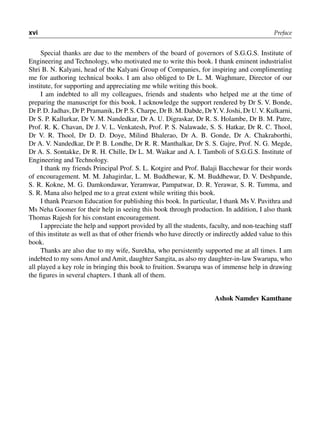
Preface
xvi Preface
Special thanks are due to the members of the board of governors of S.G.G.S. Institute of
Engineering and Technology, who motivated me to write this book. I thank eminent industrialist
Shri B. N. Kalyani, head of the Kalyani Group of Companies, for inspiring and complimenting
me for authoring technical books. I am also obliged to Dr L. M. Waghmare, Director of our
institute, for supporting and appreciating me while writing this book.
I am indebted to all my colleagues, friends and students who helped me at the time of
preparing the manuscript for this book. I acknowledge the support rendered by Dr S. V. Bonde,
Dr P. D. Jadhav, Dr P. Pramanik, Dr P. S. Charpe, Dr B. M. Dabde, DrY.V. Joshi, Dr U.V. Kulkarni,
Dr S. P. Kallurkar, Dr V. M. Nandedkar, Dr A. U. Digraskar, Dr R. S. Holambe, Dr B. M. Patre,
Prof. R. K. Chavan, Dr J. V. L. Venkatesh, Prof. P. S. Nalawade, S. S. Hatkar, Dr R. C. Thool,
Dr V. R. Thool, Dr D. D. Doye, Milind Bhalerao, Dr A. B. Gonde, Dr A. Chakraborthi,
Dr A. V. Nandedkar, Dr P. B. Londhe, Dr R. R. Manthalkar, Dr S. S. Gajre, Prof. N. G. Megde,
Dr A. S. Sontakke, Dr R. H. Chille, Dr L. M. Waikar and A. I. Tamboli of S.G.G.S. Institute of
Engineering and Technology.
I thank my friends Principal Prof. S. L. Kotgire and Prof. Balaji Bacchewar for their words
of encouragement. M. M. Jahagirdar, L. M. Buddhewar, K. M. Buddhewar, D. V. Deshpande,
S. R. Kokne, M. G. Damkondawar, Yeramwar, Pampatwar, D. R. Yerawar, S. R. Tumma, and
S. R. Mana also helped me to a great extent while writing this book.
I thank Pearson Education for publishing this book. In particular, I thank Ms V. Pavithra and
Ms Neha Goomer for their help in seeing this book through production. In addition, I also thank
Thomas Rajesh for his constant encouragement.
I appreciate the help and support provided by all the students, faculty, and non-teaching staff
of this institute as well as that of other friends who have directly or indirectly added value to this
book.
Thanks are also due to my wife, Surekha, who persistently supported me at all times. I am
indebted to my sons Amol and Amit, daughter Sangita, as also my daughter-in-law Swarupa, who
all played a key role in bringing this book to fruition. Swarupa was of immense help in drawing
the figures in several chapters. I thank all of them.
Ashok Namdev Kamthane
Ashok Namdev Kamthane obtained his M.E. (Electronics) degree from S.G.G.S. Institute of
Engineering and Technology, Nanded.A meritorious student throughout his career, he has bagged
a number of prizes including cash and medals for his distinct work in the academics. For his
M. E. (Electronics) dissertation, he worked at the Bhabha Atomic Research Center, Mumbai.
Associated with the teaching profession for the past 30 years, Kamthane was instrumental
in the development of hardware and software using the 8051 (8-bit microcontroller) on Acoustic
Transceiver System required in submarines. He has also worked at Melton as an executive.
Currently Associate Professor at the Department of Electronics and Telecommunication
Engineering in S.G.G.S Institute of Engineering and Technology, he has guided a number of
undergraduate and postgraduate students in their projects and published a number of technical
papers at both national and international conferences.
About the Author
This page is intentionally left blank.
•
•
•
•
•
•
•
•
•
•
•
•
1.1 Differences between C and C++
1.2 Evolution of C++
1.3 The ANSI Standard
1.4 The Object Oriented Technology
1.5 Disadvantage of Conventional Programming
1.6 Programming Paradigms
1.7 Preface to Object Oriented Programming
1.8 Key Concept of Object Oriented Programming
1.9 Advantages of OOP
1.10 Object Oriented Languages
1.11 Usage of OOP
1.12 Usage of C++
Introduction to C++
Chapter
Outline
1.1 Differences between c anD c++
Some differences between C and C++ are as follows:
(1) C is a procedure/function-oriented language and C++ language is driven by a procedure/
object.
(2) Data is not protected in C, whereas data is secured in C++. Data hiding concept is absent
in C.
(3) C uses a top down approach while C++ uses a bottom up approach. The program is
prepared step by step in C, and in C++ base elements are prepared first.
(4) In C, we cannot give the same name to two functions in a program, whereas due to the
function overloading feature, the above concept is possible in C++. One can initialize a
number of functions with the same name, but with different arguments. The polymorphism
feature is built in C++, which supports this concept.
c H a P t e r
1
Another random document with
no related content on Scribd:
him, 'I have sinned.'" This is the quick way home. It is a short cut to
God. The forgiving father is at the end of this road. So he goes back
in his rags. That is the way to go home. This is coming "Just as I
am, without one plea." Don't take off your rags. The Father alone
must do this and He will.
XI—Here pick up red cloth. This represents the long love of the
loving father. Red stands for love, a flaming love which causes the
father to run to meet him. This is the only time when God is said "to
run," and He does it every time when he sees the sinner coming.
XII—Here pick up a striped cloth. This represents the new robe
just like the first robe used when he went to the far country. He now
looks just like he looked when he left home. The past is all covered
up with Father's forgiveness, and when the neighbors come in, they
don't see rags but the garment beautiful. Perhaps they don't know of
his misfortune. They only know he was lost and found and lost so
long to the Father that they thought him dead, but he is alive again,
and they began to be merry.
XIII-Here pick up green cloth. This represents the jealous anger
of the elder brother who knows all about his downfall, and stayed
outside and grumbled about the past sins of his brother, and the fact
that never was a fatted calf slain for him that he might make merry
with his friends also. His Father pleads with him, and since we hear
nothing about this elder brother again, we would conclude that he
went in and joined in the festivities of his brother's return. The
Father's love had conquered both of his sons.
XIV—Here take red cloth, and cover the green with it for the
Father's love (red) had conquered the jealousy (green) of his son's
heart.34
XV—Here pick up white cloth—the white stands for peace, which
was now in the dear old home. Peace which we believe was also in
the elder brother's heart. Peace which we know was in the Father's
heart, and in the heart of the Prodigal, who had exchanged his rags
for the glad robe of eternal salvation. As they all hang upon the line,
remember the lesson, and ask the class to tell you what each rag
stands for. You can, if you so desire, in place of hanging them on a
line, place them on the furniture of the pulpit. The matter of using
cloth, muslin or silk or any other substance, is left to the
convenience and judgment of the teacher. Even colored papers can
be used in place of the rags. In that case name the lesson "The
Prodigal Son in Scraps of Paper." Place these scraps in a waste
basket and from that place of cast-off things, produce them as you
desire.
P
CHAPTER XX
WHAT CAN TAKE AWAY MY SINS?
Objects used: Large transparent jar of clear water; a small quantity
of oxalic acid; some powdered ox gall; a quantity of tincture of iron;
a small cluster of flowers; a few coins; a dictionary, It is a lesson
with chemical effects.
WHAT CAN WASH AWAY MY SINS?
A Chemical Talk
LACE on the table a large jar of plain untinted glass; fill it two-
thirds full of water and before the class assembles drop in a few
drops of tincture of iron. This receptacle we will call the Human
Heart. Secure a two-ounce bottle, paint it red, in which you place a
strong solution of oxalic acid. You cannot get this solution too
strong. This represents the Blood. Secure a third bottle and paint it
black. In this place some powdered nut galls. This represents Sin.
On the table have,—a silver coin, a music box, a cup of pure water.
These you will use in the body of the lesson later. Announce that you
will choose a text for your talk this time and it will be found in I John
1:17. "The blood of Jesus Christ, His Son, cleanseth us from all sin."
Call attention to the large jar which represents the Human Heart. To
all appearance it looks as pure as a lily. There seems to be nothing
in it to make it evil. It does not look like evil. So it often happens
that the evil in us, does not always show on the surface, but is
hidden away in our heart. It was born in us. All men are not born
sinners, but born in sin, and later on, that sin manifests itself, and
we begin to choose evil in preference to the right, and that makes us
sinners. The seed of sin was hidden deep in the heart. The jar
apparently pure has in it a hidden property no eye can see, but it is
there and when evil gets in it finds a response from that hidden
power and at once the apparently pure water has turned black with
sin. I now pour a few drops from the black bottle, the evil bottle,
into the jar. Even these few drops seem to be clear and white also,
but when I drop them into the jar of water, all is blackened because
the apparent cleanness was only on the surface. "There is a way
that seemeth right in the eyes of men, but the ways thereof are the
ways of death." You can now talk about things which men do which
they say are not bad. They look all right, that is true, but when they
enter the soul, they soil it, and sin is supreme. What shall I do to get
rid of my sin? What can take away my sin? Can I purchase my
salvation? Let us see. Now cast in the jar a number of silver coins,
and say these will bring me the white again, but the blackness is yet
there, showing that salvation cannot be bought with silver or gold.
Can education or refinement take away sin? Let us see. Place over
the top of the jar a number of school books to represent education.
Of course you see the water is yet black, because you cannot make
a black heart clean by learning. Will music take away my black sin?
Let us see. Place a music box on top of the jar, and let the music
sound forth, but you note the heart is still black and will remain
black notwithstanding the finest music of the world. Shall I say the
power of the mind can take the blackness away? Let us see. I will
say to myself "There is no blackness in this jar. It is a mental
delusion. I am mistaken. I don't see black, and if I continue so to do
long enough the black will disappear to the eye for it was never
there. It was a mental defect to say it was there." All of this sort of
thinking would never change the contents of the jar. Can beauty
take away the black? Let us see. Cast in now a few flowers. The
most beautiful things God has made. Will the handful of beauty take
the blackness away? This beauty can never do. What will do it?
What is the soul's cry? What can take away my sins? Here produce
the red bottle. "The blood of Jesus Christ, his son, cleanseth us from
all sin." Pour a few drops or more from the red bottle into the jar.
Continue to pour it in until the water is made white again. Behold!
the blackness of despair has disappeared. The Blood has taken away
the sin forever. Before you put the drops of black into the jar, take
out a small glass full of the black water and place it down on the
table and after the water has been cleared up say "When the blood
of Christ takes away our sin, He keeps us when tempted to go black
again." To illustrate that truth, pick up the small glass of black water,
and say "This represents temptation, and it seeks to get back into
the soul again and make it black with sin as before." Pour the
contents into the jar but you notice that at once there is a power in
the purified water in the jar to resist all temptation and the black
does not blacken the water again. The effect of the illustration will
be made more striking if you put two or more lighted candles back
of the jar. By rehearsal in private, work out the necessary
proportions of these chemicals so they will work out correctly when
you use them before your audience. Be very careful and keep these
chemicals away from the reach of the children as some of them are
deadly poisons.
T
CHAPTER XXI
THE GOSPEL COPY BOOK
Objects used: A small blackboard; a small New Testament; a number
of children to write on the blackboard
THE GOSPEL COPY BOOK
HIS is a lesson showing how important it is to copy Christ, not
Christians. Many go astray in their life and conduct because
they do not follow the copy. There is a gospel copy book. Christ
is that book. Follow His words and your life will not be crooked, and
what you do and say will cause people who watch you to say "He is
following the copy. He has studied well his lesson in the Gospel
Copybook." Write the word "Christian" in large letters at the top of
the blackboard and ask a tall boy to copy it as exactly as possible.
After this is done, cover up the original line, and ask another boy to
copy the copy. Keep covering up all but the last line, having various
ones to copy till six or seven have been made. Now take off the
covers and compare them with the original. You will note every copy
is different from each other and all different from the original,
because each child looked at some one else's writing and not at the
original. We are apt to copy each other's mistakes and example. This
we do when we look at Christians, and try to do as they do instead
of taking Christ as our example.
One morning a business man who lived in the suburbs was
hastening to catch the train, which he supposed was almost due. It
was important that he should go to town, but, as he was walking
along in nervous haste, he saw a gentleman ahead of him, walking
with deliberation and ease. They always took the same train, so he
watched him and not his watch. But to his great dismay, he saw the
train come in and go out, and they both were left. The watch of the
man he followed was five minutes slow. He learned his lesson—
follow no man—watch the watch and the schedule, and go straight
ahead. Run yourself on railroad time. That is good business sense
for the traveler. Jesus has given us a gospel copy book. Here it is. It
is the New Testament. Follow its teachings and your life will be
straight, and you will be like Jesus. Follow Christ and not Christians."
Be not content in saying "I am as good as most Christians." You are
not asked to be as good as even the best Christians, but to be like
Jesus.
T
CHAPTER XXII
IN HIS KEEPING
Objects used: A nest of boxes; teaching the truth of the Divine
Security
IN HIS KEEPING
HIS is a lesson based on the text John 10:28: "They shall never
perish." They shall never perish because they are in His
keeping. Oh how safe are those who trust Him in the hollow of
His hand, for "they shall never perish."
This is an object lesson teaching the divine "security of the
Believer." Produce a fair sized cardboard heart on which write your
name. This is the way of announcing your salvation. Religion is an
affair of the heart. It goes to the heart, changes the heart, keeps the
heart. An old whaler once said he'd been in the business for so many
years he could talk about nothing else save whales and said "When I
am dead, if you should open my heart, I think you would find the
word 'whale' in its centre." His business was an affair of his heart. I
am sure that deep in the believer's heart you would find the name
'Jesus' written, because religion is an affair of the heart to every true
believer.
To put this lesson over in a large way, secure a number of boxes
each just a little larger than the other so they will nest well. On the
first box, print a large cross as large as the side of the box will
permit. Now drop the heart into that box and close the lid tightly.
The heart is now hid in the Cross, and is safe forever. Your money
you may lose, a thief may make way with it. It may take wings and
fly away out of your sure keeping place, but when you give your
heart over to the keeping of the Cross, you are safe forevermore.
The word says "They shall never perish" because they are in His
keeping. Now take a slightly larger box marked "His care." Place the
box marked with a cross inside of this box and close the lid. Now I
am doubly safe, for I am in Christ, and also in God's care. God cares
for the sparrow, for the Word says, "Not a sparrow falleth to the
ground without your Heavenly Father." Not alone that He sees and
counts the fallen bird, but that He comes down with it. God attends
the funeral of even a fallen sparrow. If He so cares for a bird, will He
not care more for me! And He does and so I am safe in His care.
Take the next larger box and mark it "His Love," and in this box
place the one marked "His Care." Every believer tents in the love
land of the heart of God. "He so loved that we might not perish."
And so we are safe in His love. No man dare tamper with the love
marked children of His. Even Satan is afraid of that power. Put this
box into the larger box marked "His Power." Another wall has been
built around the believer. It is God's great wall of power. Now the
Love box believer is surrounded by God's power. Christ said "All
power is given unto me." And it wraps the believer up in this girdle
of strength for the Gospel in the heart is "the power of God unto
Salvation." In I Peter 1:15 we are told we are "kept by the power of
God." The hand that holds the sea in the hollow thereof holds me in
safety. His power is my fortress. I can smile at all foes. I am safe in
the hollow of His hand of power. Now place this box in the next
larger size box, have it marked 'His Promise.' He has given me His
promises "I will never leave thee nor forsake thee." (Hebrews 15:5.)
He whispered those dear words to me when he lifted me from the
cross of penitence and gave me the kiss of salvation. He is able to
keep His promises and | am trusting in His word. He has said that
"He that begun a good work in you shall perform it until that day."
The day of His coming. I will trust that promise, and tremble not,
nor fear what man can do unto me. "As the mountains are around
about Jerusalem, so is the Lord round about them that fear Him. As
the sides of this Promise box are around about me, so are the
mountains of His power. I am closed in by tons of mountains, a
congress of giants, so Salvation is God's safety box. It shuts the soul
in His Cross, His Care, His Love, His Power, His Promises. No wonder
it is written "They shall never perish." Marvel not it is written "No
man shall pluck them out of my hand." When Noah and his wife, and
his three sons, and their wives went into the Ark, God shut them in,
and they were safe. When God shuts the door He shuts the soul in.
No man can open. God holds the key. It is a secret combination lock.
God knows the combination. No man can know it. It is a secret God
will not whisper to any one in all the world. Closed in—locked in—
that is enough, my soul, to live by and keep me divinely calm, now,
and in the hour of death. "In His keeping" is Heaven's way of writing
the word salvation.
If the box method is too elaborate, to work out, you can use a
nest of envelopes. They put the lesson over just the same.
T
CHAPTER XXIII
A CANDLE LIGHT LESSON
Objects used: A collection of candles
A CANDLE LIGHT LESSON
HIS is a simple yet shining lesson, using a small collection of
ordinary candles as illustrators. Children's and older eyes are
always attracted by sparkling lights. Watching the glittering
stars is always a delight. These candles talk: They are white robed
prophets. They preach to you. Look and listen. Have the candles
mentioned in this chapter hidden from sight, with the exception of
one tall candle which you have placed in the centre of the table. This
represents The Light of the World. Have this burning when the
audience enters. It will have an attractive effect. Produce the other
candles as you introduce them. Say of this first tall candle that Jesus
said of Himself "As long as I am in the world, I am the light of the
world." (John 9:5.) This is the text which this candle is declaring by
its light —Jesus—the Light of the World. Without this light the world
would be in darkness. At this moment, cause all the lights of the
church to go out for a moment and say "If this candle should now be
extinguished there would be complete darkness in this room. Just so
would it be if the Light of the World—Jesus—should turn His face
from the world, all would be in darkness indeed." Cause the lights of
the church now to be turned on and proceed with your shining talk.
Next produce a small spirit lamp. Let this represent the Holy Spirit.
Light it from the Light of the World candle, and say "The Holy Spirit
takes the light of Jesus, and scatters it among men. He represents
Jesus. He was sent to continue Christ's work of sending forth the
light of truth." Now tell of the ascension of Jesus, and as you do,
take away the big candle and put it in another room if possible and
say "Jesus has now gone to shine in the Glory, but has left the Holy
Spirit here to continue His shining work. Now bring in twelve
candles, standing for the twelve disciples. Light each one from the
spirit lamp and say "The disciples have been sent to carry the light
to the uttermost parts of the world, go ye into all the world," etc.
From a corner of the platform produce candles standing for the
races of the world. They are now in darkness, "Go ye into all the
world" and then quote the last five words of Matthew 5:14. "The
Light of the World." Name each candle one of these words, so the
candles will read "The Light of the World." Jesus said these words
about His followers, and all the races are His followers. This
illustration shows how the Holy Spirit can cause Jesus to shine forth
through the nations of the world. If you wish to make an elaborate
finish to this lesson, call up five boys to represent the nations
mentioned. Let them carry a flag of each nation or marked in such a
way that they may be known as a representative of the nation
whose name they bear, and let them go to different parts of the
church bearing these candles. One may go to the gallery and call
that spot Africa; another to the rear, and call that locality India, etc.
And when they have been distributed, turn off all the lights for a
moment and say "The Holy Spirit is world wide in His mission. The
light is just beginning to shine. Pray that the Holy Spirit may
continue in the work of light-sending and He will do so if we do our
part, and we will." Let the lights be now turned on, and the people
sing as a closing hymn "The Morning Light is Breaking."
N
CHAPTER XXIV
THOSE TEN FRIENDS OF MINE
Objects: Using the Human Hand
THOSE TEN LITTLE FRIENDS OF YOURS
O one can truthfully say "I have no friends." If you do say those
words, you are mistaken, because I know your friends so well,
I can shut my eyes and count ten of them without stopping,
because all boys and girls have ten good and helpful friends. These
ten friends are never failing friends. They say to you "I'll stand by
you, and perhaps I can make you rich and great some day." We
must all depend on these ten friends, and they will never fail us.
Now hold up both hands, open wide the fingers and say "These are
your ten friends. They are your ten friends, and they are your ten
best friends. They are ten obedient friends. They always do just
what you tell them to do. They are never disobedient. They never
refuse to work for you. They never go on a strike." A little boy selling
newspapers on the streets of London, overheard a kind lady make
the remark, as she looked at him, "Poor boy! how sad and lonely
that poor little boy looks." He replied to the remark, by saying "I am
not a bit lonely, good lady, because I always have lots of company,
as I have these ten friends of mine ever with me." And as he spoke,
he held up both his little hands. He was right. He was not lonely,
because he had his ten faithful friends ever with him. Having these
little working friends we should always work with them. Many a little
boy has worked himself up the ladder of success by the aid of these
ten friends. Give them something useful to do every day. They will
do it for you and some day your friends may make the world watch
you and your company of ten, doing things. The Bible says that
"Whatsoever thy hand findeth to do, do it with thy might." That is
what the Bible says about your ten friends. When our ten friends all
cuddle up together, as if hugging each other, then we have a strong
weapon to defend us, then we can strike with the strength of the
arm. These ten friends helped the boy David, as they clinched the
cords of the sling, and brought the giant down. They go to war for
us, and every last one of them fights bravely. An old college chum of
mine was helped through school by these ten friends who worked
hard for him. These friends paid his way through school, for he
worked his way through by the labor of his hand. Sometimes the
errand boy of the store has been helped so well by these ten friends
that they helped him to a place in the firm, and he became part
owner of the store. Sometimes these ten friends are bad little
friends, they strike little sister, they steal things from shops,
sometimes they lift strong drink to our lips and do lots of evil things
but we must always remember they are only doing what we tell
them to do. We are responsible for all the evil they do, for they only
do as they are told. We should train them only to do well, and then
they will only do well. There was a little boy in the great city of
Philadelphia, that never knew the name of his father and mother,
who was one day left on the doorstep of a stranger. The good lady
who lived in the house, had pity upon the little stranger and took
him in. They called him "George Washington," for they found him on
Washington's birthday, and they called him "Child" for his last name.
So his full name the good lady gave him was "George Washington
Child." He and his ten friends sold papers on the streets of
Philadelphia. His ten friends worked so hard and well that afterward
he became the owner of the great Public Ledger of Philadelphia.
Thus we see how much a poor boy and his ten friends can do when
they all work together and for each other. These ten friends can
work for God also. They can give a cup of cold water to the thirsty,
and Jesus says it is giving unto Him. These ten friends can lead
other little boys and girls to the church where they can hear about
Jesus and be saved. Hold up the left hand and give the fingers a
letter. Call the little finger "W," the next "O," and the next "R," and
the following fingers "K" and "S"—"WORKS" is the name of the left
hand. Now hold up the right hand and spell out the word "F.A.I.T.H."
"FAITH" is the name of the right hand fingers, so working with both
hands, these five friends called "WORKS" and these five called
"FAITH" we can do wonders. Faith and Works can conquer the
world. So our ten friends are an army of conquerors.
T
CHAPTER XXV
HEAVENLY MAIL FOR THE DISCIPLES
Objects: 12 Prepared Envelopes
HEAVENLY MAIL FOR THE DISCIPLES
HIS is a fine test for the memory which can be used for older
children and adults. It will require some study before it can be
used effectively.
Secure twelve large envelopes and enclose in each a beautiful
scripture and floral card. Say you are about to distribute in the mail
twelve letters for the Disciples. You will not call out the names. Now,
ask twelve children, or adults, to come forward and say I have here
twelve letters for the Disciples. I will not read their names, but will
describe them. If you recognize them by the description I give, you
are to speak the name and I will give you the letter to be delivered
to them. If you cannot find the disciple whose name you
pronounced, then you are to keep the letter and its contents as
yours. Ask the first one in the row the first question: if he fails to
answer, ask him to take his seat. If he answers it let him stand there
in his place, but don't ask him again unless all the others have failed.
The question about the second letter to the second individual, and
so on, for the letters. Holding up the first letter you say "I have here
a letter for one of the Disciples (on the envelope you have the
description of the Disciple written) who was believed to be the oldest
of them all. He once tried to walk on the water, wrote two epistles
which bear his name, dined his Lord three times. What was his
name? (Peter.)
After this question is disposed of, ask the next question. "I now
hold in my hand a letter for the Disciple who first brought another to
Jesus" (Andrew.) "I hold in my hand a letter for the Disciple who was
called the "Son of Thunder" the first martyr—who was he? (James.)
"I have a letter for the Disciple who took Mary away from the crowd
on Calvary, to his own home. Wrote five books of the New
Testament and was especially dear to Jesus. Who was he? (John.) "I
have a letter for the Disciple who brought the second Disciple to
Jesus, Can you name him?" (Philip.) "I hold in my hand a letter for
the Disciple who was an Israelite indeed and was also called
Bartholomew. What was his other name?" (Nathaniel.) "I have a
letter for one who was a doubter. What was his name?" (Thomas.) "I
have one for the Disciple who was a collector of taxes and wrote one
of the Gospels. Can you name him?" (Matthew.) "I hold in my hand
a letter for a Disciple who was perhaps the brother of Matthew, and
the son of Alphaeus. Can you speak his name?" (James, the son of
Alphaeus.) "I have a letter for the Disciple who had three names
whose father's name was James. What were his names?" (Judas
Thaddeus Lebbaeus.) "I have one for a Disciple who belongs to the
zealots. What was his name?" (Simon of Cana.) "I have a letter for
the Disciple who committed suicide and betrayed his Lord. Who was
he?" (Judas.)
This is a good scripture exercise and can be used in the number
of ways. If you so desire you may fasten their envelopes on some
background in full view of the audience and ask the questions a
week ahead of time, so they might have time to look up the
questions and come prepared to answer them. It is a good drill for
children which will enable them to learn the names of the Disciples
and something about each of them. Study it out well, and then try it
out.
O
CHAPTER XXVI
THERE'S A MESSAGE IN THE CANDLE
Objects used: A Large Candle, standing for the story of Joseph and
His Brethren
THERES A MESSAGE IN THE CANDLE
NE day a candle spoke out from a shelf in a minister's study
and said "I see you watching me and with your eyes you seem
to say—what shall I say next to the Juniors. Listen to me and I
will answer your question." And the Candle said "Well now, Mr.
Preacher-man, I will take your place next Sunday and preach for
you. I have a message hidden away for your people." Then I though
as I watched the candle that a hidden hand, holding a lighted taper
thrust itself out from the mystic land, and glowed and throbbed as a
little star of light which crowned its upright form. Then said I "Now,
Mr. Candle, what will you tell the people?" and it said "Hold me
above your head and thus exalt me, or debase me by putting me on
the floor, I will still keep on shining. In whatsoever state I am, I
shine just the same. Men may honor me by placing me on the King's
table before the lords and ladies, or place me in a humble cottage
window, to help the pilgrim of the night to see his way onward, I will
still shine. I was made to shine. It is God's will that I shine—just
shine." Learn, ye people, the lesson. It is a message from the
candle. This is true goodness. This is pure Christianity. This is Jesus'
way—no matter where—just shine." "That is beautiful, good
prophet," said I, as I drew out a golden dart from my own heart.
"That arrow of light pierced me." "But," said the candle, "Do you
know my true name? Well, I will tell you. My name is Joseph. I was
shining long ago when the race was just tumbling over the side of
the cradle of infancy. I was there and did what I ask you to do.
When I was in Father Jacob's home, or in the field tending sheep, or
carrying messages to my brother shepherds, or when I was hated by
my home folks, or cast into the pit with creeping things and
devouring mouths, or sold into Egypt as a slave, or robed in
grandeur as a mighty ruler with Pharaoh, or when I was covered
with the poisonous lies, or cast down into prison, or when I stood
before Pharaoh, and made clear his dreams, or when I was exalted
to Pharaoh's side, and lived in untold glory, or when I met my
brethren who sold me into slavery, and with whom I could even up
the old score and sore, or when I stood face to face with my dear
old father in Egypt land, and found myself and the boys and home
folks all united under the royal canopy of Pharaoh's care, I just kept
on shining all the time. Up or down, in or out, over or under—just
shining all the time. Go thou and do likewise." Then I saw the mystic
hand come out from dreamland, and remove the white robed priest,
and I heard him exclaim as he was removed out of sight—"Here
endeth the sermon of the white candle." When at last my thought
spoke out, I said, "God was with the white minister and his message
was like an echo of the sermon on the mount." To visualize the
lesson, place a plain candle on the table, and be seated a little
distance from it. Secure a good reader, who will not be in sight, to
speak the part the candle says, and you in turn make the answer.
Make it a dialogue with the object.
T
CHAPTER XXVII
THE LONG AND SHORT OF IT
Objects used: A Tall Candle and a Stub of a Candle
THE LONG AND SHORT O' LIFE
HIS is a lesson which illustrates how important it is to give God
our whole life. Samuel did this. He did not wait until his life was
almost burned out, and then give to God the stump which was
left, but gave God the whole life, from early childhood to ripe old
age.
Secure one full length candle, and also one almost burned out. If
both are lit at the same time, the short one quickly burns away while
the tall one burns for a long time. "The tall candle stands for youth,
and where youth is given over to God, it sheds light for many happy
days. We should all offer our whole life to God and not wait till it is
almost gone and then offer a few short feeble days to Him. Don't
wait until life is almost burned out and only a little stub left like this
to offer God." As you say these words, hold up the little stump of
candle. "Here is a candle almost burnt out. It will not give light much
longer." In the old fashioned days when candle light was used it
would be cast aside as good for nothing, and yet the little stump can
do a little good for Jesus. Come to Him before it is burnt out
altogether. Come now, tomorrow darkness may come and the little
candle be entirely consumed.
One evening some years ago, when I was preaching in my
Philadelphia church, a sermon called "A Sermon of a Hundred
Candles" I lifted up a little stub of a candle almost burned out, and
said "This resembles the sinner almost burned out, only a few
minutes more and it will be gone. Turn to God quickly before time
will snuff out your flickering taper." In that audience that night sat a
man well known in river circles. He was known as Capt. Evans, a
man that knew the Delaware River like a book. Many efforts had
been made to bring him to Jesus, but everything up to this point had
failed. He said "That little stub of a candle got me." And it brought
him to Jesus, and for the rest of his days was a shining light for the
Master. Oh, ye little stubs. Turn to Jesus and shine. You cannot go
back to the happy days of youth to begin over again but begin to
shine now for Jesus. Hearken, ye youth, boys and girls, of the order
of the long candle. Come now to Jesus and shine from the days of
your youth until God bids you come up higher and shine for Him in
the White City of God.
To elaborate this lesson let a number of boys and girls come to
the platform, each bringing an unlit candle which they light from the
tall candle on the table called "The Light of the World." And then let
them place them back on the table until they are all lit. Don't let
them hold them in their hands in a lighted condition as there is
danger in this. Ask them to stand around the table while the lights
are burning and sing "Jesus bids us shine."
H
CHAPTER XXVIII
PULLING OUT THE NAIL HOLES
Objects: A Small Size Post or Board. Hammer and Nails
PULLING OUT THE NAIL HOLES
ERE is a story so old that it is new. That is, it is new to this
generation. It is about a post that may be a pulpit or a lesson
desk, and from it they may hear a loud message proclaimed.
This is the story.— Many years ago when Grandpa was young, just
like you, his mother told him a story about a boy that did wrong
things, told falsehoods, and used bad words. His mother, in order to
cause him to see how ugly sin was, and what a bad scar it left in the
heart, drove a nail into a post for every evil word he spoke. By and
by there were a large number of nails in the post and it looked very
ugly and he felt just a little ashamed of his deeds being shown up
this way. So he went to his mother and said he was very sorry, and
promised he would try not to say bad words any more if she would
pull all the nails out. This she agreed to do on the following terms:
For every good word or deed, he would say or do, she would pull
out one nail. After trying real hard he saw the nails come out one by
one, at last they were all out, but he noticed the holes left by the
nails, and wanted his mother to pull them out also, which, of course
she could not do. This taught the boy a lesson, that even good
deeds could not erase the scars evil deeds left behind them. His
father said, however, if he continued to be good, he would fill all the
holes up with a paint filler, and recoat the post with fresh paint, and
it would like quite like new, and right again. After his father had
given the post a number of coats of fresh paint, the scars all
disappeared, and the little boy never forgot the lesson when he
looked at the bright, fresh post.
Now, secure a fair sized post or board. Have it nicely planed and
painted, if possible, polished, so it will present a finished
appearance. Take now a hammer and nail and drive one in, at short
distances, at every evil deed mentioned. He told a lie—drive in a
nail. He said a swear word—drive in a nail. He stole a book—drive in
a nail, and so continue this operation until there are fifteen or
twenty nails driven in. "How shall I get rid of my sins?" Let us see.
For every good word said, pull out a nail and continue in this fashion
until the nails are extracted. But good works will not blot out our evil
deeds, for you notice that the nail holes are there. We cannot pull
the nail holes out, the scar of sin is left, The only way the scar can
be blotted out is by the planing off of the board, or filling up the nail
holes, or better still, get a new piece of board. So God must give us
a new heart, and this He will do if we pray "Create in me a new
heart, O God."
I
CHAPTER XXIX
"THE BURIED BIBLE"
Objects: A Large Bible; a Daily Newspaper; a Sunday Newspaper; a
Cash Book; Entertainment Program; a Theatrical Window Poster; a
Book of Fashions; a Book of Personal Engagements; a Popular Work
of Fiction; School Books; a Phonograph Catalogue
THE BURIED BIBLE
N the Old Testament days we read of the Scriptures or "The Law"
being hidden away under the rubbish of the neglected temple.
There is great danger in these days that we might lose our Bible
in this way also. We so easily and frequently put it aside, neglect it,
and then forget it and often forget where we put it. The cares of this
world and its sinful pleasures are the dust which so often covers our
Bible, and which covers it over to such an extent that we find it is
not even in our thoughts.
In many of our homes, the Bible is out of sight. The children do
not find it open and ever before their eyes. It is a buried book.
There should be a Bible in every room, always kept open, which will
speak in a silent tongue of power "Search me, and in so doing you
will find eternal life." To illustrate the fact that in most homes this is
not done, and that the Bible has been covered with the rubbish of
life, secure a good sized Bible, and before the children assemble,
cover it all over so it is entirely out of sight with, first, a Sunday
newspaper, next, a cash book used in business, next an
entertainment program, then a theatrical window poster folded up,
then a fashion plate picture, after this a book containing your
engagements for every night, and late night affairs; also a popular
work of fiction, a pile of school books; a well worn catalogue of
Victor records, and at last a daily newspaper. When the audience is
assembled, explain you will talk to them about the neglected book of
God or the buried Bible. Let us all look and see what we use to cover
up our Bible, and thus put it out of sight. This pile of stuff on the
table covers up the dear word of God, and prevents us from reading
it as we should. The Bible is the world's greatest medicine chest, and
it is lost. The world is in dreadful pain and we cannot find the
medicine. Let us see together what has covered it up, and search
together under the rubbish until we find it.
First lift off the daily newspaper. This is always read first by most
people, and when we have finished reading it, there is no time to
read the Bible, and we are not in a good mental state to grasp its
meaning, so we neglect to read our Bible. We should go to the Holy
Book first, if only to find one verse for the day, for in so doing, we
begin the day with God. But the daily newspaper has hid it out of
sight. Next take up the Victor talking machine catalogue, which
should be much worn by frequent use, and in so doing explain that
one-half the time listening to God speak through His word, as we
give to the popular song and music of the day, our Bibles would be
in as prominent a place as the talking machine. Popular music is
good in its place but when it takes the Bible's place, it is all wrong
and out of its place. Don't hide the Bible back of the talking
machine, or you will lose it some day.
Next, take off the School books. "No time to read the Bible, |
have so many lessons to study." This is often the cry we hear from
boys who attend school. Sometimes the school books are enemies to
the word of God and destroy all taste for the Bible. Often when the
boys and girls have finished their book learning, they have not only
no time for the Bible but no use for it at all. They cast it into the
rubbish and say "The world has outgrown the Bible." So under the
books of the school, they have buried it and called it dead and that
is the reason they buried it. Bright boys and girls should know the
Bible is the king of all books of learning, and the highest crowning
wisdom of all is to know God, that alone is the perfect education.
Don't therefore, hide your Bible under your school books. Now pick
from the rubbish heap—the novel. "I am so interested in reading
fiction I have no time to read the Bible." This is just what the boys
and girls often say. They will sit up all night if possible to see how
the story "turns out." Of course there is no time to read the Bible if
this is the way we spend our reading time and so the Bible once
more is pushed aside by the novel. Reading is a splendid means of
mental culture, and it makes a full man, but the best reading of all is
the Bible. Mix a chapter of the good Book in with your other reading,
and you have a superb mixture. The Bible contains the world's best
literature, and it is more than good literature. Its words are life and
concentrated power. They are bits of radium. They glow with inside
light, they never lose their lustre. Their light is as penetrating as the
X-ray. They shine into the other life. Don't hide the light of the
mighty word with the novel or secular reading of the present day.
Now take from the pile of stuff your book of engagements. Open
it, and discover you have an engagement for every night in the
week. They are social functions. You must go; you will lose your
standing among the "high class" if you don't. Put down among your
engagements this one. I have an engagement of thirty minutes with
my Bible. This is imperative. Keep that engagement with your Bible
as you would keep all other engagements and you will never lose
your Bible under a heap of dates.
At this time take from the heap of rubbish the book of fashion
plates. "Must attend to this book—every month brings me something
new. If I hold my own with 'my set' I must follow the fashion plates
to appear just right." This is burning incense to the Goddess of
Vanity, and this Goddess is not satisfied with a fragment of time, but
it demands full time and it generally gets it. Fashion plates and the
scriptures are impossible mates. They never mix well because they
are not of one blood. So the plate stays and the Bible goes under it.
It is right that we should give attention to our dress and address,
and the way to do this is to seek the Bible way of beauty of dress
and character adornment. To look beautiful we must commence to
be beautiful inside, and at last it will shine forth and transfigure the
outside. Follow the teaching of the Bible and be pure in heart: put
on the robe of Christ's righteousness, and then you will be in
heavenly style and unmatched by anything the wide world can
dream of for personal adornment. Follow the Bible, the world's
divine fashion plate.
Next remove the theatrical poster. In this day the popular
amusements have gripped the young people with a mad hand. No
time for the Bible. Much time for the show. "What shall I do to
amuse myself" is the cardinal question of this age and every
moment possible is given over to the answer. People grow white in
the face in their excessive seeking to find the latest thrill, and they
stay white until he cold hand of death gets them. Pleasures pure are
pleasures right. At the right hand of God there are pleasures forever
more. If they are right for heaven, they are right for the world, but
pleasures worshipped are always bad for they are tipped with sin
and bar the gates of heaven from the pleasures at the "right hand of
God." There is deep sweet pleasure in the reading of God's word.
Sing with Psalm 103. Whisper Psalm 23 when the night cometh.
Read John 14 when the darkness is at hand, and nothing in the
wide, wide world can be compared to the heart pleasure this gives.
It puts the soul in touch with a little bit of heaven. Don't cover up
God's great pleasure garden—the Bible— with a ton of worthless
worn out, dried and faded earthly flowers.
Now take off the cash book. The Bible has often been hidden by
the business ledger,—so often business crowds the Bible out. Hard
work, mental strain, and the fierce fight of the present day business
man gives but short time for the reading of the Bible, and more
often no time at all. Head and nerves are worn out at the end of the
day, and the soul also is worn out with business cares, so the cash
box, the ledger and typewriter have covered up the Bible and it is
out of sight and buried under business activities. It must be
remembered in this day of fever heat and mad rush that a business
man must give his utmost to his trade if he wishes to put it over, but
it should also be remembered that in the soul's great ledger if "A
man gains the whole world" it is reckoned as loss in the Book of
God. We can serve God and read His Book and yet be successful. Mr.
John Wanamaker, the best known citizen, and foremost Christian of
the business world of America, blended the Bible with his great
commercial enterprises by always putting up a Bible verse over his
office desk and mixing up its truth with the trade of the day. He
honored God's word and God honored his trade. He never lost his
Bible under his cash register.
Now remove the bundle of Sunday newspapers. It is because
these are read on Sunday that no time is found to read God's book
on God's day. The newspaper is on the Sunday morning breakfast
table inviting us to spend Sunday with it. No time to read the Bible.
The Sunday Newspapers often contain as many words as the entire
New Testament. We will read the papers first, after that we have no
time or mind for the Book. Very often if all the words we read were
counted they would be more than the words of the four gospels and
yet we have no time to read even a chapter of God's good book. We
mean we have no mind to read it. We have buried it under the
sensational and often nauseous Sunday newspaper. After we lift up
the last paper from the Bible, we exclaim "God's Book—long lost—
now found." Lift the Bible up and say "I will place it next to my heart
and cover it with my love, so shall the Bible not be covered with sin.
'Thy word have I hid in my heart.' May it always thus be covered and
evermore in the battle and strife of life my Bible shall always be
first."
A great merchant in the city of Philadelphia, submerged with
business cares and thoughtless about God, said to his little boy one
day he had no time to read the Bible, he was so bothered with
bonds and stocks. His little boy could not understand these big
words, and continued to ask him to read his Bible and be good. One
morning the father came down stairs with a quick step and hurried
to his paper to look over the morning news when the little boy just
recovering from a severe spell of sickness, crept up into his lap and
said "Bible first, Daddy." The father looked into his little pale face
and his heart was touched, his eyes filled with tears, and he said "It
shall be as you say, dear little fellow. God has given you back to me,
and I will go back to my Bible" and he did, and he said it made a
great man of him and a greater merchant also. Let this be your
motto "Bible first" and it will never be buried under the rubbish of
the things of this life again. "The Bible first, Daddy," is the voice of
God.
C
CHAPTER XXX
THE CHRISTMAS CANDLE
Objects used; A Small Candle; in a Common Candlestick; A
Representation of a Window. This is a Story Object Sermon
THE CHRISTMAS CANDLE
HRISTMAS fires and lights are as old as the story of the birth of
Jesus. The earliest form of lighting was the wood fire in the
cave. Around this light the ancients sat and told the stories of
old. Around the fire on the field of the shepherds, sat the ancient
guardians of the sheep, as they read from the holy parchment, of
the "coming ONE" and as they sat watching the dying embers of
some such fire, were startled by flash of heavenly light and heard
the angels' song of the new-born King. That was the first Christmas
light. Ever since that day, whenever the glad Christmas day
approaches, lights, beautiful and cheerful seem to shine out the glad
light of the first Christmas day and so from window on hill top or
valley, from tree and toy room of countless homes, the Christmas
candle plays its happy part in the drama of Merry Christmas. To
illustrate this Christmas candle story, construct a large background
like the inside view of a window, and place a tall candle in front of it.
If the window cannot be erected draw one on a blackboard or sketch
one on a piece of muslin. If there is a small window in the alcove of
the pulpit platform in good sight of the people, use that. Then tell
the following story: A little crippled child, in one of the back alleys of
a great city, wondered what she could do to brighten Christmas day
for some one else. She was too poor to give even "the widow's mite"
yet she had a kindly heart for other children poorer than herself. Her
mother, with tears dropping from her eyes, said "God had not made
it possible for us to do anything for the rest of the world except just

Programming in C 2nd Edition Safari download pdf

  • 1.
    Download the fullversion of the ebook at https://ebookgate.com Programming in C 2nd Edition Safari https://ebookgate.com/product/programming- in-c-2nd-edition-safari/ Explore and download more ebook at https://ebookgate.com
  • 2.
    Recommended digital products(PDF, EPUB, MOBI) that you can download immediately if you are interested. Programming with ANSI C 2nd ed Edition Trivedi https://ebookgate.com/product/programming-with-ansi-c-2nd-ed-edition- trivedi/ ebookgate.com C for business programming 2nd ed Edition Molluzzo https://ebookgate.com/product/c-for-business-programming-2nd-ed- edition-molluzzo/ ebookgate.com Programming Principles and Practices using C 2nd Edition Bjarne Stroustrup https://ebookgate.com/product/programming-principles-and-practices- using-c-2nd-edition-bjarne-stroustrup/ ebookgate.com Programming in Objective C 4th Edition Stephen Kochan https://ebookgate.com/product/programming-in-objective-c-4th-edition- stephen-kochan/ ebookgate.com
  • 3.
    Programming in ANSIC 6th Edition E. Balagurusamy https://ebookgate.com/product/programming-in-ansi-c-6th-edition-e- balagurusamy/ ebookgate.com Programming in Scala 2nd 2nd Edition Martin Odersky https://ebookgate.com/product/programming-in-scala-2nd-2nd-edition- martin-odersky/ ebookgate.com Mobile Computing 1st edition Edition Safari https://ebookgate.com/product/mobile-computing-1st-edition-edition- safari/ ebookgate.com Separation Process Engineering Second Edition Safari https://ebookgate.com/product/separation-process-engineering-second- edition-safari/ ebookgate.com Programming in Java 2nd edition Edition Choudhary https://ebookgate.com/product/programming-in-java-2nd-edition-edition- choudhary/ ebookgate.com
  • 6.
    Programming in C++ SecondEdition Ashok Namdev Kamthane Associate Professor Department of Electronics and Telecommunication Engineering Shri Guru Gobind Singhji Institute of Engineering and Technology Nanded, Maharashtra
  • 7.
    Copyright © 2013Dorling Kindersley (India) Pvt. Ltd. Licensees of Pearson Education in South Asia No part of this eBook may be used or reproduced in any manner whatsoever without the publisher’s prior written consent. This eBook may or may not include all assets that were part of the print version. The publisher reserves the right to remove any material in this eBook at any time. ISBN 9788131791448 eISBN 9789332520288 Head Office: A-8(A), Sector 62, Knowledge Boulevard, 7th Floor, NOIDA 201 309, India Registered Office: 11 Local Shopping Centre, Panchsheel Park, New Delhi 110 017, India
  • 8.
    PrEfAcE xv About thEAuthor xvii 1. iNtroductioN to c++ 1 2. bASicS of c++ 21 3. iNPut ANd outPut iN c++ 33 4. c++ dEclArAtioNS 99 5. dEciSioN StAtEmENtS 161 6. coNtrol looP StructurES 187 7. fuNctioNS iN c++ 203 8. clASSES ANd objEctS 257 9. coNStructorS ANd dEStructorS 345 10. oPErAtor ovErloAdiNg ANd tyPE coNvErSioN 395 11. iNhEritANcE 441 12. ArrAyS 511 Brief Contents
  • 9.
    iv Brief Contents 13.PoiNtErS 531 14. c++ ANd mEmory modElS 577 15. biNdiNg, PolymorPhiSmS, ANd virtuAl fuNctioNS 603 16. APPlicAtioNS with filES 639 17. gENEric ProgrAmmiNg with tEmPlAtES 697 18. worKiNg with StriNgS 731 19. ExcEPtioN hANdliNg 759 20. ovErviEw of StANdArd tEmPlAtE librAry 785 21. AdditioNAl iNformAtioN About ANSi ANd turbo-c++ 817 22. c++ grAPhicS 843 APPENdicES 869 iNdEx 879
  • 10.
    Preface xv About theAuthor xvii 1. iNtroductioN to c++ 1 1.1 Differences between C and C++ 1 1.2 Evolution of C++ 2 1.3 The ANSI Standard 2 1.4 The Object Oriented Technology 2 1.5 Disadvantage of Conventional Programming 4 1.6 Programming Paradigms 5 1.7 Preface to Object Oriented Programming 6 1.8 Key Concepts of Object Oriented Programming 7 1.9 Advantages of OOP 15 1.10 Object Oriented Languages 16 1.11 Usage of OOP 17 1.12 Usage of C++ 18 Summary 18 Exercises 19 2. bASicS of c++ 21 2.1 Introduction 21 2.2 Steps to Create and Execute a C++ Program 21 2.3 Flowchart for Creating a Source File, Compiling, Linking and Executing in C++ 22 2.4 C++ Environments 23 2.5 Typical C++ Environment (Borland C++) 24 2.6 Structure of a C++ Program 27 2.7 Illustrative Simple Program in C++ without Class 28 2.8 Header Files and Libraries 29 Summary 30 Exercises 31 Contents
  • 11.
    vi Contents 3. iNPutANd outPut iN c++ 33 3.1 Introduction 33 3.2 Streams in C++ and Stream Classes 34 3.3 Pre-defined Streams 34 3.4 Buffering 35 3.5 Stream Classes 36 3.6 Formatted and Unformatted Data 37 3.7 Unformatted Console I/O Operations 38 3.8 Type Casting with the cout Statement 44 3.9 Member Functions of the istream Class 56 3.10 Formatted Console I/O Operations 59 3.11 Bit Fields 67 3.12 Flags without Bit Fields 70 3.13 Manipulators 71 3.14 User-defined Manipulators 74 3.15 Manipulator with One Parameter 76 3.16 Manipulators with Multiple Parameters 77 3.17 More Programs 79 Summary 87 Exercises 88 4. c++ dEclArAtioNS 99 4.1 Introduction 99 4.2 Tokens 100 4.3 Variable Declaration and Initialization 108 4.4 Data Types in C++ 115 4.5 Operators in C and C++ 129 4.6 Scope Access Operator 133 4.7 Namespace 133 4.8 Memory Management Operators 137 4.9 Comments 141 4.10 Comma Operator 142 4.11 Comma in Place of Curly Braces 143 4.12 More Programs 145 Summary 155 Exercises 156 5. dEciSioN StAtEmENtS 161 5.1 Introduction 161 5.2 The if Statement 162 5.3 Multiple ifs 165 5.4 The if-else Statement 167 5.5 Nested if-else Statements 169 5.6 The else-if Ladder 171 5.7 Unconditional Control Transfer Statements 175
  • 12.
    Contents vii 5.8 Theswitch Statement 177 5.9 Nested switch case 182 Summary 183 Exercises 184 6. coNtrol looP StructurES 187 6.1 Introduction 187 6.2 What Is a Loop? 187 6.3 The for Loop 188 6.4 Nested for Loops 191 6.5 The while Loop 192 6.6 The do-while Loop 195 6.7 The do-while Statement with while Loop 196 6.8 More Programs 197 Summary 199 Exercises 199 7. fuNctioNS iN c++ 203 7.1 Introduction 203 7.2 Parts of a Function 205 7.3 Passing Arguments 209 7.4 Lvalues and Rvalues 215 7.5 Return by Reference 216 7.6 Returning More Values by Reference 217 7.7 Default Arguments 218 7.8 const Arguments 222 7.9 Inputting Default Arguments 224 7.10 Inline Functions 225 7.11 Function Overloading 228 7.12 Principles of Function Overloading 230 7.13 Precautions with Function Overloading 234 7.14 Recursion 235 7.15 Library Functions 237 7.16 More Programs 241 Summary 252 Exercises 252 8. clASSES ANd objEctS 257 8.1 Introduction 258 8.2 Structure in C 259 8.3 Structure in C++ 261 8.4 Classes in C++ 262 8.5 Declaring Objects 263 8.6 The public Keyword 264
  • 13.
    viii Contents 8.7 Theprivate Keyword 265 8.8 The protected Keyword 266 8.9 Access Specifiers and Their Scope 267 8.10 Defining Member Functions 268 8.11 Characteristics of Member Functions 272 8.12 Outside Member Function as Inline 272 8.13 Rules for Inline Functions 274 8.14 Data Hiding or Encapsulation 274 8.15 Classes, Objects, and Memory 277 8.16 static Member Variables 280 8.17 static Member Functions 286 8.18 static Object 289 8.19 Array of Objects 290 8.20 Objects as Function Arguments 292 8.21 friend Functions 295 8.22 The const Member Functions 304 8.23 The Volatile Member Function 305 8.24 Recursive Member Function 306 8.25 Local Classes 307 8.26 empty, static, and const Classes 310 8.27 Member Function and Non-member Function 310 8.28 The main() Function as a Member Function 311 8.29 Overloading Member Functions 312 8.30 Overloading main() Functions 313 8.31 The main(), Member Function, and Indirect Recursion 314 8.32 Bit Fields and Classes 317 8.33 Nested Class 319 8.34 More Programs 320 Summary 339 Exercises 340 9. coNStructorS ANd dEStructorS 345 9.1 Introduction 346 9.2 Constructors and Destructors 348 9.3 Characteristics of Constructors and Destructors 349 9.4 Applications with Constructors 350 9.5 Constructors with Arguments (Parameterized Constructor) 353 9.6 Overloading Constructors (Multiple Constructors) 355 9.7 Array of Objects Using Constructors 359 9.8 Constructors with Default Arguments 360 9.9 Copy Constructors 361 9.10 The const Objects 363 9.11 Destructors 364 9.12 Calling Constructors and Destructors 367 9.13 Qualifier and Nested Classes 370
  • 14.
    Contents ix 9.14 AnonymousObjects 372 9.15 Private Constructors and Destructors 374 9.16 Dynamic Initialization Using Constructors 375 9.17 Dynamic Operators and Constructors 377 9.18 main() as a Constructor and Destructor 379 9.19 Recursive Constructors 380 9.20 Program Execution Before main() 381 9.21 Constructor and Destructor with Static Members 383 9.22 Local Versus Global Object 384 9.23 More Programs 385 Summary 392 Exercises 392 10. oPErAtor ovErloAdiNg ANd tyPE coNvErSioN 395 10.1 Introduction 395 10.2 The Keyword Operator 398 10.3 Overloading Unary Operators 400 10.4 Operator Return Type 403 10.5 Constraint on Increment and Decrement Operators 404 10.6 Overloading Binary Operators 405 10.7 Overloading with friend Function 409 10.8 Overloading Assignment Operator (=) 412 10.9 Type Conversion 414 10.10 Rules for Overloading Operators 422 10.11 One-Argument Constructor and Operator Function 424 10.12 Overloading Stream Operators 425 10.13 More Programs 427 Summary 438 Exercises 439 11. iNhEritANcE 441 11.1 Introduction 442 11.2 Reusability 442 11.3 Access Specifiers and Simple Inheritance 442 11.4 Protected Data with Private Inheritance 449 11.5 Types of Inheritance 454 11.6 Single Inheritance 456 11.7 Multilevel Inheritance 457 11.8 Multiple Inheritance 459 11.9 Hierarchical Inheritance 460 11.10 Hybrid Inheritance 462 11.11 Multipath Inheritance 465 11.12 Virtual Base Classes 466 11.13 Constructors, Destructors, and Inheritance 468 11.14 Object as a Class Member 483 11.15 Abstract Classes 489
  • 15.
    x Contents 11.16 QualifierClasses and Inheritance 489 11.17 Constructors in Derived Class 490 11.18 Pointers and Inheritance 491 11.19 Overloading Member Function 492 11.20 Advantages of Inheritance 494 11.21 Disadvantages of Inheritance 494 11.22 More Programs 494 Summary 505 Exercises 506 12. ArrAyS 511 12.1 Introduction 511 12.2 One-dimensional Array Declaration and Initialization 511 12.3 Characteristics of Arrays 512 12.4 Accessing Array Elements Through Pointers 515 12.5 Arrays of Pointers 516 12.6 Passing Array Elements to a Function 517 12.7 Passing Complete Array Elements to a Function 518 12.8 Initialization of Arrays Using Functions 519 12.9 Two-dimensional Arrays 520 12.10 Pointers and Two-dimensional Arrays 523 12.11 Three- or Multi-dimensional Arrays 524 12.12 Arrays of Classes 525 Summary 528 Exercises 529 13. PoiNtErS 531 13.1 Introduction 531 13.2 Features of Pointers 532 13.3 Pointer Declaration 533 13.4 Arithmetic Operations with Pointers 536 13.5 Pointer to Pointer 538 13.6 void Pointers 539 13.7 wild Pointers 540 13.8 Pointer to Class 542 13.9 Pointer to Object 544 13.10 The this Pointer 546 13.11 Pointer to Derived Classes and Base Class 550 13.12 Pointer to Members 554 13.13 Accessing Private Members with Pointers 561 13.14 Direct Access to Private Members 562 13.15 Addresses of Objects and void Pointers 564 13.16 More Programs 565 Summary 573 Exercises 573
  • 16.
    Contents xi 14. c++ANd mEmory modElS 577 14.1 Introduction 577 14.2 Memory Models 577 14.3 Dynamic Memory Allocation 581 14.4 The new and delete Operators 582 14.5 Heap Consumption 586 14.6 Overloading new and delete Operators 588 14.7 Overloading new and delete in Classes 592 14.8 Execution Sequence of Constructor and Destructor 595 14.9 Specifying Address of an Object 597 14.10 Dynamic Objects 598 14.11 Calling Convention 599 Summary 600 Exercises 601 15. biNdiNg, PolymorPhiSmS, ANd virtuAl fuNctioNS 603 15.1 Introduction 603 15.2 Binding in C++ 604 15.3 Pointer to Base and Derived Class Objects 609 15.4 Virtual Functions 612 15.5 Rules for Virtual Functions 613 15.6 Array of Pointers 615 15.7 Pure Virtual Functions 618 15.8 Abstract Classes 619 15.9 Working of Virtual Functions 621 15.10 Virtual Functions in Derived Classes 627 15.11 Object Slicing 629 15.12 Constructors and Virtual Functions 631 15.13 Virtual Destructors 632 15.14 Destructors and Virtual Functions 634 Summary 635 Exercises 635 16. APPlicAtioNS with filES 639 16.1 Introduction 639 16.2 File Stream Classes 641 16.3 Steps of File Operations 643 16.4 Checking for Errors 650 16.5 Finding End of a File 653 16.6 File Opening Modes 655 16.7 File Pointers and Manipulators 657 16.8 Manipulators with Arguments 661 16.9 Sequential Access Files 664 16.10 Binary and ASCII Files 666
  • 17.
    xii Contents 16.11 RandomAccess Operation 670 16.12 Error Handling Functions 674 16.13 Command-Line Arguments 679 16.14 Strstreams 680 16.15 Sending Output to Devices 682 16.16 More Programs 684 Summary 691 Exercises 692 17. gENEric ProgrAmmiNg with tEmPlAtES 697 17.1 Introduction 698 17.2 Need for Templates 698 17.3 Definition of Class Templates 698 17.4 Normal Function Templates 701 17.5 Working of Function Templates 704 17.6 Class Templates with More Parameters 704 17.7 Function Templates with More Arguments 705 17.8 Overloading of Template Functions 708 17.9 Member Function Templates 709 17.10 Recursion with Template Functions 710 17.11 Class Templates with Overloaded Operators 711 17.12 Class Templates Revisited 713 17.13 Class Templates and Inheritance 715 17.14 Bubble Sort Using Function Templates 717 17.15 Guidelines for Templates 718 17.16 Differences Between Templates and Macros 719 17.17 Linked Lists with Templates 720 17.18 More Programs 722 Summary 727 Exercises 728 18. worKiNg with StriNgS 731 18.1 Introduction 731 18.2 Moving From C String to C++ String 734 18.3 Declaring and Initializing String Objects 735 18.4 Relational Operators 738 18.5 Handling String Objects 740 18.6 String Attributes 743 18.7 Accessing Elements of Strings 747 18.8 Comparing and Exchanging 750 18.9 Miscellaneous Functions 752 18.10 More Programs 754 Summary 757 Exercises 757
  • 18.
    Contents xiii 19. ExcEPtioNhANdliNg 759 19.1 Introduction 759 19.2 Principles of Exception Handling 760 19.3 The Keywords try, throw, and catch 760 19.4 Guidelines for Exception Handling 761 19.5 Multiple catch Statements 765 19.6 Catching Multiple Exceptions 767 19.7 Re-throwing Exception 768 19.8 Specifying Exceptions 769 19.9 Exceptions in Constructors and Destructors 771 19.10 Controlling Uncaught Exceptions 773 19.11 Exceptions and Operator Overloading 774 19.12 Exceptions and Inheritance 776 19.13 Class Templates with Exception Handling 777 19.14 Guidelines for Exception Handling 778 19.15 More Programs 779 Summary 781 Exercises 782 20. ovErviEw of StANdArd tEmPlAtE librAry 785 20.1 Introduction to STL 785 20.2 STL Programing Model 786 20.3 Containers 786 20.4 Sequence Containers 787 20.5 Associative Containers 789 20.6 Algorithms 789 20.7 Iterators 794 20.8 Vectors 795 20.9 Lists 801 20.10 Maps 808 20.11 Function Objects 811 Summary 814 Exercises 815 21. AdditioNAl iNformAtioN About ANSi ANd turbo-c++ 817 21.1 Introduction 817 21.2 Innovative Data Types 818 21.3 New Type-casting Operators 821 21.4 The Keyword explicit 826 21.5 The Keyword mutable 827 21.6 Namespace Scope 828 21.7 Nested Namespaces 829 21.8 Anonymous Namespaces 830 21.9 The Keyword using 830
  • 19.
    xiv Contents 21.10 NamespaceAlias 835 21.11 The Standard Namespace std 835 21.12 ANSI and Turbo-C++ Keywords 836 21.13 ANSI and Turbo-C++ Header Files 839 21.14 C++ Operator Keywords 840 Summary 840 Exercises 841 22. c++ grAPhicS 843 22.1 Introduction 843 22.2 Computer Display Modes 844 22.3 Video Display and Display Adapters 844 22.4 Initilisation of Graphics 844 22.5 Few Additional Graphics Functions 846 22.6 Programs Using Library Functions 848 22.7 Working with Texts 856 22.8 Filling Patterns with Different Colors and Styles 858 22.9 Mouse Programming 862 22.10 Drawing Noncommon Figures 866 Summary 867 Exercises 867 Appendices 869 Index 879
  • 20.
    Programming in C++is meant for students pursuing various disciplines such as engineer- ing, science, computer application, and diploma courses. Students who are learning object- oriented programming (OOP) can also refer to this book. It covers the subject of C++ as per the syllabi prescribed by various branches of Indian universities, state board of technical educations, and the Department of Electronics and Accreditation of Computer Courses. Hence, this book can be adopted in engineering, degree as well as other courses that deal with this sub- ject. Written for beginners and for those who have some knowledge of C, the book will be espe- cially useful for students who are learning object-oriented programming. Designed to bridge the gap between theory and practice, the chapters have been presented using a systematic and lucid approach. Each topic is explained in an easy-to-understand manner with ample worked-out examples and programs. The book abounds with about 700 solved programs and as many as 300 exercises for the student’s benefit. The programmer can run the solved programs, see the output and appreciate the concepts of C++. The programs have been fully tested and executed with Borland’s Turbo C++ compiler version 3.00 and Visual C++ 6.0 compiler. The programs in Chapter 22 have been tested and compiled with Java Compiler version 2. This second edition has been thoroughly revised based on comments and responses received for the previous edition. All programming examples have been tested, compiled and executed. While utmost care has been taken at the time of writing this book, it is possible that errors and omissions may have inadvertently crept in. Such incongruities, if any, may please be pointed out. Suggestions and feedback are most welcome and may be directed to my e-mail address: ankamthane@gmail.com. AcKNowlEdgEmENtS I express my gratitude to the Minister for Technical and Medical Education of Maharashtra State, Honorable Shri D. P. Sawant, who complimented and felicitated me for writing technical books, while he was invited to our institute recently in the month of May 2013. He also encouraged me to write more books. I am grateful to Prof. B. M. Naik, Former Principal of S.G.G.S. Institute of Engineering and Technology, Nanded, who has always acted as a source of encouragement. His dynamism and leadership led me to write this book and I will never forget his support and words of wisdom. Preface
  • 21.
    xvi Preface Special thanksare due to the members of the board of governors of S.G.G.S. Institute of Engineering and Technology, who motivated me to write this book. I thank eminent industrialist Shri B. N. Kalyani, head of the Kalyani Group of Companies, for inspiring and complimenting me for authoring technical books. I am also obliged to Dr L. M. Waghmare, Director of our institute, for supporting and appreciating me while writing this book. I am indebted to all my colleagues, friends and students who helped me at the time of preparing the manuscript for this book. I acknowledge the support rendered by Dr S. V. Bonde, Dr P. D. Jadhav, Dr P. Pramanik, Dr P. S. Charpe, Dr B. M. Dabde, DrY.V. Joshi, Dr U.V. Kulkarni, Dr S. P. Kallurkar, Dr V. M. Nandedkar, Dr A. U. Digraskar, Dr R. S. Holambe, Dr B. M. Patre, Prof. R. K. Chavan, Dr J. V. L. Venkatesh, Prof. P. S. Nalawade, S. S. Hatkar, Dr R. C. Thool, Dr V. R. Thool, Dr D. D. Doye, Milind Bhalerao, Dr A. B. Gonde, Dr A. Chakraborthi, Dr A. V. Nandedkar, Dr P. B. Londhe, Dr R. R. Manthalkar, Dr S. S. Gajre, Prof. N. G. Megde, Dr A. S. Sontakke, Dr R. H. Chille, Dr L. M. Waikar and A. I. Tamboli of S.G.G.S. Institute of Engineering and Technology. I thank my friends Principal Prof. S. L. Kotgire and Prof. Balaji Bacchewar for their words of encouragement. M. M. Jahagirdar, L. M. Buddhewar, K. M. Buddhewar, D. V. Deshpande, S. R. Kokne, M. G. Damkondawar, Yeramwar, Pampatwar, D. R. Yerawar, S. R. Tumma, and S. R. Mana also helped me to a great extent while writing this book. I thank Pearson Education for publishing this book. In particular, I thank Ms V. Pavithra and Ms Neha Goomer for their help in seeing this book through production. In addition, I also thank Thomas Rajesh for his constant encouragement. I appreciate the help and support provided by all the students, faculty, and non-teaching staff of this institute as well as that of other friends who have directly or indirectly added value to this book. Thanks are also due to my wife, Surekha, who persistently supported me at all times. I am indebted to my sons Amol and Amit, daughter Sangita, as also my daughter-in-law Swarupa, who all played a key role in bringing this book to fruition. Swarupa was of immense help in drawing the figures in several chapters. I thank all of them. Ashok Namdev Kamthane
  • 22.
    Ashok Namdev Kamthaneobtained his M.E. (Electronics) degree from S.G.G.S. Institute of Engineering and Technology, Nanded.A meritorious student throughout his career, he has bagged a number of prizes including cash and medals for his distinct work in the academics. For his M. E. (Electronics) dissertation, he worked at the Bhabha Atomic Research Center, Mumbai. Associated with the teaching profession for the past 30 years, Kamthane was instrumental in the development of hardware and software using the 8051 (8-bit microcontroller) on Acoustic Transceiver System required in submarines. He has also worked at Melton as an executive. Currently Associate Professor at the Department of Electronics and Telecommunication Engineering in S.G.G.S Institute of Engineering and Technology, he has guided a number of undergraduate and postgraduate students in their projects and published a number of technical papers at both national and international conferences. About the Author
  • 23.
    This page isintentionally left blank.
  • 24.
    • • • • • • • • • • • • 1.1 Differences betweenC and C++ 1.2 Evolution of C++ 1.3 The ANSI Standard 1.4 The Object Oriented Technology 1.5 Disadvantage of Conventional Programming 1.6 Programming Paradigms 1.7 Preface to Object Oriented Programming 1.8 Key Concept of Object Oriented Programming 1.9 Advantages of OOP 1.10 Object Oriented Languages 1.11 Usage of OOP 1.12 Usage of C++ Introduction to C++ Chapter Outline 1.1 Differences between c anD c++ Some differences between C and C++ are as follows: (1) C is a procedure/function-oriented language and C++ language is driven by a procedure/ object. (2) Data is not protected in C, whereas data is secured in C++. Data hiding concept is absent in C. (3) C uses a top down approach while C++ uses a bottom up approach. The program is prepared step by step in C, and in C++ base elements are prepared first. (4) In C, we cannot give the same name to two functions in a program, whereas due to the function overloading feature, the above concept is possible in C++. One can initialize a number of functions with the same name, but with different arguments. The polymorphism feature is built in C++, which supports this concept. c H a P t e r 1
  • 25.
    Another random documentwith no related content on Scribd:
  • 26.
    him, 'I havesinned.'" This is the quick way home. It is a short cut to God. The forgiving father is at the end of this road. So he goes back in his rags. That is the way to go home. This is coming "Just as I am, without one plea." Don't take off your rags. The Father alone must do this and He will. XI—Here pick up red cloth. This represents the long love of the loving father. Red stands for love, a flaming love which causes the father to run to meet him. This is the only time when God is said "to run," and He does it every time when he sees the sinner coming. XII—Here pick up a striped cloth. This represents the new robe just like the first robe used when he went to the far country. He now looks just like he looked when he left home. The past is all covered up with Father's forgiveness, and when the neighbors come in, they don't see rags but the garment beautiful. Perhaps they don't know of his misfortune. They only know he was lost and found and lost so long to the Father that they thought him dead, but he is alive again, and they began to be merry. XIII-Here pick up green cloth. This represents the jealous anger of the elder brother who knows all about his downfall, and stayed outside and grumbled about the past sins of his brother, and the fact that never was a fatted calf slain for him that he might make merry with his friends also. His Father pleads with him, and since we hear nothing about this elder brother again, we would conclude that he went in and joined in the festivities of his brother's return. The Father's love had conquered both of his sons. XIV—Here take red cloth, and cover the green with it for the Father's love (red) had conquered the jealousy (green) of his son's heart.34 XV—Here pick up white cloth—the white stands for peace, which was now in the dear old home. Peace which we believe was also in the elder brother's heart. Peace which we know was in the Father's heart, and in the heart of the Prodigal, who had exchanged his rags for the glad robe of eternal salvation. As they all hang upon the line,
  • 27.
    remember the lesson,and ask the class to tell you what each rag stands for. You can, if you so desire, in place of hanging them on a line, place them on the furniture of the pulpit. The matter of using cloth, muslin or silk or any other substance, is left to the convenience and judgment of the teacher. Even colored papers can be used in place of the rags. In that case name the lesson "The Prodigal Son in Scraps of Paper." Place these scraps in a waste basket and from that place of cast-off things, produce them as you desire.
  • 28.
    P CHAPTER XX WHAT CANTAKE AWAY MY SINS? Objects used: Large transparent jar of clear water; a small quantity of oxalic acid; some powdered ox gall; a quantity of tincture of iron; a small cluster of flowers; a few coins; a dictionary, It is a lesson with chemical effects. WHAT CAN WASH AWAY MY SINS? A Chemical Talk LACE on the table a large jar of plain untinted glass; fill it two- thirds full of water and before the class assembles drop in a few drops of tincture of iron. This receptacle we will call the Human Heart. Secure a two-ounce bottle, paint it red, in which you place a strong solution of oxalic acid. You cannot get this solution too strong. This represents the Blood. Secure a third bottle and paint it black. In this place some powdered nut galls. This represents Sin. On the table have,—a silver coin, a music box, a cup of pure water. These you will use in the body of the lesson later. Announce that you will choose a text for your talk this time and it will be found in I John 1:17. "The blood of Jesus Christ, His Son, cleanseth us from all sin." Call attention to the large jar which represents the Human Heart. To all appearance it looks as pure as a lily. There seems to be nothing in it to make it evil. It does not look like evil. So it often happens that the evil in us, does not always show on the surface, but is hidden away in our heart. It was born in us. All men are not born sinners, but born in sin, and later on, that sin manifests itself, and we begin to choose evil in preference to the right, and that makes us sinners. The seed of sin was hidden deep in the heart. The jar apparently pure has in it a hidden property no eye can see, but it is
  • 29.
    there and whenevil gets in it finds a response from that hidden power and at once the apparently pure water has turned black with sin. I now pour a few drops from the black bottle, the evil bottle, into the jar. Even these few drops seem to be clear and white also, but when I drop them into the jar of water, all is blackened because the apparent cleanness was only on the surface. "There is a way that seemeth right in the eyes of men, but the ways thereof are the ways of death." You can now talk about things which men do which they say are not bad. They look all right, that is true, but when they enter the soul, they soil it, and sin is supreme. What shall I do to get rid of my sin? What can take away my sin? Can I purchase my salvation? Let us see. Now cast in the jar a number of silver coins, and say these will bring me the white again, but the blackness is yet there, showing that salvation cannot be bought with silver or gold. Can education or refinement take away sin? Let us see. Place over the top of the jar a number of school books to represent education. Of course you see the water is yet black, because you cannot make a black heart clean by learning. Will music take away my black sin? Let us see. Place a music box on top of the jar, and let the music sound forth, but you note the heart is still black and will remain black notwithstanding the finest music of the world. Shall I say the power of the mind can take the blackness away? Let us see. I will say to myself "There is no blackness in this jar. It is a mental delusion. I am mistaken. I don't see black, and if I continue so to do long enough the black will disappear to the eye for it was never there. It was a mental defect to say it was there." All of this sort of thinking would never change the contents of the jar. Can beauty take away the black? Let us see. Cast in now a few flowers. The most beautiful things God has made. Will the handful of beauty take the blackness away? This beauty can never do. What will do it? What is the soul's cry? What can take away my sins? Here produce the red bottle. "The blood of Jesus Christ, his son, cleanseth us from all sin." Pour a few drops or more from the red bottle into the jar. Continue to pour it in until the water is made white again. Behold! the blackness of despair has disappeared. The Blood has taken away the sin forever. Before you put the drops of black into the jar, take
  • 30.
    out a smallglass full of the black water and place it down on the table and after the water has been cleared up say "When the blood of Christ takes away our sin, He keeps us when tempted to go black again." To illustrate that truth, pick up the small glass of black water, and say "This represents temptation, and it seeks to get back into the soul again and make it black with sin as before." Pour the contents into the jar but you notice that at once there is a power in the purified water in the jar to resist all temptation and the black does not blacken the water again. The effect of the illustration will be made more striking if you put two or more lighted candles back of the jar. By rehearsal in private, work out the necessary proportions of these chemicals so they will work out correctly when you use them before your audience. Be very careful and keep these chemicals away from the reach of the children as some of them are deadly poisons.
  • 31.
    T CHAPTER XXI THE GOSPELCOPY BOOK Objects used: A small blackboard; a small New Testament; a number of children to write on the blackboard THE GOSPEL COPY BOOK HIS is a lesson showing how important it is to copy Christ, not Christians. Many go astray in their life and conduct because they do not follow the copy. There is a gospel copy book. Christ is that book. Follow His words and your life will not be crooked, and what you do and say will cause people who watch you to say "He is following the copy. He has studied well his lesson in the Gospel Copybook." Write the word "Christian" in large letters at the top of the blackboard and ask a tall boy to copy it as exactly as possible. After this is done, cover up the original line, and ask another boy to copy the copy. Keep covering up all but the last line, having various ones to copy till six or seven have been made. Now take off the covers and compare them with the original. You will note every copy is different from each other and all different from the original, because each child looked at some one else's writing and not at the original. We are apt to copy each other's mistakes and example. This we do when we look at Christians, and try to do as they do instead of taking Christ as our example. One morning a business man who lived in the suburbs was hastening to catch the train, which he supposed was almost due. It was important that he should go to town, but, as he was walking along in nervous haste, he saw a gentleman ahead of him, walking with deliberation and ease. They always took the same train, so he watched him and not his watch. But to his great dismay, he saw the
  • 32.
    train come inand go out, and they both were left. The watch of the man he followed was five minutes slow. He learned his lesson— follow no man—watch the watch and the schedule, and go straight ahead. Run yourself on railroad time. That is good business sense for the traveler. Jesus has given us a gospel copy book. Here it is. It is the New Testament. Follow its teachings and your life will be straight, and you will be like Jesus. Follow Christ and not Christians." Be not content in saying "I am as good as most Christians." You are not asked to be as good as even the best Christians, but to be like Jesus.
  • 33.
    T CHAPTER XXII IN HISKEEPING Objects used: A nest of boxes; teaching the truth of the Divine Security IN HIS KEEPING HIS is a lesson based on the text John 10:28: "They shall never perish." They shall never perish because they are in His keeping. Oh how safe are those who trust Him in the hollow of His hand, for "they shall never perish." This is an object lesson teaching the divine "security of the Believer." Produce a fair sized cardboard heart on which write your name. This is the way of announcing your salvation. Religion is an affair of the heart. It goes to the heart, changes the heart, keeps the heart. An old whaler once said he'd been in the business for so many years he could talk about nothing else save whales and said "When I am dead, if you should open my heart, I think you would find the word 'whale' in its centre." His business was an affair of his heart. I am sure that deep in the believer's heart you would find the name 'Jesus' written, because religion is an affair of the heart to every true believer. To put this lesson over in a large way, secure a number of boxes each just a little larger than the other so they will nest well. On the first box, print a large cross as large as the side of the box will permit. Now drop the heart into that box and close the lid tightly. The heart is now hid in the Cross, and is safe forever. Your money you may lose, a thief may make way with it. It may take wings and fly away out of your sure keeping place, but when you give your heart over to the keeping of the Cross, you are safe forevermore.
  • 34.
    The word says"They shall never perish" because they are in His keeping. Now take a slightly larger box marked "His care." Place the box marked with a cross inside of this box and close the lid. Now I am doubly safe, for I am in Christ, and also in God's care. God cares for the sparrow, for the Word says, "Not a sparrow falleth to the ground without your Heavenly Father." Not alone that He sees and counts the fallen bird, but that He comes down with it. God attends the funeral of even a fallen sparrow. If He so cares for a bird, will He not care more for me! And He does and so I am safe in His care. Take the next larger box and mark it "His Love," and in this box place the one marked "His Care." Every believer tents in the love land of the heart of God. "He so loved that we might not perish." And so we are safe in His love. No man dare tamper with the love marked children of His. Even Satan is afraid of that power. Put this box into the larger box marked "His Power." Another wall has been built around the believer. It is God's great wall of power. Now the Love box believer is surrounded by God's power. Christ said "All power is given unto me." And it wraps the believer up in this girdle of strength for the Gospel in the heart is "the power of God unto Salvation." In I Peter 1:15 we are told we are "kept by the power of God." The hand that holds the sea in the hollow thereof holds me in safety. His power is my fortress. I can smile at all foes. I am safe in the hollow of His hand of power. Now place this box in the next larger size box, have it marked 'His Promise.' He has given me His promises "I will never leave thee nor forsake thee." (Hebrews 15:5.) He whispered those dear words to me when he lifted me from the cross of penitence and gave me the kiss of salvation. He is able to keep His promises and | am trusting in His word. He has said that "He that begun a good work in you shall perform it until that day." The day of His coming. I will trust that promise, and tremble not, nor fear what man can do unto me. "As the mountains are around about Jerusalem, so is the Lord round about them that fear Him. As the sides of this Promise box are around about me, so are the mountains of His power. I am closed in by tons of mountains, a congress of giants, so Salvation is God's safety box. It shuts the soul
  • 35.
    in His Cross,His Care, His Love, His Power, His Promises. No wonder it is written "They shall never perish." Marvel not it is written "No man shall pluck them out of my hand." When Noah and his wife, and his three sons, and their wives went into the Ark, God shut them in, and they were safe. When God shuts the door He shuts the soul in. No man can open. God holds the key. It is a secret combination lock. God knows the combination. No man can know it. It is a secret God will not whisper to any one in all the world. Closed in—locked in— that is enough, my soul, to live by and keep me divinely calm, now, and in the hour of death. "In His keeping" is Heaven's way of writing the word salvation. If the box method is too elaborate, to work out, you can use a nest of envelopes. They put the lesson over just the same.
  • 36.
    T CHAPTER XXIII A CANDLELIGHT LESSON Objects used: A collection of candles A CANDLE LIGHT LESSON HIS is a simple yet shining lesson, using a small collection of ordinary candles as illustrators. Children's and older eyes are always attracted by sparkling lights. Watching the glittering stars is always a delight. These candles talk: They are white robed prophets. They preach to you. Look and listen. Have the candles mentioned in this chapter hidden from sight, with the exception of one tall candle which you have placed in the centre of the table. This represents The Light of the World. Have this burning when the audience enters. It will have an attractive effect. Produce the other candles as you introduce them. Say of this first tall candle that Jesus said of Himself "As long as I am in the world, I am the light of the world." (John 9:5.) This is the text which this candle is declaring by its light —Jesus—the Light of the World. Without this light the world would be in darkness. At this moment, cause all the lights of the church to go out for a moment and say "If this candle should now be extinguished there would be complete darkness in this room. Just so would it be if the Light of the World—Jesus—should turn His face from the world, all would be in darkness indeed." Cause the lights of the church now to be turned on and proceed with your shining talk. Next produce a small spirit lamp. Let this represent the Holy Spirit. Light it from the Light of the World candle, and say "The Holy Spirit takes the light of Jesus, and scatters it among men. He represents Jesus. He was sent to continue Christ's work of sending forth the light of truth." Now tell of the ascension of Jesus, and as you do, take away the big candle and put it in another room if possible and
  • 37.
    say "Jesus hasnow gone to shine in the Glory, but has left the Holy Spirit here to continue His shining work. Now bring in twelve candles, standing for the twelve disciples. Light each one from the spirit lamp and say "The disciples have been sent to carry the light to the uttermost parts of the world, go ye into all the world," etc. From a corner of the platform produce candles standing for the races of the world. They are now in darkness, "Go ye into all the world" and then quote the last five words of Matthew 5:14. "The Light of the World." Name each candle one of these words, so the candles will read "The Light of the World." Jesus said these words about His followers, and all the races are His followers. This illustration shows how the Holy Spirit can cause Jesus to shine forth through the nations of the world. If you wish to make an elaborate finish to this lesson, call up five boys to represent the nations mentioned. Let them carry a flag of each nation or marked in such a way that they may be known as a representative of the nation whose name they bear, and let them go to different parts of the church bearing these candles. One may go to the gallery and call that spot Africa; another to the rear, and call that locality India, etc. And when they have been distributed, turn off all the lights for a moment and say "The Holy Spirit is world wide in His mission. The light is just beginning to shine. Pray that the Holy Spirit may continue in the work of light-sending and He will do so if we do our part, and we will." Let the lights be now turned on, and the people sing as a closing hymn "The Morning Light is Breaking."
  • 38.
    N CHAPTER XXIV THOSE TENFRIENDS OF MINE Objects: Using the Human Hand THOSE TEN LITTLE FRIENDS OF YOURS O one can truthfully say "I have no friends." If you do say those words, you are mistaken, because I know your friends so well, I can shut my eyes and count ten of them without stopping, because all boys and girls have ten good and helpful friends. These ten friends are never failing friends. They say to you "I'll stand by you, and perhaps I can make you rich and great some day." We must all depend on these ten friends, and they will never fail us. Now hold up both hands, open wide the fingers and say "These are your ten friends. They are your ten friends, and they are your ten best friends. They are ten obedient friends. They always do just what you tell them to do. They are never disobedient. They never refuse to work for you. They never go on a strike." A little boy selling newspapers on the streets of London, overheard a kind lady make the remark, as she looked at him, "Poor boy! how sad and lonely that poor little boy looks." He replied to the remark, by saying "I am not a bit lonely, good lady, because I always have lots of company, as I have these ten friends of mine ever with me." And as he spoke, he held up both his little hands. He was right. He was not lonely, because he had his ten faithful friends ever with him. Having these little working friends we should always work with them. Many a little boy has worked himself up the ladder of success by the aid of these ten friends. Give them something useful to do every day. They will do it for you and some day your friends may make the world watch you and your company of ten, doing things. The Bible says that "Whatsoever thy hand findeth to do, do it with thy might." That is
  • 39.
    what the Biblesays about your ten friends. When our ten friends all cuddle up together, as if hugging each other, then we have a strong weapon to defend us, then we can strike with the strength of the arm. These ten friends helped the boy David, as they clinched the cords of the sling, and brought the giant down. They go to war for us, and every last one of them fights bravely. An old college chum of mine was helped through school by these ten friends who worked hard for him. These friends paid his way through school, for he worked his way through by the labor of his hand. Sometimes the errand boy of the store has been helped so well by these ten friends that they helped him to a place in the firm, and he became part owner of the store. Sometimes these ten friends are bad little friends, they strike little sister, they steal things from shops, sometimes they lift strong drink to our lips and do lots of evil things but we must always remember they are only doing what we tell them to do. We are responsible for all the evil they do, for they only do as they are told. We should train them only to do well, and then they will only do well. There was a little boy in the great city of Philadelphia, that never knew the name of his father and mother, who was one day left on the doorstep of a stranger. The good lady who lived in the house, had pity upon the little stranger and took him in. They called him "George Washington," for they found him on Washington's birthday, and they called him "Child" for his last name. So his full name the good lady gave him was "George Washington Child." He and his ten friends sold papers on the streets of Philadelphia. His ten friends worked so hard and well that afterward he became the owner of the great Public Ledger of Philadelphia. Thus we see how much a poor boy and his ten friends can do when they all work together and for each other. These ten friends can work for God also. They can give a cup of cold water to the thirsty, and Jesus says it is giving unto Him. These ten friends can lead other little boys and girls to the church where they can hear about Jesus and be saved. Hold up the left hand and give the fingers a letter. Call the little finger "W," the next "O," and the next "R," and the following fingers "K" and "S"—"WORKS" is the name of the left hand. Now hold up the right hand and spell out the word "F.A.I.T.H."
  • 40.
    "FAITH" is thename of the right hand fingers, so working with both hands, these five friends called "WORKS" and these five called "FAITH" we can do wonders. Faith and Works can conquer the world. So our ten friends are an army of conquerors.
  • 41.
    T CHAPTER XXV HEAVENLY MAILFOR THE DISCIPLES Objects: 12 Prepared Envelopes HEAVENLY MAIL FOR THE DISCIPLES HIS is a fine test for the memory which can be used for older children and adults. It will require some study before it can be used effectively. Secure twelve large envelopes and enclose in each a beautiful scripture and floral card. Say you are about to distribute in the mail twelve letters for the Disciples. You will not call out the names. Now, ask twelve children, or adults, to come forward and say I have here twelve letters for the Disciples. I will not read their names, but will describe them. If you recognize them by the description I give, you are to speak the name and I will give you the letter to be delivered to them. If you cannot find the disciple whose name you pronounced, then you are to keep the letter and its contents as yours. Ask the first one in the row the first question: if he fails to answer, ask him to take his seat. If he answers it let him stand there in his place, but don't ask him again unless all the others have failed. The question about the second letter to the second individual, and so on, for the letters. Holding up the first letter you say "I have here a letter for one of the Disciples (on the envelope you have the description of the Disciple written) who was believed to be the oldest of them all. He once tried to walk on the water, wrote two epistles which bear his name, dined his Lord three times. What was his name? (Peter.) After this question is disposed of, ask the next question. "I now hold in my hand a letter for the Disciple who first brought another to
  • 42.
    Jesus" (Andrew.) "Ihold in my hand a letter for the Disciple who was called the "Son of Thunder" the first martyr—who was he? (James.) "I have a letter for the Disciple who took Mary away from the crowd on Calvary, to his own home. Wrote five books of the New Testament and was especially dear to Jesus. Who was he? (John.) "I have a letter for the Disciple who brought the second Disciple to Jesus, Can you name him?" (Philip.) "I hold in my hand a letter for the Disciple who was an Israelite indeed and was also called Bartholomew. What was his other name?" (Nathaniel.) "I have a letter for one who was a doubter. What was his name?" (Thomas.) "I have one for the Disciple who was a collector of taxes and wrote one of the Gospels. Can you name him?" (Matthew.) "I hold in my hand a letter for a Disciple who was perhaps the brother of Matthew, and the son of Alphaeus. Can you speak his name?" (James, the son of Alphaeus.) "I have a letter for the Disciple who had three names whose father's name was James. What were his names?" (Judas Thaddeus Lebbaeus.) "I have one for a Disciple who belongs to the zealots. What was his name?" (Simon of Cana.) "I have a letter for the Disciple who committed suicide and betrayed his Lord. Who was he?" (Judas.) This is a good scripture exercise and can be used in the number of ways. If you so desire you may fasten their envelopes on some background in full view of the audience and ask the questions a week ahead of time, so they might have time to look up the questions and come prepared to answer them. It is a good drill for children which will enable them to learn the names of the Disciples and something about each of them. Study it out well, and then try it out.
  • 43.
    O CHAPTER XXVI THERE'S AMESSAGE IN THE CANDLE Objects used: A Large Candle, standing for the story of Joseph and His Brethren THERES A MESSAGE IN THE CANDLE NE day a candle spoke out from a shelf in a minister's study and said "I see you watching me and with your eyes you seem to say—what shall I say next to the Juniors. Listen to me and I will answer your question." And the Candle said "Well now, Mr. Preacher-man, I will take your place next Sunday and preach for you. I have a message hidden away for your people." Then I though as I watched the candle that a hidden hand, holding a lighted taper thrust itself out from the mystic land, and glowed and throbbed as a little star of light which crowned its upright form. Then said I "Now, Mr. Candle, what will you tell the people?" and it said "Hold me above your head and thus exalt me, or debase me by putting me on the floor, I will still keep on shining. In whatsoever state I am, I shine just the same. Men may honor me by placing me on the King's table before the lords and ladies, or place me in a humble cottage window, to help the pilgrim of the night to see his way onward, I will still shine. I was made to shine. It is God's will that I shine—just shine." Learn, ye people, the lesson. It is a message from the candle. This is true goodness. This is pure Christianity. This is Jesus' way—no matter where—just shine." "That is beautiful, good prophet," said I, as I drew out a golden dart from my own heart. "That arrow of light pierced me." "But," said the candle, "Do you know my true name? Well, I will tell you. My name is Joseph. I was shining long ago when the race was just tumbling over the side of the cradle of infancy. I was there and did what I ask you to do.
  • 44.
    When I wasin Father Jacob's home, or in the field tending sheep, or carrying messages to my brother shepherds, or when I was hated by my home folks, or cast into the pit with creeping things and devouring mouths, or sold into Egypt as a slave, or robed in grandeur as a mighty ruler with Pharaoh, or when I was covered with the poisonous lies, or cast down into prison, or when I stood before Pharaoh, and made clear his dreams, or when I was exalted to Pharaoh's side, and lived in untold glory, or when I met my brethren who sold me into slavery, and with whom I could even up the old score and sore, or when I stood face to face with my dear old father in Egypt land, and found myself and the boys and home folks all united under the royal canopy of Pharaoh's care, I just kept on shining all the time. Up or down, in or out, over or under—just shining all the time. Go thou and do likewise." Then I saw the mystic hand come out from dreamland, and remove the white robed priest, and I heard him exclaim as he was removed out of sight—"Here endeth the sermon of the white candle." When at last my thought spoke out, I said, "God was with the white minister and his message was like an echo of the sermon on the mount." To visualize the lesson, place a plain candle on the table, and be seated a little distance from it. Secure a good reader, who will not be in sight, to speak the part the candle says, and you in turn make the answer. Make it a dialogue with the object.
  • 45.
    T CHAPTER XXVII THE LONGAND SHORT OF IT Objects used: A Tall Candle and a Stub of a Candle THE LONG AND SHORT O' LIFE HIS is a lesson which illustrates how important it is to give God our whole life. Samuel did this. He did not wait until his life was almost burned out, and then give to God the stump which was left, but gave God the whole life, from early childhood to ripe old age. Secure one full length candle, and also one almost burned out. If both are lit at the same time, the short one quickly burns away while the tall one burns for a long time. "The tall candle stands for youth, and where youth is given over to God, it sheds light for many happy days. We should all offer our whole life to God and not wait till it is almost gone and then offer a few short feeble days to Him. Don't wait until life is almost burned out and only a little stub left like this to offer God." As you say these words, hold up the little stump of candle. "Here is a candle almost burnt out. It will not give light much longer." In the old fashioned days when candle light was used it would be cast aside as good for nothing, and yet the little stump can do a little good for Jesus. Come to Him before it is burnt out altogether. Come now, tomorrow darkness may come and the little candle be entirely consumed. One evening some years ago, when I was preaching in my Philadelphia church, a sermon called "A Sermon of a Hundred Candles" I lifted up a little stub of a candle almost burned out, and said "This resembles the sinner almost burned out, only a few minutes more and it will be gone. Turn to God quickly before time
  • 46.
    will snuff outyour flickering taper." In that audience that night sat a man well known in river circles. He was known as Capt. Evans, a man that knew the Delaware River like a book. Many efforts had been made to bring him to Jesus, but everything up to this point had failed. He said "That little stub of a candle got me." And it brought him to Jesus, and for the rest of his days was a shining light for the Master. Oh, ye little stubs. Turn to Jesus and shine. You cannot go back to the happy days of youth to begin over again but begin to shine now for Jesus. Hearken, ye youth, boys and girls, of the order of the long candle. Come now to Jesus and shine from the days of your youth until God bids you come up higher and shine for Him in the White City of God. To elaborate this lesson let a number of boys and girls come to the platform, each bringing an unlit candle which they light from the tall candle on the table called "The Light of the World." And then let them place them back on the table until they are all lit. Don't let them hold them in their hands in a lighted condition as there is danger in this. Ask them to stand around the table while the lights are burning and sing "Jesus bids us shine."
  • 47.
    H CHAPTER XXVIII PULLING OUTTHE NAIL HOLES Objects: A Small Size Post or Board. Hammer and Nails PULLING OUT THE NAIL HOLES ERE is a story so old that it is new. That is, it is new to this generation. It is about a post that may be a pulpit or a lesson desk, and from it they may hear a loud message proclaimed. This is the story.— Many years ago when Grandpa was young, just like you, his mother told him a story about a boy that did wrong things, told falsehoods, and used bad words. His mother, in order to cause him to see how ugly sin was, and what a bad scar it left in the heart, drove a nail into a post for every evil word he spoke. By and by there were a large number of nails in the post and it looked very ugly and he felt just a little ashamed of his deeds being shown up this way. So he went to his mother and said he was very sorry, and promised he would try not to say bad words any more if she would pull all the nails out. This she agreed to do on the following terms: For every good word or deed, he would say or do, she would pull out one nail. After trying real hard he saw the nails come out one by one, at last they were all out, but he noticed the holes left by the nails, and wanted his mother to pull them out also, which, of course she could not do. This taught the boy a lesson, that even good deeds could not erase the scars evil deeds left behind them. His father said, however, if he continued to be good, he would fill all the holes up with a paint filler, and recoat the post with fresh paint, and it would like quite like new, and right again. After his father had given the post a number of coats of fresh paint, the scars all disappeared, and the little boy never forgot the lesson when he looked at the bright, fresh post.
  • 48.
    Now, secure afair sized post or board. Have it nicely planed and painted, if possible, polished, so it will present a finished appearance. Take now a hammer and nail and drive one in, at short distances, at every evil deed mentioned. He told a lie—drive in a nail. He said a swear word—drive in a nail. He stole a book—drive in a nail, and so continue this operation until there are fifteen or twenty nails driven in. "How shall I get rid of my sins?" Let us see. For every good word said, pull out a nail and continue in this fashion until the nails are extracted. But good works will not blot out our evil deeds, for you notice that the nail holes are there. We cannot pull the nail holes out, the scar of sin is left, The only way the scar can be blotted out is by the planing off of the board, or filling up the nail holes, or better still, get a new piece of board. So God must give us a new heart, and this He will do if we pray "Create in me a new heart, O God."
  • 49.
    I CHAPTER XXIX "THE BURIEDBIBLE" Objects: A Large Bible; a Daily Newspaper; a Sunday Newspaper; a Cash Book; Entertainment Program; a Theatrical Window Poster; a Book of Fashions; a Book of Personal Engagements; a Popular Work of Fiction; School Books; a Phonograph Catalogue THE BURIED BIBLE N the Old Testament days we read of the Scriptures or "The Law" being hidden away under the rubbish of the neglected temple. There is great danger in these days that we might lose our Bible in this way also. We so easily and frequently put it aside, neglect it, and then forget it and often forget where we put it. The cares of this world and its sinful pleasures are the dust which so often covers our Bible, and which covers it over to such an extent that we find it is not even in our thoughts. In many of our homes, the Bible is out of sight. The children do not find it open and ever before their eyes. It is a buried book. There should be a Bible in every room, always kept open, which will speak in a silent tongue of power "Search me, and in so doing you will find eternal life." To illustrate the fact that in most homes this is not done, and that the Bible has been covered with the rubbish of life, secure a good sized Bible, and before the children assemble, cover it all over so it is entirely out of sight with, first, a Sunday newspaper, next, a cash book used in business, next an entertainment program, then a theatrical window poster folded up, then a fashion plate picture, after this a book containing your engagements for every night, and late night affairs; also a popular work of fiction, a pile of school books; a well worn catalogue of
  • 50.
    Victor records, andat last a daily newspaper. When the audience is assembled, explain you will talk to them about the neglected book of God or the buried Bible. Let us all look and see what we use to cover up our Bible, and thus put it out of sight. This pile of stuff on the table covers up the dear word of God, and prevents us from reading it as we should. The Bible is the world's greatest medicine chest, and it is lost. The world is in dreadful pain and we cannot find the medicine. Let us see together what has covered it up, and search together under the rubbish until we find it. First lift off the daily newspaper. This is always read first by most people, and when we have finished reading it, there is no time to read the Bible, and we are not in a good mental state to grasp its meaning, so we neglect to read our Bible. We should go to the Holy Book first, if only to find one verse for the day, for in so doing, we begin the day with God. But the daily newspaper has hid it out of sight. Next take up the Victor talking machine catalogue, which should be much worn by frequent use, and in so doing explain that one-half the time listening to God speak through His word, as we give to the popular song and music of the day, our Bibles would be in as prominent a place as the talking machine. Popular music is good in its place but when it takes the Bible's place, it is all wrong and out of its place. Don't hide the Bible back of the talking machine, or you will lose it some day. Next, take off the School books. "No time to read the Bible, | have so many lessons to study." This is often the cry we hear from boys who attend school. Sometimes the school books are enemies to the word of God and destroy all taste for the Bible. Often when the boys and girls have finished their book learning, they have not only no time for the Bible but no use for it at all. They cast it into the rubbish and say "The world has outgrown the Bible." So under the books of the school, they have buried it and called it dead and that is the reason they buried it. Bright boys and girls should know the Bible is the king of all books of learning, and the highest crowning wisdom of all is to know God, that alone is the perfect education. Don't therefore, hide your Bible under your school books. Now pick
  • 51.
    from the rubbishheap—the novel. "I am so interested in reading fiction I have no time to read the Bible." This is just what the boys and girls often say. They will sit up all night if possible to see how the story "turns out." Of course there is no time to read the Bible if this is the way we spend our reading time and so the Bible once more is pushed aside by the novel. Reading is a splendid means of mental culture, and it makes a full man, but the best reading of all is the Bible. Mix a chapter of the good Book in with your other reading, and you have a superb mixture. The Bible contains the world's best literature, and it is more than good literature. Its words are life and concentrated power. They are bits of radium. They glow with inside light, they never lose their lustre. Their light is as penetrating as the X-ray. They shine into the other life. Don't hide the light of the mighty word with the novel or secular reading of the present day. Now take from the pile of stuff your book of engagements. Open it, and discover you have an engagement for every night in the week. They are social functions. You must go; you will lose your standing among the "high class" if you don't. Put down among your engagements this one. I have an engagement of thirty minutes with my Bible. This is imperative. Keep that engagement with your Bible as you would keep all other engagements and you will never lose your Bible under a heap of dates. At this time take from the heap of rubbish the book of fashion plates. "Must attend to this book—every month brings me something new. If I hold my own with 'my set' I must follow the fashion plates to appear just right." This is burning incense to the Goddess of Vanity, and this Goddess is not satisfied with a fragment of time, but it demands full time and it generally gets it. Fashion plates and the scriptures are impossible mates. They never mix well because they are not of one blood. So the plate stays and the Bible goes under it. It is right that we should give attention to our dress and address, and the way to do this is to seek the Bible way of beauty of dress and character adornment. To look beautiful we must commence to be beautiful inside, and at last it will shine forth and transfigure the outside. Follow the teaching of the Bible and be pure in heart: put
  • 52.
    on the robeof Christ's righteousness, and then you will be in heavenly style and unmatched by anything the wide world can dream of for personal adornment. Follow the Bible, the world's divine fashion plate. Next remove the theatrical poster. In this day the popular amusements have gripped the young people with a mad hand. No time for the Bible. Much time for the show. "What shall I do to amuse myself" is the cardinal question of this age and every moment possible is given over to the answer. People grow white in the face in their excessive seeking to find the latest thrill, and they stay white until he cold hand of death gets them. Pleasures pure are pleasures right. At the right hand of God there are pleasures forever more. If they are right for heaven, they are right for the world, but pleasures worshipped are always bad for they are tipped with sin and bar the gates of heaven from the pleasures at the "right hand of God." There is deep sweet pleasure in the reading of God's word. Sing with Psalm 103. Whisper Psalm 23 when the night cometh. Read John 14 when the darkness is at hand, and nothing in the wide, wide world can be compared to the heart pleasure this gives. It puts the soul in touch with a little bit of heaven. Don't cover up God's great pleasure garden—the Bible— with a ton of worthless worn out, dried and faded earthly flowers. Now take off the cash book. The Bible has often been hidden by the business ledger,—so often business crowds the Bible out. Hard work, mental strain, and the fierce fight of the present day business man gives but short time for the reading of the Bible, and more often no time at all. Head and nerves are worn out at the end of the day, and the soul also is worn out with business cares, so the cash box, the ledger and typewriter have covered up the Bible and it is out of sight and buried under business activities. It must be remembered in this day of fever heat and mad rush that a business man must give his utmost to his trade if he wishes to put it over, but it should also be remembered that in the soul's great ledger if "A man gains the whole world" it is reckoned as loss in the Book of God. We can serve God and read His Book and yet be successful. Mr.
  • 53.
    John Wanamaker, thebest known citizen, and foremost Christian of the business world of America, blended the Bible with his great commercial enterprises by always putting up a Bible verse over his office desk and mixing up its truth with the trade of the day. He honored God's word and God honored his trade. He never lost his Bible under his cash register. Now remove the bundle of Sunday newspapers. It is because these are read on Sunday that no time is found to read God's book on God's day. The newspaper is on the Sunday morning breakfast table inviting us to spend Sunday with it. No time to read the Bible. The Sunday Newspapers often contain as many words as the entire New Testament. We will read the papers first, after that we have no time or mind for the Book. Very often if all the words we read were counted they would be more than the words of the four gospels and yet we have no time to read even a chapter of God's good book. We mean we have no mind to read it. We have buried it under the sensational and often nauseous Sunday newspaper. After we lift up the last paper from the Bible, we exclaim "God's Book—long lost— now found." Lift the Bible up and say "I will place it next to my heart and cover it with my love, so shall the Bible not be covered with sin. 'Thy word have I hid in my heart.' May it always thus be covered and evermore in the battle and strife of life my Bible shall always be first." A great merchant in the city of Philadelphia, submerged with business cares and thoughtless about God, said to his little boy one day he had no time to read the Bible, he was so bothered with bonds and stocks. His little boy could not understand these big words, and continued to ask him to read his Bible and be good. One morning the father came down stairs with a quick step and hurried to his paper to look over the morning news when the little boy just recovering from a severe spell of sickness, crept up into his lap and said "Bible first, Daddy." The father looked into his little pale face and his heart was touched, his eyes filled with tears, and he said "It shall be as you say, dear little fellow. God has given you back to me, and I will go back to my Bible" and he did, and he said it made a
  • 54.
    great man ofhim and a greater merchant also. Let this be your motto "Bible first" and it will never be buried under the rubbish of the things of this life again. "The Bible first, Daddy," is the voice of God.
  • 55.
    C CHAPTER XXX THE CHRISTMASCANDLE Objects used; A Small Candle; in a Common Candlestick; A Representation of a Window. This is a Story Object Sermon THE CHRISTMAS CANDLE HRISTMAS fires and lights are as old as the story of the birth of Jesus. The earliest form of lighting was the wood fire in the cave. Around this light the ancients sat and told the stories of old. Around the fire on the field of the shepherds, sat the ancient guardians of the sheep, as they read from the holy parchment, of the "coming ONE" and as they sat watching the dying embers of some such fire, were startled by flash of heavenly light and heard the angels' song of the new-born King. That was the first Christmas light. Ever since that day, whenever the glad Christmas day approaches, lights, beautiful and cheerful seem to shine out the glad light of the first Christmas day and so from window on hill top or valley, from tree and toy room of countless homes, the Christmas candle plays its happy part in the drama of Merry Christmas. To illustrate this Christmas candle story, construct a large background like the inside view of a window, and place a tall candle in front of it. If the window cannot be erected draw one on a blackboard or sketch one on a piece of muslin. If there is a small window in the alcove of the pulpit platform in good sight of the people, use that. Then tell the following story: A little crippled child, in one of the back alleys of a great city, wondered what she could do to brighten Christmas day for some one else. She was too poor to give even "the widow's mite" yet she had a kindly heart for other children poorer than herself. Her mother, with tears dropping from her eyes, said "God had not made it possible for us to do anything for the rest of the world except just