Introduction to C++
• Readings: 1.1-1.3, 1.9-1.13, 1.16-1.18, 1.21-1.22
• C++
– Bjarne Stroustrup (Bell Labs, 1979)
– started as extension to C (macros and variables)
– added new useful, features
– nowadays a language of its own
– C++ (the next thing after C, though wouldn’t ++C be
more appropriate?)
Outline
Intro to C++
Object-Oriented Programming
Changes in C++
comments
variable declaration location
initialization
pointer changes
tagged structure type
enum types
bool type
Object-Oriented Programming
• First-class objects - atomic types in C
– int, float, char
– have:
• values
• sets of operations that can be applied to them
– how represented irrelevant to how they are manipulated
• Other objects - structures in C
– cannot be printed
– do not have operations associated with them (at least,
not directly)
Object-Oriented Idea
• Make all objects, whether C-defined or user-
defined, first-class objects
• For C++ structures (called classes) allow:
– functions to be associated with the class
– only allow certain functions to access the internals of
the class
– allow the user to re-define existing functions (for
example, input and output) to work on class
Classes of Objects in C++
• Classes
– similar to structures in C (in fact, you can can still use
the struct definition)
– have fields corresponding to fields of a structure in C
(similar to variables)
– have fields corresponding to functions in C (functions
that can be applied to that structure)
– some fields are accessible by everyone, some not (data
hiding)
– some fields shared by the entire class
Instances of Classes in C++
• A class in C++ is like a type in C
• Variables created of a particular class are instances
of that class
• Variables have values for fields of the class
• Class example: Student
– has name, id, gpa, etc. fields that store values
– has functions, changeGPA, addCredits, that can be
applied to instances of that class
• Instance examples: John Doe, Jane Doe
– each with their own values for the fields of the class
Comments in C++
• Can use C form of comments /* A Comment */
• Can also use // form:
– when // encountered, remainder of line ignored
– works only on that line
• Examples:
void main() {
int I; // Variable used in loops
char C; // No comment comment
Variable Declarations
• In C++, variable declarations are not restricted to
the beginnings of blocks (before any code)
– you may interleave declarations/statements as needed
– it is still good style to have declarations first
• Example
void main() {
int I = 5;
printf(“Please enter J: “);
int J; // Not declared at the start
scanf(“%d”,&J);
Counter Variables in a For Loop
• You can declare the variable(s) used in a for loop
in the initialization section of the for loop
– good when counter used in for loop only exists in for
loop (variable is throw-away)
• Example
for (int I = 0; I < 5; I++)
printf(“%dn”,I);
• Variable exists only during for loop (goes away
when loop ends)
Initializing Global Variables
• Not restricted to using constant literal values in
initializing global variables, can use any evaluable
expression
• Example:
int rows = 5;
int cols = 6;
int size = rows * cols;
void main() {
...
Initializing Array Elements
• When giving a list of initial array values in C++,
you can use expressions that have to be evaluated
• Values calculated at run-time before initialization
done
• Example:
void main() {
int n1, n2, n3;
int *nptr[] = { &n1, &n2, &n3 };
void*
• In C it is legal to cast other pointers to and from a
void *
• In C++ this is an error, to cast you should use an
explicit casting command
• Example:
int N;
int *P = &N;
void *Q = P; // illegal in C++
void *R = (void *) P; // ok
NULL in C++
• C++ does not use the value NULL, instead NULL
is always 0 in C++, so we simply use 0
• Example:
int *P = 0; // equivalent to
// setting P to NULL
• Can check for a 0 pointer as if true/false:
if (!P) // P is 0 (NULL)
...
else // P is not 0 (non-NULL)
...
Tags and struct
• When using struct command in C++ (and for other
tagged types), can create type using tag format and
not use tag in variable declaration:
struct MyType {
int A;
float B;
};
MyType V;
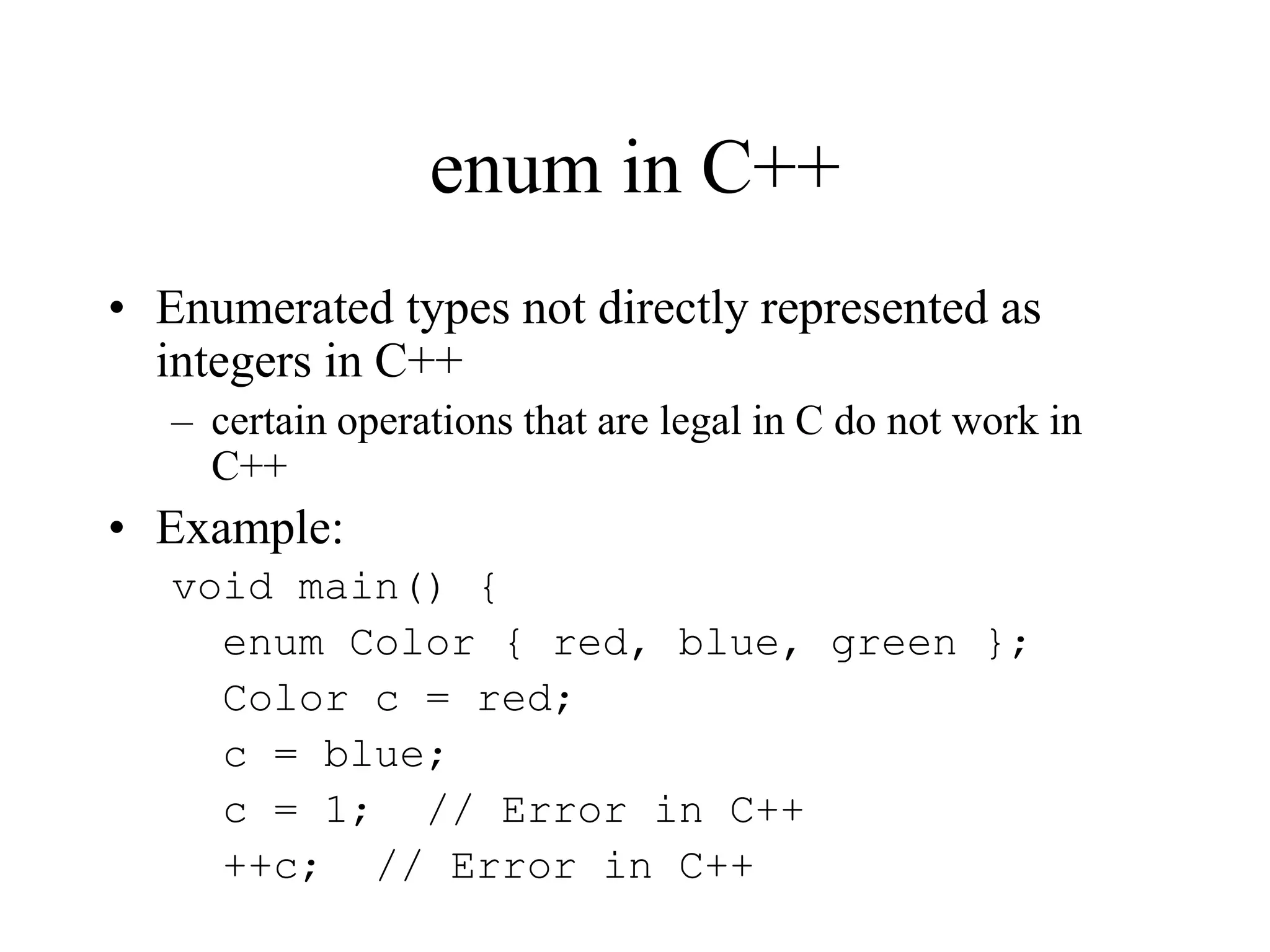
enum in C++
• Enumerated types not directly represented as
integers in C++
– certain operations that are legal in C do not work in
C++
• Example:
void main() {
enum Color { red, blue, green };
Color c = red;
c = blue;
c = 1; // Error in C++
++c; // Error in C++
bool
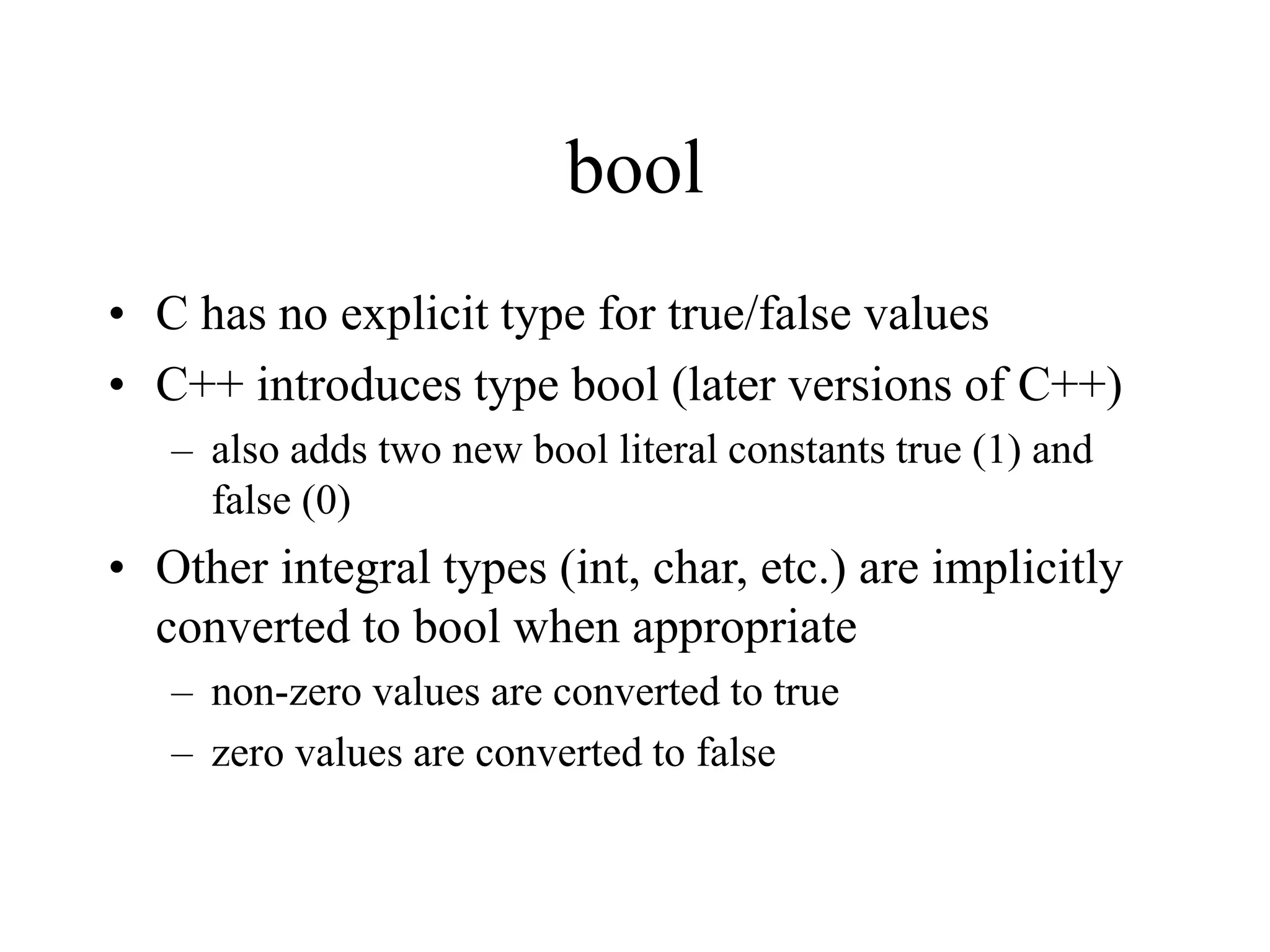
• C has no explicit type for true/false values
• C++ introduces type bool (later versions of C++)
– also adds two new bool literal constants true (1) and
false (0)
• Other integral types (int, char, etc.) are implicitly
converted to bool when appropriate
– non-zero values are converted to true
– zero values are converted to false
bool operations
• Operators requiring bool value(s) and producing a
bool value:
&& (And), || (Or), ! (Not)
• Relational operators (==, !=, <, >, <=, >=) produce
bool values
• Some statements expect expressions that produce
bool values:
if (boolean_expression)
while (boolean_expression)
do … while (boolean_expression)
for ( ; boolean_expression; )

C++Chapter01.PPT

  • 1.
    Introduction to C++ •Readings: 1.1-1.3, 1.9-1.13, 1.16-1.18, 1.21-1.22 • C++ – Bjarne Stroustrup (Bell Labs, 1979) – started as extension to C (macros and variables) – added new useful, features – nowadays a language of its own – C++ (the next thing after C, though wouldn’t ++C be more appropriate?)
  • 2.
    Outline Intro to C++ Object-OrientedProgramming Changes in C++ comments variable declaration location initialization pointer changes tagged structure type enum types bool type
  • 3.
    Object-Oriented Programming • First-classobjects - atomic types in C – int, float, char – have: • values • sets of operations that can be applied to them – how represented irrelevant to how they are manipulated • Other objects - structures in C – cannot be printed – do not have operations associated with them (at least, not directly)
  • 4.
    Object-Oriented Idea • Makeall objects, whether C-defined or user- defined, first-class objects • For C++ structures (called classes) allow: – functions to be associated with the class – only allow certain functions to access the internals of the class – allow the user to re-define existing functions (for example, input and output) to work on class
  • 5.
    Classes of Objectsin C++ • Classes – similar to structures in C (in fact, you can can still use the struct definition) – have fields corresponding to fields of a structure in C (similar to variables) – have fields corresponding to functions in C (functions that can be applied to that structure) – some fields are accessible by everyone, some not (data hiding) – some fields shared by the entire class
  • 6.
    Instances of Classesin C++ • A class in C++ is like a type in C • Variables created of a particular class are instances of that class • Variables have values for fields of the class • Class example: Student – has name, id, gpa, etc. fields that store values – has functions, changeGPA, addCredits, that can be applied to instances of that class • Instance examples: John Doe, Jane Doe – each with their own values for the fields of the class
  • 7.
    Comments in C++ •Can use C form of comments /* A Comment */ • Can also use // form: – when // encountered, remainder of line ignored – works only on that line • Examples: void main() { int I; // Variable used in loops char C; // No comment comment
  • 8.
    Variable Declarations • InC++, variable declarations are not restricted to the beginnings of blocks (before any code) – you may interleave declarations/statements as needed – it is still good style to have declarations first • Example void main() { int I = 5; printf(“Please enter J: “); int J; // Not declared at the start scanf(“%d”,&J);
  • 9.
    Counter Variables ina For Loop • You can declare the variable(s) used in a for loop in the initialization section of the for loop – good when counter used in for loop only exists in for loop (variable is throw-away) • Example for (int I = 0; I < 5; I++) printf(“%dn”,I); • Variable exists only during for loop (goes away when loop ends)
  • 10.
    Initializing Global Variables •Not restricted to using constant literal values in initializing global variables, can use any evaluable expression • Example: int rows = 5; int cols = 6; int size = rows * cols; void main() { ...
  • 11.
    Initializing Array Elements •When giving a list of initial array values in C++, you can use expressions that have to be evaluated • Values calculated at run-time before initialization done • Example: void main() { int n1, n2, n3; int *nptr[] = { &n1, &n2, &n3 };
  • 12.
    void* • In Cit is legal to cast other pointers to and from a void * • In C++ this is an error, to cast you should use an explicit casting command • Example: int N; int *P = &N; void *Q = P; // illegal in C++ void *R = (void *) P; // ok
  • 13.
    NULL in C++ •C++ does not use the value NULL, instead NULL is always 0 in C++, so we simply use 0 • Example: int *P = 0; // equivalent to // setting P to NULL • Can check for a 0 pointer as if true/false: if (!P) // P is 0 (NULL) ... else // P is not 0 (non-NULL) ...
  • 14.
    Tags and struct •When using struct command in C++ (and for other tagged types), can create type using tag format and not use tag in variable declaration: struct MyType { int A; float B; }; MyType V;
  • 15.
    enum in C++ •Enumerated types not directly represented as integers in C++ – certain operations that are legal in C do not work in C++ • Example: void main() { enum Color { red, blue, green }; Color c = red; c = blue; c = 1; // Error in C++ ++c; // Error in C++
  • 16.
    bool • C hasno explicit type for true/false values • C++ introduces type bool (later versions of C++) – also adds two new bool literal constants true (1) and false (0) • Other integral types (int, char, etc.) are implicitly converted to bool when appropriate – non-zero values are converted to true – zero values are converted to false
  • 17.
    bool operations • Operatorsrequiring bool value(s) and producing a bool value: && (And), || (Or), ! (Not) • Relational operators (==, !=, <, >, <=, >=) produce bool values • Some statements expect expressions that produce bool values: if (boolean_expression) while (boolean_expression) do … while (boolean_expression) for ( ; boolean_expression; )