Transforming Care:
Building clinical commissioning group
capability for large scale change
Jo Godman
Senior Associate
Mark Jennings
Senior Associate
26 March 2014
 Introduce NHS Improving Quality
 Explore the complex challenges faced by
CCGs
 Describe NHS Improving Quality’s experience
of working with CCGs to apply large scale
change techniques that seek to use a social
movement approach to change through
commitment rather than compliance
 Facilitate a discussion about the opportunities
and issues raised
Objectives
Improving health outcomes across England by
providing improvement and change expertise
The driving force for improvement
across the NHS in England
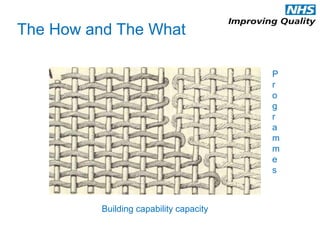
Building capability capacity
The How and The What
P
r
o
g
r
a
m
m
e
s
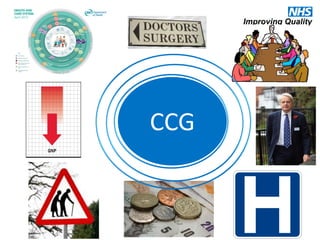
CCG
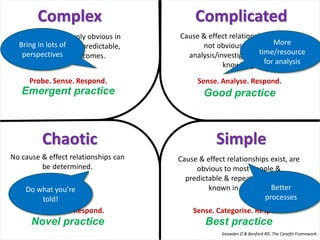
Complex Complicated
Chaotic Simple
Emergent practice Good practice
Best practiceNovel practice
Snowden D & Benford RD. The Cynefin Framework.
Cause & effect relationships exist, are
obvious to most people &
predictable & repeatable. Can be
known in advance.
Cause & effect relationships exist, but
not obvious, so require
analysis/investigation +/- expert
knowledge.
Cause & effect only obvious in
hindsight, with unpredictable,
emergent outcomes.
No cause & effect relationships can
be determined.
Probe. Sense. Respond. Sense. Analyse. Respond.
Sense. Categorise. Respond.Act. Sense. Respond.
Disorder
Better
processes
More
time/resource
for analysis
Bring in lots of
perspectives
Do what you’re
told!
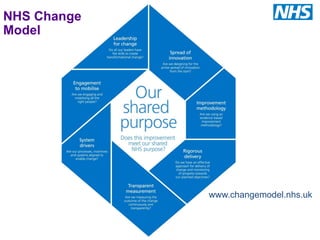
www.changemodel.nhs.uk
NHS Change
Model
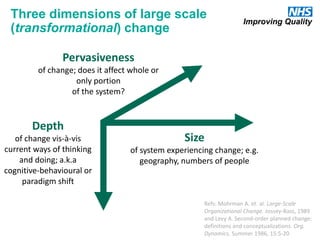
Three dimensions of large scale
(transformational) change
Depth
of change vis-à-vis
current ways of thinking
and doing; a.k.a
cognitive-behavioural or
paradigm shift
Pervasiveness
of change; does it affect whole or
only portion
of the system?
Size
of system experiencing change; e.g.
geography, numbers of people
Refs: Mohrman A. et. al. Large-Scale
Organizational Change. Jossey-Bass, 1989
and Levy A. Second-order planned change:
definitions and conceptualizations. Org.
Dynamics. Summer 1986, 15:5-20
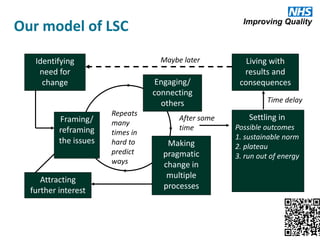
Our model of LSC
Identifying
need for
change
Framing/
reframing
the issues
Engaging/
connecting
others
Making
pragmatic
change in
multiple
processes
Attracting
further interest
After some
time
Settling in
Possible outcomes
1. sustainable norm
2. plateau
3. run out of energy
Living with
results and
consequences
Maybe later
Repeats
many
times in
hard to
predict
ways
Time delay
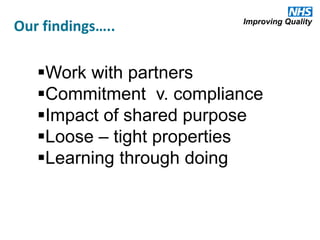
Our findings…..
Work with partners
Commitment v. compliance
Impact of shared purpose
Loose – tight properties
Learning through doing
Transforming Care Programme
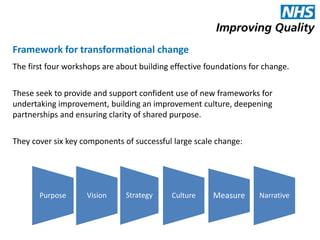
Framework for transformational change
The first four workshops are about building effective foundations for change.
These seek to provide and support confident use of new frameworks for
undertaking improvement, building an improvement culture, deepening
partnerships and ensuring clarity of shared purpose.
They cover six key components of successful large scale change:
Purpose Vision NarrativeCultureStrategy Measure
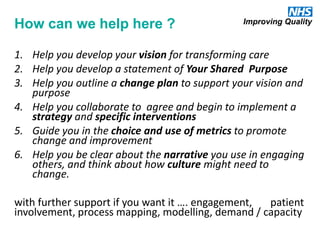
How can we help here ?
1. Help you develop your vision for transforming care
2. Help you develop a statement of Your Shared Purpose
3. Help you outline a change plan to support your vision and
purpose
4. Help you collaborate to agree and begin to implement a
strategy and specific interventions
5. Guide you in the choice and use of metrics to promote
change and improvement
6. Help you be clear about the narrative you use in engaging
others, and think about how culture might need to
change.
with further support if you want it …. engagement, patient
involvement, process mapping, modelling, demand / capacity
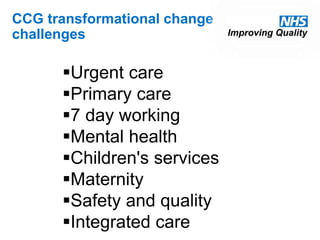
CCG transformational change
challenges
Urgent care
Primary care
7 day working
Mental health
Children's services
Maternity
Safety and quality
Integrated care
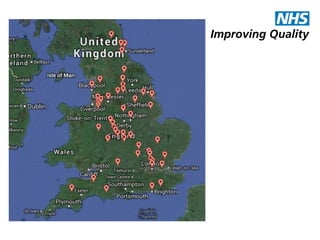
Heat map
Thank you
Contact:
London – Mark Jennings mark.Jennings@NHSIQ.nhs.uk
Midlands and East – Mani Dhesi mani.dhesi@NHSIQ.nhs.uk
North – Neil Simpson neil.simpson@NHSIQ.nhs.uk
South – Elaine Latham Elaine.latham@NHSIQ.nhs.uk

CCG transforming care programme

  • 1.
    Transforming Care: Building clinicalcommissioning group capability for large scale change Jo Godman Senior Associate Mark Jennings Senior Associate 26 March 2014
  • 2.
     Introduce NHSImproving Quality  Explore the complex challenges faced by CCGs  Describe NHS Improving Quality’s experience of working with CCGs to apply large scale change techniques that seek to use a social movement approach to change through commitment rather than compliance  Facilitate a discussion about the opportunities and issues raised Objectives
  • 3.
    Improving health outcomesacross England by providing improvement and change expertise The driving force for improvement across the NHS in England
  • 4.
    Building capability capacity TheHow and The What P r o g r a m m e s
  • 6.
  • 7.
    Complex Complicated Chaotic Simple Emergentpractice Good practice Best practiceNovel practice Snowden D & Benford RD. The Cynefin Framework. Cause & effect relationships exist, are obvious to most people & predictable & repeatable. Can be known in advance. Cause & effect relationships exist, but not obvious, so require analysis/investigation +/- expert knowledge. Cause & effect only obvious in hindsight, with unpredictable, emergent outcomes. No cause & effect relationships can be determined. Probe. Sense. Respond. Sense. Analyse. Respond. Sense. Categorise. Respond.Act. Sense. Respond. Disorder Better processes More time/resource for analysis Bring in lots of perspectives Do what you’re told!
  • 8.
  • 9.
    Three dimensions oflarge scale (transformational) change Depth of change vis-à-vis current ways of thinking and doing; a.k.a cognitive-behavioural or paradigm shift Pervasiveness of change; does it affect whole or only portion of the system? Size of system experiencing change; e.g. geography, numbers of people Refs: Mohrman A. et. al. Large-Scale Organizational Change. Jossey-Bass, 1989 and Levy A. Second-order planned change: definitions and conceptualizations. Org. Dynamics. Summer 1986, 15:5-20
  • 11.
    Our model ofLSC Identifying need for change Framing/ reframing the issues Engaging/ connecting others Making pragmatic change in multiple processes Attracting further interest After some time Settling in Possible outcomes 1. sustainable norm 2. plateau 3. run out of energy Living with results and consequences Maybe later Repeats many times in hard to predict ways Time delay
  • 12.
    Our findings….. Work withpartners Commitment v. compliance Impact of shared purpose Loose – tight properties Learning through doing
  • 13.
  • 14.
    Framework for transformationalchange The first four workshops are about building effective foundations for change. These seek to provide and support confident use of new frameworks for undertaking improvement, building an improvement culture, deepening partnerships and ensuring clarity of shared purpose. They cover six key components of successful large scale change: Purpose Vision NarrativeCultureStrategy Measure
  • 15.
    How can wehelp here ? 1. Help you develop your vision for transforming care 2. Help you develop a statement of Your Shared Purpose 3. Help you outline a change plan to support your vision and purpose 4. Help you collaborate to agree and begin to implement a strategy and specific interventions 5. Guide you in the choice and use of metrics to promote change and improvement 6. Help you be clear about the narrative you use in engaging others, and think about how culture might need to change. with further support if you want it …. engagement, patient involvement, process mapping, modelling, demand / capacity
  • 16.
    CCG transformational change challenges Urgentcare Primary care 7 day working Mental health Children's services Maternity Safety and quality Integrated care
  • 17.
  • 18.
    Thank you Contact: London –Mark Jennings mark.Jennings@NHSIQ.nhs.uk Midlands and East – Mani Dhesi mani.dhesi@NHSIQ.nhs.uk North – Neil Simpson neil.simpson@NHSIQ.nhs.uk South – Elaine Latham Elaine.latham@NHSIQ.nhs.uk