Research Question
What are the effects of a blended
mentoring program on the perceived
social support of novice NPs when
transitioning from a staff RN to a novice
NP in a hospital setting?
Introduction
•Continued growth is expected as
APRNs fill the gap in patient care as a
result of the reduction in resident
physician work hours
•Years of research have demonstrated
the difficulty novice APRNs experience
as they transition from RN to APRN
•Support for novice APRNs has been
found to be a facilitating factor in the
transition; however, there is no
consensus in the literature as to what
type of support is most beneficial
•The Institute of Medicine (IOM)
suggests a residency program for all
novice APRNs, but these are typically
one to two years in length and costly
Design
•Convenience sample of newly hired
APRNs in their first NP role with less
than 18 months experience
•51 potential participants (1st APRN
role, less than 18 months experience)
•7 mentees were enrolled in the study
(15%)
•Tool: Social Provision Scale – short
version© administered at baseline entry
into the mentoring program and again at
3 months
Method
•Pilot project
•Quasi-experimental pre-test/post-test
design
•Matched pairs
•Wilcoxin signed-rank test
Design
•Convenience sample of newly hired
APRNs in their first NP role with less
than 18 months experience
•51 potential participants (1st APRN
role, less than 18 months experience)
•7 mentees were enrolled in the study
(15%)
•Tool: Social Provision Scale – short
version© administered at baseline entry
into the mentoring program and again at
3 months
Method
•Pilot project
•Quasi-experimental pre-test/post-test
design
•Matched pairs
•Wilcoxin signed-rank test
Funding
This project was supported by the Center for
Professional Excellence/Advanced Practice but
no funding was provided.
SP2020 Pillar
Realize our full potential by
engaging, inspiring, and enabling all
employees to make a difference.
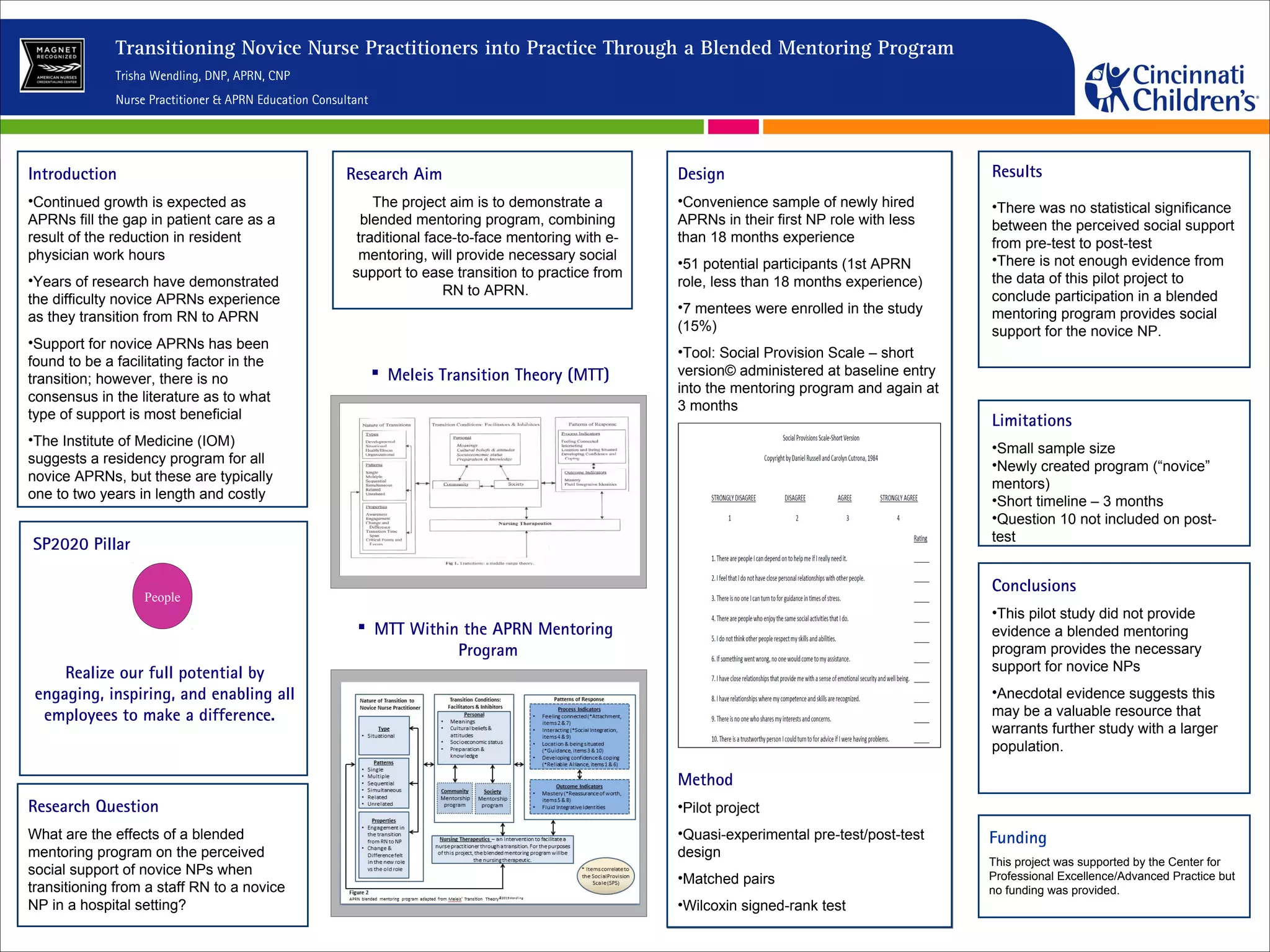
Transitioning Novice Nurse Practitioners into Practice Through a Blended Mentoring Program
Trisha Wendling, DNP, APRN, CNP
Nurse Practitioner & APRN Education Consultant
 MTT Within the APRN Mentoring
Program
Research Aim
The project aim is to demonstrate a
blended mentoring program, combining
traditional face-to-face mentoring with e-
mentoring, will provide necessary social
support to ease transition to practice from
RN to APRN.
Results
•There was no statistical significance
between the perceived social support
from pre-test to post-test
•There is not enough evidence from
the data of this pilot project to
conclude participation in a blended
mentoring program provides social
support for the novice NP.
 Meleis Transition Theory (MTT)
Limitations
•Small sample size
•Newly created program (“novice”
mentors)
•Short timeline – 3 months
•Question 10 not included on post-
test
People
Conclusions
•This pilot study did not provide
evidence a blended mentoring
program provides the necessary
support for novice NPs
•Anecdotal evidence suggests this
may be a valuable resource that
warrants further study with a larger
population.

Wendling_Final1

  • 1.
    Research Question What arethe effects of a blended mentoring program on the perceived social support of novice NPs when transitioning from a staff RN to a novice NP in a hospital setting? Introduction •Continued growth is expected as APRNs fill the gap in patient care as a result of the reduction in resident physician work hours •Years of research have demonstrated the difficulty novice APRNs experience as they transition from RN to APRN •Support for novice APRNs has been found to be a facilitating factor in the transition; however, there is no consensus in the literature as to what type of support is most beneficial •The Institute of Medicine (IOM) suggests a residency program for all novice APRNs, but these are typically one to two years in length and costly Design •Convenience sample of newly hired APRNs in their first NP role with less than 18 months experience •51 potential participants (1st APRN role, less than 18 months experience) •7 mentees were enrolled in the study (15%) •Tool: Social Provision Scale – short version© administered at baseline entry into the mentoring program and again at 3 months Method •Pilot project •Quasi-experimental pre-test/post-test design •Matched pairs •Wilcoxin signed-rank test Design •Convenience sample of newly hired APRNs in their first NP role with less than 18 months experience •51 potential participants (1st APRN role, less than 18 months experience) •7 mentees were enrolled in the study (15%) •Tool: Social Provision Scale – short version© administered at baseline entry into the mentoring program and again at 3 months Method •Pilot project •Quasi-experimental pre-test/post-test design •Matched pairs •Wilcoxin signed-rank test Funding This project was supported by the Center for Professional Excellence/Advanced Practice but no funding was provided. SP2020 Pillar Realize our full potential by engaging, inspiring, and enabling all employees to make a difference. Transitioning Novice Nurse Practitioners into Practice Through a Blended Mentoring Program Trisha Wendling, DNP, APRN, CNP Nurse Practitioner & APRN Education Consultant  MTT Within the APRN Mentoring Program Research Aim The project aim is to demonstrate a blended mentoring program, combining traditional face-to-face mentoring with e- mentoring, will provide necessary social support to ease transition to practice from RN to APRN. Results •There was no statistical significance between the perceived social support from pre-test to post-test •There is not enough evidence from the data of this pilot project to conclude participation in a blended mentoring program provides social support for the novice NP.  Meleis Transition Theory (MTT) Limitations •Small sample size •Newly created program (“novice” mentors) •Short timeline – 3 months •Question 10 not included on post- test People Conclusions •This pilot study did not provide evidence a blended mentoring program provides the necessary support for novice NPs •Anecdotal evidence suggests this may be a valuable resource that warrants further study with a larger population.