01/11/2026 2
A cateringmenu is the most
essential part of the catering
business because it is the first
thing potential customers will
ask for when looking for a
catering service. It is what
you will present to your
customers in their initial
consultation, therefore making
it your businesses' selling
point.
01/11/2026 4
Step-by-Step Guideto Create a Catering Menu
Step 1: Understand Your Target Audience
Knowing your audience’s food preferences shapes
the success of any catering business. To stand out
from the crowd, a caterer must discern his or her
audience’s dietary patterns and preferences.
Offering a tailored menu to suit different dietary
needs like vegan, gluten-free, or even religious
dietary practices could give you an edge.
Understanding your audience also helps determine
the portion sizes, thereby controlling food wastage.
5.
01/11/2026 5
Step2: Choose Your Catering Style
Catering styles vary from buffet, and plated, to family-style dining
experiences. The chosen style defines the atmosphere of the
event and influences the overall guest experience. Choosing a
style depends on factors like the nature of the event, the number
of attendees, and your budget. A buffet style might be an ideal
choice for a larger, informal gathering, whereas a plated style
would suit a small, formal affair.
Step 3: Plan Your Menu Items
Planning your menu involves more than just choosing your
favourite recipes. You should select dishes that not only align with
your catering style but also with audience preferences. Consider
the event’s theme, the season, and local food trends. Strive to
maintain a balance between traditional crowd-pleasers and some
unique dishes from your repertoire to provide a memorable dining
experience. Crafting your catering menu? This article offers
insights on essential items to add to your catering menu to
delight your guests.
6.
01/11/2026 6
Step 4:Price Your Menu
Pricing your items is a critical factor in your business’s
profitability. While it’s important to price competitively, the
prime focus should be on covering your costs and
ensuring a decent profit margin. Consider elements like
ingredient cost, preparation time, and perceived value of
the dish.
Step 5: Design Your Menu
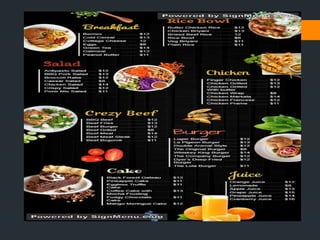
A well-designed menu isn’t just about listing your dishes.
It should be visually engaging and easy to read. Use
clear, concise descriptions and consider adding images of
your most popular dishes. Opt for a design that reflects
the style and brand of your catering business. Lastly, the
menu layout should optimally arrange items in a way that
draws attention to your high-profit dishes.
7.
01/11/2026 7
Beyond thevisual appeal and strategic placement of
dishes, the creation of a new catering menu delves
deeper into understanding market trends and
customer preferences, emphasizing the need for
research and adaptability in the competitive catering
industry.
Catering menus are essential for catering services,
with catering menu design playing a crucial role in
showcasing catering food offerings. Creating a new
catering menu requires market research to ensure it
aligns with customer preferences and food cost
considerations. Discover how to
design a menu for catering that appeals to your
clientele by including popular dishes, setting the right
prices, and utilizing an attractive layout.
8.
01/11/2026 8
Essential Factorsto Consider When
Creating a Catering Menu
Seasonality and Local Produce
Tapping into seasonality and local produce
isn’t just a trendy buzzword; it can genuinely
improve your catering menu. Seasonal
ingredients are at their peak in terms of flavour
and quality, which means your dishes will taste
better. With some planning, you can design a
menu that reflects the best of what the season
has to offer.
9.
01/11/2026 9
Dietary Restrictionsand Allergies
In today’s diverse culinary world, accommodating
dietary restrictions and allergies is essential. A
well-planned menu takes this into account to
ensure that every guest feels welcome and well-
fed.
Start by researching common food allergies and
restrictions such as gluten-free, dairy-free, vegan,
and vegetarian diets. The more you understand
about these diets, the better you can
accommodate them without compromising taste or
presentation. Avoid the pitfalls of
typical catering menu errors by educating
yourself on dietary needs and ensuring your
offerings are inclusive and appealing to all your
guests.
10.
01/11/2026 10
Portion Control
Portioncontrol in catering can solve two critical
issues – food waste and cost control. While you
want to ensure no one leaves hungry,
overestimating portions can lead to significant food
waste and increased costs.
Consider using portion control tools or plates to get
an accurate understanding of what constitutes a
meal. It’s also helpful to learn from past events;
keep track of how much food was consumed and
adjust your portion sizes accordingly.
Challenging as portion control may be, it can lead
to more efficient operations and more satisfied
customers. And with practice, you’ll become adept
at estimating the right portion sizes for different
types of events and venues.
11.
01/11/2026 11
Common Mistakesto Avoid When Creating a
Catering Menu
Overcomplicating the Menu
A widespread pitfall, particularly among ambitious
caterers, is the temptation to showcase all their
culinary prowess in one go. The result is an
overcomplicated menu that leaves customers
overwhelmed. Opting for a simpler, well-curated
selection of dishes allows you to focus on quality
and increases the odds of customer satisfaction.
Remember, complexity and quality are not
synonymous. Sometimes, a streamlined, well-
thought menu, with diverse but complementary
options, is more impactful. Carefully choose dishes
that represent your brand and resonate with your
clientele, and keep refining your selection based
on customer feedback and sales data.
12.
01/11/2026 12
Neglecting MenuDesign
Lastly, neglecting the design aspect of
your menu can deter customers even
before they place an order. The menu
isn’t just a list of dishes and prices –
it’s a strategic marketing tool. Its
presentation, readability, and overall
aesthetic influence customer
decisions, and consequently, your
sales.
13.
01/11/2026 13
To createa compelling menu design,
start with a clear, easy-to-read layout.
High-quality photos can be appealing,
but excessive imagery can clutter the
design. Instead, use textual
descriptions to evoke visual images of
your dishes. Your branding should
resonate across your menu design,
creating an atmosphere that matches
the dining experience you aim to
deliver.
14.
01/11/2026 14
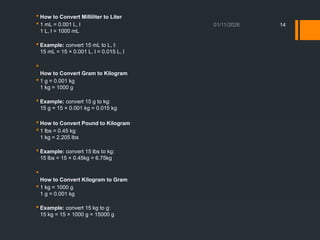
Howto Convert Milliliter to Liter
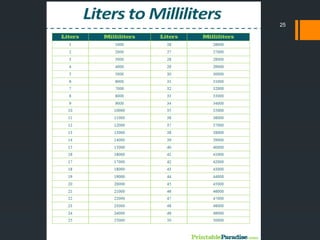
1 mL = 0.001 L, l
1 L, l = 1000 mL
Example: convert 15 mL to L, l:
15 mL = 15 × 0.001 L, l = 0.015 L, l
How to Convert Gram to Kilogram
1 g = 0.001 kg
1 kg = 1000 g
Example: convert 15 g to kg:
15 g = 15 × 0.001 kg = 0.015 kg
How to Convert Pound to Kilogram
1 lbs = 0.45 kg
1 kg = 2.205 lbs
Example: convert 15 lbs to kg:
15 lbs = 15 × 0.45kg = 6.75kg
How to Convert Kilogram to Gram
1 kg = 1000 g
1 g = 0.001 kg
Example: convert 15 kg to g:
15 kg = 15 × 1000 g = 15000 g
15.
01/11/2026 15
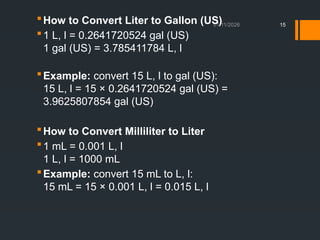
How toConvert Liter to Gallon (US)
1 L, l = 0.2641720524 gal (US)
1 gal (US) = 3.785411784 L, l
Example: convert 15 L, l to gal (US):
15 L, l = 15 × 0.2641720524 gal (US) =
3.9625807854 gal (US)
How to Convert Milliliter to Liter
1 mL = 0.001 L, l
1 L, l = 1000 mL
Example: convert 15 mL to L, l:
15 mL = 15 × 0.001 L, l = 0.015 L, l
16.
01/11/2026 16
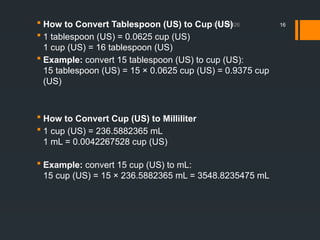
Howto Convert Tablespoon (US) to Cup (US)
1 tablespoon (US) = 0.0625 cup (US)
1 cup (US) = 16 tablespoon (US)
Example: convert 15 tablespoon (US) to cup (US):
15 tablespoon (US) = 15 × 0.0625 cup (US) = 0.9375 cup
(US)
How to Convert Cup (US) to Milliliter
1 cup (US) = 236.5882365 mL
1 mL = 0.0042267528 cup (US)
Example: convert 15 cup (US) to mL:
15 cup (US) = 15 × 236.5882365 mL = 3548.8235475 mL
17.
01/11/2026 17
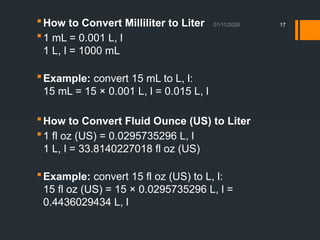
How toConvert Milliliter to Liter
1 mL = 0.001 L, l
1 L, l = 1000 mL
Example: convert 15 mL to L, l:
15 mL = 15 × 0.001 L, l = 0.015 L, l
How to Convert Fluid Ounce (US) to Liter
1 fl oz (US) = 0.0295735296 L, l
1 L, l = 33.8140227018 fl oz (US)
Example: convert 15 fl oz (US) to L, l:
15 fl oz (US) = 15 × 0.0295735296 L, l =
0.4436029434 L, l
18.
01/11/2026 18
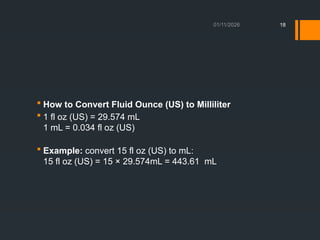
Howto Convert Fluid Ounce (US) to Milliliter
1 fl oz (US) = 29.574 mL
1 mL = 0.034 fl oz (US)
Example: convert 15 fl oz (US) to mL:
15 fl oz (US) = 15 × 29.574mL = 443.61 mL
19.
01/11/2026 19
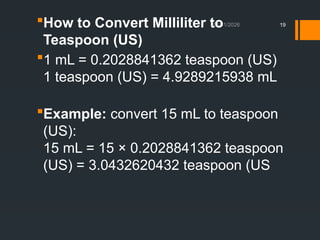
How toConvert Milliliter to
Teaspoon (US)
1 mL = 0.2028841362 teaspoon (US)
1 teaspoon (US) = 4.9289215938 mL
Example: convert 15 mL to teaspoon
(US):
15 mL = 15 × 0.2028841362 teaspoon
(US) = 3.0432620432 teaspoon (US
20.
01/11/2026 20
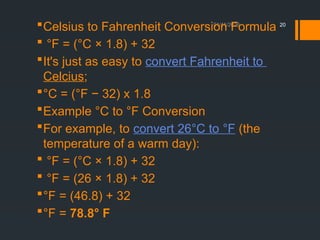
Celsius toFahrenheit Conversion Formula
°F = (°C × 1.8) + 32
It's just as easy to convert Fahrenheit to
Celcius;
°C = (°F − 32) x 1.8
Example °C to °F Conversion
For example, to convert 26°C to °F (the
temperature of a warm day):
°F = (°C × 1.8) + 32
°F = (26 × 1.8) + 32
°F = (46.8) + 32
°F = 78.8° F
21.
01/11/2026 21
Liquid MeasuringCups vs Dry
Liquid measuring cups are designed for
measuring liquid ingredients like water,
milk, and cooking oil. They feature
measurement lines that allow you to
accurately measure liquids without the risk
of spilling. Dry measuring cups are
designed to measure dry ingredients like
flour, sugar, and spices. Each cup holds a
specific measurement ranging from 1/8
cup to 1 cup, so they usually come in sets.
22.
01/11/2026 22
How toMeasure Liquid Ingredients
Liquid ingredients are measured in cups,
pints, quarts, and gallons. For these
ingredients, 1 cup = 8 fluid ounces.
Use a liquid measuring cup placed on a
level surface.
Position yourself so that your eyes are level
with the graduated markings on the cup.
Pour the liquid into the cup until the liquid is
level with the desired measurement line.
23.
01/11/2026 23
How toMeasure Dry Ingredients
Dry ingredients are measured in
teaspoons, tablespoons, cups, or by
weight. For these ingredients, 1 cup = 4.5
ounces.
Use a dry ingredient measuring cup for
larger quantities and a measuring spoon for
smaller quantities.
Level the ingredient with a spatula, knife, or
another utensil with a flat edge.
Pack moist ingredients, such as brown
sugar, tightly into the cup.