All about Category II
and Category III AIF
Nakshatra Gujrati
nakshatra@nluo.ac.in
SEBI (Alternative Investment Funds) Regulations, 2012 defines AIF as a privately pooled vehicle for
investments with a defined policy. AIF can be a company, trust, or LLP (Regulation 2(1)(b)).
Manager and Sponsor
"Manager" oversees investments and may be the sponsor.
Roles crucial for shaping investment strategy and ensuring fund success (Definitions 2(q)).
Registration
1. Initiate Application (www.siportal.sebi.gov.in)
 File application for AIF registration.
 System generates login ID and password, sent to the applicant.
2. Application Submission
 Fill details under "Fresh Registration" in the "AIF" tab on SEBI portal.
 Pay Rs.1,00,000/- + 18% GST online or via bank draft.
 Submit specified information as per SEBI (AIF) Regulations, 2012.
 Use SIPortal for data submission; upload documents under 'optional attachments.’
 Final submission through "Final Submit" button.
3. Application Tracking
 Track application status using the allotted application number.
4. Physical Submission
 Physically submit the application to SEBI alongside online submission with required documents.
5. Registration Fee Payment
 Upon SEBI approval, pay applicable registration fee:
 Category I AIF (except Angel Funds): Rs. 500,000/- + 18% GST
 Category I AIF – VCF - Angel Fund: Rs. 200,000/- + 18% GST
 Category II AIF: Rs. 10,00,000/- + 18% GST
 Category III AIF: Rs. 15,00,000/- + 18% GST
6. Grant of Registration
 Upon receipt of registration fee and verification of documents, SEBI grants registration to the applicant as an Alternative
Investment Fund within 21 working days
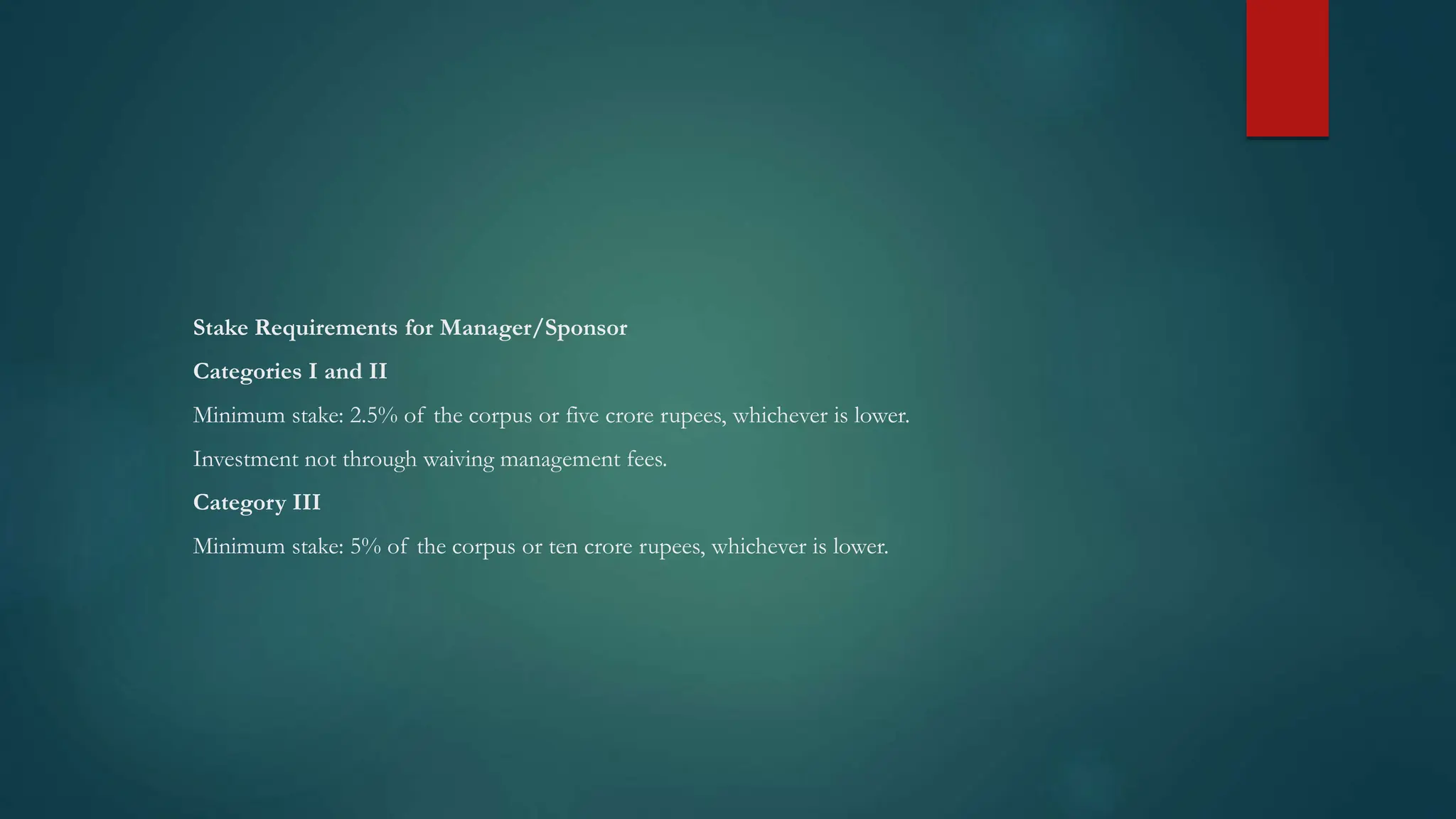
Stake Requirements for Manager/Sponsor
Categories I and II
Minimum stake: 2.5% of the corpus or five crore rupees, whichever is lower.
Investment not through waiving management fees.
Category III
Minimum stake: 5% of the corpus or ten crore rupees, whichever is lower.
Category- I Category- II [Regulation
3(4)(b)]
Category- III [Regulation
3(4)(c)]
Angel Funds Real Estate Hedge Funds
Venture Capital Funds Funds of Funds Private Investment in Public
Equity Funds
Infrastructure Funds Debt Fund
Social Venture Funds Private Equity Funds
Types of Alternative Investment Funds
Category- II Category- III
Real Estate
pool capital from many investors to invest in a diversified portfolio of real
estate assets
Hedge Funds
are private investment funds that use complex and risky strategies.
The aim is to generate returns in a short time.
Funds of Funds
Invests in other AIFs. They hold an investment portfolio of other AIFs.
They do not directly invest in stocks, bonds, or other securities.
Private Investment in Public Equity Funds
Invests in publicly traded firms by acquiring shares at a
discounted price through private placements.
Debt Fund
Invests in debt securities of listed or unlisted companies as per the fund's
stated objectives. Investment in debt funds is limited to HNIs and offers
limited diversification.
Private Equity Funds
pool capital from investors to invest in privately held companies.
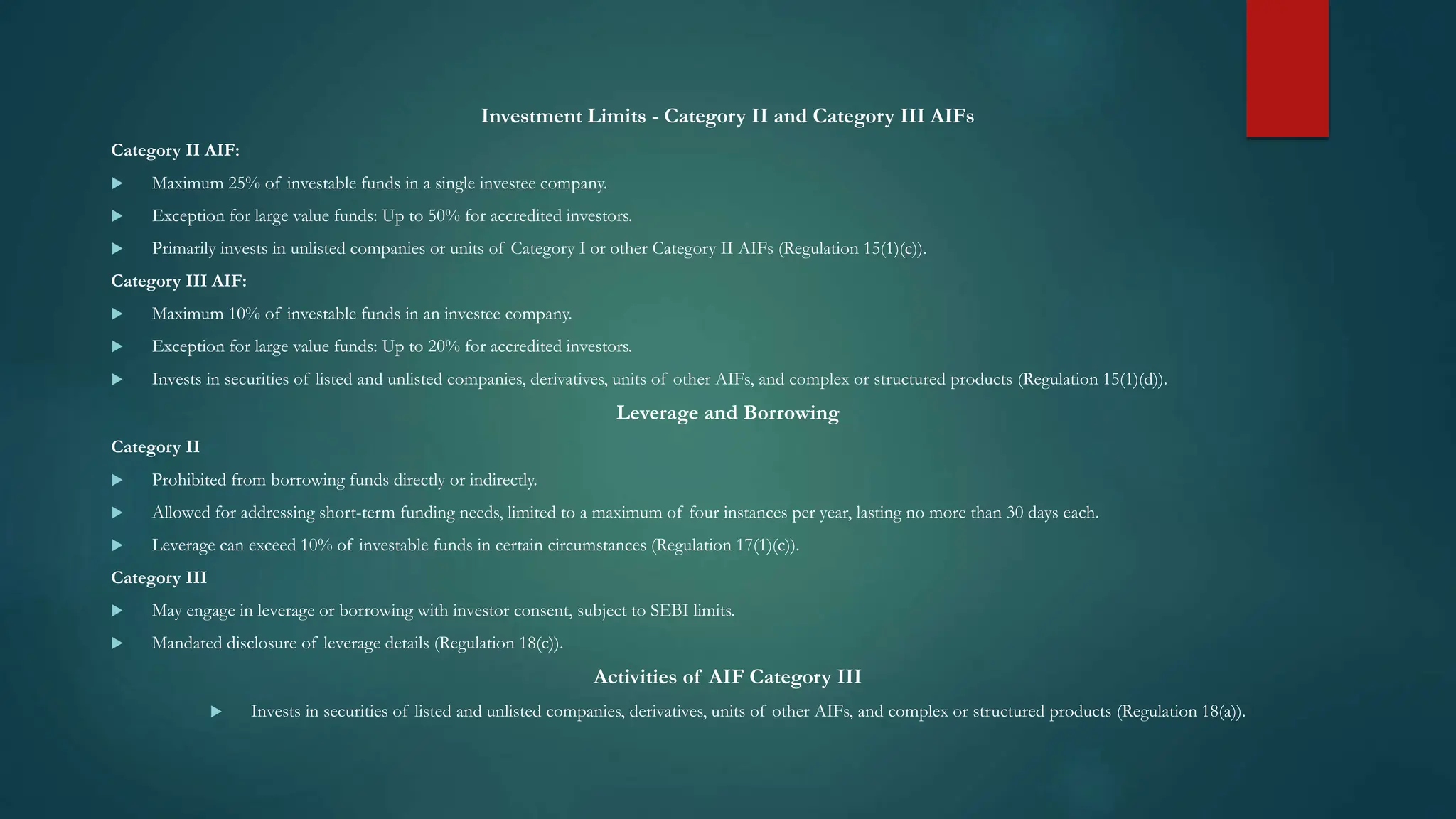
Investment Limits - Category II and Category III AIFs
Category II AIF:
 Maximum 25% of investable funds in a single investee company.
 Exception for large value funds: Up to 50% for accredited investors.
 Primarily invests in unlisted companies or units of Category I or other Category II AIFs (Regulation 15(1)(c)).
Category III AIF:
 Maximum 10% of investable funds in an investee company.
 Exception for large value funds: Up to 20% for accredited investors.
 Invests in securities of listed and unlisted companies, derivatives, units of other AIFs, and complex or structured products (Regulation 15(1)(d)).
Leverage and Borrowing
Category II
 Prohibited from borrowing funds directly or indirectly.
 Allowed for addressing short-term funding needs, limited to a maximum of four instances per year, lasting no more than 30 days each.
 Leverage can exceed 10% of investable funds in certain circumstances (Regulation 17(1)(c)).
Category III
 May engage in leverage or borrowing with investor consent, subject to SEBI limits.
 Mandated disclosure of leverage details (Regulation 18(c)).
Activities of AIF Category III
 Invests in securities of listed and unlisted companies, derivatives, units of other AIFs, and complex or structured products (Regulation 18(a)).
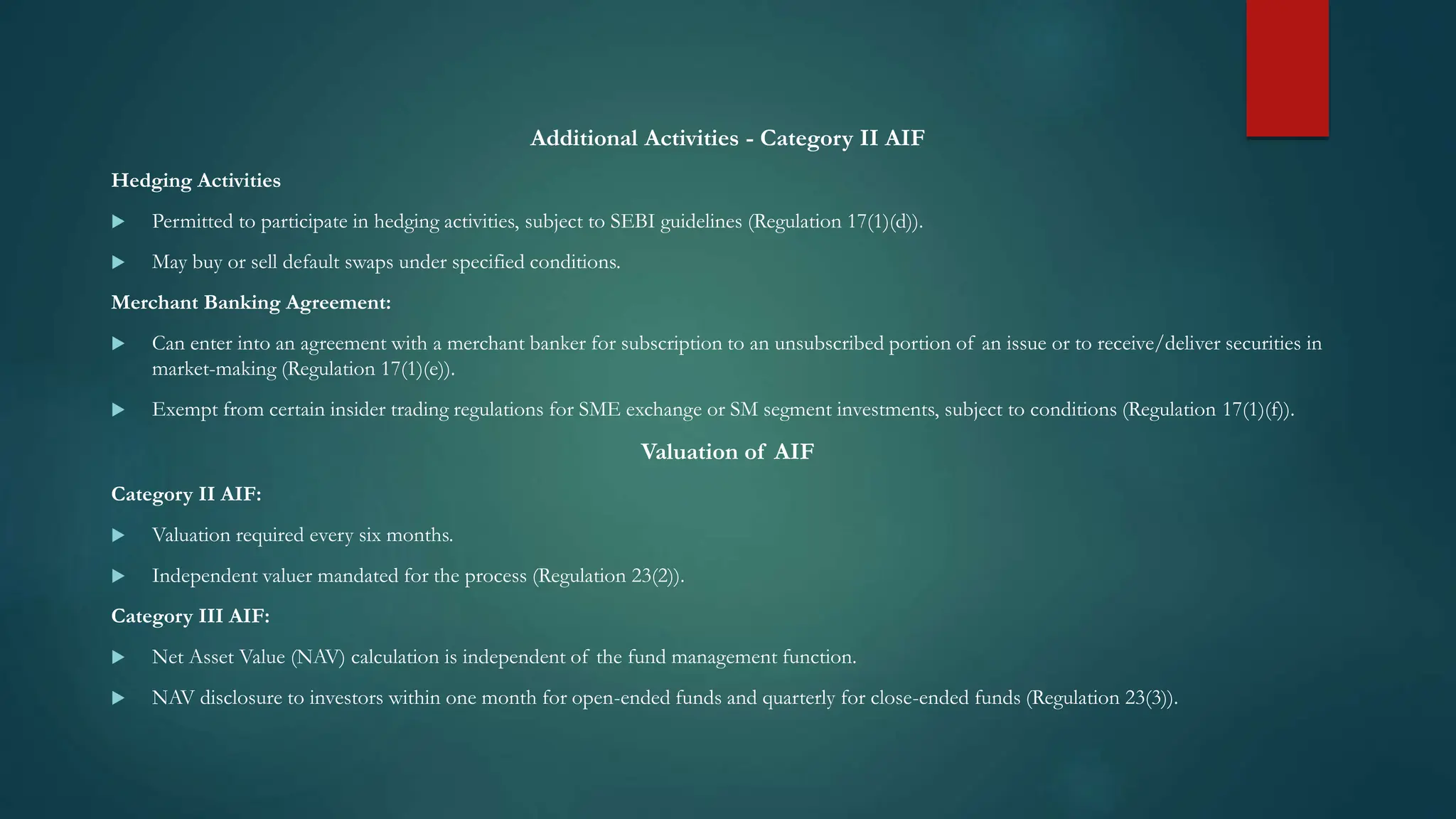
Additional Activities - Category II AIF
Hedging Activities
 Permitted to participate in hedging activities, subject to SEBI guidelines (Regulation 17(1)(d)).
 May buy or sell default swaps under specified conditions.
Merchant Banking Agreement:
 Can enter into an agreement with a merchant banker for subscription to an unsubscribed portion of an issue or to receive/deliver securities in
market-making (Regulation 17(1)(e)).
 Exempt from certain insider trading regulations for SME exchange or SM segment investments, subject to conditions (Regulation 17(1)(f)).
Valuation of AIF
Category II AIF:
 Valuation required every six months.
 Independent valuer mandated for the process (Regulation 23(2)).
Category III AIF:
 Net Asset Value (NAV) calculation is independent of the fund management function.
 NAV disclosure to investors within one month for open-ended funds and quarterly for close-ended funds (Regulation 23(3)).

Category II and Category III AIF.pptx

  • 1.
    All about CategoryII and Category III AIF Nakshatra Gujrati nakshatra@nluo.ac.in
  • 2.
    SEBI (Alternative InvestmentFunds) Regulations, 2012 defines AIF as a privately pooled vehicle for investments with a defined policy. AIF can be a company, trust, or LLP (Regulation 2(1)(b)). Manager and Sponsor "Manager" oversees investments and may be the sponsor. Roles crucial for shaping investment strategy and ensuring fund success (Definitions 2(q)).
  • 3.
    Registration 1. Initiate Application(www.siportal.sebi.gov.in)  File application for AIF registration.  System generates login ID and password, sent to the applicant. 2. Application Submission  Fill details under "Fresh Registration" in the "AIF" tab on SEBI portal.  Pay Rs.1,00,000/- + 18% GST online or via bank draft.  Submit specified information as per SEBI (AIF) Regulations, 2012.  Use SIPortal for data submission; upload documents under 'optional attachments.’  Final submission through "Final Submit" button.
  • 4.
    3. Application Tracking Track application status using the allotted application number. 4. Physical Submission  Physically submit the application to SEBI alongside online submission with required documents. 5. Registration Fee Payment  Upon SEBI approval, pay applicable registration fee:  Category I AIF (except Angel Funds): Rs. 500,000/- + 18% GST  Category I AIF – VCF - Angel Fund: Rs. 200,000/- + 18% GST  Category II AIF: Rs. 10,00,000/- + 18% GST  Category III AIF: Rs. 15,00,000/- + 18% GST 6. Grant of Registration  Upon receipt of registration fee and verification of documents, SEBI grants registration to the applicant as an Alternative Investment Fund within 21 working days
  • 5.
    Stake Requirements forManager/Sponsor Categories I and II Minimum stake: 2.5% of the corpus or five crore rupees, whichever is lower. Investment not through waiving management fees. Category III Minimum stake: 5% of the corpus or ten crore rupees, whichever is lower.
  • 6.
    Category- I Category-II [Regulation 3(4)(b)] Category- III [Regulation 3(4)(c)] Angel Funds Real Estate Hedge Funds Venture Capital Funds Funds of Funds Private Investment in Public Equity Funds Infrastructure Funds Debt Fund Social Venture Funds Private Equity Funds Types of Alternative Investment Funds
  • 7.
    Category- II Category-III Real Estate pool capital from many investors to invest in a diversified portfolio of real estate assets Hedge Funds are private investment funds that use complex and risky strategies. The aim is to generate returns in a short time. Funds of Funds Invests in other AIFs. They hold an investment portfolio of other AIFs. They do not directly invest in stocks, bonds, or other securities. Private Investment in Public Equity Funds Invests in publicly traded firms by acquiring shares at a discounted price through private placements. Debt Fund Invests in debt securities of listed or unlisted companies as per the fund's stated objectives. Investment in debt funds is limited to HNIs and offers limited diversification. Private Equity Funds pool capital from investors to invest in privately held companies.
  • 8.
    Investment Limits -Category II and Category III AIFs Category II AIF:  Maximum 25% of investable funds in a single investee company.  Exception for large value funds: Up to 50% for accredited investors.  Primarily invests in unlisted companies or units of Category I or other Category II AIFs (Regulation 15(1)(c)). Category III AIF:  Maximum 10% of investable funds in an investee company.  Exception for large value funds: Up to 20% for accredited investors.  Invests in securities of listed and unlisted companies, derivatives, units of other AIFs, and complex or structured products (Regulation 15(1)(d)). Leverage and Borrowing Category II  Prohibited from borrowing funds directly or indirectly.  Allowed for addressing short-term funding needs, limited to a maximum of four instances per year, lasting no more than 30 days each.  Leverage can exceed 10% of investable funds in certain circumstances (Regulation 17(1)(c)). Category III  May engage in leverage or borrowing with investor consent, subject to SEBI limits.  Mandated disclosure of leverage details (Regulation 18(c)). Activities of AIF Category III  Invests in securities of listed and unlisted companies, derivatives, units of other AIFs, and complex or structured products (Regulation 18(a)).
  • 9.
    Additional Activities -Category II AIF Hedging Activities  Permitted to participate in hedging activities, subject to SEBI guidelines (Regulation 17(1)(d)).  May buy or sell default swaps under specified conditions. Merchant Banking Agreement:  Can enter into an agreement with a merchant banker for subscription to an unsubscribed portion of an issue or to receive/deliver securities in market-making (Regulation 17(1)(e)).  Exempt from certain insider trading regulations for SME exchange or SM segment investments, subject to conditions (Regulation 17(1)(f)). Valuation of AIF Category II AIF:  Valuation required every six months.  Independent valuer mandated for the process (Regulation 23(2)). Category III AIF:  Net Asset Value (NAV) calculation is independent of the fund management function.  NAV disclosure to investors within one month for open-ended funds and quarterly for close-ended funds (Regulation 23(3)).