7/23/2017
1
Assessments and
Recommendations for
Implementing
ICH Q8-11 Guidances into
Pharmaceutical Quality Systems
Peiyi Ko, Ph.D., KoCreation Design
Peter Calcott, Ph. D., Calcott Consulting LLC
AHFE Conference, July 19, 2017
Overview
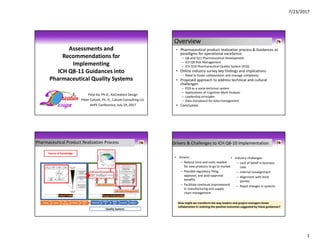
• Pharmaceutical product realization process & Guidances as
paradigms for operational excellence:
– Q8 and Q11 Pharmaceutical Development
– ICH Q9 Risk Management
– ICH Q10 Pharmaceutical Quality System (PQS)
• Online industry survey key findings and implications
– Need to foster collaboration and manage complexity
• Proposed approach to address technical and cultural
challenges:
– PQS as a socio-technical system
– Applications of Cognitive Work Analysis
– Leadership principles
– Data storyboard for data management
• Conclusion
Pharmaceutical Product Realization Process
Target Lead
Pre
Clinical
Phase I
Phase
IIa
Phase IIb
Phase
III
NDA/
BLA
Launch
Post-
approv
al
Source of Knowledge
Quality Systems
Drivers & Challenges to ICH Q8-10 Implementation
• Industry challenges:
– Lack of belief in business
case
– Internal misalignment
– Alignment with third
parties
– Rapid changes in systems
• Drivers:
– Reduce time and costs needed
for new products to go to market
– Possible regulatory filing,
approval, and post-approval
benefits
– Facilitate continual improvement
in manufacturing and supply
chain management
How might we transform the way leaders and project managers foster
collaboration in realizing the positive outcomes suggested by these guidances?
7/23/2017
2
Survey Key Findings
• ICH Q8 and 11 partially implemented
– Not biologics due to complexity
• ICH Q9 well implemented
– Value not realized for low risks
• ICH Q10 not well implemented
– New to this industry
• Knowledge Management
– Do not know where to start
– Value not fully appreciated
– Firefighting prevails
• Quality Metrics
– Metrics that drive the wrong behavior, not
effective to drive change
– in place but waiting for FDA proclamation
• Implied needs:
– Foster collaboration to
manage complexity
– Better knowledge
management strategies
– Data-driven risk
management approaches
– Utilize technologies for
integrated quality system
– Using metrics to go from
reactive to proactive
Application of Cognitive Work Analysis
External
Environment
Management Staff Work
Purpose
Public &
Regulatory Bodies
Values & Priorities Company Management
Work Functions &
Plan
Technical/Ops
Management
Supervision &
Instructions
Technical Functions Staff
Processes&
Procedures
Physical Resources
& Configuration
Actions &
Consequences
Error
• Work Domain Analysis (WDA) & Control Task Analysis (ConTA)
• Adding: Feedback loop in adaptive control system
• Decision Ladder (DL) & Strategies Analysis (StraA)
• Social Organization & Cooperation Analysis (SOCA)
• Worker Competencies Analysis (WCA)
Influencing Factors
Pharmaceutical Quality System (Q10)
GMP
Pharmaceutical
Development
Commercial
Manufacturing
Discontinuation
Technology
Transfer
Investigational products
Management Responsibilities
Process Performance & Product Quality Monitoring System
Corrective Action / Preventive Action (CAPA) System
Change Management System
Management Review
PQS
elements
Knowledge Management
Quality Risk Management
Enablers
Abstraction Hierarchy
7/23/2017
3
Apply CWA and DMAIC to Continual Improvement
• CWA as part of knowledge
used in DMAIC
• CAPA steps:
– Problem statement
– Risk assessment
– Evaluate problem
– Data gathering &
analysis
– Investigation
– Root cause analysis
– Development plan
– Implement
– Verify effectiveness
DMAIC Steps
1. Problem definition
2. CreateObjectives
& Activities Tree
3. Set & Apply Key
Performance
Indicators
4. Evaluate
Alternatives5. Select Alternative
6. Plan & Implement
Changes
7. Monitor, Evaluate,
and Modify as
Needed
ADS/AH
ContA/CAT
StraA
DL
WCA
HTA
SHERPA
Leadership Principles for Changes in Complex System
• Transformative leader mindset:
– Co-creative: engaging multiple
stakeholders
– Envisioning alternate futures
– Facilitating and catalyzing actions
– Creating an ecosystem for systemic
change
What can a company do to “catalyze” Quality by Design
with integrated quality & risk management?
• Approach to system innovation:
– System mapping and foresight
– Organizational sense-making
– Establish common ground for
effective coordination
– Three lever for collaboration:
• Purpose
• T-shape contribution
• Nimble networks
Knowledge Management Challenges and Goals
• Knowledge discovery
• Knowledge sharing
• Knowledge cocreation
• Strategies:
– Codification
– Personalization
• Optimize information flow through all-level within organization
– Right amount of knowledge
– Appropriate and well-integrated systems
– Knowledge in the right place
– Mature culture
Historical
Data
Operations
Submission
(CTD)
Knowledge
QbD Informatics Framework
Laboratories,
Process Dev
Electronic
Laboratory
Notebook (ELN)
QA/QC
Laboratories
Laboratory
Execution
System (LES)
Commercial
Manufacturing
Electronic
Batch Records
(EBR)
Instrument
Data Service
(IDS)
Sample
Management
Inventory
Management
Environmental
Monitoring
Stability
Metrology Work Request
Process
Informatics and
Visualization
LIMS
Research
Experiment-
Based Data
Optimization
Product
Data
Production Quality Data
Quality by Design
Knowledge Creation
Candidate Selection
Tech Transfer
Other Systems
7/23/2017
4
Idea: Initiative-Driven Knowledge Hub
• Leverage knowledge management design to
improve cross-functional project performanceValues
• Secure upper management support to
implement in high priority business areas
• Design for behavior and culture changes
Human Factors
• Cloud-based enterprise collaboration site
• Data security and integrity
• Compatibility with existing socio-tech system
Tech Features
• Information organization, knowledge creation
and sharing around an initiative
• Centralized, integrated, collaborative
Characteristics
Hierarchical Organization of Manufacturing Systems
Peripheral
Systems
Core Systems Mfg Hubs
BMS
MMA
HCM
ACS
Level 4: ERP, LIMS, WMS, EEAMS, Other Systems
Level 3: MES, Analytics/MII/KM
Level 2: PLC, Historian, DCS, SCADA
Level 1: Mix, Blend, Press, Coat, Package, Pallet
Nearshore
Offshore
CMOs
In House
Data Story for Data Management
• Data story
– Business values
– Stakeholder
assessment
– Criticality analysis
– Qualitative (sentiment,
opinions) &
quantitative
• Business requirements
• Data pipeline
• Dashboards https://www.tableau.com/solutions/workbook/monitor-all-relevant-
production-data-single-dashboard
7/23/2017
5
Idea: Data Storyboard Template
Data
Governance
Strategy
Organization
Policies,
Processes,
Standards
Measure-
ment &
Monitoring
Technology
Communi-
cation
Idea: Corporate Data Story Example
Conclusions
• Catalyze guidances implementation through better
knowledge management
– System analysis
– Leadership principles
– Initiative-Driven Knowledge Hub
– Data story for data management
Thank you. Questions?
Peiyi Ko, Ph.D.
KoCreation Design
info@kocreationdesign.com
Peter H. Calcott Ph.D.
President, Calcott Consulting LLC
peterc@calcott-consulting.com

Catalyze Quality by Design

  • 1.
    7/23/2017 1 Assessments and Recommendations for Implementing ICHQ8-11 Guidances into Pharmaceutical Quality Systems Peiyi Ko, Ph.D., KoCreation Design Peter Calcott, Ph. D., Calcott Consulting LLC AHFE Conference, July 19, 2017 Overview • Pharmaceutical product realization process & Guidances as paradigms for operational excellence: – Q8 and Q11 Pharmaceutical Development – ICH Q9 Risk Management – ICH Q10 Pharmaceutical Quality System (PQS) • Online industry survey key findings and implications – Need to foster collaboration and manage complexity • Proposed approach to address technical and cultural challenges: – PQS as a socio-technical system – Applications of Cognitive Work Analysis – Leadership principles – Data storyboard for data management • Conclusion Pharmaceutical Product Realization Process Target Lead Pre Clinical Phase I Phase IIa Phase IIb Phase III NDA/ BLA Launch Post- approv al Source of Knowledge Quality Systems Drivers & Challenges to ICH Q8-10 Implementation • Industry challenges: – Lack of belief in business case – Internal misalignment – Alignment with third parties – Rapid changes in systems • Drivers: – Reduce time and costs needed for new products to go to market – Possible regulatory filing, approval, and post-approval benefits – Facilitate continual improvement in manufacturing and supply chain management How might we transform the way leaders and project managers foster collaboration in realizing the positive outcomes suggested by these guidances?
  • 2.
    7/23/2017 2 Survey Key Findings •ICH Q8 and 11 partially implemented – Not biologics due to complexity • ICH Q9 well implemented – Value not realized for low risks • ICH Q10 not well implemented – New to this industry • Knowledge Management – Do not know where to start – Value not fully appreciated – Firefighting prevails • Quality Metrics – Metrics that drive the wrong behavior, not effective to drive change – in place but waiting for FDA proclamation • Implied needs: – Foster collaboration to manage complexity – Better knowledge management strategies – Data-driven risk management approaches – Utilize technologies for integrated quality system – Using metrics to go from reactive to proactive Application of Cognitive Work Analysis External Environment Management Staff Work Purpose Public & Regulatory Bodies Values & Priorities Company Management Work Functions & Plan Technical/Ops Management Supervision & Instructions Technical Functions Staff Processes& Procedures Physical Resources & Configuration Actions & Consequences Error • Work Domain Analysis (WDA) & Control Task Analysis (ConTA) • Adding: Feedback loop in adaptive control system • Decision Ladder (DL) & Strategies Analysis (StraA) • Social Organization & Cooperation Analysis (SOCA) • Worker Competencies Analysis (WCA) Influencing Factors Pharmaceutical Quality System (Q10) GMP Pharmaceutical Development Commercial Manufacturing Discontinuation Technology Transfer Investigational products Management Responsibilities Process Performance & Product Quality Monitoring System Corrective Action / Preventive Action (CAPA) System Change Management System Management Review PQS elements Knowledge Management Quality Risk Management Enablers Abstraction Hierarchy
  • 3.
    7/23/2017 3 Apply CWA andDMAIC to Continual Improvement • CWA as part of knowledge used in DMAIC • CAPA steps: – Problem statement – Risk assessment – Evaluate problem – Data gathering & analysis – Investigation – Root cause analysis – Development plan – Implement – Verify effectiveness DMAIC Steps 1. Problem definition 2. CreateObjectives & Activities Tree 3. Set & Apply Key Performance Indicators 4. Evaluate Alternatives5. Select Alternative 6. Plan & Implement Changes 7. Monitor, Evaluate, and Modify as Needed ADS/AH ContA/CAT StraA DL WCA HTA SHERPA Leadership Principles for Changes in Complex System • Transformative leader mindset: – Co-creative: engaging multiple stakeholders – Envisioning alternate futures – Facilitating and catalyzing actions – Creating an ecosystem for systemic change What can a company do to “catalyze” Quality by Design with integrated quality & risk management? • Approach to system innovation: – System mapping and foresight – Organizational sense-making – Establish common ground for effective coordination – Three lever for collaboration: • Purpose • T-shape contribution • Nimble networks Knowledge Management Challenges and Goals • Knowledge discovery • Knowledge sharing • Knowledge cocreation • Strategies: – Codification – Personalization • Optimize information flow through all-level within organization – Right amount of knowledge – Appropriate and well-integrated systems – Knowledge in the right place – Mature culture Historical Data Operations Submission (CTD) Knowledge QbD Informatics Framework Laboratories, Process Dev Electronic Laboratory Notebook (ELN) QA/QC Laboratories Laboratory Execution System (LES) Commercial Manufacturing Electronic Batch Records (EBR) Instrument Data Service (IDS) Sample Management Inventory Management Environmental Monitoring Stability Metrology Work Request Process Informatics and Visualization LIMS Research Experiment- Based Data Optimization Product Data Production Quality Data Quality by Design Knowledge Creation Candidate Selection Tech Transfer Other Systems
  • 4.
    7/23/2017 4 Idea: Initiative-Driven KnowledgeHub • Leverage knowledge management design to improve cross-functional project performanceValues • Secure upper management support to implement in high priority business areas • Design for behavior and culture changes Human Factors • Cloud-based enterprise collaboration site • Data security and integrity • Compatibility with existing socio-tech system Tech Features • Information organization, knowledge creation and sharing around an initiative • Centralized, integrated, collaborative Characteristics Hierarchical Organization of Manufacturing Systems Peripheral Systems Core Systems Mfg Hubs BMS MMA HCM ACS Level 4: ERP, LIMS, WMS, EEAMS, Other Systems Level 3: MES, Analytics/MII/KM Level 2: PLC, Historian, DCS, SCADA Level 1: Mix, Blend, Press, Coat, Package, Pallet Nearshore Offshore CMOs In House Data Story for Data Management • Data story – Business values – Stakeholder assessment – Criticality analysis – Qualitative (sentiment, opinions) & quantitative • Business requirements • Data pipeline • Dashboards https://www.tableau.com/solutions/workbook/monitor-all-relevant- production-data-single-dashboard
  • 5.
    7/23/2017 5 Idea: Data StoryboardTemplate Data Governance Strategy Organization Policies, Processes, Standards Measure- ment & Monitoring Technology Communi- cation Idea: Corporate Data Story Example Conclusions • Catalyze guidances implementation through better knowledge management – System analysis – Leadership principles – Initiative-Driven Knowledge Hub – Data story for data management Thank you. Questions? Peiyi Ko, Ph.D. KoCreation Design info@kocreationdesign.com Peter H. Calcott Ph.D. President, Calcott Consulting LLC peterc@calcott-consulting.com