Case #4:
Finding the Best Buy
BUSA 4980 (Strategic Management)
Dr. Steven Dionne
1
Strategy Formulation
Summer 2014
Company basics …
2
• Best Buy Co., Inc. is a multi-national retailer of
consumer electronics, computing and mobile
phone products, entertainment products,
appliances and related services
– Founded by Richard Schulze in 1966 (Sound of Music)
– Grew rapidly in US from 1989
– Domestic (84.5%) and International (15.5%)
• Variety in its retail format:
– Big Box stores, Geek Squad, Best Buy Mobile, Bestbuy.com,
The Carphone Warehouse (Europe), and Five Star
Appliances (China)
• Roughly 1,500 locations, $42B in annual
revenue, 140,000 employees, and among top 10
largest retail websites
Problems have emerged: Best Buy has not kept pace
with its industry in returning value to its shareholders
3
• Presence of competitors with different business
models / strategies
• 2400 US layoffs in July 2012 alone!
• 950 Canadian layoffs in January 2014
• Schulze made a proposal to acquire Best Buy for
$26 per share in August 2012 (failed)
• Discontinued BestBuy Europe, large-box format in
China, and Napster in 2013
• Is big box retailing dead?
• Stores provide hands-on experience with a product
• Best price?
• Exclusive
gadgets?
• Knowledge
center?
What issues have emerged from the General Environment?
4
Segment Elements
Demographic • The rise in dual income families and women’s purchasing power also affect
product and marketing decisions
Economic • Impact of a slow recovery: With less disposable income, consumers reduce the
types of purchases that make up Best Buy’s product line
Political / legal • The controversial sales tax legislation for online retailers
Socio-cultural • The popularity of the online marketplace: Online shopping has brought new
rivals, with lower cost structures
• The availability of product information online means that technology and
product questions can be addressed without the expertise of in-store staff
• Universal connectivity: Offers opportunities as the complexity of functionality
and the need for interaction between devices increases
Technological • The emergence of new ways of conducting business and accessing customers
• The consolidation of functions into single electronics devices
Global • Opportunities to achieve greater economies of scale, to integrate backward into
the supply chain with lower risk, and to move inventory into secondary markets
Physical
environment
• N/A
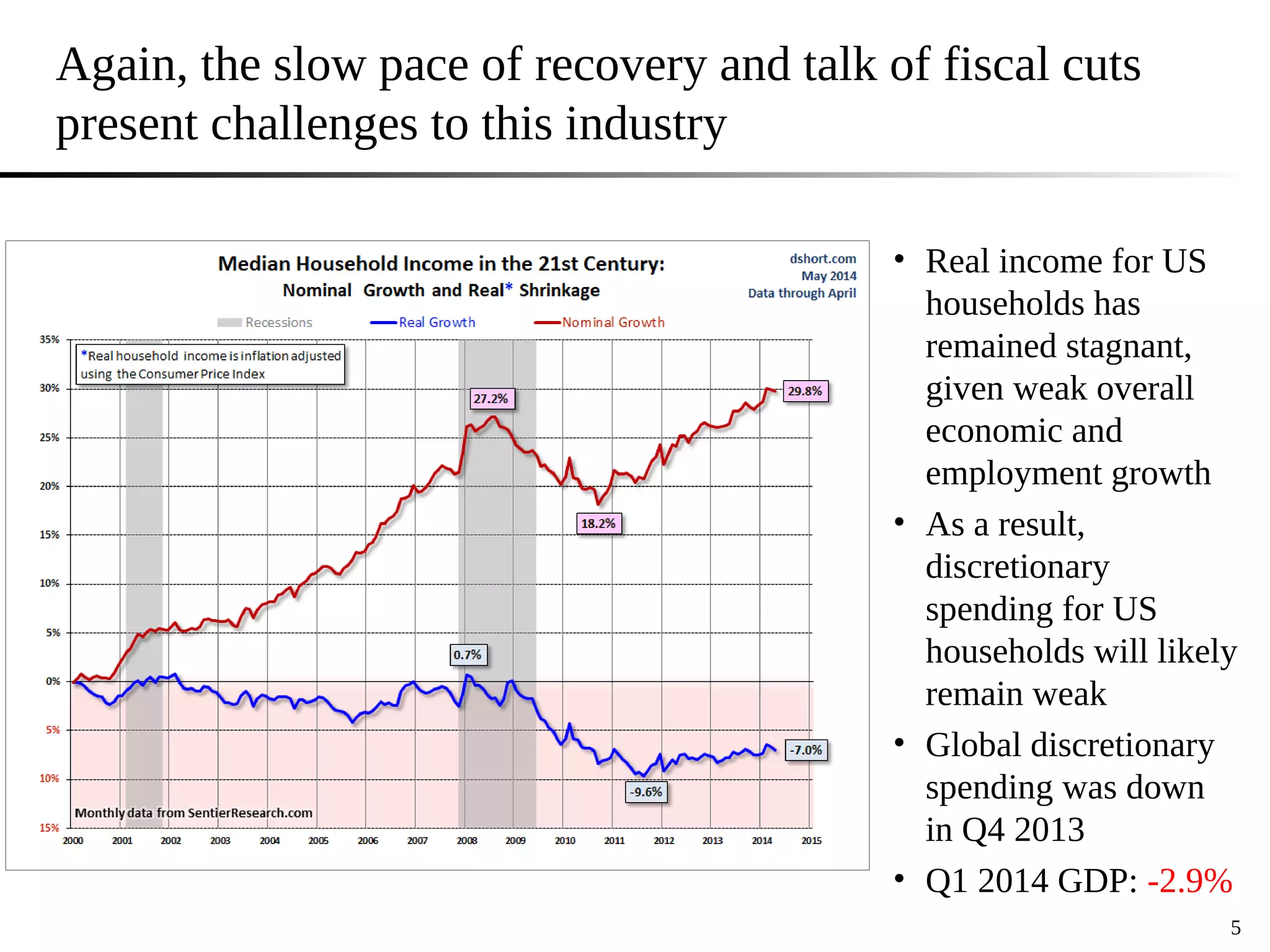
Again, the slow pace of recovery and talk of fiscal cuts
present challenges to this industry
5
• Real income for US
households has
remained stagnant,
given weak overall
economic and
employment growth
• As a result,
discretionary
spending for US
households will likely
remain weak
• Global discretionary
spending was down
in Q4 2013
• Q1 2014 GDP: -2.9%
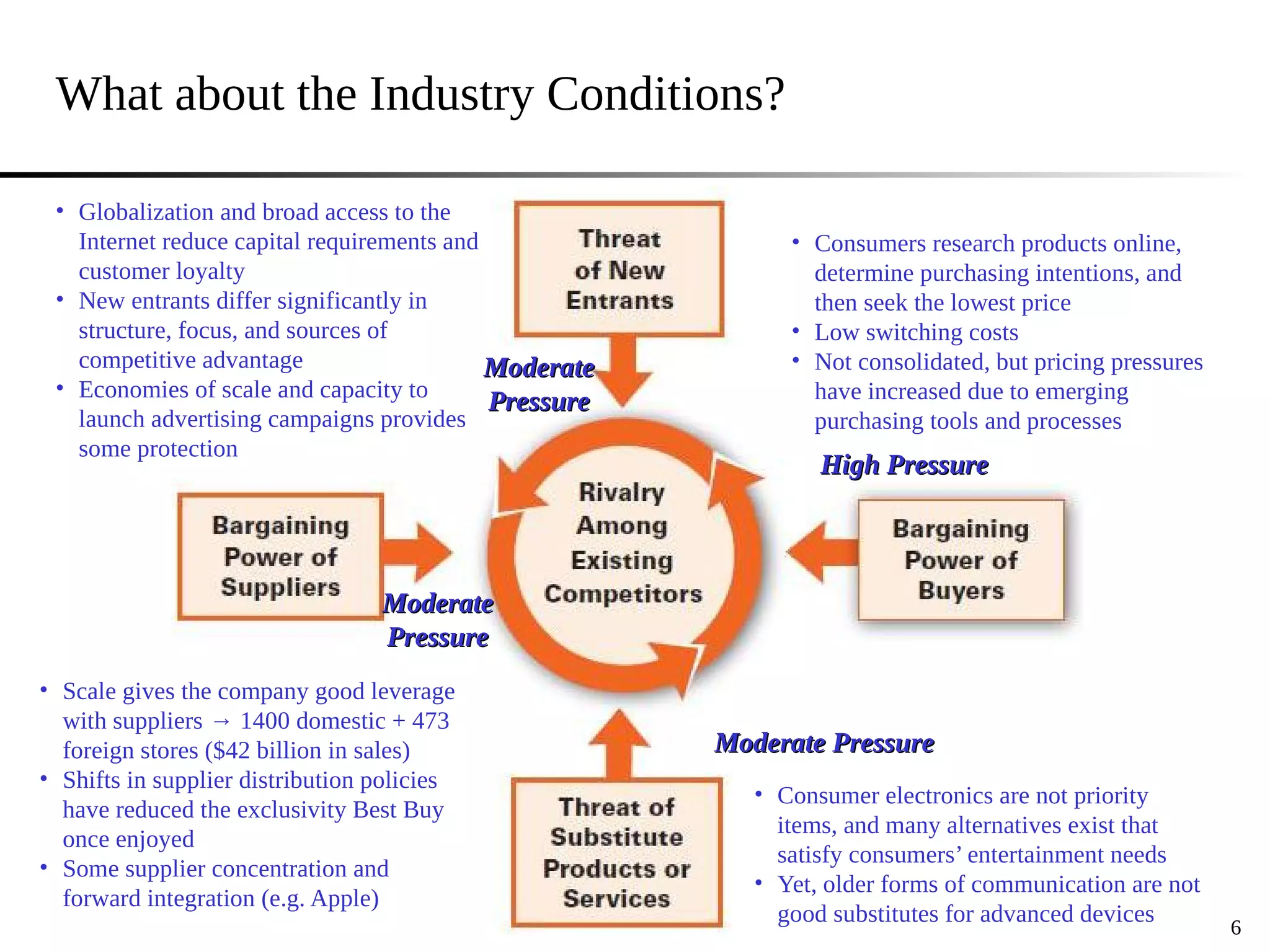
What about the Industry Conditions?
6
Moderate
Moderate
Pressure
Pressure
• Globalization and broad access to the
Internet reduce capital requirements and
customer loyalty
• New entrants differ significantly in
structure, focus, and sources of
competitive advantage
• Economies of scale and capacity to
launch advertising campaigns provides
some protection
High Pressure
High Pressure
• Consumers research products online,
determine purchasing intentions, and
then seek the lowest price
• Low switching costs
• Not consolidated, but pricing pressures
have increased due to emerging
purchasing tools and processes
Moderate Pressure
Moderate Pressure
• Consumer electronics are not priority
items, and many alternatives exist that
satisfy consumers’ entertainment needs
• Yet, older forms of communication are not
good substitutes for advanced devices
Moderate
Moderate
Pressure
Pressure
• Scale gives the company good leverage
with suppliers → 1400 domestic + 473
foreign stores ($42 billion in sales)
• Shifts in supplier distribution policies
have reduced the exclusivity Best Buy
once enjoyed
• Some supplier concentration and
forward integration (e.g. Apple)
Consumer
Electronics
Segment Segment Segment Primary
Strengths • Efficiencies
• Innovative apps
• Price / tax
advantages
• Range of products
/ services
• Scale / scope
economies
• Bargaining power
with suppliers
• Lower end
• High inventory
turnover
• Service oriented
• Customer value
• Higher quality
• Market niche
• Specialty
electronics
• Rebranding with
cell phones
TTM Revenue $74.5 billion $476.3 billion $107.9 billion $3.43 billion
3-yr Sales Growth 29.6 4.1% 10.5% -7.0%
TTM Net Income $274 million $16.0 billion $1.96 billion ($400.2 million)
3-yr Profit Margin 0.4% 3.5% 1.8% -4.0%
Increased Competitive Intensity in an Evolved and Less
Familiar Form → Price Centric Rivalry
• Switching costs for consumers are low and retailer differentiation is minimal
• Given economic conditions, rivals seeking growth further intensify
competitive pressures
7
Financial data as of April 2014
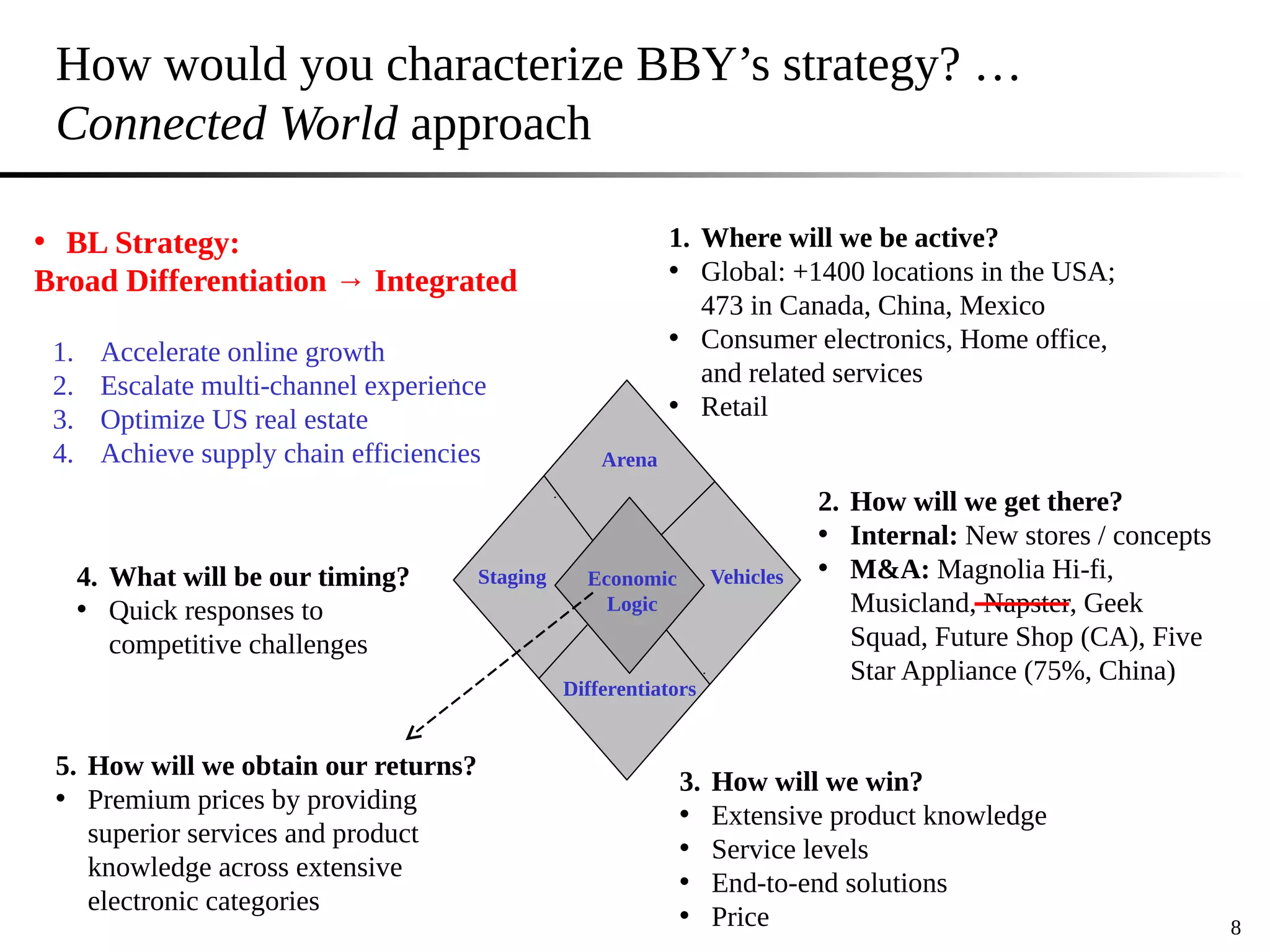
How would you characterize BBY’s strategy? …
Connected World approach
8
1. Where will we be active?
• Global: +1400 locations in the USA;
473 in Canada, China, Mexico
• Consumer electronics, Home office,
and related services
• Retail
Arena
Staging Vehicles
Economic
Logic
Differentiators
2. How will we get there?
• Internal: New stores / concepts
• M&A: Magnolia Hi-fi,
Musicland, Napster, Geek
Squad, Future Shop (CA), Five
Star Appliance (75%, China)
3. How will we win?
• Extensive product knowledge
• Service levels
• End-to-end solutions
• Price
4. What will be our timing?
• Quick responses to
competitive challenges
5. How will we obtain our returns?
• Premium prices by providing
superior services and product
knowledge across extensive
electronic categories
• BL Strategy:
Broad Differentiation → Integrated
1. Accelerate online growth
2. Escalate multi-channel experience
3. Optimize US real estate
4. Achieve supply chain efficiencies
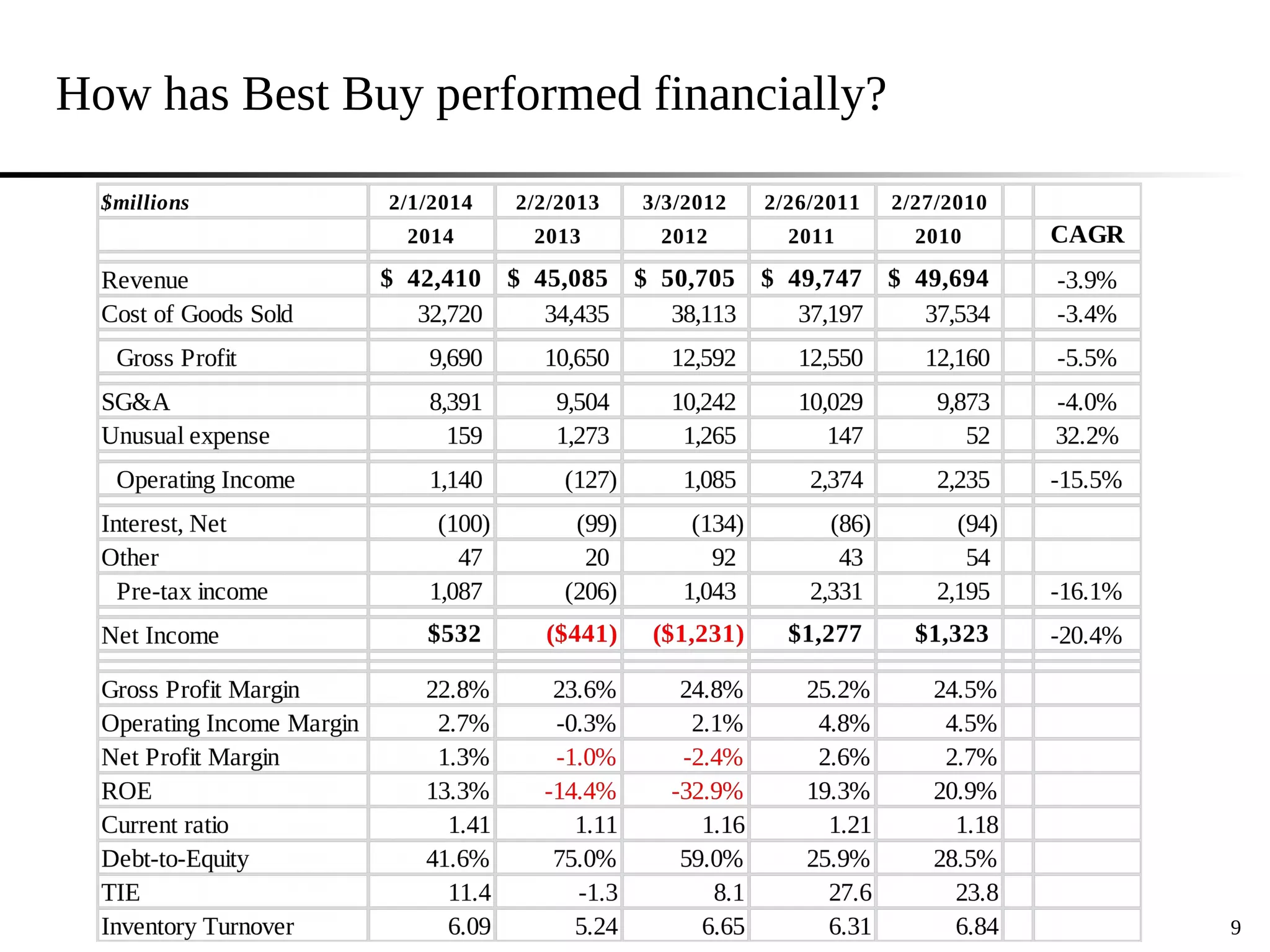
How has Best Buy performed financially?
9
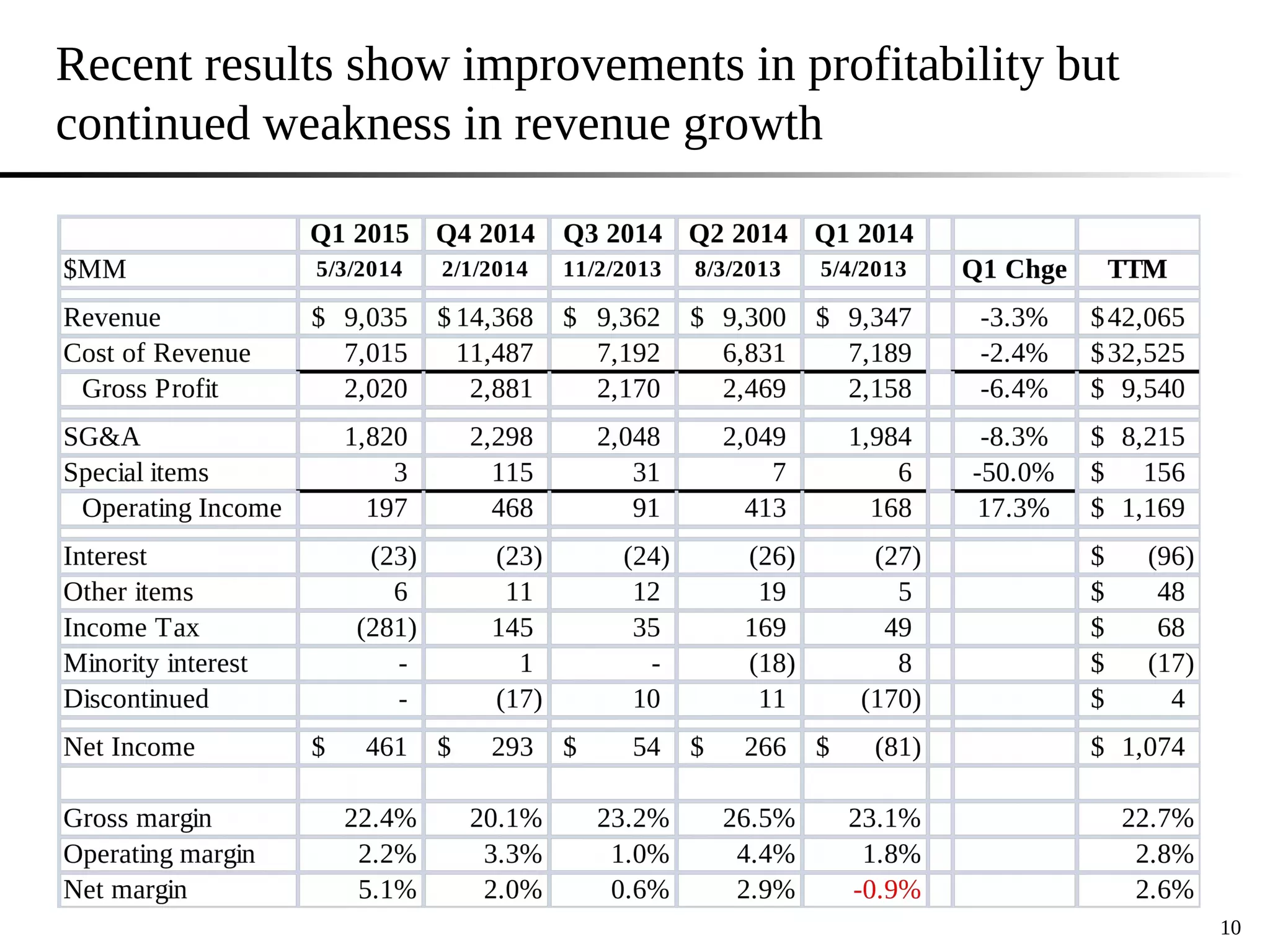
Recent results show improvements in profitability but
continued weakness in revenue growth
10
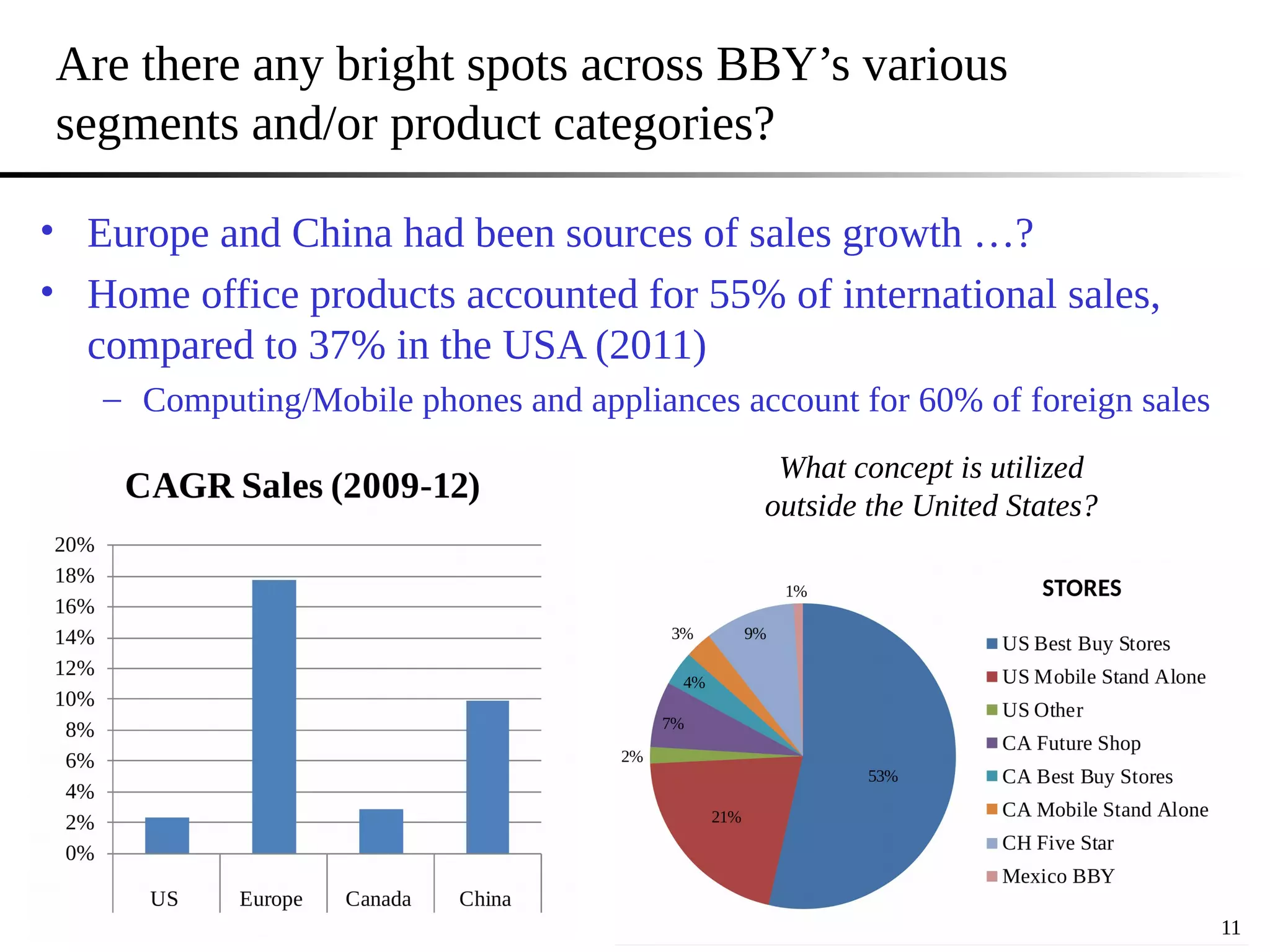
Are there any bright spots across BBY’s various
segments and/or product categories?
• Europe and China had been sources of sales growth …?
• Home office products accounted for 55% of international sales,
compared to 37% in the USA (2011)
– Computing/Mobile phones and appliances account for 60% of foreign sales
11
What concept is utilized
outside the United States?
Does Best Buy have an optimal product mix and
store configuration?
• Computing and mobile phones account for 48% of total sales
• Entertainment has been contracting, accounting for just 8% of sales
revenue in fiscal 2014
• Oddly enough, appliances are growing, even though accounting for
just 6% of sales
– Appliances are 17% of international sales and a growth category (+8.4%)
12
What are BBY’s Strengths and Weaknesses?
• Extensive product knowledge provides value-added services in an
environment where technology is changing rapidly
• Provide customers with end-to-end solutions through installation services,
product repair, and ongoing support
13
Strengths
• Strong industry presence: 1,495 retail
locations in North America and more
than 473 stores in China / Canada
• Unique, value-added business segments
(e.g. Geek Squad, Best Buy Mobile)
• Standardized processes: Scale economies
and low operating expenses
• Immediate product fulfillment
• Provides an extensive product offering
and is highly adept at anticipating and
satisfying customer needs
Weaknesses
• Market perceptions of Best Buy’s service
levels do not put the company ahead of
its competitors
• Financial vulnerabilities stemming from
downward economic and competitive
pressures on prices
• 16% increase in accounts receivable for
2011 → Bad debt losses
• Business model → Competitive
disadvantage for competing on price
What are the Critical Challenges for Best Buy?
• Increased competitive intensity: Rivals with alternative
approaches exerting margin pressure
– Cost of brick-and-mortar stores?
– Combat sales losses and manage financial stress?
• Products are increasingly becoming commoditized
– Difficulty differentiating and finding new ways to add value
• How will BBY execute its strategy?
– Strategy centers on the customer: How does it revamp products and store
design to serve customers’ new needs?
– How does BBY enhance perceptions of superior customer service?
• How to manage international ventures to realize potential in
foreign markets?
14
“Our ability to transform Best Buy is highly dependent
on our ability to transform our in-store experience”
• Enhancing customer experience:
– Ship-from-store (1400 locations)
– Opened 1400 Samsung and 600 Windows stores-within-a-store concept
– Pacific Kitchen and Home and Magnolia Design Centers
– Google announces intentions for 2014
15
Ties success to specific brands – Samsung and Microsoft
How would you address Best Buy’s issues?
• Home Office: Reposition on consultative services and products specifically for
business / home office applications → Compete against Staples / Office Depot
16
Element Options
Arena • Continue retail to offer consumer consultation during purchase →
Fashion a Best Buy Complex: store-within-a-store concept
• Cautiously seek growing, foreign markets (e.g. India and Brazil)
Vehicles • Improve cost management and internal training, using supplier
partnerships / alliances
Differentiators • Concentrate on new technologies for which prices have not eroded and
new information is required to make the purchasing decision
• Seek ways to transfer its value-added knowledge model to its website
and closely integrate with store resources
• Build value through relevant customer services:
1. Reduce confusion around new, advanced devices, features, and
technologies
2. Support technology and device integration as well as customer
desire for connectivity, access, and immediacy

Case_Discussion_7

  • 1.
    Case #4: Finding theBest Buy BUSA 4980 (Strategic Management) Dr. Steven Dionne 1 Strategy Formulation Summer 2014
  • 2.
    Company basics … 2 •Best Buy Co., Inc. is a multi-national retailer of consumer electronics, computing and mobile phone products, entertainment products, appliances and related services – Founded by Richard Schulze in 1966 (Sound of Music) – Grew rapidly in US from 1989 – Domestic (84.5%) and International (15.5%) • Variety in its retail format: – Big Box stores, Geek Squad, Best Buy Mobile, Bestbuy.com, The Carphone Warehouse (Europe), and Five Star Appliances (China) • Roughly 1,500 locations, $42B in annual revenue, 140,000 employees, and among top 10 largest retail websites
  • 3.
    Problems have emerged:Best Buy has not kept pace with its industry in returning value to its shareholders 3 • Presence of competitors with different business models / strategies • 2400 US layoffs in July 2012 alone! • 950 Canadian layoffs in January 2014 • Schulze made a proposal to acquire Best Buy for $26 per share in August 2012 (failed) • Discontinued BestBuy Europe, large-box format in China, and Napster in 2013 • Is big box retailing dead? • Stores provide hands-on experience with a product • Best price? • Exclusive gadgets? • Knowledge center?
  • 4.
    What issues haveemerged from the General Environment? 4 Segment Elements Demographic • The rise in dual income families and women’s purchasing power also affect product and marketing decisions Economic • Impact of a slow recovery: With less disposable income, consumers reduce the types of purchases that make up Best Buy’s product line Political / legal • The controversial sales tax legislation for online retailers Socio-cultural • The popularity of the online marketplace: Online shopping has brought new rivals, with lower cost structures • The availability of product information online means that technology and product questions can be addressed without the expertise of in-store staff • Universal connectivity: Offers opportunities as the complexity of functionality and the need for interaction between devices increases Technological • The emergence of new ways of conducting business and accessing customers • The consolidation of functions into single electronics devices Global • Opportunities to achieve greater economies of scale, to integrate backward into the supply chain with lower risk, and to move inventory into secondary markets Physical environment • N/A
  • 5.
    Again, the slowpace of recovery and talk of fiscal cuts present challenges to this industry 5 • Real income for US households has remained stagnant, given weak overall economic and employment growth • As a result, discretionary spending for US households will likely remain weak • Global discretionary spending was down in Q4 2013 • Q1 2014 GDP: -2.9%
  • 6.
    What about theIndustry Conditions? 6 Moderate Moderate Pressure Pressure • Globalization and broad access to the Internet reduce capital requirements and customer loyalty • New entrants differ significantly in structure, focus, and sources of competitive advantage • Economies of scale and capacity to launch advertising campaigns provides some protection High Pressure High Pressure • Consumers research products online, determine purchasing intentions, and then seek the lowest price • Low switching costs • Not consolidated, but pricing pressures have increased due to emerging purchasing tools and processes Moderate Pressure Moderate Pressure • Consumer electronics are not priority items, and many alternatives exist that satisfy consumers’ entertainment needs • Yet, older forms of communication are not good substitutes for advanced devices Moderate Moderate Pressure Pressure • Scale gives the company good leverage with suppliers → 1400 domestic + 473 foreign stores ($42 billion in sales) • Shifts in supplier distribution policies have reduced the exclusivity Best Buy once enjoyed • Some supplier concentration and forward integration (e.g. Apple)
  • 7.
    Consumer Electronics Segment Segment SegmentPrimary Strengths • Efficiencies • Innovative apps • Price / tax advantages • Range of products / services • Scale / scope economies • Bargaining power with suppliers • Lower end • High inventory turnover • Service oriented • Customer value • Higher quality • Market niche • Specialty electronics • Rebranding with cell phones TTM Revenue $74.5 billion $476.3 billion $107.9 billion $3.43 billion 3-yr Sales Growth 29.6 4.1% 10.5% -7.0% TTM Net Income $274 million $16.0 billion $1.96 billion ($400.2 million) 3-yr Profit Margin 0.4% 3.5% 1.8% -4.0% Increased Competitive Intensity in an Evolved and Less Familiar Form → Price Centric Rivalry • Switching costs for consumers are low and retailer differentiation is minimal • Given economic conditions, rivals seeking growth further intensify competitive pressures 7 Financial data as of April 2014
  • 8.
    How would youcharacterize BBY’s strategy? … Connected World approach 8 1. Where will we be active? • Global: +1400 locations in the USA; 473 in Canada, China, Mexico • Consumer electronics, Home office, and related services • Retail Arena Staging Vehicles Economic Logic Differentiators 2. How will we get there? • Internal: New stores / concepts • M&A: Magnolia Hi-fi, Musicland, Napster, Geek Squad, Future Shop (CA), Five Star Appliance (75%, China) 3. How will we win? • Extensive product knowledge • Service levels • End-to-end solutions • Price 4. What will be our timing? • Quick responses to competitive challenges 5. How will we obtain our returns? • Premium prices by providing superior services and product knowledge across extensive electronic categories • BL Strategy: Broad Differentiation → Integrated 1. Accelerate online growth 2. Escalate multi-channel experience 3. Optimize US real estate 4. Achieve supply chain efficiencies
  • 9.
    How has BestBuy performed financially? 9
  • 10.
    Recent results showimprovements in profitability but continued weakness in revenue growth 10
  • 11.
    Are there anybright spots across BBY’s various segments and/or product categories? • Europe and China had been sources of sales growth …? • Home office products accounted for 55% of international sales, compared to 37% in the USA (2011) – Computing/Mobile phones and appliances account for 60% of foreign sales 11 What concept is utilized outside the United States?
  • 12.
    Does Best Buyhave an optimal product mix and store configuration? • Computing and mobile phones account for 48% of total sales • Entertainment has been contracting, accounting for just 8% of sales revenue in fiscal 2014 • Oddly enough, appliances are growing, even though accounting for just 6% of sales – Appliances are 17% of international sales and a growth category (+8.4%) 12
  • 13.
    What are BBY’sStrengths and Weaknesses? • Extensive product knowledge provides value-added services in an environment where technology is changing rapidly • Provide customers with end-to-end solutions through installation services, product repair, and ongoing support 13 Strengths • Strong industry presence: 1,495 retail locations in North America and more than 473 stores in China / Canada • Unique, value-added business segments (e.g. Geek Squad, Best Buy Mobile) • Standardized processes: Scale economies and low operating expenses • Immediate product fulfillment • Provides an extensive product offering and is highly adept at anticipating and satisfying customer needs Weaknesses • Market perceptions of Best Buy’s service levels do not put the company ahead of its competitors • Financial vulnerabilities stemming from downward economic and competitive pressures on prices • 16% increase in accounts receivable for 2011 → Bad debt losses • Business model → Competitive disadvantage for competing on price
  • 14.
    What are theCritical Challenges for Best Buy? • Increased competitive intensity: Rivals with alternative approaches exerting margin pressure – Cost of brick-and-mortar stores? – Combat sales losses and manage financial stress? • Products are increasingly becoming commoditized – Difficulty differentiating and finding new ways to add value • How will BBY execute its strategy? – Strategy centers on the customer: How does it revamp products and store design to serve customers’ new needs? – How does BBY enhance perceptions of superior customer service? • How to manage international ventures to realize potential in foreign markets? 14
  • 15.
    “Our ability totransform Best Buy is highly dependent on our ability to transform our in-store experience” • Enhancing customer experience: – Ship-from-store (1400 locations) – Opened 1400 Samsung and 600 Windows stores-within-a-store concept – Pacific Kitchen and Home and Magnolia Design Centers – Google announces intentions for 2014 15 Ties success to specific brands – Samsung and Microsoft
  • 16.
    How would youaddress Best Buy’s issues? • Home Office: Reposition on consultative services and products specifically for business / home office applications → Compete against Staples / Office Depot 16 Element Options Arena • Continue retail to offer consumer consultation during purchase → Fashion a Best Buy Complex: store-within-a-store concept • Cautiously seek growing, foreign markets (e.g. India and Brazil) Vehicles • Improve cost management and internal training, using supplier partnerships / alliances Differentiators • Concentrate on new technologies for which prices have not eroded and new information is required to make the purchasing decision • Seek ways to transfer its value-added knowledge model to its website and closely integrate with store resources • Build value through relevant customer services: 1. Reduce confusion around new, advanced devices, features, and technologies 2. Support technology and device integration as well as customer desire for connectivity, access, and immediacy