CASE STUDY
RESEARCH
SINDI YANI PURBA
ESMERALDA KIKI AYU HUTAPEA
SEVA ZAKIYYAH PUTRI
SEVI ZAKIYYAH PUTRI
OLVA MEDIASARI
NIA CLAUDIA
01 02
03 04
Case Study Research:
Definition and Purpose
Case Study
Research Design
Sample Selection in
Case Study Research
Conducting and
Analyzing Multiple Case
Studies
TABLE OF CONTENTS
01
Case Study Research:
Definition and Purpose
Case study research is a qualitative research approach in which
researchers focus on a unit of study known as a bounded system.
Case study research is also an appropriate choice of research method
if the researcher is interested in studying process and useful when
describing the context of the study and the extent to which a particular
program or innovation has been implemented. A case study helps in
bringing the understanding of a complex issue or object.
1. When to Use the Case Study Research Approach
Case study research is appropriate when a researcher wants
to answer a descriptive question (e.g., what happened?) or
an explanatory question (e.g., how or why did something
happen?) or when the researcher is interested in studying
process.
2. Characteristics of case study research
Case studies can be
described as particularistic,
descriptive, and heuristic.
Different disciplinary fields
use case study research for
different purposes, and
specific characteristics of
the study are determined by
the discipline.
Regardless of the
disciplinary orientation,
case studies can be
characterized in terms of
their overall intent.
Case Study
Research Design
02
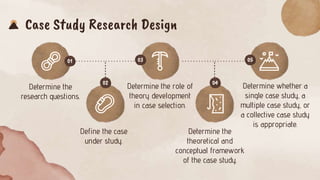
Case Study Research Design
Determine the
research questions.
Define the case
under study.
Determine the
theoretical and
conceptual framework
of the case study.
Determine the role of
theory development
in case selection.
Determine whether a
single case study, a
multiple case study, or
a collective case study
is appropriate.
01
02
03
04
05
Sample Selection in
Case Study Research
03
Data Collection Methods
 Interviewing- person to person encounter
in which one person elicits information
from another.
 Observation: a method that gives the
researcher a first-hand encounter with the
phenomenon of interest in its natural
environment.
 Questionnaire - A questionnaire is a
research instrument consisting of a series
of questions and other prompts for the
purpose of gathering information from
respondents.
Conducting and Analyzing
Multiple Case Studies
04
Conducting and Analyzing Multiple Case Studies
 Unordered Meta-Matrix.
 Site-Ordered Descriptive Matrix.
 Site-Ordered Predictor-Outcome Matrix.
 Time-Ordered Meta-Matrix.
 Scatterplots.
 Site-Ordered Effects Matrix.
 Causal Models.
CREDITS: This presentation template was created by Slidesgo,
including icons by Flaticon, and infographics & images by Freepik
THANK YOU

CASE STUDY RESEARCH_GROUP2_5A.pptx

  • 1.
    CASE STUDY RESEARCH SINDI YANIPURBA ESMERALDA KIKI AYU HUTAPEA SEVA ZAKIYYAH PUTRI SEVI ZAKIYYAH PUTRI OLVA MEDIASARI NIA CLAUDIA
  • 2.
    01 02 03 04 CaseStudy Research: Definition and Purpose Case Study Research Design Sample Selection in Case Study Research Conducting and Analyzing Multiple Case Studies TABLE OF CONTENTS
  • 3.
  • 4.
    Case study researchis a qualitative research approach in which researchers focus on a unit of study known as a bounded system. Case study research is also an appropriate choice of research method if the researcher is interested in studying process and useful when describing the context of the study and the extent to which a particular program or innovation has been implemented. A case study helps in bringing the understanding of a complex issue or object.
  • 5.
    1. When toUse the Case Study Research Approach Case study research is appropriate when a researcher wants to answer a descriptive question (e.g., what happened?) or an explanatory question (e.g., how or why did something happen?) or when the researcher is interested in studying process.
  • 6.
    2. Characteristics ofcase study research Case studies can be described as particularistic, descriptive, and heuristic. Different disciplinary fields use case study research for different purposes, and specific characteristics of the study are determined by the discipline. Regardless of the disciplinary orientation, case studies can be characterized in terms of their overall intent.
  • 7.
  • 8.
    Case Study ResearchDesign Determine the research questions. Define the case under study. Determine the theoretical and conceptual framework of the case study. Determine the role of theory development in case selection. Determine whether a single case study, a multiple case study, or a collective case study is appropriate. 01 02 03 04 05
  • 9.
    Sample Selection in CaseStudy Research 03
  • 10.
    Data Collection Methods Interviewing- person to person encounter in which one person elicits information from another.  Observation: a method that gives the researcher a first-hand encounter with the phenomenon of interest in its natural environment.  Questionnaire - A questionnaire is a research instrument consisting of a series of questions and other prompts for the purpose of gathering information from respondents.
  • 11.
  • 12.
    Conducting and AnalyzingMultiple Case Studies  Unordered Meta-Matrix.  Site-Ordered Descriptive Matrix.  Site-Ordered Predictor-Outcome Matrix.  Time-Ordered Meta-Matrix.  Scatterplots.  Site-Ordered Effects Matrix.  Causal Models.
  • 13.
    CREDITS: This presentationtemplate was created by Slidesgo, including icons by Flaticon, and infographics & images by Freepik THANK YOU