Comprehensive Automationfor Specialty CropsShowcaseMay 20th, 2010
Reconfigurable MobilityShowcase
Recent WorkCreating a useable interfaceNew methods for row detectionNew methods for turning and row entry
Autonomous Vehicle User InterfaceGoal: Create an interface for the vehicle useable by growers and workers without engineer assistanceApproach: Follow structured, formal human-computer interaction design methodologiesInterview workers to understand farm operations and equipmentDefine requirements that must be satisfied in the final interface productFollow a top-down design approach from requirements to functionalitiesTest with the workers on the APM
Existing InterfaceHere’s what the engineers use
Existing InterfaceIt tells us a lotGood for testing and debuggingHard to use even for usImpossible to use without lots of trainingScary for those without computer backgrounds
Designing a New InterfaceStart from the beginningWhat does the vehicle have to do?Who will be using it?What is their current experience/expectation?
Designers’ Initial Assessment
Assessment (cont.)
Initial InterviewsDesigners interviewed owners and workers from four orchards
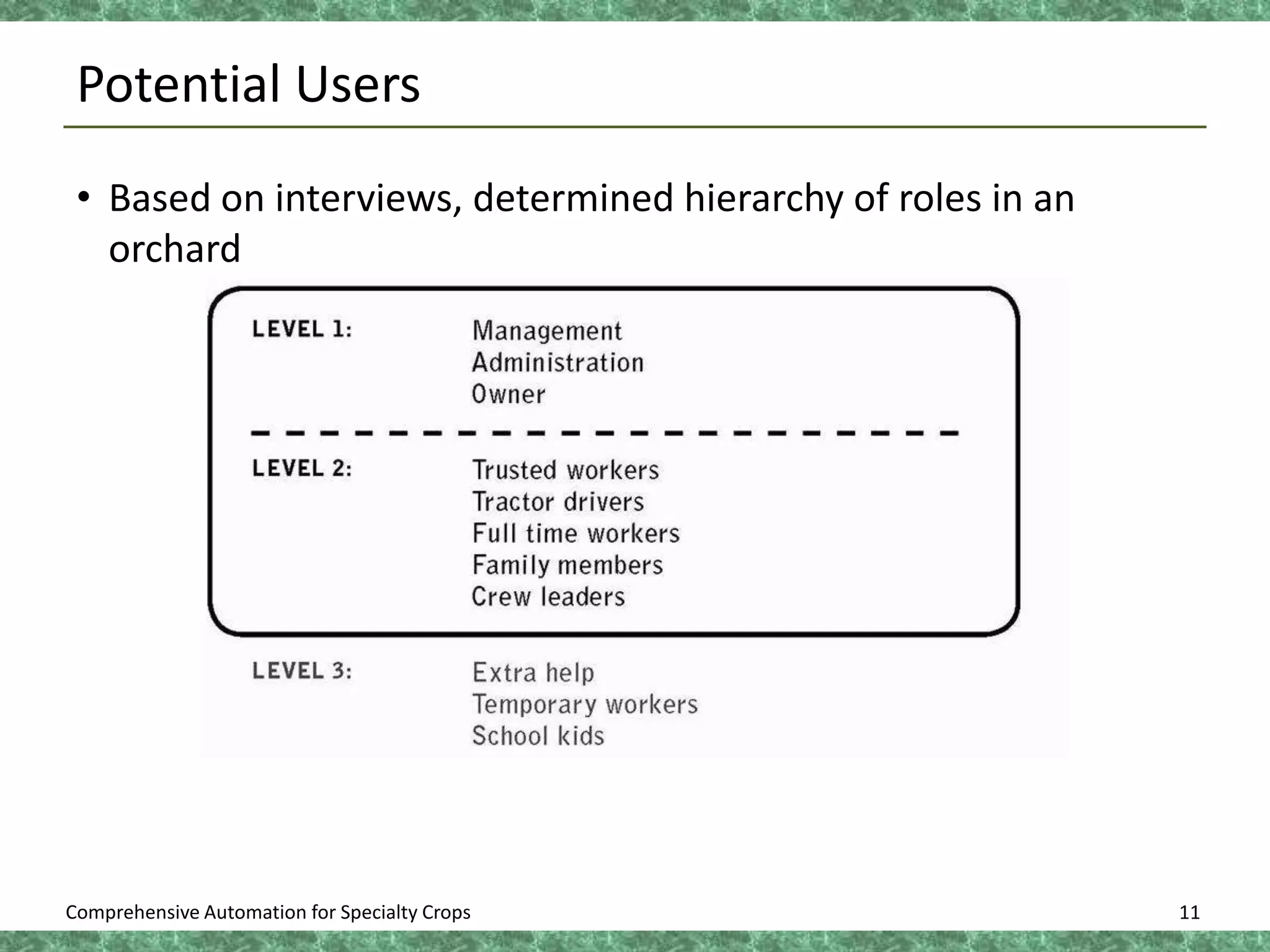
Potential UsersBased on interviews, determined hierarchy of roles in an orchard
Design IdeasFocus on things solvable within one semester and with limited budget
First DraftDesigns on paper presented to usersNo prior instructionLead users through scenario of vehicle useFind out what works
Task Selection, Farm View
Vehicle Control
First Interface Prototype
WiFi Communication with Interface
User Tests: First RoundInterface run on laptop, controlling simulated vehicleWorkers completely unfamiliar with interfacePresented with similar scenarios as beforeTold to use vehicle in a variety of tasks
First Round ResultsComputer-experienced users felt comfortableOthers were afraid to give an incorrect commandAutonomous vehicle is an expensive piece of equipmentConclusion:Users need some training, even if it is short
Final User TestsInterface stayed the sameWent to Hollabaugh Orchards, BiglervilleFour users operated APMOwner/manager and three workersTwo workers understood some English,one understood very little
Final User TestsAll were able to control APMAll understood speed, offset, and go/stop modeMany mentioned potential applications for which they would like to use the APMOne common complaintNeed for speed control in stop/go modehttp://www.cs.cmu.edu/~casc/public/showcase_video1.wmv
Final Design
Help Screen
ConclusionsThis interface can make APMs easy to use by:Reducing text on screenPresenting vehicle’s location clearlyAbstracting orchard tasks to single button clicks
ConclusionsIn order to make performing tasks simpler for workers,additional setup is required by managers
Recommended Future Work
Recent WorkCreating a useable interfaceNew methods for row detectionNew methods for turning and row entry
Previous Row DetectionSusceptible to spurious dataApply some filters to reduce the effect of bad detectionsBut we want to have no bad detections
New Row Detection WorkUsing particle filter to track row over timeLooks good so farNeeds more testing
New Row Entry WorkMake wider turnsPoints vehicle at row soonerEasier to detect row Smoother turns in tight spacesAccount for trailer when turningUse high accuracy localization (Area 1.2 work) to improve vehicle control
Back to the OrchardsMay 24: N. Blosi platform testing in Biglerville, PAJune 7: APM testing in BiglervilleJuly 19: APM testing in Washington
AcknowledgmentsReed SoergelJoy Kline (Bear Mountain)Bruce Hollabaugh
Questions?
Augmented HarvestingShowcase
Augmented HarvestDBR Conveyor Concepts updateStatement of work and contract finalizedWork initiatedNew bin filler head looks goodLaying out power unit with integrated exhaust silencing and intake filteringOrdering parts for hoses and vacuum chambersBubble pack bin fillerRobin Pritz and Gwendolyn Barr completed first bruise testingMethod shows promise, but new prototype is required for field testing
http://www.cs.cmu.edu/~casc/public/showcase_video2.mpg
Results
SummaryBubble pack bin filler shows promiseBruising is not bad given distance apples are tossedUpcoming improvementsMore guiding by netBetter distribution of bubble pack layersLighter and better padded frameMechanism for raising and lowering frameWork with DBR Conveyor Concepts is ramping up
Thank you.

CASC Showcase 2010 05 20