ALA
Update
Session
June 29, 2024
Meeting Agenda
1. Introductions & Background
2. Collaboration models
3. Description of the focus of CCLIP Working Groups
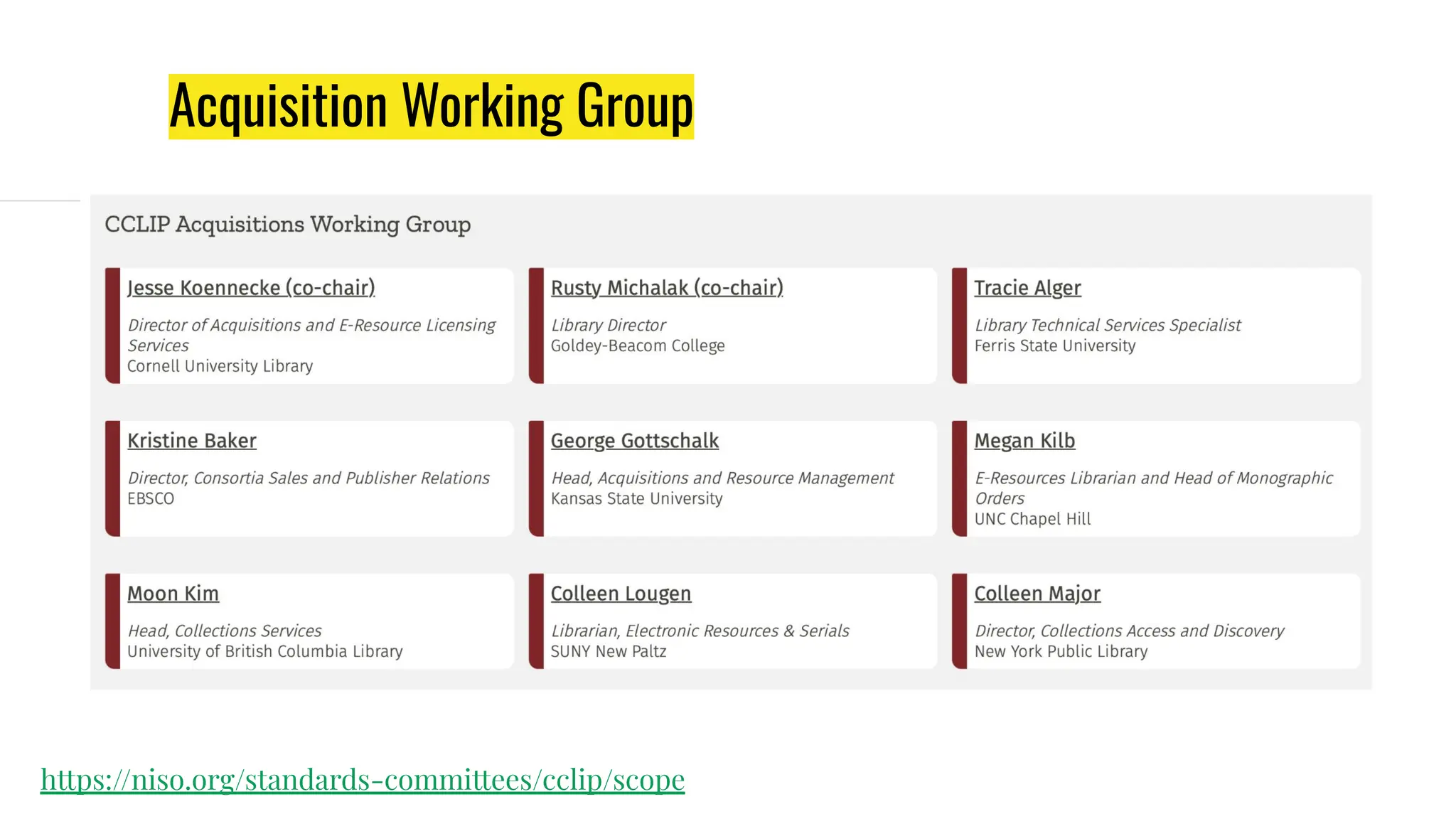
a. Acquisitions
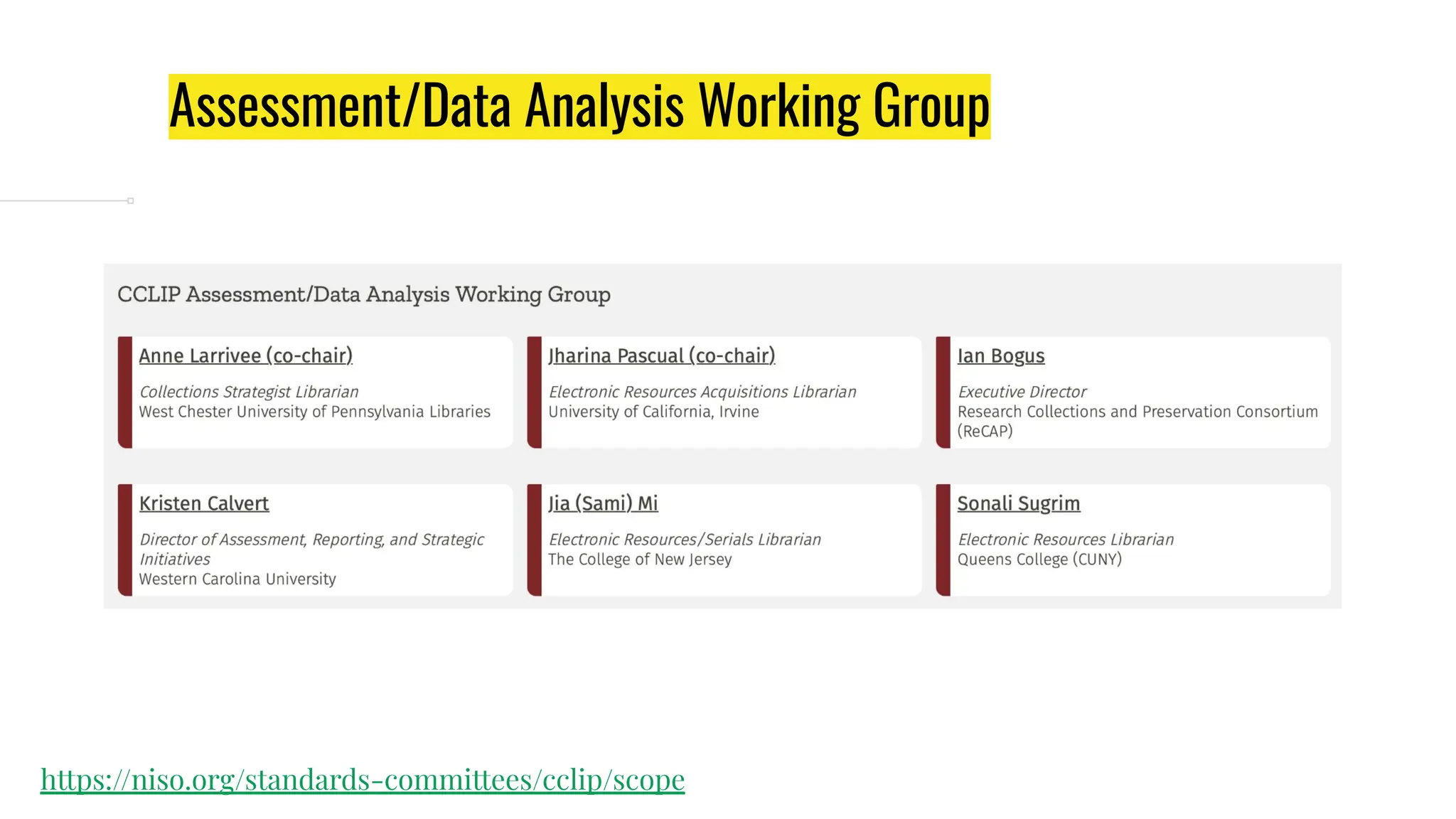
b. Assessment/Data Analysis
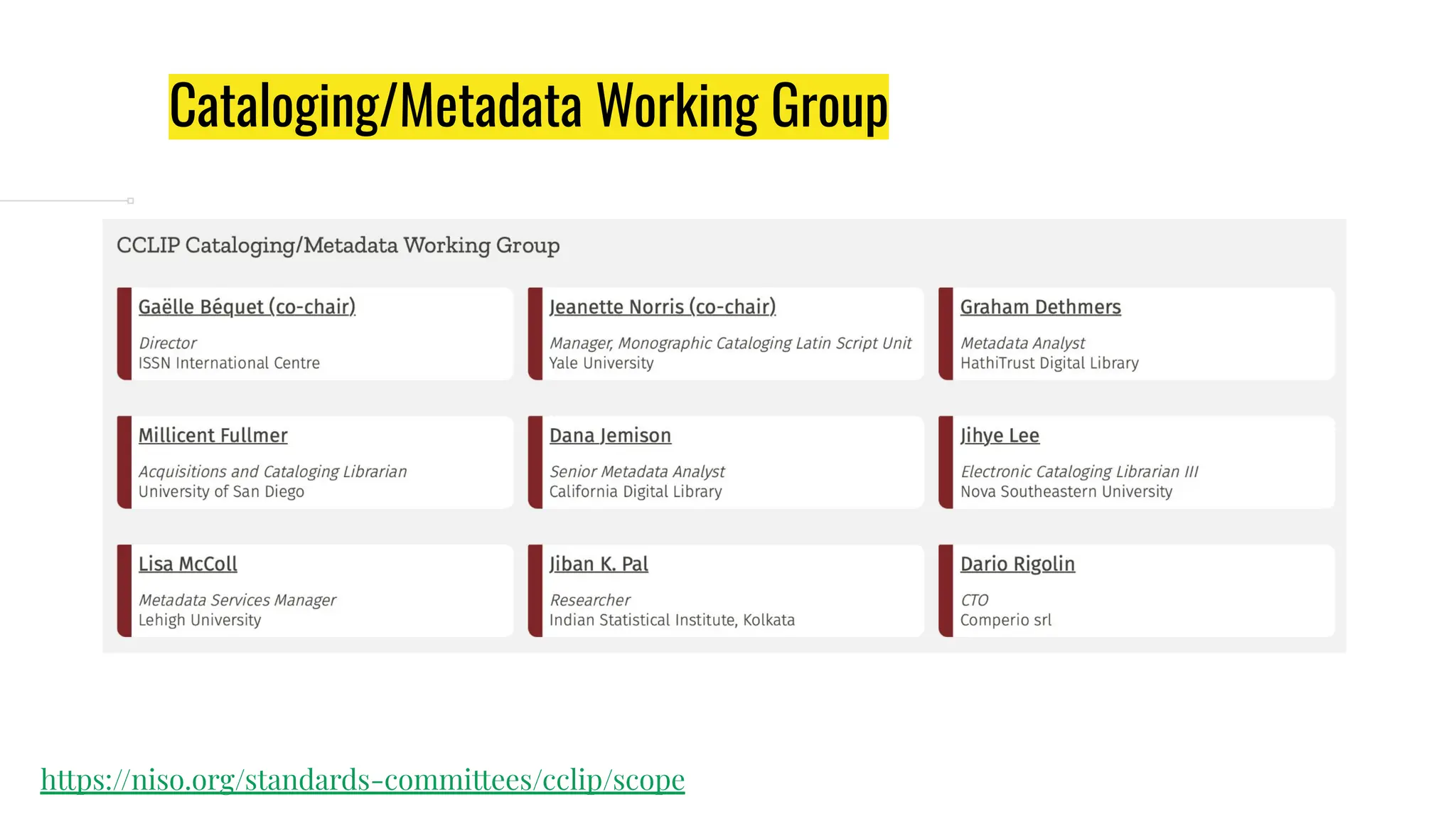
c. Cataloging/Metadata
d. Collections Development & Selection
e. Infrastructure
f. Organizational Strategy & Governance
g. Consortia (Newly announced)
h. Vendors (forthcoming in Q3 2024)
i. Publishers (forthcoming in Q3 2024)
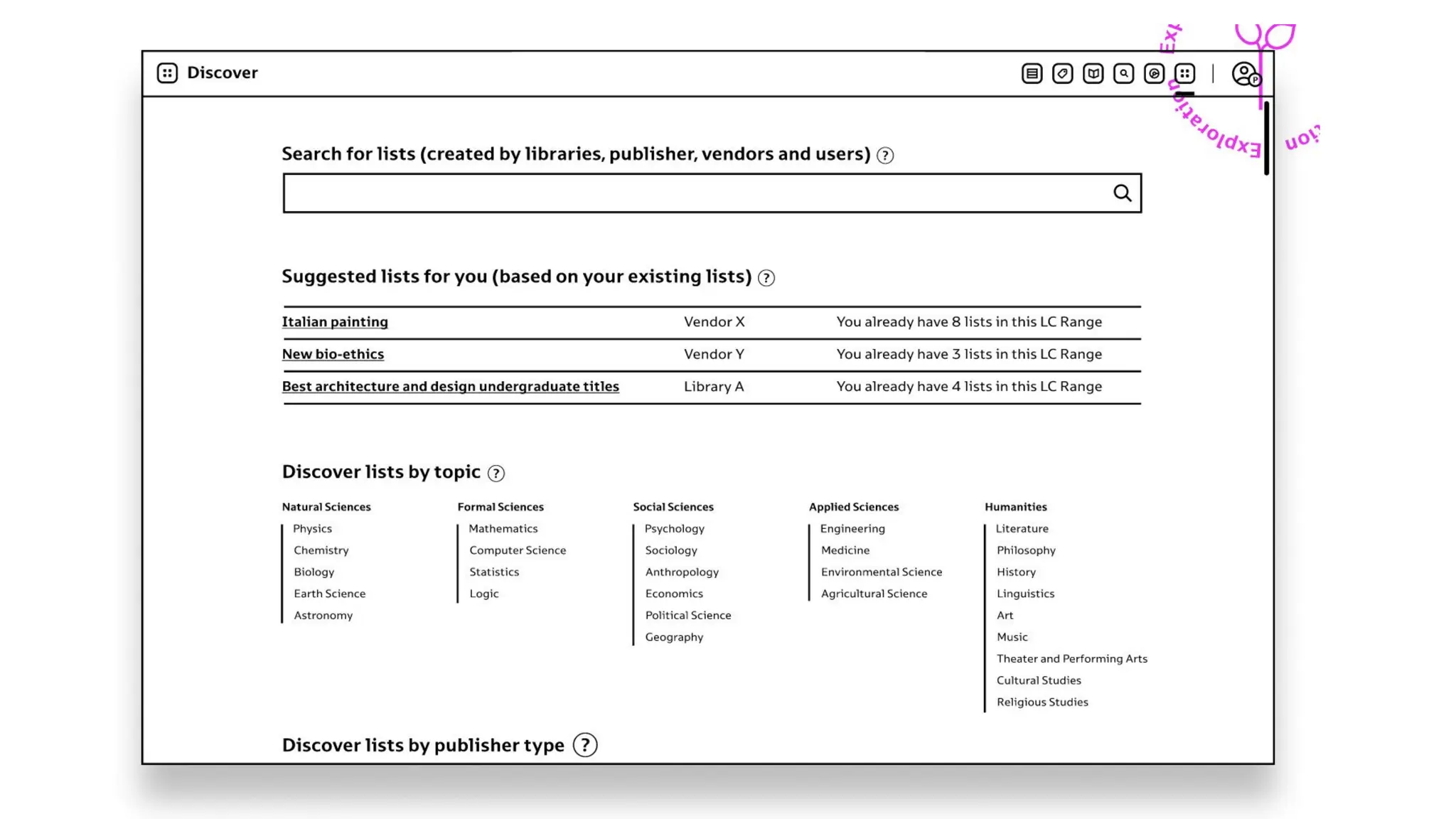
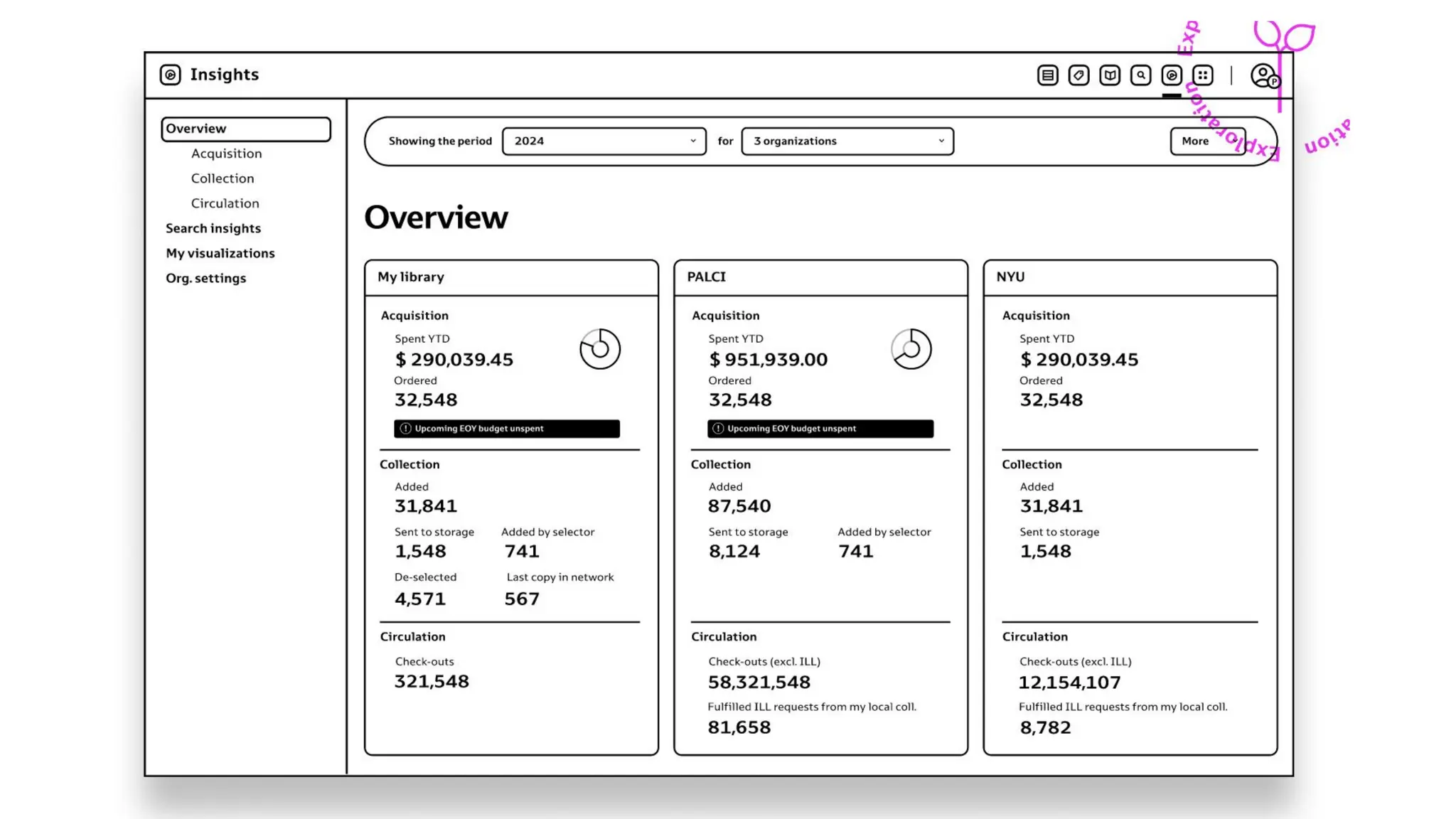
4. Progress on UX Work and prototype mockups
5. Next Steps in the CCLP Project, new groups
6. Q&A
Thank you for the support!
The CCLP project was made possible in part by
the Institute of Museum and Library Services (IMLS)
Grant #: LG-252384-OLS-22.
For more information about this grant visit:
https:/
/www.imls.gov/grants/awarded/lg-252384-ols-22
We are grateful for the support and contributions of:
● Big Ten Academic Alliance (BTAA)
● Canadian Research Knowledge Network (CRKN)
● Greater Western Library Alliance (GWLA)
● Center for Research Libraries
● Colorado Alliance of Research Libraries
● Minitex
● Orbis Cascade Alliance,
● Boston Library Consortium
● Eastern Academic Scholars’ Trust (EAST)
● Virginia's Academic Library Consortium (VIVA)
● Washington Research Library Consortium (WRLC)
● Ithaka S+R
● Index Data, LLC
● ISSN International Centre
● Paratext, LLC
● Cornell University Library
● Columbia University Libraries
● Johns Hopkins University Libraries
● New York University Libraries
● Rutgers University Libraries
● Tulane University Libraries
● University of Delaware Library Museums and Press
● University of Denver Libraries
● University of Pittsburgh Library System
● Washington & Jefferson College
● Duke University Library and Press
● JSTOR
● Project MUSE
In addition, we like to thank individuals from Brandeis University Library, The Internet Archive, Princeton University Library, Bloomsbury
Publishing, Hathi Trust, The California Digital Library, New York Public Library, University of Miami Libraries, Yale University Libraries,
The Research Collections and Preservation Consortium (ReCAP), and many more supporting the CCLIP Working Groups
Mission & Vision
Mission
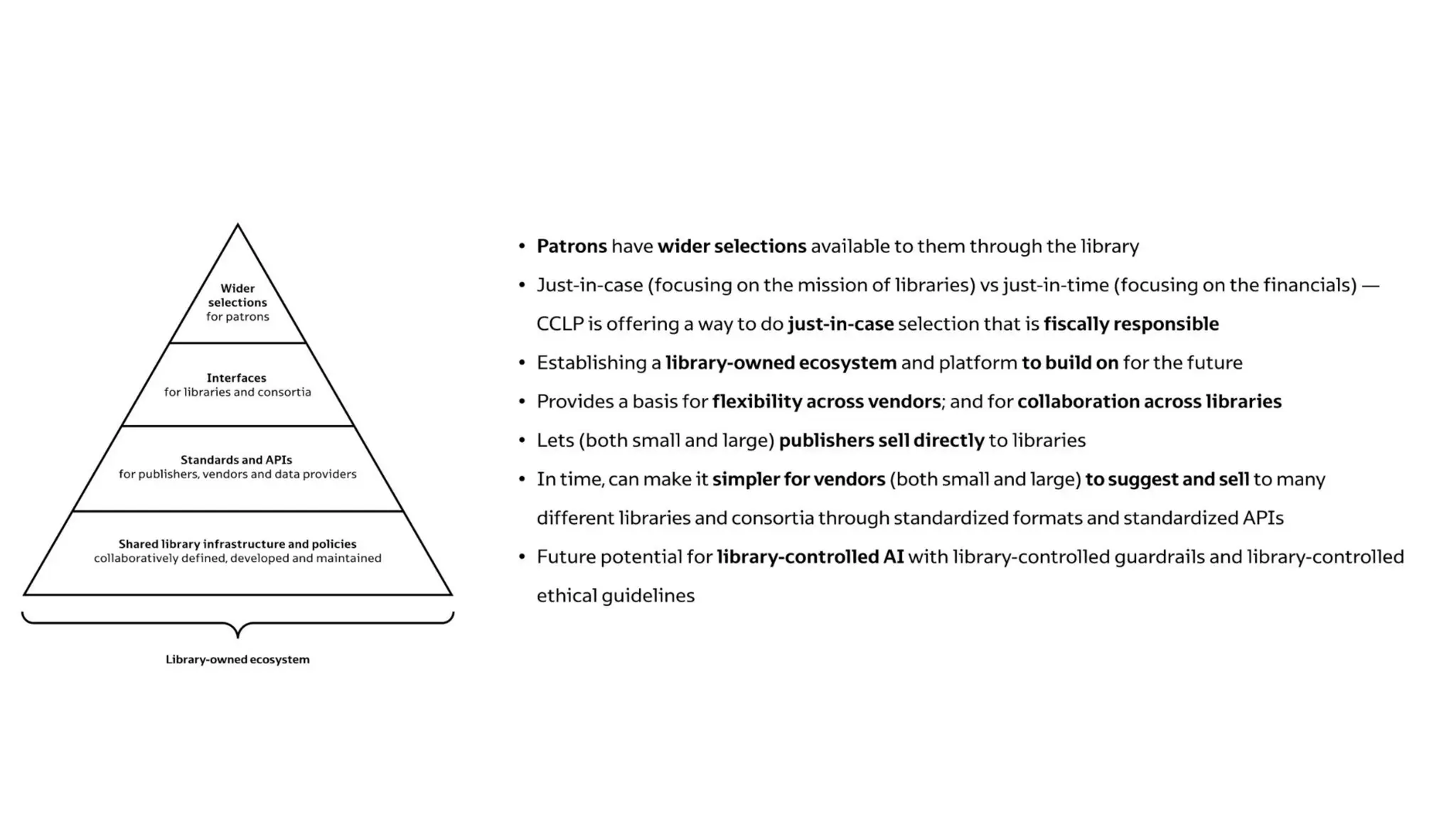
Through collaboration and innovation with trusted partners in an interoperable,
community-owned infrastructure, CCLP will create best practices, improve standards, and
develop prototype middleware to empower value-driven library collecting, increase
collection diversity, availability and access, and improve stewardship and institutional
efficiency in a collaboration-first environment.
Vision
Our vision is for a world in which all libraries may have and steward equitable, financially
sustainable, and efficient access to library resources and the scholarly record by fostering an
ecosystem of interoperable systems, standards, and open collaboration among libraries,
publishers, and service providers.
Core Values and Principles
Co-ownership of project outputs
Provider-neutral approaches
Interoperability
Engagement of community promoting mutual understanding &
stewardship for collaborating around collections, including
models/mechanisms for acquiring and accessing open content
Cost-effective, highly practical and usable solutions
Data privacy & security
http:/
/cclproject.org
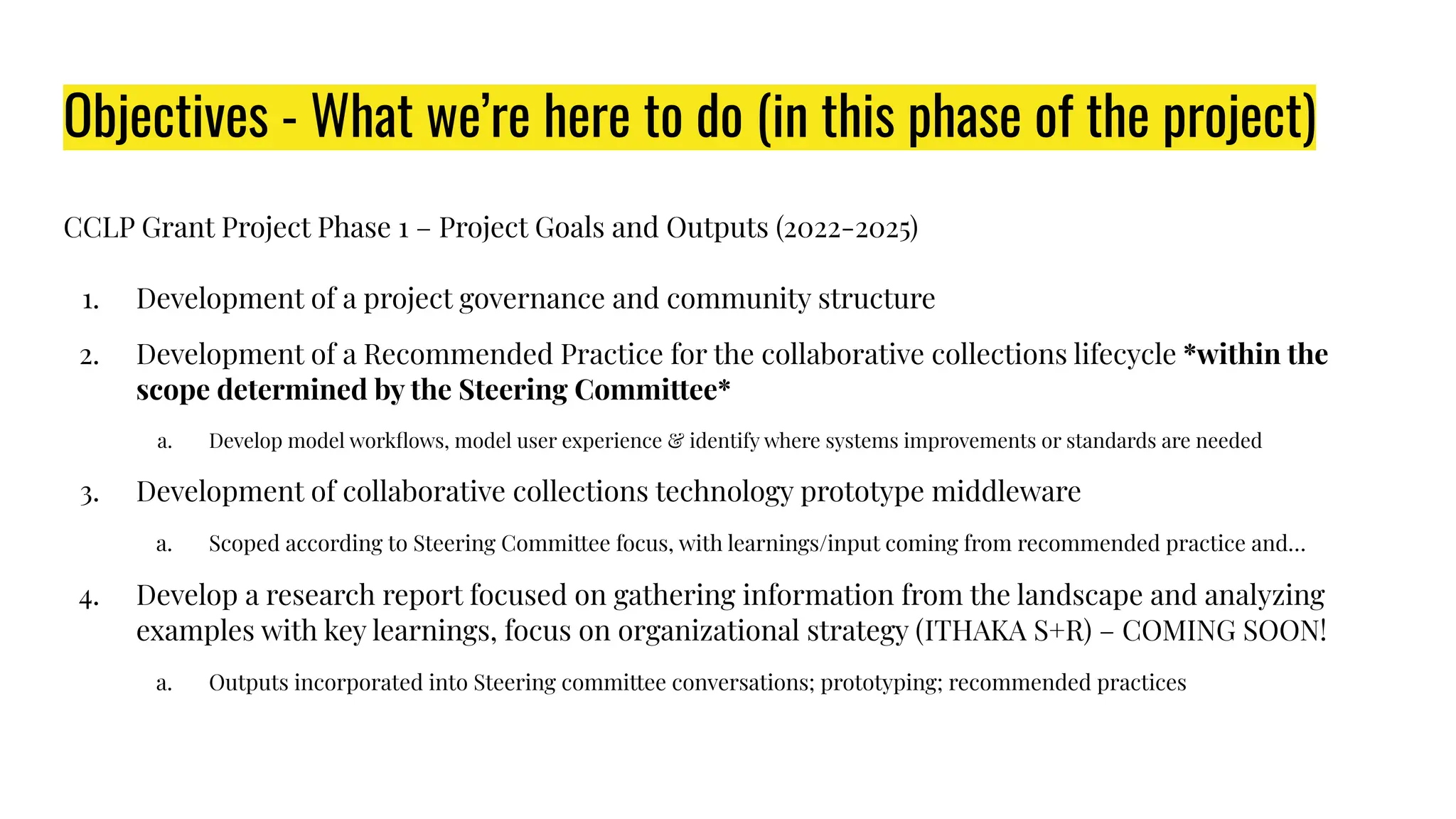
Objectives - What we’re here to do (in this phase of the project)
CCLP Grant Project Phase 1 – Project Goals and Outputs (2022-2025)
1. Development of a project governance and community structure
2. Development of a Recommended Practice for the collaborative collections lifecycle *within the
scope determined by the Steering Committee*
a. Develop model workflows, model user experience & identify where systems improvements or standards are needed
3. Development of collaborative collections technology prototype middleware
a. Scoped according to Steering Committee focus, with learnings/input coming from recommended practice and…
4. Develop a research report focused on gathering information from the landscape and analyzing
examples with key learnings, focus on organizational strategy (ITHAKA S+R) – COMING SOON!
a. Outputs incorporated into Steering committee conversations; prototyping; recommended practices
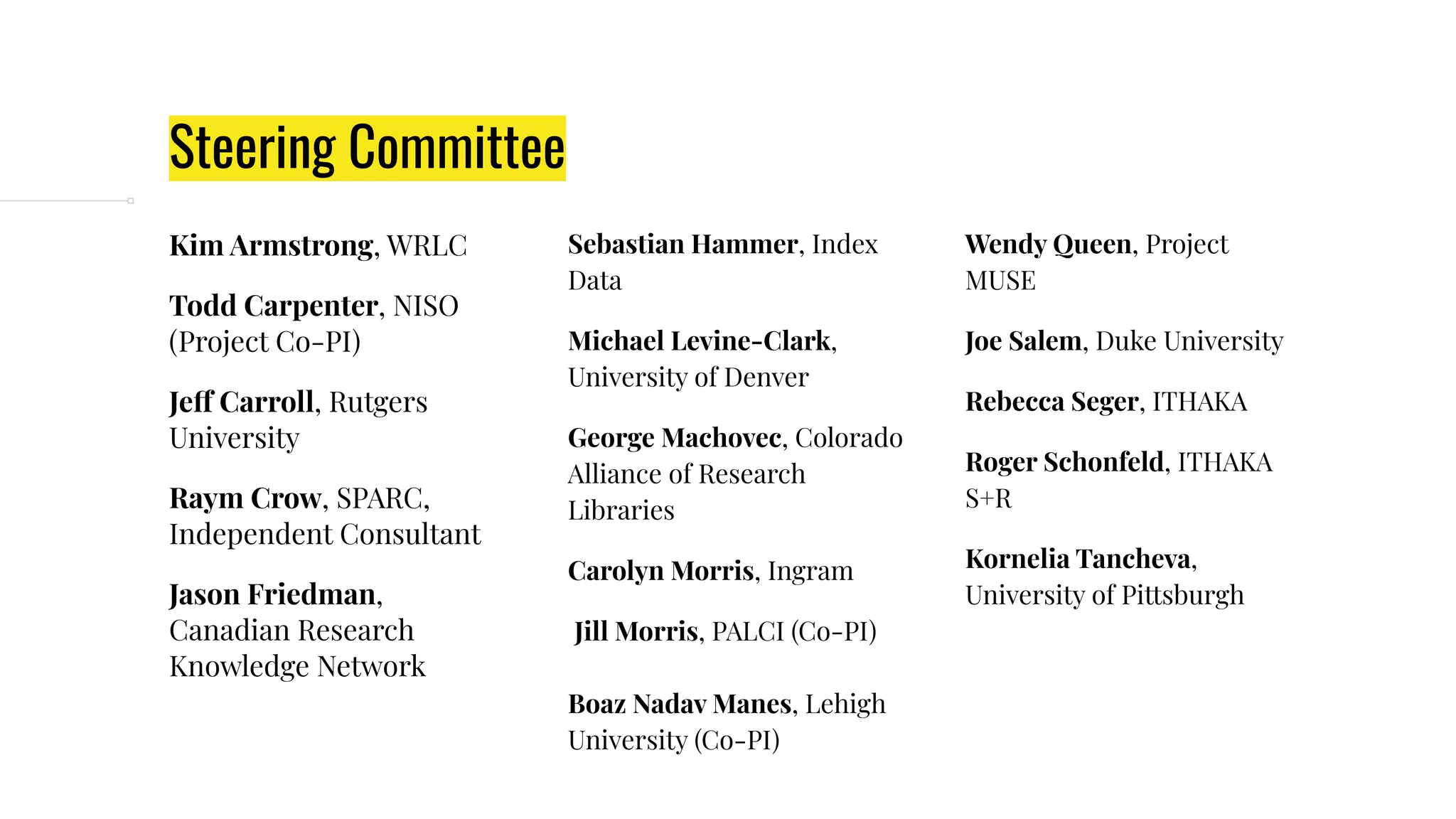
Steering Committee
Kim Armstrong, WRLC
Todd Carpenter, NISO
(Project Co-PI)
Jeff Carroll, Rutgers
University
Raym Crow, SPARC,
Independent Consultant
Jason Friedman,
Canadian Research
Knowledge Network
Sebastian Hammer, Index
Data
Michael Levine-Clark,
University of Denver
George Machovec, Colorado
Alliance of Research
Libraries
Carolyn Morris, Ingram
Jill Morris, PALCI (Co-PI)
Boaz Nadav Manes, Lehigh
University (Co-PI)
Wendy Queen, Project
MUSE
Joe Salem, Duke University
Rebecca Seger, ITHAKA
Roger Schonfeld, ITHAKA
S+R
Kornelia Tancheva,
University of Pittsburgh
The NISO CCLIP
Recommended Practice
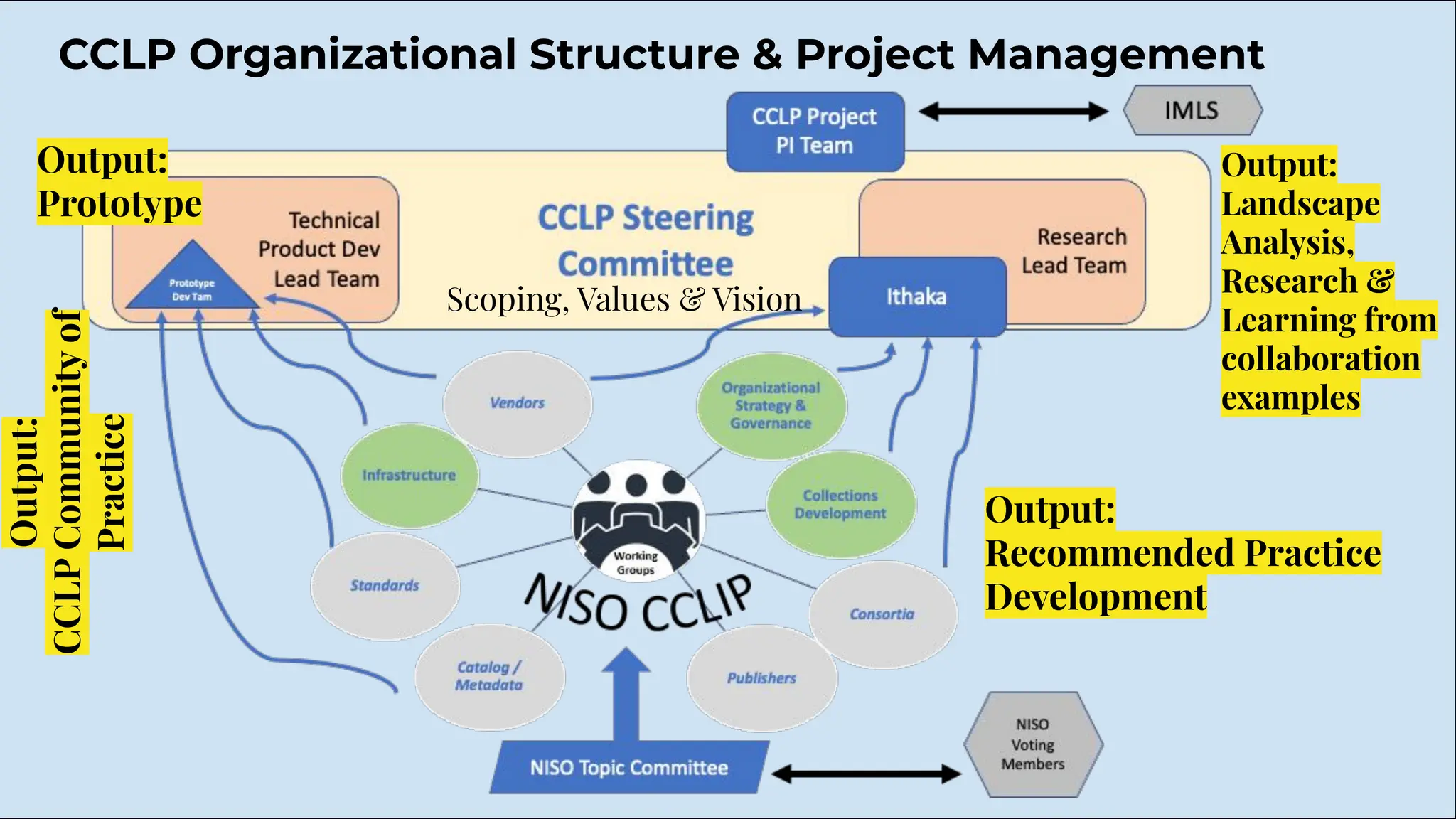
CCLP Organizational Structure & Project Management
Output:
Recommended Practice
Development
Scoping, Values & Vision
Output:
Prototype
Output:
Landscape
Analysis,
Research &
Learning from
collaboration
examples
Output:
CCLP
Community
of
Practice
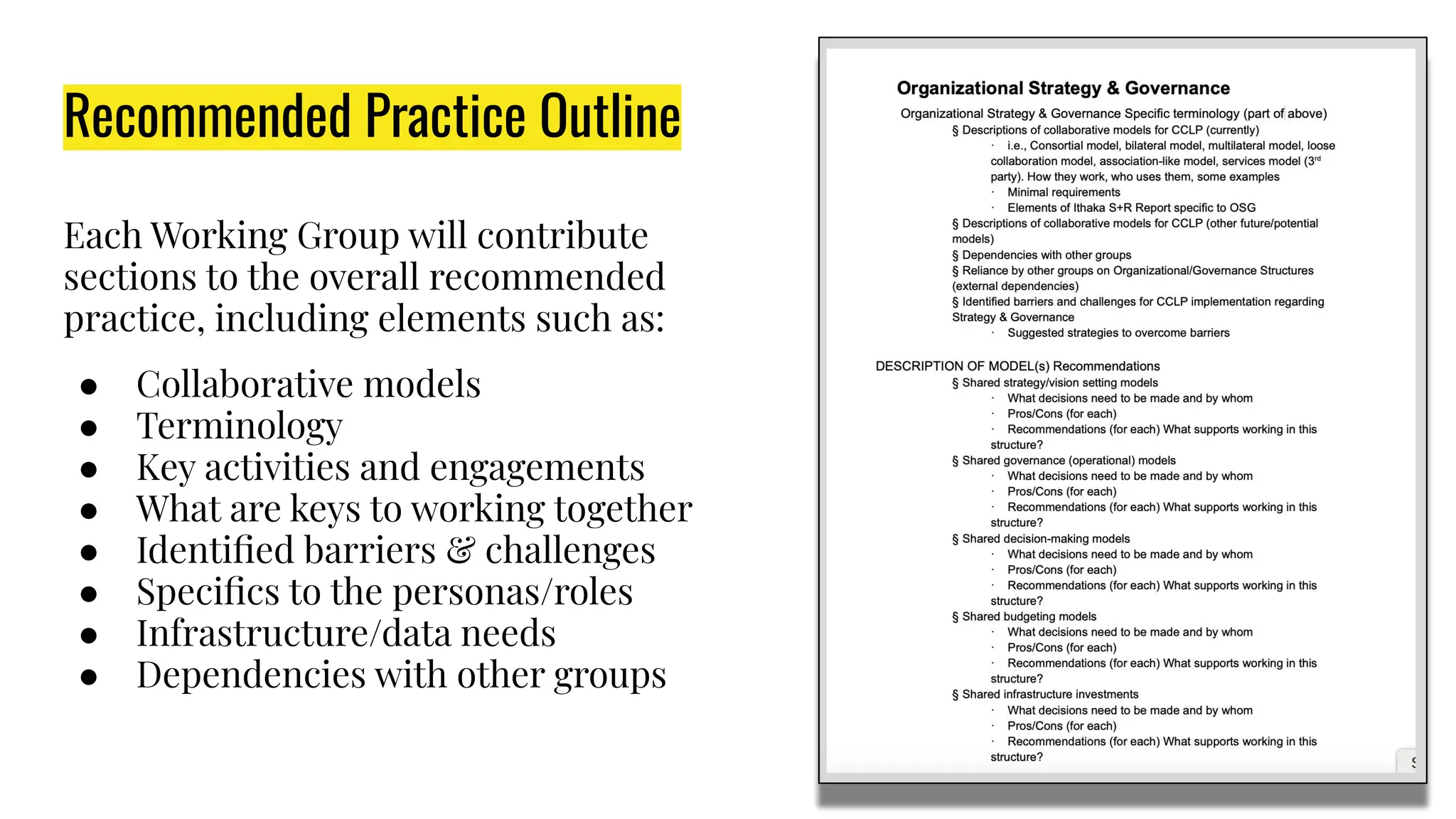
Recommended Practice Outline
Each Working Group will contribute
sections to the overall recommended
practice, including elements such as:
● Collaborative models
● Terminology
● Key activities and engagements
● What are keys to working together
● Identified barriers & challenges
● Specifics to the personas/roles
● Infrastructure/data needs
● Dependencies with other groups
CCLIP
Case Study Research
● Ithaka S+R’s role is advising the Collaborative Collection
Lifecycle Project (CCLP) Steering Group and conducted research
on cooperative collections development practice in support of
the initiative’s goals.
● Ithaka S+R Research Team:
○ Tracy Bergstrom, Program Manager for Collections
and Infrastructure
○ Oya Y. Rieger, Senior Strategist
○ Roger C. Schonfeld, Vice President, Organizational Strategy
& Libraries, Scholarly Communication, and Museums
Ithaka S+R Consultancy Scope and Objectives
● Provide a high-level landscape analysis (10 projects, services, programs) to
contextualize specific collaborative collections development exemplars
● Held an interactive workshop with CCLP project team representatives to establish
common ground on CCD landscape and situate the project’s goals
● Conducted eight CCD case studies and held a series of workshops to discuss findings
● Advising the CCLP Steering Group on organizational model, governance,
sustainability, communication strategies, and engagement of interested parties
● Will Publish a final Ithaka S+R report to share the research outcomes
Ithaka S+R Consultancy Scope and Objectives
CCLP Collaboration Models
Collaboration Model 1: “I live in an apartment building - I just want
to know my neighbors”
Principles:
I need network level information to be more efficient and smart about my own local CD and CM decisions
My own local decisions will be fed into network level decision making whether these are centralized or local
No need for an MOU nor governing structure but it can function to supplement one
I need to be aware of multiple buildings and multiple collaborative models (models 2-4) even if I don’t participate
I can choose to belong to model 1, model 2, model 3, model 4 when maturity levels/need increases or decreases
Expectations:
Data should be efficient to allow me to make quick decisions [what inputs are required?]
Data about my own decisions need to be registered [how? where?]
Data about my own local usage needs to be registered [how? where?]
Way to locally fund, select, and deselect
Collaboration Model 3: “I live in an apartment building - I want to co-own
it and build an optimized commune with everyone in the building”
Principles:
I need network level information to be more efficient and smart about network level CD and CM decisions
Network level decision making will be centralized
MOU and governing structure are needed and machine registered
I need to be aware of multiple buildings, multiple collaborative models, and singular decisions (models 1-4)
I can choose to belong to model 1, model 2, model 3, model 4 when maturity levels increases or decreases
Expectations:
Data should be efficient to allow me to make quick decisions
Data about my own network decisions need to be registered and shared
Data about prioritization of network level collaborations needs to be registered (load balancing)
Way to jointly fund, select, communicate and deselect together
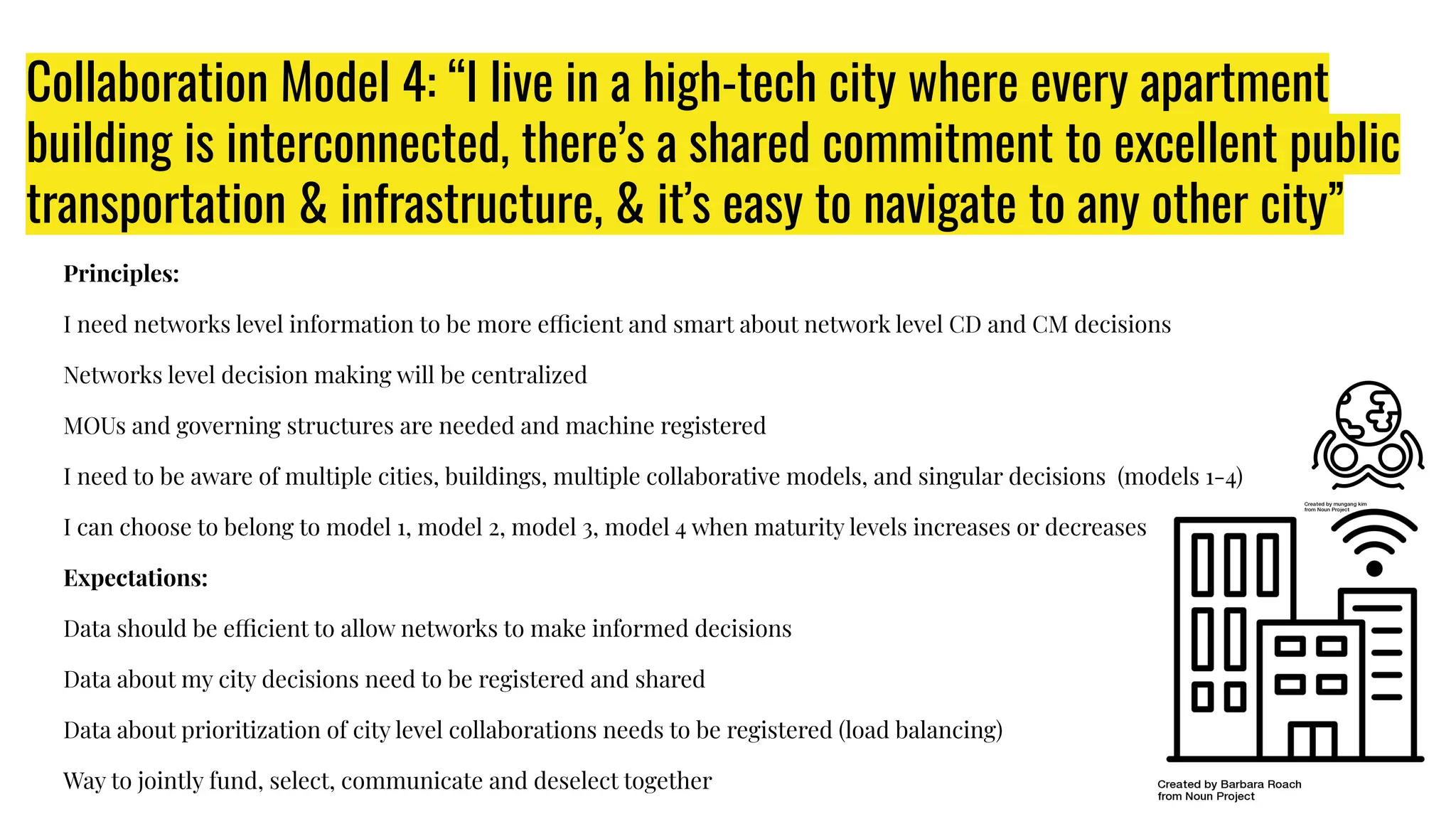
Collaboration Model 4: “I live in a high-tech city where every apartment
building is interconnected, there’s a shared commitment to excellent public
transportation & infrastructure, & it’s easy to navigate to any other city”
Principles:
I need networks level information to be more efficient and smart about network level CD and CM decisions
Networks level decision making will be centralized
MOUs and governing structures are needed and machine registered
I need to be aware of multiple cities, buildings, multiple collaborative models, and singular decisions (models 1-4)
I can choose to belong to model 1, model 2, model 3, model 4 when maturity levels increases or decreases
Expectations:
Data should be efficient to allow networks to make informed decisions
Data about my city decisions need to be registered and shared
Data about prioritization of city level collaborations needs to be registered (load balancing)
Way to jointly fund, select, communicate and deselect together
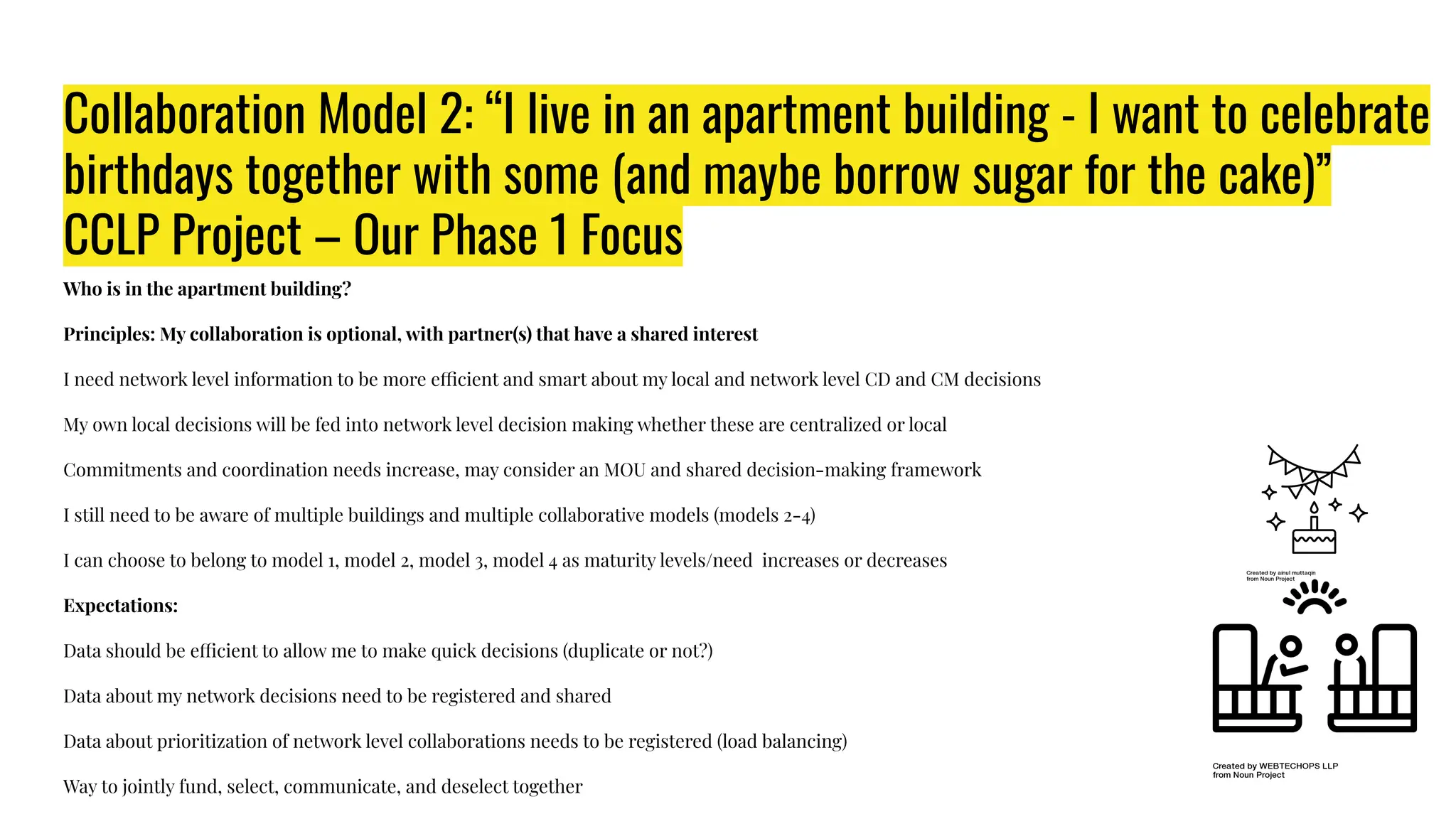
Collaboration Model 2: “I live in an apartment building - I want to celebrate
birthdays together with some (and maybe borrow sugar for the cake)”
CCLP Project – Our Phase 1 Focus
Who is in the apartment building?
Principles: My collaboration is optional, with partner(s) that have a shared interest
I need network level information to be more efficient and smart about my local and network level CD and CM decisions
My own local decisions will be fed into network level decision making whether these are centralized or local
Commitments and coordination needs increase, may consider an MOU and shared decision-making framework
I still need to be aware of multiple buildings and multiple collaborative models (models 2-4)
I can choose to belong to model 1, model 2, model 3, model 4 as maturity levels/need increases or decreases
Expectations:
Data should be efficient to allow me to make quick decisions (duplicate or not?)
Data about my network decisions need to be registered and shared
Data about prioritization of network level collaborations needs to be registered (load balancing)
Way to jointly fund, select, communicate, and deselect together
Vestibulum congue
Vestibulum congue
Vestibulum
congue
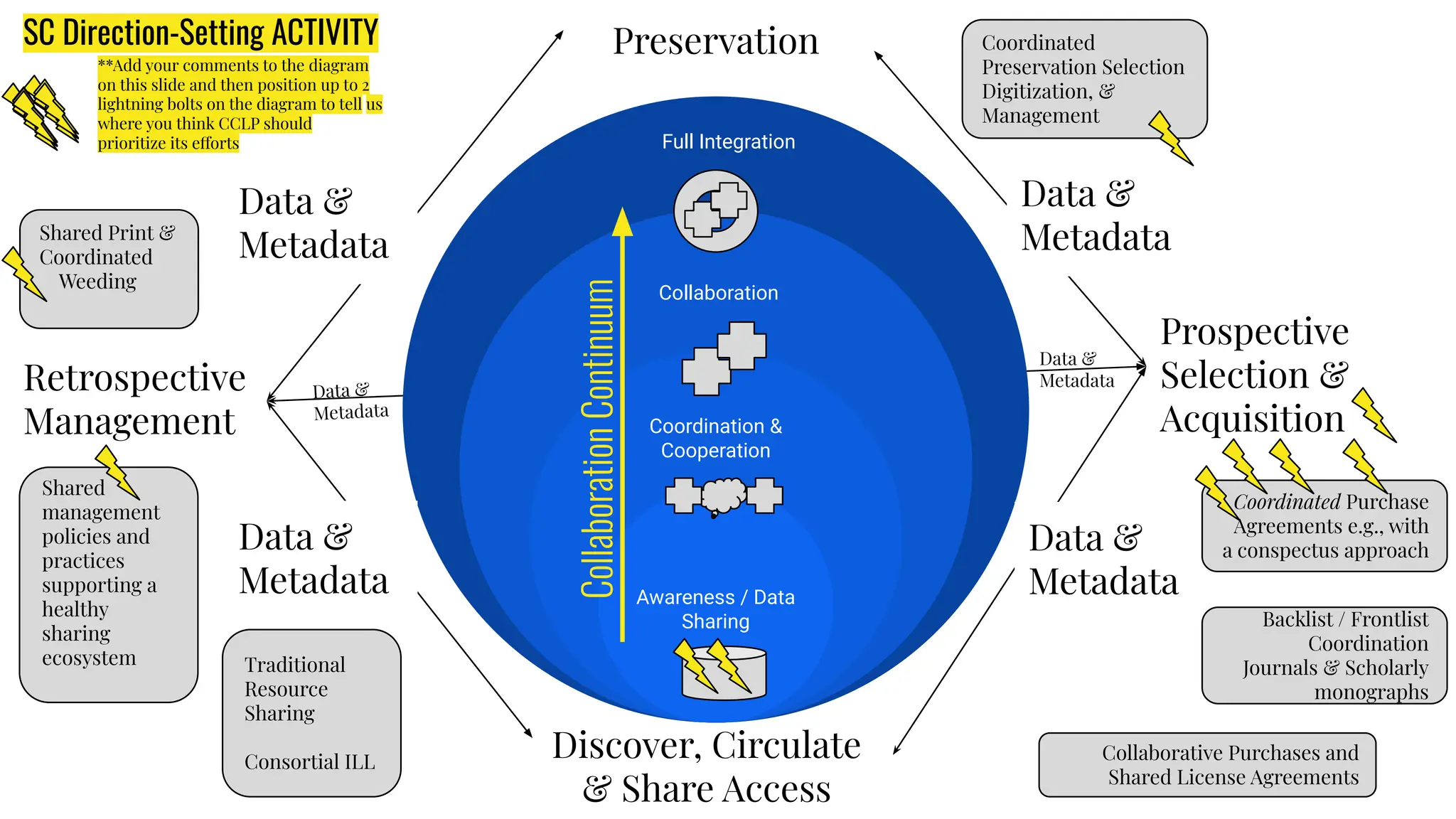
Collaboration
Coordination &
Cooperation
Awareness / Data
Sharing
Retrospective
Management
Prospective
Selection &
Acquisition
Discover, Circulate
& Share Access
Preservation
Collaboration
Continuum
Full Integration
Data &
Metadata
Data &
Metadata
Data &
Metadata
Coordinated
Preservation Selection
Digitization, &
Management
Shared Print &
Coordinated
Weeding
Shared
management
policies and
practices
supporting a
healthy
sharing
ecosystem Traditional
Resource
Sharing
Consortial ILL
Coordinated Purchase
Agreements e.g., with
a conspectus approach
Backlist / Frontlist
Coordination
Journals & Scholarly
monographs
Collaborative Purchases and
Shared License Agreements
Data &
Metadata
Data &
Metadata
SC Direction-Setting ACTIVITY
**Add your comments to the diagram
on this slide and then position up to 2
lightning bolts on the diagram to tell us
where you think CCLP should
prioritize its efforts
Data &
Metadata
Steering Committee Focus:
“Making good on promise of shared print
“Making use of data about our retained and shared collections”
“Most bang for the buck is in coordinated purchasing”
“Prospective as a primary focus”
CCLP’s scope for this phase of the project will be to focus on improving our ability to prospectively make decisions together
about acquiring collections within a “Model 2” optional collaboration structure where shared goals and needs are identified
across more than one institution.
To accomplish that scope, we’ll be using data about our retrospective collections and thinking about what standards /practices are
required to allow for data sharing across institutions, as well as what social, organizational, and technical decision-making
frameworks and infrastructures will help facilitate those arrangements.
→Collaboration initiators, decision-makers and stakeholders may vary within this scope, depending on the use case and goals.
We want each group thinking about identified personas, typical workflows and high impact opportunities + low-hanging fruit
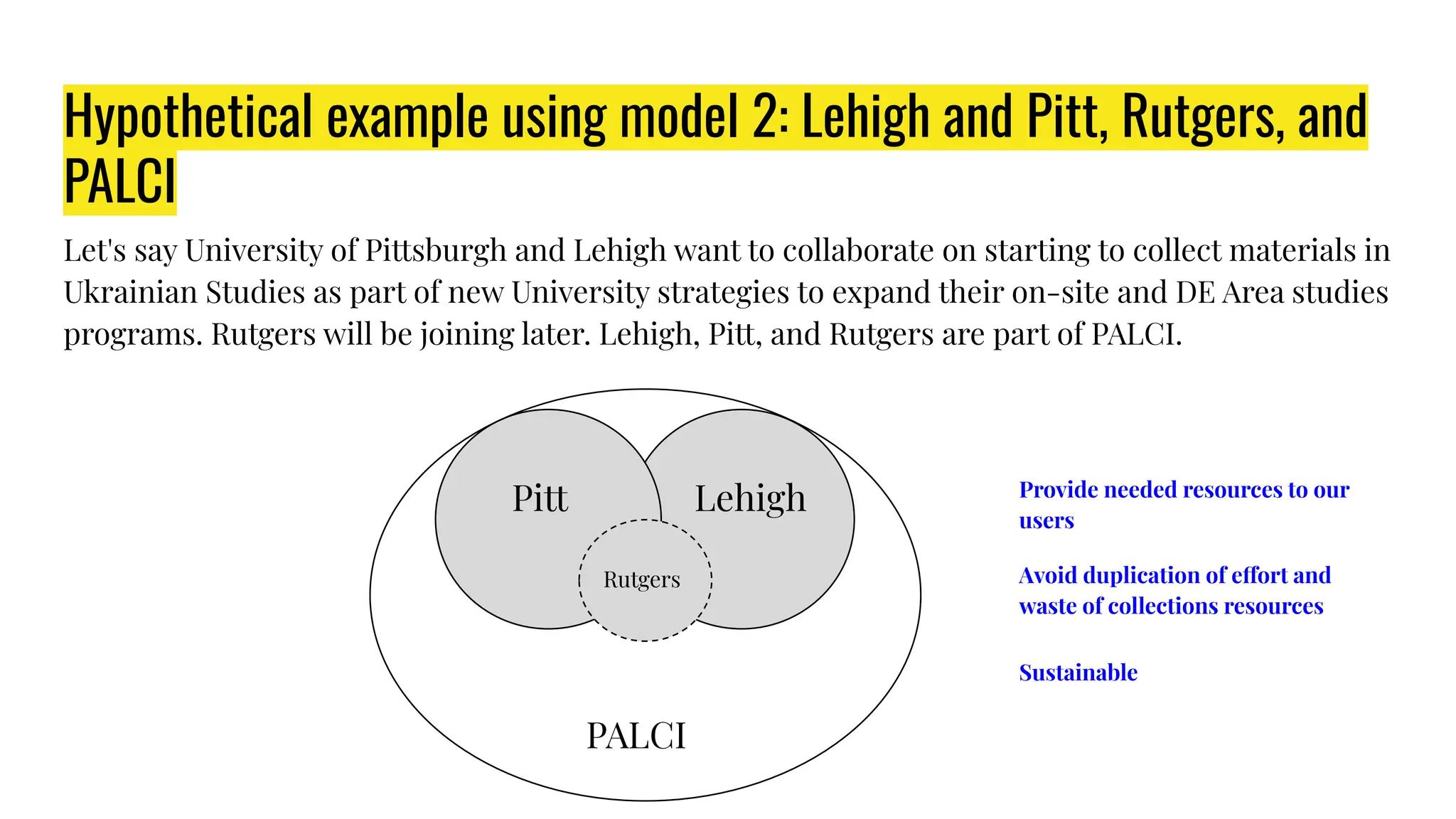
Hypothetical example using model 2: Lehigh and Pitt, Rutgers, and
PALCI
Let's say University of Pittsburgh and Lehigh want to collaborate on starting to collect materials in
Ukrainian Studies as part of new University strategies to expand their on-site and DE Area studies
programs. Rutgers will be joining later. Lehigh, Pitt, and Rutgers are part of PALCI.
Pitt Lehigh
Rutgers
PALCI
Provide needed resources to our
users
Avoid duplication of effort and
waste of collections resources
Sustainable
Reports from
Working Groups
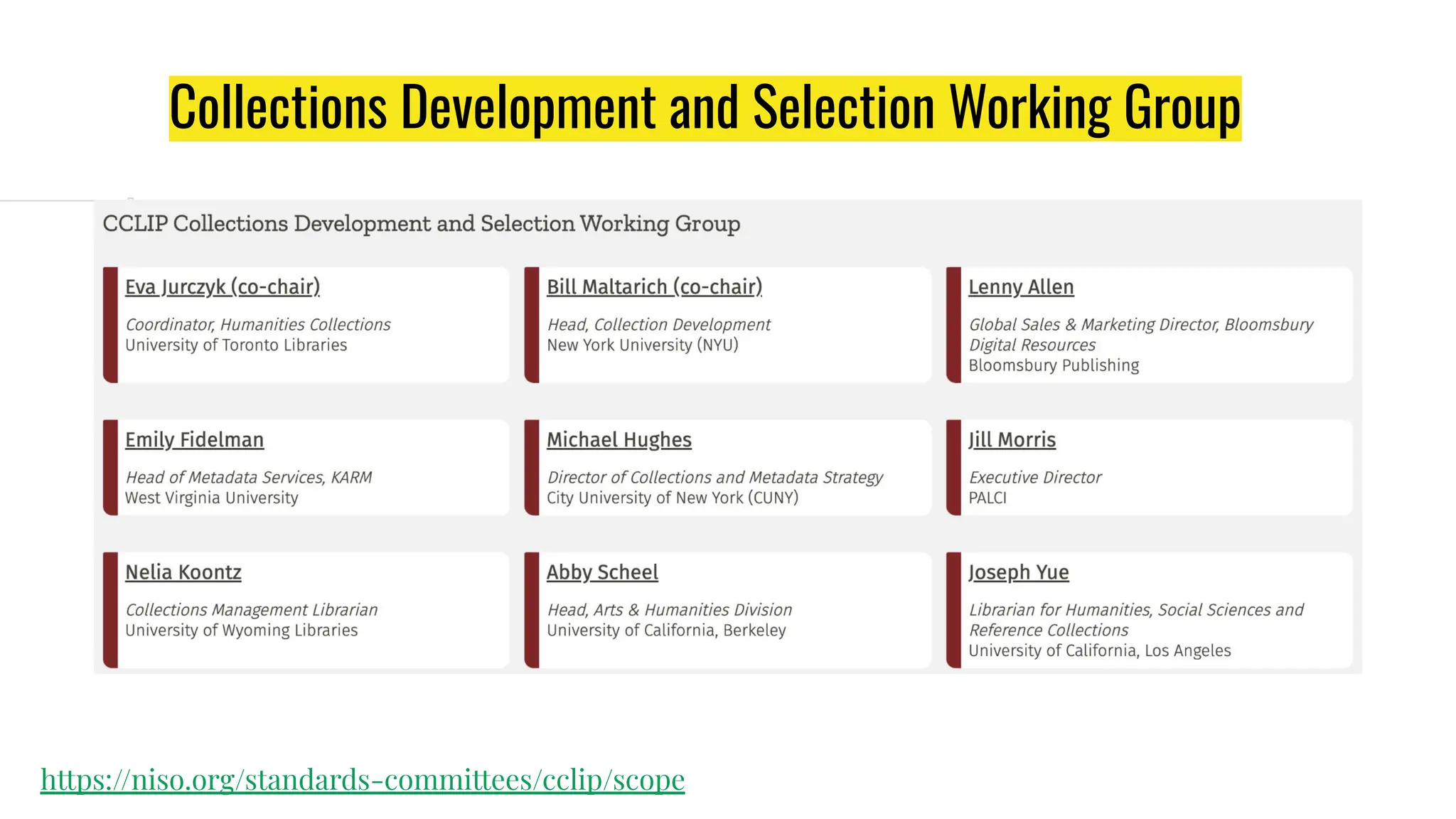
Collections Development and Selection Working Group
https://niso.org/standards-committees/cclip/scope
From draft recommendation:
“At a very high level, the first step in understanding the potential for collaborative collections
activities in this particular model of optional or opt-in collaborations, sits at the intersection of an
awareness of the possible collections landscape (i.e., what is possible to collect), and an
awareness of the goals, commitments, intentions, and holdings of others in the same
ecosystem. At present building such an awareness is a highly manual process among most
optional or opt-in collaborations, and especially among those lacking in shared technical
infrastructure and systems. Even in the most highly integrated collaborations with shared technical
infrastructures and systems, achieving such awareness levels is difficult, arduous and often costly
due to the many disparate sources of information, lack of interchangeable data, and lack of
standards.“
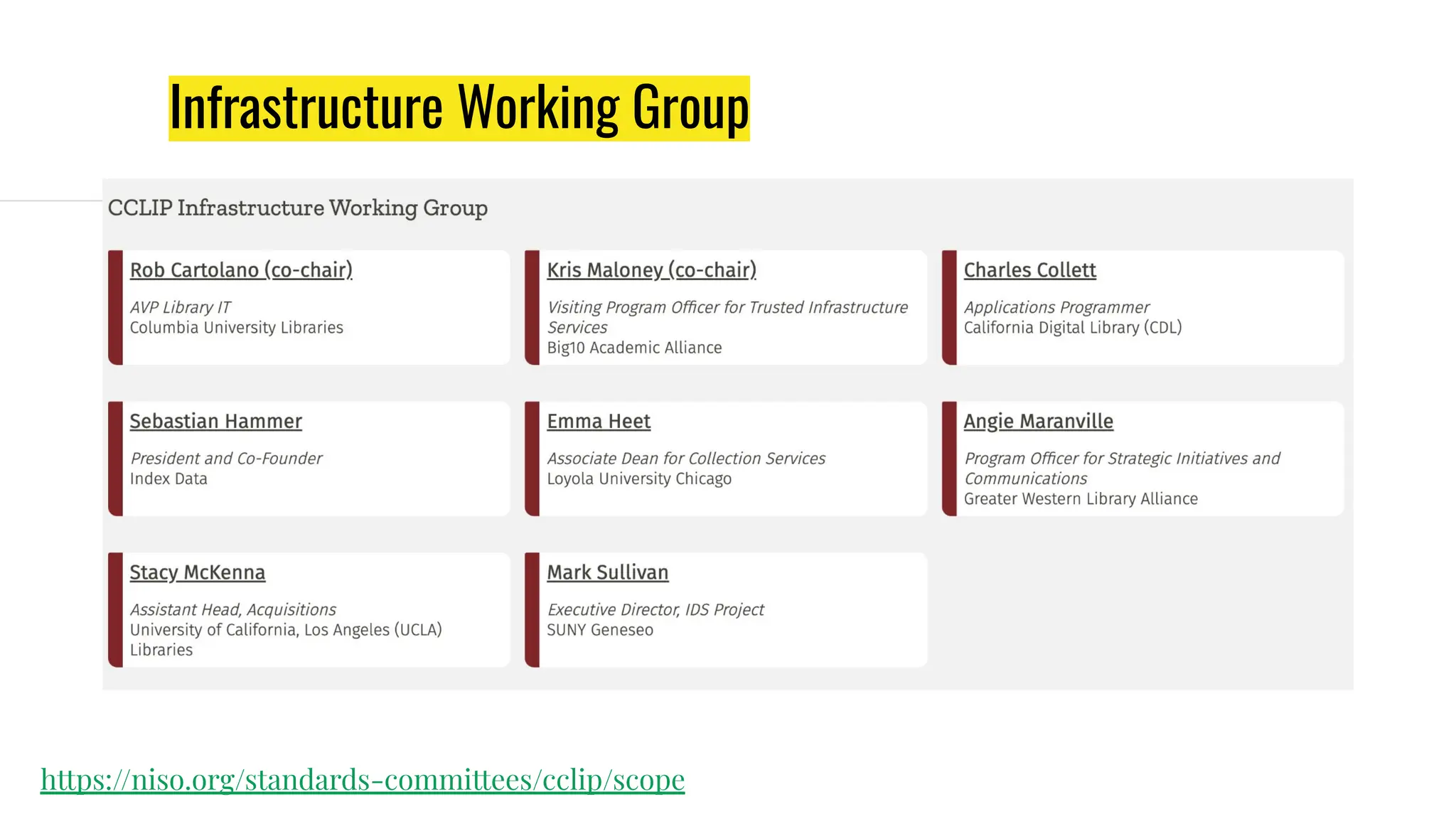
Infrastructure Working Group
https://niso.org/standards-committees/cclip/scope
From draft recommendation:
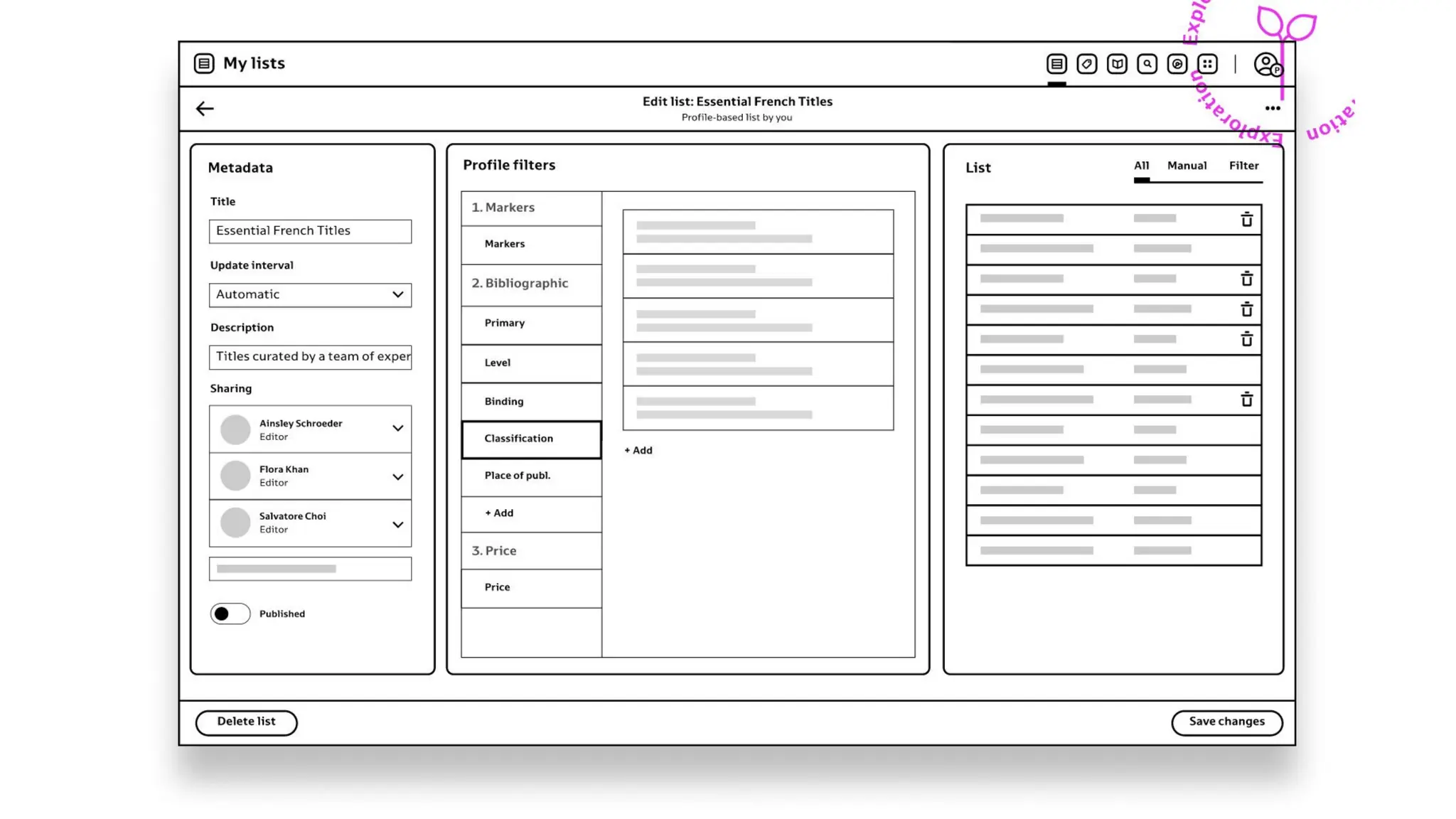
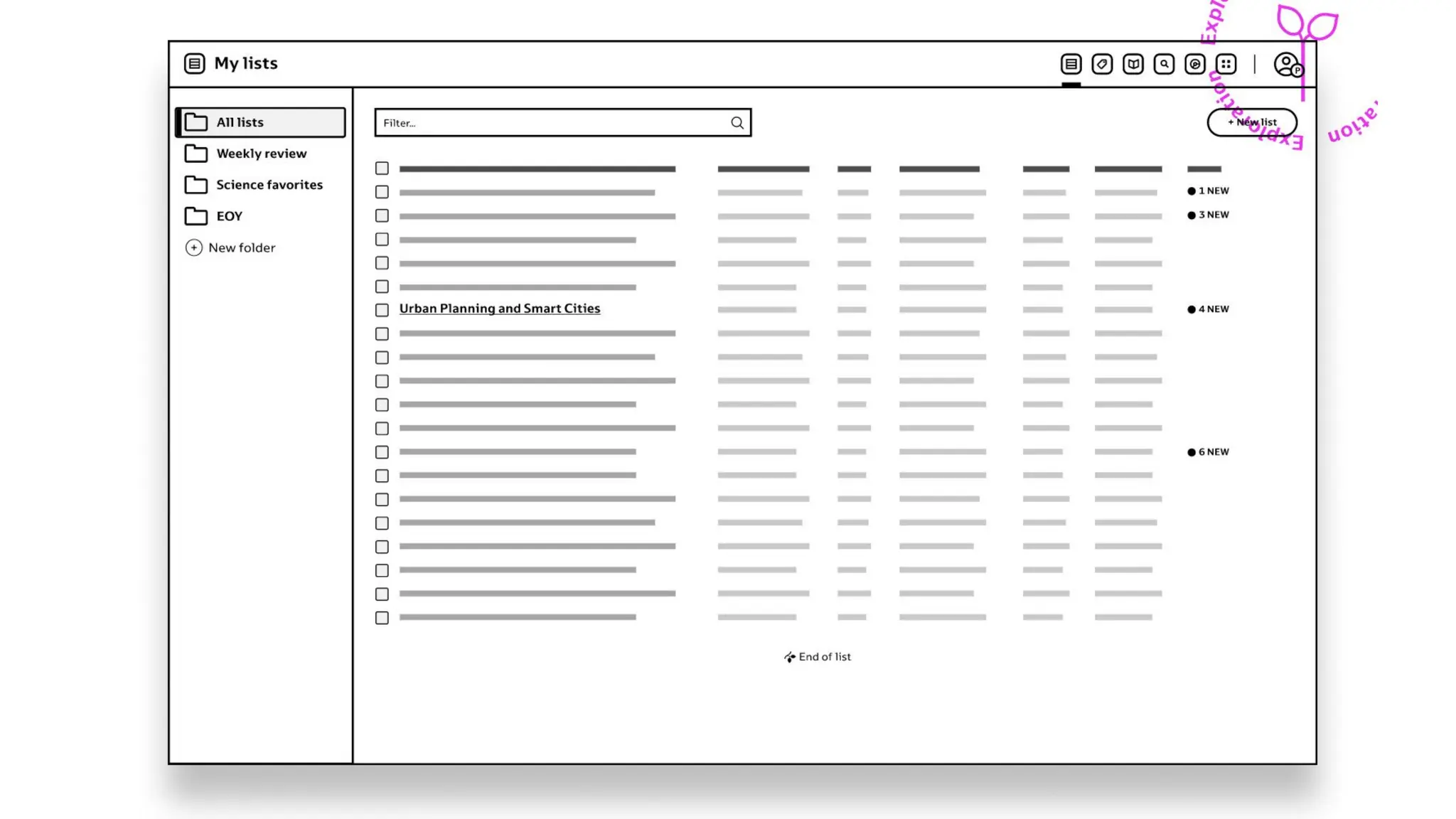
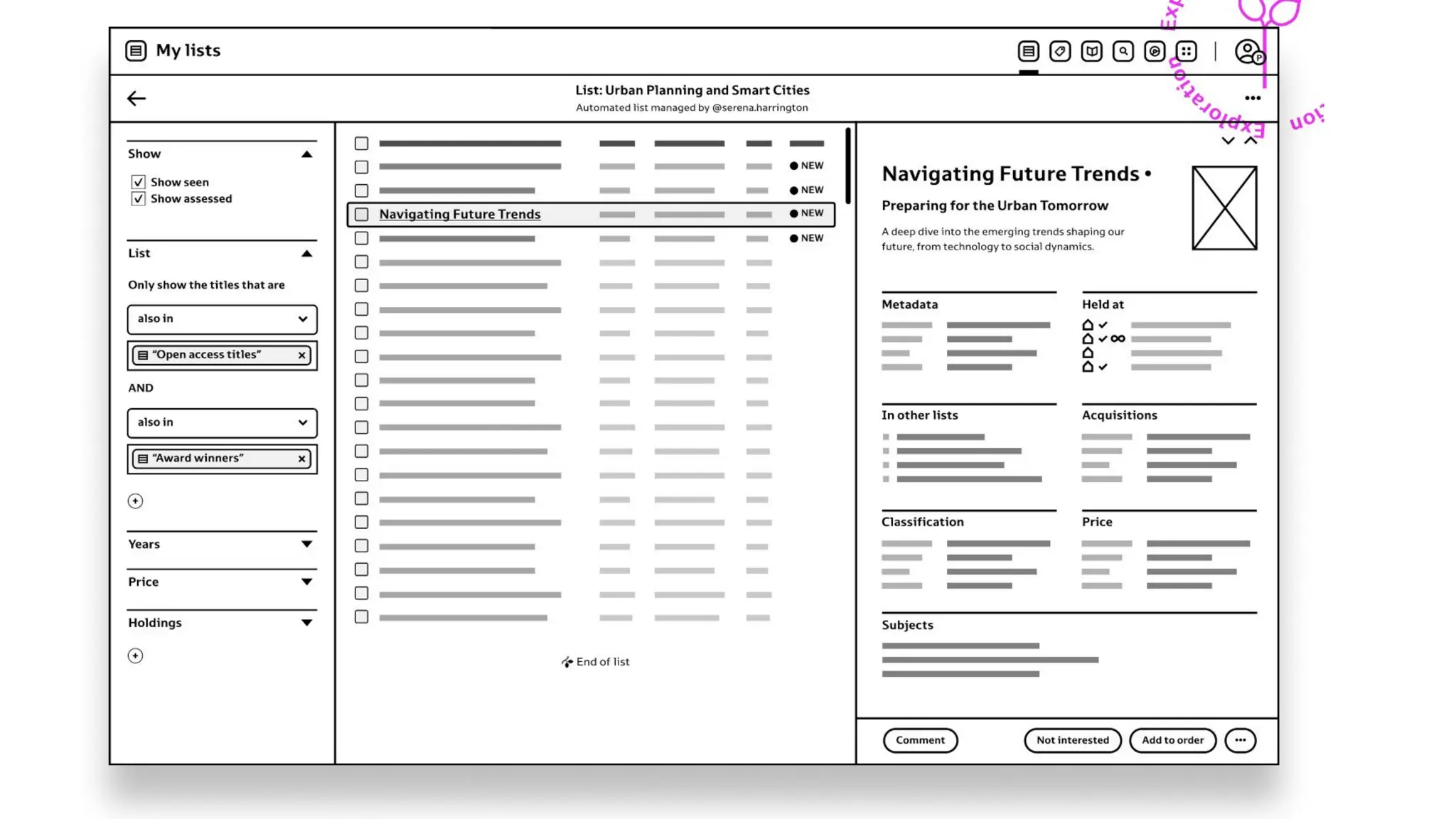
“Applications that provide services: Middleware applications typically encapsulate functionalities or
capabilities that other applications or components can utilize. These services could include defining and
modifying profiles to filter titles, sharing profiles with other institutions, and generating lists of titles
based on profiles. The prototype under development explores the functional requirements necessary to
support awareness for selection and collection development.”
“Publishers and libraries should resist the temptation to create new types of identifiers and subject
taxonomies and focus instead on crosswalks and interoperability of what exists.”
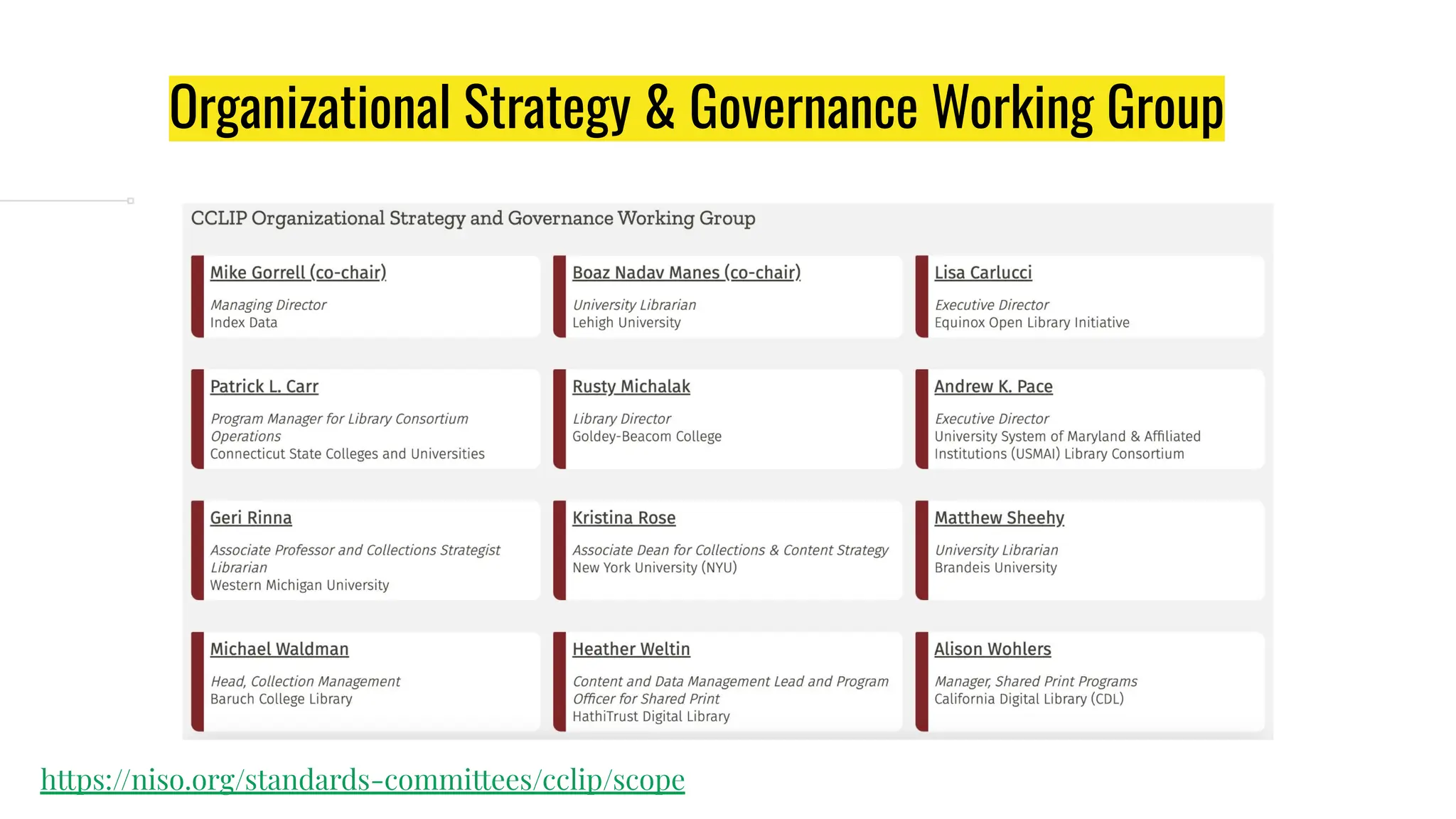
Organizational Strategy & Governance Working Group
https://niso.org/standards-committees/cclip/scope
From draft recommendation:
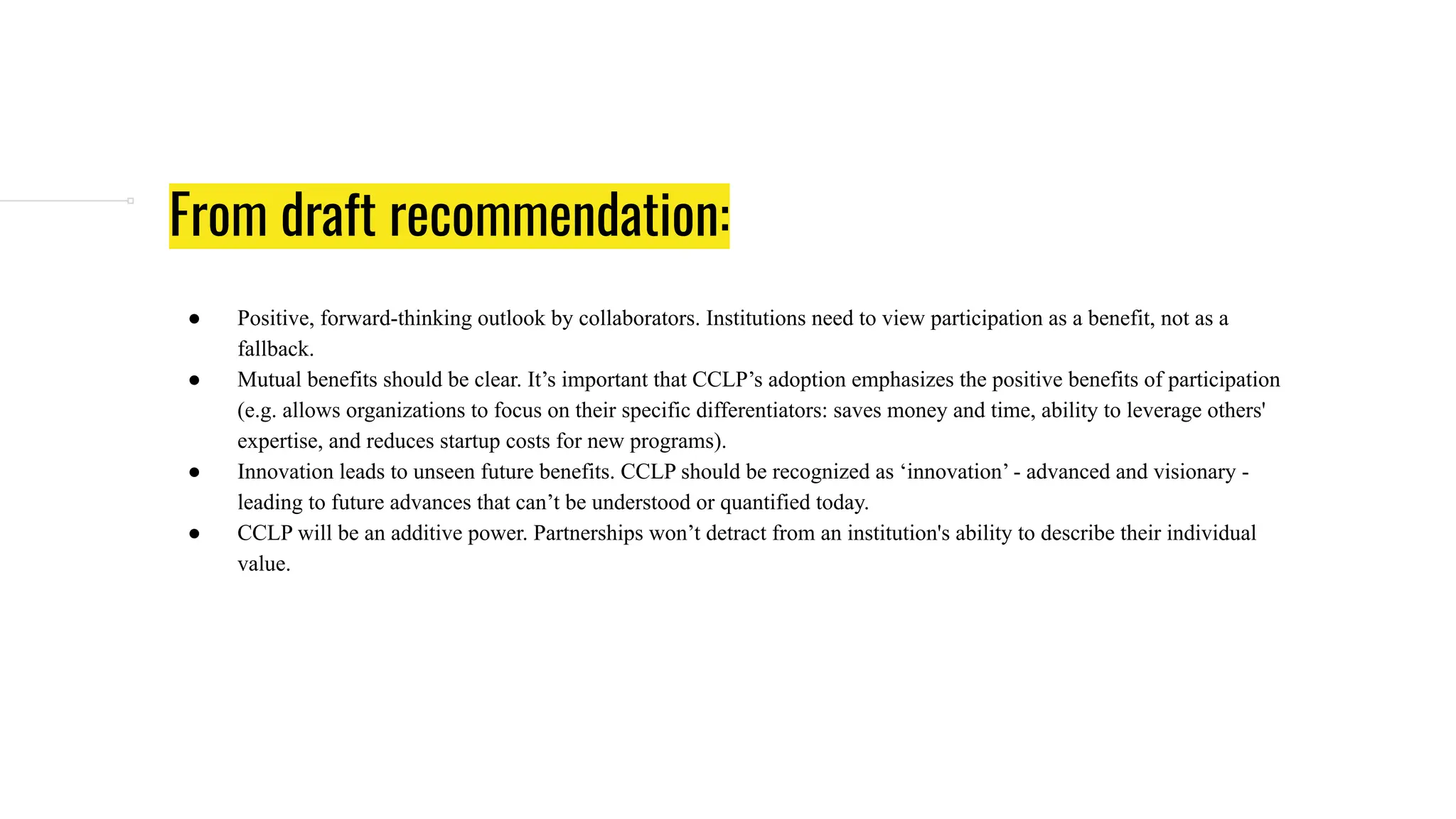
● Positive, forward-thinking outlook by collaborators. Institutions need to view participation as a benefit, not as a
fallback.
● Mutual benefits should be clear. It’s important that CCLP’s adoption emphasizes the positive benefits of participation
(e.g. allows organizations to focus on their specific differentiators: saves money and time, ability to leverage others'
expertise, and reduces startup costs for new programs).
● Innovation leads to unseen future benefits. CCLP should be recognized as ‘innovation’ - advanced and visionary -
leading to future advances that can’t be understood or quantified today.
● CCLP will be an additive power. Partnerships won’t detract from an institution's ability to describe their individual
value.
Acquisition Working Group
https://niso.org/standards-committees/cclip/scope
Assessment/Data Analysis Working Group
https://niso.org/standards-committees/cclip/scope
Cataloging/Metadata Working Group
https://niso.org/standards-committees/cclip/scope
CCLIP
Prototype Development
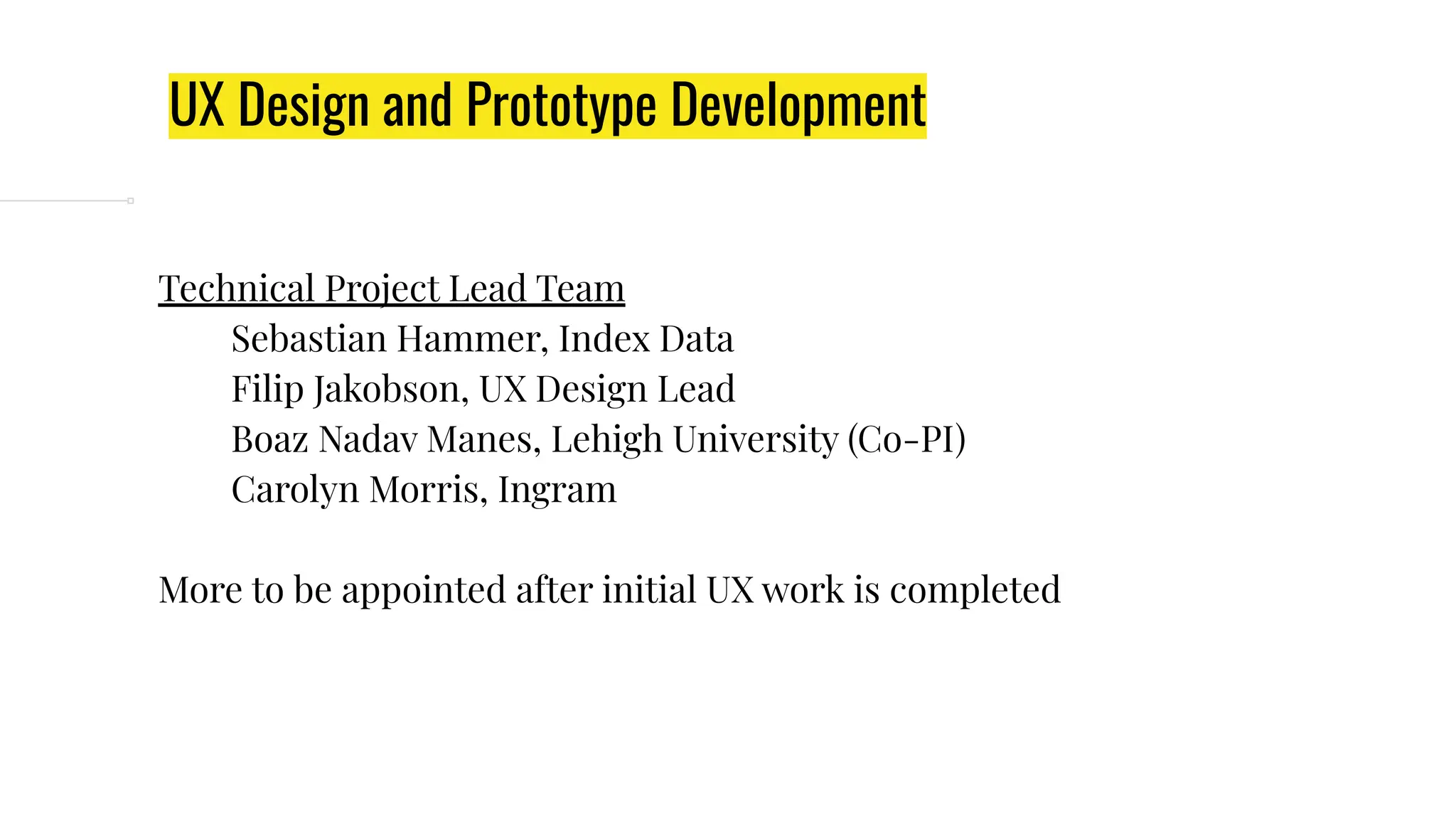
UX Design and Prototype Development
Technical Project Lead Team
Sebastian Hammer, Index Data
Filip Jakobson, UX Design Lead
Boaz Nadav Manes, Lehigh University (Co-PI)
Carolyn Morris, Ingram
More to be appointed after initial UX work is completed
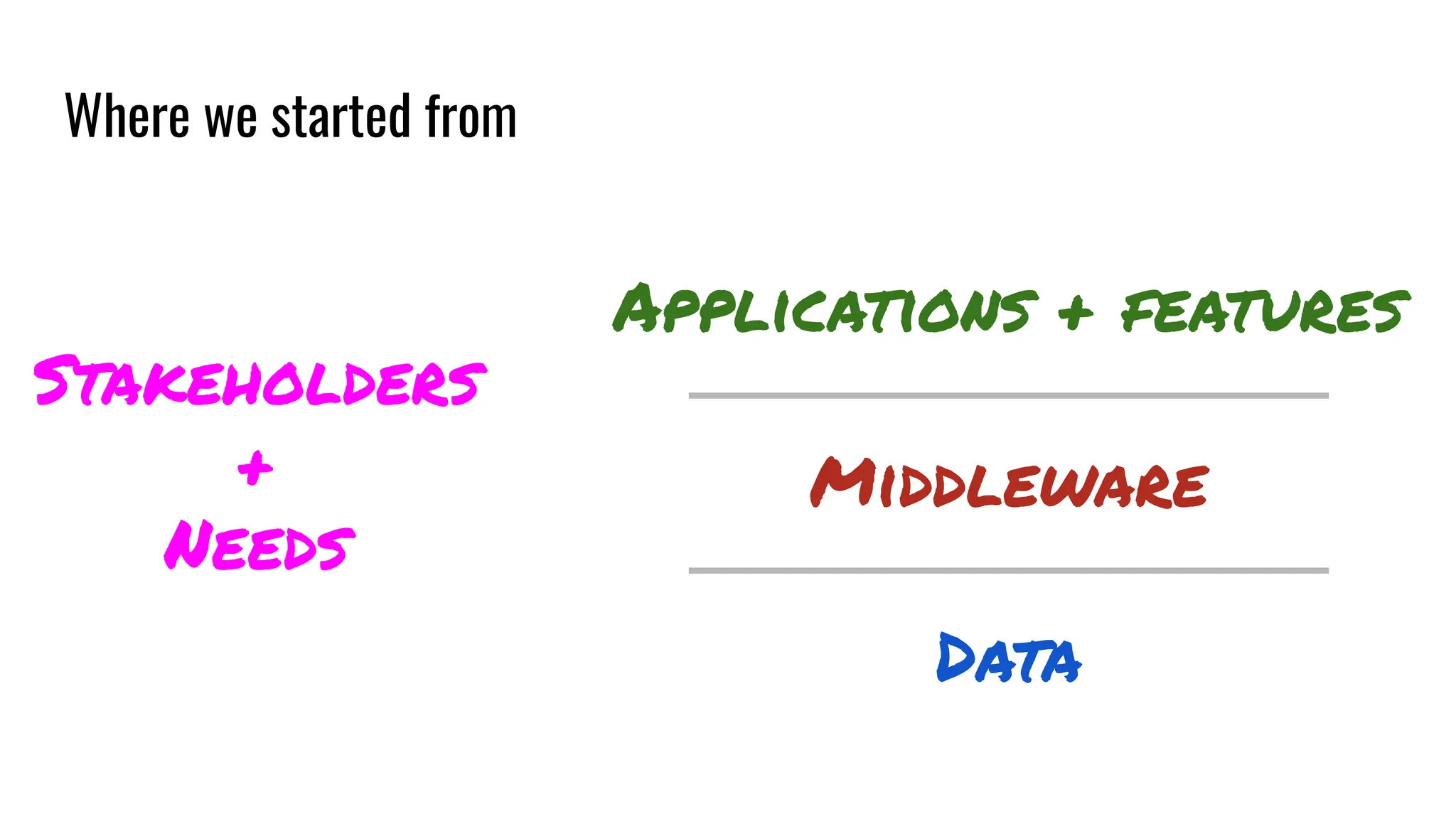
Where we started from
Data
Middleware
Applications + features
Stakeholders
+
Needs
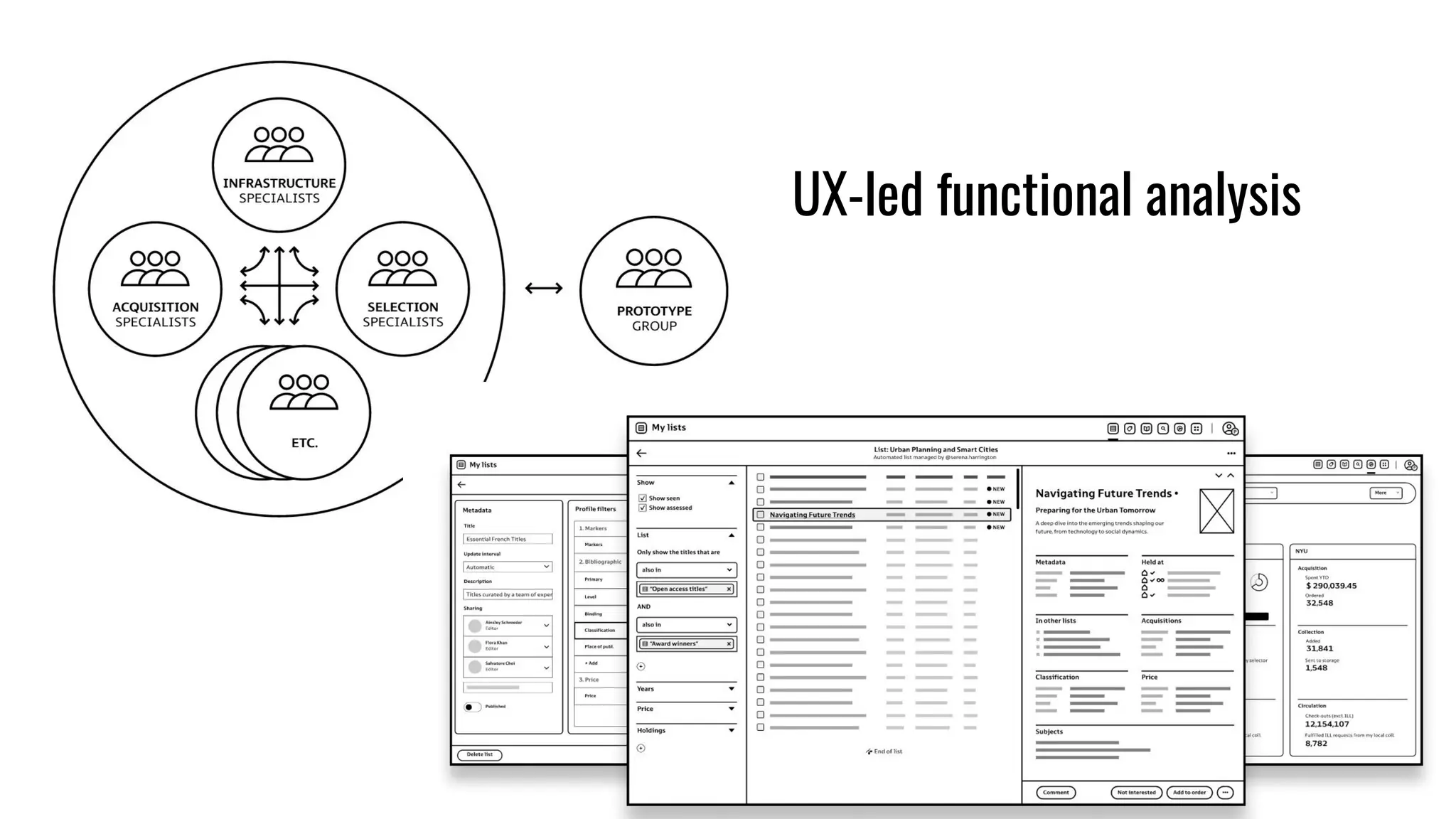
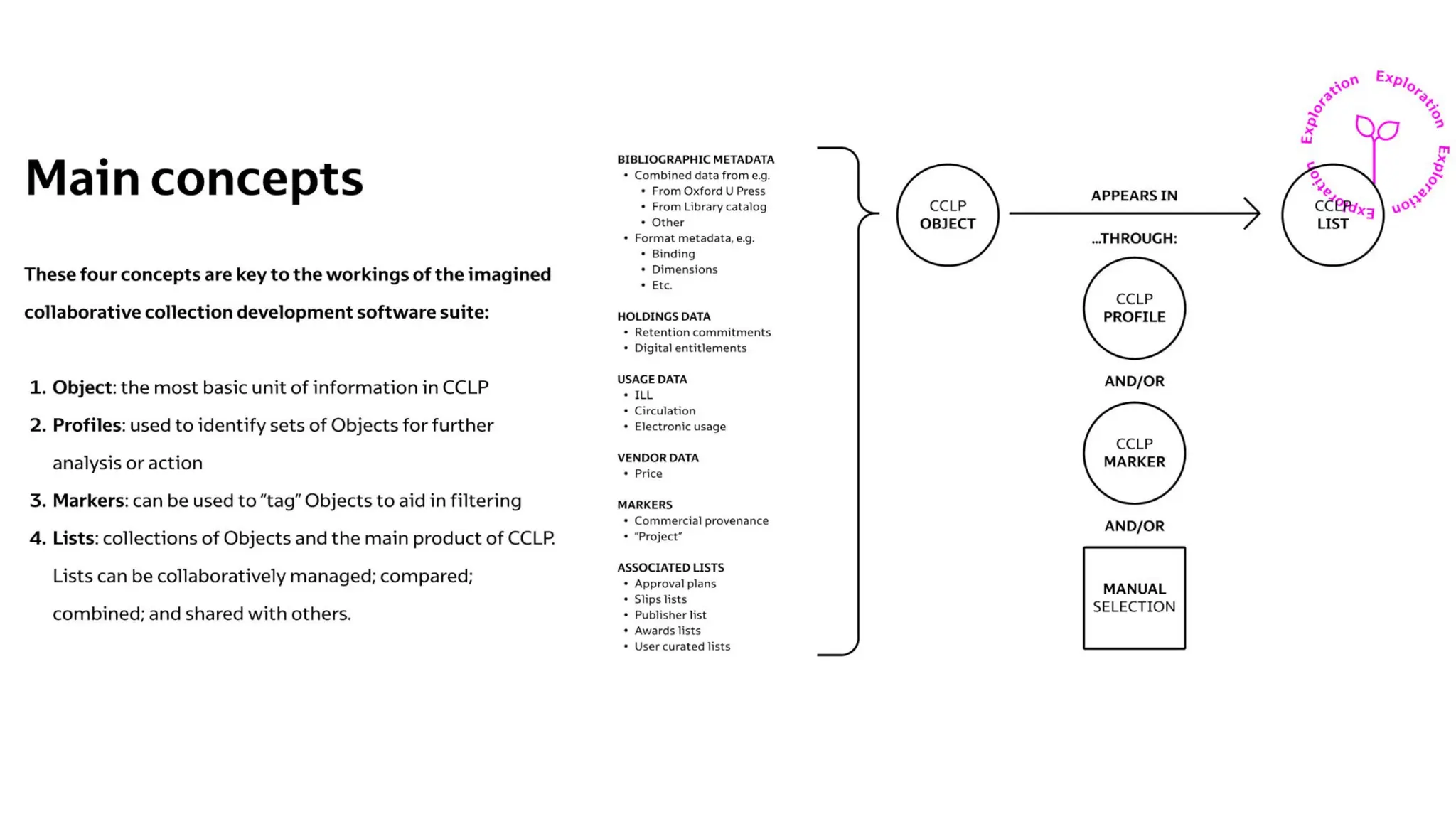
UX-led functional analysis
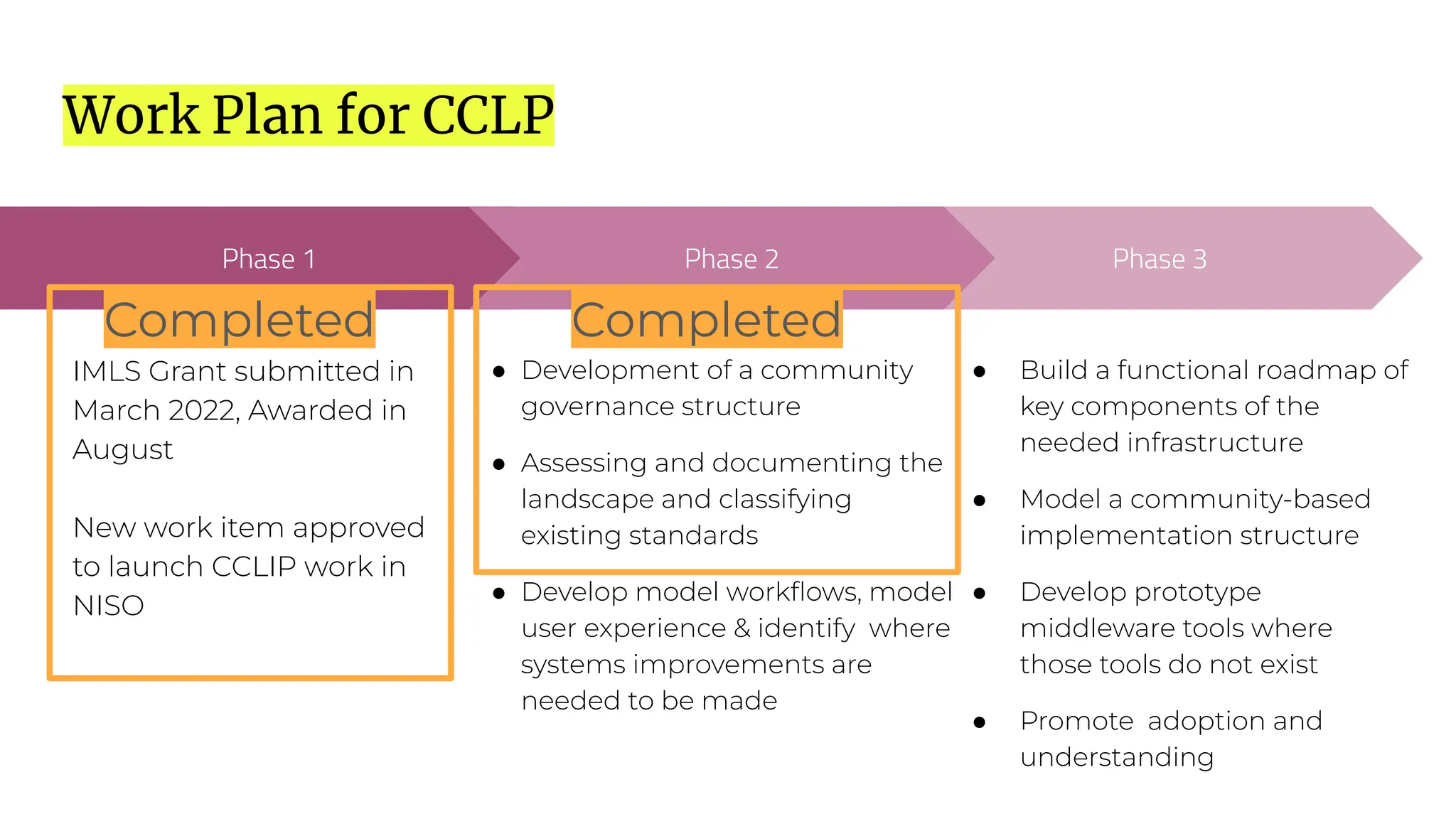
Work Plan for CCLP
Phase 3
● Build a functional roadmap of
key components of the
needed infrastructure
● Model a community-based
implementation structure
● Develop prototype
middleware tools where
those tools do not exist
● Promote adoption and
understanding
Phase 1
IMLS Grant submitted in
March 2022, Awarded in
August
New work item approved
to launch CCLIP work in
NISO
Phase 2
● Development of a community
governance structure
● Assessing and documenting the
landscape and classifying
existing standards
● Develop model workflows, model
user experience & identify where
systems improvements are
needed to be made
Completed Completed
Next Steps
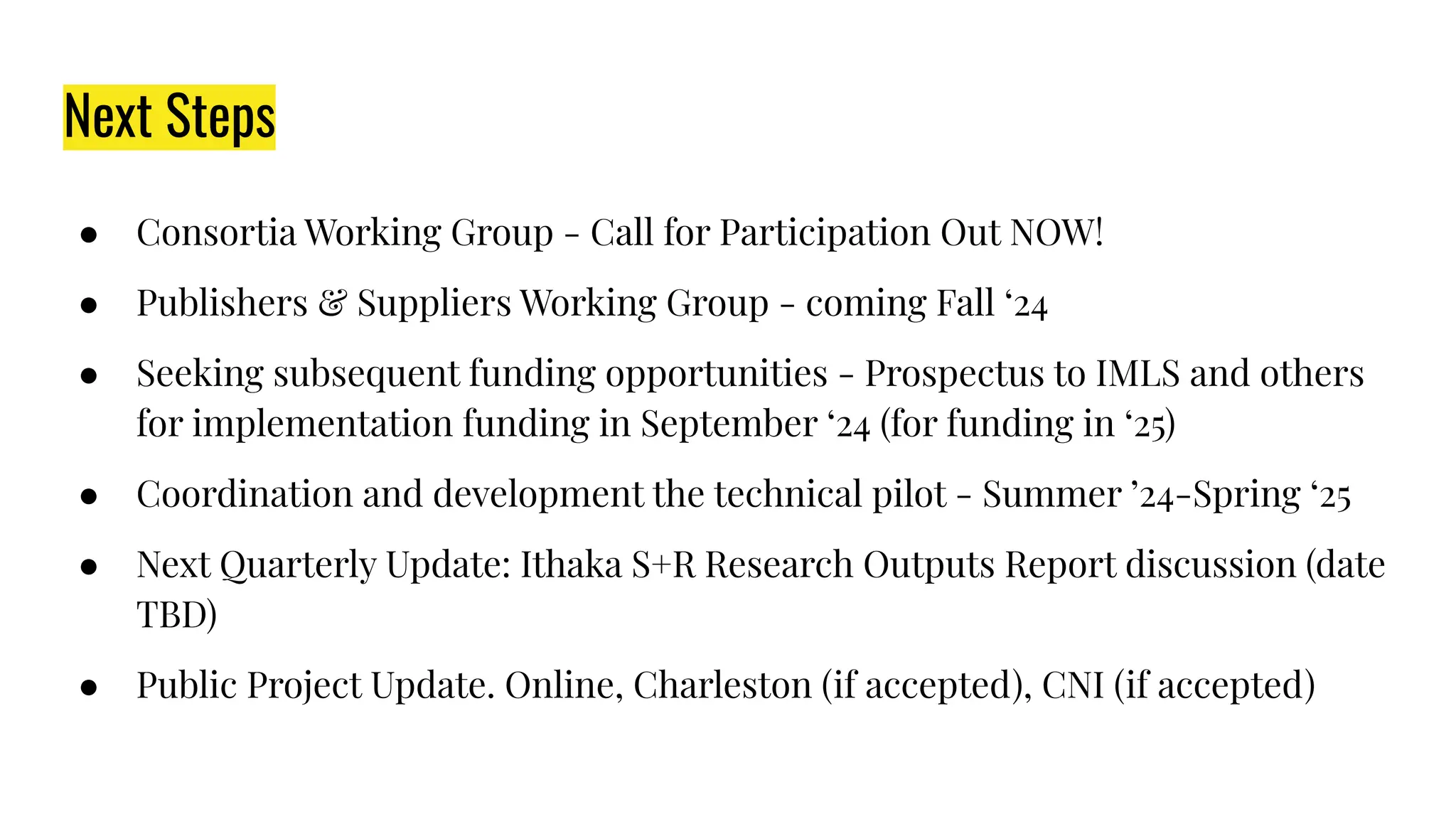
● Consortia Working Group - Call for Participation Out NOW!
● Publishers & Suppliers Working Group - coming Fall ‘24
● Seeking subsequent funding opportunities - Prospectus to IMLS and others
for implementation funding in September ‘24 (for funding in ‘25)
● Coordination and development the technical pilot - Summer ’24-Spring ‘25
● Next Quarterly Update: Ithaka S+R Research Outputs Report discussion (date
TBD)
● Public Project Update. Online, Charleston (if accepted), CNI (if accepted)
QUESTIONS?
We welcome any questions or comments you may have.
THANK YOU!
Co-PI Team
Todd Carpenter — Boaz Nadav Manes — Jill Morris
NISO Staff Support
Keondra Bailey — Nettie Lagace
Collaborative Collections Lifecycle Project website
This project is generously supported, in part, by a National Leadership Grant from the
Institute for Museum and Library Services. (Grant ID: LG-252384-OLS-22)

Carpenter, Hammer, and Nadav-Manes "Collaborative Collections Lifecycle Project Update"

  • 1.
  • 2.
    Meeting Agenda 1. Introductions& Background 2. Collaboration models 3. Description of the focus of CCLIP Working Groups a. Acquisitions b. Assessment/Data Analysis c. Cataloging/Metadata d. Collections Development & Selection e. Infrastructure f. Organizational Strategy & Governance g. Consortia (Newly announced) h. Vendors (forthcoming in Q3 2024) i. Publishers (forthcoming in Q3 2024) 4. Progress on UX Work and prototype mockups 5. Next Steps in the CCLP Project, new groups 6. Q&A
  • 3.
    Thank you forthe support! The CCLP project was made possible in part by the Institute of Museum and Library Services (IMLS) Grant #: LG-252384-OLS-22. For more information about this grant visit: https:/ /www.imls.gov/grants/awarded/lg-252384-ols-22
  • 4.
    We are gratefulfor the support and contributions of: ● Big Ten Academic Alliance (BTAA) ● Canadian Research Knowledge Network (CRKN) ● Greater Western Library Alliance (GWLA) ● Center for Research Libraries ● Colorado Alliance of Research Libraries ● Minitex ● Orbis Cascade Alliance, ● Boston Library Consortium ● Eastern Academic Scholars’ Trust (EAST) ● Virginia's Academic Library Consortium (VIVA) ● Washington Research Library Consortium (WRLC) ● Ithaka S+R ● Index Data, LLC ● ISSN International Centre ● Paratext, LLC ● Cornell University Library ● Columbia University Libraries ● Johns Hopkins University Libraries ● New York University Libraries ● Rutgers University Libraries ● Tulane University Libraries ● University of Delaware Library Museums and Press ● University of Denver Libraries ● University of Pittsburgh Library System ● Washington & Jefferson College ● Duke University Library and Press ● JSTOR ● Project MUSE In addition, we like to thank individuals from Brandeis University Library, The Internet Archive, Princeton University Library, Bloomsbury Publishing, Hathi Trust, The California Digital Library, New York Public Library, University of Miami Libraries, Yale University Libraries, The Research Collections and Preservation Consortium (ReCAP), and many more supporting the CCLIP Working Groups
  • 5.
    Mission & Vision Mission Throughcollaboration and innovation with trusted partners in an interoperable, community-owned infrastructure, CCLP will create best practices, improve standards, and develop prototype middleware to empower value-driven library collecting, increase collection diversity, availability and access, and improve stewardship and institutional efficiency in a collaboration-first environment. Vision Our vision is for a world in which all libraries may have and steward equitable, financially sustainable, and efficient access to library resources and the scholarly record by fostering an ecosystem of interoperable systems, standards, and open collaboration among libraries, publishers, and service providers.
  • 6.
    Core Values andPrinciples Co-ownership of project outputs Provider-neutral approaches Interoperability Engagement of community promoting mutual understanding & stewardship for collaborating around collections, including models/mechanisms for acquiring and accessing open content Cost-effective, highly practical and usable solutions Data privacy & security http:/ /cclproject.org
  • 7.
    Objectives - Whatwe’re here to do (in this phase of the project) CCLP Grant Project Phase 1 – Project Goals and Outputs (2022-2025) 1. Development of a project governance and community structure 2. Development of a Recommended Practice for the collaborative collections lifecycle *within the scope determined by the Steering Committee* a. Develop model workflows, model user experience & identify where systems improvements or standards are needed 3. Development of collaborative collections technology prototype middleware a. Scoped according to Steering Committee focus, with learnings/input coming from recommended practice and… 4. Develop a research report focused on gathering information from the landscape and analyzing examples with key learnings, focus on organizational strategy (ITHAKA S+R) – COMING SOON! a. Outputs incorporated into Steering committee conversations; prototyping; recommended practices
  • 8.
    Steering Committee Kim Armstrong,WRLC Todd Carpenter, NISO (Project Co-PI) Jeff Carroll, Rutgers University Raym Crow, SPARC, Independent Consultant Jason Friedman, Canadian Research Knowledge Network Sebastian Hammer, Index Data Michael Levine-Clark, University of Denver George Machovec, Colorado Alliance of Research Libraries Carolyn Morris, Ingram Jill Morris, PALCI (Co-PI) Boaz Nadav Manes, Lehigh University (Co-PI) Wendy Queen, Project MUSE Joe Salem, Duke University Rebecca Seger, ITHAKA Roger Schonfeld, ITHAKA S+R Kornelia Tancheva, University of Pittsburgh
  • 9.
  • 10.
    CCLP Organizational Structure& Project Management Output: Recommended Practice Development Scoping, Values & Vision Output: Prototype Output: Landscape Analysis, Research & Learning from collaboration examples Output: CCLP Community of Practice
  • 11.
    Recommended Practice Outline EachWorking Group will contribute sections to the overall recommended practice, including elements such as: ● Collaborative models ● Terminology ● Key activities and engagements ● What are keys to working together ● Identified barriers & challenges ● Specifics to the personas/roles ● Infrastructure/data needs ● Dependencies with other groups
  • 12.
  • 13.
    ● Ithaka S+R’srole is advising the Collaborative Collection Lifecycle Project (CCLP) Steering Group and conducted research on cooperative collections development practice in support of the initiative’s goals. ● Ithaka S+R Research Team: ○ Tracy Bergstrom, Program Manager for Collections and Infrastructure ○ Oya Y. Rieger, Senior Strategist ○ Roger C. Schonfeld, Vice President, Organizational Strategy & Libraries, Scholarly Communication, and Museums Ithaka S+R Consultancy Scope and Objectives
  • 14.
    ● Provide ahigh-level landscape analysis (10 projects, services, programs) to contextualize specific collaborative collections development exemplars ● Held an interactive workshop with CCLP project team representatives to establish common ground on CCD landscape and situate the project’s goals ● Conducted eight CCD case studies and held a series of workshops to discuss findings ● Advising the CCLP Steering Group on organizational model, governance, sustainability, communication strategies, and engagement of interested parties ● Will Publish a final Ithaka S+R report to share the research outcomes Ithaka S+R Consultancy Scope and Objectives
  • 15.
  • 16.
    Collaboration Model 1:“I live in an apartment building - I just want to know my neighbors” Principles: I need network level information to be more efficient and smart about my own local CD and CM decisions My own local decisions will be fed into network level decision making whether these are centralized or local No need for an MOU nor governing structure but it can function to supplement one I need to be aware of multiple buildings and multiple collaborative models (models 2-4) even if I don’t participate I can choose to belong to model 1, model 2, model 3, model 4 when maturity levels/need increases or decreases Expectations: Data should be efficient to allow me to make quick decisions [what inputs are required?] Data about my own decisions need to be registered [how? where?] Data about my own local usage needs to be registered [how? where?] Way to locally fund, select, and deselect
  • 17.
    Collaboration Model 3:“I live in an apartment building - I want to co-own it and build an optimized commune with everyone in the building” Principles: I need network level information to be more efficient and smart about network level CD and CM decisions Network level decision making will be centralized MOU and governing structure are needed and machine registered I need to be aware of multiple buildings, multiple collaborative models, and singular decisions (models 1-4) I can choose to belong to model 1, model 2, model 3, model 4 when maturity levels increases or decreases Expectations: Data should be efficient to allow me to make quick decisions Data about my own network decisions need to be registered and shared Data about prioritization of network level collaborations needs to be registered (load balancing) Way to jointly fund, select, communicate and deselect together
  • 18.
    Collaboration Model 4:“I live in a high-tech city where every apartment building is interconnected, there’s a shared commitment to excellent public transportation & infrastructure, & it’s easy to navigate to any other city” Principles: I need networks level information to be more efficient and smart about network level CD and CM decisions Networks level decision making will be centralized MOUs and governing structures are needed and machine registered I need to be aware of multiple cities, buildings, multiple collaborative models, and singular decisions (models 1-4) I can choose to belong to model 1, model 2, model 3, model 4 when maturity levels increases or decreases Expectations: Data should be efficient to allow networks to make informed decisions Data about my city decisions need to be registered and shared Data about prioritization of city level collaborations needs to be registered (load balancing) Way to jointly fund, select, communicate and deselect together
  • 19.
    Collaboration Model 2:“I live in an apartment building - I want to celebrate birthdays together with some (and maybe borrow sugar for the cake)” CCLP Project – Our Phase 1 Focus Who is in the apartment building? Principles: My collaboration is optional, with partner(s) that have a shared interest I need network level information to be more efficient and smart about my local and network level CD and CM decisions My own local decisions will be fed into network level decision making whether these are centralized or local Commitments and coordination needs increase, may consider an MOU and shared decision-making framework I still need to be aware of multiple buildings and multiple collaborative models (models 2-4) I can choose to belong to model 1, model 2, model 3, model 4 as maturity levels/need increases or decreases Expectations: Data should be efficient to allow me to make quick decisions (duplicate or not?) Data about my network decisions need to be registered and shared Data about prioritization of network level collaborations needs to be registered (load balancing) Way to jointly fund, select, communicate, and deselect together
  • 20.
    Vestibulum congue Vestibulum congue Vestibulum congue Collaboration Coordination& Cooperation Awareness / Data Sharing Retrospective Management Prospective Selection & Acquisition Discover, Circulate & Share Access Preservation Collaboration Continuum Full Integration Data & Metadata Data & Metadata Data & Metadata Coordinated Preservation Selection Digitization, & Management Shared Print & Coordinated Weeding Shared management policies and practices supporting a healthy sharing ecosystem Traditional Resource Sharing Consortial ILL Coordinated Purchase Agreements e.g., with a conspectus approach Backlist / Frontlist Coordination Journals & Scholarly monographs Collaborative Purchases and Shared License Agreements Data & Metadata Data & Metadata SC Direction-Setting ACTIVITY **Add your comments to the diagram on this slide and then position up to 2 lightning bolts on the diagram to tell us where you think CCLP should prioritize its efforts Data & Metadata
  • 21.
    Steering Committee Focus: “Makinggood on promise of shared print “Making use of data about our retained and shared collections” “Most bang for the buck is in coordinated purchasing” “Prospective as a primary focus” CCLP’s scope for this phase of the project will be to focus on improving our ability to prospectively make decisions together about acquiring collections within a “Model 2” optional collaboration structure where shared goals and needs are identified across more than one institution. To accomplish that scope, we’ll be using data about our retrospective collections and thinking about what standards /practices are required to allow for data sharing across institutions, as well as what social, organizational, and technical decision-making frameworks and infrastructures will help facilitate those arrangements. →Collaboration initiators, decision-makers and stakeholders may vary within this scope, depending on the use case and goals. We want each group thinking about identified personas, typical workflows and high impact opportunities + low-hanging fruit
  • 22.
    Hypothetical example usingmodel 2: Lehigh and Pitt, Rutgers, and PALCI Let's say University of Pittsburgh and Lehigh want to collaborate on starting to collect materials in Ukrainian Studies as part of new University strategies to expand their on-site and DE Area studies programs. Rutgers will be joining later. Lehigh, Pitt, and Rutgers are part of PALCI. Pitt Lehigh Rutgers PALCI Provide needed resources to our users Avoid duplication of effort and waste of collections resources Sustainable
  • 23.
  • 24.
    Collections Development andSelection Working Group https://niso.org/standards-committees/cclip/scope
  • 26.
    From draft recommendation: “Ata very high level, the first step in understanding the potential for collaborative collections activities in this particular model of optional or opt-in collaborations, sits at the intersection of an awareness of the possible collections landscape (i.e., what is possible to collect), and an awareness of the goals, commitments, intentions, and holdings of others in the same ecosystem. At present building such an awareness is a highly manual process among most optional or opt-in collaborations, and especially among those lacking in shared technical infrastructure and systems. Even in the most highly integrated collaborations with shared technical infrastructures and systems, achieving such awareness levels is difficult, arduous and often costly due to the many disparate sources of information, lack of interchangeable data, and lack of standards.“
  • 27.
  • 28.
    From draft recommendation: “Applicationsthat provide services: Middleware applications typically encapsulate functionalities or capabilities that other applications or components can utilize. These services could include defining and modifying profiles to filter titles, sharing profiles with other institutions, and generating lists of titles based on profiles. The prototype under development explores the functional requirements necessary to support awareness for selection and collection development.” “Publishers and libraries should resist the temptation to create new types of identifiers and subject taxonomies and focus instead on crosswalks and interoperability of what exists.”
  • 29.
    Organizational Strategy &Governance Working Group https://niso.org/standards-committees/cclip/scope
  • 30.
    From draft recommendation: ●Positive, forward-thinking outlook by collaborators. Institutions need to view participation as a benefit, not as a fallback. ● Mutual benefits should be clear. It’s important that CCLP’s adoption emphasizes the positive benefits of participation (e.g. allows organizations to focus on their specific differentiators: saves money and time, ability to leverage others' expertise, and reduces startup costs for new programs). ● Innovation leads to unseen future benefits. CCLP should be recognized as ‘innovation’ - advanced and visionary - leading to future advances that can’t be understood or quantified today. ● CCLP will be an additive power. Partnerships won’t detract from an institution's ability to describe their individual value.
  • 31.
  • 32.
    Assessment/Data Analysis WorkingGroup https://niso.org/standards-committees/cclip/scope
  • 33.
  • 34.
  • 35.
    UX Design andPrototype Development Technical Project Lead Team Sebastian Hammer, Index Data Filip Jakobson, UX Design Lead Boaz Nadav Manes, Lehigh University (Co-PI) Carolyn Morris, Ingram More to be appointed after initial UX work is completed
  • 36.
    Where we startedfrom Data Middleware Applications + features Stakeholders + Needs
  • 37.
  • 45.
    Work Plan forCCLP Phase 3 ● Build a functional roadmap of key components of the needed infrastructure ● Model a community-based implementation structure ● Develop prototype middleware tools where those tools do not exist ● Promote adoption and understanding Phase 1 IMLS Grant submitted in March 2022, Awarded in August New work item approved to launch CCLIP work in NISO Phase 2 ● Development of a community governance structure ● Assessing and documenting the landscape and classifying existing standards ● Develop model workflows, model user experience & identify where systems improvements are needed to be made Completed Completed
  • 46.
    Next Steps ● ConsortiaWorking Group - Call for Participation Out NOW! ● Publishers & Suppliers Working Group - coming Fall ‘24 ● Seeking subsequent funding opportunities - Prospectus to IMLS and others for implementation funding in September ‘24 (for funding in ‘25) ● Coordination and development the technical pilot - Summer ’24-Spring ‘25 ● Next Quarterly Update: Ithaka S+R Research Outputs Report discussion (date TBD) ● Public Project Update. Online, Charleston (if accepted), CNI (if accepted)
  • 47.
    QUESTIONS? We welcome anyquestions or comments you may have.
  • 48.
    THANK YOU! Co-PI Team ToddCarpenter — Boaz Nadav Manes — Jill Morris NISO Staff Support Keondra Bailey — Nettie Lagace Collaborative Collections Lifecycle Project website This project is generously supported, in part, by a National Leadership Grant from the Institute for Museum and Library Services. (Grant ID: LG-252384-OLS-22)