Download to read offline



![Sources text Edwards, T.L. (2008). Brazil: A global studies handbook . Santa Barbara, CA: ABC- Clio, Inc. Rix, A.C. (2009). A close-up of Carnival season in Brazil [Electronic version]. Ohmy News International.](https://image.slidesharecdn.com/carnivalpowerpoint-090310143752-phpapp01-111109210936-phpapp02/85/Carnivalpowerpoint-090310143752-phpapp01-10-320.jpg)

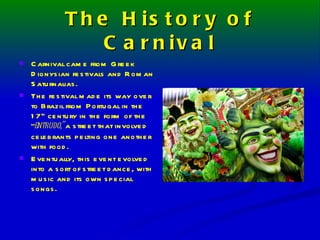
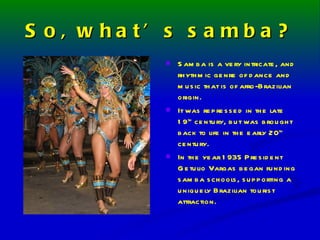
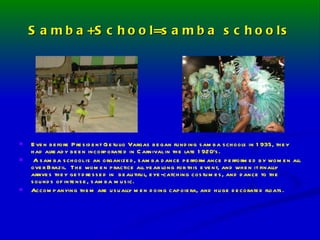
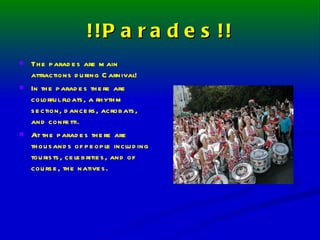
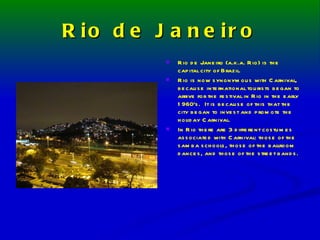
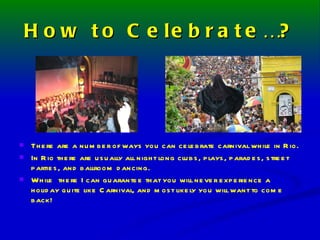
Carnival in Brazil originated from Greek and Roman festivals and was brought to Brazil by the Portuguese in the 17th century. It evolved into a street celebration with music and dancing. Samba is an intricate Afro-Brazilian music and dance genre that was incorporated into Carnival performances in the 1920s. President Vargas began funding samba schools in 1935 to promote them as a Brazilian cultural attraction. Samba schools involve organized dance performances by women in elaborate costumes to intense samba music accompanied by men doing capoeira and floats. Rio de Janeiro is synonymous with Carnival as international tourists arrived in the 1960s, promoting parades, street parties, and dancing during the holiday season.


