Carnival is the most
important festival of
   Barranquilla, the
 happiest, the most
  libertarian, which
     reflects more
 strongly the jovial
 and creative spirit
 of our people, and
      affirms our
   belonging to the
      Caribbean.
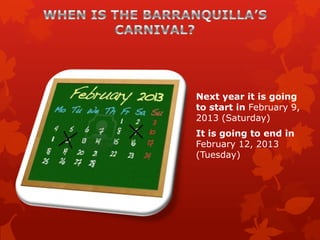
Next year it is going
to start in February 9,
2013 (Saturday)
It is going to end in
February 12, 2013
(Tuesday)
WHERE IS THE
 BARRANQUILLA’S CARNIVAL?
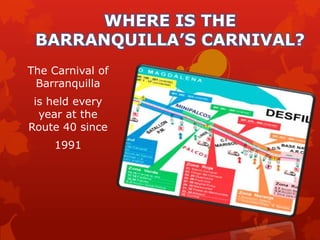
The Carnival of
 Barranquilla
 is held every
  year at the
Route 40 since
    1991
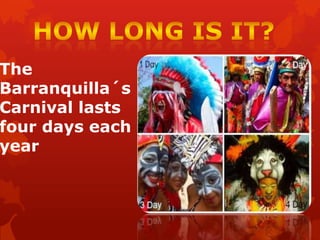
The
Barranquilla´s
Carnival lasts
four days each
year
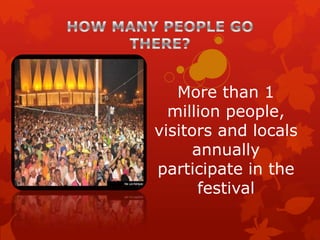
More than 1
  million people,
visitors and locals
     annually
participate in the
      festival
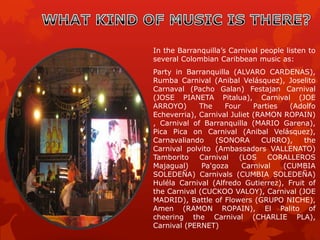
In the Barranquilla’s Carnival people listen to
several Colombian Caribbean music as:
Party in Barranquilla (ALVARO CARDENAS),
Rumba Carnival (Anibal Velásquez), Joselito
Carnaval (Pacho Galan) Festajan Carnival
(JOSE PIANETA Pitalua), Carnival (JOE
ARROYO)      The    Four     Parties   (Adolfo
Echeverria), Carnival Juliet (RAMON ROPAIN)
, Carnival of Barranquilla (MARIO Garena),
Pica Pica on Carnival (Anibal Velásquez),
Carnavaliando     (SONORA      CURRO),    the
Carnival polvito (Ambassadors VALLENATO)
Tamborito    Carnival (LOS       CORALLEROS
Majagual)     Pa'goza     Carnival   (CUMBIA
SOLEDEÑA) Carnivals (CUMBIA SOLEDEÑA)
Huléla Carnival (Alfredo Gutierrez), Fruit of
the Carnival (CUCKOO VALOY), Carnival (JOE
MADRID), Battle of Flowers (GRUPO NICHE),
Amen (RAMON ROPAIN), El Palito of
cheering the Carnival (CHARLIE PLA),
Carnival (PERNET)
The Carnival is a cultural event
which expresses and represents
all   cultural   varieties   of   the
Colombian      Atlantic    Coast,   it
unleashes the folklore of the
region, the most diverse local
cultural    events,     music     and
dancing. It is, without question,
the most representative of the
city, a fun space that attracts all
and sundry.
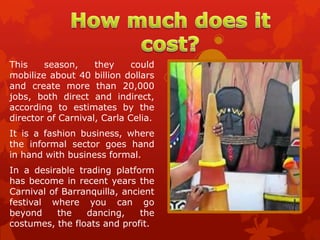
This    season,     they     could
mobilize about 40 billion dollars
and create more than 20,000
jobs, both direct and indirect,
according to estimates by the
director of Carnival, Carla Celia.
It is a fashion business, where
the informal sector goes hand
in hand with business formal.
In a desirable trading platform
has become in recent years the
Carnival of Barranquilla, ancient
festival where you can go
beyond     the   dancing,     the
costumes, the floats and profit.
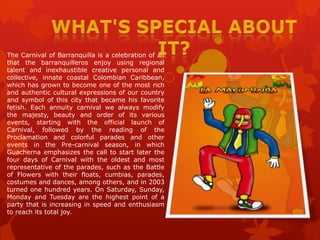
The Carnival of Barranquilla is a celebration of all
that the barranquilleros enjoy using regional
talent and inexhaustible creative personal and
collective, innate coastal Colombian Caribbean,
which has grown to become one of the most rich
and authentic cultural expressions of our country
and symbol of this city that became his favorite
fetish. Each annuity carnival we always modify
the majesty, beauty and order of its various
events, starting with the official launch of
Carnival, followed by the reading of the
Proclamation and colorful parades and other
events in the Pre-carnival season, in which
Guacherna emphasizes the call to start later the
four days of Carnival with the oldest and most
representative of the parades, such as the Battle
of Flowers with their floats, cumbias, parades,
costumes and dances, among others, and in 2003
turned one hundred years. On Saturday, Sunday,
Monday and Tuesday are the highest point of a
party that is increasing in speed and enthusiasm
to reach its total joy.

Barranquilla's carnival

  • 2.
    Carnival is themost important festival of Barranquilla, the happiest, the most libertarian, which reflects more strongly the jovial and creative spirit of our people, and affirms our belonging to the Caribbean.
  • 3.
    Next year itis going to start in February 9, 2013 (Saturday) It is going to end in February 12, 2013 (Tuesday)
  • 4.
    WHERE IS THE BARRANQUILLA’S CARNIVAL? The Carnival of Barranquilla is held every year at the Route 40 since 1991
  • 5.
  • 6.
    More than 1 million people, visitors and locals annually participate in the festival
  • 7.
    In the Barranquilla’sCarnival people listen to several Colombian Caribbean music as: Party in Barranquilla (ALVARO CARDENAS), Rumba Carnival (Anibal Velásquez), Joselito Carnaval (Pacho Galan) Festajan Carnival (JOSE PIANETA Pitalua), Carnival (JOE ARROYO) The Four Parties (Adolfo Echeverria), Carnival Juliet (RAMON ROPAIN) , Carnival of Barranquilla (MARIO Garena), Pica Pica on Carnival (Anibal Velásquez), Carnavaliando (SONORA CURRO), the Carnival polvito (Ambassadors VALLENATO) Tamborito Carnival (LOS CORALLEROS Majagual) Pa'goza Carnival (CUMBIA SOLEDEÑA) Carnivals (CUMBIA SOLEDEÑA) Huléla Carnival (Alfredo Gutierrez), Fruit of the Carnival (CUCKOO VALOY), Carnival (JOE MADRID), Battle of Flowers (GRUPO NICHE), Amen (RAMON ROPAIN), El Palito of cheering the Carnival (CHARLIE PLA), Carnival (PERNET)
  • 8.
    The Carnival isa cultural event which expresses and represents all cultural varieties of the Colombian Atlantic Coast, it unleashes the folklore of the region, the most diverse local cultural events, music and dancing. It is, without question, the most representative of the city, a fun space that attracts all and sundry.
  • 9.
    This season, they could mobilize about 40 billion dollars and create more than 20,000 jobs, both direct and indirect, according to estimates by the director of Carnival, Carla Celia. It is a fashion business, where the informal sector goes hand in hand with business formal. In a desirable trading platform has become in recent years the Carnival of Barranquilla, ancient festival where you can go beyond the dancing, the costumes, the floats and profit.
  • 10.
    The Carnival ofBarranquilla is a celebration of all that the barranquilleros enjoy using regional talent and inexhaustible creative personal and collective, innate coastal Colombian Caribbean, which has grown to become one of the most rich and authentic cultural expressions of our country and symbol of this city that became his favorite fetish. Each annuity carnival we always modify the majesty, beauty and order of its various events, starting with the official launch of Carnival, followed by the reading of the Proclamation and colorful parades and other events in the Pre-carnival season, in which Guacherna emphasizes the call to start later the four days of Carnival with the oldest and most representative of the parades, such as the Battle of Flowers with their floats, cumbias, parades, costumes and dances, among others, and in 2003 turned one hundred years. On Saturday, Sunday, Monday and Tuesday are the highest point of a party that is increasing in speed and enthusiasm to reach its total joy.