
Carlisle Letter to Supreme Court
•
1 like•1,948 views

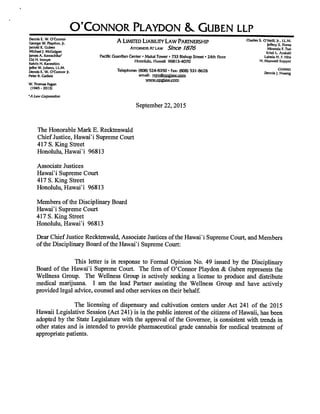
This letter responds to Formal Opinion No. 49 issued by the Hawaii Supreme Court Disciplinary Board regarding the provision of legal services for medical marijuana businesses. The letter proposes two alternatives to amend Hawaii Rule of Professional Conduct 1.2(d) to allow such legal services: 1) Add a comment clarifying that lawyers can advise on conduct permitted by state law, or 2) Directly amend Rule 1.2(d) to include such language. The letter also urges reconsideration of Formal Opinion No. 49 given the passage of Hawaii's medical marijuana law.

Recommended
Recommended
More Related Content
What's hot
What's hot (20)
Similar to Carlisle Letter to Supreme Court
Similar to Carlisle Letter to Supreme Court (20)
More from Honolulu Civil Beat
More from Honolulu Civil Beat (20)
Recently uploaded
Recently uploaded (20)
Carlisle Letter to Supreme Court
- 1. O'CONNOR PLAYDON & GUBEN LLP Dennis LW. O'Connor A LIMrI-ED LIABILITY LAW PARTNERSHIP Charles S. O'Neill, Jr., I.L.M. George W. Playdon, Jr. Jeffery S. Flores Jerrold K. Guben ATTORNEYS AT LAW Since 1876 Miranda F. Tsai Michael J. McGuigan KristI L. Arakald James A. Kawachlka Pacific Guardian Center • Makal Tower • 733 Bishop Street • 24th Floor Lahela H. F. Hite Cid H. Inouye Honolulu, Hawaii 96813-4070 H. Maxwell Kopper Kelvin H. Kaneshlro Jefite W. Jullano, LL.M. Dennis E. W. O'Connor Jr. Telephone: (808) 524-8350 • Fax (808) 531-8628 COUNSEL Peter B. Carlisle email: mjm@ooglaw.com Dennis J. Hwang www.00slaw.com W. Thomas Fagan (1945- 2013) *A Law Corporation September 22, 2015 The Honorable Mark E. Recktenwald Chief Justice, Hawai'i Supreme Court 417 S. King Street Honolulu, Hawai'i 96813 Associate Justices Hawai'i Supreme Court 417 S. King Street Honolulu, Hawai'i 96813 Members of the Disciplinary Board Hawai'i Supreme Court 417 S. King Street Honolulu, Hawai'i 96813 Dear Chief Justice Recktenwald, Associate Justices of the Hawai'i Supreme Court, and Members of the Disciplinary Board of the Hawai'i Supreme Court: This letter is in response to Formal Opinion No. 49 issued by the Disciplinary Board of the Hawai'i Supreme Court. The firm of O'Connor Playdon & Guben represents the Wellness Group. The Wellness Group is actively seeking a license to produce and distribute medical marijuana. I am the lead Partner assisting the Wellness Group and have actively provided legal advice, counsel and other services on their behalf. The licensing of dispensary and cultivation centers under Act 241 of the 2015 Hawaii Legislative Session (Act 241) is in the public interest of the citizens of Hawaii, has been adopted by the State Legislature with the approval of the Governor, is consistent with trends in other states and is intended to provide pharmaceutical grade cannabis for medical treatment of appropriate patients.
- 2. Hawaii Supreme Court September 22, 2015 Page 2 Given the passage of Act 241, we respectfully request that Rule 1.2(d) of the Hawaii Rules of Professional Conduct (HRPC) be amended to allow for lawyers to provide legal services to facilitate the establishment and operation of a medical marijuana business under Act 241. This letter provides two alternative methods to allow for legal services with respect to Act 241. The first option is to provide a comment to the existing HRPC Rule 1.2(d). The second option is to amend Rule 1.2(d). Lastly, this letter respectfully urges the Disciplinary Board of the Hawai'i Supreme Court to reconsider Formal Opinion No. 49. Proposed Comment to HRPC Rule 1.2(d) Several states that allow both recreational and medical marijuana dispensaries have issued comments to their version of the Rules of Professional Conduct Rule 1.2(d) to allow for the legal services of lawyers. Colorado's Rule 1.2 (d) of the Colorado Rules of Professional Conduct is essentially identical to HRPC Rule 1.2(d). In providing a comment to this rule, the Colorado Supreme Court expressly allowed the legal services with respect to Colorado's medical and recreational marijuana constitutional provisions. Comment 14 to Rule 1.2(d) of Colorado Rules of Professional Conduct states: A lawyer may counsel a client regarding the validity, scope, and meaning of Colorado constitution article XTIII, secs. 14 & 16, and may assist a client in conduct that the lawyer reasonably believes is permitted by these constitutional provisions and the statutes, regulations, orders, and other state or local provisions implementing them. In these circumstances, the lawyer shall also advise the client regarding related federal law and policy. 1 Washington provides a slightly different version of the Colorado and Nevada comments. Washington specifically mentions the current federal enforcement policy with respect to medical and recreational marijuana, yet excludes any other reference to federal law. 1 The Nevada Supreme Court provides an almost identical comment to its Rules of Professional Conduct Rule 1.2(d): A lawyer may counsel a client regarding the validity, scope, and meaning of Nevada Constitution Article 4, Section 38, and NRS Chapter 453A, and may assist a client in conduct that the lawyer reasonably believes is permitted by these constitutional provisions and statutes, including regulations, orders, and other state or local provisions implementing them. In these circumstances, the lawyer shall also advise the client regarding related federal law and policy.
- 3. Hawaii Supreme Court September 22, 2015 Page 3 At least until there is a change in federal enforcement policy, a lawyer may counsel a client regarding the validity, scope and meaning of Washington Initiative 502 (Laws of 2013, ch. 3) and may assist a client in conduct that the lawyer reasonably believes is permitted by this statute and the other statutes, regulations, orders, and other state and local provisions implementing them. With these rules in mind we recommend following the Nevada and Colorado approach. We do not believe it is necessary to include a reference to the federal enforcement policy. Rather, lawyers should be permitted to advise with respect to activities expressly allowed under Hawaii law, in this case, Act 241. Furthermore, limiting the rule to the currently enacted Marijuana Legislation is shortsighted, as any new law may require additional comments. Therefore, we propose that the following Comment to HRPC Rule 1.2(d): A lawyer may counsel a client regarding conduct expressly permitted by Hawaii law, provided that in the event Hawaii law conflicts with federal or other laws or regulations, the lawyer shall also advise the client regarding related federal or other laws or regulations. Proposed Amendment to HRPC 1.2(d) An alternative to adding a comment to HRPC 1.2(d) is to amend HRPC 1.2(d). Connecticut has currently taken this approach, adding to its version of 1.2(d): A lawyer shall not counsel a client to engage, or assist a client, in conduct that the lawyer knows is criminal or fraudulent, but a lawyer may (1) discuss the legal consequences of any proposed course of conduct with a client; (2) counsel or assist a client to make a good faith effort to determine the validity, scope, meaning or application of the law; or (3) counsel or assist a client regarding conduct expressly permitted by Connecticut law, provided that the lawyer counsels the client about the legal consequences, under other applicable law, of the client's proposed course of conduct. Similarly, Oregon has recently amended its version of Rule 1.2. Like Hawaii, Oregon had allowed medical marijuana for many years, yet a change to Rule 1.2 was not needed until Oregon recently allowed for marijuana dispensaries. Oregon's Rules of Professional Conduct 1.2(c) and (d) now read as follows:
- 4. Hawaii Supreme Court September 22, 2015 Page 4 (c) A lawyer shall not counsel a client to engage, or assist a client, in conduct that the lawyer knows is illegal or fraudulent, but a lawyer may discuss the legal consequences of any proposed course of conduct with a client and may counsel or assist a client to make a good faith effort to determine the validity, scope, meaning or application of the law. (d) Notwithstanding paragraph (c), a lawyer may counsel and assist a client regarding Oregon's marijuana-related laws. In the event Oregon law conflicts with federal or tribal law, the lawyer shall also advise the client regarding related federal and tribal law and policy. While both approaches would be sufficient to resolve this issue in Hawaii, we believe the Connecticut approach is more appropriate as it does not single out marijuana-related laws, but rather expressly allows legal services for all conduct permissible under state laws. With this in mind we propose the following amendment to HRPC Rule 1.2(d) as an alternative to the proposed comment provided above: A lawyer shall not counsel a client to engage, or assist a client, in conduct that the lawyer knows is criminal or fraudulent, but a lawyer may discuss the legal consequences of any proposed course of conduct with a client and may counsel or assist a client to make a good faith effort to determine the validity, scope, meaning, or application of the law and may also counsel or assist a client regarding conduct expressly permitted by Hawaii Law, provided that the lawyer counsels the client about the legal consequences, under other applicable law, of the client's proposed course of conduct. (Proposed Amendment Underlined).
- 5. Hawaii Supreme Court September 22, 2015 Page 5 Legal Services With Regard to Act 241 Should be Permitted Under HRPC 1.2(d) as Currently Written As a final alternative to the comment and rule change suggested above, we respectfully urge the Disciplinary Board of the Hawaii Supreme Court to reconsider its Formal Opinion No. 49. The New York State Bar Association, State Bar of Arizona, King County (Washington) Bar Association and Bar Association of San Francisco have all issued opinions that allow legal services to be provided under state marijuana laws. 2 All four opinions focus on two factors, first that the conduct is specifically allowed for under state law, and second that the current federal policy is to not preempt state law. A further look at the Arizona and New York opinions is useful here. The Arizona opinion specifically focuses on the lack of a judicial finding of a conflict between federal and state law: A state law now expressly permits certain conduct. Legal services are necessary or desirable to implement and bring to fruition that conduct expressly permitted under state law. In any potential conflict between state and federal authority, such as may be presented by the interplay between the Act and federal law, lawyers have a critical role to perform in the activities that will lead to the proper resolution of the controversy. Although the Act may be found to be preempted by federal law or otherwise invalid, as of this time there has been no such judicial determination. State Bar of Arizona, Ethics Opinion 11-01 at p. 4. The New York State Bar Association opined that the New York Rules of Professional Conduct permits lawyers to give legal assistance with respect to medical marijuana distribution, which "goes beyond a mere discussion of the legality of the client's proposed conduct." In doing so, the New York State Bar Association focused on the lack of conflict between state law and federal policy: 2 The Rules of Professional Conduct for Arizona and Washington are essentially identical to the Hawaii rule. The New York version differs in wording slightly, reading: "A lawyer shall not counsel a client to engage, or assist a client, in conduct that the lawyer knows is illegal or fraudulent, except that the lawyer may discuss the legal consequences of any proposed course of conduct with a client." Lastly the California version of the rule states: "A member shall not advise the violation of any law, rule, or ruling of a tribunal unless the member believes in good faith that such law, rule, or ruling is invalid. A member may take appropriate steps in good faith to test the validity of any law, rule, or ruling of a tribunal."
- 6. Hawaii Supreme Court September 22, 2015 Page 6 But the situation is different where the state executive branch determines to implement the state legislation by authorizing and regulating medical marijuana, consistent with current, published federal executive-branch enforcement policy, and the federal government does not take effective measures to prevent the implementation of the state law. In that event, the question under Rule 1.2(d) is whether a lawyer may assist in conduct under the state medical marijuana law that the lawyer knows would violate federal narcotics law that is on the books but deliberately unenforced as a matter of federal executive discretion. New York State Bar Association, Ethics Opinion 1024 at ¶ 23. As Act 241 expressly provides for the establishment of medical marijuana dispensaries in Hawaii, the logic of this opinion applies here. A lawyer should be permitted to advise as to activities expressly permitted under state law, where federal policy and case law does not preempt state law. Conclusion Given the enactment of Act 241, and the short time frame in which permits for dispensaries will be issued under the law, we respectfully request that a decision regarding this matter be made quickly. While any three of the above alternatives would suffice to allow lawyers to represent clients under Act 241, in order to allow this representation to occur as soon as possible, we submit that Formal Opinion 49 should be withdrawn, and that a comment or rule change be issued as quickly as possible. Act 241 contains numerous critical deadlines. These imminent deadlines are essential and necessary to the immediate implementation of Act 241. Accordingly, we additionally request that the public comment period for the proposed rule and or comment be waived. Thank you for your consideration. Very truly yours, 2L1Peter B. Carlisle