Career Research  1.1.2 Family Economics and Financial Education  Take Charge of Your Finances
Making an informed Career Decision   Includes a self evaluation of interests Making future career projections  Selecting personal goals Goals are the end result of something a person intends to acquire, achieve, do, reach, or accomplish sometime in the near or distant future Short-term goals are accomplished within one year  Long-term goals are accomplished in more then one year © Family Economics & Financial Education – Revised April 2008 – Career Development Unit – Career Research – Slide  Funded by a grant from Take Charge America, Inc. to the Norton School of Family and Consumer Sciences at the University of Arizona
Career vs. Job What is the difference between a job and a career? Career A commitment to a profession which requires continued training and offers a clear path for occupational growth  Example: Educator Job An employment position obtained mainly to earn money  Example: Gas Station Attendant  © Family Economics & Financial Education – Revised April 2008 – Career Development Unit – Career Research – Slide  Funded by a grant from Take Charge America, Inc. to the Norton School of Family and Consumer Sciences at the University of Arizona
Job Opportunities   Pick a career path with job opportunities in the future Three main factors influencing future job opportunities Population Labor force Demand for goods and services © Family Economics & Financial Education – Revised April 2008 – Career Development Unit – Career Research – Slide  Funded by a grant from Take Charge America, Inc. to the Norton School of Family and Consumer Sciences at the University of Arizona
Factors Population affects the size of the labor force  Affects the quantity of goods produced Demand for goods and services determines employment within industries © Family Economics & Financial Education – Revised April 2008 – Career Development Unit – Career Research – Slide  Funded by a grant from Take Charge America, Inc. to the Norton School of Family and Consumer Sciences at the University of Arizona
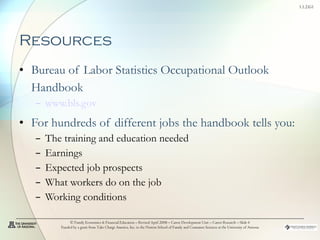
Resources Bureau of Labor Statistics Occupational Outlook Handbook www.bls.gov   For hundreds of different jobs the handbook tells you:  The training and education needed Earnings  Expected job prospects What workers do on the job  Working conditions © Family Economics & Financial Education – Revised April 2008 – Career Development Unit – Career Research – Slide  Funded by a grant from Take Charge America, Inc. to the Norton School of Family and Consumer Sciences at the University of Arizona
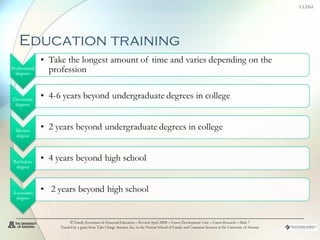
Education training © Family Economics & Financial Education – Revised April 2008 – Career Development Unit – Career Research – Slide  Funded by a grant from Take Charge America, Inc. to the Norton School of Family and Consumer Sciences at the University of Arizona
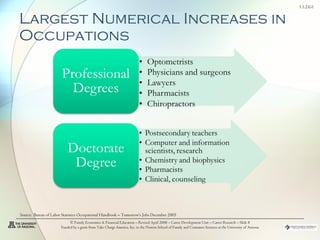
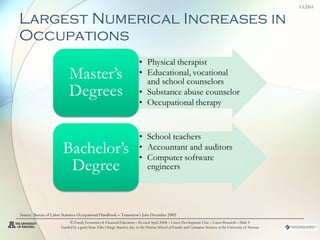
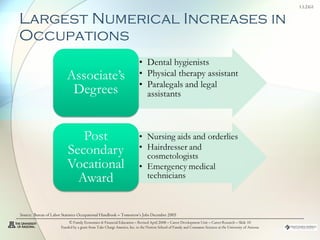
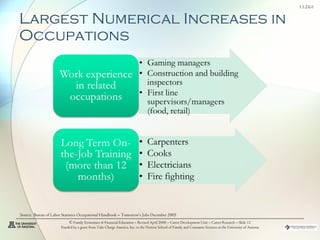
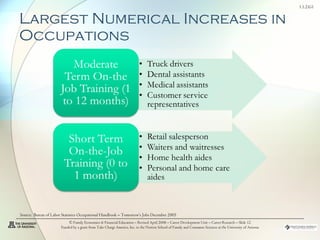
Largest Numerical Increases in Occupations © Family Economics & Financial Education – Revised April 2008 – Career Development Unit – Career Research – Slide  Funded by a grant from Take Charge America, Inc. to the Norton School of Family and Consumer Sciences at the University of Arizona Source:  Bureau of Labor Statistics Occupational Handbook – Tomorrow’s Jobs December 2005
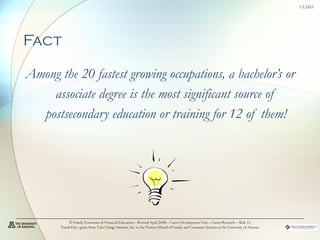
Fact Among the 20 fastest growing occupations, a bachelor’s or associate degree is the most significant source of postsecondary education or training for 12 of them! © Family Economics & Financial Education – Revised April 2008 – Career Development Unit – Career Research – Slide  Funded by a grant from Take Charge America, Inc. to the Norton School of Family and Consumer Sciences at the University of Arizona
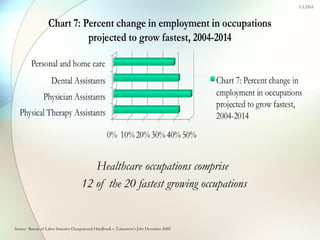
Healthcare occupations comprise  12 of the 20 fastest growing occupations Source:  Bureau of Labor Statistics Occupational Handbook – Tomorrow’s Jobs December 2005
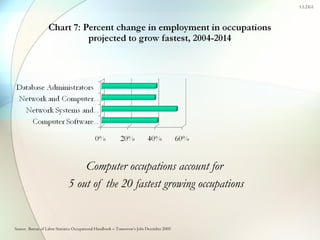
Computer occupations account for  5 out of the 20 fastest growing occupations Source:  Bureau of Labor Statistics Occupational Handbook – Tomorrow’s Jobs December 2005
Occupations projected to Grow Fastest,   2004-2014 In groups of 2-3 hypothesize why health care positions and computer/technology positions are growing so fast  These combined jobs will add more than 1.8 million new jobs Source:  Bureau of Labor Statistics Occupational Handbook – Tomorrow’s Jobs December 2005
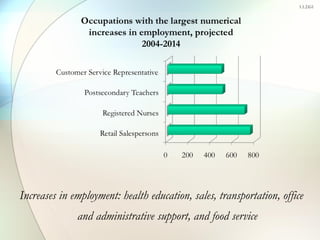
Increases in employment: health education, sales, transportation, office and administrative support, and food service
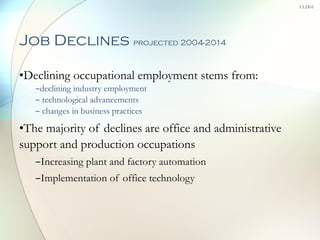
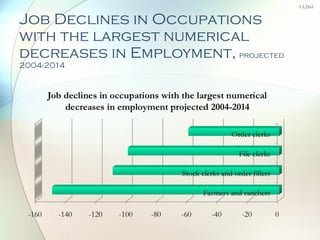
Job Declines  projected 2004-2014 Declining occupational employment stems from: declining industry employment technological advancements changes in business practices The majority of declines are office and administrative support and production occupations  Increasing plant and factory automation  Implementation of office technology
Job Declines in Occupations with the largest numerical decreases in Employment,   projected 2004-2014
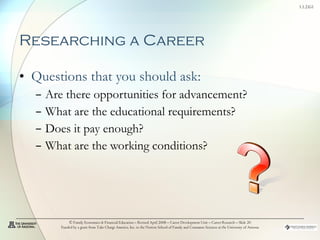
Researching a Career Questions that you should ask: Are there opportunities for advancement? What are the educational requirements? Does it pay enough? What are the working conditions? © Family Economics & Financial Education – Revised April 2008 – Career Development Unit – Career Research – Slide  Funded by a grant from Take Charge America, Inc. to the Norton School of Family and Consumer Sciences at the University of Arizona

Career research power_point_1.1.2.g1

  • 1.
    Career Research 1.1.2 Family Economics and Financial Education Take Charge of Your Finances
  • 2.
    Making an informedCareer Decision Includes a self evaluation of interests Making future career projections Selecting personal goals Goals are the end result of something a person intends to acquire, achieve, do, reach, or accomplish sometime in the near or distant future Short-term goals are accomplished within one year Long-term goals are accomplished in more then one year © Family Economics & Financial Education – Revised April 2008 – Career Development Unit – Career Research – Slide Funded by a grant from Take Charge America, Inc. to the Norton School of Family and Consumer Sciences at the University of Arizona
  • 3.
    Career vs. JobWhat is the difference between a job and a career? Career A commitment to a profession which requires continued training and offers a clear path for occupational growth Example: Educator Job An employment position obtained mainly to earn money Example: Gas Station Attendant © Family Economics & Financial Education – Revised April 2008 – Career Development Unit – Career Research – Slide Funded by a grant from Take Charge America, Inc. to the Norton School of Family and Consumer Sciences at the University of Arizona
  • 4.
    Job Opportunities Pick a career path with job opportunities in the future Three main factors influencing future job opportunities Population Labor force Demand for goods and services © Family Economics & Financial Education – Revised April 2008 – Career Development Unit – Career Research – Slide Funded by a grant from Take Charge America, Inc. to the Norton School of Family and Consumer Sciences at the University of Arizona
  • 5.
    Factors Population affectsthe size of the labor force Affects the quantity of goods produced Demand for goods and services determines employment within industries © Family Economics & Financial Education – Revised April 2008 – Career Development Unit – Career Research – Slide Funded by a grant from Take Charge America, Inc. to the Norton School of Family and Consumer Sciences at the University of Arizona
  • 6.
    Resources Bureau ofLabor Statistics Occupational Outlook Handbook www.bls.gov For hundreds of different jobs the handbook tells you: The training and education needed Earnings Expected job prospects What workers do on the job Working conditions © Family Economics & Financial Education – Revised April 2008 – Career Development Unit – Career Research – Slide Funded by a grant from Take Charge America, Inc. to the Norton School of Family and Consumer Sciences at the University of Arizona
  • 7.
    Education training ©Family Economics & Financial Education – Revised April 2008 – Career Development Unit – Career Research – Slide Funded by a grant from Take Charge America, Inc. to the Norton School of Family and Consumer Sciences at the University of Arizona
  • 8.
    Largest Numerical Increasesin Occupations © Family Economics & Financial Education – Revised April 2008 – Career Development Unit – Career Research – Slide Funded by a grant from Take Charge America, Inc. to the Norton School of Family and Consumer Sciences at the University of Arizona Source: Bureau of Labor Statistics Occupational Handbook – Tomorrow’s Jobs December 2005
  • 9.
    Largest Numerical Increasesin Occupations © Family Economics & Financial Education – Revised April 2008 – Career Development Unit – Career Research – Slide Funded by a grant from Take Charge America, Inc. to the Norton School of Family and Consumer Sciences at the University of Arizona Source: Bureau of Labor Statistics Occupational Handbook – Tomorrow’s Jobs December 2005
  • 10.
    Largest Numerical Increasesin Occupations © Family Economics & Financial Education – Revised April 2008 – Career Development Unit – Career Research – Slide Funded by a grant from Take Charge America, Inc. to the Norton School of Family and Consumer Sciences at the University of Arizona Source: Bureau of Labor Statistics Occupational Handbook – Tomorrow’s Jobs December 2005
  • 11.
    Largest Numerical Increasesin Occupations © Family Economics & Financial Education – Revised April 2008 – Career Development Unit – Career Research – Slide Funded by a grant from Take Charge America, Inc. to the Norton School of Family and Consumer Sciences at the University of Arizona Source: Bureau of Labor Statistics Occupational Handbook – Tomorrow’s Jobs December 2005
  • 12.
    Largest Numerical Increasesin Occupations © Family Economics & Financial Education – Revised April 2008 – Career Development Unit – Career Research – Slide Funded by a grant from Take Charge America, Inc. to the Norton School of Family and Consumer Sciences at the University of Arizona Source: Bureau of Labor Statistics Occupational Handbook – Tomorrow’s Jobs December 2005
  • 13.
    Fact Among the20 fastest growing occupations, a bachelor’s or associate degree is the most significant source of postsecondary education or training for 12 of them! © Family Economics & Financial Education – Revised April 2008 – Career Development Unit – Career Research – Slide Funded by a grant from Take Charge America, Inc. to the Norton School of Family and Consumer Sciences at the University of Arizona
  • 14.
    Healthcare occupations comprise 12 of the 20 fastest growing occupations Source: Bureau of Labor Statistics Occupational Handbook – Tomorrow’s Jobs December 2005
  • 15.
    Computer occupations accountfor 5 out of the 20 fastest growing occupations Source: Bureau of Labor Statistics Occupational Handbook – Tomorrow’s Jobs December 2005
  • 16.
    Occupations projected toGrow Fastest, 2004-2014 In groups of 2-3 hypothesize why health care positions and computer/technology positions are growing so fast These combined jobs will add more than 1.8 million new jobs Source: Bureau of Labor Statistics Occupational Handbook – Tomorrow’s Jobs December 2005
  • 17.
    Increases in employment:health education, sales, transportation, office and administrative support, and food service
  • 18.
    Job Declines projected 2004-2014 Declining occupational employment stems from: declining industry employment technological advancements changes in business practices The majority of declines are office and administrative support and production occupations Increasing plant and factory automation Implementation of office technology
  • 19.
    Job Declines inOccupations with the largest numerical decreases in Employment, projected 2004-2014
  • 20.
    Researching a CareerQuestions that you should ask: Are there opportunities for advancement? What are the educational requirements? Does it pay enough? What are the working conditions? © Family Economics & Financial Education – Revised April 2008 – Career Development Unit – Career Research – Slide Funded by a grant from Take Charge America, Inc. to the Norton School of Family and Consumer Sciences at the University of Arizona