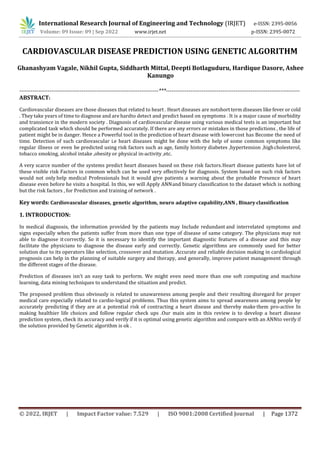
International Research Journal of Engineering and Technology (IRJET) e-ISSN: 2395-0056
Volume: 09 Issue: 09 | Sep 2022 www.irjet.net p-ISSN: 2395-0072
© 2022, IRJET | Impact Factor value: 7.529 | ISO 9001:2008 Certified Journal | Page 1372
CARDIOVASCULAR DISEASE PREDICTION USING GENETIC ALGORITHM
--------------------------------------------------------------------------***-----------------------------------------------------------------------
ABSTRACT:
Cardiovascular diseases are those diseases that related to heart . Heart diseases are notshort term diseases like fever or cold
. They take years of time to diagnose and are hardto detect and predict based on symptoms . It is a major cause of morbidity
and transience in the modern society . Diagnosis of cardiovascular disease using various medical tests is an important but
complicated task which should be performed accurately. If there are any errors or mistakes in those predictions , the life of
patient might be in danger. Hence a Powerful tool in the prediction of heart disease with lowercost has Become the need of
time. Detection of such cardiovascular i.e heart diseases might be done with the help of some common symptoms like
regular illness or even be predicted using risk factors such as age, family history diabetes ,hypertension ,highcholesterol,
tobacco smoking, alcohol intake ,obesity or physical in-activity ,etc.
A very scarce number of the systems predict heart diseases based on these risk factors.Heart disease patients have lot of
these visible risk Factors in common which can be used very effectively for diagnosis. System based on such risk factors
would not only help medical Professionals but it would give patients a warning about the probable Presence of heart
disease even before he visits a hospital. In this, we will Apply ANNand binary classification to the dataset which is nothing
but the risk factors , for Prediction and training of network .
Key words: Cardiovascular diseases, genetic algorithm, neuro adaptive capability,ANN , Binary classification
1. INTRODUCTION:
In medical diagnosis, the information provided by the patients may Include redundant and interrelated symptoms and
signs especially when the patients suffer from more than one type of disease of same category. The physicians may not
able to diagnose it correctly. So it is necessary to identify the important diagnostic features of a disease and this may
facilitate the physicians to diagnose the disease early and correctly. Genetic algorithms are commonly used for better
solution due to its operators like selection, crossover and mutation .Accurate and reliable decision making in cardiological
prognosis can help in the planning of suitable surgery and therapy, and generally, improve patient management through
the different stages of the disease.
Prediction of diseases isn’t an easy task to perform. We might even need more than one soft computing and machine
learning, data mining techniques to understand the situation and predict.
The proposed problem thus obviously is related to unawareness among people and their resulting disregard for proper
medical care especially related to cardio-logical problems. Thus this system aims to spread awareness among people by
accurately predicting if they are at a potential risk of contracting a heart disease and thereby make them pro-active In
making healthier life choices and follow regular check ups .Our main aim in this review is to develop a heart disease
prediction system, check its accuracy and verify if it is optimal using genetic algorithm and compare with an ANNto verify if
the solution provided by Genetic algorithm is ok .
Ghanashyam Vagale, Nikhil Gupta, Siddharth Mittal, Deepti Botlaguduru, Hardique Dasore, Ashee
Kanungo
International Research Journal of Engineering and Technology (IRJET) e-ISSN: 2395-0056
Volume: 09 Issue: 09 | Sep 2022 www.irjet.net p-ISSN: 2395-0072
© 2022, IRJET | Impact Factor value: 7.529 | ISO 9001:2008 Certified Journal | Page 1373
2) General Architecture
a) For genetic algorithm:
b) Genetic algorithm general architecture :
Heart
disease
prediction
system
(Using
genetic
algorithm)
User’s
Output
User input
International Research Journal of Engineering and Technology (IRJET) e-ISSN: 2395-0056
Volume: 09 Issue: 09 | Sep 2022 www.irjet.net p-ISSN: 2395-0072
© 2022, IRJET | Impact Factor value: 7.529 | ISO 9001:2008 Certified Journal | Page 1374
3)Dataset specification:
Heart dataset:
About dataset:
Data Set Characteristics: Multivariate Number of
Instances:
303 Area: Life
Attribute Characteristics: Categorical,
Integer, Real
Number of
Attributes:
75 Date Donated 1988-07-01
Associated Tasks:
Classification
Missing Values? Yes Number ofWeb
Hits:
1469955
1. SYSTEM DESIGN
1.1. Architecture Diagram / Flow Diagram / Flowchart
International Research Journal of Engineering and Technology (IRJET) e-ISSN: 2395-0056
Volume: 09 Issue: 09 | Sep 2022 www.irjet.net p-ISSN: 2395-0072
© 2022, IRJET | Impact Factor value: 7.529 | ISO 9001:2008 Certified Journal | Page 1375
System architecture:
5.2 Detailed Description of Modules
Patient database: Generally in hospitals certain patient databases are maintained for future use. We are using that data as
our dataset from Kaggle website. This data is themain source of our project and with the help of database we will perform
all the otheroperations in the flow chart.
Pre-processing: We have two types of attributes in the database; primary attributes(more important) and secondary
attributes(less important). Through pre- processing we will refine the data by separating more important attributes from
less one.
Tokenization: It is the process of turning sensitive data into non-sensitive data called "tokens" that can be used in a
database or internal system without bringing it into scope. Tokenization can be used to secure sensitive data by replacing
the original datawith an unrelated value of the same length and format. We will replace the fuzzy valuesof the data as crisp
values and change the data into bit strings so that the data can be easily used in genetic algorithm.
Training the model: Training of the model is done by artificial neural network in which we will perform updation of
weights with the help of old weights present in database. Then by using threshold value and activation function according
to the dataobtained we will compare and provide the output and updated weights as results.
Testing the model: Testing the gained results provide the accuracy of the model. We are performing testing through
genetic algorithm as the best fitted chromosomes survives and the least fitted will be dead. This mechanism gives the
performance of the model. The decision variable ‘x’ is coded into finite length string and initial population is selected
randomly.
Designing fitness of genetic algorithm: Fitness Function (also known as the Evaluation Function) evaluates how
close a given solution is to the optimum solution of the desired problem. It determines how fit a solution is. Then ‘x’ values
aredecoded for initial population.
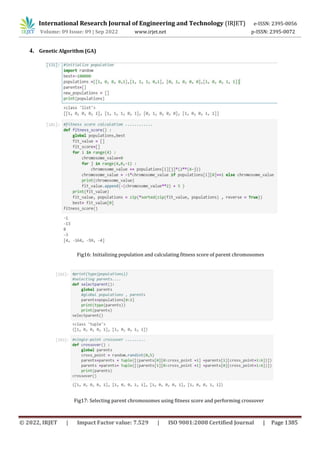
Applying genetic algorithm: Here genetic algorithm comes into action. Genetic Algorithm (GA) is a search-based
optimization technique based on the principles of Genetics and Natural Selection. It is frequently used to find optimal or
near-optimal solutions to difficult problems which otherwise would take a lifetime to solve. The sub tasks of genetic
algorithm like producing child chromosomes from parent chromosomes is done by “crossover” and “mutation” techniques.
International Research Journal of Engineering and Technology (IRJET) e-ISSN: 2395-0056
Volume: 09 Issue: 09 | Sep 2022 www.irjet.net p-ISSN: 2395-0072
© 2022, IRJET | Impact Factor value: 7.529 | ISO 9001:2008 Certified Journal | Page 1376
Collection of results: After crossover and mutation we will get best score of the childchromosomes and matched against
their respected parent fitness score. If the child’s score is greater than parents then child is best fitted and it can proceed
for further survival, otherwise we have to repeat from testing module again till we get the best score.
Prediction of heart disease: With the help of artificial neural network and genetic algorithm we can predict the accuracy
of the model. Genetic based neural network is used for training the system. The final weights of the neural network are
stored in theweight base and are used for predicting the risk of cardiovascular disease. Theclassification accuracy obtained
using this approach is 81.3%.
2. SOFTWARE REQUIREMENTS SPECIFICATION
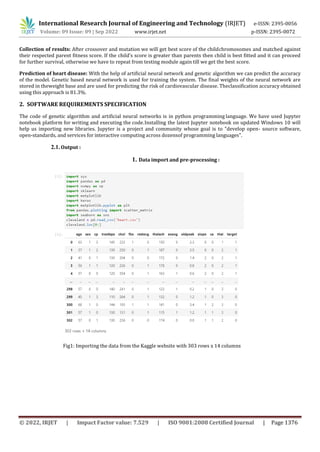
The code of genetic algorithm and artificial neural networks is in python programming language. We have used Jupyter
notebook platform for writing and executing the code.Installing the latest Jupyter notebook on updated Windows 10 will
help us importing new libraries. Jupyter is a project and community whose goal is to "develop open- source software,
open-standards, and services for interactive computing across dozensof programming languages".
2.1. Output :
1. Data import and pre-processing :
Fig1: Importing the data from the Kaggle website with 303 rows x 14 columns
International Research Journal of Engineering and Technology (IRJET) e-ISSN: 2395-0056
Volume: 09 Issue: 09 | Sep 2022 www.irjet.net p-ISSN: 2395-0072
© 2022, IRJET | Impact Factor value: 7.529 | ISO 9001:2008 Certified Journal | Page 1377
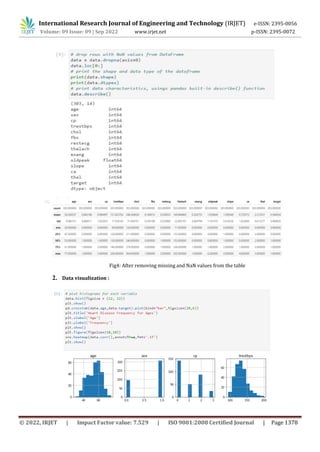
Fig2: removing the missing data from the table
Fig3: Dropping the rows with NaN values from the table
International Research Journal of Engineering and Technology (IRJET) e-ISSN: 2395-0056
Volume: 09 Issue: 09 | Sep 2022 www.irjet.net p-ISSN: 2395-0072
© 2022, IRJET | Impact Factor value: 7.529 | ISO 9001:2008 Certified Journal | Page 1378
Fig4: After removing missing and NaN values from the table
2. Data visualization :
International Research Journal of Engineering and Technology (IRJET) e-ISSN: 2395-0056
Volume: 09 Issue: 09 | Sep 2022 www.irjet.net p-ISSN: 2395-0072
© 2022, IRJET | Impact Factor value: 7.529 | ISO 9001:2008 Certified Journal | Page 1379
Fig5: Histograms of every attribute in the data
Fig6: Heart disease frequency for ages with targets-0,1
International Research Journal of Engineering and Technology (IRJET) e-ISSN: 2395-0056
Volume: 09 Issue: 09 | Sep 2022 www.irjet.net p-ISSN: 2395-0072
© 2022, IRJET | Impact Factor value: 7.529 | ISO 9001:2008 Certified Journal | Page 1380
Fig7: Matrix representation of linear data with its own attributes
3. Training and Testing
Fig8: Training the data using ANN algorithm-only 80% data is used
International Research Journal of Engineering and Technology (IRJET) e-ISSN: 2395-0056
Volume: 09 Issue: 09 | Sep 2022 www.irjet.net p-ISSN: 2395-0072
© 2022, IRJET | Impact Factor value: 7.529 | ISO 9001:2008 Certified Journal | Page 1381
Fig9: Testing the data with accuracy and loss-20% of data is used
International Research Journal of Engineering and Technology (IRJET) e-ISSN: 2395-0056
Volume: 09 Issue: 09 | Sep 2022 www.irjet.net p-ISSN: 2395-0072
© 2022, IRJET | Impact Factor value: 7.529 | ISO 9001:2008 Certified Journal | Page 1382
Fig10: Model loss graph forANN
Fig11: Model accuracy graph for ANN
International Research Journal of Engineering and Technology (IRJET) e-ISSN: 2395-0056
Volume: 09 Issue: 09 | Sep 2022 www.irjet.net p-ISSN: 2395-0072
© 2022, IRJET | Impact Factor value: 7.529 | ISO 9001:2008 Certified Journal | Page 1383
Fig12: Training of data with binary classification algorithm
Fig13: Testing of data with binary classification algorithm
International Research Journal of Engineering and Technology (IRJET) e-ISSN: 2395-0056
Volume: 09 Issue: 09 | Sep 2022 www.irjet.net p-ISSN: 2395-0072
© 2022, IRJET | Impact Factor value: 7.529 | ISO 9001:2008 Certified Journal | Page 1384
Fig14: Model accuracy graph for binary classification
Fig15: Model loss graph for binary classification
International Research Journal of Engineering and Technology (IRJET) e-ISSN: 2395-0056
Volume: 09 Issue: 09 | Sep 2022 www.irjet.net p-ISSN: 2395-0072
© 2022, IRJET | Impact Factor value: 7.529 | ISO 9001:2008 Certified Journal | Page 1385
4. Genetic Algorithm (GA)
Fig16: Initializing population and calculating fitness score of parent chromosomes
Fig17: Selecting parent chromosomes using fitness score and performing crossover
International Research Journal of Engineering and Technology (IRJET) e-ISSN: 2395-0056
Volume: 09 Issue: 09 | Sep 2022 www.irjet.net p-ISSN: 2395-0072
© 2022, IRJET | Impact Factor value: 7.529 | ISO 9001:2008 Certified Journal | Page 1386
Fig18: Performing mutation and getting children chromosomes
International Research Journal of Engineering and Technology (IRJET) e-ISSN: 2395-0056
Volume: 09 Issue: 09 | Sep 2022 www.irjet.net p-ISSN: 2395-0072
© 2022, IRJET | Impact Factor value: 7.529 | ISO 9001:2008 Certified Journal | Page 1387
5. Final Results :
Fig19: Calculating best score of children chromosome
Fig20: Metrics of ANN algorithm for predicting heart disease
International Research Journal of Engineering and Technology (IRJET) e-ISSN: 2395-0056
Volume: 09 Issue: 09 | Sep 2022 www.irjet.net p-ISSN: 2395-0072
© 2022, IRJET | Impact Factor value: 7.529 | ISO 9001:2008 Certified Journal | Page 1388
Fig21: Metrics of binary classification algorithm for predicting heart disease
8. REFERENCES
[1] Reddi, Sivaranjani & srinivasa naresh, Vankamamidi & Murthy, Nistala V.E.S.. (2019). Coronary Heart
Disease prediction using genetic algorithm based decision tree. 10.1515/9783110621105-004.
[2] Gadekallu, Thippa & Reddy, Praveen & Lakshman, Kuruva & Rajput, Dharmendra & Kaluri, Rajesh &
Srivastava, Gautam. (2020). Hybrid genetic algorithm and a fuzzy logic classifier for heart disease diagnosis.
Evolutionary Intelligence. 13. 10.1007/s12065-019-00327-1.
[3] Bano, Shaikh. (2019). Heart Disease Prediction System using Genetic Algorithm.International Journal for
Research in Applied Science and Engineering Technology. 7.2178-2182. 10.22214/ijraset.2019.6366.
[4] Kumkum Chaudhary, Radhika Naidu, Rhea Rai, Narendra Gawai. (2019). HybridArchitecture of Heart
Disease Prediction System using Genetic Neural Network.
V6/i5/IRJET-V6I5857
[5] Uyar, Kaan & Ilhan, Ahmet. (2017). Diagnosis of heart disease using genetic algorithm based trained
recurrent fuzzy neural networks. Procedia Computer Science.120. 588-593. 10.1016/j.procs.2017.11.283.
[6] Awan, Shahid & Riaz, Muhammad & Khan, Abdul. (2018). PREDICTION OF HEART DISEASE USING
ARTIFICIAL NEURAL NETWORK. 13. 102-112.
[7] Prasadgouda B Patil, Dr. P Mallikarjun Shastry, Dr Ashokumar P S. (2020). A Novel Approach for
Prediction of Cardio Vascular Disease: An Improved Genetic Algorithm Approach Using Classifiers. International Journal
ofAdvanced ScienceandTechnology, 29(7s), 4493 – 4504.
[8] Srikanth Meda1 , Raveendra Babu Bhogapathi 2 1 Research scholar, Acharya Nagarjuna University,
Guntur & Associate Professor in the Department of Computer Science and Engineering at R.V.R. & J.C. College of
Engineering, Guntur 522019, India 2 Professor, Department of Computer Science and Engineering, R.V.R & J.C College of
Engineering, Guntur 552019, India
International Research Journal of Engineering and Technology (IRJET) e-ISSN: 2395-0056
Volume: 09 Issue: 09 | Sep 2022 www.irjet.net p-ISSN: 2395-0072
© 2022, IRJET | Impact Factor value: 7.529 | ISO 9001:2008 Certified Journal | Page 1389
[9] Akruti Dave, Prof. Gayatri Pandi , Master of Engineering Student, Head of Department Department of
Computer Engineering ,L. J Institute of Engineering&Technology (Gujarat Technological University), Ahmedabad, India
[10] Kasbe, Tanmay & Pippal, Ravi. (2017). Design of heart disease diagnosis systemusing fuzzy logic. 3183-
3187. 10.1109/ICECDS.2017.8390044.
[11] Zeinab Arabasadi , Roohallah Alizadehsani , Mohamad Roshanzamir , Hossein Moosaei , Ali Asghar
Yarifard , Computer aided decision making for heart disease detection using hybrid neural network-Genetic algorithm ,
Computer Methods and Programs in Bio medicine , Volume 141,2017,Pages 19-26,ISSN 0169-2607.
[12] Zabeen, Ashiya & Utsav, Ankur & Lal, Kanhaiya. (2018). Detection of Heart Disease Applying Fuzzy
Logics and Its Comparison with Neural Networks. 461-467.10.1109/RTEICT42901.2018.9012315.
[13] Kumar, S., & Sahoo, G. (2018). Enhanced decision tree algorithm using genetic algorithm for heart
disease prediction. International Journal of Bioinformatics Research and Applications, 14(1-2), 49-69.
[14] Nikam, S., Shukla, P., & Shah, M. (2017). Cardiovascular disease prediction using genetic algorithm and
neuro-fuzzy system.
[15] http://www.ijareeie.com/upload/2016/rapideet/20_PP_RE1145_NEW.pdf
[16] Kumar, P. S., Anand, D., Kumar, V. U., Bhattacharyya, D., & Kim, T. H. (2016).A computational intelligence
method for effective diagnosis of heart disease using genetic algorithm. International Journal of Bio-Science and Bio-
Technology, 8(2), 363-372.
[17] Salem, T. (2018). Study and analysis of prediction model for heart disease: an optimization approach
using genetic algorithm. International Journal of Pure and Applied Mathematics, 119(16), 5323-5336.
[18] Santhanam, T., & Ephzibah, E. P. (2015). Heart disease prediction using hybrid genetic fuzzy model.
Indian Journal of Science and Technology, 8(9), 797.

CARDIOVASCULAR DISEASE PREDICTION USING GENETIC ALGORITHM

  • 1.
    International Research Journalof Engineering and Technology (IRJET) e-ISSN: 2395-0056 Volume: 09 Issue: 09 | Sep 2022 www.irjet.net p-ISSN: 2395-0072 © 2022, IRJET | Impact Factor value: 7.529 | ISO 9001:2008 Certified Journal | Page 1372 CARDIOVASCULAR DISEASE PREDICTION USING GENETIC ALGORITHM --------------------------------------------------------------------------***----------------------------------------------------------------------- ABSTRACT: Cardiovascular diseases are those diseases that related to heart . Heart diseases are notshort term diseases like fever or cold . They take years of time to diagnose and are hardto detect and predict based on symptoms . It is a major cause of morbidity and transience in the modern society . Diagnosis of cardiovascular disease using various medical tests is an important but complicated task which should be performed accurately. If there are any errors or mistakes in those predictions , the life of patient might be in danger. Hence a Powerful tool in the prediction of heart disease with lowercost has Become the need of time. Detection of such cardiovascular i.e heart diseases might be done with the help of some common symptoms like regular illness or even be predicted using risk factors such as age, family history diabetes ,hypertension ,highcholesterol, tobacco smoking, alcohol intake ,obesity or physical in-activity ,etc. A very scarce number of the systems predict heart diseases based on these risk factors.Heart disease patients have lot of these visible risk Factors in common which can be used very effectively for diagnosis. System based on such risk factors would not only help medical Professionals but it would give patients a warning about the probable Presence of heart disease even before he visits a hospital. In this, we will Apply ANNand binary classification to the dataset which is nothing but the risk factors , for Prediction and training of network . Key words: Cardiovascular diseases, genetic algorithm, neuro adaptive capability,ANN , Binary classification 1. INTRODUCTION: In medical diagnosis, the information provided by the patients may Include redundant and interrelated symptoms and signs especially when the patients suffer from more than one type of disease of same category. The physicians may not able to diagnose it correctly. So it is necessary to identify the important diagnostic features of a disease and this may facilitate the physicians to diagnose the disease early and correctly. Genetic algorithms are commonly used for better solution due to its operators like selection, crossover and mutation .Accurate and reliable decision making in cardiological prognosis can help in the planning of suitable surgery and therapy, and generally, improve patient management through the different stages of the disease. Prediction of diseases isn’t an easy task to perform. We might even need more than one soft computing and machine learning, data mining techniques to understand the situation and predict. The proposed problem thus obviously is related to unawareness among people and their resulting disregard for proper medical care especially related to cardio-logical problems. Thus this system aims to spread awareness among people by accurately predicting if they are at a potential risk of contracting a heart disease and thereby make them pro-active In making healthier life choices and follow regular check ups .Our main aim in this review is to develop a heart disease prediction system, check its accuracy and verify if it is optimal using genetic algorithm and compare with an ANNto verify if the solution provided by Genetic algorithm is ok . Ghanashyam Vagale, Nikhil Gupta, Siddharth Mittal, Deepti Botlaguduru, Hardique Dasore, Ashee Kanungo
  • 2.
    International Research Journalof Engineering and Technology (IRJET) e-ISSN: 2395-0056 Volume: 09 Issue: 09 | Sep 2022 www.irjet.net p-ISSN: 2395-0072 © 2022, IRJET | Impact Factor value: 7.529 | ISO 9001:2008 Certified Journal | Page 1373 2) General Architecture a) For genetic algorithm: b) Genetic algorithm general architecture : Heart disease prediction system (Using genetic algorithm) User’s Output User input
  • 3.
    International Research Journalof Engineering and Technology (IRJET) e-ISSN: 2395-0056 Volume: 09 Issue: 09 | Sep 2022 www.irjet.net p-ISSN: 2395-0072 © 2022, IRJET | Impact Factor value: 7.529 | ISO 9001:2008 Certified Journal | Page 1374 3)Dataset specification: Heart dataset: About dataset: Data Set Characteristics: Multivariate Number of Instances: 303 Area: Life Attribute Characteristics: Categorical, Integer, Real Number of Attributes: 75 Date Donated 1988-07-01 Associated Tasks: Classification Missing Values? Yes Number ofWeb Hits: 1469955 1. SYSTEM DESIGN 1.1. Architecture Diagram / Flow Diagram / Flowchart
  • 4.
    International Research Journalof Engineering and Technology (IRJET) e-ISSN: 2395-0056 Volume: 09 Issue: 09 | Sep 2022 www.irjet.net p-ISSN: 2395-0072 © 2022, IRJET | Impact Factor value: 7.529 | ISO 9001:2008 Certified Journal | Page 1375 System architecture: 5.2 Detailed Description of Modules Patient database: Generally in hospitals certain patient databases are maintained for future use. We are using that data as our dataset from Kaggle website. This data is themain source of our project and with the help of database we will perform all the otheroperations in the flow chart. Pre-processing: We have two types of attributes in the database; primary attributes(more important) and secondary attributes(less important). Through pre- processing we will refine the data by separating more important attributes from less one. Tokenization: It is the process of turning sensitive data into non-sensitive data called "tokens" that can be used in a database or internal system without bringing it into scope. Tokenization can be used to secure sensitive data by replacing the original datawith an unrelated value of the same length and format. We will replace the fuzzy valuesof the data as crisp values and change the data into bit strings so that the data can be easily used in genetic algorithm. Training the model: Training of the model is done by artificial neural network in which we will perform updation of weights with the help of old weights present in database. Then by using threshold value and activation function according to the dataobtained we will compare and provide the output and updated weights as results. Testing the model: Testing the gained results provide the accuracy of the model. We are performing testing through genetic algorithm as the best fitted chromosomes survives and the least fitted will be dead. This mechanism gives the performance of the model. The decision variable ‘x’ is coded into finite length string and initial population is selected randomly. Designing fitness of genetic algorithm: Fitness Function (also known as the Evaluation Function) evaluates how close a given solution is to the optimum solution of the desired problem. It determines how fit a solution is. Then ‘x’ values aredecoded for initial population. Applying genetic algorithm: Here genetic algorithm comes into action. Genetic Algorithm (GA) is a search-based optimization technique based on the principles of Genetics and Natural Selection. It is frequently used to find optimal or near-optimal solutions to difficult problems which otherwise would take a lifetime to solve. The sub tasks of genetic algorithm like producing child chromosomes from parent chromosomes is done by “crossover” and “mutation” techniques.
  • 5.
    International Research Journalof Engineering and Technology (IRJET) e-ISSN: 2395-0056 Volume: 09 Issue: 09 | Sep 2022 www.irjet.net p-ISSN: 2395-0072 © 2022, IRJET | Impact Factor value: 7.529 | ISO 9001:2008 Certified Journal | Page 1376 Collection of results: After crossover and mutation we will get best score of the childchromosomes and matched against their respected parent fitness score. If the child’s score is greater than parents then child is best fitted and it can proceed for further survival, otherwise we have to repeat from testing module again till we get the best score. Prediction of heart disease: With the help of artificial neural network and genetic algorithm we can predict the accuracy of the model. Genetic based neural network is used for training the system. The final weights of the neural network are stored in theweight base and are used for predicting the risk of cardiovascular disease. Theclassification accuracy obtained using this approach is 81.3%. 2. SOFTWARE REQUIREMENTS SPECIFICATION The code of genetic algorithm and artificial neural networks is in python programming language. We have used Jupyter notebook platform for writing and executing the code.Installing the latest Jupyter notebook on updated Windows 10 will help us importing new libraries. Jupyter is a project and community whose goal is to "develop open- source software, open-standards, and services for interactive computing across dozensof programming languages". 2.1. Output : 1. Data import and pre-processing : Fig1: Importing the data from the Kaggle website with 303 rows x 14 columns
  • 6.
    International Research Journalof Engineering and Technology (IRJET) e-ISSN: 2395-0056 Volume: 09 Issue: 09 | Sep 2022 www.irjet.net p-ISSN: 2395-0072 © 2022, IRJET | Impact Factor value: 7.529 | ISO 9001:2008 Certified Journal | Page 1377 Fig2: removing the missing data from the table Fig3: Dropping the rows with NaN values from the table
  • 7.
    International Research Journalof Engineering and Technology (IRJET) e-ISSN: 2395-0056 Volume: 09 Issue: 09 | Sep 2022 www.irjet.net p-ISSN: 2395-0072 © 2022, IRJET | Impact Factor value: 7.529 | ISO 9001:2008 Certified Journal | Page 1378 Fig4: After removing missing and NaN values from the table 2. Data visualization :
  • 8.
    International Research Journalof Engineering and Technology (IRJET) e-ISSN: 2395-0056 Volume: 09 Issue: 09 | Sep 2022 www.irjet.net p-ISSN: 2395-0072 © 2022, IRJET | Impact Factor value: 7.529 | ISO 9001:2008 Certified Journal | Page 1379 Fig5: Histograms of every attribute in the data Fig6: Heart disease frequency for ages with targets-0,1
  • 9.
    International Research Journalof Engineering and Technology (IRJET) e-ISSN: 2395-0056 Volume: 09 Issue: 09 | Sep 2022 www.irjet.net p-ISSN: 2395-0072 © 2022, IRJET | Impact Factor value: 7.529 | ISO 9001:2008 Certified Journal | Page 1380 Fig7: Matrix representation of linear data with its own attributes 3. Training and Testing Fig8: Training the data using ANN algorithm-only 80% data is used
  • 10.
    International Research Journalof Engineering and Technology (IRJET) e-ISSN: 2395-0056 Volume: 09 Issue: 09 | Sep 2022 www.irjet.net p-ISSN: 2395-0072 © 2022, IRJET | Impact Factor value: 7.529 | ISO 9001:2008 Certified Journal | Page 1381 Fig9: Testing the data with accuracy and loss-20% of data is used
  • 11.
    International Research Journalof Engineering and Technology (IRJET) e-ISSN: 2395-0056 Volume: 09 Issue: 09 | Sep 2022 www.irjet.net p-ISSN: 2395-0072 © 2022, IRJET | Impact Factor value: 7.529 | ISO 9001:2008 Certified Journal | Page 1382 Fig10: Model loss graph forANN Fig11: Model accuracy graph for ANN
  • 12.
    International Research Journalof Engineering and Technology (IRJET) e-ISSN: 2395-0056 Volume: 09 Issue: 09 | Sep 2022 www.irjet.net p-ISSN: 2395-0072 © 2022, IRJET | Impact Factor value: 7.529 | ISO 9001:2008 Certified Journal | Page 1383 Fig12: Training of data with binary classification algorithm Fig13: Testing of data with binary classification algorithm
  • 13.
    International Research Journalof Engineering and Technology (IRJET) e-ISSN: 2395-0056 Volume: 09 Issue: 09 | Sep 2022 www.irjet.net p-ISSN: 2395-0072 © 2022, IRJET | Impact Factor value: 7.529 | ISO 9001:2008 Certified Journal | Page 1384 Fig14: Model accuracy graph for binary classification Fig15: Model loss graph for binary classification
  • 14.
    International Research Journalof Engineering and Technology (IRJET) e-ISSN: 2395-0056 Volume: 09 Issue: 09 | Sep 2022 www.irjet.net p-ISSN: 2395-0072 © 2022, IRJET | Impact Factor value: 7.529 | ISO 9001:2008 Certified Journal | Page 1385 4. Genetic Algorithm (GA) Fig16: Initializing population and calculating fitness score of parent chromosomes Fig17: Selecting parent chromosomes using fitness score and performing crossover
  • 15.
    International Research Journalof Engineering and Technology (IRJET) e-ISSN: 2395-0056 Volume: 09 Issue: 09 | Sep 2022 www.irjet.net p-ISSN: 2395-0072 © 2022, IRJET | Impact Factor value: 7.529 | ISO 9001:2008 Certified Journal | Page 1386 Fig18: Performing mutation and getting children chromosomes
  • 16.
    International Research Journalof Engineering and Technology (IRJET) e-ISSN: 2395-0056 Volume: 09 Issue: 09 | Sep 2022 www.irjet.net p-ISSN: 2395-0072 © 2022, IRJET | Impact Factor value: 7.529 | ISO 9001:2008 Certified Journal | Page 1387 5. Final Results : Fig19: Calculating best score of children chromosome Fig20: Metrics of ANN algorithm for predicting heart disease
  • 17.
    International Research Journalof Engineering and Technology (IRJET) e-ISSN: 2395-0056 Volume: 09 Issue: 09 | Sep 2022 www.irjet.net p-ISSN: 2395-0072 © 2022, IRJET | Impact Factor value: 7.529 | ISO 9001:2008 Certified Journal | Page 1388 Fig21: Metrics of binary classification algorithm for predicting heart disease 8. REFERENCES [1] Reddi, Sivaranjani & srinivasa naresh, Vankamamidi & Murthy, Nistala V.E.S.. (2019). Coronary Heart Disease prediction using genetic algorithm based decision tree. 10.1515/9783110621105-004. [2] Gadekallu, Thippa & Reddy, Praveen & Lakshman, Kuruva & Rajput, Dharmendra & Kaluri, Rajesh & Srivastava, Gautam. (2020). Hybrid genetic algorithm and a fuzzy logic classifier for heart disease diagnosis. Evolutionary Intelligence. 13. 10.1007/s12065-019-00327-1. [3] Bano, Shaikh. (2019). Heart Disease Prediction System using Genetic Algorithm.International Journal for Research in Applied Science and Engineering Technology. 7.2178-2182. 10.22214/ijraset.2019.6366. [4] Kumkum Chaudhary, Radhika Naidu, Rhea Rai, Narendra Gawai. (2019). HybridArchitecture of Heart Disease Prediction System using Genetic Neural Network. V6/i5/IRJET-V6I5857 [5] Uyar, Kaan & Ilhan, Ahmet. (2017). Diagnosis of heart disease using genetic algorithm based trained recurrent fuzzy neural networks. Procedia Computer Science.120. 588-593. 10.1016/j.procs.2017.11.283. [6] Awan, Shahid & Riaz, Muhammad & Khan, Abdul. (2018). PREDICTION OF HEART DISEASE USING ARTIFICIAL NEURAL NETWORK. 13. 102-112. [7] Prasadgouda B Patil, Dr. P Mallikarjun Shastry, Dr Ashokumar P S. (2020). A Novel Approach for Prediction of Cardio Vascular Disease: An Improved Genetic Algorithm Approach Using Classifiers. International Journal ofAdvanced ScienceandTechnology, 29(7s), 4493 – 4504. [8] Srikanth Meda1 , Raveendra Babu Bhogapathi 2 1 Research scholar, Acharya Nagarjuna University, Guntur & Associate Professor in the Department of Computer Science and Engineering at R.V.R. & J.C. College of Engineering, Guntur 522019, India 2 Professor, Department of Computer Science and Engineering, R.V.R & J.C College of Engineering, Guntur 552019, India
  • 18.
    International Research Journalof Engineering and Technology (IRJET) e-ISSN: 2395-0056 Volume: 09 Issue: 09 | Sep 2022 www.irjet.net p-ISSN: 2395-0072 © 2022, IRJET | Impact Factor value: 7.529 | ISO 9001:2008 Certified Journal | Page 1389 [9] Akruti Dave, Prof. Gayatri Pandi , Master of Engineering Student, Head of Department Department of Computer Engineering ,L. J Institute of Engineering&Technology (Gujarat Technological University), Ahmedabad, India [10] Kasbe, Tanmay & Pippal, Ravi. (2017). Design of heart disease diagnosis systemusing fuzzy logic. 3183- 3187. 10.1109/ICECDS.2017.8390044. [11] Zeinab Arabasadi , Roohallah Alizadehsani , Mohamad Roshanzamir , Hossein Moosaei , Ali Asghar Yarifard , Computer aided decision making for heart disease detection using hybrid neural network-Genetic algorithm , Computer Methods and Programs in Bio medicine , Volume 141,2017,Pages 19-26,ISSN 0169-2607. [12] Zabeen, Ashiya & Utsav, Ankur & Lal, Kanhaiya. (2018). Detection of Heart Disease Applying Fuzzy Logics and Its Comparison with Neural Networks. 461-467.10.1109/RTEICT42901.2018.9012315. [13] Kumar, S., & Sahoo, G. (2018). Enhanced decision tree algorithm using genetic algorithm for heart disease prediction. International Journal of Bioinformatics Research and Applications, 14(1-2), 49-69. [14] Nikam, S., Shukla, P., & Shah, M. (2017). Cardiovascular disease prediction using genetic algorithm and neuro-fuzzy system. [15] http://www.ijareeie.com/upload/2016/rapideet/20_PP_RE1145_NEW.pdf [16] Kumar, P. S., Anand, D., Kumar, V. U., Bhattacharyya, D., & Kim, T. H. (2016).A computational intelligence method for effective diagnosis of heart disease using genetic algorithm. International Journal of Bio-Science and Bio- Technology, 8(2), 363-372. [17] Salem, T. (2018). Study and analysis of prediction model for heart disease: an optimization approach using genetic algorithm. International Journal of Pure and Applied Mathematics, 119(16), 5323-5336. [18] Santhanam, T., & Ephzibah, E. P. (2015). Heart disease prediction using hybrid genetic fuzzy model. Indian Journal of Science and Technology, 8(9), 797.