Chapter 25
Carbohydrates
25.1
Classification of Carbohydrates
monosaccharide
disaccharide
oligosaccharide
polysaccharide
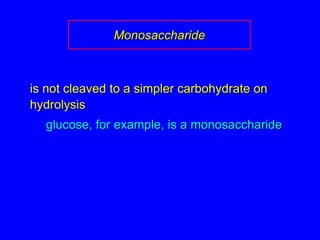
is not cleaved to a simpler carbohydrate on
hydrolysis
glucose, for example, is a monosaccharide
Monosaccharide
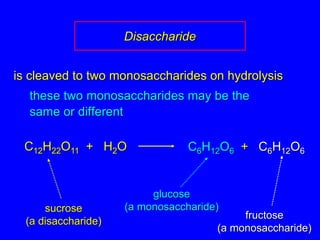
is cleaved to two monosaccharides on hydrolysis
these two monosaccharides may be the
same or different
Disaccharide
C12H22O11 + H2O
sucrose
(a disaccharide)
is cleaved to two monosaccharides on hydrolysis
these two monosaccharides may be the
same or different
Disaccharide
C12H22O11 + H2O C6H12O6 + C6H12O6
sucrose
(a disaccharide)
glucose
(a monosaccharide)
fructose
(a monosaccharide)
oligosaccharide:
gives three or more monosaccharide units on
hydrolysis
polysaccharide:
yields more than 10 monosaccharide units
Higher Saccharides
No. of carbons Aldose Ketose
4 Aldotetrose Ketotetrose
5 Aldopentose Ketopentose
6 Aldohexose Ketopentose
7 Aldoheptose Ketoheptose
8 Aldooctose Ketooctose
Table 25.1 Some Classes of Carbohydrates
25.2
Fischer Projections and D-L Notation
Fischer Projections
Fischer Projections
Fischer Projections of Enantiomers
Enantiomers of Glyceraldehyde
CH O
CH2OH
H OH
D
CH O
CH2OH
H
HO
L
(+)-Glyceraldehyde (–)-Glyceraldehyde
25.3
The Aldotetroses
stereochemistry assigned on basis of whether
configuration of highest-numbered stereogenic center
is analogous to D or L-glyceraldehyde
An Aldotetrose
CH O
CH2OH
H OH
H OH
1
2
3
4
stereochemistry assigned on basis of whether
configuration of highest-numbered stereogenic center
is analogous to D or L-glyceraldehyde
An Aldotetrose
CH O
CH2OH
H OH
H OH
1
2
3
4
D
An Aldotetrose
CH O
CH2OH
H OH
H OH
1
2
3
4
D-Erythrose
The Four Aldotetroses
CH O
CH2OH
H OH
H OH
D-Erythrose L-Erythrose
CH O
CH2OH
HO H
H
HO
D-Erythrose and
L-erythrose are
enantiomers
The Four Aldotetroses
CH O
CH2OH
H OH
H OH
CH O
CH2OH
H
HO
H OH
D-Erythrose D-Threose
D-Erythrose and
D-threose are
diastereomers
CH O
CH2OH
HO H
H
HO
The Four Aldotetroses
CH O
CH2OH
H
HO
H OH
L-Erythrose D-Threose
L-Erythrose and
D-threose are
diastereomers
The Four Aldotetroses
CH O
CH2OH
H
HO
H OH
D-Threose
D-Threose and
L-threose are
enantiomers
L-Threose
OH
CH O
CH2OH
H
HO
H
The Four Aldotetroses
CH O
CH2OH
H OH
H OH
CH O
CH2OH
H
HO
H OH
H OH
CH O
CH2OH
H
HO
D-Erythrose L-Erythrose D-Threose L-Threose
CH O
CH2OH
HO H
H
HO
25.4
Aldopentoses and Aldohexoses
The Aldopentoses
There are 8 aldopentoses.
Four belong to the D-series; four belong to
the L-series.
Their names are ribose, arabinose, xylose,
and lyxose.
The Four D-Aldopentoses
D-Ribose
H
CH O
CH2OH
OH
D-Arabinose D-Xylose D-Lyxose
CH2OH
H OH
CH O
H OH
CH O
CH2OH
H OH
CH O
CH2OH
The Four D-Aldopentoses
D-Ribose
CH O
CH2OH
H OH
H OH
D-Arabinose D-Xylose D-Lyxose
CH2OH
H OH
H OH
CH O
H
HO
OH
H
CH O
CH2OH
H OH
H
HO
CH O
CH2OH
The Four D-Aldopentoses
D-Ribose
CH O
CH2OH
H OH
H OH
H OH
D-Arabinose D-Xylose D-Lyxose
HO
CH2OH
H OH
H OH
H
CH O
HO
H OH
H OH
H
CH O
CH2OH
H OH
H
H
HO
HO
CH O
CH2OH
The Four D-Aldopentoses
D-Ribose
CH O
CH2OH
H OH
H OH
H OH
D-Arabinose D-Xylose D-Lyxose
HO
CH2OH
H OH
H OH
H
CH O
HO
H OH
H OH
H
CH O
CH2OH
H OH
H
H
HO
HO
CH O
CH2OH
Aldohexoses
There are 16 aldopentoses.
8 belong to the D-series; 8 belong to the L-
series.
Their names and configurations are best
remembered with the aid of the mnemonic
described in Section 25.5.

carbohydrate classification 1.ppt