Capillary Puncture
Equipment and
Procedure
PREPARED BY: VEDASTO A. CALUB III, RMT (INSTRUCTOR)
Reminder!
Please “Take down notes”
Prepare 10-15 quiz after discussion
Equipment
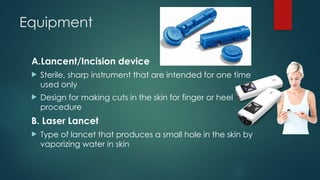
A.Lancent/Incision device
 Sterile, sharp instrument that are intended for one time
used only
 Design for making cuts in the skin for finger or heel
procedure
B. Laser Lancet
 Type of lancet that produces a small hole in the skin by
vaporizing water in skin
Equipment
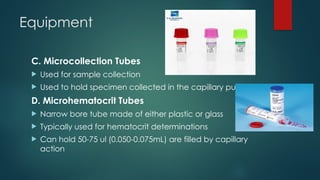
C. Microcollection Tubes
 Used for sample collection
 Used to hold specimen collected in the capillary puncture
D. Microhematocrit Tubes
 Narrow bore tube made of either plastic or glass
 Typically used for hematocrit determinations
 Can hold 50-75 ul (0.050-0.075mL) are filled by capillary
action
Equipment
E. Warming Device
 Used to increase the blood flow seven-fold by warming
the puncture site
 Alternative: massage
F. Microscope Slide
 Used for blood films in hematologic determinations
 Blood smears
Equipment
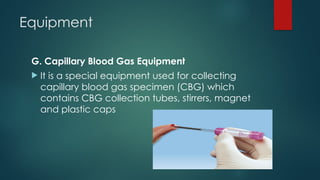
G. Capillary Blood Gas Equipment
 It is a special equipment used for collecting
capillary blood gas specimen (CBG) which
contains CBG collection tubes, stirrers, magnet
and plastic caps
Composition of Capillary Blood, The
Test and Reference Values
 The capillary blood is a mixture of different blood and fluids which includes
the following:
1. Arterial Blood- Bright red
2. Venous Blood-Dark red
3. Capillary Blood
4. Interstitial Fluid- source of contaminations
5. Intracellular Fluid- source of contaminations
Capillary reference values may vary from venous values.
Higher Glucose, Lower Total protein, calcium, potassium
Indication of Performing capillary
puncture on Adults, Children and Infants
A. For adults and Older Children
 Veins are fragile and are not accessible
 Veins are reserved for another procedure such as
chemotherapy and dialysis
 Clotting tendencies
 Extreme fear of needles
 Veins will be used for POCT( Point of Care Testing)- Bedside
tests
Indication of Performing Capillary
Puncture on Adults, Children and Infants
B. For Infants and younger children
 Health risks
 Requires only small volume of blood
 Venipuncture could damage veins and tissues surrounding the site
 Puncturing could result to hemorrhage, Thrombosis, gangrene and
infection
 Risk of injury because of the restraint need in venipuncture
 Capillary blood is preffered specimen
“NOT APPLICABLE FOR BLOOD CULTURE)
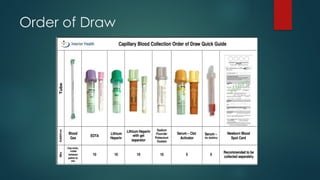
Order of Draw
Capillary Puncture Procedure
1. Review and Accession Test Request
2. Approach, Identify and Prepare Patient
3. Verify the diet restrictions and Latex sensitivity
4. Sanitize hands
5. Position the patients
6. Select the puncture site or incision site
a. Finger tips ( ring finger and middle finger: Lateral sides)
b. Heel ( lateral sides )
c. Lateral sides of big toe
d. Ear lobe
Capillary Puncture Procedure
7. Warm the site
8. Clean and Dry the site
9. Prepare the equipment
10. Puncture the site and discard equipment (2mm-recommended depth)
11. Wipe away the first drop of blood
12. Fill and mix tubes or container in the proper order of draw
13. Place gauze and apply preasure
14. Label specimen and observe handling precautions
15. Check the site then apply bandage
16. Dispose contaminated and used materials
17. Thank the patients, remove gloves and sanitize
18. Transport the specimen to the laboratory
Types of Specimen collection and
Capillary Blood Tests
A. Capillary Blood Gas Specimen
 Heel puncture (Children and infants)
 Blood sample are collected on the same site as routine capillary
specimens
B. Neonatal Bilirubin Collection
 Bilirubin- waste product
 It is used to help determine any liver disorder in infants
 Heel sticks
 Photosensitive substance
Types of Specimen collection and
Capillary Blood Tests
C. Newborn Screening Blood Spot Collection
 Done 24-48 hours after the baby is born
 Few drops of blood collected through heel stick to determine
disorders that are not apparent at birth that could lead to disability
or even deaths
 Gene defects
 No manifestations
 AUGUST 1996: Approved
Types of Specimen collection and
Capillary Blood Tests
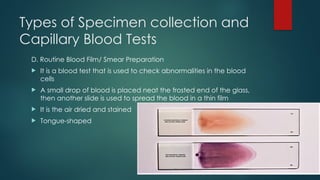
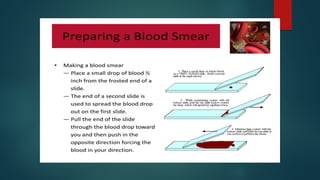
D. Routine Blood Film/ Smear Preparation
 It is a blood test that is used to check abnormalities in the blood
cells
 A small drop of blood is placed neat the frosted end of the glass,
then another slide is used to spread the blood in a thin film
 It is the air dried and stained
 Tongue-shaped
Types of Specimen collection and
Capillary Blood Tests
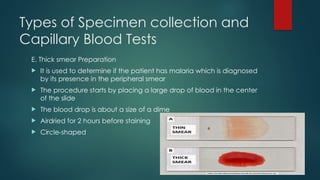
E. Thick smear Preparation
 It is used to determine if the patient has malaria which is diagnosed
by its presence in the peripheral smear
 The procedure starts by placing a large drop of blood in the center
of the slide
 The blood drop is about a size of a dime
 Airdried for 2 hours before staining
 Circle-shaped
Quiz!
1. What is capillary puncture primarily used for?
• A. Diagnostic testing
• B. Administering medication
• C. Blood transfusion
• D. Intravenous therapy
2. Which finger is most commonly used for adult capillary puncture?
• A. Thumb
• B. Index finger
• C. Middle finger
• D. Ring finger
Quiz!
3. What should be done if blood flow ceases during a capillary puncture?
• A. Squeeze the puncture site
• B. Discard the lancet and try again
• C. Gently massage the site
• D. Apply pressure and wait
4. Which condition can be screened for using a capillary puncture?
• A. Diabetes mellitus
• B. Hypertension
• C. Chronic obstructive pulmonary disease (COPD)
• D. Osteoporosis
Quiz!
5. The concentration of this analyte is higher in blood collected by
dermal puncture than in venipuncture:
A. glucose
B. potassium
C. total protein
D. calcium
Identification
Identification
Identification
Identification
Identification

Capillary-Puncture-Equipment-and-Procedure.pptx

  • 1.
    Capillary Puncture Equipment and Procedure PREPAREDBY: VEDASTO A. CALUB III, RMT (INSTRUCTOR)
  • 2.
    Reminder! Please “Take downnotes” Prepare 10-15 quiz after discussion
  • 3.
    Equipment A.Lancent/Incision device  Sterile,sharp instrument that are intended for one time used only  Design for making cuts in the skin for finger or heel procedure B. Laser Lancet  Type of lancet that produces a small hole in the skin by vaporizing water in skin
  • 4.
    Equipment C. Microcollection Tubes Used for sample collection  Used to hold specimen collected in the capillary puncture D. Microhematocrit Tubes  Narrow bore tube made of either plastic or glass  Typically used for hematocrit determinations  Can hold 50-75 ul (0.050-0.075mL) are filled by capillary action
  • 5.
    Equipment E. Warming Device Used to increase the blood flow seven-fold by warming the puncture site  Alternative: massage F. Microscope Slide  Used for blood films in hematologic determinations  Blood smears
  • 6.
    Equipment G. Capillary BloodGas Equipment  It is a special equipment used for collecting capillary blood gas specimen (CBG) which contains CBG collection tubes, stirrers, magnet and plastic caps
  • 7.
    Composition of CapillaryBlood, The Test and Reference Values  The capillary blood is a mixture of different blood and fluids which includes the following: 1. Arterial Blood- Bright red 2. Venous Blood-Dark red 3. Capillary Blood 4. Interstitial Fluid- source of contaminations 5. Intracellular Fluid- source of contaminations Capillary reference values may vary from venous values. Higher Glucose, Lower Total protein, calcium, potassium
  • 8.
    Indication of Performingcapillary puncture on Adults, Children and Infants A. For adults and Older Children  Veins are fragile and are not accessible  Veins are reserved for another procedure such as chemotherapy and dialysis  Clotting tendencies  Extreme fear of needles  Veins will be used for POCT( Point of Care Testing)- Bedside tests
  • 9.
    Indication of PerformingCapillary Puncture on Adults, Children and Infants B. For Infants and younger children  Health risks  Requires only small volume of blood  Venipuncture could damage veins and tissues surrounding the site  Puncturing could result to hemorrhage, Thrombosis, gangrene and infection  Risk of injury because of the restraint need in venipuncture  Capillary blood is preffered specimen “NOT APPLICABLE FOR BLOOD CULTURE)
  • 10.
  • 11.
    Capillary Puncture Procedure 1.Review and Accession Test Request 2. Approach, Identify and Prepare Patient 3. Verify the diet restrictions and Latex sensitivity 4. Sanitize hands 5. Position the patients 6. Select the puncture site or incision site a. Finger tips ( ring finger and middle finger: Lateral sides) b. Heel ( lateral sides ) c. Lateral sides of big toe d. Ear lobe
  • 12.
    Capillary Puncture Procedure 7.Warm the site 8. Clean and Dry the site 9. Prepare the equipment 10. Puncture the site and discard equipment (2mm-recommended depth) 11. Wipe away the first drop of blood 12. Fill and mix tubes or container in the proper order of draw 13. Place gauze and apply preasure 14. Label specimen and observe handling precautions 15. Check the site then apply bandage 16. Dispose contaminated and used materials 17. Thank the patients, remove gloves and sanitize 18. Transport the specimen to the laboratory
  • 13.
    Types of Specimencollection and Capillary Blood Tests A. Capillary Blood Gas Specimen  Heel puncture (Children and infants)  Blood sample are collected on the same site as routine capillary specimens B. Neonatal Bilirubin Collection  Bilirubin- waste product  It is used to help determine any liver disorder in infants  Heel sticks  Photosensitive substance
  • 14.
    Types of Specimencollection and Capillary Blood Tests C. Newborn Screening Blood Spot Collection  Done 24-48 hours after the baby is born  Few drops of blood collected through heel stick to determine disorders that are not apparent at birth that could lead to disability or even deaths  Gene defects  No manifestations  AUGUST 1996: Approved
  • 15.
    Types of Specimencollection and Capillary Blood Tests D. Routine Blood Film/ Smear Preparation  It is a blood test that is used to check abnormalities in the blood cells  A small drop of blood is placed neat the frosted end of the glass, then another slide is used to spread the blood in a thin film  It is the air dried and stained  Tongue-shaped
  • 18.
    Types of Specimencollection and Capillary Blood Tests E. Thick smear Preparation  It is used to determine if the patient has malaria which is diagnosed by its presence in the peripheral smear  The procedure starts by placing a large drop of blood in the center of the slide  The blood drop is about a size of a dime  Airdried for 2 hours before staining  Circle-shaped
  • 19.
    Quiz! 1. What iscapillary puncture primarily used for? • A. Diagnostic testing • B. Administering medication • C. Blood transfusion • D. Intravenous therapy 2. Which finger is most commonly used for adult capillary puncture? • A. Thumb • B. Index finger • C. Middle finger • D. Ring finger
  • 20.
    Quiz! 3. What shouldbe done if blood flow ceases during a capillary puncture? • A. Squeeze the puncture site • B. Discard the lancet and try again • C. Gently massage the site • D. Apply pressure and wait 4. Which condition can be screened for using a capillary puncture? • A. Diabetes mellitus • B. Hypertension • C. Chronic obstructive pulmonary disease (COPD) • D. Osteoporosis
  • 21.
    Quiz! 5. The concentrationof this analyte is higher in blood collected by dermal puncture than in venipuncture: A. glucose B. potassium C. total protein D. calcium
  • 22.
  • 23.
  • 24.
  • 25.
  • 26.