
Can Process Make You Happy?

                 Making your organization work for
                               you


02 August 2012             ©Q:PIT Ltd 2011-2012      1
Copyright Statement
•   SM Architecture Tradeoff Analysis Method, ATAM, CMM Integration, COTS Usage
    Risk Evaluation, CURE, EPIC, Evolutionary Process for Integrating COTS-based
    systems, Framework for Software Product Line Practice, IDEAL, Interim Profile,
    OAR, OCTAVE, Operationally Critical Threat, Asset, and Vulnerability Evaluation,
    Options Analysis for Reengineering, Personal Software Process, PLTP, Product Line
    Technical Probe, PSP, SCAMPI, SCAMPI Lead Appraiser, SCE, SEPG, SoS Navigator, T-
    Checks, Team Software Process, TSP, are service marks of Carnegie Mellon
    University
•   TM Carnegie Mellon Software Engineering Institute (stylized), Carnegie Mellon
    Software Engineering Institute (and design), Simplex, Stylized hexagon are
    trademarks of Carnegie Mellon University
    Q:PIT is a trademark of Q:PIT Ltd, Milton Keynes, UK
•   ®     Capability Maturity Model, Capability Maturity Modeling, Carnegie Mellon,
    CERT, CERT Coordination Center, CMM, CMMI, FloCon, OCTAVE are registered in
    the U.S. Patent and Trademark Office by Carnegie Mellon University
    The Q:PIT swirl is a registered trademark of Q:PIT Ltd, Milton Keynes, UK


02 August 2012                     ©Q:PIT Ltd 2011-2012                             2
Peter Leeson
•   Director of Q:PIT Ltd
•   SCAMPI Lead Appraiser and CMMI Instructor
•   SEI Visiting Scientist
•   Over 35 years of software engineering
•   20 years as process improvement professional
•   Process Improvement experience in Australia,
    Austria, Belgium, China, Denmark, England,
    France, Germany, India, Ireland, Japan, Mexico,
    Netherlands, Poland, Romania, Spain, Sweden,
    Switzerland…

02 August 2012         ©Q:PIT Ltd 2011-2012           3
Q:PIT Ltd
• International association of independent
  process improvement professionals
• Q:PIT means…
      – Reducing the cost of Quality through Process
        improvement, Information management and
        Teamwork


02 August 2012           ©Q:PIT Ltd 2011-2012          4
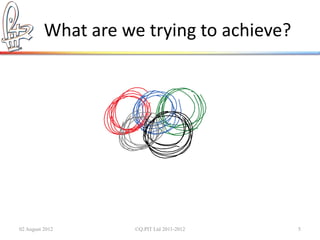
What are we trying to achieve?


02 August 2012       ©Q:PIT Ltd 2011-2012   5
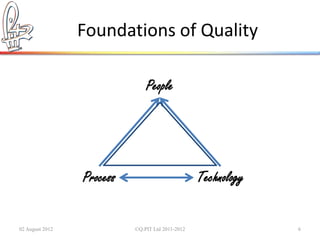
Foundations of Quality

                               People


                 Process                          Technology


02 August 2012             ©Q:PIT Ltd 2011-2012                6
What do you need?


02 August 2012       ©Q:PIT Ltd 2011-2012   7
What do you need?


02 August 2012       ©Q:PIT Ltd 2011-2012   8
What do you need?


02 August 2012       ©Q:PIT Ltd 2011-2012   9
How do you make people happy?


02 August 2012   ©Q:PIT Ltd 2011-2012   10
Living Wages


02 August 2012     ©Q:PIT Ltd 2011-2012   11
Resources


02 August 2012   ©Q:PIT Ltd 2011-2012   12
Skills


02 August 2012   ©Q:PIT Ltd 2011-2012   13
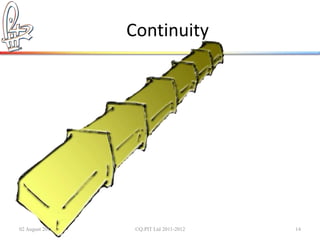
Continuity


02 August 2012    ©Q:PIT Ltd 2011-2012   14
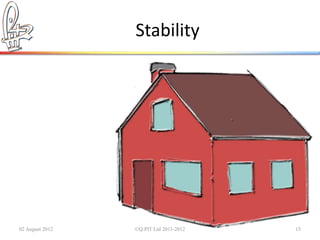
Stability


02 August 2012   ©Q:PIT Ltd 2011-2012   15
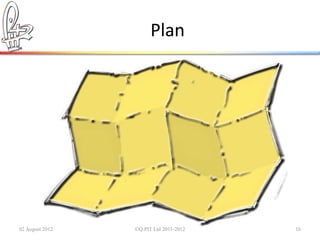
Plan


02 August 2012   ©Q:PIT Ltd 2011-2012   16
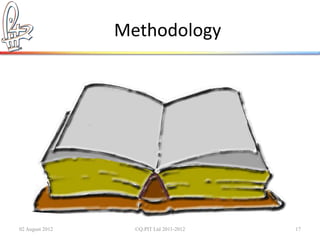
Methodology


02 August 2012     ©Q:PIT Ltd 2011-2012   17
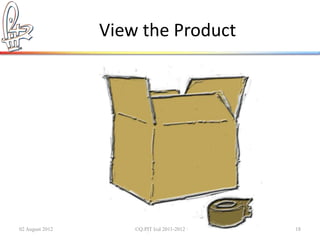
View the Product


02 August 2012       ©Q:PIT Ltd 2011-2012   18
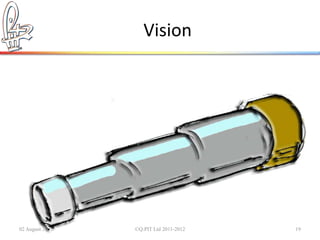
Vision


02 August 2012   ©Q:PIT Ltd 2011-2012   19
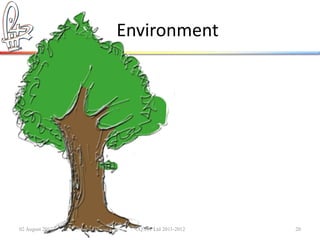
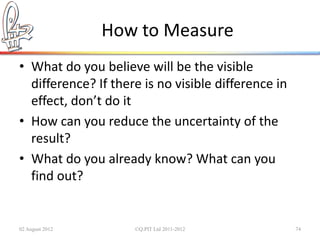
Environment


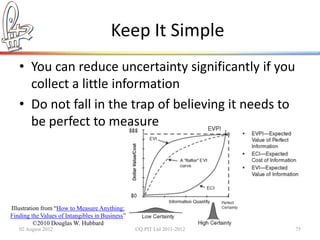
02 August 2012    ©Q:PIT Ltd 2011-2012   20
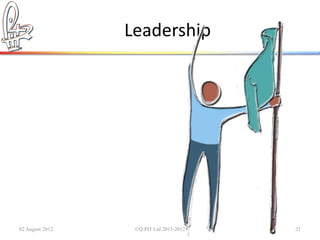
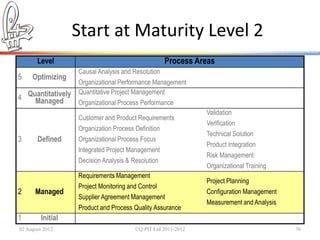
Leadership


02 August 2012    ©Q:PIT Ltd 2011-2012   21
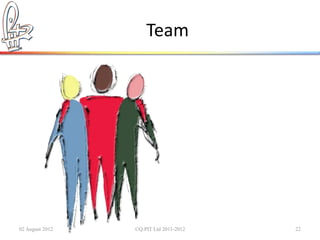
Team


02 August 2012   ©Q:PIT Ltd 2011-2012   22
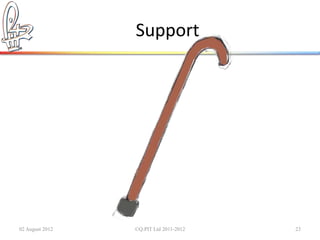
Support


02 August 2012   ©Q:PIT Ltd 2011-2012   23
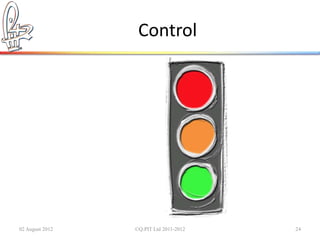
Control


02 August 2012   ©Q:PIT Ltd 2011-2012   24
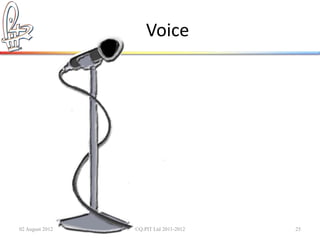
Voice


02 August 2012   ©Q:PIT Ltd 2011-2012   25
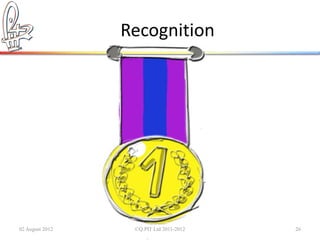
Recognition


02 August 2012    ©Q:PIT Ltd 2011-2012   26
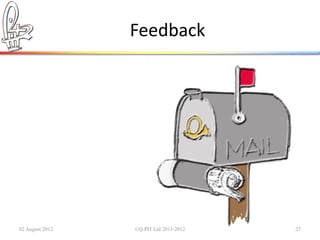
Feedback


02 August 2012   ©Q:PIT Ltd 2011-2012   27
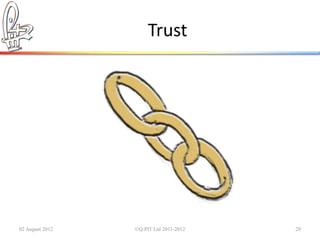
Trust


02 August 2012   ©Q:PIT Ltd 2011-2012   28
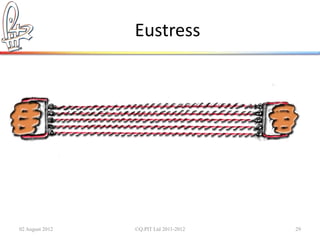
Eustress


02 August 2012   ©Q:PIT Ltd 2011-2012   29
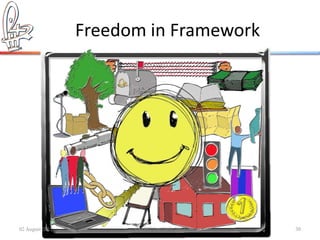
Freedom in Framework


02 August 2012         ©Q:PIT Ltd 2011-2012   30
Putting it into context


02 August 2012         ©Q:PIT Ltd 2011-2012   31
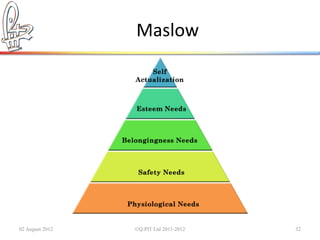
Maslow


02 August 2012   ©Q:PIT Ltd 2011-2012   32
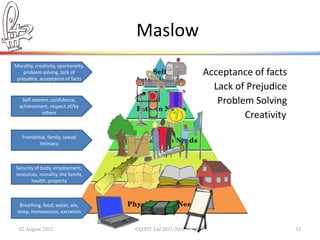
Maslow
Morality, creativity, spontaneity,
    problem solving, lack of
 prejudice, acceptance of facts
                                                            Acceptance of facts
                                                              Lack of Prejudice
   Self-esteem, confidence,
  achievement, respect of/by
                                                               Problem Solving
            others
                                                                     Creativity
   Friendship, family, sexual
           intimacy


Security of body, employment,
resources, morality, the family,
       health, property


  Breathing, food, water, sex,
 sleep, homeostasis, excretion


  02 August 2012                     ©Q:PIT Ltd 2011-2012                         33
Maturity

                 Maturity is climbing the Maslow
                              pyramid


02 August 2012            ©Q:PIT Ltd 2011-2012     34
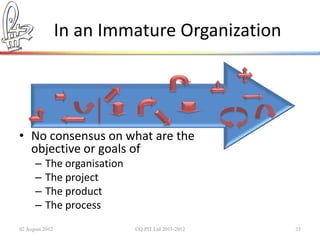
In an Immature Organization


• No consensus on what are the
  objective or goals of
      –   The organisation
      –   The project
      –   The product
      –   The process
02 August 2012               ©Q:PIT Ltd 2011-2012   35
Improving…
• Requires commitment from all levels of
  management and practitioners to the effort
• Document what you are doing, then read
  what you did
• Measure, collect, analyse, learn
• Management requires that processes be
  documented and measured
• People accept to learn from their mistakes
  rather than fear retribution
02 August 2012     ©Q:PIT Ltd 2011-2012        36
Life in a Maturing Organization
• People (at all levels) see issues and problems
  as possibilities to improve
• Measurements are seen as a necessary
  management tool
• Estimates are based on facts and documented
• The schedule is based on the estimates
• Commitment is maintained and considered as
  commitments by all involved
02 August 2012       ©Q:PIT Ltd 2011-2012      37
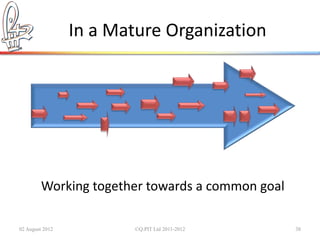
In a Mature Organization


         Working together towards a common goal

02 August 2012           ©Q:PIT Ltd 2011-2012     38
A Mature Culture 1/2
• Common approach to the work and the success
  of the organization
• Decisions and estimates based on facts, data and
  experience
• Plans based on what can be achieved and
  working together to ensure customer satisfaction
  with regard to quality, functionality, budget and
  delays
• Assurance that the resources required for a task
  will be available as expected
02 August 2012        ©Q:PIT Ltd 2011-2012        39
A Mature Culture 2/2
• Liberation of the imagination to continuous,
  common improvement
• Focus of all on delivering a product that satisfies
  the customer and placing the customer’s needs
  and expectations first
• Everyone taking personal responsibility for the
  quality of his/her own work and ensuring that the
  quality is optimized before responsibility is
  handed over to the next step of the development
  lifecycle
02 August 2012        ©Q:PIT Ltd 2011-2012          40
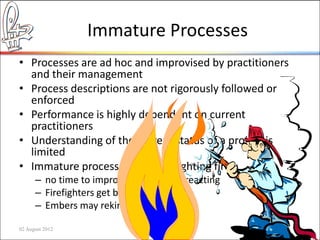
Immature Processes
• Processes are ad hoc and improvised by practitioners
  and their management
• Process descriptions are not rigorously followed or
  enforced
• Performance is highly dependent on current
  practitioners
• Understanding of the current status of a project is
  limited
• Immature processes result in fighting fires:
      – no time to improve—constantly reacting
      – Firefighters get burned
      – Embers may rekindle later

02 August 2012             ©Q:PIT Ltd 2011-2012          41
Immature Processes
• Processes are ad hoc and improvised by practitioners
  and their management
• Process descriptions are not rigorously followed or
  enforced
• Performance is highly dependent on current
  practitioners
• Understanding of the current status of a project is
  limited
• Immature processes result in fighting fires:
      – no time to improve—constantly reacting
      – Firefighters get burned
      – Embers may rekindle later

02 August 2012             ©Q:PIT Ltd 2011-2012          42
Mature Processes = Fire Prevention
• Process descriptions are consistent with the way work
  actually gets done
• They are defined, documented, and continuously
  improved
• Processes are supported visibly by management and
  others
• They are well controlled—process fidelity is evaluated
  and enforced
• There is constructive use of product and process
  measurement
• Technology is introduced in a disciplined manner

02 August 2012         ©Q:PIT Ltd 2011-2012                43
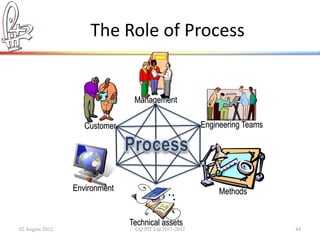
The Role of Process


                                Management

                    Customer                           Engineering Teams


                 Environment                                Methods


                               Technical assets
02 August 2012                  ©Q:PIT Ltd 2011-2012                       44
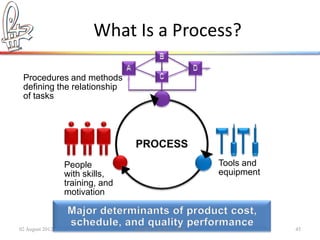
What Is a Process?

 Procedures and methods
 defining the relationship
 of tasks


                 People                                 Tools and
                 with skills,                           equipment
                 training, and
                 motivation


02 August 2012                   ©Q:PIT Ltd 2011-2012               45
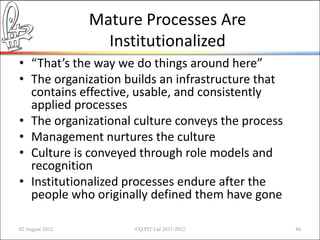
Mature Processes Are
                   Institutionalized
• “That’s the way we do things around here”
• The organization builds an infrastructure that
  contains effective, usable, and consistently
  applied processes
• The organizational culture conveys the process
• Management nurtures the culture
• Culture is conveyed through role models and
  recognition
• Institutionalized processes endure after the
  people who originally defined them have gone

02 August 2012        ©Q:PIT Ltd 2011-2012         46
Using Your Brain

                 The Context for Improvement


02 August 2012          ©Q:PIT Ltd 2011-2012   47
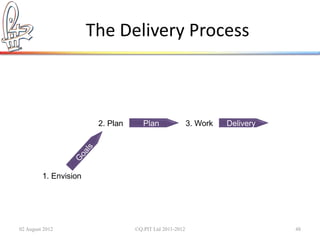
The Delivery Process


                        2. Plan                          3. Work


         1. Envision


02 August 2012                    ©Q:PIT Ltd 2011-2012             48
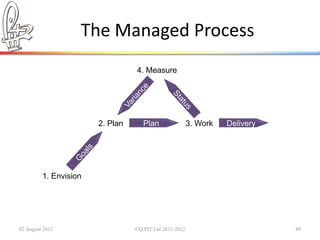
The Managed Process
                                 4. Measure


                       2. Plan                          3. Work


         1. Envision


02 August 2012                   ©Q:PIT Ltd 2011-2012             49
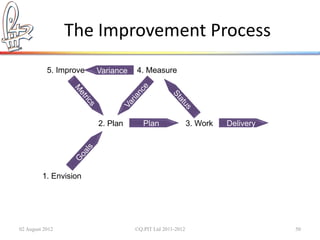
The Improvement Process
           5. Improve             4. Measure


                        2. Plan                          3. Work


         1. Envision


02 August 2012                    ©Q:PIT Ltd 2011-2012             50
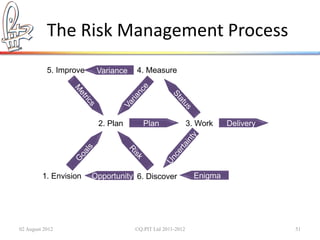
The Risk Management Process
           5. Improve             4. Measure


                        2. Plan                          3. Work


         1. Envision              6. Discover              Enigma


02 August 2012                    ©Q:PIT Ltd 2011-2012              51
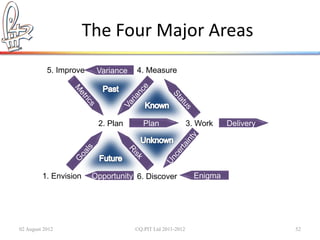
The Four Major Areas
           5. Improve             4. Measure


                        2. Plan                          3. Work


         1. Envision              6. Discover              Enigma


02 August 2012                    ©Q:PIT Ltd 2011-2012              52
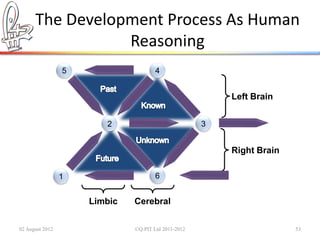
The Development Process As Human
                 Reasoning
                 5                    4


                                                         Left Brain


                        2                            3


                                                         Right Brain

                 1                    6


                     Limbic   Cerebral

02 August 2012                ©Q:PIT Ltd 2011-2012                     53
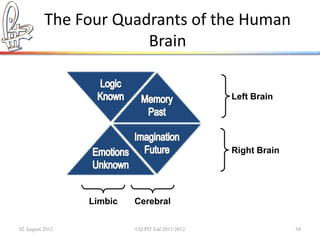
The Four Quadrants of the Human
                       Brain

                                                 Left Brain


                                                 Right Brain


                 Limbic   Cerebral

02 August 2012            ©Q:PIT Ltd 2011-2012                 54
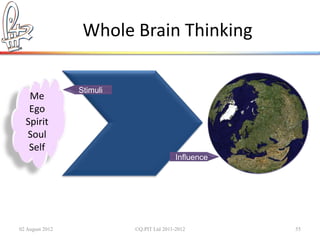
Whole Brain Thinking

                 Stimuli
   Me
   Ego
  Spirit
  Soul
   Self


02 August 2012             ©Q:PIT Ltd 2011-2012   55
Establishing Direction

                    Deciding to Change
                    Promoting Change


02 August 2012         ©Q:PIT Ltd 2011-2012   56
Value and Cost
• What is the value of improvement to your
  organization?
• Why would you want to invest so much
  money, knowing you will have no return on
  investment in this budget cycle or the next?
• What are the benefits of improvement to your
  business, to the quality of your products and
  services, to your customer satisfaction?

02 August 2012      ©Q:PIT Ltd 2011-2012      57
Cost and Investment
Cost                                             Investment
• Improvement is a cost:                         • Improvement is an investment:
      – Staff is not made available                    – The cost of bad quality is
      – Tools are too expensive                          understood
      – Don’t bother the “real” projects               – Improving all future projects is
      – What is the minimum we need to                   critically important – even if it
        do to satisfy the lead appraiser?                presents a risk to the success of
                                                         one on-going project
      – Can we do a CMMI appraisal in 2
        days like an ISO audit?                        – Customers are involved in the
                                                         improvement programme
      – Focus on training staff to answer
        the questions of the appraisal team            – All new processes, projects,
                                                         products are measured according
      – Staff are trusted to understand and              to a primary need
        apply without training or support
                                                       – Management is actively and visibly
                                                         interested in the return on their
                                                         investment

02 August 2012                       ©Q:PIT Ltd 2011-2012                                 58
Management and Leadership
• Management needs to understand the cost of
  process improvement and be willing to make the
  necessary adjustments
• Leadership means going there first:
      – Is management ready to apply the principles of
        process improvement to their own work?
      – Who does quality assurance on management’s work?
      – Has your management applied formal decision and
        risk analysis techniques to deciding why they should
        do process improvement?

02 August 2012            ©Q:PIT Ltd 2011-2012                 59
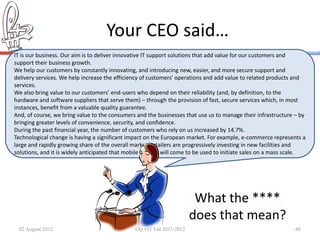
Your CEO said…
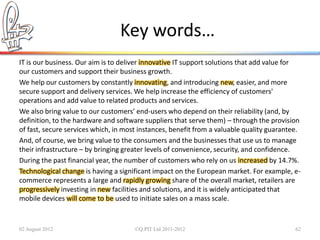
IT is our business. Our aim is to deliver innovative IT support solutions that add value for our customers and
support their business growth.
We help our customers by constantly innovating, and introducing new, easier, and more secure support and
delivery services. We help increase the efficiency of customers' operations and add value to related products and
services.
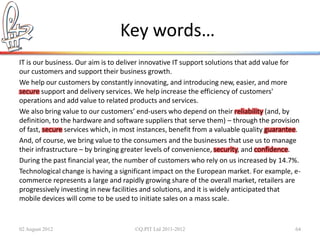
We also bring value to our customers’ end-users who depend on their reliability (and, by definition, to the
hardware and software suppliers that serve them) – through the provision of fast, secure services which, in most
instances, benefit from a valuable quality guarantee.
And, of course, we bring value to the consumers and the businesses that use us to manage their infrastructure – by
bringing greater levels of convenience, security, and confidence.
During the past financial year, the number of customers who rely on us increased by 14.7%.
Technological change is having a significant impact on the European market. For example, e-commerce represents a
large and rapidly growing share of the overall market, retailers are progressively investing in new facilities and
solutions, and it is widely anticipated that mobile devices will come to be used to initiate sales on a mass scale.


                                                                       What the ****
                                                                      does that mean?
  02 August 2012                               ©Q:PIT Ltd 2011-2012                                           60
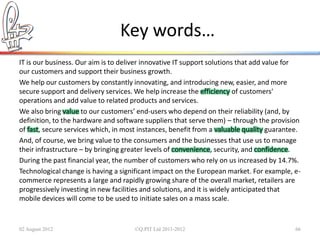
Key words…
IT is our business. Our aim is to deliver innovative IT support solutions that add value for
our customers and support their business growth.
We help our customers by constantly innovating, and introducing new, easier, and more
secure support and delivery services. We help increase the efficiency of customers'
operations and add value to related products and services.
We also bring value to our customers’ end-users who depend on their reliability (and, by
definition, to the hardware and software suppliers that serve them) – through the provision
of fast, secure services which, in most instances, benefit from a valuable quality guarantee.
And, of course, we bring value to the consumers and the businesses that use us to manage
their infrastructure – by bringing greater levels of convenience, security, and confidence.
During the past financial year, the number of customers who rely on us increased by 14.7%.
Technological change is having a significant impact on the European market. For example, e-
commerce represents a large and rapidly growing share of the overall market, retailers are
progressively investing in new facilities and solutions, and it is widely anticipated that
mobile devices will come to be used to initiate sales on a mass scale.


02 August 2012                        ©Q:PIT Ltd 2011-2012                                 61
Key words…
IT is our business. Our aim is to deliver innovative IT support solutions that add value for
our customers and support their business growth.
We help our customers by constantly innovating, and introducing new, easier, and more
secure support and delivery services. We help increase the efficiency of customers'
operations and add value to related products and services.
We also bring value to our customers’ end-users who depend on their reliability (and, by
definition, to the hardware and software suppliers that serve them) – through the provision
of fast, secure services which, in most instances, benefit from a valuable quality guarantee.
And, of course, we bring value to the consumers and the businesses that use us to manage
their infrastructure – by bringing greater levels of convenience, security, and confidence.
During the past financial year, the number of customers who rely on us increased by 14.7%.
Technological change is having a significant impact on the European market. For example, e-
commerce represents a large and rapidly growing share of the overall market, retailers are
progressively investing in new facilities and solutions, and it is widely anticipated that
mobile devices will come to be used to initiate sales on a mass scale.


02 August 2012                        ©Q:PIT Ltd 2011-2012                                 62
Innovation
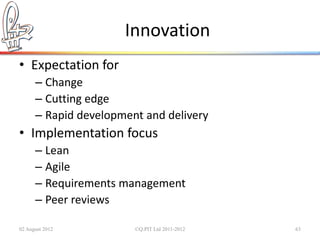
• Expectation for
      – Change
      – Cutting edge
      – Rapid development and delivery
• Implementation focus
      – Lean
      – Agile
      – Requirements management
      – Peer reviews

02 August 2012          ©Q:PIT Ltd 2011-2012   63
Key words…
IT is our business. Our aim is to deliver innovative IT support solutions that add value for
our customers and support their business growth.
We help our customers by constantly innovating, and introducing new, easier, and more
secure support and delivery services. We help increase the efficiency of customers'
operations and add value to related products and services.
We also bring value to our customers’ end-users who depend on their reliability (and, by
definition, to the hardware and software suppliers that serve them) – through the provision
of fast, secure services which, in most instances, benefit from a valuable quality guarantee.
And, of course, we bring value to the consumers and the businesses that use us to manage
their infrastructure – by bringing greater levels of convenience, security, and confidence.
During the past financial year, the number of customers who rely on us increased by 14.7%.
Technological change is having a significant impact on the European market. For example, e-
commerce represents a large and rapidly growing share of the overall market, retailers are
progressively investing in new facilities and solutions, and it is widely anticipated that
mobile devices will come to be used to initiate sales on a mass scale.


02 August 2012                        ©Q:PIT Ltd 2011-2012                                 64
Reliable
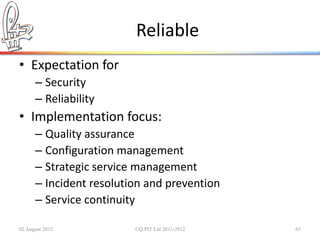
• Expectation for
      – Security
      – Reliability
• Implementation focus:
      – Quality assurance
      – Configuration management
      – Strategic service management
      – Incident resolution and prevention
      – Service continuity

02 August 2012           ©Q:PIT Ltd 2011-2012   65
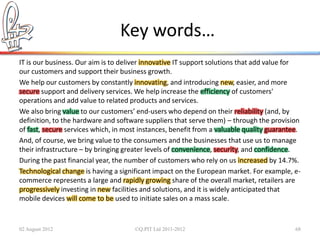
Key words…
IT is our business. Our aim is to deliver innovative IT support solutions that add value for
our customers and support their business growth.
We help our customers by constantly innovating, and introducing new, easier, and more
secure support and delivery services. We help increase the efficiency of customers'
operations and add value to related products and services.
We also bring value to our customers’ end-users who depend on their reliability (and, by
definition, to the hardware and software suppliers that serve them) – through the provision
of fast, secure services which, in most instances, benefit from a valuable quality guarantee.
And, of course, we bring value to the consumers and the businesses that use us to manage
their infrastructure – by bringing greater levels of convenience, security, and confidence.
During the past financial year, the number of customers who rely on us increased by 14.7%.
Technological change is having a significant impact on the European market. For example, e-
commerce represents a large and rapidly growing share of the overall market, retailers are
progressively investing in new facilities and solutions, and it is widely anticipated that
mobile devices will come to be used to initiate sales on a mass scale.


02 August 2012                        ©Q:PIT Ltd 2011-2012                                 66
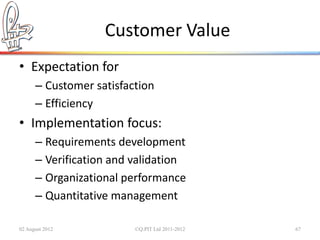
Customer Value
• Expectation for
      – Customer satisfaction
      – Efficiency
• Implementation focus:
      – Requirements development
      – Verification and validation
      – Organizational performance
      – Quantitative management

02 August 2012           ©Q:PIT Ltd 2011-2012   67
Key words…
IT is our business. Our aim is to deliver innovative IT support solutions that add value for
our customers and support their business growth.
We help our customers by constantly innovating, and introducing new, easier, and more
secure support and delivery services. We help increase the efficiency of customers'
operations and add value to related products and services.
We also bring value to our customers’ end-users who depend on their reliability (and, by
definition, to the hardware and software suppliers that serve them) – through the provision
of fast, secure services which, in most instances, benefit from a valuable quality guarantee.
And, of course, we bring value to the consumers and the businesses that use us to manage
their infrastructure – by bringing greater levels of convenience, security, and confidence.
During the past financial year, the number of customers who rely on us increased by 14.7%.
Technological change is having a significant impact on the European market. For example, e-
commerce represents a large and rapidly growing share of the overall market, retailers are
progressively investing in new facilities and solutions, and it is widely anticipated that
mobile devices will come to be used to initiate sales on a mass scale.


02 August 2012                        ©Q:PIT Ltd 2011-2012                                 68
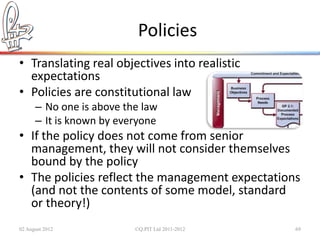
Policies
• Translating real objectives into realistic
  expectations
• Policies are constitutional law
      – No one is above the law
      – It is known by everyone
• If the policy does not come from senior
  management, they will not consider themselves
  bound by the policy
• The policies reflect the management expectations
  (and not the contents of some model, standard
  or theory!)
02 August 2012            ©Q:PIT Ltd 2011-2012   69
Writing a Policy
• Questions:
      – What makes us different from others?
      – Why would a prospect come to us rather than to our competitors?
      – How can we ensure that we are satisfying our customers without
        jeopardizing the future of our organization?
      – What do we mean when we use the word "quality"? How do we
        measure that?
      – What are the critical practices that are required by all teams in order
        to satisfy these objectives?
      – What behaviour do we expect from our staff?
      – How can we ensure that we learn and continuously improve these
        practices and behaviours over time?
      – How can we encourage, monitor, measure and enforce this behaviour?
      – How can we communicate this to everyone concerned?


02 August 2012                   ©Q:PIT Ltd 2011-2012                        70
Contents of the Policy
• Define Quality
      – When you talk about quality in your marketing material,
        what do you mean? How do you define quality in a
        pragmatic, measurable manner?
• Process Expectations
      – Why do you believe that process is going to help your
        organization?
      – What do you expect to get out of processes?
• Staff Expectations
      – What do you expect your staff to be doing? What should
        their attitude be?
      – What do you want your staff to deliver in terms of results?

02 August 2012               ©Q:PIT Ltd 2011-2012                 71
Enforcing the Policy
• A law is useless if it is not enforced
• The policy must reflect the monitoring, control
  and enforcement procedure
• Before enforcing staff activities, you need to
  understand how to monitor it, how to
  measure your objectives


02 August 2012        ©Q:PIT Ltd 2011-2012      72
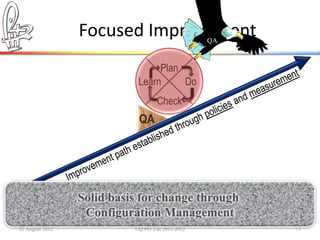
Focused Improvement              QA


                 Solid basis for change through
                  Configuration Management
02 August 2012             ©Q:PIT Ltd 2011-2012        73
How to Measure
• What do you believe will be the visible
  difference? If there is no visible difference in
  effect, don’t do it
• How can you reduce the uncertainty of the
  result?
• What do you already know? What can you
  find out?


02 August 2012       ©Q:PIT Ltd 2011-2012            74
Keep It Simple
   • You can reduce uncertainty significantly if you
     collect a little information
   • Do not fall in the trap of believing it needs to
     be perfect to measure


Illustration from “How to Measure Anything:
Finding the Values of Intangibles in Business”
          ©2010 Douglas W. Hubbard
   02 August 2012                                ©Q:PIT Ltd 2011-2012   75
Start at Maturity Level 2
       Level                                         Process Areas
                   Causal Analysis and Resolution
5    Optimizing
                   Organizational Performance Management
                   Quantitative Project Management
4 Quantitatively
    Managed      Organizational Process Performance
                                                               Validation
                   Customer and Product Requirements
                                                               Verification
                   Organization Process Definition
                                                               Technical Solution
3      Defined     Organizational Process Focus
                                                               Product Integration
                   Integrated Project Management
                                                               Risk Management
                   Decision Analysis & Resolution
                                                               Organizational Training
                   Requirements Management
                                                               Project Planning
                   Project Monitoring and Control
2     Managed                                                  Configuration Management
                   Supplier Agreement Management
                                                               Measurement and Analysis
                   Product and Process Quality Assurance
1        Initial
02 August 2012                          ©Q:PIT Ltd 2011-2012                              76
Start at Maturity Level 2
• Maturity Level 2 focuses on understanding
  what satisfies needs and expectations, what
  works
• Maturity Level 3 focuses on sharing the best
  practices that were identified at Maturity
  Level 2


02 August 2012           ©Q:PIT Ltd 2011-2012    77
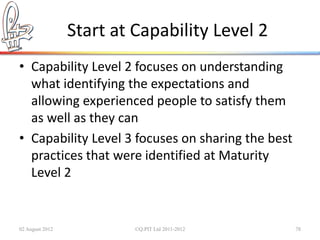
Start at Capability Level 2
• Capability Level 2 focuses on understanding
  what identifying the expectations and
  allowing experienced people to satisfy them
  as well as they can
• Capability Level 3 focuses on sharing the best
  practices that were identified at Maturity
  Level 2


02 August 2012            ©Q:PIT Ltd 2011-2012     78
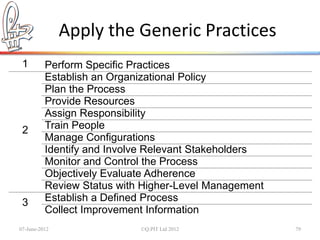
Apply the Generic Practices
 1        Perform Specific Practices
          Establish an Organizational Policy
          Plan the Process
          Provide Resources
          Assign Responsibility
 2        Train People
          Manage Configurations
          Identify and Involve Relevant Stakeholders
          Monitor and Control the Process
          Objectively Evaluate Adherence
          Review Status with Higher-Level Management
 3        Establish a Defined Process
          Collect Improvement Information
07-June-2012                ©Q:PIT Ltd 2012            79
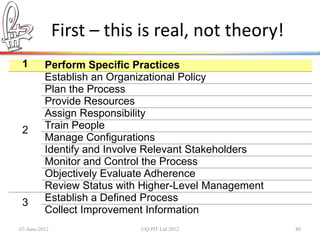
First – this is real, not theory!
 1        Perform Specific Practices
          Establish an Organizational Policy
          Plan the Process
          Provide Resources
          Assign Responsibility
 2        Train People
          Manage Configurations
          Identify and Involve Relevant Stakeholders
          Monitor and Control the Process
          Objectively Evaluate Adherence
          Review Status with Higher-Level Management
 3        Establish a Defined Process
          Collect Improvement Information
07-June-2012                ©Q:PIT Ltd 2012            80
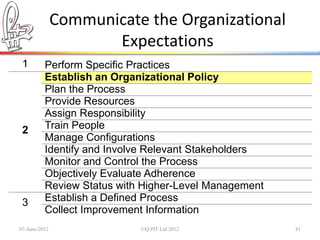
Communicate the Organizational
                      Expectations
 1        Perform Specific Practices
          Establish an Organizational Policy
          Plan the Process
          Provide Resources
          Assign Responsibility
 2        Train People
          Manage Configurations
          Identify and Involve Relevant Stakeholders
          Monitor and Control the Process
          Objectively Evaluate Adherence
          Review Status with Higher-Level Management
 3        Establish a Defined Process
          Collect Improvement Information
07-June-2012                ©Q:PIT Ltd 2012            81
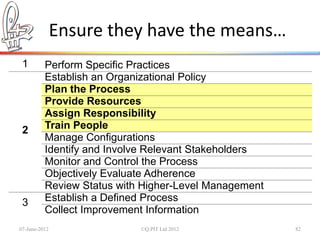
Ensure they have the means…
 1        Perform Specific Practices
          Establish an Organizational Policy
          Plan the Process
          Provide Resources
          Assign Responsibility
 2        Train People
          Manage Configurations
          Identify and Involve Relevant Stakeholders
          Monitor and Control the Process
          Objectively Evaluate Adherence
          Review Status with Higher-Level Management
 3        Establish a Defined Process
          Collect Improvement Information
07-June-2012                ©Q:PIT Ltd 2012            82
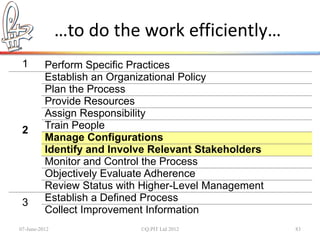
…to do the work efficiently…
 1        Perform Specific Practices
          Establish an Organizational Policy
          Plan the Process
          Provide Resources
          Assign Responsibility
 2        Train People
          Manage Configurations
          Identify and Involve Relevant Stakeholders
          Monitor and Control the Process
          Objectively Evaluate Adherence
          Review Status with Higher-Level Management
 3        Establish a Defined Process
          Collect Improvement Information
07-June-2012                ©Q:PIT Ltd 2012            83
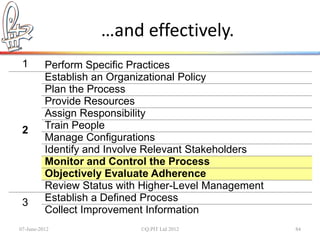
…and effectively.
 1        Perform Specific Practices
          Establish an Organizational Policy
          Plan the Process
          Provide Resources
          Assign Responsibility
 2        Train People
          Manage Configurations
          Identify and Involve Relevant Stakeholders
          Monitor and Control the Process
          Objectively Evaluate Adherence
          Review Status with Higher-Level Management
 3        Establish a Defined Process
          Collect Improvement Information
07-June-2012                ©Q:PIT Ltd 2012            84
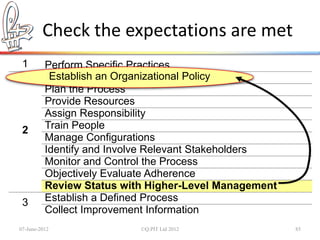
Check the expectations are met
 1        Perform Specific Practices
           Establish an Organizational Policy
          Establish an Organizational Policy
          Plan the Process
          Provide Resources
          Assign Responsibility
 2        Train People
          Manage Configurations
          Identify and Involve Relevant Stakeholders
          Monitor and Control the Process
          Objectively Evaluate Adherence
          Review Status with Higher-Level Management
 3        Establish a Defined Process
          Collect Improvement Information
07-June-2012               ©Q:PIT Ltd 2012             85
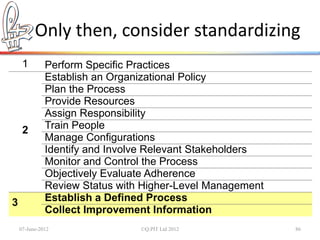
Only then, consider standardizing
     1        Perform Specific Practices
              Establish an Organizational Policy
              Plan the Process
              Provide Resources
              Assign Responsibility
     2        Train People
              Manage Configurations
              Identify and Involve Relevant Stakeholders
              Monitor and Control the Process
              Objectively Evaluate Adherence
              Review Status with Higher-Level Management
3             Establish a Defined Process
              Collect Improvement Information
    07-June-2012                ©Q:PIT Ltd 2012            86
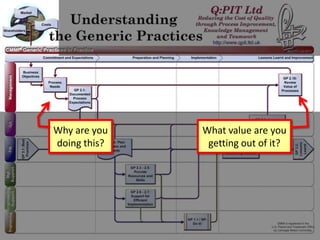
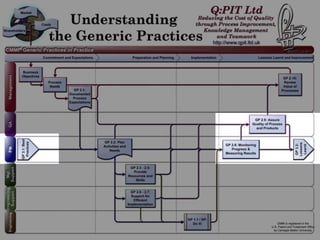
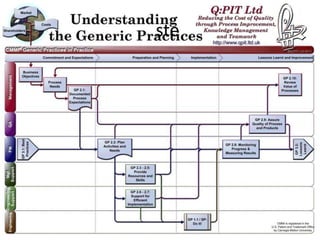
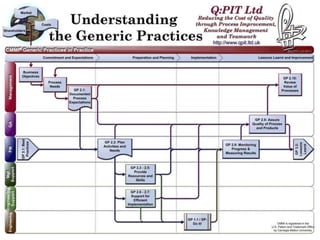
Generic Practices


               Why are you                     What value are you
               doing this?                      getting out of it?


07-June-2012                 ©Q:PIT Ltd 2012                         87
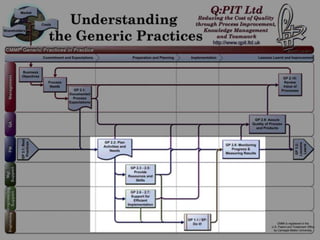
Generic Practices


07-June-2012        ©Q:PIT Ltd 2012   88
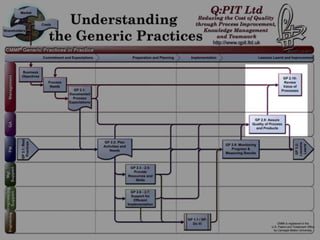
Generic Practices


07-June-2012        ©Q:PIT Ltd 2012   89
Generic Practices


07-June-2012        ©Q:PIT Ltd 2012   90
ste
Always remember
• Performance Improvement is a culture change
      – It is not easy
      – It is completely dependent on management
      – It can be highly successful if done correctly
      – It requires you to change (and not only everyone
        else!)


02 August 2012           ©Q:PIT Ltd 2011-2012              92
But it’s worth it!
• The result will make life more predictable for
  you in your daily work
• The result will remove the barriers that keep
  you from being proud of your work
• The result will focus on fixing the system
  instead of blaming the people


02 August 2012       ©Q:PIT Ltd 2011-2012          93
But it’s worth it!
• The result will make life more predictable for
  you in your daily work
• The result will remove the barriers that keep
  you from being proud of your work
• The result will focus on fixing the system
  instead of blaming the people


02 August 2012       ©Q:PIT Ltd 2011-2012          94
02 August 2012   ©Q:PIT Ltd 2011-2012   95
Resources
• The first part of this presentation is extracted
  from “Forget Process; Focus on People” (FP2):
  http://prezi.com/qm4wcnk_5hnb/forget-
  process-focus-on-people/ (with explanations)


02 August 2012       ©Q:PIT Ltd 2011-2012            96
Contact Information
• Peter Leeson
      – Q:PIT Ltd
        PO Box 6066
        Milton Keynes
        MK1 9BH
        United Kingdom
      – Direct Line: +44 (0)20 8133 4120
      – Tel: +44 (0)1 908 506 908
      – Fax: +44 (0)7006 010 575
      – Mobile/Cell: +44 (0)773 998 98 67
      – E Mail: Peter@qpit.ltd.uk
      – Skype: qpitpjl
      – Internet: http://www.qpit.net
02 August 2012              ©Q:PIT Ltd 2011-2012   97

Can Process Make You Happy?

  • 1.
    Can Process MakeYou Happy? Making your organization work for you 02 August 2012 ©Q:PIT Ltd 2011-2012 1
  • 2.
    Copyright Statement • SM Architecture Tradeoff Analysis Method, ATAM, CMM Integration, COTS Usage Risk Evaluation, CURE, EPIC, Evolutionary Process for Integrating COTS-based systems, Framework for Software Product Line Practice, IDEAL, Interim Profile, OAR, OCTAVE, Operationally Critical Threat, Asset, and Vulnerability Evaluation, Options Analysis for Reengineering, Personal Software Process, PLTP, Product Line Technical Probe, PSP, SCAMPI, SCAMPI Lead Appraiser, SCE, SEPG, SoS Navigator, T- Checks, Team Software Process, TSP, are service marks of Carnegie Mellon University • TM Carnegie Mellon Software Engineering Institute (stylized), Carnegie Mellon Software Engineering Institute (and design), Simplex, Stylized hexagon are trademarks of Carnegie Mellon University Q:PIT is a trademark of Q:PIT Ltd, Milton Keynes, UK • ® Capability Maturity Model, Capability Maturity Modeling, Carnegie Mellon, CERT, CERT Coordination Center, CMM, CMMI, FloCon, OCTAVE are registered in the U.S. Patent and Trademark Office by Carnegie Mellon University The Q:PIT swirl is a registered trademark of Q:PIT Ltd, Milton Keynes, UK 02 August 2012 ©Q:PIT Ltd 2011-2012 2
  • 3.
    Peter Leeson • Director of Q:PIT Ltd • SCAMPI Lead Appraiser and CMMI Instructor • SEI Visiting Scientist • Over 35 years of software engineering • 20 years as process improvement professional • Process Improvement experience in Australia, Austria, Belgium, China, Denmark, England, France, Germany, India, Ireland, Japan, Mexico, Netherlands, Poland, Romania, Spain, Sweden, Switzerland… 02 August 2012 ©Q:PIT Ltd 2011-2012 3
  • 4.
    Q:PIT Ltd • Internationalassociation of independent process improvement professionals • Q:PIT means… – Reducing the cost of Quality through Process improvement, Information management and Teamwork 02 August 2012 ©Q:PIT Ltd 2011-2012 4
  • 5.
    What are wetrying to achieve? 02 August 2012 ©Q:PIT Ltd 2011-2012 5
  • 6.
    Foundations of Quality People Process Technology 02 August 2012 ©Q:PIT Ltd 2011-2012 6
  • 7.
    What do youneed? 02 August 2012 ©Q:PIT Ltd 2011-2012 7
  • 8.
    What do youneed? 02 August 2012 ©Q:PIT Ltd 2011-2012 8
  • 9.
    What do youneed? 02 August 2012 ©Q:PIT Ltd 2011-2012 9
  • 10.
    How do youmake people happy? 02 August 2012 ©Q:PIT Ltd 2011-2012 10
  • 11.
    Living Wages 02 August2012 ©Q:PIT Ltd 2011-2012 11
  • 12.
    Resources 02 August 2012 ©Q:PIT Ltd 2011-2012 12
  • 13.
    Skills 02 August 2012 ©Q:PIT Ltd 2011-2012 13
  • 14.
    Continuity 02 August 2012 ©Q:PIT Ltd 2011-2012 14
  • 15.
    Stability 02 August 2012 ©Q:PIT Ltd 2011-2012 15
  • 16.
    Plan 02 August 2012 ©Q:PIT Ltd 2011-2012 16
  • 17.
    Methodology 02 August 2012 ©Q:PIT Ltd 2011-2012 17
  • 18.
    View the Product 02August 2012 ©Q:PIT Ltd 2011-2012 18
  • 19.
    Vision 02 August 2012 ©Q:PIT Ltd 2011-2012 19
  • 20.
    Environment 02 August 2012 ©Q:PIT Ltd 2011-2012 20
  • 21.
    Leadership 02 August 2012 ©Q:PIT Ltd 2011-2012 21
  • 22.
    Team 02 August 2012 ©Q:PIT Ltd 2011-2012 22
  • 23.
    Support 02 August 2012 ©Q:PIT Ltd 2011-2012 23
  • 24.
    Control 02 August 2012 ©Q:PIT Ltd 2011-2012 24
  • 25.
    Voice 02 August 2012 ©Q:PIT Ltd 2011-2012 25
  • 26.
    Recognition 02 August 2012 ©Q:PIT Ltd 2011-2012 26
  • 27.
    Feedback 02 August 2012 ©Q:PIT Ltd 2011-2012 27
  • 28.
    Trust 02 August 2012 ©Q:PIT Ltd 2011-2012 28
  • 29.
    Eustress 02 August 2012 ©Q:PIT Ltd 2011-2012 29
  • 30.
    Freedom in Framework 02August 2012 ©Q:PIT Ltd 2011-2012 30
  • 31.
    Putting it intocontext 02 August 2012 ©Q:PIT Ltd 2011-2012 31
  • 32.
    Maslow 02 August 2012 ©Q:PIT Ltd 2011-2012 32
  • 33.
    Maslow Morality, creativity, spontaneity, problem solving, lack of prejudice, acceptance of facts Acceptance of facts Lack of Prejudice Self-esteem, confidence, achievement, respect of/by Problem Solving others Creativity Friendship, family, sexual intimacy Security of body, employment, resources, morality, the family, health, property Breathing, food, water, sex, sleep, homeostasis, excretion 02 August 2012 ©Q:PIT Ltd 2011-2012 33
  • 34.
    Maturity Maturity is climbing the Maslow pyramid 02 August 2012 ©Q:PIT Ltd 2011-2012 34
  • 35.
    In an ImmatureOrganization • No consensus on what are the objective or goals of – The organisation – The project – The product – The process 02 August 2012 ©Q:PIT Ltd 2011-2012 35
  • 36.
    Improving… • Requires commitmentfrom all levels of management and practitioners to the effort • Document what you are doing, then read what you did • Measure, collect, analyse, learn • Management requires that processes be documented and measured • People accept to learn from their mistakes rather than fear retribution 02 August 2012 ©Q:PIT Ltd 2011-2012 36
  • 37.
    Life in aMaturing Organization • People (at all levels) see issues and problems as possibilities to improve • Measurements are seen as a necessary management tool • Estimates are based on facts and documented • The schedule is based on the estimates • Commitment is maintained and considered as commitments by all involved 02 August 2012 ©Q:PIT Ltd 2011-2012 37
  • 38.
    In a MatureOrganization Working together towards a common goal 02 August 2012 ©Q:PIT Ltd 2011-2012 38
  • 39.
    A Mature Culture1/2 • Common approach to the work and the success of the organization • Decisions and estimates based on facts, data and experience • Plans based on what can be achieved and working together to ensure customer satisfaction with regard to quality, functionality, budget and delays • Assurance that the resources required for a task will be available as expected 02 August 2012 ©Q:PIT Ltd 2011-2012 39
  • 40.
    A Mature Culture2/2 • Liberation of the imagination to continuous, common improvement • Focus of all on delivering a product that satisfies the customer and placing the customer’s needs and expectations first • Everyone taking personal responsibility for the quality of his/her own work and ensuring that the quality is optimized before responsibility is handed over to the next step of the development lifecycle 02 August 2012 ©Q:PIT Ltd 2011-2012 40
  • 41.
    Immature Processes • Processesare ad hoc and improvised by practitioners and their management • Process descriptions are not rigorously followed or enforced • Performance is highly dependent on current practitioners • Understanding of the current status of a project is limited • Immature processes result in fighting fires: – no time to improve—constantly reacting – Firefighters get burned – Embers may rekindle later 02 August 2012 ©Q:PIT Ltd 2011-2012 41
  • 42.
    Immature Processes • Processesare ad hoc and improvised by practitioners and their management • Process descriptions are not rigorously followed or enforced • Performance is highly dependent on current practitioners • Understanding of the current status of a project is limited • Immature processes result in fighting fires: – no time to improve—constantly reacting – Firefighters get burned – Embers may rekindle later 02 August 2012 ©Q:PIT Ltd 2011-2012 42
  • 43.
    Mature Processes =Fire Prevention • Process descriptions are consistent with the way work actually gets done • They are defined, documented, and continuously improved • Processes are supported visibly by management and others • They are well controlled—process fidelity is evaluated and enforced • There is constructive use of product and process measurement • Technology is introduced in a disciplined manner 02 August 2012 ©Q:PIT Ltd 2011-2012 43
  • 44.
    The Role ofProcess Management Customer Engineering Teams Environment Methods Technical assets 02 August 2012 ©Q:PIT Ltd 2011-2012 44
  • 45.
    What Is aProcess? Procedures and methods defining the relationship of tasks People Tools and with skills, equipment training, and motivation 02 August 2012 ©Q:PIT Ltd 2011-2012 45
  • 46.
    Mature Processes Are Institutionalized • “That’s the way we do things around here” • The organization builds an infrastructure that contains effective, usable, and consistently applied processes • The organizational culture conveys the process • Management nurtures the culture • Culture is conveyed through role models and recognition • Institutionalized processes endure after the people who originally defined them have gone 02 August 2012 ©Q:PIT Ltd 2011-2012 46
  • 47.
    Using Your Brain The Context for Improvement 02 August 2012 ©Q:PIT Ltd 2011-2012 47
  • 48.
    The Delivery Process 2. Plan 3. Work 1. Envision 02 August 2012 ©Q:PIT Ltd 2011-2012 48
  • 49.
    The Managed Process 4. Measure 2. Plan 3. Work 1. Envision 02 August 2012 ©Q:PIT Ltd 2011-2012 49
  • 50.
    The Improvement Process 5. Improve 4. Measure 2. Plan 3. Work 1. Envision 02 August 2012 ©Q:PIT Ltd 2011-2012 50
  • 51.
    The Risk ManagementProcess 5. Improve 4. Measure 2. Plan 3. Work 1. Envision 6. Discover Enigma 02 August 2012 ©Q:PIT Ltd 2011-2012 51
  • 52.
    The Four MajorAreas 5. Improve 4. Measure 2. Plan 3. Work 1. Envision 6. Discover Enigma 02 August 2012 ©Q:PIT Ltd 2011-2012 52
  • 53.
    The Development ProcessAs Human Reasoning 5 4 Left Brain 2 3 Right Brain 1 6 Limbic Cerebral 02 August 2012 ©Q:PIT Ltd 2011-2012 53
  • 54.
    The Four Quadrantsof the Human Brain Left Brain Right Brain Limbic Cerebral 02 August 2012 ©Q:PIT Ltd 2011-2012 54
  • 55.
    Whole Brain Thinking Stimuli Me Ego Spirit Soul Self 02 August 2012 ©Q:PIT Ltd 2011-2012 55
  • 56.
    Establishing Direction Deciding to Change Promoting Change 02 August 2012 ©Q:PIT Ltd 2011-2012 56
  • 57.
    Value and Cost •What is the value of improvement to your organization? • Why would you want to invest so much money, knowing you will have no return on investment in this budget cycle or the next? • What are the benefits of improvement to your business, to the quality of your products and services, to your customer satisfaction? 02 August 2012 ©Q:PIT Ltd 2011-2012 57
  • 58.
    Cost and Investment Cost Investment • Improvement is a cost: • Improvement is an investment: – Staff is not made available – The cost of bad quality is – Tools are too expensive understood – Don’t bother the “real” projects – Improving all future projects is – What is the minimum we need to critically important – even if it do to satisfy the lead appraiser? presents a risk to the success of one on-going project – Can we do a CMMI appraisal in 2 days like an ISO audit? – Customers are involved in the improvement programme – Focus on training staff to answer the questions of the appraisal team – All new processes, projects, products are measured according – Staff are trusted to understand and to a primary need apply without training or support – Management is actively and visibly interested in the return on their investment 02 August 2012 ©Q:PIT Ltd 2011-2012 58
  • 59.
    Management and Leadership •Management needs to understand the cost of process improvement and be willing to make the necessary adjustments • Leadership means going there first: – Is management ready to apply the principles of process improvement to their own work? – Who does quality assurance on management’s work? – Has your management applied formal decision and risk analysis techniques to deciding why they should do process improvement? 02 August 2012 ©Q:PIT Ltd 2011-2012 59
  • 60.
    Your CEO said… ITis our business. Our aim is to deliver innovative IT support solutions that add value for our customers and support their business growth. We help our customers by constantly innovating, and introducing new, easier, and more secure support and delivery services. We help increase the efficiency of customers' operations and add value to related products and services. We also bring value to our customers’ end-users who depend on their reliability (and, by definition, to the hardware and software suppliers that serve them) – through the provision of fast, secure services which, in most instances, benefit from a valuable quality guarantee. And, of course, we bring value to the consumers and the businesses that use us to manage their infrastructure – by bringing greater levels of convenience, security, and confidence. During the past financial year, the number of customers who rely on us increased by 14.7%. Technological change is having a significant impact on the European market. For example, e-commerce represents a large and rapidly growing share of the overall market, retailers are progressively investing in new facilities and solutions, and it is widely anticipated that mobile devices will come to be used to initiate sales on a mass scale. What the **** does that mean? 02 August 2012 ©Q:PIT Ltd 2011-2012 60
  • 61.
    Key words… IT isour business. Our aim is to deliver innovative IT support solutions that add value for our customers and support their business growth. We help our customers by constantly innovating, and introducing new, easier, and more secure support and delivery services. We help increase the efficiency of customers' operations and add value to related products and services. We also bring value to our customers’ end-users who depend on their reliability (and, by definition, to the hardware and software suppliers that serve them) – through the provision of fast, secure services which, in most instances, benefit from a valuable quality guarantee. And, of course, we bring value to the consumers and the businesses that use us to manage their infrastructure – by bringing greater levels of convenience, security, and confidence. During the past financial year, the number of customers who rely on us increased by 14.7%. Technological change is having a significant impact on the European market. For example, e- commerce represents a large and rapidly growing share of the overall market, retailers are progressively investing in new facilities and solutions, and it is widely anticipated that mobile devices will come to be used to initiate sales on a mass scale. 02 August 2012 ©Q:PIT Ltd 2011-2012 61
  • 62.
    Key words… IT isour business. Our aim is to deliver innovative IT support solutions that add value for our customers and support their business growth. We help our customers by constantly innovating, and introducing new, easier, and more secure support and delivery services. We help increase the efficiency of customers' operations and add value to related products and services. We also bring value to our customers’ end-users who depend on their reliability (and, by definition, to the hardware and software suppliers that serve them) – through the provision of fast, secure services which, in most instances, benefit from a valuable quality guarantee. And, of course, we bring value to the consumers and the businesses that use us to manage their infrastructure – by bringing greater levels of convenience, security, and confidence. During the past financial year, the number of customers who rely on us increased by 14.7%. Technological change is having a significant impact on the European market. For example, e- commerce represents a large and rapidly growing share of the overall market, retailers are progressively investing in new facilities and solutions, and it is widely anticipated that mobile devices will come to be used to initiate sales on a mass scale. 02 August 2012 ©Q:PIT Ltd 2011-2012 62
  • 63.
    Innovation • Expectation for – Change – Cutting edge – Rapid development and delivery • Implementation focus – Lean – Agile – Requirements management – Peer reviews 02 August 2012 ©Q:PIT Ltd 2011-2012 63
  • 64.
    Key words… IT isour business. Our aim is to deliver innovative IT support solutions that add value for our customers and support their business growth. We help our customers by constantly innovating, and introducing new, easier, and more secure support and delivery services. We help increase the efficiency of customers' operations and add value to related products and services. We also bring value to our customers’ end-users who depend on their reliability (and, by definition, to the hardware and software suppliers that serve them) – through the provision of fast, secure services which, in most instances, benefit from a valuable quality guarantee. And, of course, we bring value to the consumers and the businesses that use us to manage their infrastructure – by bringing greater levels of convenience, security, and confidence. During the past financial year, the number of customers who rely on us increased by 14.7%. Technological change is having a significant impact on the European market. For example, e- commerce represents a large and rapidly growing share of the overall market, retailers are progressively investing in new facilities and solutions, and it is widely anticipated that mobile devices will come to be used to initiate sales on a mass scale. 02 August 2012 ©Q:PIT Ltd 2011-2012 64
  • 65.
    Reliable • Expectation for – Security – Reliability • Implementation focus: – Quality assurance – Configuration management – Strategic service management – Incident resolution and prevention – Service continuity 02 August 2012 ©Q:PIT Ltd 2011-2012 65
  • 66.
    Key words… IT isour business. Our aim is to deliver innovative IT support solutions that add value for our customers and support their business growth. We help our customers by constantly innovating, and introducing new, easier, and more secure support and delivery services. We help increase the efficiency of customers' operations and add value to related products and services. We also bring value to our customers’ end-users who depend on their reliability (and, by definition, to the hardware and software suppliers that serve them) – through the provision of fast, secure services which, in most instances, benefit from a valuable quality guarantee. And, of course, we bring value to the consumers and the businesses that use us to manage their infrastructure – by bringing greater levels of convenience, security, and confidence. During the past financial year, the number of customers who rely on us increased by 14.7%. Technological change is having a significant impact on the European market. For example, e- commerce represents a large and rapidly growing share of the overall market, retailers are progressively investing in new facilities and solutions, and it is widely anticipated that mobile devices will come to be used to initiate sales on a mass scale. 02 August 2012 ©Q:PIT Ltd 2011-2012 66
  • 67.
    Customer Value • Expectationfor – Customer satisfaction – Efficiency • Implementation focus: – Requirements development – Verification and validation – Organizational performance – Quantitative management 02 August 2012 ©Q:PIT Ltd 2011-2012 67
  • 68.
    Key words… IT isour business. Our aim is to deliver innovative IT support solutions that add value for our customers and support their business growth. We help our customers by constantly innovating, and introducing new, easier, and more secure support and delivery services. We help increase the efficiency of customers' operations and add value to related products and services. We also bring value to our customers’ end-users who depend on their reliability (and, by definition, to the hardware and software suppliers that serve them) – through the provision of fast, secure services which, in most instances, benefit from a valuable quality guarantee. And, of course, we bring value to the consumers and the businesses that use us to manage their infrastructure – by bringing greater levels of convenience, security, and confidence. During the past financial year, the number of customers who rely on us increased by 14.7%. Technological change is having a significant impact on the European market. For example, e- commerce represents a large and rapidly growing share of the overall market, retailers are progressively investing in new facilities and solutions, and it is widely anticipated that mobile devices will come to be used to initiate sales on a mass scale. 02 August 2012 ©Q:PIT Ltd 2011-2012 68
  • 69.
    Policies • Translating realobjectives into realistic expectations • Policies are constitutional law – No one is above the law – It is known by everyone • If the policy does not come from senior management, they will not consider themselves bound by the policy • The policies reflect the management expectations (and not the contents of some model, standard or theory!) 02 August 2012 ©Q:PIT Ltd 2011-2012 69
  • 70.
    Writing a Policy •Questions: – What makes us different from others? – Why would a prospect come to us rather than to our competitors? – How can we ensure that we are satisfying our customers without jeopardizing the future of our organization? – What do we mean when we use the word "quality"? How do we measure that? – What are the critical practices that are required by all teams in order to satisfy these objectives? – What behaviour do we expect from our staff? – How can we ensure that we learn and continuously improve these practices and behaviours over time? – How can we encourage, monitor, measure and enforce this behaviour? – How can we communicate this to everyone concerned? 02 August 2012 ©Q:PIT Ltd 2011-2012 70
  • 71.
    Contents of thePolicy • Define Quality – When you talk about quality in your marketing material, what do you mean? How do you define quality in a pragmatic, measurable manner? • Process Expectations – Why do you believe that process is going to help your organization? – What do you expect to get out of processes? • Staff Expectations – What do you expect your staff to be doing? What should their attitude be? – What do you want your staff to deliver in terms of results? 02 August 2012 ©Q:PIT Ltd 2011-2012 71
  • 72.
    Enforcing the Policy •A law is useless if it is not enforced • The policy must reflect the monitoring, control and enforcement procedure • Before enforcing staff activities, you need to understand how to monitor it, how to measure your objectives 02 August 2012 ©Q:PIT Ltd 2011-2012 72
  • 73.
    Focused Improvement QA Solid basis for change through Configuration Management 02 August 2012 ©Q:PIT Ltd 2011-2012 73
  • 74.
    How to Measure •What do you believe will be the visible difference? If there is no visible difference in effect, don’t do it • How can you reduce the uncertainty of the result? • What do you already know? What can you find out? 02 August 2012 ©Q:PIT Ltd 2011-2012 74
  • 75.
    Keep It Simple • You can reduce uncertainty significantly if you collect a little information • Do not fall in the trap of believing it needs to be perfect to measure Illustration from “How to Measure Anything: Finding the Values of Intangibles in Business” ©2010 Douglas W. Hubbard 02 August 2012 ©Q:PIT Ltd 2011-2012 75
  • 76.
    Start at MaturityLevel 2 Level Process Areas Causal Analysis and Resolution 5 Optimizing Organizational Performance Management Quantitative Project Management 4 Quantitatively Managed Organizational Process Performance Validation Customer and Product Requirements Verification Organization Process Definition Technical Solution 3 Defined Organizational Process Focus Product Integration Integrated Project Management Risk Management Decision Analysis & Resolution Organizational Training Requirements Management Project Planning Project Monitoring and Control 2 Managed Configuration Management Supplier Agreement Management Measurement and Analysis Product and Process Quality Assurance 1 Initial 02 August 2012 ©Q:PIT Ltd 2011-2012 76
  • 77.
    Start at MaturityLevel 2 • Maturity Level 2 focuses on understanding what satisfies needs and expectations, what works • Maturity Level 3 focuses on sharing the best practices that were identified at Maturity Level 2 02 August 2012 ©Q:PIT Ltd 2011-2012 77
  • 78.
    Start at CapabilityLevel 2 • Capability Level 2 focuses on understanding what identifying the expectations and allowing experienced people to satisfy them as well as they can • Capability Level 3 focuses on sharing the best practices that were identified at Maturity Level 2 02 August 2012 ©Q:PIT Ltd 2011-2012 78
  • 79.
    Apply the GenericPractices 1 Perform Specific Practices Establish an Organizational Policy Plan the Process Provide Resources Assign Responsibility 2 Train People Manage Configurations Identify and Involve Relevant Stakeholders Monitor and Control the Process Objectively Evaluate Adherence Review Status with Higher-Level Management 3 Establish a Defined Process Collect Improvement Information 07-June-2012 ©Q:PIT Ltd 2012 79
  • 80.
    First – thisis real, not theory! 1 Perform Specific Practices Establish an Organizational Policy Plan the Process Provide Resources Assign Responsibility 2 Train People Manage Configurations Identify and Involve Relevant Stakeholders Monitor and Control the Process Objectively Evaluate Adherence Review Status with Higher-Level Management 3 Establish a Defined Process Collect Improvement Information 07-June-2012 ©Q:PIT Ltd 2012 80
  • 81.
    Communicate the Organizational Expectations 1 Perform Specific Practices Establish an Organizational Policy Plan the Process Provide Resources Assign Responsibility 2 Train People Manage Configurations Identify and Involve Relevant Stakeholders Monitor and Control the Process Objectively Evaluate Adherence Review Status with Higher-Level Management 3 Establish a Defined Process Collect Improvement Information 07-June-2012 ©Q:PIT Ltd 2012 81
  • 82.
    Ensure they havethe means… 1 Perform Specific Practices Establish an Organizational Policy Plan the Process Provide Resources Assign Responsibility 2 Train People Manage Configurations Identify and Involve Relevant Stakeholders Monitor and Control the Process Objectively Evaluate Adherence Review Status with Higher-Level Management 3 Establish a Defined Process Collect Improvement Information 07-June-2012 ©Q:PIT Ltd 2012 82
  • 83.
    …to do thework efficiently… 1 Perform Specific Practices Establish an Organizational Policy Plan the Process Provide Resources Assign Responsibility 2 Train People Manage Configurations Identify and Involve Relevant Stakeholders Monitor and Control the Process Objectively Evaluate Adherence Review Status with Higher-Level Management 3 Establish a Defined Process Collect Improvement Information 07-June-2012 ©Q:PIT Ltd 2012 83
  • 84.
    …and effectively. 1 Perform Specific Practices Establish an Organizational Policy Plan the Process Provide Resources Assign Responsibility 2 Train People Manage Configurations Identify and Involve Relevant Stakeholders Monitor and Control the Process Objectively Evaluate Adherence Review Status with Higher-Level Management 3 Establish a Defined Process Collect Improvement Information 07-June-2012 ©Q:PIT Ltd 2012 84
  • 85.
    Check the expectationsare met 1 Perform Specific Practices Establish an Organizational Policy Establish an Organizational Policy Plan the Process Provide Resources Assign Responsibility 2 Train People Manage Configurations Identify and Involve Relevant Stakeholders Monitor and Control the Process Objectively Evaluate Adherence Review Status with Higher-Level Management 3 Establish a Defined Process Collect Improvement Information 07-June-2012 ©Q:PIT Ltd 2012 85
  • 86.
    Only then, considerstandardizing 1 Perform Specific Practices Establish an Organizational Policy Plan the Process Provide Resources Assign Responsibility 2 Train People Manage Configurations Identify and Involve Relevant Stakeholders Monitor and Control the Process Objectively Evaluate Adherence Review Status with Higher-Level Management 3 Establish a Defined Process Collect Improvement Information 07-June-2012 ©Q:PIT Ltd 2012 86
  • 87.
    Generic Practices Why are you What value are you doing this? getting out of it? 07-June-2012 ©Q:PIT Ltd 2012 87
  • 88.
  • 89.
  • 90.
  • 91.
  • 92.
    Always remember • PerformanceImprovement is a culture change – It is not easy – It is completely dependent on management – It can be highly successful if done correctly – It requires you to change (and not only everyone else!) 02 August 2012 ©Q:PIT Ltd 2011-2012 92
  • 93.
    But it’s worthit! • The result will make life more predictable for you in your daily work • The result will remove the barriers that keep you from being proud of your work • The result will focus on fixing the system instead of blaming the people 02 August 2012 ©Q:PIT Ltd 2011-2012 93
  • 94.
    But it’s worthit! • The result will make life more predictable for you in your daily work • The result will remove the barriers that keep you from being proud of your work • The result will focus on fixing the system instead of blaming the people 02 August 2012 ©Q:PIT Ltd 2011-2012 94
  • 95.
    02 August 2012 ©Q:PIT Ltd 2011-2012 95
  • 96.
    Resources • The firstpart of this presentation is extracted from “Forget Process; Focus on People” (FP2): http://prezi.com/qm4wcnk_5hnb/forget- process-focus-on-people/ (with explanations) 02 August 2012 ©Q:PIT Ltd 2011-2012 96
  • 97.
    Contact Information • PeterLeeson – Q:PIT Ltd PO Box 6066 Milton Keynes MK1 9BH United Kingdom – Direct Line: +44 (0)20 8133 4120 – Tel: +44 (0)1 908 506 908 – Fax: +44 (0)7006 010 575 – Mobile/Cell: +44 (0)773 998 98 67 – E Mail: Peter@qpit.ltd.uk – Skype: qpitpjl – Internet: http://www.qpit.net 02 August 2012 ©Q:PIT Ltd 2011-2012 97