Can	computers	replace	
teachers?
Cesare	Miglioli
Research	Center	for	Statistics	– GSEM	– Université	de	Genève
Ignacio	Monge
Sciences	de	l'éducation	– Université	de	Genève
21st	International	Interdisciplinary	Seminar
Netherhall	House
London,	January	5th	2019
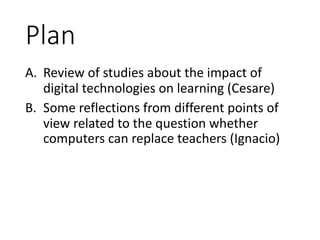
Plan
A. Review	of	studies	about	the	impact	of	
digital	technologies	on	learning	(Cesare)
B. Some	reflections	from	different	points	of	
view	related	to	the	question	whether	
computers	can	replace	teachers	(Ignacio)
Can Computers Replace Teachers ?
Cesare Miglioli
University of Geneva
IIS Netherhall House
5 January, 2019
Cesare Miglioli (University of Geneva) Can Computers Replace Teachers ? Netherhall, 5 Jan 2019 1 / 8
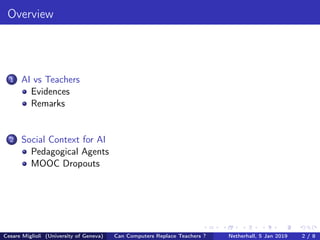
Overview
1 AI vs Teachers
Evidences
Remarks
2 Social Context for AI
Pedagogical Agents
MOOC Dropouts
Cesare Miglioli (University of Geneva) Can Computers Replace Teachers ? Netherhall, 5 Jan 2019 2 / 8
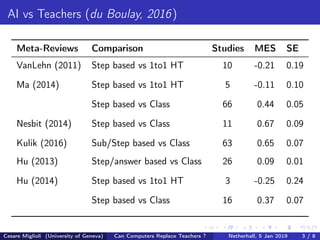
AI vs Teachers (du Boulay, 2016)
Meta-Reviews Comparison Studies MES SE
VanLehn (2011) Step based vs 1to1 HT 10 -0.21 0.19
Ma (2014) Step based vs 1to1 HT 5 -0.11 0.10
Step based vs Class 66 0.44 0.05
Nesbit (2014) Step based vs Class 11 0.67 0.09
Kulik (2016) Sub/Step based vs Class 63 0.65 0.07
Hu (2013) Step/answer based vs Class 26 0.09 0.01
Hu (2014) Step based vs 1to1 HT 3 -0.25 0.24
Step based vs Class 16 0.37 0.07
Cesare Miglioli (University of Geneva) Can Computers Replace Teachers ? Netherhall, 5 Jan 2019 3 / 8
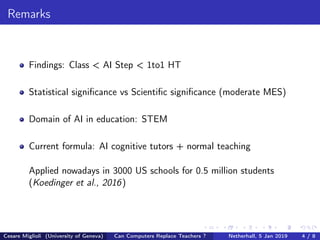
Remarks
Findings: Class < AI Step < 1to1 HT
Statistical significance vs Scientific significance (moderate MES)
Domain of AI in education: STEM
Current formula: AI cognitive tutors + normal teaching
Applied nowadays in 3000 US schools for 0.5 million students
(Koedinger et al., 2016)
Cesare Miglioli (University of Geneva) Can Computers Replace Teachers ? Netherhall, 5 Jan 2019 4 / 8
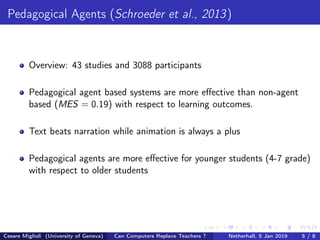
Pedagogical Agents (Schroeder et al., 2013)
Overview: 43 studies and 3088 participants
Pedagogical agent based systems are more effective than non-agent
based (MES = 0.19) with respect to learning outcomes.
Text beats narration while animation is always a plus
Pedagogical agents are more effective for younger students (4-7 grade)
with respect to older students
Cesare Miglioli (University of Geneva) Can Computers Replace Teachers ? Netherhall, 5 Jan 2019 5 / 8
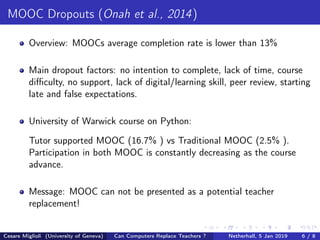
MOOC Dropouts (Onah et al., 2014)
Overview: MOOCs average completion rate is lower than 13%
Main dropout factors: no intention to complete, lack of time, course
difficulty, no support, lack of digital/learning skill, peer review, starting
late and false expectations.
University of Warwick course on Python:
Tutor supported MOOC (16.7% ) vs Traditional MOOC (2.5% ).
Participation in both MOOC is constantly decreasing as the course
advance.
Message: MOOC can not be presented as a potential teacher
replacement!
Cesare Miglioli (University of Geneva) Can Computers Replace Teachers ? Netherhall, 5 Jan 2019 6 / 8
B.	Can	computers	replace	teachers?
Some	reflections
1. Different	visions	of	the	aim	of	(higher)	education
2. Understanding	teaching-learning	as	a	
didactic contract
3. What	makes	the	difference	between	persons	and	
computers?
B.	Can	computers	replace	teachers?
Some	reflections
1. Different	visions	of	the	aim	of	(higher)	education
2. Understanding	teaching-learning	as	a	contract
3. What	makes	the	difference	between	persons	and	
computers?
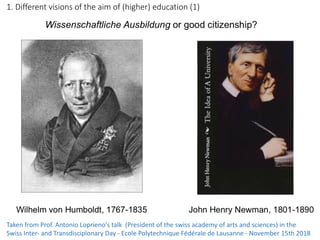
1.	Different	visions	of	the	aim	of	(higher)	education	(1)
Taken	from	Prof.	Antonio	Loprieno's	talk		(President	of	the	swiss	academy	of	arts	and	sciences)	in	the	
Swiss	Inter- and	Transdisciplonary	Day	- Ecole	Polytechnique	Fédérale	de	Lausanne	- November	15th	2018
• If	the	final	aim	of	(higher)	education	is	to		
achieve"Bildung"	or	"good	citizenship",	can	
computers	teach	(lead	to)	this?
• The	question	seems	to	be	deeply	related	to	ETHICS
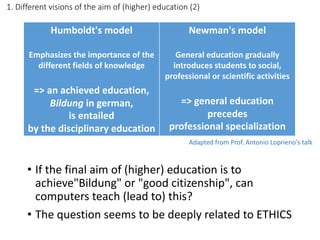
1.	Different	visions	of	the	aim	of	(higher)	education	(2)
Adapted	from	Prof.	Antonio	Loprieno's	talk
Humboldt's	model
Emphasizes	the	importance	of	the	
different	fields	of	knowledge
=>	an	achieved	education,	
Bildung in	german,
is	entailed
by	the	disciplinary	education
Newman's	model
General	education	gradually	
introduces	students	to	social,	
professional	or	scientific	activities
=>	general	education	
precedes
professional	specialization
B.	Can	computers	replace	teachers?
Some	reflections
1. Different	visions	of	the	aim	of	(higher)	education
2. Understanding	teaching-learning	as	a
didactic contract
3. What	makes	the	difference	between	persons	and	
computers?
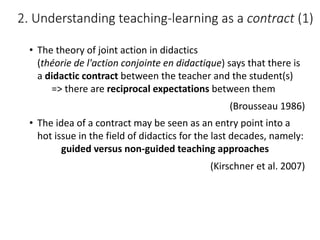
• The	theory	of	joint	action	in	didactics	
(théorie	de	l'action	conjointe	en	didactique)	says	that	there	is	
a	didactic	contract	between	the	teacher	and	the	student(s)
=>	there	are	reciprocal	expectations	between	them
(Brousseau	1986)
• The	idea	of	a	contract	may	be	seen	as	an	entry	point	into	a	
hot	issue	in	the	field	of	didactics	for	the	last	decades,	namely:
guided	versus	non-guided	teaching	approaches
(Kirschner	et	al.	2007)
2.	Understanding	teaching-learning	as	a	contract (1)
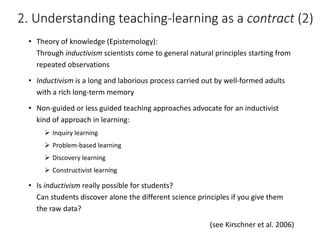
• Theory	of	knowledge	(Epistemology):
Through	inductivism scientists	come	to	general	natural	principles	starting	from	
repeated	observations
• Inductivism is	a	long	and	laborious	process	carried	out	by	well-formed	adults	
with	a	rich	long-term	memory
• Non-guided	or	less	guided	teaching	approaches	advocate	for	an	inductivist	
kind	of	approach	in	learning:
Ø Inquiry	learning
Ø Problem-based	learning
Ø Discovery	learning
Ø Constructivist	learning
• Is	inductivism really	possible	for	students?
Can	students	discover	alone	the	different	science	principles	if	you	give	them	
the	raw	data?
(see	Kirschner	et	al.	2006)
2.	Understanding	teaching-learning	as	a	contract (2)
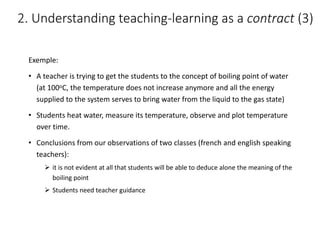
Exemple:
• A	teacher	is	trying	to	get	the	students	to	the	concept	of	boiling	point	of	water	
(at	100oC,	the	temperature	does	not	increase	anymore	and	all	the	energy	
supplied	to	the	system	serves	to	bring	water	from	the	liquid	to	the	gas	state)
• Students	heat	water,	measure	its	temperature,	observe	and	plot	temperature	
over	time.
• Conclusions	from	our	observations	of	two	classes	(french	and	english	speaking	
teachers):
Ø it	is	not	evident	at	all	that	students	will	be	able	to	deduce	alone	the	meaning	of	the	
boiling	point
Ø Students	need	teacher	guidance
2.	Understanding	teaching-learning	as	a	contract (3)
From	the	point	of	view	of	teaching	and	learning,	the	
existance	of	a	didactic	contract	implicitly	shows	that	
guidance	is	something	fundamental	when	learning
=>	one	person,	the	teacher,	guides	one	or	several	other	
persons	and	tells	them:
"THIS	IS	IMPORTANT,	CRUCIAL,	KEY…"
(for	exemple,	if	we	consider	again	the	boiling	point,	when	the	
teacher	insists	on	the	importance	of	observing	everything	
that	happens	at	100oC)
2.	Understanding	teaching-learning	as	a	contract (4)
• Leaving	alone	students	to	learn	with	computers	may	lead	
to	superficial	learning,	through	adaptation	to	the	computer	
actions	and	reactions,	but	without	fully	and	truly	
understanding	concepts,	meanings	and	sense
• The	developed	concept	of	a	didactic	contract	is	not	usable	
as	it	is	for	learning	with	computers
• is	a	didactic	contract	possible	between	a	person	and	a	computer?
• a	contract	is	only	possible	between	two	persons	or	group	of	
persons?
2.	Understanding	teaching-learning	as	a	contract (5)
B.	Can	computers	replace	teachers?
Some	reflections
1. Different	visions	of	the	aim	of	(higher)	education
2. Understanding	teaching-learning	as	a	contract
3. What	makes	the	difference	between	persons	
and	computers?
• The	meanings	that	a	person	can	transmit	are	far	from	being	only	
cognitive,	they	are	associated	or	marked	with
Ø emotions
Ø attitudes
Ø motivations
Ø intentions
Ø … ?
• Only	another	person	can	truly	elevate	the	students	by	fostering	socio-
emotional	skills that	will	contribute	to	thier	personal	develoment	as	a	
human	being
• Only	a	person	can	bring	other	human beings	to	think	out	of	the	box
("out	of	the	programme")	or	to	creativity (what	is	creativity?)
3.	What	makes	the	difference	between	persons	and	computers?
Bibliographie
Brousseau,	Guy	(1986).	Fondements	et	méthodes	en	didachque	des	
mathématiques.	Recherches	en	didac@ques	des	mathématiques,	7(2),	33-
115.
Kirschner	Paul	,	Sweller	John	&	Clark	Richard	E.	(2006).	Why	Minimal	
Guidance	During	Instruction	Does	Not	Work:	An	Analysis	of	the	Failure	of	
Constructivist,	Discovery,	Problem-Based,	Experiential,	and	Inquiry-Based	
Teaching,	Educational	Psychologist,	41:2,	75-86.
Questions? Open Discussion
Cesare Miglioli (University of Geneva) Can Computers Replace Teachers ? Netherhall, 5 Jan 2019 8 / 8

Can computers replace teachers?