TVS-5304.13 - 141
DEPARTMENT OF TECHNICAL EDUCATION
ANDHRA PRADESH
Name : K.V. Niranjan Rao
Designation : Lecturer in TV & Sound
Branch : TV & Sound ENGG.
Semester/year : 5th
Semester
College : Govt. Institute of Electronics
Subject : TV Studio & Broadcasting
Techniques
Code No : TVS-5304
Major Topic : Studio Camera and Lighting
Presentation Duration : 50 Mins.
Sub Topic : Basic camera chain & parts of
camera , CCU
Teaching Aids : Photos , Animations
2.
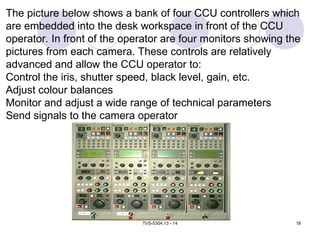
TVS-5304.13 - 142
Objectives
After this class the students will be able to know
•The basic camera chain
•Parts of camera
•Camera control unit (CCU)
3.
TVS-5304.13 - 143
In last class we have learned about
Various formats in TV studios and outdoor
Recap
4.
TVS-5304.13 - 144
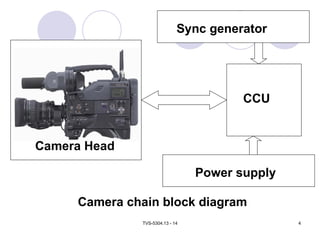
Sync generator
Power supply
CCU
Camera Head
Camera chain block diagram
5.
TVS-5304.13 - 145
CAMERA CHAIN
When looking at a high-quality studio camera, you
can see that it is connected by cable to an electrical outlet.
This Cable connects the camera to a chain of equipment
necessary to produce pictures.
The major parts of the camera chain are
(1) The actual camera, called the camera head because it is at
the head of the chain.
(2) The camera control unit, or CCU.
(3) The sync generator that provides the synchronization pulses
to keep the scanning of the various pieces of television
equipment in step.
(4) The power supply.
6.
TVS-5304.13 - 146
CAMERA CONTROL UNIT
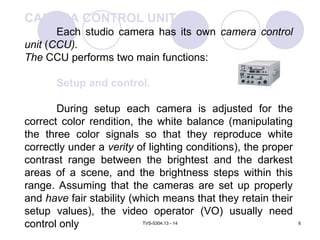
Each studio camera has its own camera control
unit (CCU).
The CCU performs two main functions:
Setup and control.
During setup each camera is adjusted for the
correct color rendition, the white balance (manipulating
the three color signals so that they reproduce white
correctly under a verity of lighting conditions), the proper
contrast range between the brightest and the darkest
areas of a scene, and the brightness steps within this
range. Assuming that the cameras are set up properly
and have fair stability (which means that they retain their
setup values), the video operator (VO) usually need
control only
7.
TVS-5304.13 - 147
"master black" or "pedestal" (adjusting the camera
for the darkest part of the scene), and the "white level"
or "iris" (adjusting the f-stop of the lens so that it will
permit only the desired amount of light to reach the
imaging device).
The VO has two primary instruments for checking
the relative quality of the color signal:
The waveform monitor, also called the
oscilloscope, that displays the luminance (brightness)
information.
The vector scope that shows the chrominance
(color) signals. Both displays enable the VO to
achieve optimal pictures.
8.
TVS-5304.13 - 148
Sometimes, when the actual operational controls are
separated from the CCU, they are known as a remote
control unit (RCU) or, more accurate, an operation
control panel (OCP).
For example, the actual CCUs may be located
in master control, but the OCPs are in the studio
control room. This arrangement allows the video
operator to do the initial camera setup in master
control and then sit in the control room with the
production crew and "shade" the pictures (maintain
optimal picture quality) according not only to technical
standards but also to the aesthetic requirements of the
production. Now you know why the VO is also called a
shader. The term RCU also refers to a small CCU that
can be taken to EFP locations to make field cameras
perform at optimal levels.
9.
TVS-5304.13 - 149
The sync generator produces electronic
synchronization pulses.
sync pulses—that keep in step the scanning in
the various pieces of equipment (cameras, monitors,
and videotape recorders).
A genlock provides various pieces of studio
equipment with a general synchronization pulse, called
house sync.
Through the genlocking process, the scanning
of video signals is perfectly synchronized, allowing you
to switch among and intermix the video signals of
various cameras and/or videotape recorders (VTRs)
without the need for additional digital equipment.
10.
TVS-5304.13 - 1410
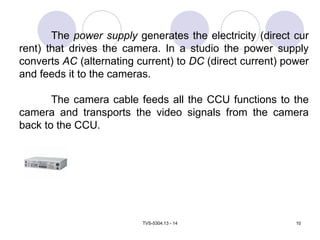
The power supply generates the electricity (direct cur
rent) that drives the camera. In a studio the power supply
converts AC (alternating current) to DC (direct current) power
and feeds it to the cameras.
The camera cable feeds all the CCU functions to the
camera and transports the video signals from the camera
back to the CCU.
11.
TVS-5304.13 - 1411
Video Cameras
Can be divided into several major types
Though most of them operate in same way ,
there are a few differences
It helps to know the common components
12.
TVS-5304.13 - 1412
All the cameras will have these basic components
Body:
Light tight compartment to house recording medium
Lens:
Transparent element to focus light rays on to recording
medium
Aperture:
Method of controlling how light reaches the recording
medium
Shutter:
Method of controlling how long the recording medium is
exposed to incoming light
13.
TVS-5304.13 - 1413
Viewfinder:
Way to see the image to be captured
Transport:
In film cameras, a method of moving the film and hold in
correct position
14.
TVS-5304.13 - 1414
The camera control unit (CCU) is installed in the
production control room (PCR), and allows various
aspects of the video camera on the studio floor to be
controlled remotely. The most commonly made
adjustments are for white balance and aperture,
although almost all technical adjustments are made
from controls on the CCU rather than on the camera.
This frees the camera operator to concentrate on
composition and focus, and also allows the technical
director of the studio to ensure uniformity between all
the cameras.
15.
TVS-5304.13 - 1415
As well as acting as a remote control, the CCU
usually provides the external interfaces for the
camera to other studio equipment, such as the
vision mixer and intercom system, and contains the
camera's power supply.
16.
TVS-5304.13 - 1416
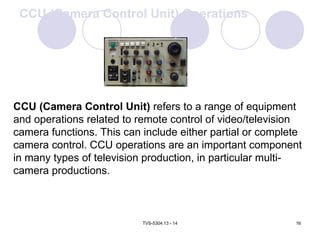
CCU (Camera Control Unit) refers to a range of equipment
and operations related to remote control of video/television
camera functions. This can include either partial or complete
camera control. CCU operations are an important component
in many types of television production, in particular multi-
camera productions.
CCU (Camera Control Unit) Operations
17.
TVS-5304.13 - 1417
Partial CCU Control
This is a common method for controlling camera functions in
television production. It is a professional approach, allowing for
maximum control and quality.
Most of the camera functions (framing, focus, etc) are
controlled normally by a camera operator, whilst certain functions
(colour balance, shutter speed, etc) are controlled remotely by the
CCU operator. This allows the camera operator to concentrate on
framing and composition without being distracted by technical
issues. At the same time the CCU operator, who is a specialist in
the more technical issues, is concentrating on the quality and
consistency of the pictures.
In a multi-camera production the CCU operator will usually
be responsible for more than one camera (2-3 cameras is common,
but up to 10 is possible). Obviously a large production may require
a number of CCU operators. For example, a 20-camera broadcast
could have 5 CCU operators, each controlling 4 cameras.
18.
TVS-5304.13 - 1418
The picture below shows a bank of four CCU controllers which
are embedded into the desk workspace in front of the CCU
operator. In front of the operator are four monitors showing the
pictures from each camera. These controls are relatively
advanced and allow the CCU operator to:
Control the iris, shutter speed, black level, gain, etc.
Adjust colour balances
Monitor and adjust a wide range of technical parameters
Send signals to the camera operator
19.
TVS-5304.13 - 1419
Complete Remote Camera Control
Since the advent of high-performance remote-
controlled cameras, CCU can also refer to cameras
which are completely controlled by the CCU operator
(the camera itself is unmanned).
Such controllers may include any of the
features mentioned above, with the addition of
pan/tilt, zoom and focus controls.
20.
TVS-5304.13 - 1420
The Technical Director
The Technical Director is the person responsible for
setting up and maintaining the technical parameters of the
production's video images. In many cases this is the same
person as the CCU operator, but in any case the two jobs are
closely linked.
The TD's responsibilities include making sure all vision
sources (cameras, tape machines, graphic generators, etc) meet
the technical requirements for broadcast, and that their outputs
are consistent and stable. In older equipment much of this is
done manually by monitoring video signals with a waveform
monitor and vectorscope. In the digital era many of these
functions are performed automatically.
Although it's not always necessary, a good CCU operator
should have a solid technical understanding of how video and
television works.
21.
TVS-5304.13 - 1421
Summary
•The basic camera chain
•Parts of camera
•Camera control unit (CCU)
22.
TVS-5304.13 - 1422
1. The CCU performs two main functions.
They are ___________ and _________.
Ans: setup , control
23.
TVS-5304.13 - 1423
2. ________ is transparent element to focus light
rays on to recording medium.
Ans : Lens
24.
TVS-5304.13 - 1424
Frequently asked questions
1.Explain the basic camera chain.
2.List the parts of camera.