









Raising the Bar: 
Critical New Concepts 
in the 2014 
ACA Code of Ethics
David Kaplan 
ACA Chief Professional Officer 
dkaplan@counseling.org 
www.counseling.org/kaplan
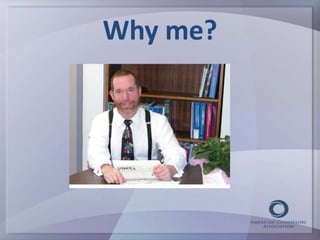
Why me?
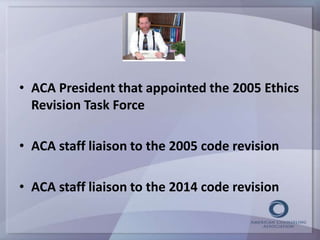
• ACA President that appointed the 2005 Ethics 
Revision Task Force 
• ACA staff liaison to the 2005 code revision 
• ACA staff liaison to the 2014 code revision
www.counseling.org/ethics
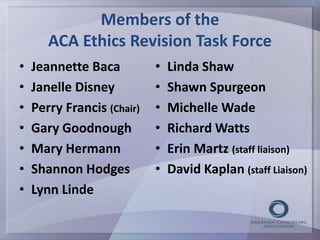
Members of the 
ACA Ethics Revision Task Force 
• Jeannette Baca 
• Janelle Disney 
• Perry Francis (Chair) 
• Gary Goodnough 
• Mary Hermann 
• Shannon Hodges 
• Lynn Linde 
• Linda Shaw 
• Shawn Spurgeon 
• Michelle Wade 
• Richard Watts 
• Erin Martz (staff liaison) 
• David Kaplan (staff Liaison)
Why do you need to know this stuff? 
THE 500 POUND GORILLA 
EFFECT
9
10
11
12
13
14
15
55,000 professional 
counselors agree to abide 
by the ACA Code of Ethics
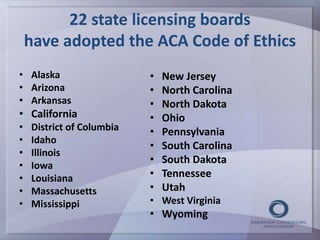
22 state licensing boards 
have adopted the ACA Code of Ethics 
• Alaska 
• Arizona 
• Arkansas 
• California 
• District of Columbia 
• Idaho 
• Illinois 
• Iowa 
• Louisiana 
• Massachusetts 
• Mississippi 
• New Jersey 
• North Carolina 
• North Dakota 
• Ohio 
• Pennsylvania 
• South Carolina 
• South Dakota 
• Tennessee 
• Utah 
• West Virginia 
• Wyoming
The judicial system uses the ACA code 
as the ethical standard for counselors 
• Ward v. Wilbanks 
• Keeton v. Anderson-Wiley
19
I have been counseling an adult woman with a presenting problem 
of difficulty in coping with the death of her mother. Her mother 
and grandmother (who is also deceased) suffered from 
progressive Alzheimer’s disease. My client revealed to me that 
she administered a lethal dose of sleeping pills to her grandmother 
during the final stages of the Alzheimer’s, and that she also 
caused the death of her mother by withholding cardiac medication. 
It was then revealed that it is likely she will have to take care of a 
third relative with Alzheimer’s disease, an elderly Aunt. It is 
important to understand that my client is not a bad person and did 
what she did while under tremendous stress and pressure and 
with feelings of compassion for the deteriorating condition of her 
mother and grandmother. My question is in two parts: First, what 
are my ethical obligations upon hearing the manner in which my 
client’s mother and grandmother died? Second, am I responsible 
to do anything about the upcoming situation with the Aunt?
Theme: 
Raising the Bar 
21
Raising the Bar 
• Professional values 
• Ethical decision making 
• Counselor Educators 
• Counselor Personal values 
• Social media & distance 
counseling
Raising the Bar 
• Professional values 
• Ethical decision making 
• Counselor Educators 
• Counselor Personal values 
• Social media & distance 
counseling
Raising the bar 
for 
professional values
The values of our profession 
are now explicitly stated 
• Human development 
• Multiculturalism and diversity 
• Social Justice 
• Safeguarding the counselor-client 
relationship 
• Practicing in a competent & ethical manner
And on the more nuts and bolts 
level…… 
The code states for the first time that all 
counselors must take case notes 
“Counselors create and maintain records and 
documentation necessary for rendering 
professional services.” (B.6.a.)
And make a reasonable 
effort to provide pro-bono 
services 
(C.6.e)
As well as adding a 
whistleblower policy 
“Counselors do not harass a colleague or 
employee or dismiss an employee who 
has acted in a responsible and ethical 
manner to expose inappropriate 
employer policies or practices.” (D.1.i)
Raising the bar 
for 
ethical decision 
making
The principles of ethical behavior 
are now explicitly stated 
• Autonomy 
• Nonmaleficence 
• Beneficence 
• Justice 
• Fidelity 
• Veracity
Along with a new focus on using a 
methodical approach 
I.1.b. Ethical Decision Making 
When counselors are faced with an 
ethical dilemma, they use and 
document, as appropriate, an ethical 
decision making model….
An example: 
A Practitioner’s Guide to 
Ethical Decision Making by 
Forest-Miller & Davis 
www.counseling.org/knowledge-center/ethics
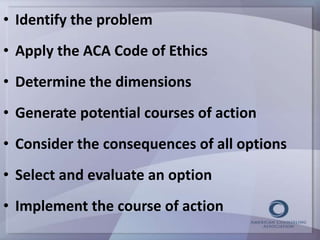
• Identify the problem 
• Apply the ACA Code of Ethics 
• Determine the dimensions 
• Generate potential courses of action 
• Consider the consequences of all options 
• Select and evaluate an option 
• Implement the course of action
Raising the bar 
for 
counselor educators
Counselor educators now have the 
ethical obligation to provide: 
• Current information & knowledge (F.7.b) 
• Instruction only within their areas of 
competency (F.7.b) 
• Direct assistance with field placements (F.7.i) 
• Career assistance to students (F.8.b)
As well as now explicitly stating the 
ethics of gatekeeping 
“[Counselor educators] recommend dismissal from 
training programs…when students are unable to 
demonstrate they can provide competent 
professional services to a range of diverse clients.” 
(F.6.b) 
“Counselor Educators may require students to 
address any personal concerns that have the 
potential to affect professional competency” (F.8.d)
Raising the bar 
for 
counselor personal 
values
Let’s talk lawsuits 
Ward v. Wilbanks 
Keeton v. Anderson-Wiley
ACA’s official position on the 
Ward Case 
www.counseling.org/knowledge-center/ethics 
Scroll down to: 
Ethical Implications of a Critical Legal Case for the Counseling 
Profession: Ward v. Wilbanks 
39
As a result of these cases…
An explicit focus on 
avoiding the imposition of a 
counselor’s personal values
A.4.b. Personal Values 
Counselors are aware of – 
and avoid – imposing their own 
values, attitudes, beliefs, and 
behaviors.
Which extends to referrals 
A.11.b 
Counselors refrain from referring 
prospective and current clients based 
solely on the counselor’s personally 
held values, attitudes, beliefs, and 
behaviors 
43
So what does this mean? 
• Our clients are more important than we 
are. 
• Professional counselors may not deny 
counseling services to a GLBTQ client (or an 
individual belonging to any other protected 
class of clients in C.5) on the basis of the 
counselor’s values.
• Referrals are to be made on the basis of 
skill-based competency, not values. 
• Referral is an issue of last resort. 
- Kaplan, D.M. (2014). Ethical implications of a critical legal 
case for the counseling profession: Ward v. Wilbanks. Journal of 
Counseling and Development, 92, 142-146. doi: 10.1002/j.1556- 
6676.2014.00140.x
Raising the bar 
for 
Social Media & Distance 
Counseling
Distance Counseling, technology 
and social media now get their 
own section (H)
What the heck is a personal virtual 
relationship? 
A.5.e Personal Virtual Relationships With Current 
Clients 
Counselors are prohibited from engaging in a 
personal virtual relationship with individuals with 
whom they have a current counseling 
relationship…
Translation
No Friending
And 
Social media romances 
are treated the same as 
in-person affairs
Other new 
“read between the lines” social 
media imperatives 
• Make your texting rules clear (H.6.b) 
• Don’t check out your client’s Facebook 
page without their permission (H.6.c)
• Don’t disclose confidential information 
through public social media (H6.d.) 
• Ask yourself if you really want a 
personal Facebook page (H.6.a)
New distance counseling 
responsibilities 
• Determine whether counseling your 
client is legal (H1.b) 
• Verify your client’s identity (H.3) 
• Address distance counseling in your 
informed consent procedures (H.2.a)
New distance counseling 
responsibilities 
• Acknowledge the inherent 
confidentiality limits (H.2.b) 
• Encrypt (H.2.d)
• Mandated clients can choose to refuse 
services (A.2.e.) 
• Counselors are now explicitly prohibited 
from counseling someone with whom they 
have had a previous romantic/sexual 
relationship (A.5.b) 
• Self-referrals to your own private practice 
are now explicitly prohibited unless 
certain conditions are met (A.10.a)
• Counselors do not engage in fee splitting or 
provide/receive other forms of 
remuneration for referrals (A.10.b) 
• A sliding scale is now explicitly acceptable 
(A.10.c) 
• The use of legal means to collect unpaid 
fees must be included in your informed 
consent documents (A.10.d)
• Confidentiality now extends to prospective 
clients (B.1.c) 
• The requirement to confirm the diagnosis of 
a life-threating disease in order to protect 
an innocent third party has been removed 
(B.2.c) 
• In the absence of an agreement to the 
contrary, the couple or family is now 
considered to be the client when conducting 
couples or family counseling (B.4.b)
• There are now explicit guidelines for using case 
studies in a classroom (F.7.f) and presentation or 
publication (G.5.a) that protect the client 
• Faculty cannot require students to participate in 
research (G.2.b) 
• Faculty cannot submit manuscripts or conduct 
presentations based on a student’s work without 
the student’s permission and listing the student 
as the lead author (G.5.f)
WHERE TO GO FROM HERE 
THE ACA KNOWLEDGE CENTER 
WWW.COUNSELING.ORG
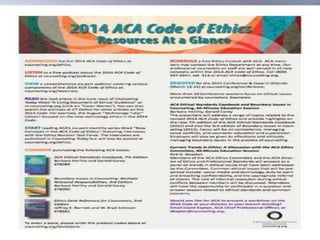
ACA 2014 ethics code resources 
• The code itself 
• Podcast 
• Webinar series 
• Interview series 
• Books 
* See handout
63
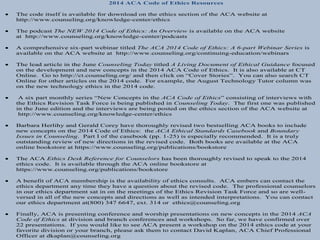
2014 ACA Code of Ethics Resources 
 The code itself is available for download on the ethics section of the ACA website at 
http://www.counseling.org/knowledge-center/ethics 
 The podcast The NEW 2014 Code of Ethics: An Overview is available on the ACA website 
at http://www.counseling.org/knowledge-center/podcasts 
 A comprehensive six-part webinar titled The ACA 2014 Code of Ethics: A 6-part Webinar Series is 
available on the ACA website at http://www.counseling.org/continuing-education/webinars 
 The lead article in the June Counseling Today titled A Living Document of Ethical Guidance focused 
on the development and new concepts in the 2014 ACA Code of Ethics. It is also available at CT 
Online. Go to http://ct.counseling.org/ and then click on “Cover Stories”. You can also search CT 
Online for other articles on the 2014 code. For example, the August Technology Tutor column was 
on the new technology ethics in the 2014 code. 
 A six part monthly series “New Concepts in the ACA Code of Ethics” consisting of interviews with 
the Ethics Revision Task Force is being published in Counseling Today. The first one was published 
in the June edition and the interviews are being posted on the ethics section of the ACA website at 
http://www.counseling.org/knowledge-center/ethics 
 Barbara Herlihy and Gerald Corey have thoroughly revised two bestselling ACA books to include 
new concepts on the 2014 Code of Ethics: the ACA Ethical Standards Casebook and Boundary 
Issues in Counseling. Part I of the casebook (pp. 1-25) is especially recommended. It is a truly 
outstanding review of new directions in the revised code. Both books are available at the ACA 
online bookstore at https://www.counseling.org/publications/bookstore 
 The ACA Ethics Desk Reference for Counselors has been thoroughly revised to speak to the 2014 
ethics code. It is available through the ACA online bookstore at 
https://www.counseling.org/publications/bookstore 
 A benefit of ACA membership is the availability of ethics consults. ACA embers can contact the 
ethics department any time they have a question about the revised code. The professional counselors 
in our ethics department sat in on the meetings of the Ethics Revision Task Force and so are well-versed 
in all of the new concepts and directions as well as intended interpretations. You can contact 
our ethics department at(800) 347 6647, ext. 314 or ethics@counseling.org 
 Finally, ACA is presenting conference and worship presentations on new concepts in the 2014 ACA 
Code of Ethics at division and branch conferences and workshops. So far, we have confirmed over 
22 presentations. If you would like to see ACA present a workshop on the 2014 ethics code at your 
favorite division or your branch, please ask them to contact David Kaplan, ACA Chief Professional 
Officer at dkaplan@counseling.org
Let’s Schmooze
David Kaplan 
ACA Chief Professional Officer 
dkaplan@counseling.org 
www.counseling.org/kaplan

CALPCC SF Conference - 2014 ACA Code of Ethics Presentation

  • 1.
    Raising the Bar: Critical New Concepts in the 2014 ACA Code of Ethics
  • 2.
    David Kaplan ACAChief Professional Officer dkaplan@counseling.org www.counseling.org/kaplan
  • 4.
  • 5.
    • ACA Presidentthat appointed the 2005 Ethics Revision Task Force • ACA staff liaison to the 2005 code revision • ACA staff liaison to the 2014 code revision
  • 6.
  • 7.
    Members of the ACA Ethics Revision Task Force • Jeannette Baca • Janelle Disney • Perry Francis (Chair) • Gary Goodnough • Mary Hermann • Shannon Hodges • Lynn Linde • Linda Shaw • Shawn Spurgeon • Michelle Wade • Richard Watts • Erin Martz (staff liaison) • David Kaplan (staff Liaison)
  • 8.
    Why do youneed to know this stuff? THE 500 POUND GORILLA EFFECT
  • 9.
  • 10.
  • 11.
  • 12.
  • 13.
  • 14.
  • 15.
  • 16.
    55,000 professional counselorsagree to abide by the ACA Code of Ethics
  • 17.
    22 state licensingboards have adopted the ACA Code of Ethics • Alaska • Arizona • Arkansas • California • District of Columbia • Idaho • Illinois • Iowa • Louisiana • Massachusetts • Mississippi • New Jersey • North Carolina • North Dakota • Ohio • Pennsylvania • South Carolina • South Dakota • Tennessee • Utah • West Virginia • Wyoming
  • 18.
    The judicial systemuses the ACA code as the ethical standard for counselors • Ward v. Wilbanks • Keeton v. Anderson-Wiley
  • 19.
  • 20.
    I have beencounseling an adult woman with a presenting problem of difficulty in coping with the death of her mother. Her mother and grandmother (who is also deceased) suffered from progressive Alzheimer’s disease. My client revealed to me that she administered a lethal dose of sleeping pills to her grandmother during the final stages of the Alzheimer’s, and that she also caused the death of her mother by withholding cardiac medication. It was then revealed that it is likely she will have to take care of a third relative with Alzheimer’s disease, an elderly Aunt. It is important to understand that my client is not a bad person and did what she did while under tremendous stress and pressure and with feelings of compassion for the deteriorating condition of her mother and grandmother. My question is in two parts: First, what are my ethical obligations upon hearing the manner in which my client’s mother and grandmother died? Second, am I responsible to do anything about the upcoming situation with the Aunt?
  • 21.
  • 22.
    Raising the Bar • Professional values • Ethical decision making • Counselor Educators • Counselor Personal values • Social media & distance counseling
  • 23.
    Raising the Bar • Professional values • Ethical decision making • Counselor Educators • Counselor Personal values • Social media & distance counseling
  • 24.
    Raising the bar for professional values
  • 25.
    The values ofour profession are now explicitly stated • Human development • Multiculturalism and diversity • Social Justice • Safeguarding the counselor-client relationship • Practicing in a competent & ethical manner
  • 26.
    And on themore nuts and bolts level…… The code states for the first time that all counselors must take case notes “Counselors create and maintain records and documentation necessary for rendering professional services.” (B.6.a.)
  • 27.
    And make areasonable effort to provide pro-bono services (C.6.e)
  • 28.
    As well asadding a whistleblower policy “Counselors do not harass a colleague or employee or dismiss an employee who has acted in a responsible and ethical manner to expose inappropriate employer policies or practices.” (D.1.i)
  • 29.
    Raising the bar for ethical decision making
  • 30.
    The principles ofethical behavior are now explicitly stated • Autonomy • Nonmaleficence • Beneficence • Justice • Fidelity • Veracity
  • 31.
    Along with anew focus on using a methodical approach I.1.b. Ethical Decision Making When counselors are faced with an ethical dilemma, they use and document, as appropriate, an ethical decision making model….
  • 32.
    An example: APractitioner’s Guide to Ethical Decision Making by Forest-Miller & Davis www.counseling.org/knowledge-center/ethics
  • 33.
    • Identify theproblem • Apply the ACA Code of Ethics • Determine the dimensions • Generate potential courses of action • Consider the consequences of all options • Select and evaluate an option • Implement the course of action
  • 34.
    Raising the bar for counselor educators
  • 35.
    Counselor educators nowhave the ethical obligation to provide: • Current information & knowledge (F.7.b) • Instruction only within their areas of competency (F.7.b) • Direct assistance with field placements (F.7.i) • Career assistance to students (F.8.b)
  • 36.
    As well asnow explicitly stating the ethics of gatekeeping “[Counselor educators] recommend dismissal from training programs…when students are unable to demonstrate they can provide competent professional services to a range of diverse clients.” (F.6.b) “Counselor Educators may require students to address any personal concerns that have the potential to affect professional competency” (F.8.d)
  • 37.
    Raising the bar for counselor personal values
  • 38.
    Let’s talk lawsuits Ward v. Wilbanks Keeton v. Anderson-Wiley
  • 39.
    ACA’s official positionon the Ward Case www.counseling.org/knowledge-center/ethics Scroll down to: Ethical Implications of a Critical Legal Case for the Counseling Profession: Ward v. Wilbanks 39
  • 40.
    As a resultof these cases…
  • 41.
    An explicit focuson avoiding the imposition of a counselor’s personal values
  • 42.
    A.4.b. Personal Values Counselors are aware of – and avoid – imposing their own values, attitudes, beliefs, and behaviors.
  • 43.
    Which extends toreferrals A.11.b Counselors refrain from referring prospective and current clients based solely on the counselor’s personally held values, attitudes, beliefs, and behaviors 43
  • 44.
    So what doesthis mean? • Our clients are more important than we are. • Professional counselors may not deny counseling services to a GLBTQ client (or an individual belonging to any other protected class of clients in C.5) on the basis of the counselor’s values.
  • 45.
    • Referrals areto be made on the basis of skill-based competency, not values. • Referral is an issue of last resort. - Kaplan, D.M. (2014). Ethical implications of a critical legal case for the counseling profession: Ward v. Wilbanks. Journal of Counseling and Development, 92, 142-146. doi: 10.1002/j.1556- 6676.2014.00140.x
  • 46.
    Raising the bar for Social Media & Distance Counseling
  • 47.
    Distance Counseling, technology and social media now get their own section (H)
  • 48.
    What the heckis a personal virtual relationship? A.5.e Personal Virtual Relationships With Current Clients Counselors are prohibited from engaging in a personal virtual relationship with individuals with whom they have a current counseling relationship…
  • 49.
  • 50.
  • 51.
    And Social mediaromances are treated the same as in-person affairs
  • 52.
    Other new “readbetween the lines” social media imperatives • Make your texting rules clear (H.6.b) • Don’t check out your client’s Facebook page without their permission (H.6.c)
  • 53.
    • Don’t discloseconfidential information through public social media (H6.d.) • Ask yourself if you really want a personal Facebook page (H.6.a)
  • 54.
    New distance counseling responsibilities • Determine whether counseling your client is legal (H1.b) • Verify your client’s identity (H.3) • Address distance counseling in your informed consent procedures (H.2.a)
  • 55.
    New distance counseling responsibilities • Acknowledge the inherent confidentiality limits (H.2.b) • Encrypt (H.2.d)
  • 57.
    • Mandated clientscan choose to refuse services (A.2.e.) • Counselors are now explicitly prohibited from counseling someone with whom they have had a previous romantic/sexual relationship (A.5.b) • Self-referrals to your own private practice are now explicitly prohibited unless certain conditions are met (A.10.a)
  • 58.
    • Counselors donot engage in fee splitting or provide/receive other forms of remuneration for referrals (A.10.b) • A sliding scale is now explicitly acceptable (A.10.c) • The use of legal means to collect unpaid fees must be included in your informed consent documents (A.10.d)
  • 59.
    • Confidentiality nowextends to prospective clients (B.1.c) • The requirement to confirm the diagnosis of a life-threating disease in order to protect an innocent third party has been removed (B.2.c) • In the absence of an agreement to the contrary, the couple or family is now considered to be the client when conducting couples or family counseling (B.4.b)
  • 60.
    • There arenow explicit guidelines for using case studies in a classroom (F.7.f) and presentation or publication (G.5.a) that protect the client • Faculty cannot require students to participate in research (G.2.b) • Faculty cannot submit manuscripts or conduct presentations based on a student’s work without the student’s permission and listing the student as the lead author (G.5.f)
  • 61.
    WHERE TO GOFROM HERE THE ACA KNOWLEDGE CENTER WWW.COUNSELING.ORG
  • 62.
    ACA 2014 ethicscode resources • The code itself • Podcast • Webinar series • Interview series • Books * See handout
  • 63.
  • 64.
    2014 ACA Codeof Ethics Resources  The code itself is available for download on the ethics section of the ACA website at http://www.counseling.org/knowledge-center/ethics  The podcast The NEW 2014 Code of Ethics: An Overview is available on the ACA website at http://www.counseling.org/knowledge-center/podcasts  A comprehensive six-part webinar titled The ACA 2014 Code of Ethics: A 6-part Webinar Series is available on the ACA website at http://www.counseling.org/continuing-education/webinars  The lead article in the June Counseling Today titled A Living Document of Ethical Guidance focused on the development and new concepts in the 2014 ACA Code of Ethics. It is also available at CT Online. Go to http://ct.counseling.org/ and then click on “Cover Stories”. You can also search CT Online for other articles on the 2014 code. For example, the August Technology Tutor column was on the new technology ethics in the 2014 code.  A six part monthly series “New Concepts in the ACA Code of Ethics” consisting of interviews with the Ethics Revision Task Force is being published in Counseling Today. The first one was published in the June edition and the interviews are being posted on the ethics section of the ACA website at http://www.counseling.org/knowledge-center/ethics  Barbara Herlihy and Gerald Corey have thoroughly revised two bestselling ACA books to include new concepts on the 2014 Code of Ethics: the ACA Ethical Standards Casebook and Boundary Issues in Counseling. Part I of the casebook (pp. 1-25) is especially recommended. It is a truly outstanding review of new directions in the revised code. Both books are available at the ACA online bookstore at https://www.counseling.org/publications/bookstore  The ACA Ethics Desk Reference for Counselors has been thoroughly revised to speak to the 2014 ethics code. It is available through the ACA online bookstore at https://www.counseling.org/publications/bookstore  A benefit of ACA membership is the availability of ethics consults. ACA embers can contact the ethics department any time they have a question about the revised code. The professional counselors in our ethics department sat in on the meetings of the Ethics Revision Task Force and so are well-versed in all of the new concepts and directions as well as intended interpretations. You can contact our ethics department at(800) 347 6647, ext. 314 or ethics@counseling.org  Finally, ACA is presenting conference and worship presentations on new concepts in the 2014 ACA Code of Ethics at division and branch conferences and workshops. So far, we have confirmed over 22 presentations. If you would like to see ACA present a workshop on the 2014 ethics code at your favorite division or your branch, please ask them to contact David Kaplan, ACA Chief Professional Officer at dkaplan@counseling.org
  • 65.
  • 66.
    David Kaplan ACAChief Professional Officer dkaplan@counseling.org www.counseling.org/kaplan