Autor: Gisela Ferreyra 
Tema: Holidays 
Subtema: Touristic places. 
Nivel: Elemental. 
Marco Teórico: 
Gramática: Pasado simple: verbos regulares e irregulares. 
Vocabulario: Medios de transporte, Vocabulario relacionado a actividades de 
vacaciones (go camping, go shopping, travel, stay at a hotel,etc) 
Libro: What’s up 1 
Tiempo requerido: 6 horas 
Introducción a la secuencia: 
En esta secuencia los alumnos relataran sus vacaciones. Asi como también serán 
estimulados a imaginar que en sus vacaciones pasadas visitaron alguna atracción 
turística y plantearan posibles acciones realizadas en ese lugar por ellos mismos y 
también por un tercero. 
Objetivo de la secuencia: 
Aprender a expresar acciones en el pasado. 
Destrezas implicadas: 
Comprensión y producción: oral y escrita. 
Fundamentación: 
La enseñanza de una lengua extranjera permite a los alumnos enriquecerse con 
una educación integral que les proveerá de las capacidades necesarias para 
desenvolverse en un futuro laboral. Asi como también se les incita a respetar y 
reflexionar sobre otras culturas diferentes a la de ellos. En nuestros días, es 
imprescindible tener en cuenta que el estudio de otras lenguas permite a los 
estudiantes sensibilizarse hacia diversos modos de expresión, conocimiento, y 
relación de las sociedades humanas.
ANTES DE EMPEZAR: 
En la primer parte de la secuencia los alumnos conocerán mediante videos y otras 
herramientas (explorador) diferentes puntos turísticos de todo el mundo. 
Expresaran preferencias sobre cada lugar (los mostrados por la profesora asi 
como también los buscados por ellos mismos) 
 Clase 1: 
Tema: Holidays 
Objetivo: hacia el final de la clase los estudiantes seran capaces de: 
 Reconocer paises y lugares del mundo. 
 Reconocer expresiones de preferencias como: “I like…I 
prefer…" 
Nivel: Elementary 
Tiempo: 40 min 
Recursos: projector, worksheets, computers. 
Warming up-Pre- viewing: 
Teacher shows students a World map and asks students: “How many 
tourist places do you know?” she asks them to point out some of them. “ In our 
country, which tourist places do we have?” “ Have you visited some of them?” 
“What do usually do on holidays?” “Which places do you visit?”(7 min)
Teacher delivers students a photocopy with a chart, she asks them to read it and 
make predictions: (According to the chart): “Are you going to listen a song or to 
watch a video?” “About what?” 
1-COMPLETE THE CHART. 
WORLD’S TOP 10 TOURIST DESTINATIONS 
VIDEO Countries’ flags colours ………………….(name of the 
students) 
Presentation: 
Teacher shows a video about tourist destinations (link 
https://www.youtube.com/watch?v=4HJVxc99-bo ) She asks students to watch 
once and to complete the chart with the colours of the flags. (5 min)
While viewing: Students are asked watch the video once more and to complete 
the chart with the information of the video. (5 min) 
The video is showed a third time and students correct the activities (5 min) 
Post viewing- Practice: 
Students are asked to work in pairs and make their own ranking. They have to 
write it in the right side of the chart. (ACTIVITY 1) (5 min) 
: 
Production-ACTIVITY 2: (13 min) Students are asked to make a video with 
the ranking made by them: 
 Make a video about your favourite holiday’s destinations . Include images, 
and sentences such as “My favourite destination is…”. Then, create an 
account in youtube.com and upload your video with music. 
Use one of the following tools: 
 Moviemaker. 
 Animoto 
Students are asked to finish the video for next class. 
OBSERVAR Y COMPRENDER 
En esta sección los alumnos observaran medios de transporte y diferentes lugares 
turísticos de nuestro país. El objetivo es incorporar vocabulario relacionado a las 
actividades de vacaciones como así también los medios (transportes) usuales 
para ir de un lugar a otro. También mediante el relato en imágenes de un 
personaje aprenderán verbos regulares en pasado para posteriormente aplicarlos 
a sus propias vivencias y compartirlo con sus compañeros de clase mediante una 
herramienta tecnológica (voicethread). 
Clase 2: 
Objetivo: hacia el final de la clase los estudiantes seran capaces de: 
 Revisar verbos regulares 
 Revisar actividades vacacionales. 
 Reconocer el uso de pasado simple.
Tiempo: 40 min 
Recursos: computer, worksheets, board. 
Warming up: 
 Teacher asks students to show to the rest of the class their productions. (10 
min) 
Presentation of vocabulary: 
 Teacher shows a power point presentation in which she presents means of 
transport. (5 min) 
(https://docs.google.com/file/d/0Bw6hUgZbo_o3c21wNkRDYUxNM0E/edit) 
Practice of vocabulary. 
 She asks them to go to the page 60 of their book and do the activity 1. 
Then, They check orally (7 min) 
 She asks students to go to this site: 
http://www.languageguide.org/english/vocabulary/land-travel/ . They are 
asked to add new means of transport to the list presented by the teacher. 
(10) 
PRESENTATION of GRAMMAR 
 Teacher presents a timeline (http://www.capzles.com/b3eb98c7-989d-427b- 
8b2b-89b820dbd9a7) which was made by Robert (an invented character). 
She asks students to read the title and asks: Robert made a timeline about 
what? Where did he travel? Which places did he visit?... (10 min) 
 Then, she asks them to click on the images and read the descriptions of 
each picture. She makes questions about each of them. Then she asks: 
“Those actions, verbs that you read there… are in the present or in the 
past? Look at the verbs…what do you add at the end of the verbs to put 
them into the past?”Then, she explains that those verbs in the past with a – 
ED suffix are called REGULAR VERBS. (15 min)
PRACTICE 
 She delivers a worksheet with sentences to systematize grammar. 
Then, they correct the activities on the board. (8 min) 
Complete with the past form of the verbs in brackets. 
1_I____ some hamburgers with my friends.(cook) 
2_ I ___ football in Corrientes. (play) 
3_ We ___ in a hotel in Buenos Aires. (stay) 
4_ They ____ late to the school. (arrive) 
5_We____to my grandma’s house with my sister.(Walk) 
 Students are asked to register in voicethread (http://voicethread.com/) and 
work in groups of three. 
They have to tell to each other what they did on their last holidays, using 
regular verbs. If they travelled, they had to mention the mean of transport 
used to arrive to their destinations.(15 min) 
RECURSOS LINGÛISTICOS: 
Los alumnos escucharan un diálogo donde se repasan los verbos regulares 
utilizados en actividades de vacaciones. La docente seguirá los pasos de “pre 
listening” (antes de la escucha) donde los chicos tendrán un primer contacto con el 
texto que tienen que completar, un “while listening” (durante la escucha), donde 
los chicos escucharan el audio y completaran el texto, y un “post listening” 
(después de la escucha) donde se corroborará si los estudiantes efectivamente 
entendieron el texto. 
CLASE 3: 
Objetivo: hacia el final de la clase los alumnos serán capaces 
de:
 Reconocer verbos regulares. 
 Producir oraciones usando vocabulario visto previamente 
(holiday activities) y verbos regulares. 
Tiempo: 40 min. 
Recursos: worksheets, audio, computer. 
Warming up: 
Students present their work in voicethread to the rest of the class. If there’s 
any grammar or language mistake, teacher will ask for feedback to the rest 
of the class. If necessary, she will give the feedback (10 min) 
Pre listening: (7 min) 
 Teacher delivers some worksheets with an incomplete text. In this text a 
man talks about the activities he did during his last holidays. Teacher asks 
students to look at the worksheets: “What is it?” “A dialogue? A song? A 
short text?” “Is it complete or in incomplete?” “How many spaces to 
complete do you have there?” “The story is about the present or the past?” “ 
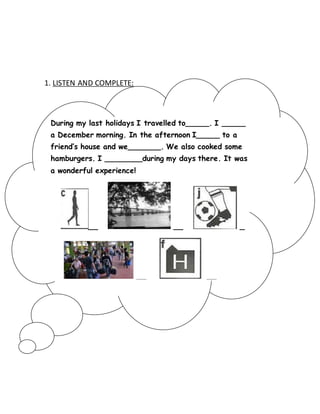
How do you know that”. Teacher asks students to look at the pictures below 
the text and asks: “What do the pictures represent?” “ What are these 
people doing?”
1. LISTEN AND COMPLETE: 
During my last holidays I travelled to_____. I _____ 
a December morning. In the afternoon I_____ to a 
friend’s house and we_______. We also cooked some 
hamburgers. I ________during my days there. It was 
a wonderful experience! 
__ __ _ 
__ __
While listening: (7 min) 
Teacher plays the audio 
((https://drive.google.com/?tab=wo&authuser=0#my-drive) and makes 
pauses after each sentence. Students try to complete. Teacher tell students 
that they are going to listen it twice. 
Post listening (6 min): 
Students correct the listening. Then, they are asked to put the images in 
order according to the audio. 
Practice- Activity (10 min) : 
Students are asked to work in pairs. They have to choose a destination and 
imagine that they travelled to that place together. They are asked to work with a 
online timeline maker (capzles) . They had to record themselves and add the audio 
(following the example provided by the teacher) to the timeline. If they don’t finish, 
they will continue next class. 
PRODUCIR Y COMUNICAR: 
En esta sección los alumnos leerán textos donde tendrán que reconocer verbos 
regulares e irregulares. La docente dará pistas para que los alumnos lleguen a 
reconocerlos. Luego, los estudiantes tendrán que utilizar todo lo aprendido 
(vocabulario y gramática) en esta secuencia para producir un poster donde 
recurrirán a su imaginación para inventar un personaje y un posible lugar visitado 
por el mismo. 
Clase 4: 
Objetivo: hacia el final de la clase los alumnos serán capaces de: 
 Reconocer verbos irregulares. 
 Producir oraciones usando vocabulario visto previamente (holiday activities) 
con verbos regulares e irregulares. 
Tiempo: 80 min.
Warming up: 
 Students are asked to finish the timeline of the previous lesson (10 
min) 
 Then, they are asked to show and explain their timeline to their 
classmates (10 min). 
Presentation: 
 Teacher divides the class in four groups. Each group reads a text 
about someone’s holidays. 
While students read the text, teacher draws a chart on the board (7 
min): 
Present Past 
Stay 
Arrive 
Visit 
Play 
Take 
See 
Saw 
 Then, she asks each group to find the past of these verbs on the text 
and complete the chart on the board. They will write the past of 
almost every verb, but they won’t write the past of take,see and saw. 
So teacher will ask: “Look at the text again, you will find the past of 
take,see and saw” If they cannot recognize she asks to look at the 
highlighted words. Teacher asks to each group to come to the front 
and complete the chart. Then, she asks them: “Do we add –ED to 
these verbs?” “What do we actually do?” “If these ones (pointing at 
the regular verbs) are called REGULAR verbs, how do we call to 
these ones?(pointing at the irregular ones). Finally, students are 
asked to copy this chart on their copybooks. (10 min) 
 Then, they have to complete the chart below the text according to 
what they read. They share their answers with the rest of the class. (7 
min)
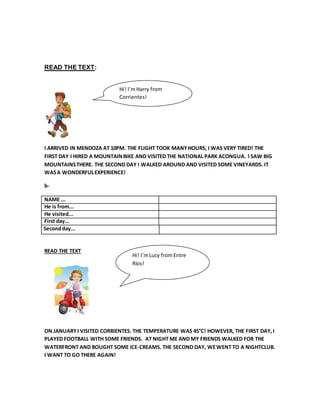
Hi! I’m Harry from 
Corrientes! 
READ THE TEXT: 
I ARRIVED IN MENDOZA AT 10PM. THE FLIGHT TOOK MANY HOURS, I WAS VERY TIRED! THE 
FIRST DAY I HIRED A MOUNTAIN BIKE AND VISITED THE NATIONAL PARK ACONGUA. I SAW BIG 
MOUNTAINS THERE. THE SECOND DAY I WALKED AROUND AND VISITED SOME VINEYARDS. IT 
WAS A WONDERFUL EXPERIENCE! 
b- 
NAME ... 
He is from... 
He visited... 
First day... 
Second day... 
READ THE TEXT 
Hi! I’m Lucy from Entre 
Ríos! 
ON JANUARY I VISITED CORRIENTES. THE TEMPERATURE WAS 45°C! HOWEVER, THE FIRST DAY, I 
PLAYED FOOTBALL WITH SOME FRIENDS. AT NIGHT ME AND MY FRIENDS WALKED FOR THE 
WATERFRONT AND BOUGHT SOME ICE-CREAMS. THE SECOND DAY, WE WENT TO A NIGHTCLUB. 
I WANT TO GO THERE AGAIN!
NAME ... 
She is from... 
She visited... 
First day... 1. 
2. 
3. 
Second day... 
READ THE TEXT 
I TRAVELLED TO BUENOS AIRES ON MY LAST HOLIDAYS. THE FIRST DAY ME AND MY SISTER 
TOOK THE UNDERGROUND AND WENT SHOPPING. WE BOUGHT GIFTS FOR OUR FAMILY. THE 
SECOND DAY WE TOOK A COACH TO MAR DEL PLATA AND WENT TO THE BEACH. WE WISH TO 
VISIT BUENOS AIRES AGAIN! 
NAME ... 
He is from... 
He visited... 
First day... 
Second day... 
READ THE TEXT 
Hi! I’m Joseph from Chaco! 
Hi! I’m Sarah from Buenos 
Aires!
ON THE LAST WEEK OF OUR HOLIDAYS, ME AND MY FAMILY WENT CAMPING TO JUJUY. THE 
FIRST DAY, WE VISITED THE “SEVEN COLOURS HILL” , A WONDERFUL TOURIST ATTRACTION IN 
OUR COUNTRY, THE SECOND DAY WE VISITED A MUSEUM. AT NIGHT WE COOKED 
HAMBURGERS-THEY WERE DELICIOUS! 
b. 
NAME ... 
She is from... 
She visited... 
First day... 
Second day... 
Teacher asks students to work with the same groups and sign up in glogster 
(http://edu.glogster.com/) as student. They have to invent a character and imagine 
that this character had traveled to a place, teacher gives some options (France, 
Brazil, Argentina, United Kingdom, United States), they have to do a search on the 
internet about this place and make a poster with images,video,etc and a text using 
regulars and irregulars verbs. They also have to mention the mean of transport 
used to travel. Then, they present this poster to the rest of the class, teacher and 
classmates give feedback. (36 min)

Call secuencia

  • 1.
    Autor: Gisela Ferreyra Tema: Holidays Subtema: Touristic places. Nivel: Elemental. Marco Teórico: Gramática: Pasado simple: verbos regulares e irregulares. Vocabulario: Medios de transporte, Vocabulario relacionado a actividades de vacaciones (go camping, go shopping, travel, stay at a hotel,etc) Libro: What’s up 1 Tiempo requerido: 6 horas Introducción a la secuencia: En esta secuencia los alumnos relataran sus vacaciones. Asi como también serán estimulados a imaginar que en sus vacaciones pasadas visitaron alguna atracción turística y plantearan posibles acciones realizadas en ese lugar por ellos mismos y también por un tercero. Objetivo de la secuencia: Aprender a expresar acciones en el pasado. Destrezas implicadas: Comprensión y producción: oral y escrita. Fundamentación: La enseñanza de una lengua extranjera permite a los alumnos enriquecerse con una educación integral que les proveerá de las capacidades necesarias para desenvolverse en un futuro laboral. Asi como también se les incita a respetar y reflexionar sobre otras culturas diferentes a la de ellos. En nuestros días, es imprescindible tener en cuenta que el estudio de otras lenguas permite a los estudiantes sensibilizarse hacia diversos modos de expresión, conocimiento, y relación de las sociedades humanas.
  • 2.
    ANTES DE EMPEZAR: En la primer parte de la secuencia los alumnos conocerán mediante videos y otras herramientas (explorador) diferentes puntos turísticos de todo el mundo. Expresaran preferencias sobre cada lugar (los mostrados por la profesora asi como también los buscados por ellos mismos)  Clase 1: Tema: Holidays Objetivo: hacia el final de la clase los estudiantes seran capaces de:  Reconocer paises y lugares del mundo.  Reconocer expresiones de preferencias como: “I like…I prefer…" Nivel: Elementary Tiempo: 40 min Recursos: projector, worksheets, computers. Warming up-Pre- viewing: Teacher shows students a World map and asks students: “How many tourist places do you know?” she asks them to point out some of them. “ In our country, which tourist places do we have?” “ Have you visited some of them?” “What do usually do on holidays?” “Which places do you visit?”(7 min)
  • 3.
    Teacher delivers studentsa photocopy with a chart, she asks them to read it and make predictions: (According to the chart): “Are you going to listen a song or to watch a video?” “About what?” 1-COMPLETE THE CHART. WORLD’S TOP 10 TOURIST DESTINATIONS VIDEO Countries’ flags colours ………………….(name of the students) Presentation: Teacher shows a video about tourist destinations (link https://www.youtube.com/watch?v=4HJVxc99-bo ) She asks students to watch once and to complete the chart with the colours of the flags. (5 min)
  • 4.
    While viewing: Studentsare asked watch the video once more and to complete the chart with the information of the video. (5 min) The video is showed a third time and students correct the activities (5 min) Post viewing- Practice: Students are asked to work in pairs and make their own ranking. They have to write it in the right side of the chart. (ACTIVITY 1) (5 min) : Production-ACTIVITY 2: (13 min) Students are asked to make a video with the ranking made by them:  Make a video about your favourite holiday’s destinations . Include images, and sentences such as “My favourite destination is…”. Then, create an account in youtube.com and upload your video with music. Use one of the following tools:  Moviemaker.  Animoto Students are asked to finish the video for next class. OBSERVAR Y COMPRENDER En esta sección los alumnos observaran medios de transporte y diferentes lugares turísticos de nuestro país. El objetivo es incorporar vocabulario relacionado a las actividades de vacaciones como así también los medios (transportes) usuales para ir de un lugar a otro. También mediante el relato en imágenes de un personaje aprenderán verbos regulares en pasado para posteriormente aplicarlos a sus propias vivencias y compartirlo con sus compañeros de clase mediante una herramienta tecnológica (voicethread). Clase 2: Objetivo: hacia el final de la clase los estudiantes seran capaces de:  Revisar verbos regulares  Revisar actividades vacacionales.  Reconocer el uso de pasado simple.
  • 5.
    Tiempo: 40 min Recursos: computer, worksheets, board. Warming up:  Teacher asks students to show to the rest of the class their productions. (10 min) Presentation of vocabulary:  Teacher shows a power point presentation in which she presents means of transport. (5 min) (https://docs.google.com/file/d/0Bw6hUgZbo_o3c21wNkRDYUxNM0E/edit) Practice of vocabulary.  She asks them to go to the page 60 of their book and do the activity 1. Then, They check orally (7 min)  She asks students to go to this site: http://www.languageguide.org/english/vocabulary/land-travel/ . They are asked to add new means of transport to the list presented by the teacher. (10) PRESENTATION of GRAMMAR  Teacher presents a timeline (http://www.capzles.com/b3eb98c7-989d-427b- 8b2b-89b820dbd9a7) which was made by Robert (an invented character). She asks students to read the title and asks: Robert made a timeline about what? Where did he travel? Which places did he visit?... (10 min)  Then, she asks them to click on the images and read the descriptions of each picture. She makes questions about each of them. Then she asks: “Those actions, verbs that you read there… are in the present or in the past? Look at the verbs…what do you add at the end of the verbs to put them into the past?”Then, she explains that those verbs in the past with a – ED suffix are called REGULAR VERBS. (15 min)
  • 6.
    PRACTICE  Shedelivers a worksheet with sentences to systematize grammar. Then, they correct the activities on the board. (8 min) Complete with the past form of the verbs in brackets. 1_I____ some hamburgers with my friends.(cook) 2_ I ___ football in Corrientes. (play) 3_ We ___ in a hotel in Buenos Aires. (stay) 4_ They ____ late to the school. (arrive) 5_We____to my grandma’s house with my sister.(Walk)  Students are asked to register in voicethread (http://voicethread.com/) and work in groups of three. They have to tell to each other what they did on their last holidays, using regular verbs. If they travelled, they had to mention the mean of transport used to arrive to their destinations.(15 min) RECURSOS LINGÛISTICOS: Los alumnos escucharan un diálogo donde se repasan los verbos regulares utilizados en actividades de vacaciones. La docente seguirá los pasos de “pre listening” (antes de la escucha) donde los chicos tendrán un primer contacto con el texto que tienen que completar, un “while listening” (durante la escucha), donde los chicos escucharan el audio y completaran el texto, y un “post listening” (después de la escucha) donde se corroborará si los estudiantes efectivamente entendieron el texto. CLASE 3: Objetivo: hacia el final de la clase los alumnos serán capaces de:
  • 7.
     Reconocer verbosregulares.  Producir oraciones usando vocabulario visto previamente (holiday activities) y verbos regulares. Tiempo: 40 min. Recursos: worksheets, audio, computer. Warming up: Students present their work in voicethread to the rest of the class. If there’s any grammar or language mistake, teacher will ask for feedback to the rest of the class. If necessary, she will give the feedback (10 min) Pre listening: (7 min)  Teacher delivers some worksheets with an incomplete text. In this text a man talks about the activities he did during his last holidays. Teacher asks students to look at the worksheets: “What is it?” “A dialogue? A song? A short text?” “Is it complete or in incomplete?” “How many spaces to complete do you have there?” “The story is about the present or the past?” “ How do you know that”. Teacher asks students to look at the pictures below the text and asks: “What do the pictures represent?” “ What are these people doing?”
  • 8.
    1. LISTEN ANDCOMPLETE: During my last holidays I travelled to_____. I _____ a December morning. In the afternoon I_____ to a friend’s house and we_______. We also cooked some hamburgers. I ________during my days there. It was a wonderful experience! __ __ _ __ __
  • 9.
    While listening: (7min) Teacher plays the audio ((https://drive.google.com/?tab=wo&authuser=0#my-drive) and makes pauses after each sentence. Students try to complete. Teacher tell students that they are going to listen it twice. Post listening (6 min): Students correct the listening. Then, they are asked to put the images in order according to the audio. Practice- Activity (10 min) : Students are asked to work in pairs. They have to choose a destination and imagine that they travelled to that place together. They are asked to work with a online timeline maker (capzles) . They had to record themselves and add the audio (following the example provided by the teacher) to the timeline. If they don’t finish, they will continue next class. PRODUCIR Y COMUNICAR: En esta sección los alumnos leerán textos donde tendrán que reconocer verbos regulares e irregulares. La docente dará pistas para que los alumnos lleguen a reconocerlos. Luego, los estudiantes tendrán que utilizar todo lo aprendido (vocabulario y gramática) en esta secuencia para producir un poster donde recurrirán a su imaginación para inventar un personaje y un posible lugar visitado por el mismo. Clase 4: Objetivo: hacia el final de la clase los alumnos serán capaces de:  Reconocer verbos irregulares.  Producir oraciones usando vocabulario visto previamente (holiday activities) con verbos regulares e irregulares. Tiempo: 80 min.
  • 10.
    Warming up: Students are asked to finish the timeline of the previous lesson (10 min)  Then, they are asked to show and explain their timeline to their classmates (10 min). Presentation:  Teacher divides the class in four groups. Each group reads a text about someone’s holidays. While students read the text, teacher draws a chart on the board (7 min): Present Past Stay Arrive Visit Play Take See Saw  Then, she asks each group to find the past of these verbs on the text and complete the chart on the board. They will write the past of almost every verb, but they won’t write the past of take,see and saw. So teacher will ask: “Look at the text again, you will find the past of take,see and saw” If they cannot recognize she asks to look at the highlighted words. Teacher asks to each group to come to the front and complete the chart. Then, she asks them: “Do we add –ED to these verbs?” “What do we actually do?” “If these ones (pointing at the regular verbs) are called REGULAR verbs, how do we call to these ones?(pointing at the irregular ones). Finally, students are asked to copy this chart on their copybooks. (10 min)  Then, they have to complete the chart below the text according to what they read. They share their answers with the rest of the class. (7 min)
  • 11.
    Hi! I’m Harryfrom Corrientes! READ THE TEXT: I ARRIVED IN MENDOZA AT 10PM. THE FLIGHT TOOK MANY HOURS, I WAS VERY TIRED! THE FIRST DAY I HIRED A MOUNTAIN BIKE AND VISITED THE NATIONAL PARK ACONGUA. I SAW BIG MOUNTAINS THERE. THE SECOND DAY I WALKED AROUND AND VISITED SOME VINEYARDS. IT WAS A WONDERFUL EXPERIENCE! b- NAME ... He is from... He visited... First day... Second day... READ THE TEXT Hi! I’m Lucy from Entre Ríos! ON JANUARY I VISITED CORRIENTES. THE TEMPERATURE WAS 45°C! HOWEVER, THE FIRST DAY, I PLAYED FOOTBALL WITH SOME FRIENDS. AT NIGHT ME AND MY FRIENDS WALKED FOR THE WATERFRONT AND BOUGHT SOME ICE-CREAMS. THE SECOND DAY, WE WENT TO A NIGHTCLUB. I WANT TO GO THERE AGAIN!
  • 12.
    NAME ... Sheis from... She visited... First day... 1. 2. 3. Second day... READ THE TEXT I TRAVELLED TO BUENOS AIRES ON MY LAST HOLIDAYS. THE FIRST DAY ME AND MY SISTER TOOK THE UNDERGROUND AND WENT SHOPPING. WE BOUGHT GIFTS FOR OUR FAMILY. THE SECOND DAY WE TOOK A COACH TO MAR DEL PLATA AND WENT TO THE BEACH. WE WISH TO VISIT BUENOS AIRES AGAIN! NAME ... He is from... He visited... First day... Second day... READ THE TEXT Hi! I’m Joseph from Chaco! Hi! I’m Sarah from Buenos Aires!
  • 13.
    ON THE LASTWEEK OF OUR HOLIDAYS, ME AND MY FAMILY WENT CAMPING TO JUJUY. THE FIRST DAY, WE VISITED THE “SEVEN COLOURS HILL” , A WONDERFUL TOURIST ATTRACTION IN OUR COUNTRY, THE SECOND DAY WE VISITED A MUSEUM. AT NIGHT WE COOKED HAMBURGERS-THEY WERE DELICIOUS! b. NAME ... She is from... She visited... First day... Second day... Teacher asks students to work with the same groups and sign up in glogster (http://edu.glogster.com/) as student. They have to invent a character and imagine that this character had traveled to a place, teacher gives some options (France, Brazil, Argentina, United Kingdom, United States), they have to do a search on the internet about this place and make a poster with images,video,etc and a text using regulars and irregulars verbs. They also have to mention the mean of transport used to travel. Then, they present this poster to the rest of the class, teacher and classmates give feedback. (36 min)