Downloaded 52 times
![Museum – a definition “ A museum is a non-profit making, permanent institution in the service of society and of its development, and open to the public, which acquires, conserves, researches, communicates and exhibits, for purposes of study, education and enjoyment, material evidence of people and their environment.” [http://icom.museum/definition.html]](https://image.slidesharecdn.com/califanotashkent2008-100201085159-phpapp02/85/Museums-Open-Closed-Musings-on-Museum-Form-Content-and-Function-4-320.jpg)
![Intangible Heritage – a definition “ Culture manifests itself not only in tangible forms but also through intangible ones… transmitted from generation to generation by … a whole range of forms of mediation. [It] includes voices, values, traditions, languages, oral history, folk life, creativity, adaptability and indeed all that is distinctive of a people.” [http://icom.museum/pdf/E_news2003/extra/p10_2003-4.pdf]](https://image.slidesharecdn.com/califanotashkent2008-100201085159-phpapp02/85/Museums-Open-Closed-Musings-on-Museum-Form-Content-and-Function-5-320.jpg)
![Lateral Thinking – a definition Lateral thinking is … a technique of problem solving by approaching problems indirectly at diverse angles instead of concentrating on one approach at length. [http://en.wikipedia.org/wiki/ Lateral_thinking ]](https://image.slidesharecdn.com/califanotashkent2008-100201085159-phpapp02/85/Museums-Open-Closed-Musings-on-Museum-Form-Content-and-Function-8-320.jpg)
![Fuzzy Logic – a definition Fuzzy logic is a form of… reasoning that is approximate rather than precise. Fuzzy logic is not any less precise than any other form of logic: it is an organized and mathematical method of handling inherently imprecise concepts... [http://en.wikipedia.org/wiki/ Fuzzy_logic ]](https://image.slidesharecdn.com/califanotashkent2008-100201085159-phpapp02/85/Museums-Open-Closed-Musings-on-Museum-Form-Content-and-Function-9-320.jpg)
![Neoteny – a definition Neoteny is a term in developmental biology that describes the retention of juvenile characteristics in the adults of a species. [http://en.wikipedia.org/wiki/Neoteny]](https://image.slidesharecdn.com/califanotashkent2008-100201085159-phpapp02/85/Museums-Open-Closed-Musings-on-Museum-Form-Content-and-Function-10-320.jpg)
![Neoteny in human beings “ Animals love playing while puppies, but … human beings use to play the whole life long. Of course, they call this activity differently: they speak of it as Art or Research, Sports or Philosophy, Music or Poetry, Tourism or Entertainment.” [Desmond Morris, 2004]](https://image.slidesharecdn.com/califanotashkent2008-100201085159-phpapp02/85/Museums-Open-Closed-Musings-on-Museum-Form-Content-and-Function-11-320.jpg)
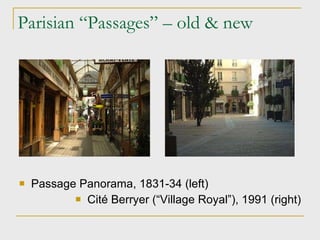
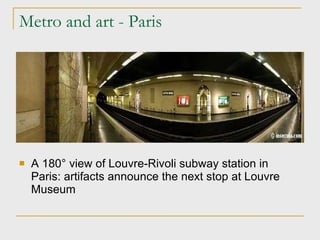
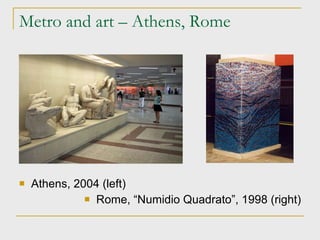
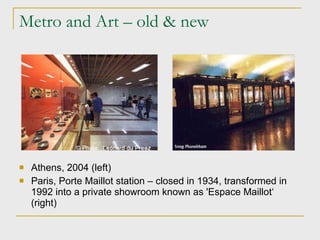
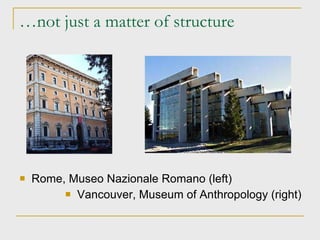
![Buildings – a definition “ Every building is a home, be it the Senate or just a simple house.” [Louis I. Kahn, quoted by Heinz Ronner – Sharad Jhaveri, 1987]](https://image.slidesharecdn.com/califanotashkent2008-100201085159-phpapp02/85/Museums-Open-Closed-Musings-on-Museum-Form-Content-and-Function-20-320.jpg)
![Buildings – a psychological factor Not all buildings are functional. They must function, of course, but they do so at a psychological level. This psychological function has a primary role… This idea brings us to a completely new era in architecture, where utilitarian factors alone will no longer be enough. [Louis I. Kahn, 1957]](https://image.slidesharecdn.com/califanotashkent2008-100201085159-phpapp02/85/Museums-Open-Closed-Musings-on-Museum-Form-Content-and-Function-21-320.jpg)
![Artists in Residence, Japan Aomori City, Contemporary Art Centre for a residential programme (left, photo by Mitsuo Matsuoka) [Tadao Ando Architect & Ass., 2001]](https://image.slidesharecdn.com/califanotashkent2008-100201085159-phpapp02/85/Museums-Open-Closed-Musings-on-Museum-Form-Content-and-Function-22-320.jpg)
![A Swiss tower Friedrich D ü rrenmatt Centre, Neuch âtel (in show: the writer’s drawings) – descent to a subterranean world of dreams [Mario Botta, 2000]](https://image.slidesharecdn.com/califanotashkent2008-100201085159-phpapp02/85/Museums-Open-Closed-Musings-on-Museum-Form-Content-and-Function-23-320.jpg)
![The Pit – a think-tank Benetton’s Fabrica, Treviso – the “negative image” of the later Art Centre in Aomori (Japan) [ Tadao Ando Architect & Ass., 2000]](https://image.slidesharecdn.com/califanotashkent2008-100201085159-phpapp02/85/Museums-Open-Closed-Musings-on-Museum-Form-Content-and-Function-24-320.jpg)
![Light and shade in Portugal Serralves Foundation, Contemporary Art Museum – but a few windows, in a Mediterranean style ( photo by Galinsky) [Álvaro Siza Vieira , 1999]](https://image.slidesharecdn.com/califanotashkent2008-100201085159-phpapp02/85/Museums-Open-Closed-Musings-on-Museum-Form-Content-and-Function-25-320.jpg)
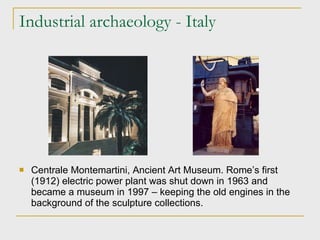
![Industrial archaeology – Great Britain Tate Modern, London – “Bankside’s electric power plant replaced electricity with a new energy: the driving force of contemporary art” (photos by Philip Greenspun, 2001) [Herzog & de Meuron , 2000]](https://image.slidesharecdn.com/califanotashkent2008-100201085159-phpapp02/85/Museums-Open-Closed-Musings-on-Museum-Form-Content-and-Function-27-320.jpg)
![Industrial archaeology – Germany (1) Museum im Kulturspeicher, W ürzburg – an old (1901?) silo , its outside mostly untouched , reused as a “heritage container” [Brückner & Brückner , 2002]](https://image.slidesharecdn.com/califanotashkent2008-100201085159-phpapp02/85/Museums-Open-Closed-Musings-on-Museum-Form-Content-and-Function-28-320.jpg)
![Industrial archaeology – Germany (2) Museum im Kulturspeicher, W ürzburg – exhibition space is in self-supporting concrete boxes, the lobby keeps its old wooden structure [Brückner & Brückner , 2002]](https://image.slidesharecdn.com/califanotashkent2008-100201085159-phpapp02/85/Museums-Open-Closed-Musings-on-Museum-Form-Content-and-Function-29-320.jpg)
![Integrating old & new – Canada Musée National de la Civilisation, Québec – two old buildings (1752 & 1865) and other 18° century remains have been integrated in the “ghats” descending to the St.Lawrence river, photo by P.Gignac 2002 (CCDMD) [Moshe Safdie , 1988]](https://image.slidesharecdn.com/califanotashkent2008-100201085159-phpapp02/85/Museums-Open-Closed-Musings-on-Museum-Form-Content-and-Function-30-320.jpg)
![A closed box opens up - Australia Ian Potter Museum of Art, Melbourne – Christine O’Loughlin’s “Cultural rubble”, included in the museum’s facade, seem to burst out of a closed box , photo by D.Sirianni 1997-98 [Nonda Katsalidis , 1998]](https://image.slidesharecdn.com/califanotashkent2008-100201085159-phpapp02/85/Museums-Open-Closed-Musings-on-Museum-Form-Content-and-Function-31-320.jpg)
![Into the future - USA Art Museum (Extension), Milwaukee – a large bird taking off over Lake Michigan, a new dramatic landmark of great urban and emotional impact (photos: left by Philip Greenspun, right by rycam.net) [Santiago Calatrava , 2001]](https://image.slidesharecdn.com/califanotashkent2008-100201085159-phpapp02/85/Museums-Open-Closed-Musings-on-Museum-Form-Content-and-Function-32-320.jpg)
![Function, context, culture “ There are very few people you will find anywhere who will talk about matter in spiritual terms. Nothingness mattered to him, silence mattered to him, the enigma of light mattered to him… And when somebody understands this, he cannot be an ordinary person. He has to be a highly cultivated soul, who we call guru , we call him a yogi – and that is why, I think, for us he was from here.” [ B.V. Doshi, in N.Kahn’s “My Architect”, 2003, 01:38:55 – 01:39:42 ]](https://image.slidesharecdn.com/califanotashkent2008-100201085159-phpapp02/85/Museums-Open-Closed-Musings-on-Museum-Form-Content-and-Function-33-320.jpg)
![Capital Complex, Dhaka (Sher-e-Bangla Nagar) “ Good building would produce a marvelous ruin” [ Louis I. Kahn ]](https://image.slidesharecdn.com/califanotashkent2008-100201085159-phpapp02/85/Museums-Open-Closed-Musings-on-Museum-Form-Content-and-Function-34-320.jpg)

The document discusses the evolving role of museums as institutions in society, exploring concepts such as 'open' versus 'closed' museums and their impact on cultural communication. It highlights the importance of heritage, both tangible and intangible, and presents innovative ideas on integrating old and new architectural forms in museum design. The presentation also reflects on the psychological functions of buildings, emphasizing that museums must engage creatively with their communities to remain relevant.


