Scientific Notation
Really large,
and really small
numbers
Why?
Chemistry often deals with very large and
very small numbers.
There are
602,000,000,000,000,000,000,000
molecules of water in 18 mL
one electron has a mass of
0.000000000000000000000000000911 g
We need a shorter way of writing these
numbers
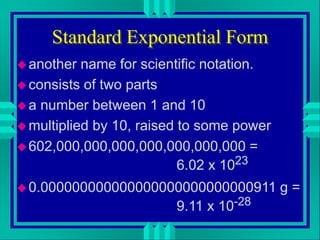
Standard Exponential Form
another name for scientific notation.
consists of two parts
a number between 1 and 10
multiplied by 10, raised to some power
602,000,000,000,000,000,000,000 =
6.02 x 10²³
0.000000000000000000000000000911 g =
9.11 x 10⁻²⁸
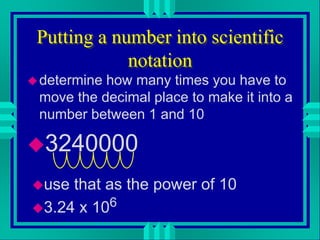
Putting a number into scientific
notation
determine how many times you have to
move the decimal place to make it into a
number between 1 and 10
3240000
use that as the power of 10
3.24 x 10⁶
What is the number is smaller?
if you make the number bigger by
moving the decimal point, make the
exponent smaller and visa-versa
0.00045
4.5 x 10⁻⁴
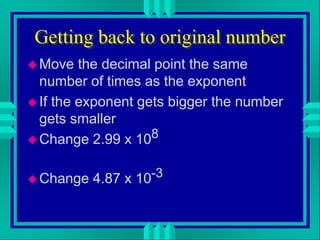
Getting back to original number
Move the decimal point the same
number of times as the exponent
If the exponent gets bigger the number
gets smaller
Change 2.99 x 10⁸
Change 4.87 x 10⁻³
Using your calculator
EE and EXP button stand for x 10 to the
4.5 x 10⁻⁴
push 4.5
push either EXP or EE
push 4 +/- or -4
see what your display says.
Practice these problems
(4.8 x 10 5 ) x (6.7 x 10⁻⁶)
 (6.8 x 10 -6)
(3.2 x 10 4)
Remember when you multiply you add
exponents
106 x 10-4
When you divide you subtract
exponents.
Adding and Subtracting
You can’t add or subtract numbers until
they are to the same power of ten.
Your calculator does this automatically.
(4.8 x 10 5 ) + (6.7 x 10⁶)
(6.8 x 10 -6) -(3.2 x 10⁻⁵)
Remember- standard form starts with a
number between 1 and 10 to start.
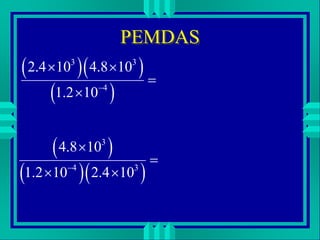
PEMDAS
  
 
3 3
4
2.4 10 4.8 10
1.2 10
 


 
  
3
4 3
4.8 10
1.2 10 2.4 10



 
PEMDAS
  
 
3 3
4
2.4 10 4.8 10
1.2 10
 


 
  
3
4 3
4.8 10
1.2 10 2.4 10



 

Calculator.ppt

  • 1.
  • 2.
    Why? Chemistry often dealswith very large and very small numbers. There are 602,000,000,000,000,000,000,000 molecules of water in 18 mL one electron has a mass of 0.000000000000000000000000000911 g We need a shorter way of writing these numbers
  • 3.
    Standard Exponential Form anothername for scientific notation. consists of two parts a number between 1 and 10 multiplied by 10, raised to some power 602,000,000,000,000,000,000,000 = 6.02 x 10²³ 0.000000000000000000000000000911 g = 9.11 x 10⁻²⁸
  • 4.
    Putting a numberinto scientific notation determine how many times you have to move the decimal place to make it into a number between 1 and 10 3240000 use that as the power of 10 3.24 x 10⁶
  • 5.
    What is thenumber is smaller? if you make the number bigger by moving the decimal point, make the exponent smaller and visa-versa 0.00045 4.5 x 10⁻⁴
  • 6.
    Getting back tooriginal number Move the decimal point the same number of times as the exponent If the exponent gets bigger the number gets smaller Change 2.99 x 10⁸ Change 4.87 x 10⁻³
  • 7.
    Using your calculator EEand EXP button stand for x 10 to the 4.5 x 10⁻⁴ push 4.5 push either EXP or EE push 4 +/- or -4 see what your display says.
  • 8.
    Practice these problems (4.8x 10 5 ) x (6.7 x 10⁻⁶)  (6.8 x 10 -6) (3.2 x 10 4) Remember when you multiply you add exponents 106 x 10-4 When you divide you subtract exponents.
  • 9.
    Adding and Subtracting Youcan’t add or subtract numbers until they are to the same power of ten. Your calculator does this automatically. (4.8 x 10 5 ) + (6.7 x 10⁶) (6.8 x 10 -6) -(3.2 x 10⁻⁵) Remember- standard form starts with a number between 1 and 10 to start.
  • 10.
    PEMDAS     3 3 4 2.4 10 4.8 10 1.2 10          3 4 3 4.8 10 1.2 10 2.4 10     
  • 11.
    PEMDAS     3 3 4 2.4 10 4.8 10 1.2 10          3 4 3 4.8 10 1.2 10 2.4 10     