Srinivas Maripala Int. Journal of Engineering Research and Applications www.ijera.com 
ISSN : 2248-9622, Vol. 4, Issue 9( Version 4), September 2014, pp.17-26 
www.ijera.com 17 | P a g e 
Dufour and Soret Effects on Convective Heat and Mass Transfer in Non-Darcy Doubly Stratified Porous Media Srinivas Maripala1, N.Kishan2 1Dept of Mathematics, Sreenidhi Institute of Science and Technology, Hyd. 2 Department of mathematics, Osmania University, Hyd. Abstract This paper deals with the MHD convention non-Darcy flow with heat and mass transfer along the vertical surface in a fluid stratified non porous media in the presence of temperature gradients (Soret effects) and concentration gradients (Dufour effects). The differential equations of the governing flow are expand a in terms of perturbation functions as a result we get set of ordinary differential equations of zero,first and second order so the set of equations are solved by using the implicit finite difference scheme. A parametric study of the physical parameters involve in the problem is conducted and a representative set of numerical results are illustrated graphically Key words: MHD, heat transfer , mass transfer double stratification , boundary layer, porous mediua, convection ,dufour number, soret number, finite difference method. 
I. Introduction 
Simultaneous heat and mass transfer from different geometries embedded in porous media has many engineering and geophysical applications such as geothermal reservoirs, drying of porous solids, thermal insulation, enhanced oil recovery, packed- bed catalytic reactors, cooling of nuclear reactors, and underground energy transport. Cheng and Minkowycz [1] have presented similarity solutions for free thermal convection from a vertical plate in a fluid-saturated porous medium. The problem of combined thermal convection from a semi-infinite vertical plate in the presence or absence of a porous medium has been studied by many authors (see, for example [2–5]). Nakayama and Koyama [4] have studied pure, combined and forced convection in Darcian and non-Darcian porous media. Lai and Kulacki [6] has investigated coupled heat and mass transfer by mixed convection from an isothermal vertical plate in a porous medium. Hsieh et al. [5] has presented non-similar solutions for combined convection in porous media. Chamkha [7] has investigated hydro magnetic natural convection from a isothermal inclined surface adjacent to a thermally stratified porous medium.There has been a renewed interest in studying magneto hydrodynamic (MHD) flow and heat transfer in porous and non-porous media due to the effect of magnetic fields on the boundary layer flow control and on the performance of many systems using electrically conducting fluids. In addition, this type of flow has attracted the interest of many investigators in view of its applications in many engineering problems such as MHD generators, plasma studies, nuclear reactors, geothermal energy extractions. For example, Rapits et al. [8] have analyzed hydro magnetic free convection flow through a porous medium between two parallel plates. Aldoss et al. [9] have studied mixed convection from a vertical plate embedded in a porous medium in the presence of a magnetic field. Gribben [10] has studied boundary-layer flow over a semi-infinite plate with an aligned magnetic field in the presence of a pressure gradient. He has obtained solutions for large and small magnetic Prandtl numbers using the method of matched asymptotic expansion. Soundalegkar [11] obtained approximate solutions for two-dimensional flow of an incompressible, viscous fluid past an infinite porous vertical plate with constant suction velocity, the difference between the temperature of the plate and the free steam is moderately large causing the free convection currents. Raptis and Kafousias [12] have studied the influence of a magnetic field on steady free convection flow through a porous medium bounded by an infinite vertical plate with constant suction velocity. Raptis [13] has studied mathematically the case of time-varying two- dimensional natural convective flow of an incompressible, electrically conducting fluid along an infinite vertical porous plate embedded in a porous medium. Bian et al. [14] have reported on the effect of an electromagnetic field on natural convection in an inclined porous medium. Buoyancy-driven convection in a rectangular enclosure with a transverse magnetic field has been considered by Garandet et al. [15] and Khanafer and Chamkha [16]. 
It is well-known that in double-diffusive (e.g. thermohaline) convection the coupling between the transport of heat and mass takes place because the density q of the fluid mixture depends on both 
RESEARCH ARTICLE OPEN ACCESS
Srinivas Maripala Int. Journal of Engineering Research and Applications www.ijera.com 
ISSN : 2248-9622, Vol. 4, Issue 9( Version 4), September 2014, pp.17-26 
www.ijera.com 18 | P a g e 
temperature T and concentration C. For suffi- ciently small isobaric changes in temperature and concentration the mixture density q depends linearly on both T and C (Nield and Bejan [17]). In some circumstances there is direct coupling between T and C. This is when cross-diffusion (Soret and Dufour effects) is not negligible. The energy flux caused by a composition gradient was discovered in 1873 by Dufour and was correspondingly reffered to the Dufour effect. It was also called the diffusion-thermo effect. On the other hand, mass flux can also be created by a temperature gradient, as was established by Soret. This is the thermal-diffusion effect. The Soret effect has been also used for isotope separation and in mixture between gases with very light molecular weight ðH2;HeÞ and of medium molecular weight (H2, air) (Postelnicu [18]). In many studies Soret and Dufour effects are neglected, on the basis that they are of a smaller order of magnitude than the effects described by Fourier’s and Fick’s laws. There are, however, exceptions. Eckert and Drake [19] have presented several cases when the Dufour effect cannot be neglected. Platten and Legros [20] state that in most liquid mixtures the Dufour effect is inoperate, but that this may not be the case in gases. Mojtabi and Charrier-Mojtabi [21] confirm this by noting that in liquids the Dufour coefficient is an order of magnitude smaller than the Soret effect. Benano-Molly et al. [22] have studied the problem of thermal diffusion in binary fluid mixture, lying within a porous medium and subjected to a horizontal thermal gradient and have shown that multiple convection-roll flow patterns can develop depending on the values of the Soret number. They conclude that for saturated porous media, the phenomenon of cross diffusion is further complicated because of the interaction between the fluid and the porous matrix and because accurate values of the cross-diffusion coefficients are not available. The onset of Soret- driven convection in an infinite cell filled with a porous medium saturated by a binary fluid was studied by Sovran et al. [23]. However, Soret and Dufour effects have been found to appreciably influence the flow field in free convection boundary layer over a vertical surface embedded in a fluid- saturated porous medium (Postelnicu [18] and Anghel et al. [24]). 
In certain porous media applications such as those involving heat removal from nuclear fuel debris, underground disposal of radioactive waste material, storage of food stuffs, and exothermic and/or endothermic chemical reactions and issociating fluids in packed-bed reactors, the working fluid heat generation (source) or absorption (sink) effects are important. Representative studies dealing with these effects have been reported by such authors as Acharya and Goldstein [25], Vajravelu and Nayfeh [26] and Chamkha [27,28]. In the combined heat and mass transfer studies in porous media, Murthy et al .[29] reported that the temperature and concentration became negative in the boundary layer depending on the relative intensity thermal and solutal stratification. These are a few articles to quote from the literature where the temperature/concentration or non dimensional heat/mass transfer coefficients becoming negative. Angirasa et al . [30] presented and analysis of combined heat and mass transfer in thermally stratified porous enclosure. Srinivasachrya et.al [31] studied the MHD and Radiation on Non- Darcy Mixed Convection, Ramakrishna and Hemalatha analyzed the Non-Darcy Mixed convection with Thermal Disipersion in a satrated porous medium. Rathish kumar and Shalini[32] presented the free convection heat and mass from a vertical wavy surface in a doubly stratified external porous layer. 
Fig.I. Free convective heat and mass transfer from a semi infinite vertical wall in a fluid saturated doubly stratified doubly stratified porous medium. 
The results presented in[29,33] have given the impetus for investigating free convection heat and mass transfer characteristics in a non-Darcian fluid saturated doubly stratified purpose medium .Unlike in [29] and [33], the medium is assumed to be stratified linearly with the height, which is more physically realistic case. As a result of this, mathematical model ceases to have a similar solution. In the light of the results obtained [34] Lakshmi Narayana and P.A.,Murthy has extended the analysis be more significant given be clear from the section, “Results and Discussion.” This type of investigation is useful in understanding heat and mass transfer characteristics around a hot radioactive subsurface storage site or around a cooling magnetic intrusion, where the theory of convection heat and mass transport is involved. In this paper we have investigated the MHD effects on steady free convective heat and mass transfer from a vertical surface embedded in a doubly stratified non-Darcy porous medium by using the implicit finite difference
Srinivas Maripala Int. Journal of Engineering Research and Applications www.ijera.com 
ISSN : 2248-9622, Vol. 4, Issue 9( Version 4), September 2014, pp.17-26 
www.ijera.com 19 | P a g e 
scheme. The results were compared with [35] when the Dufour and souret number is absent. Governing Equations Consider the flow configuration shown in figure.I. The flow is moderate (i.e., order of Reynolds number is greater than one), so pressure drop is proportional to the linear combination of fluid velocity and the square of the velocity (Forchheimer flow model). Viscous resistance due to the solid boundary is neglected under the assumption that the medium is with low permeability. A magnetic field is applied in the y-direction. The vertical wall temperature and concentration are assumed to be constant and the porous medium is assumed to be vertically linearly stratified with respect to both heat and concentration as indicated in Fig.I. The boundary layer equations along with the equation of continuity may be written as 휕푢 휕푥 + 휕푣 휕푦 =0 (1) [1+ 휎퐵02퐾 휌푣 ] 휕푢 휕푦 + 푐√퐾 푣 휕푢2 휕푦 = 훽푇퐾푔 푣 휕푇 휕푦 + 훽퐶퐾푔 푣 휕퐶 휕푦 (2) u 휕푇 휕푥 +푣 휕푇 휕푦 =훼 휕2푇 휕푦2 + 퐷푚퐾푇 푐푠푐푝 휕2퐶 휕푦2 (3) 푢 휕퐶 휕푥 +푣 휕퐶 휕푦 =D∂2C∂y2 + 퐷푚퐾푇 푇푚 휕2푇 휕푦2 (4) and the boundary conditions are 푦=0: 푣=0, T=푇푤, C = 퐶푤,} (5) 푦→∞: 푢→0, T=푇∞,0+퐴푥, C = 퐶∞,0+퐵푥 Here x and y are the Cartesian coordinate , 푢 and 푣 are the averaged velocity components in x and y directions respectively ,T and C are the dimensional temperature and concentration, respectively, 훽푇 and 훽퐶 are the coefficients of thermal and solutal expansion, respectively, c is the Forchheimer constant, ν is the kinematic viscosity of the fluid, K is the permeability, g is the acceleration due to gravity and α, D are the thermal and solutal diffusivities of the medium. 퐵0 is the strength of the maagetic field, 휎 is the electrical conductivity of the fluid, 흆 is the density, v is the kinematic viscosity. Here, A and B are constants ,varied to alter the intensity of stratification in the medium . Thicknesses of thermal and solutal boundary layers (훿푇,훿푐) which are shown in Fig. 1, are depending on the strength of the respective field and for all calculations we have taken the boundary layer thickness as the maximum of these values .The subscripts w, (∞, 0 )and ∞ indicate the conditions at the wall, at some reference point in the medium, and at the outer edge of the boundary layer respectively. 
Making use of the following transformation which is derived using order magnitudes 
Η = 푦 푥 R푎푥 12 , f (x,η)= 휓 훼푅푎푥 12 , (6) θ(x,η) = 푇−푇푥,0 푇푊−푇∞,0 - 퐴푥 푇푊−푇∞,0, (7) 휑(x,η) = 퐶−퐶∞,표 퐶푊−퐶∞,0 - 퐵푥 퐶푤−퐶∞,0, The governing eqns.(1)-(4) become (1+퐻푎2)푓"+2퐹푐푓ʹ푓"=휃ʹ+푁휑ʹ (8) 휃ʹʹ+ 12 푓휃ʹ+ 퐷푓휑″ = ε푓ʹ+ ε(푓ʹ휕휃 휕휀 −휃ʹ휕푓 휕휀 ) (9) 휑ʹʹ+ 12 퐿푒푓휑ʹ+ Le Sr 휃″ = LeSrε푓ʹ+Le ε(푓ʹ휕휑 휕휀 −휑ʹ휕푓 휕휀 ) (10) And the boundary conditions (5) transform into η=0: f(ε,0)=0, θ(ε,0)=1, 휑(ε,0)=1 η→∞ : 푓ʹ(휀,∞) =0, θ(ε,∞)=1, 휑(ε,∞)=0 11) 
The various parameters involved in the present study which influence the system are the Darcy- Rayleigh number 푅푎푥= 퐾푔훽푇 푇푤−푇∞,0 푥 /훼푣 which is defined with reference to the thermal conditions, the inertia parameter 퐹푐 which is defined as 푐√퐾퐾푔훽푇 푇푤−푇∞,0 /푣2 the diffusivity ratio Le=α/D and the buoyancy ratio N = [훽푐(퐶푤− 퐶∞,0)]/[훽푇 푇푤−푇∞,0 ].When the Forchheimer coefficient c is zero, 퐹푐 will become zero, the inertia effects are absent in the medium , and the study becomes double stratification in the Darcy porous medium. Thermal buoyancy acts always vertically upwards, the species buoyancy may act in either direction depending on the relative molecular weight. So N>0 indicates aiding buoyancy where both the thermal and solutal buoyancies are in the same directions and N<0 indicates opposing buoyancy where the solutal buoyancy is in the opposite direction to the thermal buoyancy. .when N=0 ,the flow is driven by thermal buoyancy alone . The thermal stratification parameter is given by 휀= 퐴푥/ 푇푤−푇∞,0 . Here we are defining a quantity called the stratification ratio 푆푟=퐵 푇푤−푇∞,0 / 퐴(퐶푤−퐶∞,0) which is a constant , it indicates the relative strengths of solutal and thermal stratification in the medium. As 푇푤−푇∞,0 and 퐶푤− 퐶∞,0 are constants, when Sr>1, solutal stratification is more than the thermal stratification in the medium and vice versa. The product 푆푟.휀=퐵푥/(퐶푤− 퐶∞,0) Will be the solutal stratification parameter. 퐻푎2= 1+ 휎퐵02퐾 휌푣 is the magnetic parameter.
Srinivas Maripala Int. Journal of Engineering Research and Applications www.ijera.com 
ISSN : 2248-9622, Vol. 4, Issue 9( Version 4), September 2014, pp.17-26 
www.ijera.com 20 | P a g e 
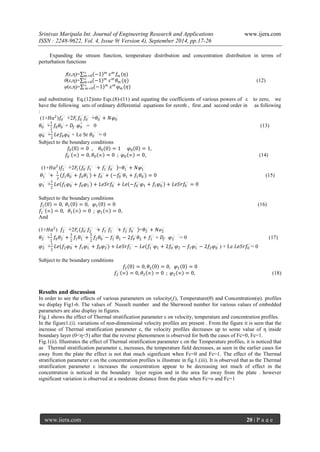
Expanding the stream function, temperature distribution and concentration distribution in terms of perturbation functions f(ε,η)= −1 푚∞ 푚=0휀푚푓푚(휂) θ(ε,η)= −1 푚∞ 푚=0휀푚휃푚(휂) (12) φ(ε,η)= −1 푚∞ 푚=0휀푚휑푚(휂) and substituting Eq.(12)into Eqs.(8)-(11) and equating the coefficients of various powers of ε to zero, we have the following sets of ordinary differential equations for zeroth , first ,and second order in as following : (1+퐻푎2)푓0ʹʹ+2퐹푐푓0ʹ푓0ʹʹ=휃0ʹ+푁휑0ʹ 휃0ʹʹ+ 12 푓0휃0ʹ + 퐷푓 휑0″ = 0 (13) 휑0ʹʹ+ 12 퐿푒푓0휑0ʹ + Le Sr 휃0ʹʹ = 0 Subject to the boundary conditions 푓0 0 =0 , 휃0 0 =1 휑0 0 =1, 푓0ʹ ∞ =0,휃0 ∞ =0 ; 휑0 ∞ =0, (14) (1+퐻푎2)푓1ʹʹ+2퐹푐 푓0ʹ푓1ʹʹ+푓1ʹ푓0ʹʹ =휃1ʹ+푁휑1ʹ 휃1ʹʹ+ 1 2 푓1휃0ʹ+푓0휃1ʹ +푓0ʹ+(−푓0ʹ휃1+푓1휃0ʹ)=0 (15) 휑1ʹʹ+ 12 퐿푒 푓1휑0ʹ+푓0휑1ʹ +퐿푒푆푟푓0ʹ+퐿푒 −푓0ʹ휑1+푓1휑0ʹ +퐿푒푆푟푓0ʹ=0 Subject to the boundary conditions 푓1 0 =0, 휃1 0 =0, 휑1 0 =0 (16) 푓1ʹ ∞ =0, 휃1 ∞ =0 ; 휑1 ∞ =0, And (1+퐻푎2) 푓2ʹʹ+2퐹푐(푓0ʹ푓2ʹʹ+푓1ʹ푓1ʹʹ+푓2ʹ푓0ʹʹ)=휃2ʹ+푁ø2ʹ 휃2ʹʹ+ 12 푓0휃2ʹ+ 32 푓1휃1ʹ+ 52 푓2휃0ʹ−푓1ʹ휃1−2푓0ʹ휃2+푓1ʹ + 퐷푓 휑2ʹʹ = 0 (17) 휑2ʹʹ+ 12 퐿푒(푓2휑0ʹ+푓1휑1ʹ+푓0휑2ʹ)+퐿푒푆푟푓1ʹ−퐿푒(푓1ʹ휑1+2푓0ʹ휑2−푓1휑1ʹ−2푓2휑0ʹ ) + Le 퐿푒푆푟푓0ʹ= 0 Subject to the boundary conditions 푓2 0 =0,휃2 0 =0, 휑2 0 =0 푓2ʹ ∞ =0,휃2 ∞ =0 ; 휑2 ∞ =0, (18) Results and discussion In order to see the effects of various parameters on velocity(ƒ), Temperature(θ) and Concentration(φ). profiles we display Fig1-6. The values of Nusselt number and the Sherwood number for various values of embedded parameters are also display in figures. Fig.1 shows the effect of Thermal stratification parameter ε on velocity, temperature and concentration profiles. In the figure1.(i). variations of non-dimensional velocity profiles are present . From the figure it is seen that the increase of Thermal stratification parameter ε, the velocity profiles decreases up to some value of η inside boundary layer (0<η<5) after that the reverse phenomenon is observed for both the cases of Fc=0, Fc=1. Fig.1(ii). Illustrates the effect of Thermal stratification parameter ε on the Temperature profiles, it is noticed that as Thermal stratification parameter ε, increases, the temperature field decreases, as seen in the earlier cases for away from the plate the effect is not that much significant when Fc=0 and Fc=1. The effect of the Thermal stratification parameter ε on the concentration profiles is illustrate in fig.1.(iii). It is observed that as the Thermal stratification parameter ε increases the concentration appear to be decreasing not much of effect in the concentration is noticed in the boundary layer region and in the area far away from the plate . however significant variation is observed at a moderate distance from the plate when Fc=o and Fc=1
Srinivas Maripala Int. Journal of Engineering Research and Applications www.ijera.com 
ISSN : 2248-9622, Vol. 4, Issue 9( Version 4), September 2014, pp.17-26 
www.ijera.com 21 | P a g e 
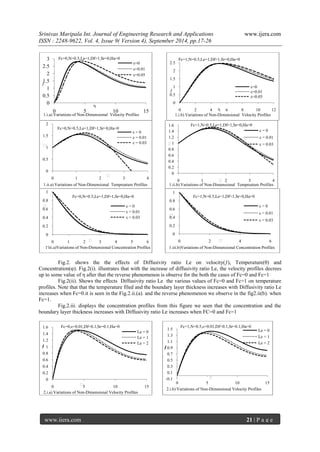
Fig.2. shows the the effects of Diffusivity ratio Le on velocity(ƒ), Temperature(θ) and Concentration(φ). Fig.2(i). illustrates that with the increase of diffusivity ratio Le, the velocity profiles decrees up to some value of η after that the reverse phenomenon is observe for the both the cases of Fc=0 and Fc=1 Fig.2(ii). Shows the effects Diffusivity ratio Le the various values of Fc=0 and Fc=1 on temperature profiles. Note that that the temperature filed and the boundary layer thickness increases with Diffusivity ratio Le increases when Fc=0.it is seen in the Fig.2.ii.(a). and the reverse phenomenon we observe in the fig2.ii(b). when Fc=1. Fig.2.iii. displays the concentration profiles from this figure we seen that the concentration and the boundary layer thickness increases with Diffusivity ratio Le increases when FC=0 and Fc=1 
0 
0.5 
1 
1.5 
2 
2.5 
3 
0 
5 
10 
15 
ε=0 
ε=0.01 
ε=0.05 
ƒ 
Fc=0,N=0.5,Le=1,Df=1,Sr=0,Ha=0 
1.i.a) Variationsof Non-Dimensional Velocity Profiles 
η 
0 
0.5 
1 
1.5 
2 
2.5 
0 
2 
4 
6 
8 
10 
12 
ε=0 
ε=0.01 
ε=0.05 
Fc=1,N=0.5,Le=1,Df=1,Sr=0,Ha=0 
η 
1.i.b) Variationsof Non-Dimensional Velocity Profiles 
ƒ 
0 
0.5 
1 
1.5 
2 
0 
1 
2 
3 
4 
ε = 0 
ε = 0.01 
ε = 0.03 
η 
η 
Fc=0,N=0.5,Le=1,Df=1,Sr=0,Ha=0 
1.ii.a) Variationsof Non-Dimensional Tempreature Profiles 
0 
0.2 
0.4 
0.6 
0.8 
1 
1.2 
1.4 
1.6 
0 
1 
2 
3 
4 
ε = 0 
ε = 0.01 
ε = 0.03 
Fc=1,N=0.5,Le=1,Df=1,Sr=0,Ha=0 
η 
η 
1.ii.b) Variationsof Non-Dimensional Tempreature Profiles 
0 
0.2 
0.4 
0.6 
0.8 
1 
0 
1 
2 
3 
4 
5 
6 
ε = 0 
ε = 0.01 
ε = 0.03 
Fc=0,N=0.5,Le=1,Df=1,Sr=0,Ha=0 
1'iii.a)Variationsof Non-Dimensional Concentration Profiles 
η 
η 
0 
0.2 
0.4 
0.6 
0.8 
1 
0 
2 
4 
6 
ε = 0 
ε = 0.01 
ε = 0.03 
Fc=1,N=0.5,Le=1,Df=1,Sr=0,Ha=0 
1.iii.b)Variationsof Non-Dimensional Concentration Profiles 
η 
η 
0 
0.2 
0.4 
0.6 
0.8 
1 
1.2 
1.4 
1.6 
0 
5 
10 
15 
Le = 0 
Le = 1 
Le = 2 
η 
ƒ 
Fc=0,ε=0.01,Df=0.1,Sr=0.1,Ha=0 
2.i.a) Variationsof Non-Dimensional Velocity Profiles 
-0.1 
0.1 
0.3 
0.5 
0.7 
0.9 
1.1 
1.3 
1.5 
0 
5 
10 
15 
Le = 0 
Le = 1 
Le = 2 
η 
ƒ 
Fc=1,N=0.5,ε=0.01,Df=0.1,Sr=0.1,Ha=0 
2.i.b) Variationsof Non-Dimensional Velocity Profiles
Srinivas Maripala Int. Journal of Engineering Research and Applications www.ijera.com 
ISSN : 2248-9622, Vol. 4, Issue 9( Version 4), September 2014, pp.17-26 
www.ijera.com 22 | P a g e 
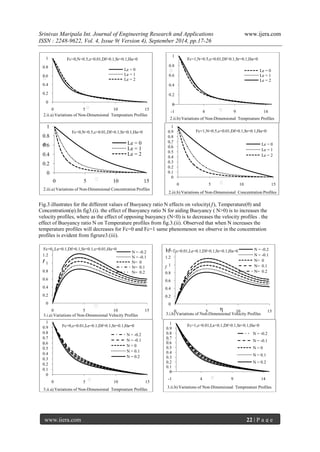
Fig.3.illustrates for the different values of Buoyancy ratio N effects on velocity(ƒ), Temperature(θ) and Concentration(φ).In fig3.(i). the effect of Buoyancy ratio N for aiding Buoyancy ( N>0) is to increases the velocity profiles, where as the effect of opposing buoyancy (N<0) is to decreases the velocity profiles . the effect of Buoyancy ratio N on Temperature profiles from fig.3.(ii). Observed that when N increases the temperature profiles will decreases for Fc=0 and Fc=1 same phenomenon we observe in the concentration profiles is evident from figrure3.(iii). 
0 
0.2 
0.4 
0.6 
0.8 
1 
0 
5 
10 
15 
Le = 0 
Le = 1 
Le = 2 
Fc=0,N=0.5,ε=0.01,Df=0.1,Sr=0.1,Ha=0 
2.ii.a) Variationsof Non-Dimensional Tempreature Profiles 
η 
η 
0 
0.2 
0.4 
0.6 
0.8 
1 
-1 
4 
9 
14 
Le = 0 
Le = 1 
Le = 2 
Fc=1,N=0.5,ε=0.01,Df=0.1,Sr=0.1,Ha=0 
2.ii.b) Variationsof Non-Dimensional Tempreature Profiles 
η 
η 
0 
0.2 
0.4 
0.6 
0.8 
1 
0 
5 
10 
15 
Le = 0 
Le = 1 
Le = 2 
2.iii.a) Variationsof Non-Dimensional Concentration Profiles 
Fc=0,N=0.5,ε=0.01,Df=0.1,Sr=0.1,Ha=0 
Ф 
η 
0 
0.1 
0.2 
0.3 
0.4 
0.5 
0.6 
0.7 
0.8 
0.9 
1 
0 
5 
10 
15 
Le = 0 
Le = 1 
Le = 2 
Fc=1,N=0.5,ε=0.01,Df=0.1,Sr=0.1,Ha=0 
2.iii.b) Variationsof Non-Dimensional Concentration Profiles 
η 
η 
0 
0.2 
0.4 
0.6 
0.8 
1 
1.2 
0 
5 
10 
15 
N = -0.2 
N = -0.1 
N= 0 
N= 0.1 
N= 0.2 
ƒ 
Fc=0,,Le=0.1,Df=0.1,Sr=0.1,ε=0.01,Ha=0 
η 
3.i.a) Variationsof Non-Dimensional Velocity Profiles 
0 
0.2 
0.4 
0.6 
0.8 
1 
1.2 
1.4 
0 
5 
10 
15 
N = -0.2 
N = -0.1 
N= 0 
N= 0.1 
N= 0.2 
3.i.b) Variationsof Non-Dimensional Velocity Profiles 
Fc=1,ε=0.01,Le=0.1,Df=0.1,Sr=0.1,Ha=0 
ƒ 
η 
0 
0.1 
0.2 
0.3 
0.4 
0.5 
0.6 
0.7 
0.8 
0.9 
1 
0 
5 
10 
15 
N = -0.2 
N = -0.1 
N = 0 
N = 0.1 
N = 0.2 
Fc=0,ε=0.01,Le=0.1,Df=0.1,Sr=0.1,Ha=0 
3.ii.a) Variationsof Non-Dimensional Tempreature Profiles 
η 
η 
0 
0.1 
0.2 
0.3 
0.4 
0.5 
0.6 
0.7 
0.8 
0.9 
1 
-1 
4 
9 
14 
N = -0.2 
N = -0.1 
N = 0 
N = 0.1 
N = 0.2 
Fc=1,ε=0.01,Le=0.1,Df=0.1,Sr=0.1,Ha=0 
3.ii.b) Variationsof Non-Dimensional Tempreature Profiles 
η 
η
Srinivas Maripala Int. Journal of Engineering Research and Applications www.ijera.com 
ISSN : 2248-9622, Vol. 4, Issue 9( Version 4), September 2014, pp.17-26 
www.ijera.com 23 | P a g e 
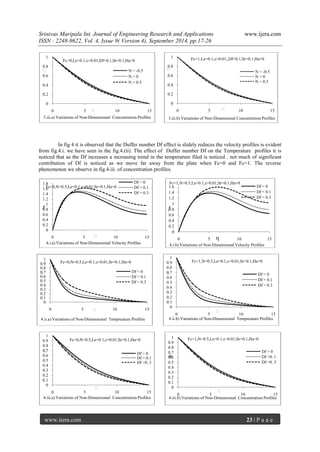
In fig 4 it is observed that the Duffer number Df effect is slidely reduces the velocity profiles is evident from fig.4.i. we have seen in the fig.4.(ii). The effect of Duffer number Df on the Temperature profiles it is noticed that as the Df increases a increasing trend in the temperature filed is noticed . not much of significant contribution of Df is noticed as we move far away from the plate when Fc=0 and Fc=1. The reverse phenomenon we observe in fig.4.iii. of concentration profiles. 
0 
0.2 
0.4 
0.6 
0.8 
1 
0 
5 
10 
15 
N = -0.5 
N = 0 
N = 0.5 
3.iii.a) Variationsof Non-Dimensional Concentration Profiles 
Fc=0,Le=0.1,ε=0.01,Df=0.1,Sr=0.1,Ha=0 
η 
η 
0 
0.2 
0.4 
0.6 
0.8 
1 
0 
5 
10 
15 
N = -0.5 
N = 0 
N = 0.5 
Fc=1,Le=0.1,ε=0.01,,Df=0.1,Sr=0.1,Ha=0 
η 
η 
3.iii.b) Variationsof Non-Dimensional Concentration Profiles 
0 
0.2 
0.4 
0.6 
0.8 
1 
1.2 
1.4 
1.6 
1.8 
0 
5 
10 
15 
Df = 0 
Df = 0.1 
Df = 0.3 
Fc=0,N=0.5,Le=0.1,ε=0.01,Sr=0.1,Ha=0 
4.i.a) Variationsof Non-Dimensional Velocity Profiles 
ƒ 
η 
0 
0.2 
0.4 
0.6 
0.8 
1 
1.2 
1.4 
1.6 
0 
5 
10 
15 
Df = 0 
Df = 0.1 
Df = 0.3 
η 
Fc=1,N=0.5,Le=0.1,ε=0.01,Sr=0.1,Ha=0 
ƒ 
4.i.b) Variationsof Non-Dimensional Velocity Profiles 
0 
0.1 
0.2 
0.3 
0.4 
0.5 
0.6 
0.7 
0.8 
0.9 
1 
0 
5 
10 
15 
Df = 0 
Df = 0.1 
Df = 0.3 
Fc=0,N=0.5,Le=0.1,ε=0.01,Sr=0.1,Ha=0 
4.ii.a) Variationsof Non-Dimensional Tempreature Profiles 
η 
η 
0 
0.1 
0.2 
0.3 
0.4 
0.5 
0.6 
0.7 
0.8 
0.9 
1 
0 
5 
10 
15 
Df = 0 
Df = 0.1 
Df = 0.3 
4.ii.b) Variationsof Non-Dimensional Tempreature Profiles 
Fc=1,N=0.5,Le=0.1,ε=0.01,Sr=0.1,Ha=0 
η 
η 
0 
0.1 
0.2 
0.3 
0.4 
0.5 
0.6 
0.7 
0.8 
0.9 
1 
0 
5 
10 
15 
Df = 0 
Df = 0.1 
Df =0. 3 
4.iii.a) Variationsof Non-Dimensional ConcentrationProfiles 
Fc=0,N=0.5,Le=0.1,ε=0.01,Sr=0.1,Ha=0 
η 
η 
0 
0.1 
0.2 
0.3 
0.4 
0.5 
0.6 
0.7 
0.8 
0.9 
1 
0 
5 
10 
15 
Df = 0 
Df =0. 1 
Df =0. 3 
Fc=1,N=0.5,Le=0.1,ε=0.01,Sr=0.1,Ha=0 
4.iii.b) Variationsof Non-Dimensional Concentration Profiles 
Ф 
η
Srinivas Maripala Int. Journal of Engineering Research and Applications www.ijera.com 
ISSN : 2248-9622, Vol. 4, Issue 9( Version 4), September 2014, pp.17-26 
www.ijera.com 24 | P a g e 
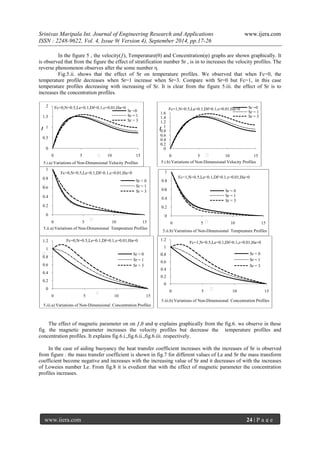
In the figure 5 , the velocity(ƒ), Temperature(θ) and Concentration(φ) graphs are shown graphically. It is observed that from the figure the effect of stratification number Sr , is in to increases the velocity profiles. The reverse phenomenon observes after the some number η. Fig.5.ii. shows that the effect of Sr on temperature profiles. We observed that when Fc=0, the temperature profile decreases when Sr=1 increase when Sr=3. Compare with Sr=0 but Fc=1, in this case temperature profiles decreasing with increasing of Sr. It is clear from the figure 5.iii. the effect of Sr is to increases the concentration profiles. 
The effect of magnetic parameter on on ƒ,θ and φ explains graphically from the fig.6. we observe in these fig. the magnetic parameter increases the velocity profiles but decrease the temperature profiles and concentration profiles. It explains fig.6.i.,fig.6.ii.,fig.6.iii. respectively. In the case of aiding buoyancy the heat transfer coefficient increases with the increases of Sr is observed from figure . the mass transfer coefficient is shown in fig.7 for different values of Le and Sr the mass transform coefficient become negative and increases with the increasing value of Sr and it decreases of with the increases of Loweies number Le. From fig.8 it is evedient that with the effect of magnetic parameter the concentration profiles increases. 
0 
0.5 
1 
1.5 
2 
0 
5 
10 
15 
Sr =0 
Sr = 1 
Sr = 3 
5.i.a) Variationsof Non-Dimensional Velocity Profiles 
Fc=0,N=0.5,Le=0.1,Df=0.1,ε=0.01,Ha=0 
ƒ 
η 
0 
0.2 
0.4 
0.6 
0.8 
1 
1.2 
1.4 
1.6 
0 
5 
10 
15 
Sr =0 
Sr = 1 
Sr = 3 
η 
Fc=1,N=0.5,Le=0.1,Df=0.1,ε=0.01,Ha=0 
ƒ 
5.i.b) Variationsof Non-Dimensional Velocity Profiles 
0 
0.2 
0.4 
0.6 
0.8 
1 
0 
5 
10 
15 
Sr = 0 
Sr = 1 
Sr = 3 
5.ii.a) Variationsof Non-Dimensional Tempreature Profiles 
Fc=0,N=0.5,Le=0.1,Df=0.1,ε=0.01,Ha=0 
η 
η 
0 
0.2 
0.4 
0.6 
0.8 
1 
0 
5 
10 
15 
Sr = 0 
Sr = 1 
Sr = 3 
Fc=1,N=0.5,Le=0.1,Df=0.1,ε=0.01,Ha=0 
5.ii.b) Variationsof Non-Dimensional Tempreature Profiles 
η 
η 
0 
0.2 
0.4 
0.6 
0.8 
1 
1.2 
0 
5 
10 
15 
Sr = 0 
Sr = 1 
Sr = 3 
Fc=0,N=0.5,Le=0.1,Df=0.1,ε=0.01,Ha=0 
5.iii.a) Variationsof Non-Dimensional Concentration Profiles 
η 
η 
0 
0.2 
0.4 
0.6 
0.8 
1 
1.2 
0 
5 
10 
15 
Sr = 0 
Sr = 1 
Sr = 3 
5.iii.b) Variationsof Non-Dimensional Concentration Profiles 
Fc=1,N=0.5,Le=0.1,Df=0.1,ε=0.01,Ha=0 
η 
η
Srinivas Maripala Int. Journal of Engineering Research and Applications www.ijera.com 
ISSN : 2248-9622, Vol. 4, Issue 9( Version 4), September 2014, pp.17-26 
www.ijera.com 25 | P a g e 
References 
[1.] P. Cheng, W.J. Minkowycz, J. Geophys. 82 (1977) 2040. 
[2.] W.J. Minkowycz, P. Cheng, C.H. Chang, Numer. Heat Transfer 8 (1985) 349. 
[3.] P. Ranganathan, R. Viskanta, Numer. Heat Transfer 7 (1984) 305. 
[4.] A. Nakayama, H. Koyama, J. Heat Transfer 109 (1987) 1041. 
[5.] J.C. Hsieh, T.S. Chen, B.F. Armaly, Int. J. Heat Mass Transfer 36 (1985) 1485. 
[6.] F.C. Lai, F.A. Kulacki, Int. J. Heat Mass Transfer 113 (1991) 252. 
[7.] A.J. Chamkha, Int. J. Eng. Sci. 35 (1997) 975. 
[8.] A. Rapits, C. Massias, G. Tzivanidis, Phys. Lett. 90A (1982) 288. 
[9.] T.K. Aldoss, M.A. Al-Nimr, M.A. Jarrah, Numer. Heat Transfer 28A (1995) 635. 
[10.] R.J. Gribben, Proc. Royal Soc. London A 287 (1965) 123. 
[11.] V.M. Soundalgekar, Proc. Royal Soc. London A 333 (1973) 25. 
[12.] A.A. Raptis, N. Kafousias, Int. J. Energy Res. 6 (1982) 241. 
[13.] A.J. Chamkha / International Journal of Engineering Science 42 (2004) 217–230 229 
[14.] A.A. Raptis, Int. J. Energy Res. 10 (1986) 97 
[15.] W. Bian, P. Vasseur, F. Meng, Int. J. Heat Fluid Flow 17 (1996) 36 
[16.] J.P. Garandet, T. Alboussiere, R. Moreau, Int. J. Heat Mass Transfer 34 (1992) 741 
[17.] K. Khanafer, A.J. Chamkha, Numer. Heat Transfer 33 (1998) 891 
[18.] Nield DA, Bejan A. Convection in porous media. 3rd ed. New York: Springer; 2006. 
[19.] Postelnicu A. Influence of a magnetic field on heat and mass transfer by natural convection from vertical surfaces in porous media considering Soret and Dufour effects. Int J Heat Mass Transfer 2004;47:1467–72 
[20.] Eckert ER, Drake RM. Analysis of heat and mass transfer. New York: McGraw Hill; 1972. 
[21.] Platten JK, Legros JC. Convection in liquids. New York: Springer; 1984. 
[22.] Mojtabi A, Charrier-Mojtabi MC. Double-diffusive convection in porous media. In: Vafai K, editor. Handbook of porous media. New York: Marcel Dekker; 2000. 
[23.] Benano-Melly LB, Caltagirone JP, Faissat B, Montel F, Costeseque P. Modeling Soret coefficient measurement experiments in porous media considering thermal and solutal convection. Int J Heat Mass Transfer 2001;44:1285–97. 
[24.] Sovran O, Charrier-Mojtabi MC, Mojtabi A. Onset of Soret-driven convection in an infinite porous layer. C R Acad Sci 2001;IIB 329:287–93. 
[25.] Angel M, Takhar HS, Pop I. Doufor and Soret effects on free convection over a vertical surface in a porous medium. Studia Univ Babes_ – Bolyai, ser Mathematica 2000;45:11–22. 
[26.] S. Acharya, R.J. Goldstein, J. Heat Transfer 107 (1985) 855 
[27.] K. Vajravelu, J. Nayfeh, Int. Commun. Heat Mass Transfer 19 (1992) 701. 
[28.] A.J. Chamkha, Int. Commun. Heat Mass Transfer 23 (1996) 875 
[29.] A.J. Chamkha, Numer. Heat Transfer 32 (1997) 853 
[30.] Murthy, P. V. S. N., Srinivasacharya, D., and Krishna, P. V. S. S. S. R., 2004, “Effect of Double Stratification on Free Convection in Darcian Porous Medium,”Medium,” J. Heat Transfer, 126, pp. 297–300 
[31.] Angirasa, D., Peterson, G. P., and Pop, I., 1997, “Combined Heat and Mass Transfer by Natural Convection in a Saturated Thermally Stratified Porous Medium,” Numer. Heat Transfer, Part A, 31, pp. 255–272 
[32.] Srinivasachrya.D., Pranitha.J.,Ramreddy.Ch., “MHD and Radiation on Non-Darcy Mixed Convection ,” International journal of Nonlinear Science , Vol.10,No.1,pp.61-69 
0 
1 
2 
3 
4 
5 
6 
7 
0 
0.2 
0.4 
0.6 
0.8 
1 
Le=0.1,Sr=0.1 
Le=0.1,sr=1 
Le=0.1,Sr=5 
(7).Variationof nondimensional heat transfer coefficient with εfor 
fixed Fc,N,Df,Ha 
ε 
Nux/Rax 
Fc=0,N=2 
-5 
-4 
-3 
-2 
-1 
0 
0 
0.2 
0.4 
0.6 
0.8 
1 
Le=1,Sr=0.1 
Le=0.1,Sr=5 
Le=0.1,Sr=1 
Le=0.1,sr=0.1 
ε 
Shx/Rax 
(8).Varation of nondimentional mass transfer coefficientwith 
ε for fixed Fc,N,Df,Ha
Srinivas Maripala Int. Journal of Engineering Research and Applications www.ijera.com 
ISSN : 2248-9622, Vol. 4, Issue 9( Version 4), September 2014, pp.17-26 
www.ijera.com 26 | P a g e 
[33.] Rathish Kumar, B. V., and Shalini, G., 2005, “Combined Influence of Mass and Thermal Stratification on Double Diffusion non-Darcian Natural Convection from a Wavy Vertical Wall to Porous Media,” ASME J. Heat Transfer,127, pp. 637–642 
[34.] Chamkha, A. J., and Khaled, A.-R. A., 2000, “Hydro-Magnetic Simultaneous Heat and Mass Transfer by Mixed Convection from a Vertical Plate Embedded in a Stratified Porous Medium With Thermal Dispersion Effects,” Int. J. Heat Mass Transfer, 36, pp. 63–70 
[35.] Lakshmi Narayana P.A.,Murthy.P.V.S.N.,2006, “Free Convective Heat and Mass Transfer in a Doubly Stratified Non-Darcy Porous Medium,” Journal of Heat Transfer ,vol.128 
[36.] N.Kishan , Srinivas Maripala and C.Srinivas Reddy .2011, “MHD EFFECTS ON FREE CONVECTIVE HEAT AND MASS TRANSRFER IN A DOUBLY STRATIFIED NON-DARCY POROUS MEDIUM”, Vol. 3 No.12 December 2011

Dufour and Soret Effects on Convective Heat and Mass Transfer in Non-Darcy Doubly Stratified Porous Media

  • 1.
    Srinivas Maripala Int.Journal of Engineering Research and Applications www.ijera.com ISSN : 2248-9622, Vol. 4, Issue 9( Version 4), September 2014, pp.17-26 www.ijera.com 17 | P a g e Dufour and Soret Effects on Convective Heat and Mass Transfer in Non-Darcy Doubly Stratified Porous Media Srinivas Maripala1, N.Kishan2 1Dept of Mathematics, Sreenidhi Institute of Science and Technology, Hyd. 2 Department of mathematics, Osmania University, Hyd. Abstract This paper deals with the MHD convention non-Darcy flow with heat and mass transfer along the vertical surface in a fluid stratified non porous media in the presence of temperature gradients (Soret effects) and concentration gradients (Dufour effects). The differential equations of the governing flow are expand a in terms of perturbation functions as a result we get set of ordinary differential equations of zero,first and second order so the set of equations are solved by using the implicit finite difference scheme. A parametric study of the physical parameters involve in the problem is conducted and a representative set of numerical results are illustrated graphically Key words: MHD, heat transfer , mass transfer double stratification , boundary layer, porous mediua, convection ,dufour number, soret number, finite difference method. I. Introduction Simultaneous heat and mass transfer from different geometries embedded in porous media has many engineering and geophysical applications such as geothermal reservoirs, drying of porous solids, thermal insulation, enhanced oil recovery, packed- bed catalytic reactors, cooling of nuclear reactors, and underground energy transport. Cheng and Minkowycz [1] have presented similarity solutions for free thermal convection from a vertical plate in a fluid-saturated porous medium. The problem of combined thermal convection from a semi-infinite vertical plate in the presence or absence of a porous medium has been studied by many authors (see, for example [2–5]). Nakayama and Koyama [4] have studied pure, combined and forced convection in Darcian and non-Darcian porous media. Lai and Kulacki [6] has investigated coupled heat and mass transfer by mixed convection from an isothermal vertical plate in a porous medium. Hsieh et al. [5] has presented non-similar solutions for combined convection in porous media. Chamkha [7] has investigated hydro magnetic natural convection from a isothermal inclined surface adjacent to a thermally stratified porous medium.There has been a renewed interest in studying magneto hydrodynamic (MHD) flow and heat transfer in porous and non-porous media due to the effect of magnetic fields on the boundary layer flow control and on the performance of many systems using electrically conducting fluids. In addition, this type of flow has attracted the interest of many investigators in view of its applications in many engineering problems such as MHD generators, plasma studies, nuclear reactors, geothermal energy extractions. For example, Rapits et al. [8] have analyzed hydro magnetic free convection flow through a porous medium between two parallel plates. Aldoss et al. [9] have studied mixed convection from a vertical plate embedded in a porous medium in the presence of a magnetic field. Gribben [10] has studied boundary-layer flow over a semi-infinite plate with an aligned magnetic field in the presence of a pressure gradient. He has obtained solutions for large and small magnetic Prandtl numbers using the method of matched asymptotic expansion. Soundalegkar [11] obtained approximate solutions for two-dimensional flow of an incompressible, viscous fluid past an infinite porous vertical plate with constant suction velocity, the difference between the temperature of the plate and the free steam is moderately large causing the free convection currents. Raptis and Kafousias [12] have studied the influence of a magnetic field on steady free convection flow through a porous medium bounded by an infinite vertical plate with constant suction velocity. Raptis [13] has studied mathematically the case of time-varying two- dimensional natural convective flow of an incompressible, electrically conducting fluid along an infinite vertical porous plate embedded in a porous medium. Bian et al. [14] have reported on the effect of an electromagnetic field on natural convection in an inclined porous medium. Buoyancy-driven convection in a rectangular enclosure with a transverse magnetic field has been considered by Garandet et al. [15] and Khanafer and Chamkha [16]. It is well-known that in double-diffusive (e.g. thermohaline) convection the coupling between the transport of heat and mass takes place because the density q of the fluid mixture depends on both RESEARCH ARTICLE OPEN ACCESS
  • 2.
    Srinivas Maripala Int.Journal of Engineering Research and Applications www.ijera.com ISSN : 2248-9622, Vol. 4, Issue 9( Version 4), September 2014, pp.17-26 www.ijera.com 18 | P a g e temperature T and concentration C. For suffi- ciently small isobaric changes in temperature and concentration the mixture density q depends linearly on both T and C (Nield and Bejan [17]). In some circumstances there is direct coupling between T and C. This is when cross-diffusion (Soret and Dufour effects) is not negligible. The energy flux caused by a composition gradient was discovered in 1873 by Dufour and was correspondingly reffered to the Dufour effect. It was also called the diffusion-thermo effect. On the other hand, mass flux can also be created by a temperature gradient, as was established by Soret. This is the thermal-diffusion effect. The Soret effect has been also used for isotope separation and in mixture between gases with very light molecular weight ðH2;HeÞ and of medium molecular weight (H2, air) (Postelnicu [18]). In many studies Soret and Dufour effects are neglected, on the basis that they are of a smaller order of magnitude than the effects described by Fourier’s and Fick’s laws. There are, however, exceptions. Eckert and Drake [19] have presented several cases when the Dufour effect cannot be neglected. Platten and Legros [20] state that in most liquid mixtures the Dufour effect is inoperate, but that this may not be the case in gases. Mojtabi and Charrier-Mojtabi [21] confirm this by noting that in liquids the Dufour coefficient is an order of magnitude smaller than the Soret effect. Benano-Molly et al. [22] have studied the problem of thermal diffusion in binary fluid mixture, lying within a porous medium and subjected to a horizontal thermal gradient and have shown that multiple convection-roll flow patterns can develop depending on the values of the Soret number. They conclude that for saturated porous media, the phenomenon of cross diffusion is further complicated because of the interaction between the fluid and the porous matrix and because accurate values of the cross-diffusion coefficients are not available. The onset of Soret- driven convection in an infinite cell filled with a porous medium saturated by a binary fluid was studied by Sovran et al. [23]. However, Soret and Dufour effects have been found to appreciably influence the flow field in free convection boundary layer over a vertical surface embedded in a fluid- saturated porous medium (Postelnicu [18] and Anghel et al. [24]). In certain porous media applications such as those involving heat removal from nuclear fuel debris, underground disposal of radioactive waste material, storage of food stuffs, and exothermic and/or endothermic chemical reactions and issociating fluids in packed-bed reactors, the working fluid heat generation (source) or absorption (sink) effects are important. Representative studies dealing with these effects have been reported by such authors as Acharya and Goldstein [25], Vajravelu and Nayfeh [26] and Chamkha [27,28]. In the combined heat and mass transfer studies in porous media, Murthy et al .[29] reported that the temperature and concentration became negative in the boundary layer depending on the relative intensity thermal and solutal stratification. These are a few articles to quote from the literature where the temperature/concentration or non dimensional heat/mass transfer coefficients becoming negative. Angirasa et al . [30] presented and analysis of combined heat and mass transfer in thermally stratified porous enclosure. Srinivasachrya et.al [31] studied the MHD and Radiation on Non- Darcy Mixed Convection, Ramakrishna and Hemalatha analyzed the Non-Darcy Mixed convection with Thermal Disipersion in a satrated porous medium. Rathish kumar and Shalini[32] presented the free convection heat and mass from a vertical wavy surface in a doubly stratified external porous layer. Fig.I. Free convective heat and mass transfer from a semi infinite vertical wall in a fluid saturated doubly stratified doubly stratified porous medium. The results presented in[29,33] have given the impetus for investigating free convection heat and mass transfer characteristics in a non-Darcian fluid saturated doubly stratified purpose medium .Unlike in [29] and [33], the medium is assumed to be stratified linearly with the height, which is more physically realistic case. As a result of this, mathematical model ceases to have a similar solution. In the light of the results obtained [34] Lakshmi Narayana and P.A.,Murthy has extended the analysis be more significant given be clear from the section, “Results and Discussion.” This type of investigation is useful in understanding heat and mass transfer characteristics around a hot radioactive subsurface storage site or around a cooling magnetic intrusion, where the theory of convection heat and mass transport is involved. In this paper we have investigated the MHD effects on steady free convective heat and mass transfer from a vertical surface embedded in a doubly stratified non-Darcy porous medium by using the implicit finite difference
  • 3.
    Srinivas Maripala Int.Journal of Engineering Research and Applications www.ijera.com ISSN : 2248-9622, Vol. 4, Issue 9( Version 4), September 2014, pp.17-26 www.ijera.com 19 | P a g e scheme. The results were compared with [35] when the Dufour and souret number is absent. Governing Equations Consider the flow configuration shown in figure.I. The flow is moderate (i.e., order of Reynolds number is greater than one), so pressure drop is proportional to the linear combination of fluid velocity and the square of the velocity (Forchheimer flow model). Viscous resistance due to the solid boundary is neglected under the assumption that the medium is with low permeability. A magnetic field is applied in the y-direction. The vertical wall temperature and concentration are assumed to be constant and the porous medium is assumed to be vertically linearly stratified with respect to both heat and concentration as indicated in Fig.I. The boundary layer equations along with the equation of continuity may be written as 휕푢 휕푥 + 휕푣 휕푦 =0 (1) [1+ 휎퐵02퐾 휌푣 ] 휕푢 휕푦 + 푐√퐾 푣 휕푢2 휕푦 = 훽푇퐾푔 푣 휕푇 휕푦 + 훽퐶퐾푔 푣 휕퐶 휕푦 (2) u 휕푇 휕푥 +푣 휕푇 휕푦 =훼 휕2푇 휕푦2 + 퐷푚퐾푇 푐푠푐푝 휕2퐶 휕푦2 (3) 푢 휕퐶 휕푥 +푣 휕퐶 휕푦 =D∂2C∂y2 + 퐷푚퐾푇 푇푚 휕2푇 휕푦2 (4) and the boundary conditions are 푦=0: 푣=0, T=푇푤, C = 퐶푤,} (5) 푦→∞: 푢→0, T=푇∞,0+퐴푥, C = 퐶∞,0+퐵푥 Here x and y are the Cartesian coordinate , 푢 and 푣 are the averaged velocity components in x and y directions respectively ,T and C are the dimensional temperature and concentration, respectively, 훽푇 and 훽퐶 are the coefficients of thermal and solutal expansion, respectively, c is the Forchheimer constant, ν is the kinematic viscosity of the fluid, K is the permeability, g is the acceleration due to gravity and α, D are the thermal and solutal diffusivities of the medium. 퐵0 is the strength of the maagetic field, 휎 is the electrical conductivity of the fluid, 흆 is the density, v is the kinematic viscosity. Here, A and B are constants ,varied to alter the intensity of stratification in the medium . Thicknesses of thermal and solutal boundary layers (훿푇,훿푐) which are shown in Fig. 1, are depending on the strength of the respective field and for all calculations we have taken the boundary layer thickness as the maximum of these values .The subscripts w, (∞, 0 )and ∞ indicate the conditions at the wall, at some reference point in the medium, and at the outer edge of the boundary layer respectively. Making use of the following transformation which is derived using order magnitudes Η = 푦 푥 R푎푥 12 , f (x,η)= 휓 훼푅푎푥 12 , (6) θ(x,η) = 푇−푇푥,0 푇푊−푇∞,0 - 퐴푥 푇푊−푇∞,0, (7) 휑(x,η) = 퐶−퐶∞,표 퐶푊−퐶∞,0 - 퐵푥 퐶푤−퐶∞,0, The governing eqns.(1)-(4) become (1+퐻푎2)푓"+2퐹푐푓ʹ푓"=휃ʹ+푁휑ʹ (8) 휃ʹʹ+ 12 푓휃ʹ+ 퐷푓휑″ = ε푓ʹ+ ε(푓ʹ휕휃 휕휀 −휃ʹ휕푓 휕휀 ) (9) 휑ʹʹ+ 12 퐿푒푓휑ʹ+ Le Sr 휃″ = LeSrε푓ʹ+Le ε(푓ʹ휕휑 휕휀 −휑ʹ휕푓 휕휀 ) (10) And the boundary conditions (5) transform into η=0: f(ε,0)=0, θ(ε,0)=1, 휑(ε,0)=1 η→∞ : 푓ʹ(휀,∞) =0, θ(ε,∞)=1, 휑(ε,∞)=0 11) The various parameters involved in the present study which influence the system are the Darcy- Rayleigh number 푅푎푥= 퐾푔훽푇 푇푤−푇∞,0 푥 /훼푣 which is defined with reference to the thermal conditions, the inertia parameter 퐹푐 which is defined as 푐√퐾퐾푔훽푇 푇푤−푇∞,0 /푣2 the diffusivity ratio Le=α/D and the buoyancy ratio N = [훽푐(퐶푤− 퐶∞,0)]/[훽푇 푇푤−푇∞,0 ].When the Forchheimer coefficient c is zero, 퐹푐 will become zero, the inertia effects are absent in the medium , and the study becomes double stratification in the Darcy porous medium. Thermal buoyancy acts always vertically upwards, the species buoyancy may act in either direction depending on the relative molecular weight. So N>0 indicates aiding buoyancy where both the thermal and solutal buoyancies are in the same directions and N<0 indicates opposing buoyancy where the solutal buoyancy is in the opposite direction to the thermal buoyancy. .when N=0 ,the flow is driven by thermal buoyancy alone . The thermal stratification parameter is given by 휀= 퐴푥/ 푇푤−푇∞,0 . Here we are defining a quantity called the stratification ratio 푆푟=퐵 푇푤−푇∞,0 / 퐴(퐶푤−퐶∞,0) which is a constant , it indicates the relative strengths of solutal and thermal stratification in the medium. As 푇푤−푇∞,0 and 퐶푤− 퐶∞,0 are constants, when Sr>1, solutal stratification is more than the thermal stratification in the medium and vice versa. The product 푆푟.휀=퐵푥/(퐶푤− 퐶∞,0) Will be the solutal stratification parameter. 퐻푎2= 1+ 휎퐵02퐾 휌푣 is the magnetic parameter.
  • 4.
    Srinivas Maripala Int.Journal of Engineering Research and Applications www.ijera.com ISSN : 2248-9622, Vol. 4, Issue 9( Version 4), September 2014, pp.17-26 www.ijera.com 20 | P a g e Expanding the stream function, temperature distribution and concentration distribution in terms of perturbation functions f(ε,η)= −1 푚∞ 푚=0휀푚푓푚(휂) θ(ε,η)= −1 푚∞ 푚=0휀푚휃푚(휂) (12) φ(ε,η)= −1 푚∞ 푚=0휀푚휑푚(휂) and substituting Eq.(12)into Eqs.(8)-(11) and equating the coefficients of various powers of ε to zero, we have the following sets of ordinary differential equations for zeroth , first ,and second order in as following : (1+퐻푎2)푓0ʹʹ+2퐹푐푓0ʹ푓0ʹʹ=휃0ʹ+푁휑0ʹ 휃0ʹʹ+ 12 푓0휃0ʹ + 퐷푓 휑0″ = 0 (13) 휑0ʹʹ+ 12 퐿푒푓0휑0ʹ + Le Sr 휃0ʹʹ = 0 Subject to the boundary conditions 푓0 0 =0 , 휃0 0 =1 휑0 0 =1, 푓0ʹ ∞ =0,휃0 ∞ =0 ; 휑0 ∞ =0, (14) (1+퐻푎2)푓1ʹʹ+2퐹푐 푓0ʹ푓1ʹʹ+푓1ʹ푓0ʹʹ =휃1ʹ+푁휑1ʹ 휃1ʹʹ+ 1 2 푓1휃0ʹ+푓0휃1ʹ +푓0ʹ+(−푓0ʹ휃1+푓1휃0ʹ)=0 (15) 휑1ʹʹ+ 12 퐿푒 푓1휑0ʹ+푓0휑1ʹ +퐿푒푆푟푓0ʹ+퐿푒 −푓0ʹ휑1+푓1휑0ʹ +퐿푒푆푟푓0ʹ=0 Subject to the boundary conditions 푓1 0 =0, 휃1 0 =0, 휑1 0 =0 (16) 푓1ʹ ∞ =0, 휃1 ∞ =0 ; 휑1 ∞ =0, And (1+퐻푎2) 푓2ʹʹ+2퐹푐(푓0ʹ푓2ʹʹ+푓1ʹ푓1ʹʹ+푓2ʹ푓0ʹʹ)=휃2ʹ+푁ø2ʹ 휃2ʹʹ+ 12 푓0휃2ʹ+ 32 푓1휃1ʹ+ 52 푓2휃0ʹ−푓1ʹ휃1−2푓0ʹ휃2+푓1ʹ + 퐷푓 휑2ʹʹ = 0 (17) 휑2ʹʹ+ 12 퐿푒(푓2휑0ʹ+푓1휑1ʹ+푓0휑2ʹ)+퐿푒푆푟푓1ʹ−퐿푒(푓1ʹ휑1+2푓0ʹ휑2−푓1휑1ʹ−2푓2휑0ʹ ) + Le 퐿푒푆푟푓0ʹ= 0 Subject to the boundary conditions 푓2 0 =0,휃2 0 =0, 휑2 0 =0 푓2ʹ ∞ =0,휃2 ∞ =0 ; 휑2 ∞ =0, (18) Results and discussion In order to see the effects of various parameters on velocity(ƒ), Temperature(θ) and Concentration(φ). profiles we display Fig1-6. The values of Nusselt number and the Sherwood number for various values of embedded parameters are also display in figures. Fig.1 shows the effect of Thermal stratification parameter ε on velocity, temperature and concentration profiles. In the figure1.(i). variations of non-dimensional velocity profiles are present . From the figure it is seen that the increase of Thermal stratification parameter ε, the velocity profiles decreases up to some value of η inside boundary layer (0<η<5) after that the reverse phenomenon is observed for both the cases of Fc=0, Fc=1. Fig.1(ii). Illustrates the effect of Thermal stratification parameter ε on the Temperature profiles, it is noticed that as Thermal stratification parameter ε, increases, the temperature field decreases, as seen in the earlier cases for away from the plate the effect is not that much significant when Fc=0 and Fc=1. The effect of the Thermal stratification parameter ε on the concentration profiles is illustrate in fig.1.(iii). It is observed that as the Thermal stratification parameter ε increases the concentration appear to be decreasing not much of effect in the concentration is noticed in the boundary layer region and in the area far away from the plate . however significant variation is observed at a moderate distance from the plate when Fc=o and Fc=1
  • 5.
    Srinivas Maripala Int.Journal of Engineering Research and Applications www.ijera.com ISSN : 2248-9622, Vol. 4, Issue 9( Version 4), September 2014, pp.17-26 www.ijera.com 21 | P a g e Fig.2. shows the the effects of Diffusivity ratio Le on velocity(ƒ), Temperature(θ) and Concentration(φ). Fig.2(i). illustrates that with the increase of diffusivity ratio Le, the velocity profiles decrees up to some value of η after that the reverse phenomenon is observe for the both the cases of Fc=0 and Fc=1 Fig.2(ii). Shows the effects Diffusivity ratio Le the various values of Fc=0 and Fc=1 on temperature profiles. Note that that the temperature filed and the boundary layer thickness increases with Diffusivity ratio Le increases when Fc=0.it is seen in the Fig.2.ii.(a). and the reverse phenomenon we observe in the fig2.ii(b). when Fc=1. Fig.2.iii. displays the concentration profiles from this figure we seen that the concentration and the boundary layer thickness increases with Diffusivity ratio Le increases when FC=0 and Fc=1 0 0.5 1 1.5 2 2.5 3 0 5 10 15 ε=0 ε=0.01 ε=0.05 ƒ Fc=0,N=0.5,Le=1,Df=1,Sr=0,Ha=0 1.i.a) Variationsof Non-Dimensional Velocity Profiles η 0 0.5 1 1.5 2 2.5 0 2 4 6 8 10 12 ε=0 ε=0.01 ε=0.05 Fc=1,N=0.5,Le=1,Df=1,Sr=0,Ha=0 η 1.i.b) Variationsof Non-Dimensional Velocity Profiles ƒ 0 0.5 1 1.5 2 0 1 2 3 4 ε = 0 ε = 0.01 ε = 0.03 η η Fc=0,N=0.5,Le=1,Df=1,Sr=0,Ha=0 1.ii.a) Variationsof Non-Dimensional Tempreature Profiles 0 0.2 0.4 0.6 0.8 1 1.2 1.4 1.6 0 1 2 3 4 ε = 0 ε = 0.01 ε = 0.03 Fc=1,N=0.5,Le=1,Df=1,Sr=0,Ha=0 η η 1.ii.b) Variationsof Non-Dimensional Tempreature Profiles 0 0.2 0.4 0.6 0.8 1 0 1 2 3 4 5 6 ε = 0 ε = 0.01 ε = 0.03 Fc=0,N=0.5,Le=1,Df=1,Sr=0,Ha=0 1'iii.a)Variationsof Non-Dimensional Concentration Profiles η η 0 0.2 0.4 0.6 0.8 1 0 2 4 6 ε = 0 ε = 0.01 ε = 0.03 Fc=1,N=0.5,Le=1,Df=1,Sr=0,Ha=0 1.iii.b)Variationsof Non-Dimensional Concentration Profiles η η 0 0.2 0.4 0.6 0.8 1 1.2 1.4 1.6 0 5 10 15 Le = 0 Le = 1 Le = 2 η ƒ Fc=0,ε=0.01,Df=0.1,Sr=0.1,Ha=0 2.i.a) Variationsof Non-Dimensional Velocity Profiles -0.1 0.1 0.3 0.5 0.7 0.9 1.1 1.3 1.5 0 5 10 15 Le = 0 Le = 1 Le = 2 η ƒ Fc=1,N=0.5,ε=0.01,Df=0.1,Sr=0.1,Ha=0 2.i.b) Variationsof Non-Dimensional Velocity Profiles
  • 6.
    Srinivas Maripala Int.Journal of Engineering Research and Applications www.ijera.com ISSN : 2248-9622, Vol. 4, Issue 9( Version 4), September 2014, pp.17-26 www.ijera.com 22 | P a g e Fig.3.illustrates for the different values of Buoyancy ratio N effects on velocity(ƒ), Temperature(θ) and Concentration(φ).In fig3.(i). the effect of Buoyancy ratio N for aiding Buoyancy ( N>0) is to increases the velocity profiles, where as the effect of opposing buoyancy (N<0) is to decreases the velocity profiles . the effect of Buoyancy ratio N on Temperature profiles from fig.3.(ii). Observed that when N increases the temperature profiles will decreases for Fc=0 and Fc=1 same phenomenon we observe in the concentration profiles is evident from figrure3.(iii). 0 0.2 0.4 0.6 0.8 1 0 5 10 15 Le = 0 Le = 1 Le = 2 Fc=0,N=0.5,ε=0.01,Df=0.1,Sr=0.1,Ha=0 2.ii.a) Variationsof Non-Dimensional Tempreature Profiles η η 0 0.2 0.4 0.6 0.8 1 -1 4 9 14 Le = 0 Le = 1 Le = 2 Fc=1,N=0.5,ε=0.01,Df=0.1,Sr=0.1,Ha=0 2.ii.b) Variationsof Non-Dimensional Tempreature Profiles η η 0 0.2 0.4 0.6 0.8 1 0 5 10 15 Le = 0 Le = 1 Le = 2 2.iii.a) Variationsof Non-Dimensional Concentration Profiles Fc=0,N=0.5,ε=0.01,Df=0.1,Sr=0.1,Ha=0 Ф η 0 0.1 0.2 0.3 0.4 0.5 0.6 0.7 0.8 0.9 1 0 5 10 15 Le = 0 Le = 1 Le = 2 Fc=1,N=0.5,ε=0.01,Df=0.1,Sr=0.1,Ha=0 2.iii.b) Variationsof Non-Dimensional Concentration Profiles η η 0 0.2 0.4 0.6 0.8 1 1.2 0 5 10 15 N = -0.2 N = -0.1 N= 0 N= 0.1 N= 0.2 ƒ Fc=0,,Le=0.1,Df=0.1,Sr=0.1,ε=0.01,Ha=0 η 3.i.a) Variationsof Non-Dimensional Velocity Profiles 0 0.2 0.4 0.6 0.8 1 1.2 1.4 0 5 10 15 N = -0.2 N = -0.1 N= 0 N= 0.1 N= 0.2 3.i.b) Variationsof Non-Dimensional Velocity Profiles Fc=1,ε=0.01,Le=0.1,Df=0.1,Sr=0.1,Ha=0 ƒ η 0 0.1 0.2 0.3 0.4 0.5 0.6 0.7 0.8 0.9 1 0 5 10 15 N = -0.2 N = -0.1 N = 0 N = 0.1 N = 0.2 Fc=0,ε=0.01,Le=0.1,Df=0.1,Sr=0.1,Ha=0 3.ii.a) Variationsof Non-Dimensional Tempreature Profiles η η 0 0.1 0.2 0.3 0.4 0.5 0.6 0.7 0.8 0.9 1 -1 4 9 14 N = -0.2 N = -0.1 N = 0 N = 0.1 N = 0.2 Fc=1,ε=0.01,Le=0.1,Df=0.1,Sr=0.1,Ha=0 3.ii.b) Variationsof Non-Dimensional Tempreature Profiles η η
  • 7.
    Srinivas Maripala Int.Journal of Engineering Research and Applications www.ijera.com ISSN : 2248-9622, Vol. 4, Issue 9( Version 4), September 2014, pp.17-26 www.ijera.com 23 | P a g e In fig 4 it is observed that the Duffer number Df effect is slidely reduces the velocity profiles is evident from fig.4.i. we have seen in the fig.4.(ii). The effect of Duffer number Df on the Temperature profiles it is noticed that as the Df increases a increasing trend in the temperature filed is noticed . not much of significant contribution of Df is noticed as we move far away from the plate when Fc=0 and Fc=1. The reverse phenomenon we observe in fig.4.iii. of concentration profiles. 0 0.2 0.4 0.6 0.8 1 0 5 10 15 N = -0.5 N = 0 N = 0.5 3.iii.a) Variationsof Non-Dimensional Concentration Profiles Fc=0,Le=0.1,ε=0.01,Df=0.1,Sr=0.1,Ha=0 η η 0 0.2 0.4 0.6 0.8 1 0 5 10 15 N = -0.5 N = 0 N = 0.5 Fc=1,Le=0.1,ε=0.01,,Df=0.1,Sr=0.1,Ha=0 η η 3.iii.b) Variationsof Non-Dimensional Concentration Profiles 0 0.2 0.4 0.6 0.8 1 1.2 1.4 1.6 1.8 0 5 10 15 Df = 0 Df = 0.1 Df = 0.3 Fc=0,N=0.5,Le=0.1,ε=0.01,Sr=0.1,Ha=0 4.i.a) Variationsof Non-Dimensional Velocity Profiles ƒ η 0 0.2 0.4 0.6 0.8 1 1.2 1.4 1.6 0 5 10 15 Df = 0 Df = 0.1 Df = 0.3 η Fc=1,N=0.5,Le=0.1,ε=0.01,Sr=0.1,Ha=0 ƒ 4.i.b) Variationsof Non-Dimensional Velocity Profiles 0 0.1 0.2 0.3 0.4 0.5 0.6 0.7 0.8 0.9 1 0 5 10 15 Df = 0 Df = 0.1 Df = 0.3 Fc=0,N=0.5,Le=0.1,ε=0.01,Sr=0.1,Ha=0 4.ii.a) Variationsof Non-Dimensional Tempreature Profiles η η 0 0.1 0.2 0.3 0.4 0.5 0.6 0.7 0.8 0.9 1 0 5 10 15 Df = 0 Df = 0.1 Df = 0.3 4.ii.b) Variationsof Non-Dimensional Tempreature Profiles Fc=1,N=0.5,Le=0.1,ε=0.01,Sr=0.1,Ha=0 η η 0 0.1 0.2 0.3 0.4 0.5 0.6 0.7 0.8 0.9 1 0 5 10 15 Df = 0 Df = 0.1 Df =0. 3 4.iii.a) Variationsof Non-Dimensional ConcentrationProfiles Fc=0,N=0.5,Le=0.1,ε=0.01,Sr=0.1,Ha=0 η η 0 0.1 0.2 0.3 0.4 0.5 0.6 0.7 0.8 0.9 1 0 5 10 15 Df = 0 Df =0. 1 Df =0. 3 Fc=1,N=0.5,Le=0.1,ε=0.01,Sr=0.1,Ha=0 4.iii.b) Variationsof Non-Dimensional Concentration Profiles Ф η
  • 8.
    Srinivas Maripala Int.Journal of Engineering Research and Applications www.ijera.com ISSN : 2248-9622, Vol. 4, Issue 9( Version 4), September 2014, pp.17-26 www.ijera.com 24 | P a g e In the figure 5 , the velocity(ƒ), Temperature(θ) and Concentration(φ) graphs are shown graphically. It is observed that from the figure the effect of stratification number Sr , is in to increases the velocity profiles. The reverse phenomenon observes after the some number η. Fig.5.ii. shows that the effect of Sr on temperature profiles. We observed that when Fc=0, the temperature profile decreases when Sr=1 increase when Sr=3. Compare with Sr=0 but Fc=1, in this case temperature profiles decreasing with increasing of Sr. It is clear from the figure 5.iii. the effect of Sr is to increases the concentration profiles. The effect of magnetic parameter on on ƒ,θ and φ explains graphically from the fig.6. we observe in these fig. the magnetic parameter increases the velocity profiles but decrease the temperature profiles and concentration profiles. It explains fig.6.i.,fig.6.ii.,fig.6.iii. respectively. In the case of aiding buoyancy the heat transfer coefficient increases with the increases of Sr is observed from figure . the mass transfer coefficient is shown in fig.7 for different values of Le and Sr the mass transform coefficient become negative and increases with the increasing value of Sr and it decreases of with the increases of Loweies number Le. From fig.8 it is evedient that with the effect of magnetic parameter the concentration profiles increases. 0 0.5 1 1.5 2 0 5 10 15 Sr =0 Sr = 1 Sr = 3 5.i.a) Variationsof Non-Dimensional Velocity Profiles Fc=0,N=0.5,Le=0.1,Df=0.1,ε=0.01,Ha=0 ƒ η 0 0.2 0.4 0.6 0.8 1 1.2 1.4 1.6 0 5 10 15 Sr =0 Sr = 1 Sr = 3 η Fc=1,N=0.5,Le=0.1,Df=0.1,ε=0.01,Ha=0 ƒ 5.i.b) Variationsof Non-Dimensional Velocity Profiles 0 0.2 0.4 0.6 0.8 1 0 5 10 15 Sr = 0 Sr = 1 Sr = 3 5.ii.a) Variationsof Non-Dimensional Tempreature Profiles Fc=0,N=0.5,Le=0.1,Df=0.1,ε=0.01,Ha=0 η η 0 0.2 0.4 0.6 0.8 1 0 5 10 15 Sr = 0 Sr = 1 Sr = 3 Fc=1,N=0.5,Le=0.1,Df=0.1,ε=0.01,Ha=0 5.ii.b) Variationsof Non-Dimensional Tempreature Profiles η η 0 0.2 0.4 0.6 0.8 1 1.2 0 5 10 15 Sr = 0 Sr = 1 Sr = 3 Fc=0,N=0.5,Le=0.1,Df=0.1,ε=0.01,Ha=0 5.iii.a) Variationsof Non-Dimensional Concentration Profiles η η 0 0.2 0.4 0.6 0.8 1 1.2 0 5 10 15 Sr = 0 Sr = 1 Sr = 3 5.iii.b) Variationsof Non-Dimensional Concentration Profiles Fc=1,N=0.5,Le=0.1,Df=0.1,ε=0.01,Ha=0 η η
  • 9.
    Srinivas Maripala Int.Journal of Engineering Research and Applications www.ijera.com ISSN : 2248-9622, Vol. 4, Issue 9( Version 4), September 2014, pp.17-26 www.ijera.com 25 | P a g e References [1.] P. Cheng, W.J. Minkowycz, J. Geophys. 82 (1977) 2040. [2.] W.J. Minkowycz, P. Cheng, C.H. Chang, Numer. Heat Transfer 8 (1985) 349. [3.] P. Ranganathan, R. Viskanta, Numer. Heat Transfer 7 (1984) 305. [4.] A. Nakayama, H. Koyama, J. Heat Transfer 109 (1987) 1041. [5.] J.C. Hsieh, T.S. Chen, B.F. Armaly, Int. J. Heat Mass Transfer 36 (1985) 1485. [6.] F.C. Lai, F.A. Kulacki, Int. J. Heat Mass Transfer 113 (1991) 252. [7.] A.J. Chamkha, Int. J. Eng. Sci. 35 (1997) 975. [8.] A. Rapits, C. Massias, G. Tzivanidis, Phys. Lett. 90A (1982) 288. [9.] T.K. Aldoss, M.A. Al-Nimr, M.A. Jarrah, Numer. Heat Transfer 28A (1995) 635. [10.] R.J. Gribben, Proc. Royal Soc. London A 287 (1965) 123. [11.] V.M. Soundalgekar, Proc. Royal Soc. London A 333 (1973) 25. [12.] A.A. Raptis, N. Kafousias, Int. J. Energy Res. 6 (1982) 241. [13.] A.J. Chamkha / International Journal of Engineering Science 42 (2004) 217–230 229 [14.] A.A. Raptis, Int. J. Energy Res. 10 (1986) 97 [15.] W. Bian, P. Vasseur, F. Meng, Int. J. Heat Fluid Flow 17 (1996) 36 [16.] J.P. Garandet, T. Alboussiere, R. Moreau, Int. J. Heat Mass Transfer 34 (1992) 741 [17.] K. Khanafer, A.J. Chamkha, Numer. Heat Transfer 33 (1998) 891 [18.] Nield DA, Bejan A. Convection in porous media. 3rd ed. New York: Springer; 2006. [19.] Postelnicu A. Influence of a magnetic field on heat and mass transfer by natural convection from vertical surfaces in porous media considering Soret and Dufour effects. Int J Heat Mass Transfer 2004;47:1467–72 [20.] Eckert ER, Drake RM. Analysis of heat and mass transfer. New York: McGraw Hill; 1972. [21.] Platten JK, Legros JC. Convection in liquids. New York: Springer; 1984. [22.] Mojtabi A, Charrier-Mojtabi MC. Double-diffusive convection in porous media. In: Vafai K, editor. Handbook of porous media. New York: Marcel Dekker; 2000. [23.] Benano-Melly LB, Caltagirone JP, Faissat B, Montel F, Costeseque P. Modeling Soret coefficient measurement experiments in porous media considering thermal and solutal convection. Int J Heat Mass Transfer 2001;44:1285–97. [24.] Sovran O, Charrier-Mojtabi MC, Mojtabi A. Onset of Soret-driven convection in an infinite porous layer. C R Acad Sci 2001;IIB 329:287–93. [25.] Angel M, Takhar HS, Pop I. Doufor and Soret effects on free convection over a vertical surface in a porous medium. Studia Univ Babes_ – Bolyai, ser Mathematica 2000;45:11–22. [26.] S. Acharya, R.J. Goldstein, J. Heat Transfer 107 (1985) 855 [27.] K. Vajravelu, J. Nayfeh, Int. Commun. Heat Mass Transfer 19 (1992) 701. [28.] A.J. Chamkha, Int. Commun. Heat Mass Transfer 23 (1996) 875 [29.] A.J. Chamkha, Numer. Heat Transfer 32 (1997) 853 [30.] Murthy, P. V. S. N., Srinivasacharya, D., and Krishna, P. V. S. S. S. R., 2004, “Effect of Double Stratification on Free Convection in Darcian Porous Medium,”Medium,” J. Heat Transfer, 126, pp. 297–300 [31.] Angirasa, D., Peterson, G. P., and Pop, I., 1997, “Combined Heat and Mass Transfer by Natural Convection in a Saturated Thermally Stratified Porous Medium,” Numer. Heat Transfer, Part A, 31, pp. 255–272 [32.] Srinivasachrya.D., Pranitha.J.,Ramreddy.Ch., “MHD and Radiation on Non-Darcy Mixed Convection ,” International journal of Nonlinear Science , Vol.10,No.1,pp.61-69 0 1 2 3 4 5 6 7 0 0.2 0.4 0.6 0.8 1 Le=0.1,Sr=0.1 Le=0.1,sr=1 Le=0.1,Sr=5 (7).Variationof nondimensional heat transfer coefficient with εfor fixed Fc,N,Df,Ha ε Nux/Rax Fc=0,N=2 -5 -4 -3 -2 -1 0 0 0.2 0.4 0.6 0.8 1 Le=1,Sr=0.1 Le=0.1,Sr=5 Le=0.1,Sr=1 Le=0.1,sr=0.1 ε Shx/Rax (8).Varation of nondimentional mass transfer coefficientwith ε for fixed Fc,N,Df,Ha
  • 10.
    Srinivas Maripala Int.Journal of Engineering Research and Applications www.ijera.com ISSN : 2248-9622, Vol. 4, Issue 9( Version 4), September 2014, pp.17-26 www.ijera.com 26 | P a g e [33.] Rathish Kumar, B. V., and Shalini, G., 2005, “Combined Influence of Mass and Thermal Stratification on Double Diffusion non-Darcian Natural Convection from a Wavy Vertical Wall to Porous Media,” ASME J. Heat Transfer,127, pp. 637–642 [34.] Chamkha, A. J., and Khaled, A.-R. A., 2000, “Hydro-Magnetic Simultaneous Heat and Mass Transfer by Mixed Convection from a Vertical Plate Embedded in a Stratified Porous Medium With Thermal Dispersion Effects,” Int. J. Heat Mass Transfer, 36, pp. 63–70 [35.] Lakshmi Narayana P.A.,Murthy.P.V.S.N.,2006, “Free Convective Heat and Mass Transfer in a Doubly Stratified Non-Darcy Porous Medium,” Journal of Heat Transfer ,vol.128 [36.] N.Kishan , Srinivas Maripala and C.Srinivas Reddy .2011, “MHD EFFECTS ON FREE CONVECTIVE HEAT AND MASS TRANSRFER IN A DOUBLY STRATIFIED NON-DARCY POROUS MEDIUM”, Vol. 3 No.12 December 2011