P a g e | 1
NB : Make necessary corrections if required
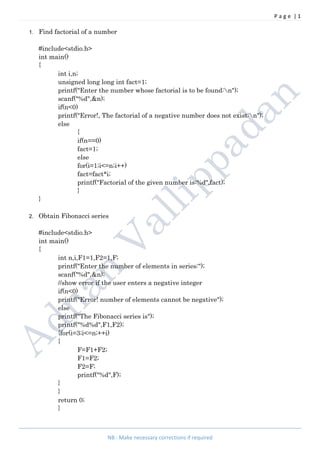
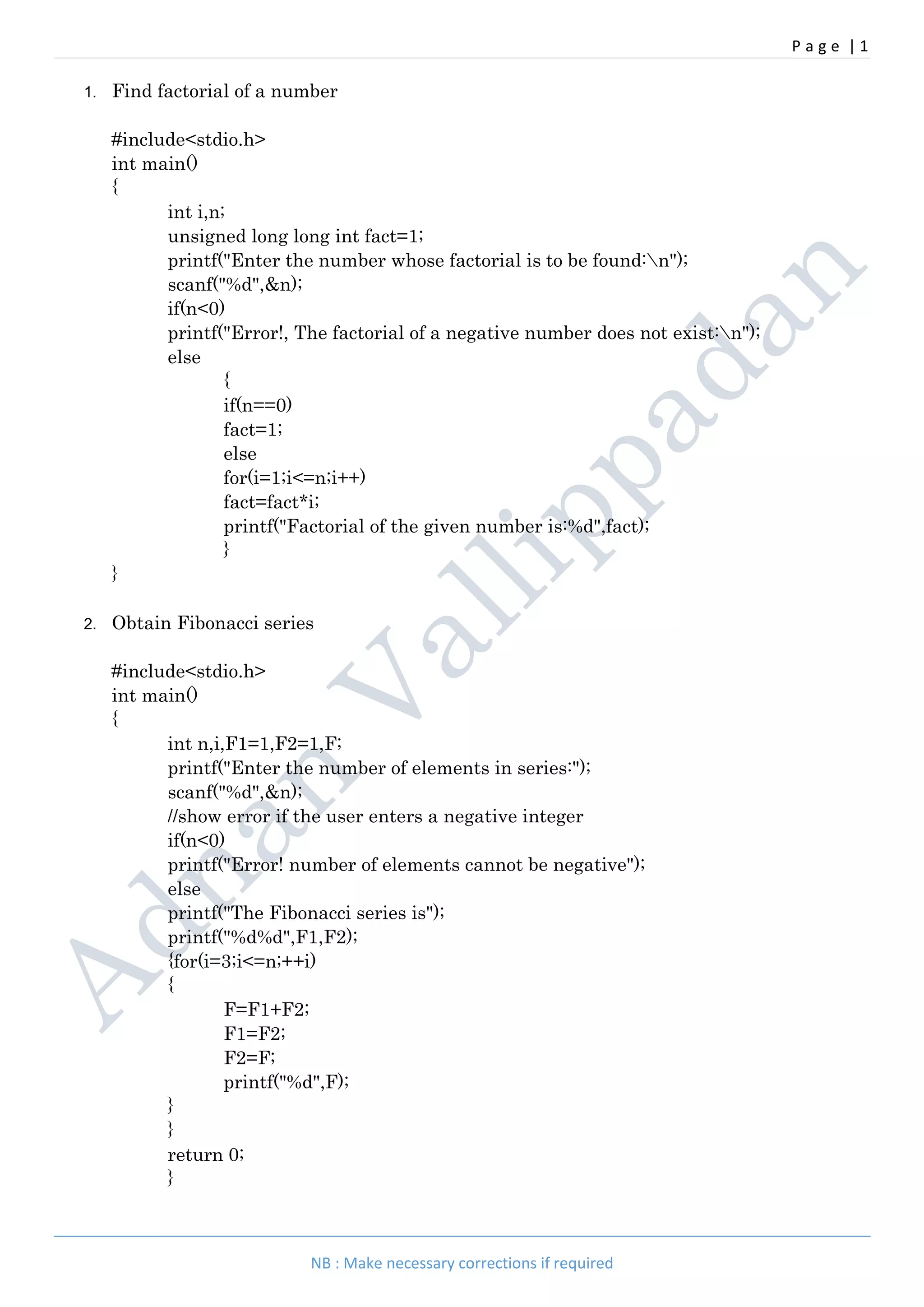
1. Find factorial of a number
#include<stdio.h>
int main()
{
int i,n;
unsigned long long int fact=1;
printf("Enter the number whose factorial is to be found:n");
scanf("%d",&n);
if(n<0)
printf("Error!, The factorial of a negative number does not exist:n");
else
{
if(n==0)
fact=1;
else
for(i=1;i<=n;i++)
fact=fact*i;
printf("Factorial of the given number is:%d",fact);
}
}
2. Obtain Fibonacci series
#include<stdio.h>
int main()
{
int n,i,F1=1,F2=1,F;
printf("Enter the number of elements in series:");
scanf("%d",&n);
//show error if the user enters a negative integer
if(n<0)
printf("Error! number of elements cannot be negative");
else
printf("The Fibonacci series is");
printf("%d%d",F1,F2);
{for(i=3;i<=n;++i)
{
F=F1+F2;
F1=F2;
F2=F;
printf("%d",F);
}
}
return 0;
}
P a g e | 2
NB : Make necessary corrections if required
3. To check for a prime number
#include<stdio.h>
#include<math.h>
int main()
{
int n,f=0,d=2;
printf("Enter the number to check whether prime or not:n");
scanf("%d",&n);
do
{
if(n%d==0)
f=1;
d++;
}while(d<=n/2 && f==0);
if(n==2)
f=0;
if(f==0)
printf("The given number is prime:n");
else
printf("The given number is not prime:n");
return 0;
}
4. To write and run C programs to sort a set of numbers in ascending & descending order
using bubble sorting algorithm
#include <stdio.h>
void readarray(int a[],int m)
{
int i;
printf("Enter the elements:n");
for(i=0;i<m;i++) scanf("%d",&a[i]);
}
void swap(int *a,int *b)
{
int temp=*a;
*a=*b;
*b=temp;
}
void ascending(int a[],int m)
{
int i,j;
for(i=0;i<m;i++)
{
for(j=0;j<m-1;j++)
P a g e | 3
NB : Make necessary corrections if required
if(a[j]>a[j+1])
swap(&a[j],&a[j+1]);
}
for(i=0;i<m;i++)
printf("%dt",a[i]);
}
void descending(int a[],int m)
{
int i,j;
for(i=0;i<m;i++)
{
for(j=0;j<m-1;j++)
if(a[j]<a[j+1])
swap(&a[j],&a[j+1]);
}
for(i=0;i<m;i++)
printf("%dt",a[i]);
}
int main()
{
int n,i,asd[100];
printf("Enter the number of elements:n");
scanf("%d",&n);
readarray(asd,n);
printf("Sorted array in ascending order is:n");
ascending(asd,n);
printf("nSorted array in descending order is:n");
descending(asd,n);
}
5. Write C programs to find inverse of a matrix
#include<stdio.h>
void Swaprows(float a[10][10],int r1,int r2,int n)
{
int j;
float temp;
for(j=0;j<n;j++)
{
temp=a[r1][j];
a[r1][j]=a[r2][j];
a[r2][j]=temp;
}
}
float determinant(float matrix[10][10],int n)
{
int i;
float det=1;
for(i=0;i<n;i++)
P a g e | 4
NB : Make necessary corrections if required
det=det*matrix[i][i];
printf("nnDeterminant of the Given matrix is %fn",det);
if(det==0)
{
printf("nnInverse can't be find when determinant is zero:n");
}
return det;
}
void uppertriangular(float matrix[10][10],float idnt[10][10],int n)
{
int i,j,k;
float ratio;
for(i=0;i<n;i++)
{
for(j=0;j<n;j++)
{
if(i>j)
{
ratio = matrix[i][j]/matrix[j][j];
for(k=0;k<n;k++)
{
matrix[i][k]=matrix[i][k]-ratio*matrix[j][k];
idnt[i][k]=idnt[i][k]-ratio*idnt[j][k];
}
}
}
}
}
void lowertriangular(float matrix[10][10],float idnt[10][10],int n)
{
int i,j,k;
float ratio;
for(i=n-1;i>=0;i--)
{
for(j=n-1;j>=0;j--)
{
if(i<j)
{
ratio = matrix[i][j]/matrix[j][j];
for(k=0;k<n;k++)
{
matrix[i][k]=matrix[i][k]-ratio*matrix[j][k];
idnt[i][k]=idnt[i][k]-ratio*idnt[j][k];
}
}
}
}
}
void RowDiv(float a[10][10],float b[10][10],int r,int n,float T)
P a g e | 5
NB : Make necessary corrections if required
{
int j;
for(j=0;j<n;j++)
{
a[r][j]=a[r][j]/T;
b[r][j]=b[r][j]/T;
}
}
void print_matrix(float matrix[10][10],int n)
{
int i,j;
for(i=0;i<n;i++)
{
printf("n");
for(j=0;j<n;j++)
{
printf("%ft",matrix[i][j]);
}
}
}
int main()
{
float matrix[10][10],ratio,idnt[10][10];
int i,j,k,n;
printf("Enter the order of matrix:n");
scanf("%d",&n);
printf("Enter the matrix:n");
for(i=0;i<n;i++)
{
for(j=0;j<n;j++)
scanf("%f",&matrix[i][j]);
}
printf("nthe matrix is n");
print_matrix(matrix,n);
for(i=0;i<n;i++)
{
for(j=0;j<n;j++)
if(i==j)
idnt[i][j]=1;
else
idnt[i][j]=0;
}
printf("nIdentity matrix is n");
print_matrix(idnt,n);
for(i=0;i<n;i++)
{
if(matrix[i][i]==0)
{
if(i=n-1)
P a g e | 6
NB : Make necessary corrections if required
Swaprows(matrix,i,0,n);
else
Swaprows(matrix,i,i+1,n);
}
}
printf("nnAfter Swaping Operation The given Matrix is changed to: n");
print_matrix(matrix,n);
lowertriangular(matrix,idnt,n);
if(determinant(matrix,n)!=0)
{
uppertriangular(matrix,idnt,n);
printf("nThe given Matrix is changed to: n");
print_matrix(matrix,n);
printf("nIdentity matrix is changed to:n");
print_matrix(idnt,n);
for(i=0;i<n;i++)
RowDiv(matrix,idnt,i,n,matrix[i][i]);
printf("nThe given Matrix is changed to: n");
print_matrix(matrix,n);
printf("nIdentity matrix is changed to:n");
print_matrix(idnt,n);
printf("nInverse of the Given matrix is:n");
print_matrix(idnt,n);
}
}
6. Write C programs to find sum of two matrices
#include <stdio.h>
void read_matrices(int mat1[10][10],int mat2[10][10],int r1,int r2,int c1,int c2)
{
int i,j;
printf("Enter the elements of 1st matrix:n");
for(i=0;i<r1;i++)
{
for(j=0;j<c1;j++)
scanf("%d",&mat1[i][j]);
}
printf("Enter the elements of 2nd matrix:n");
for(i=0;i<r2;i++)
{
for(j=0;j<c2;j++)
scanf("%d",&mat2[i][j]);
}
}
void Addition(int mat1[10][10],int mat2[10][10],int mat3[10][10],int r1,int r2,int c1,int
c2)
{
int i,j;
P a g e | 7
NB : Make necessary corrections if required
for(i=0;i<r2;i++)
{
for(j=0;j<c2;j++)
mat3[i][j]=mat1[i][j]+mat2[i][j];
}
}
void print_matrices(int mat1[10][10],int mat2[10][10],int mat3[10][10],int r1,int r2,int
c1,int c2)
{
int i,j;
printf("nThe 1st matrix is:n");
for(i=0;i<r1;i++)
{
printf("n");
for(j=0;j<c1;j++)
printf("%d t",mat1[i][j]);
}
printf("nThe 2nd matrix is:n");
for(i=0;i<r2;i++)
{
printf("n");
for(j=0;j<c2;j++)
printf("%d t",mat2[i][j]);
}
printf("nThe Addition Result is:n");
for(i=0;i<r1;i++)
{
for(j=0;j<c2;j++)
printf("%d t",mat3[i][j]);
printf("n");
}
}
int main()
{
int r1,r2,c1,c2,mat1[10][10],mat2[10][10],mat3[10][10];
printf("Enter the no.of rows & columns of Matrix 1 n");
scanf("%d %d",&r1,&c1);
printf("Enter the no.of rows & columns of Matrix 2 n");
scanf("%d %d",&r2,&c2);
if(r1==r2 && c1==c2)
{
read_matrices(mat1,mat2,r1,r2,c1,c2);
Addition(mat1,mat2,mat3,r1,r2,c1,c2);
print_matrices(mat1,mat2,mat3,r1,r2,c1,c2);
}
else
printf("Error! nAddition is not possible if both matrices are of same order n");
return 0;
}
P a g e | 8
NB : Make necessary corrections if required
7. Write C programs to find product of two matrices
#include <stdio.h>
void read_matrices(int mat1[10][10],int mat2[10][10],int r1,int r2,int c1,int c2)
{
int i,j;
printf("Enter the elements of 1st matrix:n");
for(i=0;i<r1;i++)
{
for(j=0;j<c1;j++)
scanf("%d",&mat1[i][j]);
}
printf("Enter the elements of 2nd matrix:n");
for(i=0;i<r2;i++)
{
for(j=0;j<c2;j++)
scanf("%d",&mat2[i][j]);
}
}
void multiplication(int mat1[10][10],int mat2[10][10],int mat3[10][10],int r1,int r2,int
c1,int c2)
{
int i,j,k,sum;
for(i=0;i<r1;i++)
for(j=0;j<c2;j++)
mat3[i][j]=0;
for(i=0;i<r1;i++)
for(j=0;j<c2;j++)
for(k=0;k<c1;k++)
mat3[i][j]=mat3[i][j]+mat1[i][k]*mat2[k][j];
}
void print_matrices(int mat1[10][10],int mat2[10][10],int mat3[10][10],int r1,int r2,int
c1,int c2)
{
int i,j;
printf("nThe 1st matrix is:n");
for(i=0;i<r1;i++)
{
printf("n");
for(j=0;j<c1;j++)
printf("%d t",mat1[i][j]);
}
printf("nThe 2nd matrix is:n");
for(i=0;i<r2;i++)
{
printf("n");
for(j=0;j<c2;j++)
printf("%d t",mat2[i][j]);
P a g e | 9
NB : Make necessary corrections if required
}
printf("nThe multiplication Result is:n");
for(i=0;i<r1;i++)
{
for(j=0;j<c2;j++)
printf("%d t",mat3[i][j]);
printf("n");
}
}
int main()
{
int r1,r2,c1,c2,mat1[10][10],mat2[10][10],mat3[10][10];
printf("Enter the no.of rows & columns of Matrix 1 n");
scanf("%d %d",&r1,&c1);
printf("Enter the no.of rows & columns of Matrix 2 n");
scanf("%d %d",&r2,&c2);
if(r2==c1)
{
read_matrices(mat1,mat2,r1,r2,c1,c2);
multiplication(mat1,mat2,mat3,r1,r2,c1,c2);
print_matrices(mat1,mat2,mat3,r1,r2,c1,c2);
}
else
printf("Error! nMultiplication is not possiblen");
return 0;
}
8. Write C programs to find determinant of a matrix
#include<stdio.h>
int main()
{
float matrix[10][10],ratio,det=1;
int i,j,k,n;
printf("Enter the order of matrix:");
scanf("%d",&n);
printf("Enter the matrix: n");
for(i=0;i<n;i++)
{
for(j=0;j<n;j++)
scanf("%f",&matrix[i][j]);
}
for(i=0;i<n;i++)
{
for(j=0;j<n;j++)
{
if(i>j)
{
ratio = matrix[i][j]/matrix[j][j];
P a g e | 10
NB : Make necessary corrections if required
for(k=0;k<n;k++)
{
matrix[i][k]=matrix[i][k]-ratio*matrix[j][k];
}
}
}
}
printf("the upper triangular matrix is ");
for(i=0;i<n;i++)
{
printf("n");
for(j=0;j<n;j++)
{
printf("%ft",matrix[i][j]);
}
}
for(i=0;i<n;i++)
det=det*matrix[i][i];
printf("nDeterminand of given matrix is:%f",det);
}
9. Using C program find
( )!
, where m and n are integers.
#include <stdio.h>
int main()
{
int n,fact=1,i,m,r;
printf("Enter the number 'n':n");
scanf("%d",&n);
printf("Enter the number 'm':n");
scanf("%d",&m);
for(i=1;i<n;i++)
fact=fact*i;
r=fact/m;
printf("The result is:%d",r);
}
10. Write a c program to obtain the series 7 7 14 21 35 up to n terms
#include <stdio.h>
int main()
{
int f1=7,f2=7,f,n;
printf("Enter the number of elements in the fibonacci series:t");
scanf("%d",&n);
if(n<=0)
printf("Error! Number of elements can not be zero or negative:n");
else
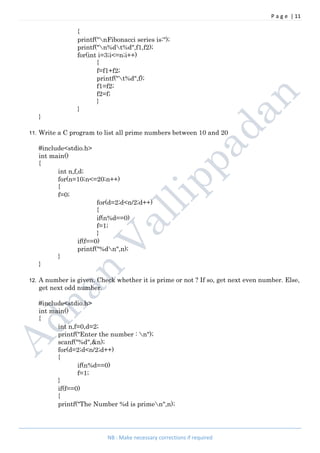
P a g e | 11
NB : Make necessary corrections if required
{
printf("nFibonacci series is:");
printf("n%dt%d",f1,f2);
for(int i=3;i<=n;i++)
{
f=f1+f2;
printf("t%d",f);
f1=f2;
f2=f;
}
}
}
11. Write a C program to list all prime numbers between 10 and 20
#include<stdio.h>
int main()
{
int n,f,d;
for(n=10;n<=20;n++)
{
f=0;
for(d=2;d<n/2;d++)
{
if(n%d==0)
f=1;
}
if(f==0)
printf("%dn",n);
}
}
12. A number is given. Check whether it is prime or not ? If so, get next even number. Else,
get next odd number.
#include<stdio.h>
int main()
{
int n,f=0,d=2;
printf("Enter the number : n");
scanf("%d",&n);
for(d=2;d<n/2;d++)
{
if(n%d==0)
f=1;
}
if(f==0)
{
printf("The Number %d is primen",n);
P a g e | 12
NB : Make necessary corrections if required
if(n%2==0)
printf("The next even number is %d n",n+2);
else
printf("The next even number is %d n",n+1);
}
if(f==1)
{
printf("The Number %d is not primen",n);
if(n%2==1)
printf("The next odd number is %d n",n+2);
else
printf("The next odd number is %d n",n+1);
}
}
13. Write a program to interchange second and fourth numbers of an array
#include <stdio.h>
int main()
{
int array[10],i,n,temp;
printf("Enter size of arrayn");
scanf("%d",&n);
printf("Enter elements of arrayn");
for(i=0;i<n;i++)
scanf("%d",&array[i]);
printf("The elements of given array aren");
for(i=0;i<n;i++)
printf("array[%d]=%dn",i,array[i]);
temp=array[1];
array[1]=array[3];
array[3]=temp;
printf("The elements of array after swaping aren");
for(i=0;i<n;i++)
printf("array[%d]=%dn",i,array[i]);
}
14. Using C program to find largest number from an array
#include<stdio.h>
int main()
{
int n,i,a[100],lr;
printf("Enter the number of elements:n ");
scanf("%d",&n);
printf("Enter the number of elements:n");
for(i=0;i<n;i++)
scanf("%d",&a[i]);
lr=a[0];
P a g e | 13
NB : Make necessary corrections if required
for(i=0;i<n-1;i++)
{
if(a[i+1]>lr)
lr=a[i+1];
}
printf("nLargest number is %d",lr);
return 0;
}
15. Write C program to interchange first and third rows of a matrix
#include <stdio.h>
int main()
{
int n,m[10][10],i,j,temp;
printf("Enter the order of matrix:n");
scanf("%d",&n);
printf("enter the elementsn");
for(i=0;i<n;i++)
{
for(j=0;j<n;j++)
scanf("%d",&m[i][j]);
}
printf("given matrix isn");
for(i=0;i<n;i++)
{
printf("n");
for(j=0;j<n;j++)
printf("%dt",m[i][j]);
}
for(j=0;j<n;j++)
{
temp=m[0][j];
m[0][j]=m[2][j];
m[2][j]=temp;
}
printf("nthe result isn");
for(i=0;i<n;i++)
{
printf("n");
for(j=0;j<n;j++)
printf("%dt",m[i][j]);
}
}
16. Write C program to interchange a row and next row of a matrix
#include <stdio.h>
int main()
P a g e | 14
NB : Make necessary corrections if required
{
int n,m[10][10],i,j,temp,k;
printf("Enter the order of matrix:n");
scanf("%d",&n);
printf("enter the elementsn");
for(i=0;i<n;i++)
{
for(j=0;j<n;j++)
scanf("%d",&m[i][j]);
}
printf("given matrix isn");
for(i=0;i<n;i++)
{
printf("n");
for(j=0;j<n;j++)
printf("%dt",m[i][j]);
}
printf("nEnter the row number you want to interchange:n");
scanf("%d",&k);
for(j=0;j<n;j++)
{
temp=m[k-1][j];
m[k-1][j]=m[k][j];
m[k][j]=temp;
}
printf("nthe result isn");
for(i=0;i<n;i++)
{
printf("n");
for(j=0;j<n;j++)
printf("%dt",m[i][j]);
}
}
17. An nxn matrix is given. Convert it into an upper triangular matrix using C
program
#include<stdio.h>
int main()
{
float matrix[10][10],ratio;
int i,j,k,n;
printf("Enter the order of matrix:n");
scanf("%d",&n);
printf("Enter the elements of matrix: n");
for(i=0;i<n;i++)
{
for(j=0;j<n;j++)
scanf("%f",&matrix[i][j]);
P a g e | 15
NB : Make necessary corrections if required
}
for(i=0;i<n;i++)
{
for(j=0;j<n;j++)
{
if(i>j)
{
ratio = matrix[i][j]/matrix[j][j];
for(k=0;k<n;k++)
{
matrix[i][k]=matrix[i][k]-ratio*matrix[j][k];
}
}
}
}
printf("the upper triangular matrix is ");
for(i=0;i<n;i++)
{
printf("n");
for(j=0;j<n;j++)
{
printf("%ft",matrix[i][j]);
}
}
}
18. An nxn matrix is given. Convert it into a lower triangular matrix using C program
#include<stdio.h>
int main()
{
float matrix[10][10],ratio;
int i,j,k,n;
printf("Enter the order of matrix:");
scanf("%d",&n);
printf("Enter the matrix: n");
for(i=0;i<n;i++)
{
for(j=0;j<n;j++)
scanf("%f",&matrix[i][j]);
}
for(i=n-1;i>=0;i--)
{
for(j=n-1;j>=0;j--)
{
if(i<j)
{
ratio = matrix[i][j]/matrix[j][j];
P a g e | 16
NB : Make necessary corrections if required
for(k=0;k<n;k++)
{
matrix[i][k]=matrix[i][k]-ratio*matrix[j][k];
}
}
}
}
printf("the lower triangular matrix is ");
for(i=0;i<n;i++)
{
printf("n");
for(j=0;j<n;j++)
{
printf("%ft",matrix[i][j]);
}
}
}
19. Consider the augmented matrix Ab = A/I, where A is an nXn matrix and I is an identity
matrix of order n. Do same elementary operations on both A and I so that A is
transformed into an upper triangular matrix. Write a C program.
#include<stdio.h>
void print_matrix(float matrix[10][10],int n)
{
int i,j;
for(i=0;i<n;i++)
{
printf("n");
for(j=0;j<n;j++)
{
printf("%ft",matrix[i][j]);
}
}
}
int main()
{
float matrix[10][10],ratio,idnt[10][10];
int i,j,k,n;
printf("Enter the order of matrix:");
scanf("%d",&n);
printf("Enter the matrix: n");
for(i=0;i<n;i++)
{
for(j=0;j<n;j++)
scanf("%f",&matrix[i][j]);
}
for(i=0;i<n;i++)
P a g e | 17
NB : Make necessary corrections if required
{
for(j=0;j<n;j++)
if(i==j)
idnt[i][j]=1;
else
idnt[i][j]=0;
}
printf("nIdentity matrix is n");
print_matrix(idnt,n);
for(i=0;i<n;i++)
{
for(j=0;j<n;j++)
{
if(i>j)
{
ratio = matrix[i][j]/matrix[j][j];
for(k=0;k<n;k++)
{
matrix[i][k]=matrix[i][k]-ratio*matrix[j][k];
idnt[i][k]=idnt[i][k]-ratio*idnt[j][k];
}
}
}
}
printf("nthe upper triangular matrix is n");
print_matrix(matrix,n);
printf("nIdentity matrix is changed ton");
print_matrix(idnt,n);
}
20. Using C program, find + , where A and B are matrices.
#include <stdio.h>
int main()
{
int i,j,n,a[10][10],b[10][10],c[10][10],d[10][10],k;
printf("Enter the order of matrix :n");
scanf("%d",&n);
printf("Enter the elements of matrix A:n");
for(i=0;i<n;i++)
{
for(j=0;j<n;j++)
scanf("%d",&a[i][j]);
}
printf("Enter the elements of matrix B:n");
for(i=0;i<n;i++)
{
P a g e | 18
NB : Make necessary corrections if required
for(j=0;j<n;j++)
{
scanf("%d",&b[i][j]);
c[i][j]=0;
}
}
for(i=0;i<n;i++)
for(j=0;j<n;j++)
{
for(k=0;k<n;k++)
c[i][j]=c[i][j]+a[i][k]*a[k][j];
}
printf("nThe A^2 matrix is:n");
for(i=0;i<n;i++)
{
printf("n");
for(j=0;j<n;j++)
printf("%d t",c[i][j]);
}
for(i=0;i<n;i++)
for(j=0;j<n;j++)
d[i][j]=c[i][j]+b[i][j];
printf("nThe Final result is:n");
for(i=0;i<n;i++)
{
printf("n");
for(j=0;j<n;j++)
printf("%d t",d[i][j]);
}
}
21. Write a C program to find the solution of
= sin
Using Euler method.
#include<stdio.h>
#include<math.h>
float function(float x,float t)
{
float f=sin(x);
return f;
}
void euler(int n,float t0,float tn,float x0,float x[100],float t[100])
{
int k=0;
x[0]=x0;
t[0]=t0;
P a g e | 19
NB : Make necessary corrections if required
float h=(tn-t0)/n;
while(t[k]!=tn)
{
x[k+1]=x[k]+h*function(x[k],t[k]);
t[k+1]=t[k]+h;
k++;
}
}
int main()
{
int i,n;
float t0,tn,x0,t[100],x[100];
printf("nEnter the initial & final times nEnter no.of iterations:n");
scanf("%f%f%d",&t0,&tn,&n);
printf("Enter the initial value:x0n");
scanf("%f",&x0);
printf("nsolution using euler's methodnn");
euler(n,t0,tn,x0,x,t);
printf("ttxnn");
for(i=0;i!=n;i++)
printf("%2.4ft%2.4fn",t[i],x[i]);
return 0;
}
22. Write a C program to find the solution of
= cos
using Ranga-Kutta method.
#include<stdio.h>
#include<math.h>
float fnctn(float x,float t)
{
float f;
f=cos(x);
return f;
}
void RK(int n,float t0,float tn,float x0,float x[100],float t[100])
{
float h,K1,K2,K3,K4;
int m;
t[0]=t0;
x[0]=x0;
m=0;
h=(tn-t0)/n;
while(t[m]<=tn)
{
K1=h*fnctn(x[m],t[m]);
P a g e | 20
NB : Make necessary corrections if required
K2=h*fnctn(x[m]+K1/2,t[m]+h/2);
K3=h*fnctn(x[m]+K2/2,t[m]+h/2);
K4=h*fnctn(x[m]+K3/2,t[m]+h);
x[m+1]=x[m]+(K1+2*K2+2*K3+K4)/6;
t[m+1]=t[m]+h;
m=m+1;
}
}
int main()
{
int n,i;
float x[100],t[100],t0,tn;
printf("enter initial and final times and number of iterations:n");
scanf("%f%f%d",&t0,&tn,&n);
printf("enter the initial value x0:");
scanf("%f",&x[0]);
printf("n solution using Runge-Kutta methodnn");
RK(n,t0,tn,x[0],x,t);
printf("ttxn");
for(i=0;i!=n;i++)
printf("%ft%fn",t[i],x[i]);
return 0;
}
23. Using C program,find the solution of linear equations. (Use Gauss elimination method)
#include<stdio.h>
int main()
{
int i,j,k,n;
float A[20][20],c,x[10],sum=0.0;
printf("nEnter the order of matrix: ");
scanf("%d",&n);
printf("nEnter the elements of augmented matrix row-wise:nn");
for(i=1; i<=n; i++)
{
for(j=1; j<=(n+1); j++)
{
printf("A[%d][%d] : ", i,j);
scanf("%f",&A[i][j]);
}
}
for(j=1; j<=n; j++) /* loop for the generation of upper triangular matrix*/
{
for(i=1; i<=n; i++)
{
if(i>j)
{
c=A[i][j]/A[j][j];
P a g e | 21
NB : Make necessary corrections if required
for(k=1; k<=n+1; k++)
{
A[i][k]=A[i][k]-c*A[j][k];
}
}
}
}
x[n]=A[n][n+1]/A[n][n];
/* this loop is for backward substitution*/
for(i=n-1; i>=1; i--)
{
sum=0;
for(j=i+1; j<=n; j++)
{
sum=sum+A[i][j]*x[j];
}
x[i]=(A[i][n+1]-sum)/A[i][i];
}
printf("nThe solution is: n");
for(i=1; i<=n; i++)
{
printf("nx%d=%ft",i,x[i]); /* x1, x2, x3 are the required solutions*/
}
return(0);
}
24. Using C program,find the solution of linear equations. (Use Gauss siedal method)
#include<stdio.h>
int main()
{
float a[10][10],b[10],x[10],y[10];
intn,m,i,j;
printf("Enter the no. of linear equation n");
scanf("%d",&n);
printf("Enter the coefficients of the equationsn");
for(i=0;i<n;i++)
{
for(j=0;j<n;j++)
{
printf("Matrix[%d][%d] = ",i,j);
scanf("%f",&a[i][j]);
}
}
printf("nEnter Values of the right side of equationn");
for(i=0;i<n;i++)
{
printf("b[%d] = ",i);
P a g e | 22
NB : Make necessary corrections if required
scanf("%f",&b[i]);
}
printf("Enter initial values of xn");
for(i=0;i<n;i++)
{
printf("x[%d] = ",i);
scanf("%f",&x[i]);
}
printf("nEnter the no. of iteration :");
scanf("%d",&m);
while(m>0)
{
for(i=0;i<n;i++)
{
y[i]=(b[i]/a[i][i]);
for(j=0;j<n;j++)
{
if(j==i)
continue;
y[i]=y[i]-((a[i][j]/a[i][i])*x[j]);
x[i]=y[i];
}
printf("x%d=%6.2f ",i+1,y[i]);
}
printf("n");
m--;
}
return 0;
}
25. Using C program, find the sum of first n Fibonacci numbers
#include<stdio.h>
int main()
{
int n,i,F1=1,F2=1,F,sum=F1+F2;
printf("Enter the number of elements in series:t");
scanf("%d",&n);
if(n<0)
printf("Error! number of elements cannot be negative");
else
{
printf("The Fibonacci series isn");
printf("%dt%dt",F1,F2);
{
for(i=3;i<=n;++i)
{
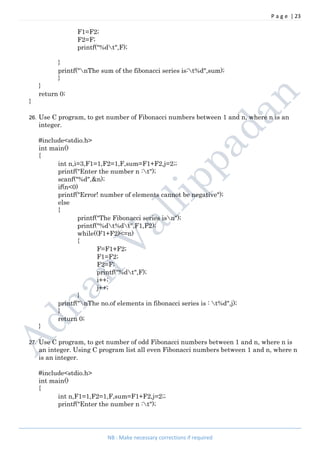
F=F1+F2;
sum=sum+F;
P a g e | 23
NB : Make necessary corrections if required
F1=F2;
F2=F;
printf("%dt",F);
}
printf("nThe sum of the fibonacci series is:t%d",sum);
}
}
return 0;
}
26. Use C program, to get number of Fibonacci numbers between 1 and n, where n is an
integer.
#include<stdio.h>
int main()
{
int n,i=3,F1=1,F2=1,F,sum=F1+F2,j=2;;
printf("Enter the number n :t");
scanf("%d",&n);
if(n<0)
printf("Error! number of elements cannot be negative");
else
{
printf("The Fibonacci series isn");
printf("%dt%dt",F1,F2);
while((F1+F2)<=n)
{
F=F1+F2;
F1=F2;
F2=F;
printf("%dt",F);
i++;
j++;
}
printf("nThe no.of elements in fibonacci series is : t%d",j);
}
return 0;
}
27. Use C program, to get number of odd Fibonacci numbers between 1 and n, where n is
an integer. Using C program list all even Fibonacci numbers between 1 and n, where n
is an integer.
#include<stdio.h>
int main()
{
int n,F1=1,F2=1,F,sum=F1+F2,j=2;;
printf("Enter the number n :t");
P a g e | 24
NB : Make necessary corrections if required
scanf("%d",&n);
if(n<0)
printf("Error! number of elements cannot be negative");
else
{
printf("The Even Fibonacci series isn");
while((F1+F2)<=n)
{
F=F1+F2;
F1=F2;
F2=F;
if(F%2==0)
printf("%dt",F);
else
j++;
}
printf("nThe no.of odd elements in fibonacci series is : t%d",j);
}
return 0;
}
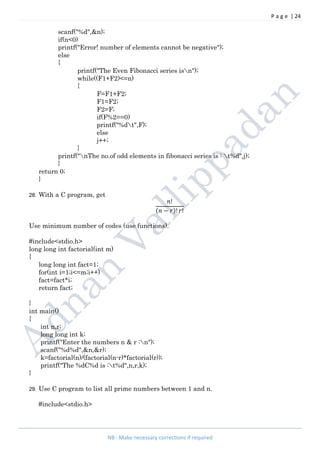
28. With a C program, get
!
( − )! !
Use minimum number of codes (use functions).
#include<stdio.h>
long long int factorial(int m)
{
long long int fact=1;
for(int i=1;i<=m;i++)
fact=fact*i;
return fact;
}
int main()
{
int n,r;
long long int k;
printf("Enter the numbers n & r :n");
scanf("%d%d",&n,&r);
k=factorial(n)/(factorial(n-r)*factorial(r));
printf("The %dC%d is :t%d",n,r,k);
}
29. Use C program to list all prime numbers between 1 and n.
#include<stdio.h>
P a g e | 25
NB : Make necessary corrections if required
int main()
{
int n,m,f,d;
printf("Enter the upper limit n:n");
scanf("%d",&m);
printf("Prime numbers between 1 & %d isn",m);
for(n=1;n<=m;n++)
{
f=0;
for(d=2;d<=n/2;d++)
{
if(n%d==0)
f=1;
}
if(f==0)
printf("%dn",n);
}
}
30. A set of numbers are given. With a c program, group them to prime and composite
numbers and then arrange each group in descending order.
#include<stdio.h>
void swap(int *a,int *b)
{
int temp=*a;
*a=*b;
*b=temp;
}
void sorting(int a[50],int m)
{
int i,j;
for(i=0;i<m;i++)
{
for(j=0;j<m-1;j++)
if(a[j]<a[j+1])
swap(&a[j],&a[j+1]);
}
}
void print_numbers(int prime[50],int not_prime[50],int k,int j)
{
int i;
printf("The list of prime numbers is:n");
for(i=0;i<j;i++)
printf("%dn",prime[i]);
printf("The list of composite numbers is:n");
for(i=0;i<k;i++)
printf("%dn",not_prime[i]);
}
void prime_numbers(int a[50],int n)
P a g e | 26
NB : Make necessary corrections if required
{
int prime[50],not_prime[50];
int f,d,i,j=0,k=0;
for(i=0;i<n;i++)
{
f=0;
for(d=2;d<=n/2;d++)
{
if(a[i]%d==0)
f=1;
}
if(f==0)
{
prime[j]=a[i];
j++;
}
else
{
not_prime[k]=a[i];
k++;
}
}
sorting(prime,j);
sorting(not_prime,k);
print_numbers(prime,not_prime,k,j);
}
int main()
{
int n,f,d,i,a[50],j=0,k=0,prime[50],not_prime[50];
printf("Enter the no.of elements n:n");
scanf("%d",&n);
printf("Enter the elements:n");
for(i=0;i<n;i++)
scanf("%d",&a[i]);
prime_numbers(a,n);
}
31. A list of integers are given. Arrange the numbers such that first three numbers are
arranged in descending order and remaining in ascending order. Use minimum number
of codes
#include<stdio.h>
void readarray(int a[],int m)
{
int i;
printf("Enter the elements:n");
for(i=0;i<m;i++)
scanf("%d",&a[i]);
}
P a g e | 27
NB : Make necessary corrections if required
void swap(int *a,int *b)
{
int temp=*a;
*a=*b;
*b=temp;
}
void ascending(int a[],int m)
{
int i,j;
for(i=3;i<m;i++)
{
for(j=3;j<m-1;j++)
if(a[j]>a[j+1])
swap(&a[j],&a[j+1]);
}
}
void descending(int a[],int m)
{
int i,j;
for(i=0;i<m;i++)
{
for(j=0;j<m-1;j++)
if(a[j]<a[j+1])
swap(&a[j],&a[j+1]);
}
}
int main()
{
int n,i,asd[100];
printf("Enter the number of elements:n");
scanf("%d",&n);
readarray(asd,n);
printf("Sorted array in which 1st 3 numbers are in descending order & remaining
in ascending order is:n");
descending(asd,3);
ascending(asd,n);
for(i=0;i<n;i++)
printf("%dt",asd[i]);
}
32. Show that ∗ =
#include<stdio.h>
void Swaprows(float a[10][10],int r1,int r2,int n)
{
int j;
float temp;
for(j=0;j<n;j++)
{
P a g e | 28
NB : Make necessary corrections if required
temp=a[r1][j];
a[r1][j]=a[r2][j];
a[r2][j]=temp;
}
}
float determinant(float matrix[10][10],int n)
{
int i;
float det=1;
for(i=0;i<n;i++)
det=det*matrix[i][i];
printf("nnDeterminant of the Given matrix is %fn",det);
if(det==0)
{
printf("nnInverse can't be find when determinant is zero:n");
}
return det;
}
void uppertriangular(float matrix[10][10],float idnt[10][10],int n)
{
int i,j,k;
float ratio;
for(i=0;i<n;i++)
{
for(j=0;j<n;j++)
{
if(i>j)
{
ratio = matrix[i][j]/matrix[j][j];
for(k=0;k<n;k++)
{
matrix[i][k]=matrix[i][k]-ratio*matrix[j][k];
idnt[i][k]=idnt[i][k]-ratio*idnt[j][k];
}
}
}
}
}
void lowertriangular(float matrix[10][10],float idnt[10][10],int n)
{
int i,j,k;
float ratio;
for(i=n-1;i>=0;i--)
{
for(j=n-1;j>=0;j--)
{
if(i<j)
{
ratio = matrix[i][j]/matrix[j][j];
P a g e | 29
NB : Make necessary corrections if required
for(k=0;k<n;k++)
{
matrix[i][k]=matrix[i][k]-ratio*matrix[j][k];
idnt[i][k]=idnt[i][k]-ratio*idnt[j][k];
}
}
}
}
}
void RowDiv(float a[10][10],float b[10][10],int r,int n,float T)
{
int j;
for(j=0;j<n;j++)
{
a[r][j]=a[r][j]/T;
b[r][j]=b[r][j]/T;
}
}
void print_matrix(float matrix[10][10],int n)
{
int i,j;
for(i=0;i<n;i++)
{
printf("n");
for(j=0;j<n;j++)
printf("%ft",matrix[i][j]);
}
}
void multiplication(float matrix1[10][10],float matrix2[10][10],int n)
{
int i,j,k;
float matrix3[10][10],sum;
for(i=0;i<n;i++)
for(j=0;j<n;j++)
{
sum=0;
for(k=0;k<n;k++)
sum=sum+matrix1[i][k]*matrix2[k][j];
matrix3[i][j]=sum;
}
print_matrix(matrix3,n);
}
int main()
{
float matrix[10][10],ratio,inverse[10][10],idnt[10][10],matrix2[10][10];
int i,j,k,n;
printf("Enter the order of matrix:n");
scanf("%d",&n);
printf("Enter the matrix:n");
P a g e | 30
NB : Make necessary corrections if required
for(i=0;i<n;i++)
{
for(j=0;j<n;j++)
scanf("%f",&matrix[i][j]);
}
printf("nthe matrix is n");
print_matrix(matrix,n);
for(i=0;i<n;i++)
{
for(j=0;j<n;j++)
if(i==j)
inverse[i][j]=1;
else
inverse[i][j]=0;
}
printf("nIdentity matrix is n");
print_matrix(inverse,n);
for(i=0;i<n;i++)
for(j=0;j<n;j++)
matrix2[i][j]=matrix[i][j];
for(i=0;i<n;i++)
{
if(matrix[i][i]==0)
{
if(i=n-1)
Swaprows(matrix,i,0,n);
else
Swaprows(matrix,i,i+1,n);
}
}
printf("nnAfter Swaping Operation The given Matrix is changed to: n");
print_matrix(matrix,n);
lowertriangular(matrix,inverse,n);
if(determinant(matrix,n)!=0)
{
uppertriangular(matrix,inverse,n);
printf("nThe given Matrix is changed to: n");
print_matrix(matrix,n);
printf("nIdentity matrix is changed to:n");
print_matrix(inverse,n);
for(i=0;i<n;i++)
RowDiv(matrix,inverse,i,n,matrix[i][i]);
printf("nThe given Matrix is changed to: n");
print_matrix(matrix,n);
printf("nIdentity matrix is changed to:n");
print_matrix(inverse,n);
printf("nInverse of the Given matrix is:n");
print_matrix(inverse,n);
printf("nThe Given matrix is : n");
P a g e | 31
NB : Make necessary corrections if required
print_matrix(matrix2,n);
printf("nThe multiplication result is (A*A^-1) is : n");
multiplication(matrix2,inverse,n);
}
}
33. Use c program to interchange two rows of a matrix with highest and lowest diagonal
elements.
#include <stdio.h>
void swap(int m[10][10],int n,int p,int q)
{
int j,temp;
for(j=0;j<n;j++)
{
temp=m[p][j];
m[p][j]=m[q][j];
m[q][j]=temp;
}
}
void print_matrix(int m[10][10],int n)
{
int i,j;
for(i=0;i<n;i++)
{
printf("n");
for(j=0;j<n;j++)
printf("%dt",m[i][j]);
}
}
int largest(int m[10][10],int n)
{
int i,large=m[0][0];
for(i=0;i<n;i++)
{
if(m[i][i]>=large)
large=m[i][i];
}
for(i=0;i<n;i++)
if(large==m[i][i])
return i;
}
int smallest(int m[10][10],int n)
{
int i,small=m[0][0];
for(i=0;i<n;i++)
{
if(m[i][i]<=small)
small=m[i][i];
P a g e | 32
NB : Make necessary corrections if required
}
for(i=0;i<n;i++)
if(small==m[i][i])
return i;
}
int main()
{
int n,m[10][10],i,j,temp,p,q;
printf("Enter the order of matrix:n");
scanf("%d",&n);
printf("enter the elementsn");
for(i=0;i<n;i++)
{
for(j=0;j<n;j++)
scanf("%d",&m[i][j]);
}
printf("given matrix isn");
print_matrix(m,n);
p=largest(m,n);
q=smallest(m,n);
swap(m,n,p,q);
printf("nAfter swapping rows with highest & lowest diagonal elements : n");
print_matrix(m,n);
}
34. Use c program to get 2I - A, where A is a square matrix and I is an identity matrix of
order n.
#include <stdio.h>
void print_matrix(int m[10][10],int n)
{
int i,j;
for(i=0;i<n;i++)
{
printf("n");
for(j=0;j<n;j++)
printf("%d t",m[i][j]);
}
}
void subtraction(int mat1[10][10],int mat2[10][10],int n)
{
int i,j,mat3[10][10];
for(i=0;i<n;i++)
{
for(j=0;j<n;j++)
mat3[i][j]=mat1[i][j]-mat2[i][j];
}
printf("n2I-A matrix is : n");
print_matrix(mat3,n);
P a g e | 33
NB : Make necessary corrections if required
}
int main()
{
int n,MatA[10][10],idnt[10][10],i,j;
printf("Enter the order of A matrix:n");
scanf("%d",&n);
printf("Enter the elements of A matrix : n");
for(i=0;i<n;i++)
for(j=0;j<n;j++)
scanf("%d",&MatA[i][j]);
printf("The A matrix is : n");
print_matrix(MatA,n);
for(i=0;i<n;i++)
for(j=0;j<n;j++)
{
if(i==j)
idnt[i][j]=2;
else
idnt[i][j]=0;
}
printf("nThe 2I matrix is : n");
print_matrix(idnt,n);
subtraction(idnt,MatA,n);
}
35. Use c program to get (2I - A)/det(A), where A is a square matrix and I is an identity
matrix of order n.
#include <stdio.h>
void print_matrix(float m[10][10],int n)
{
int i,j;
for(i=0;i<n;i++)
{
printf("n");
for(j=0;j<n;j++)
printf("%f t",m[i][j]);
}
}
void RowDiv(float a[10][10],int n,float T)
{
int j,r;
for(r=0;r<n;r++)
{
for(j=0;j<n;j++)
a[r][j]=a[r][j]/T;
}
P a g e | 34
NB : Make necessary corrections if required
printf("nnThe Result (2I-A)/det(A) is : n");
print_matrix(a,n);
}
void subtraction(float mat1[10][10],float mat2[10][10],int n,float det)
{
int i,j;
float mat3[10][10];
for(i=0;i<n;i++)
{
for(j=0;j<n;j++)
mat3[i][j]=mat1[i][j]-mat2[i][j];
}
printf("nn2I-A matrix is : n");
print_matrix(mat3,n);
RowDiv(mat3,n,det);
}
float determinant(float matrix[10][10],int n)
{
int i,j,ratio,k;
float det=1;
for(i=0;i<n;i++)
{
for(j=0;j<n;j++)
{
if(i>j)
{
ratio = matrix[i][j]/matrix[j][j];
for(k=0;k<n;k++)
matrix[i][k]=matrix[i][k]-ratio*matrix[j][k];
}
}
}
for(i=0;i<n;i++)
det=det*matrix[i][i];
return det;
}
int main()
{
int n,i,j;
float MatA[10][10],det,idnt[10][10],MatB[10][10];
printf("Enter the order of A matrix:n");
scanf("%d",&n);
printf("Enter the elements of A matrix : n");
for(i=0;i<n;i++)
for(j=0;j<n;j++)
scanf("%f",&MatA[i][j]);
printf("The A matrix is : n");
print_matrix(MatA,n);
P a g e | 35
NB : Make necessary corrections if required
for(i=0;i<n;i++)
for(j=0;j<n;j++)
{
MatB[i][j]=MatA[i][j];
if(i==j)
idnt[i][j]=2;
else
idnt[i][j]=0;
}
printf("nnThe 2I matrix is : n");
print_matrix(idnt,n);
det=determinant(MatB,n);
printf("nnDeterminant of the A matrix is : %fn",det);
subtraction(idnt,MatA,n,det);
}
36. Arrange rows of a matrix such that the sum of rows are in ascending order.
#include <stdio.h>
void print_matrix(int m[10][10],int n)
{
int i,j;
for(i=0;i<n;i++)
{
printf("n");
for(j=0;j<n;j++)
printf("%dt",m[i][j]);
}
}
void sum_of_rows(int mat[10][10],int n)
{
int i,j;
for(i=0;i<n;i++)
{
mat[i][n]=0;
for(j=0;j<n;j++)
mat[i][n]=mat[i][n]+mat[i][j];
}
printf("nThe sum of rows are : n");
for(i=0;i<n;i++)
printf("%dn",mat[i][n]);
}
void swap(int a,int b,int mt[10][10],int n)
{
int j,temp;
for(j=0;j<=n;j++)
{
temp=mt[a][j];
mt[a][j]=mt[b][j];
P a g e | 36
NB : Make necessary corrections if required
mt[b][j]=temp;
}
}
void ascending(int a[10][10],int m)
{
int i,j;
for(i=0;i<m;i++)
{
for(j=0;j<m-1;j++)
if(a[j][m]>a[j+1][m])
swap(j,j+1,a,m);
}
for(i=0;i<m;i++)
printf("%dt",a[i][m]);
}
int main()
{
int mat[10][10],n,sum[10],i,j;
printf("Enter the order of the matrix : n");
scanf("%d",&n);
printf("Enter the elements of matrix :n");
for(i=0;i<n;i++)
for(j=0;j<n;j++)
scanf("%d",&mat[i][j]);
printf("The Given Matrix is : n");
print_matrix(mat,n);
sum_of_rows(mat,n);
printf("nThe sum of rows of matrix in Ascending order is :n");
ascending(mat,n);
printf("nnAfter Arranging rows of a matrix such that the sum of rows are in
ascending order :n");
print_matrix(mat,n);
}
37. Using C program, verify that in general AB ≠ BA
#include<stdio.h>
void multiplication(int mat1[10][10],int mat2[10][10],int mat3[10][10],int n)
{
int i,j,k,sum;
for(i=0;i<n;i++)
for(j=0;j<n;j++)
{
sum=0;
for(k=0;k<n;k++)
sum=sum+mat1[i][k]*mat2[k][j];
mat3[i][j]=sum;
P a g e | 37
NB : Make necessary corrections if required
}
}
void print_matrix(int m[10][10],int n)
{
int i,j;
for(i=0;i<n;i++)
{
printf("n");
for(j=0;j<n;j++)
printf("%dt",m[i][j]);
}
}
void check_equality(int A1[10][10],int A2[10][10],int n)
{
int i,j,f=0;
for(i=0;i<n;i++)
for(j=0;j<n;j++)
{
if(A1[i][j]==A2[i][j])
f++;
}
if(f==n*n)
printf("nFrom the above results AB=BAn");
else
printf("nFrom the above results AB!=BAn");
}
int main()
{
int n,A[10][10],B[10][10],AB[10][10],BA[10][10],i,j;
printf("Enter the order of the Matrix:n");
scanf("%d",&n);
printf("Enter Elements of A matrix :n");
for(i=0;i<n;i++)
for(j=0;j<n;j++)
scanf("%d",&A[i][j]);
printf("nA matrix is : n");
print_matrix(A,n);
printf("nEnter Elements of B matrix :n");
for(i=0;i<n;i++)
for(j=0;j<n;j++)
scanf("%d",&B[i][j]);
printf("nB matrix is : n");
print_matrix(B,n);
multiplication(A,B,AB,n);
printf("nAB matrix is : n");
print_matrix(AB,n);
multiplication(B,A,BA,n);
printf("nBA matrix is : n");
print_matrix(BA,n);
P a g e | 38
NB : Make necessary corrections if required
check_equality(AB,BA,n);
}
38. Using c program, find + 2 where A and B are matrices.
#include <stdio.h>
void print_matrix(int d[10][10],int n)
{
int i,j;
for(i=0;i<n;i++)
{
printf("n");
for(j=0;j<n;j++)
printf("%d t",d[i][j]);
}
}
int main()
{
int i,j,n,a[10][10],b[10][10],c[10][10],d[10][10],k;
printf("Enter the order of matrix :n");
scanf("%d",&n);
printf("Enter the elements of matrix A:n");
for(i=0;i<n;i++)
{
for(j=0;j<n;j++)
scanf("%d",&a[i][j]);
}
printf("Enter the elements of matrix B:n");
for(i=0;i<n;i++)
{
for(j=0;j<n;j++)
{
scanf("%d",&b[i][j]);
c[i][j]=0;
}
}
printf("nThe A Matrix is :n");
print_matrix(a,n);
for(i=0;i<n;i++)
{
for(j=0;j<n;j++)
b[i][j]=2*b[i][j];
}
printf("nThe 2B Matrix is :n");
print_matrix(b,n);
for(i=0;i<n;i++)
for(j=0;j<n;j++)
{
for(k=0;k<n;k++)
P a g e | 39
NB : Make necessary corrections if required
c[i][j]=c[i][j]+a[i][k]*a[k][j];
}
printf("nThe A^2 matrix is:n");
print_matrix(c,n);
for(i=0;i<n;i++)
for(j=0;j<n;j++)
d[i][j]=c[i][j]+b[i][j];
printf("nThe Final result A^2+2B is :n");
print_matrix(d,n);
}
39. Using c program, Check whether a number is palindrom or not ?
#include<stdio.h>
int main()
{
int n, reverse=0, temp;
printf("Enter the number to check palindrome or notn");
scanf("%d",&n);
temp=n;
while(temp!=0)
{
reverse=reverse*10;
reverse=reverse+temp%10;
temp=temp/10;
}
if(n==reverse)
printf("The given number %d is palindrome numbern",n);
else
printf("The given number %d is not palindrome numbern",n);
}
40. Using c program, Check whether a string is palindrom or not ?
#include<stdio.h>
#include<string.h>
int main()
{
char a[100], b[100];
printf("Enter the word to check palindromn");
gets(a);
strcpy(b,a);
strrev(b);
if(strcmp(a,b)==0)
printf("Enterd string is a palindromen");
else
printf("Enterd string is not palindromen");
return 0;
P a g e | 40
NB : Make necessary corrections if required
}
41. Write C Program to find solution of a Quadratic Equation ?
#include<stdio.h>
#include<math.h>
int main()
{
float a, b, c, determinant,r1,r2,real,imag;
printf("Enter the coefficients a,b and c n");
scanf("n%f n%f n%f",&a,&b,&c);
determinant=b*b-4*a*c;
printf("Determinant is : t %f n",determinant);
if(determinant>0)
{
r1=(-b+sqrt(determinant))/(2*a);
r2=(-b-sqrt(determinant))/(2*a);
printf("Roots are: %f and %f",r1,r2);
}
else if(determinant==0)
{
r1=r2=-b/(2*a);
printf("Roots are: %f and %f",r1,r2);
}
else
{
real=-b/(2*a);
imag=sqrt(-determinant)/(2*a);
printf("Roots are : %f+j%f and t %f-j%f ",real,imag,real,imag);
}
return 0;
}
42. Use c program, to find the matrix[ … ]
#include <stdio.h>
read_matrix(float a[10][10],int r,int c)
{
int i,j;
for(i=0;i<r;i++)
for(j=0;j<c;j++)
scanf("%f",&a[i][j]);
P a g e | 41
NB : Make necessary corrections if required
}
void print_matrix(float d[10][10],int r,int c)
{
int i,j;
for(i=0;i<r;i++)
{
printf("n");
for(j=0;j<c;j++)
printf("%f t",d[i][j]);
}
}
void multiplication(float a[10][10],float b[10][10],float c[10][10],int r,int d)
{
int i,j,k;
for(i=0;i<r;i++)
for(j=0;j<d;j++)
{
c[i][j]=0;
for(k=0;k<r;k++)
c[i][j]=c[i][j]+a[i][k]*b[k][j];
}
}
void assign(float a[10][10],float b[10][10],int r,int c)
{
int i,j;
for(i=0;i<r;i++)
for(j=0;j<c;j++)
a[i][j]=b[i][j];
}
void controllability(float a[10][10],float b[10][10],float c[10][10],float con[10][10],int r,int
d)
{
int i,j,k,m=r;
for(k=1;k<m;k++)
{
multiplication(a,b,c,r,d);
assign(b,c,r,d);
for(i=0;i<r;i++)
for(j=0;j<d;j++)
{
con[i][j+d*k]=c[i][j];
}
}
}
int main()
{
int r1,r2,c1,c2,i,k,j;
float a[10][10],b[10][10],c[10][10],con[10][10];
printf("Enter the order of A matrix (no.of rows * no.of columns) :n");
P a g e | 42
NB : Make necessary corrections if required
scanf("%d%d",&r1,&c1);
printf("Enter the elements of A matrix:n");
read_matrix(a,r1,c1);
printf("A matrix is : n");
print_matrix(a,r1,c1);
printf("nEnter the order of B matrix (no.of rows * no.of columns) :n");
scanf("%d%d",&r2,&c2);
printf("Enter the elements of B matrix:n");
read_matrix(b,r2,c2);
printf("nB matrix is :n");
print_matrix(b,r2,c2);
assign(con,b,r2,c2);
if(r2==c1)
controllability(a,b,c,con,r1,c2);
printf("nThe controllability matrix is :n");
print_matrix(con,r2,r1*c2);
}
43. Use c program, to find the matrix[ … ]
#include <stdio.h>
void print_matrix(float d[10][10],int r,int c)
{
int i,j;
for(i=0;i<r;i++)
{
printf("n");
for(j=0;j<c;j++)
printf("%f t",d[i][j]);
}
}
void transpose(float a[10][10],float b[10][10],int r,int c)
{
int i,j,temp;
for(i=0;i<c;i++)
for(j=0;j<r;j++)
b[i][j]=a[j][i];
}
void swap_order(int *a,int *b)
{
int temp=*a;
*a=*b;
*b=temp;
}
read_matrix(float a[10][10],int r,int c)
{
int i,j;
for(i=0;i<r;i++)
P a g e | 43
NB : Make necessary corrections if required
for(j=0;j<c;j++)
scanf("%f",&a[i][j]);
}
void multiplication(float a[10][10],float b[10][10],float c[10][10],int r,int d)
{
int i,j,k;
for(i=0;i<r;i++)
for(j=0;j<d;j++)
{
c[i][j]=0;
for(k=0;k<r;k++)
c[i][j]=c[i][j]+a[i][k]*b[k][j];
}
}
void assign(float a[10][10],float b[10][10],int r,int c)
{
int i,j;
for(i=0;i<r;i++)
for(j=0;j<c;j++)
a[i][j]=b[i][j];
}
void observability(float a[10][10],float b[10][10],float c[10][10],float obs[10][10],int r,int
d)
{
int i,j,k,m=r;
for(k=1;k<m;k++)
{
multiplication(a,b,c,r,d);
assign(b,c,r,d);
for(i=0;i<r;i++)
for(j=0;j<d;j++)
{
obs[i][j+d*k]=c[i][j];
}
}
}
int main()
{
int r1,r2,c1,c2,i,k,j;
float a[10][10],b[10][10],c[10][10],obs[10][10],aT[10][10],bT[10][10];
printf("Enter the order of A matrix (no.of rows * no.of columns) :n");
scanf("%d%d",&r1,&c1);
printf("Enter the elements of A matrix:n");
read_matrix(a,r1,c1);
printf("A matrix is : n");
print_matrix(a,r1,c1);
transpose(a,aT,r1,c1);
P a g e | 44
NB : Make necessary corrections if required
swap_order(&r1,&c1);
printf("nA Transpose matrix is : n");
print_matrix(aT,r1,c1);
printf("nEnter the order of B matrix (no.of rows * no.of columns) :n");
scanf("%d%d",&r2,&c2);
printf("Enter the elements of B matrix:n");
read_matrix(b,r2,c2);
printf("nB matrix is :n");
print_matrix(b,r2,c2);
transpose(b,bT,r2,c2);
swap_order(&r2,&c2);
printf("nB Transpose matrix is : n");
print_matrix(bT,r2,c2);
assign(obs,bT,r2,c2);
if(r2==c1)
observability(aT,bT,c,obs,r1,c2);
printf("nThe observability matrix is :n");
print_matrix(obs,r2,r1*c2);
}

C programs

  • 1.
    P a ge | 1 NB : Make necessary corrections if required 1. Find factorial of a number #include<stdio.h> int main() { int i,n; unsigned long long int fact=1; printf("Enter the number whose factorial is to be found:n"); scanf("%d",&n); if(n<0) printf("Error!, The factorial of a negative number does not exist:n"); else { if(n==0) fact=1; else for(i=1;i<=n;i++) fact=fact*i; printf("Factorial of the given number is:%d",fact); } } 2. Obtain Fibonacci series #include<stdio.h> int main() { int n,i,F1=1,F2=1,F; printf("Enter the number of elements in series:"); scanf("%d",&n); //show error if the user enters a negative integer if(n<0) printf("Error! number of elements cannot be negative"); else printf("The Fibonacci series is"); printf("%d%d",F1,F2); {for(i=3;i<=n;++i) { F=F1+F2; F1=F2; F2=F; printf("%d",F); } } return 0; }
  • 2.
    P a ge | 2 NB : Make necessary corrections if required 3. To check for a prime number #include<stdio.h> #include<math.h> int main() { int n,f=0,d=2; printf("Enter the number to check whether prime or not:n"); scanf("%d",&n); do { if(n%d==0) f=1; d++; }while(d<=n/2 && f==0); if(n==2) f=0; if(f==0) printf("The given number is prime:n"); else printf("The given number is not prime:n"); return 0; } 4. To write and run C programs to sort a set of numbers in ascending & descending order using bubble sorting algorithm #include <stdio.h> void readarray(int a[],int m) { int i; printf("Enter the elements:n"); for(i=0;i<m;i++) scanf("%d",&a[i]); } void swap(int *a,int *b) { int temp=*a; *a=*b; *b=temp; } void ascending(int a[],int m) { int i,j; for(i=0;i<m;i++) { for(j=0;j<m-1;j++)
  • 3.
    P a ge | 3 NB : Make necessary corrections if required if(a[j]>a[j+1]) swap(&a[j],&a[j+1]); } for(i=0;i<m;i++) printf("%dt",a[i]); } void descending(int a[],int m) { int i,j; for(i=0;i<m;i++) { for(j=0;j<m-1;j++) if(a[j]<a[j+1]) swap(&a[j],&a[j+1]); } for(i=0;i<m;i++) printf("%dt",a[i]); } int main() { int n,i,asd[100]; printf("Enter the number of elements:n"); scanf("%d",&n); readarray(asd,n); printf("Sorted array in ascending order is:n"); ascending(asd,n); printf("nSorted array in descending order is:n"); descending(asd,n); } 5. Write C programs to find inverse of a matrix #include<stdio.h> void Swaprows(float a[10][10],int r1,int r2,int n) { int j; float temp; for(j=0;j<n;j++) { temp=a[r1][j]; a[r1][j]=a[r2][j]; a[r2][j]=temp; } } float determinant(float matrix[10][10],int n) { int i; float det=1; for(i=0;i<n;i++)
  • 4.
    P a ge | 4 NB : Make necessary corrections if required det=det*matrix[i][i]; printf("nnDeterminant of the Given matrix is %fn",det); if(det==0) { printf("nnInverse can't be find when determinant is zero:n"); } return det; } void uppertriangular(float matrix[10][10],float idnt[10][10],int n) { int i,j,k; float ratio; for(i=0;i<n;i++) { for(j=0;j<n;j++) { if(i>j) { ratio = matrix[i][j]/matrix[j][j]; for(k=0;k<n;k++) { matrix[i][k]=matrix[i][k]-ratio*matrix[j][k]; idnt[i][k]=idnt[i][k]-ratio*idnt[j][k]; } } } } } void lowertriangular(float matrix[10][10],float idnt[10][10],int n) { int i,j,k; float ratio; for(i=n-1;i>=0;i--) { for(j=n-1;j>=0;j--) { if(i<j) { ratio = matrix[i][j]/matrix[j][j]; for(k=0;k<n;k++) { matrix[i][k]=matrix[i][k]-ratio*matrix[j][k]; idnt[i][k]=idnt[i][k]-ratio*idnt[j][k]; } } } } } void RowDiv(float a[10][10],float b[10][10],int r,int n,float T)
  • 5.
    P a ge | 5 NB : Make necessary corrections if required { int j; for(j=0;j<n;j++) { a[r][j]=a[r][j]/T; b[r][j]=b[r][j]/T; } } void print_matrix(float matrix[10][10],int n) { int i,j; for(i=0;i<n;i++) { printf("n"); for(j=0;j<n;j++) { printf("%ft",matrix[i][j]); } } } int main() { float matrix[10][10],ratio,idnt[10][10]; int i,j,k,n; printf("Enter the order of matrix:n"); scanf("%d",&n); printf("Enter the matrix:n"); for(i=0;i<n;i++) { for(j=0;j<n;j++) scanf("%f",&matrix[i][j]); } printf("nthe matrix is n"); print_matrix(matrix,n); for(i=0;i<n;i++) { for(j=0;j<n;j++) if(i==j) idnt[i][j]=1; else idnt[i][j]=0; } printf("nIdentity matrix is n"); print_matrix(idnt,n); for(i=0;i<n;i++) { if(matrix[i][i]==0) { if(i=n-1)
  • 6.
    P a ge | 6 NB : Make necessary corrections if required Swaprows(matrix,i,0,n); else Swaprows(matrix,i,i+1,n); } } printf("nnAfter Swaping Operation The given Matrix is changed to: n"); print_matrix(matrix,n); lowertriangular(matrix,idnt,n); if(determinant(matrix,n)!=0) { uppertriangular(matrix,idnt,n); printf("nThe given Matrix is changed to: n"); print_matrix(matrix,n); printf("nIdentity matrix is changed to:n"); print_matrix(idnt,n); for(i=0;i<n;i++) RowDiv(matrix,idnt,i,n,matrix[i][i]); printf("nThe given Matrix is changed to: n"); print_matrix(matrix,n); printf("nIdentity matrix is changed to:n"); print_matrix(idnt,n); printf("nInverse of the Given matrix is:n"); print_matrix(idnt,n); } } 6. Write C programs to find sum of two matrices #include <stdio.h> void read_matrices(int mat1[10][10],int mat2[10][10],int r1,int r2,int c1,int c2) { int i,j; printf("Enter the elements of 1st matrix:n"); for(i=0;i<r1;i++) { for(j=0;j<c1;j++) scanf("%d",&mat1[i][j]); } printf("Enter the elements of 2nd matrix:n"); for(i=0;i<r2;i++) { for(j=0;j<c2;j++) scanf("%d",&mat2[i][j]); } } void Addition(int mat1[10][10],int mat2[10][10],int mat3[10][10],int r1,int r2,int c1,int c2) { int i,j;
  • 7.
    P a ge | 7 NB : Make necessary corrections if required for(i=0;i<r2;i++) { for(j=0;j<c2;j++) mat3[i][j]=mat1[i][j]+mat2[i][j]; } } void print_matrices(int mat1[10][10],int mat2[10][10],int mat3[10][10],int r1,int r2,int c1,int c2) { int i,j; printf("nThe 1st matrix is:n"); for(i=0;i<r1;i++) { printf("n"); for(j=0;j<c1;j++) printf("%d t",mat1[i][j]); } printf("nThe 2nd matrix is:n"); for(i=0;i<r2;i++) { printf("n"); for(j=0;j<c2;j++) printf("%d t",mat2[i][j]); } printf("nThe Addition Result is:n"); for(i=0;i<r1;i++) { for(j=0;j<c2;j++) printf("%d t",mat3[i][j]); printf("n"); } } int main() { int r1,r2,c1,c2,mat1[10][10],mat2[10][10],mat3[10][10]; printf("Enter the no.of rows & columns of Matrix 1 n"); scanf("%d %d",&r1,&c1); printf("Enter the no.of rows & columns of Matrix 2 n"); scanf("%d %d",&r2,&c2); if(r1==r2 && c1==c2) { read_matrices(mat1,mat2,r1,r2,c1,c2); Addition(mat1,mat2,mat3,r1,r2,c1,c2); print_matrices(mat1,mat2,mat3,r1,r2,c1,c2); } else printf("Error! nAddition is not possible if both matrices are of same order n"); return 0; }
  • 8.
    P a ge | 8 NB : Make necessary corrections if required 7. Write C programs to find product of two matrices #include <stdio.h> void read_matrices(int mat1[10][10],int mat2[10][10],int r1,int r2,int c1,int c2) { int i,j; printf("Enter the elements of 1st matrix:n"); for(i=0;i<r1;i++) { for(j=0;j<c1;j++) scanf("%d",&mat1[i][j]); } printf("Enter the elements of 2nd matrix:n"); for(i=0;i<r2;i++) { for(j=0;j<c2;j++) scanf("%d",&mat2[i][j]); } } void multiplication(int mat1[10][10],int mat2[10][10],int mat3[10][10],int r1,int r2,int c1,int c2) { int i,j,k,sum; for(i=0;i<r1;i++) for(j=0;j<c2;j++) mat3[i][j]=0; for(i=0;i<r1;i++) for(j=0;j<c2;j++) for(k=0;k<c1;k++) mat3[i][j]=mat3[i][j]+mat1[i][k]*mat2[k][j]; } void print_matrices(int mat1[10][10],int mat2[10][10],int mat3[10][10],int r1,int r2,int c1,int c2) { int i,j; printf("nThe 1st matrix is:n"); for(i=0;i<r1;i++) { printf("n"); for(j=0;j<c1;j++) printf("%d t",mat1[i][j]); } printf("nThe 2nd matrix is:n"); for(i=0;i<r2;i++) { printf("n"); for(j=0;j<c2;j++) printf("%d t",mat2[i][j]);
  • 9.
    P a ge | 9 NB : Make necessary corrections if required } printf("nThe multiplication Result is:n"); for(i=0;i<r1;i++) { for(j=0;j<c2;j++) printf("%d t",mat3[i][j]); printf("n"); } } int main() { int r1,r2,c1,c2,mat1[10][10],mat2[10][10],mat3[10][10]; printf("Enter the no.of rows & columns of Matrix 1 n"); scanf("%d %d",&r1,&c1); printf("Enter the no.of rows & columns of Matrix 2 n"); scanf("%d %d",&r2,&c2); if(r2==c1) { read_matrices(mat1,mat2,r1,r2,c1,c2); multiplication(mat1,mat2,mat3,r1,r2,c1,c2); print_matrices(mat1,mat2,mat3,r1,r2,c1,c2); } else printf("Error! nMultiplication is not possiblen"); return 0; } 8. Write C programs to find determinant of a matrix #include<stdio.h> int main() { float matrix[10][10],ratio,det=1; int i,j,k,n; printf("Enter the order of matrix:"); scanf("%d",&n); printf("Enter the matrix: n"); for(i=0;i<n;i++) { for(j=0;j<n;j++) scanf("%f",&matrix[i][j]); } for(i=0;i<n;i++) { for(j=0;j<n;j++) { if(i>j) { ratio = matrix[i][j]/matrix[j][j];
  • 10.
    P a ge | 10 NB : Make necessary corrections if required for(k=0;k<n;k++) { matrix[i][k]=matrix[i][k]-ratio*matrix[j][k]; } } } } printf("the upper triangular matrix is "); for(i=0;i<n;i++) { printf("n"); for(j=0;j<n;j++) { printf("%ft",matrix[i][j]); } } for(i=0;i<n;i++) det=det*matrix[i][i]; printf("nDeterminand of given matrix is:%f",det); } 9. Using C program find ( )! , where m and n are integers. #include <stdio.h> int main() { int n,fact=1,i,m,r; printf("Enter the number 'n':n"); scanf("%d",&n); printf("Enter the number 'm':n"); scanf("%d",&m); for(i=1;i<n;i++) fact=fact*i; r=fact/m; printf("The result is:%d",r); } 10. Write a c program to obtain the series 7 7 14 21 35 up to n terms #include <stdio.h> int main() { int f1=7,f2=7,f,n; printf("Enter the number of elements in the fibonacci series:t"); scanf("%d",&n); if(n<=0) printf("Error! Number of elements can not be zero or negative:n"); else
  • 11.
    P a ge | 11 NB : Make necessary corrections if required { printf("nFibonacci series is:"); printf("n%dt%d",f1,f2); for(int i=3;i<=n;i++) { f=f1+f2; printf("t%d",f); f1=f2; f2=f; } } } 11. Write a C program to list all prime numbers between 10 and 20 #include<stdio.h> int main() { int n,f,d; for(n=10;n<=20;n++) { f=0; for(d=2;d<n/2;d++) { if(n%d==0) f=1; } if(f==0) printf("%dn",n); } } 12. A number is given. Check whether it is prime or not ? If so, get next even number. Else, get next odd number. #include<stdio.h> int main() { int n,f=0,d=2; printf("Enter the number : n"); scanf("%d",&n); for(d=2;d<n/2;d++) { if(n%d==0) f=1; } if(f==0) { printf("The Number %d is primen",n);
  • 12.
    P a ge | 12 NB : Make necessary corrections if required if(n%2==0) printf("The next even number is %d n",n+2); else printf("The next even number is %d n",n+1); } if(f==1) { printf("The Number %d is not primen",n); if(n%2==1) printf("The next odd number is %d n",n+2); else printf("The next odd number is %d n",n+1); } } 13. Write a program to interchange second and fourth numbers of an array #include <stdio.h> int main() { int array[10],i,n,temp; printf("Enter size of arrayn"); scanf("%d",&n); printf("Enter elements of arrayn"); for(i=0;i<n;i++) scanf("%d",&array[i]); printf("The elements of given array aren"); for(i=0;i<n;i++) printf("array[%d]=%dn",i,array[i]); temp=array[1]; array[1]=array[3]; array[3]=temp; printf("The elements of array after swaping aren"); for(i=0;i<n;i++) printf("array[%d]=%dn",i,array[i]); } 14. Using C program to find largest number from an array #include<stdio.h> int main() { int n,i,a[100],lr; printf("Enter the number of elements:n "); scanf("%d",&n); printf("Enter the number of elements:n"); for(i=0;i<n;i++) scanf("%d",&a[i]); lr=a[0];
  • 13.
    P a ge | 13 NB : Make necessary corrections if required for(i=0;i<n-1;i++) { if(a[i+1]>lr) lr=a[i+1]; } printf("nLargest number is %d",lr); return 0; } 15. Write C program to interchange first and third rows of a matrix #include <stdio.h> int main() { int n,m[10][10],i,j,temp; printf("Enter the order of matrix:n"); scanf("%d",&n); printf("enter the elementsn"); for(i=0;i<n;i++) { for(j=0;j<n;j++) scanf("%d",&m[i][j]); } printf("given matrix isn"); for(i=0;i<n;i++) { printf("n"); for(j=0;j<n;j++) printf("%dt",m[i][j]); } for(j=0;j<n;j++) { temp=m[0][j]; m[0][j]=m[2][j]; m[2][j]=temp; } printf("nthe result isn"); for(i=0;i<n;i++) { printf("n"); for(j=0;j<n;j++) printf("%dt",m[i][j]); } } 16. Write C program to interchange a row and next row of a matrix #include <stdio.h> int main()
  • 14.
    P a ge | 14 NB : Make necessary corrections if required { int n,m[10][10],i,j,temp,k; printf("Enter the order of matrix:n"); scanf("%d",&n); printf("enter the elementsn"); for(i=0;i<n;i++) { for(j=0;j<n;j++) scanf("%d",&m[i][j]); } printf("given matrix isn"); for(i=0;i<n;i++) { printf("n"); for(j=0;j<n;j++) printf("%dt",m[i][j]); } printf("nEnter the row number you want to interchange:n"); scanf("%d",&k); for(j=0;j<n;j++) { temp=m[k-1][j]; m[k-1][j]=m[k][j]; m[k][j]=temp; } printf("nthe result isn"); for(i=0;i<n;i++) { printf("n"); for(j=0;j<n;j++) printf("%dt",m[i][j]); } } 17. An nxn matrix is given. Convert it into an upper triangular matrix using C program #include<stdio.h> int main() { float matrix[10][10],ratio; int i,j,k,n; printf("Enter the order of matrix:n"); scanf("%d",&n); printf("Enter the elements of matrix: n"); for(i=0;i<n;i++) { for(j=0;j<n;j++) scanf("%f",&matrix[i][j]);
  • 15.
    P a ge | 15 NB : Make necessary corrections if required } for(i=0;i<n;i++) { for(j=0;j<n;j++) { if(i>j) { ratio = matrix[i][j]/matrix[j][j]; for(k=0;k<n;k++) { matrix[i][k]=matrix[i][k]-ratio*matrix[j][k]; } } } } printf("the upper triangular matrix is "); for(i=0;i<n;i++) { printf("n"); for(j=0;j<n;j++) { printf("%ft",matrix[i][j]); } } } 18. An nxn matrix is given. Convert it into a lower triangular matrix using C program #include<stdio.h> int main() { float matrix[10][10],ratio; int i,j,k,n; printf("Enter the order of matrix:"); scanf("%d",&n); printf("Enter the matrix: n"); for(i=0;i<n;i++) { for(j=0;j<n;j++) scanf("%f",&matrix[i][j]); } for(i=n-1;i>=0;i--) { for(j=n-1;j>=0;j--) { if(i<j) { ratio = matrix[i][j]/matrix[j][j];
  • 16.
    P a ge | 16 NB : Make necessary corrections if required for(k=0;k<n;k++) { matrix[i][k]=matrix[i][k]-ratio*matrix[j][k]; } } } } printf("the lower triangular matrix is "); for(i=0;i<n;i++) { printf("n"); for(j=0;j<n;j++) { printf("%ft",matrix[i][j]); } } } 19. Consider the augmented matrix Ab = A/I, where A is an nXn matrix and I is an identity matrix of order n. Do same elementary operations on both A and I so that A is transformed into an upper triangular matrix. Write a C program. #include<stdio.h> void print_matrix(float matrix[10][10],int n) { int i,j; for(i=0;i<n;i++) { printf("n"); for(j=0;j<n;j++) { printf("%ft",matrix[i][j]); } } } int main() { float matrix[10][10],ratio,idnt[10][10]; int i,j,k,n; printf("Enter the order of matrix:"); scanf("%d",&n); printf("Enter the matrix: n"); for(i=0;i<n;i++) { for(j=0;j<n;j++) scanf("%f",&matrix[i][j]); } for(i=0;i<n;i++)
  • 17.
    P a ge | 17 NB : Make necessary corrections if required { for(j=0;j<n;j++) if(i==j) idnt[i][j]=1; else idnt[i][j]=0; } printf("nIdentity matrix is n"); print_matrix(idnt,n); for(i=0;i<n;i++) { for(j=0;j<n;j++) { if(i>j) { ratio = matrix[i][j]/matrix[j][j]; for(k=0;k<n;k++) { matrix[i][k]=matrix[i][k]-ratio*matrix[j][k]; idnt[i][k]=idnt[i][k]-ratio*idnt[j][k]; } } } } printf("nthe upper triangular matrix is n"); print_matrix(matrix,n); printf("nIdentity matrix is changed ton"); print_matrix(idnt,n); } 20. Using C program, find + , where A and B are matrices. #include <stdio.h> int main() { int i,j,n,a[10][10],b[10][10],c[10][10],d[10][10],k; printf("Enter the order of matrix :n"); scanf("%d",&n); printf("Enter the elements of matrix A:n"); for(i=0;i<n;i++) { for(j=0;j<n;j++) scanf("%d",&a[i][j]); } printf("Enter the elements of matrix B:n"); for(i=0;i<n;i++) {
  • 18.
    P a ge | 18 NB : Make necessary corrections if required for(j=0;j<n;j++) { scanf("%d",&b[i][j]); c[i][j]=0; } } for(i=0;i<n;i++) for(j=0;j<n;j++) { for(k=0;k<n;k++) c[i][j]=c[i][j]+a[i][k]*a[k][j]; } printf("nThe A^2 matrix is:n"); for(i=0;i<n;i++) { printf("n"); for(j=0;j<n;j++) printf("%d t",c[i][j]); } for(i=0;i<n;i++) for(j=0;j<n;j++) d[i][j]=c[i][j]+b[i][j]; printf("nThe Final result is:n"); for(i=0;i<n;i++) { printf("n"); for(j=0;j<n;j++) printf("%d t",d[i][j]); } } 21. Write a C program to find the solution of = sin Using Euler method. #include<stdio.h> #include<math.h> float function(float x,float t) { float f=sin(x); return f; } void euler(int n,float t0,float tn,float x0,float x[100],float t[100]) { int k=0; x[0]=x0; t[0]=t0;
  • 19.
    P a ge | 19 NB : Make necessary corrections if required float h=(tn-t0)/n; while(t[k]!=tn) { x[k+1]=x[k]+h*function(x[k],t[k]); t[k+1]=t[k]+h; k++; } } int main() { int i,n; float t0,tn,x0,t[100],x[100]; printf("nEnter the initial & final times nEnter no.of iterations:n"); scanf("%f%f%d",&t0,&tn,&n); printf("Enter the initial value:x0n"); scanf("%f",&x0); printf("nsolution using euler's methodnn"); euler(n,t0,tn,x0,x,t); printf("ttxnn"); for(i=0;i!=n;i++) printf("%2.4ft%2.4fn",t[i],x[i]); return 0; } 22. Write a C program to find the solution of = cos using Ranga-Kutta method. #include<stdio.h> #include<math.h> float fnctn(float x,float t) { float f; f=cos(x); return f; } void RK(int n,float t0,float tn,float x0,float x[100],float t[100]) { float h,K1,K2,K3,K4; int m; t[0]=t0; x[0]=x0; m=0; h=(tn-t0)/n; while(t[m]<=tn) { K1=h*fnctn(x[m],t[m]);
  • 20.
    P a ge | 20 NB : Make necessary corrections if required K2=h*fnctn(x[m]+K1/2,t[m]+h/2); K3=h*fnctn(x[m]+K2/2,t[m]+h/2); K4=h*fnctn(x[m]+K3/2,t[m]+h); x[m+1]=x[m]+(K1+2*K2+2*K3+K4)/6; t[m+1]=t[m]+h; m=m+1; } } int main() { int n,i; float x[100],t[100],t0,tn; printf("enter initial and final times and number of iterations:n"); scanf("%f%f%d",&t0,&tn,&n); printf("enter the initial value x0:"); scanf("%f",&x[0]); printf("n solution using Runge-Kutta methodnn"); RK(n,t0,tn,x[0],x,t); printf("ttxn"); for(i=0;i!=n;i++) printf("%ft%fn",t[i],x[i]); return 0; } 23. Using C program,find the solution of linear equations. (Use Gauss elimination method) #include<stdio.h> int main() { int i,j,k,n; float A[20][20],c,x[10],sum=0.0; printf("nEnter the order of matrix: "); scanf("%d",&n); printf("nEnter the elements of augmented matrix row-wise:nn"); for(i=1; i<=n; i++) { for(j=1; j<=(n+1); j++) { printf("A[%d][%d] : ", i,j); scanf("%f",&A[i][j]); } } for(j=1; j<=n; j++) /* loop for the generation of upper triangular matrix*/ { for(i=1; i<=n; i++) { if(i>j) { c=A[i][j]/A[j][j];
  • 21.
    P a ge | 21 NB : Make necessary corrections if required for(k=1; k<=n+1; k++) { A[i][k]=A[i][k]-c*A[j][k]; } } } } x[n]=A[n][n+1]/A[n][n]; /* this loop is for backward substitution*/ for(i=n-1; i>=1; i--) { sum=0; for(j=i+1; j<=n; j++) { sum=sum+A[i][j]*x[j]; } x[i]=(A[i][n+1]-sum)/A[i][i]; } printf("nThe solution is: n"); for(i=1; i<=n; i++) { printf("nx%d=%ft",i,x[i]); /* x1, x2, x3 are the required solutions*/ } return(0); } 24. Using C program,find the solution of linear equations. (Use Gauss siedal method) #include<stdio.h> int main() { float a[10][10],b[10],x[10],y[10]; intn,m,i,j; printf("Enter the no. of linear equation n"); scanf("%d",&n); printf("Enter the coefficients of the equationsn"); for(i=0;i<n;i++) { for(j=0;j<n;j++) { printf("Matrix[%d][%d] = ",i,j); scanf("%f",&a[i][j]); } } printf("nEnter Values of the right side of equationn"); for(i=0;i<n;i++) { printf("b[%d] = ",i);
  • 22.
    P a ge | 22 NB : Make necessary corrections if required scanf("%f",&b[i]); } printf("Enter initial values of xn"); for(i=0;i<n;i++) { printf("x[%d] = ",i); scanf("%f",&x[i]); } printf("nEnter the no. of iteration :"); scanf("%d",&m); while(m>0) { for(i=0;i<n;i++) { y[i]=(b[i]/a[i][i]); for(j=0;j<n;j++) { if(j==i) continue; y[i]=y[i]-((a[i][j]/a[i][i])*x[j]); x[i]=y[i]; } printf("x%d=%6.2f ",i+1,y[i]); } printf("n"); m--; } return 0; } 25. Using C program, find the sum of first n Fibonacci numbers #include<stdio.h> int main() { int n,i,F1=1,F2=1,F,sum=F1+F2; printf("Enter the number of elements in series:t"); scanf("%d",&n); if(n<0) printf("Error! number of elements cannot be negative"); else { printf("The Fibonacci series isn"); printf("%dt%dt",F1,F2); { for(i=3;i<=n;++i) { F=F1+F2; sum=sum+F;
  • 23.
    P a ge | 23 NB : Make necessary corrections if required F1=F2; F2=F; printf("%dt",F); } printf("nThe sum of the fibonacci series is:t%d",sum); } } return 0; } 26. Use C program, to get number of Fibonacci numbers between 1 and n, where n is an integer. #include<stdio.h> int main() { int n,i=3,F1=1,F2=1,F,sum=F1+F2,j=2;; printf("Enter the number n :t"); scanf("%d",&n); if(n<0) printf("Error! number of elements cannot be negative"); else { printf("The Fibonacci series isn"); printf("%dt%dt",F1,F2); while((F1+F2)<=n) { F=F1+F2; F1=F2; F2=F; printf("%dt",F); i++; j++; } printf("nThe no.of elements in fibonacci series is : t%d",j); } return 0; } 27. Use C program, to get number of odd Fibonacci numbers between 1 and n, where n is an integer. Using C program list all even Fibonacci numbers between 1 and n, where n is an integer. #include<stdio.h> int main() { int n,F1=1,F2=1,F,sum=F1+F2,j=2;; printf("Enter the number n :t");
  • 24.
    P a ge | 24 NB : Make necessary corrections if required scanf("%d",&n); if(n<0) printf("Error! number of elements cannot be negative"); else { printf("The Even Fibonacci series isn"); while((F1+F2)<=n) { F=F1+F2; F1=F2; F2=F; if(F%2==0) printf("%dt",F); else j++; } printf("nThe no.of odd elements in fibonacci series is : t%d",j); } return 0; } 28. With a C program, get ! ( − )! ! Use minimum number of codes (use functions). #include<stdio.h> long long int factorial(int m) { long long int fact=1; for(int i=1;i<=m;i++) fact=fact*i; return fact; } int main() { int n,r; long long int k; printf("Enter the numbers n & r :n"); scanf("%d%d",&n,&r); k=factorial(n)/(factorial(n-r)*factorial(r)); printf("The %dC%d is :t%d",n,r,k); } 29. Use C program to list all prime numbers between 1 and n. #include<stdio.h>
  • 25.
    P a ge | 25 NB : Make necessary corrections if required int main() { int n,m,f,d; printf("Enter the upper limit n:n"); scanf("%d",&m); printf("Prime numbers between 1 & %d isn",m); for(n=1;n<=m;n++) { f=0; for(d=2;d<=n/2;d++) { if(n%d==0) f=1; } if(f==0) printf("%dn",n); } } 30. A set of numbers are given. With a c program, group them to prime and composite numbers and then arrange each group in descending order. #include<stdio.h> void swap(int *a,int *b) { int temp=*a; *a=*b; *b=temp; } void sorting(int a[50],int m) { int i,j; for(i=0;i<m;i++) { for(j=0;j<m-1;j++) if(a[j]<a[j+1]) swap(&a[j],&a[j+1]); } } void print_numbers(int prime[50],int not_prime[50],int k,int j) { int i; printf("The list of prime numbers is:n"); for(i=0;i<j;i++) printf("%dn",prime[i]); printf("The list of composite numbers is:n"); for(i=0;i<k;i++) printf("%dn",not_prime[i]); } void prime_numbers(int a[50],int n)
  • 26.
    P a ge | 26 NB : Make necessary corrections if required { int prime[50],not_prime[50]; int f,d,i,j=0,k=0; for(i=0;i<n;i++) { f=0; for(d=2;d<=n/2;d++) { if(a[i]%d==0) f=1; } if(f==0) { prime[j]=a[i]; j++; } else { not_prime[k]=a[i]; k++; } } sorting(prime,j); sorting(not_prime,k); print_numbers(prime,not_prime,k,j); } int main() { int n,f,d,i,a[50],j=0,k=0,prime[50],not_prime[50]; printf("Enter the no.of elements n:n"); scanf("%d",&n); printf("Enter the elements:n"); for(i=0;i<n;i++) scanf("%d",&a[i]); prime_numbers(a,n); } 31. A list of integers are given. Arrange the numbers such that first three numbers are arranged in descending order and remaining in ascending order. Use minimum number of codes #include<stdio.h> void readarray(int a[],int m) { int i; printf("Enter the elements:n"); for(i=0;i<m;i++) scanf("%d",&a[i]); }
  • 27.
    P a ge | 27 NB : Make necessary corrections if required void swap(int *a,int *b) { int temp=*a; *a=*b; *b=temp; } void ascending(int a[],int m) { int i,j; for(i=3;i<m;i++) { for(j=3;j<m-1;j++) if(a[j]>a[j+1]) swap(&a[j],&a[j+1]); } } void descending(int a[],int m) { int i,j; for(i=0;i<m;i++) { for(j=0;j<m-1;j++) if(a[j]<a[j+1]) swap(&a[j],&a[j+1]); } } int main() { int n,i,asd[100]; printf("Enter the number of elements:n"); scanf("%d",&n); readarray(asd,n); printf("Sorted array in which 1st 3 numbers are in descending order & remaining in ascending order is:n"); descending(asd,3); ascending(asd,n); for(i=0;i<n;i++) printf("%dt",asd[i]); } 32. Show that ∗ = #include<stdio.h> void Swaprows(float a[10][10],int r1,int r2,int n) { int j; float temp; for(j=0;j<n;j++) {
  • 28.
    P a ge | 28 NB : Make necessary corrections if required temp=a[r1][j]; a[r1][j]=a[r2][j]; a[r2][j]=temp; } } float determinant(float matrix[10][10],int n) { int i; float det=1; for(i=0;i<n;i++) det=det*matrix[i][i]; printf("nnDeterminant of the Given matrix is %fn",det); if(det==0) { printf("nnInverse can't be find when determinant is zero:n"); } return det; } void uppertriangular(float matrix[10][10],float idnt[10][10],int n) { int i,j,k; float ratio; for(i=0;i<n;i++) { for(j=0;j<n;j++) { if(i>j) { ratio = matrix[i][j]/matrix[j][j]; for(k=0;k<n;k++) { matrix[i][k]=matrix[i][k]-ratio*matrix[j][k]; idnt[i][k]=idnt[i][k]-ratio*idnt[j][k]; } } } } } void lowertriangular(float matrix[10][10],float idnt[10][10],int n) { int i,j,k; float ratio; for(i=n-1;i>=0;i--) { for(j=n-1;j>=0;j--) { if(i<j) { ratio = matrix[i][j]/matrix[j][j];
  • 29.
    P a ge | 29 NB : Make necessary corrections if required for(k=0;k<n;k++) { matrix[i][k]=matrix[i][k]-ratio*matrix[j][k]; idnt[i][k]=idnt[i][k]-ratio*idnt[j][k]; } } } } } void RowDiv(float a[10][10],float b[10][10],int r,int n,float T) { int j; for(j=0;j<n;j++) { a[r][j]=a[r][j]/T; b[r][j]=b[r][j]/T; } } void print_matrix(float matrix[10][10],int n) { int i,j; for(i=0;i<n;i++) { printf("n"); for(j=0;j<n;j++) printf("%ft",matrix[i][j]); } } void multiplication(float matrix1[10][10],float matrix2[10][10],int n) { int i,j,k; float matrix3[10][10],sum; for(i=0;i<n;i++) for(j=0;j<n;j++) { sum=0; for(k=0;k<n;k++) sum=sum+matrix1[i][k]*matrix2[k][j]; matrix3[i][j]=sum; } print_matrix(matrix3,n); } int main() { float matrix[10][10],ratio,inverse[10][10],idnt[10][10],matrix2[10][10]; int i,j,k,n; printf("Enter the order of matrix:n"); scanf("%d",&n); printf("Enter the matrix:n");
  • 30.
    P a ge | 30 NB : Make necessary corrections if required for(i=0;i<n;i++) { for(j=0;j<n;j++) scanf("%f",&matrix[i][j]); } printf("nthe matrix is n"); print_matrix(matrix,n); for(i=0;i<n;i++) { for(j=0;j<n;j++) if(i==j) inverse[i][j]=1; else inverse[i][j]=0; } printf("nIdentity matrix is n"); print_matrix(inverse,n); for(i=0;i<n;i++) for(j=0;j<n;j++) matrix2[i][j]=matrix[i][j]; for(i=0;i<n;i++) { if(matrix[i][i]==0) { if(i=n-1) Swaprows(matrix,i,0,n); else Swaprows(matrix,i,i+1,n); } } printf("nnAfter Swaping Operation The given Matrix is changed to: n"); print_matrix(matrix,n); lowertriangular(matrix,inverse,n); if(determinant(matrix,n)!=0) { uppertriangular(matrix,inverse,n); printf("nThe given Matrix is changed to: n"); print_matrix(matrix,n); printf("nIdentity matrix is changed to:n"); print_matrix(inverse,n); for(i=0;i<n;i++) RowDiv(matrix,inverse,i,n,matrix[i][i]); printf("nThe given Matrix is changed to: n"); print_matrix(matrix,n); printf("nIdentity matrix is changed to:n"); print_matrix(inverse,n); printf("nInverse of the Given matrix is:n"); print_matrix(inverse,n); printf("nThe Given matrix is : n");
  • 31.
    P a ge | 31 NB : Make necessary corrections if required print_matrix(matrix2,n); printf("nThe multiplication result is (A*A^-1) is : n"); multiplication(matrix2,inverse,n); } } 33. Use c program to interchange two rows of a matrix with highest and lowest diagonal elements. #include <stdio.h> void swap(int m[10][10],int n,int p,int q) { int j,temp; for(j=0;j<n;j++) { temp=m[p][j]; m[p][j]=m[q][j]; m[q][j]=temp; } } void print_matrix(int m[10][10],int n) { int i,j; for(i=0;i<n;i++) { printf("n"); for(j=0;j<n;j++) printf("%dt",m[i][j]); } } int largest(int m[10][10],int n) { int i,large=m[0][0]; for(i=0;i<n;i++) { if(m[i][i]>=large) large=m[i][i]; } for(i=0;i<n;i++) if(large==m[i][i]) return i; } int smallest(int m[10][10],int n) { int i,small=m[0][0]; for(i=0;i<n;i++) { if(m[i][i]<=small) small=m[i][i];
  • 32.
    P a ge | 32 NB : Make necessary corrections if required } for(i=0;i<n;i++) if(small==m[i][i]) return i; } int main() { int n,m[10][10],i,j,temp,p,q; printf("Enter the order of matrix:n"); scanf("%d",&n); printf("enter the elementsn"); for(i=0;i<n;i++) { for(j=0;j<n;j++) scanf("%d",&m[i][j]); } printf("given matrix isn"); print_matrix(m,n); p=largest(m,n); q=smallest(m,n); swap(m,n,p,q); printf("nAfter swapping rows with highest & lowest diagonal elements : n"); print_matrix(m,n); } 34. Use c program to get 2I - A, where A is a square matrix and I is an identity matrix of order n. #include <stdio.h> void print_matrix(int m[10][10],int n) { int i,j; for(i=0;i<n;i++) { printf("n"); for(j=0;j<n;j++) printf("%d t",m[i][j]); } } void subtraction(int mat1[10][10],int mat2[10][10],int n) { int i,j,mat3[10][10]; for(i=0;i<n;i++) { for(j=0;j<n;j++) mat3[i][j]=mat1[i][j]-mat2[i][j]; } printf("n2I-A matrix is : n"); print_matrix(mat3,n);
  • 33.
    P a ge | 33 NB : Make necessary corrections if required } int main() { int n,MatA[10][10],idnt[10][10],i,j; printf("Enter the order of A matrix:n"); scanf("%d",&n); printf("Enter the elements of A matrix : n"); for(i=0;i<n;i++) for(j=0;j<n;j++) scanf("%d",&MatA[i][j]); printf("The A matrix is : n"); print_matrix(MatA,n); for(i=0;i<n;i++) for(j=0;j<n;j++) { if(i==j) idnt[i][j]=2; else idnt[i][j]=0; } printf("nThe 2I matrix is : n"); print_matrix(idnt,n); subtraction(idnt,MatA,n); } 35. Use c program to get (2I - A)/det(A), where A is a square matrix and I is an identity matrix of order n. #include <stdio.h> void print_matrix(float m[10][10],int n) { int i,j; for(i=0;i<n;i++) { printf("n"); for(j=0;j<n;j++) printf("%f t",m[i][j]); } } void RowDiv(float a[10][10],int n,float T) { int j,r; for(r=0;r<n;r++) { for(j=0;j<n;j++) a[r][j]=a[r][j]/T; }
  • 34.
    P a ge | 34 NB : Make necessary corrections if required printf("nnThe Result (2I-A)/det(A) is : n"); print_matrix(a,n); } void subtraction(float mat1[10][10],float mat2[10][10],int n,float det) { int i,j; float mat3[10][10]; for(i=0;i<n;i++) { for(j=0;j<n;j++) mat3[i][j]=mat1[i][j]-mat2[i][j]; } printf("nn2I-A matrix is : n"); print_matrix(mat3,n); RowDiv(mat3,n,det); } float determinant(float matrix[10][10],int n) { int i,j,ratio,k; float det=1; for(i=0;i<n;i++) { for(j=0;j<n;j++) { if(i>j) { ratio = matrix[i][j]/matrix[j][j]; for(k=0;k<n;k++) matrix[i][k]=matrix[i][k]-ratio*matrix[j][k]; } } } for(i=0;i<n;i++) det=det*matrix[i][i]; return det; } int main() { int n,i,j; float MatA[10][10],det,idnt[10][10],MatB[10][10]; printf("Enter the order of A matrix:n"); scanf("%d",&n); printf("Enter the elements of A matrix : n"); for(i=0;i<n;i++) for(j=0;j<n;j++) scanf("%f",&MatA[i][j]); printf("The A matrix is : n"); print_matrix(MatA,n);
  • 35.
    P a ge | 35 NB : Make necessary corrections if required for(i=0;i<n;i++) for(j=0;j<n;j++) { MatB[i][j]=MatA[i][j]; if(i==j) idnt[i][j]=2; else idnt[i][j]=0; } printf("nnThe 2I matrix is : n"); print_matrix(idnt,n); det=determinant(MatB,n); printf("nnDeterminant of the A matrix is : %fn",det); subtraction(idnt,MatA,n,det); } 36. Arrange rows of a matrix such that the sum of rows are in ascending order. #include <stdio.h> void print_matrix(int m[10][10],int n) { int i,j; for(i=0;i<n;i++) { printf("n"); for(j=0;j<n;j++) printf("%dt",m[i][j]); } } void sum_of_rows(int mat[10][10],int n) { int i,j; for(i=0;i<n;i++) { mat[i][n]=0; for(j=0;j<n;j++) mat[i][n]=mat[i][n]+mat[i][j]; } printf("nThe sum of rows are : n"); for(i=0;i<n;i++) printf("%dn",mat[i][n]); } void swap(int a,int b,int mt[10][10],int n) { int j,temp; for(j=0;j<=n;j++) { temp=mt[a][j]; mt[a][j]=mt[b][j];
  • 36.
    P a ge | 36 NB : Make necessary corrections if required mt[b][j]=temp; } } void ascending(int a[10][10],int m) { int i,j; for(i=0;i<m;i++) { for(j=0;j<m-1;j++) if(a[j][m]>a[j+1][m]) swap(j,j+1,a,m); } for(i=0;i<m;i++) printf("%dt",a[i][m]); } int main() { int mat[10][10],n,sum[10],i,j; printf("Enter the order of the matrix : n"); scanf("%d",&n); printf("Enter the elements of matrix :n"); for(i=0;i<n;i++) for(j=0;j<n;j++) scanf("%d",&mat[i][j]); printf("The Given Matrix is : n"); print_matrix(mat,n); sum_of_rows(mat,n); printf("nThe sum of rows of matrix in Ascending order is :n"); ascending(mat,n); printf("nnAfter Arranging rows of a matrix such that the sum of rows are in ascending order :n"); print_matrix(mat,n); } 37. Using C program, verify that in general AB ≠ BA #include<stdio.h> void multiplication(int mat1[10][10],int mat2[10][10],int mat3[10][10],int n) { int i,j,k,sum; for(i=0;i<n;i++) for(j=0;j<n;j++) { sum=0; for(k=0;k<n;k++) sum=sum+mat1[i][k]*mat2[k][j]; mat3[i][j]=sum;
  • 37.
    P a ge | 37 NB : Make necessary corrections if required } } void print_matrix(int m[10][10],int n) { int i,j; for(i=0;i<n;i++) { printf("n"); for(j=0;j<n;j++) printf("%dt",m[i][j]); } } void check_equality(int A1[10][10],int A2[10][10],int n) { int i,j,f=0; for(i=0;i<n;i++) for(j=0;j<n;j++) { if(A1[i][j]==A2[i][j]) f++; } if(f==n*n) printf("nFrom the above results AB=BAn"); else printf("nFrom the above results AB!=BAn"); } int main() { int n,A[10][10],B[10][10],AB[10][10],BA[10][10],i,j; printf("Enter the order of the Matrix:n"); scanf("%d",&n); printf("Enter Elements of A matrix :n"); for(i=0;i<n;i++) for(j=0;j<n;j++) scanf("%d",&A[i][j]); printf("nA matrix is : n"); print_matrix(A,n); printf("nEnter Elements of B matrix :n"); for(i=0;i<n;i++) for(j=0;j<n;j++) scanf("%d",&B[i][j]); printf("nB matrix is : n"); print_matrix(B,n); multiplication(A,B,AB,n); printf("nAB matrix is : n"); print_matrix(AB,n); multiplication(B,A,BA,n); printf("nBA matrix is : n"); print_matrix(BA,n);
  • 38.
    P a ge | 38 NB : Make necessary corrections if required check_equality(AB,BA,n); } 38. Using c program, find + 2 where A and B are matrices. #include <stdio.h> void print_matrix(int d[10][10],int n) { int i,j; for(i=0;i<n;i++) { printf("n"); for(j=0;j<n;j++) printf("%d t",d[i][j]); } } int main() { int i,j,n,a[10][10],b[10][10],c[10][10],d[10][10],k; printf("Enter the order of matrix :n"); scanf("%d",&n); printf("Enter the elements of matrix A:n"); for(i=0;i<n;i++) { for(j=0;j<n;j++) scanf("%d",&a[i][j]); } printf("Enter the elements of matrix B:n"); for(i=0;i<n;i++) { for(j=0;j<n;j++) { scanf("%d",&b[i][j]); c[i][j]=0; } } printf("nThe A Matrix is :n"); print_matrix(a,n); for(i=0;i<n;i++) { for(j=0;j<n;j++) b[i][j]=2*b[i][j]; } printf("nThe 2B Matrix is :n"); print_matrix(b,n); for(i=0;i<n;i++) for(j=0;j<n;j++) { for(k=0;k<n;k++)
  • 39.
    P a ge | 39 NB : Make necessary corrections if required c[i][j]=c[i][j]+a[i][k]*a[k][j]; } printf("nThe A^2 matrix is:n"); print_matrix(c,n); for(i=0;i<n;i++) for(j=0;j<n;j++) d[i][j]=c[i][j]+b[i][j]; printf("nThe Final result A^2+2B is :n"); print_matrix(d,n); } 39. Using c program, Check whether a number is palindrom or not ? #include<stdio.h> int main() { int n, reverse=0, temp; printf("Enter the number to check palindrome or notn"); scanf("%d",&n); temp=n; while(temp!=0) { reverse=reverse*10; reverse=reverse+temp%10; temp=temp/10; } if(n==reverse) printf("The given number %d is palindrome numbern",n); else printf("The given number %d is not palindrome numbern",n); } 40. Using c program, Check whether a string is palindrom or not ? #include<stdio.h> #include<string.h> int main() { char a[100], b[100]; printf("Enter the word to check palindromn"); gets(a); strcpy(b,a); strrev(b); if(strcmp(a,b)==0) printf("Enterd string is a palindromen"); else printf("Enterd string is not palindromen"); return 0;
  • 40.
    P a ge | 40 NB : Make necessary corrections if required } 41. Write C Program to find solution of a Quadratic Equation ? #include<stdio.h> #include<math.h> int main() { float a, b, c, determinant,r1,r2,real,imag; printf("Enter the coefficients a,b and c n"); scanf("n%f n%f n%f",&a,&b,&c); determinant=b*b-4*a*c; printf("Determinant is : t %f n",determinant); if(determinant>0) { r1=(-b+sqrt(determinant))/(2*a); r2=(-b-sqrt(determinant))/(2*a); printf("Roots are: %f and %f",r1,r2); } else if(determinant==0) { r1=r2=-b/(2*a); printf("Roots are: %f and %f",r1,r2); } else { real=-b/(2*a); imag=sqrt(-determinant)/(2*a); printf("Roots are : %f+j%f and t %f-j%f ",real,imag,real,imag); } return 0; } 42. Use c program, to find the matrix[ … ] #include <stdio.h> read_matrix(float a[10][10],int r,int c) { int i,j; for(i=0;i<r;i++) for(j=0;j<c;j++) scanf("%f",&a[i][j]);
  • 41.
    P a ge | 41 NB : Make necessary corrections if required } void print_matrix(float d[10][10],int r,int c) { int i,j; for(i=0;i<r;i++) { printf("n"); for(j=0;j<c;j++) printf("%f t",d[i][j]); } } void multiplication(float a[10][10],float b[10][10],float c[10][10],int r,int d) { int i,j,k; for(i=0;i<r;i++) for(j=0;j<d;j++) { c[i][j]=0; for(k=0;k<r;k++) c[i][j]=c[i][j]+a[i][k]*b[k][j]; } } void assign(float a[10][10],float b[10][10],int r,int c) { int i,j; for(i=0;i<r;i++) for(j=0;j<c;j++) a[i][j]=b[i][j]; } void controllability(float a[10][10],float b[10][10],float c[10][10],float con[10][10],int r,int d) { int i,j,k,m=r; for(k=1;k<m;k++) { multiplication(a,b,c,r,d); assign(b,c,r,d); for(i=0;i<r;i++) for(j=0;j<d;j++) { con[i][j+d*k]=c[i][j]; } } } int main() { int r1,r2,c1,c2,i,k,j; float a[10][10],b[10][10],c[10][10],con[10][10]; printf("Enter the order of A matrix (no.of rows * no.of columns) :n");
  • 42.
    P a ge | 42 NB : Make necessary corrections if required scanf("%d%d",&r1,&c1); printf("Enter the elements of A matrix:n"); read_matrix(a,r1,c1); printf("A matrix is : n"); print_matrix(a,r1,c1); printf("nEnter the order of B matrix (no.of rows * no.of columns) :n"); scanf("%d%d",&r2,&c2); printf("Enter the elements of B matrix:n"); read_matrix(b,r2,c2); printf("nB matrix is :n"); print_matrix(b,r2,c2); assign(con,b,r2,c2); if(r2==c1) controllability(a,b,c,con,r1,c2); printf("nThe controllability matrix is :n"); print_matrix(con,r2,r1*c2); } 43. Use c program, to find the matrix[ … ] #include <stdio.h> void print_matrix(float d[10][10],int r,int c) { int i,j; for(i=0;i<r;i++) { printf("n"); for(j=0;j<c;j++) printf("%f t",d[i][j]); } } void transpose(float a[10][10],float b[10][10],int r,int c) { int i,j,temp; for(i=0;i<c;i++) for(j=0;j<r;j++) b[i][j]=a[j][i]; } void swap_order(int *a,int *b) { int temp=*a; *a=*b; *b=temp; } read_matrix(float a[10][10],int r,int c) { int i,j; for(i=0;i<r;i++)
  • 43.
    P a ge | 43 NB : Make necessary corrections if required for(j=0;j<c;j++) scanf("%f",&a[i][j]); } void multiplication(float a[10][10],float b[10][10],float c[10][10],int r,int d) { int i,j,k; for(i=0;i<r;i++) for(j=0;j<d;j++) { c[i][j]=0; for(k=0;k<r;k++) c[i][j]=c[i][j]+a[i][k]*b[k][j]; } } void assign(float a[10][10],float b[10][10],int r,int c) { int i,j; for(i=0;i<r;i++) for(j=0;j<c;j++) a[i][j]=b[i][j]; } void observability(float a[10][10],float b[10][10],float c[10][10],float obs[10][10],int r,int d) { int i,j,k,m=r; for(k=1;k<m;k++) { multiplication(a,b,c,r,d); assign(b,c,r,d); for(i=0;i<r;i++) for(j=0;j<d;j++) { obs[i][j+d*k]=c[i][j]; } } } int main() { int r1,r2,c1,c2,i,k,j; float a[10][10],b[10][10],c[10][10],obs[10][10],aT[10][10],bT[10][10]; printf("Enter the order of A matrix (no.of rows * no.of columns) :n"); scanf("%d%d",&r1,&c1); printf("Enter the elements of A matrix:n"); read_matrix(a,r1,c1); printf("A matrix is : n"); print_matrix(a,r1,c1); transpose(a,aT,r1,c1);
  • 44.
    P a ge | 44 NB : Make necessary corrections if required swap_order(&r1,&c1); printf("nA Transpose matrix is : n"); print_matrix(aT,r1,c1); printf("nEnter the order of B matrix (no.of rows * no.of columns) :n"); scanf("%d%d",&r2,&c2); printf("Enter the elements of B matrix:n"); read_matrix(b,r2,c2); printf("nB matrix is :n"); print_matrix(b,r2,c2); transpose(b,bT,r2,c2); swap_order(&r2,&c2); printf("nB Transpose matrix is : n"); print_matrix(bT,r2,c2); assign(obs,bT,r2,c2); if(r2==c1) observability(aT,bT,c,obs,r1,c2); printf("nThe observability matrix is :n"); print_matrix(obs,r2,r1*c2); }